


















Opening
Some games announce, the moment you boot them up, that they will eat your evening whole. Risk of Rain 2 does it with a timer. It drops you onto a hostile alien planet with a popgun and a thin sliver of health, and then a difficulty clock in the top-right corner starts to crawl — easy, medium, hard, and finally a tier that just reads HAHAHAHAHAHA, which is Death laughing at how slowly you are dying.
What no rival has managed to copy is that visible clock. Linger one more second to crack open a chest and the monsters get stronger; stack one more item and so do you. Every run is a wager placed over and over between recklessness and survival, and that wager — not the art, not the plot — is the thing this game owns outright.
Hopoo built it as a 3D over-the-shoulder remake of a 2D sidescroller, shipped it into Early Access in 2019, gave it a 1.0 in 2020, and watched it sell past seven million copies. What started as a cult curiosity became one of the most-recommended co-op roguelikes on the market, and it got there without a marketing blitz — purely on the strength of a loop people couldn't put down.
This review pulls apart every layer of it — story, sound, visuals, gameplay, content and the whole — to explain why, in a genre this crowded, it still sits at the top of the pile.
Story | 6.5/10
Story: 6.5/10Come here for a plot and you will be left standing in an empty room. Risk of Rain 2 barely speaks to you at all. But crouch down and read the small print on the things you pick up, and you'll find the whole world has been smuggled into your backpack.
A world told in item logs, not cutscenes
There is almost no theatre here. No carefully staged cinematics, no character planted in front of the camera to confess their feelings. The game takes the colder, stranger road instead: it shatters its narrative and buries the shards in the flavour text of individual items. You scoop up some forgettable trinket mid-firefight, flip to its log back in the menu, and there it is — a few lines that have nothing to do with the mechanics and everything to do with the mood.
This is a design choice with real spine. Most games in the genre either skip story entirely or bolt on a thin frame nobody remembers; this one commits to a third path and trusts it completely. The upside is that the story never once interrupts your rhythm. A player who only wants to shoot can ignore every word and snowball to the end of time. A player who slows down can reconstruct a bleak, restrained universe with the cold breath of an interstellar freight company on it. Nobody is forced to read; the curious are simply rewarded for digging. It is narrative you can take or leave, and that confidence is rarer than another gigabyte of cutscene.
There's a quiet thematic rhyme here, too. A game about scrambling for resources against a rising clock tells its story through inventory entries — the literal record of what people carried and lost. The form mirrors the play. You are always reading objects to understand power, whether that object is an item's stat line or its little buried obituary.

A teddy bear, a manifest, and the cold cosmos they imply
Vague talk of "fragmented storytelling" earns its keep only with examples, so here are two. One item lands its whole joke through a single wry picture, no words required — and across the catalogue, log after log returns to the same notes: a freight corporation that does not care, the small people it grinds up, the residue they leave behind on the objects they carried. Read the entry on an energy drink and you'll find a delivery manifest folded into a scrap of history; what looks like a cargo label turns out to be a footnote to an entire era.
None of these texts is long. Stacked against each other, though, they sketch the outline of a place. The game refuses to connect the dots for you, leaving the threads to be gathered, run by run, chest by chest. For the kind of player who likes to excavate, that buried-treasure approach has more chew to it than any expository scene.
It helps that the writing has a voice. The logs are dry, occasionally funny, often quietly grim, and they trust you to sit with ambiguity rather than spelling out a lore bible. You never learn the full shape of what happened on this planet, and that's the point — the gaps do the work, letting your imagination fill a vacuum that a cutscene would only flatten. Years on, the community is still trading theories about who Mithrix is and what the Providence storyline really means, which is its own quiet endorsement: a game with "no story" does not generate that kind of conversation. And the 1.0 launch finally gave the sprawl a destination: the moon stage, Commencement, and a final boss, Mithrix, where every scrap of power you stacked is dragged out and tested. Set beside a narrative-forward roguelike — Hades, which talks to you constantly and pulls you back with relationships — Risk of Rain 2 simply chooses the opposite. One holds you with the warmth of its people; the other hooks you with the silence of its world. That deliberate restraint costs it points in this one column, but calling it "storyless" would be a slander against a game that hands the act of storytelling back to anyone patient enough to read the fine print, rather than strong-arming a cutscene into your eyeline. For a genre built on repetition, that quiet, optional depth is a feature, not an absence.
Audio | 8.5/10
Sound: 8.5/10If the gameplay is the skeleton, the score is the nervous system. Chris Christodoulou's soundtrack is not merely pleasant background — it is wired straight into how the game tightens the screws.
The score is the difficulty clock, translated into sound
The cleverest trick in the whole production is that the music breathes in time with that crawling clock. The opening minutes, while your footing is still safe, sound like light rain: spare, patient, the synths laid on in the thinnest of coats. Then the clock starts to climb, and the music climbs with it — drums thicken, layer stacks on layer, and by the time the screen is a wall of monsters the track has swollen into a full monsoon roar.
You don't need to glance at the corner of the screen. The sheer density of the music tells you the danger is closing in. It is a beautiful piece of feedback design: the soundtrack counts down for you, warning your ears before your eyes catch up. Plenty of games treat their music as wallpaper. Here it is the stopwatch and the pressure gauge, an active limb of the design — which is exactly why audio scores high. It isn't garnish; it's the rescue rope.

A soundtrack people loop on its own
The style resists a one-line summary — somewhere between electronica and post-rock, half cold synthetic loneliness and half slow-burning instrumental build. It is good enough that a lot of veterans close the game and put the album on by itself, which is high praise indeed; it means the music has shrugged off the label of "game asset" and stands as a record in its own right.
Held up against a melodic, almost operatic score like Hades', Christodoulou writes something more atmospheric and architectural. Where Hades leaves you humming a hook, this leaves you carrying a rising sense of suffocation. Both prove the same point: in a first-rate roguelike, the soundtrack is never optional trim.
What's easy to miss is how the music shapes your decisions, not just your nerves. When the track is still soft, you feel licensed to loiter, to crack one more chest, to chase a shrine across the map. When it thickens, something animal in you wants to move. The score is effectively a second difficulty UI, one you read with your ears instead of your eyes, and it nudges the risk-versus-survival wager that the whole game runs on. Few soundtracks earn the right to be called a mechanic; this one does.
And the moment-to-moment sound work earns its keep too. The crack of weapons, the bark of abilities, the dense percussion of a hundred enemies crashing in at once — it all underpins the punch a third-person shooter lives or dies by. There's real craft in how distinct each survivor's kit sounds, so that even in a chaotic four-player lobby you can tell, blind, which ability just went off. Stack your items until dozens of projectiles fill the air, and that crackling barrage of sound becomes part of the snowball's thrill, not a side effect of it. Turn the music off and the whole experience goes strangely flat — the surest sign that, here, the audio isn't decoration. It's load-bearing.
Visuals | 7.5/10
Grafik: 7.5/10From the first game to the second, Risk of Rain didn't touch up its looks — it had its bones replaced. A 2D pixel sidescroller was rebuilt into a 3D over-the-shoulder shooter, and that single move all but redefined the series.
Why the jump to three dimensions is the whole point
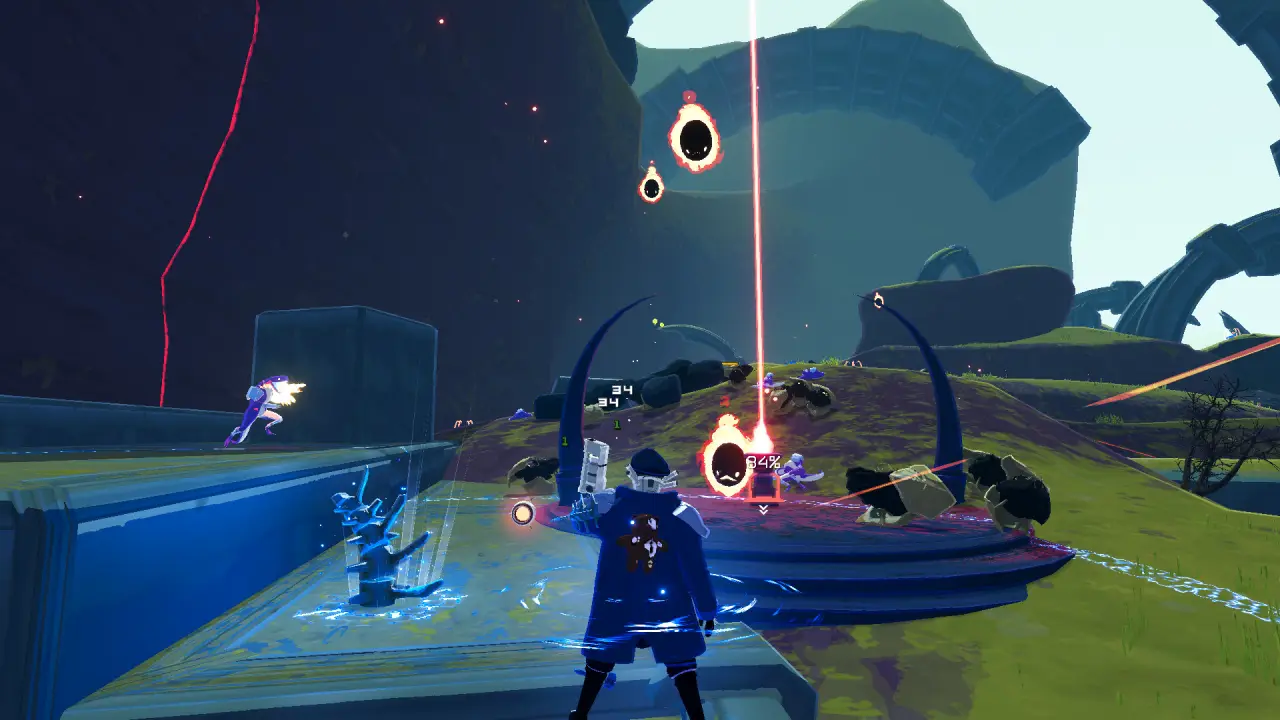
The original kept you at arm's length, scrolling past the action like a banner unrolling. The boldest and most important decision of the sequel was to haul the entire thing into three dimensions and put the camera over your shoulder, turning you from a spectator into the person standing dead centre of the chaos. The studio spent years on that remake, and the gamble paid off: depth gave dodging, weaving and point-blank trades a real third axis, and what used to be a flat lane became a stack of genuine arenas.
This wasn't a cosmetic upgrade — it rewired how the game feels in the hand. Drone-summoning playstyles, for instance, got noticeably stronger once their effective range expanded from a line into a whole plane. Melee survivors finally had room to operate, ducking into a fray and back out again, threading between projectiles in a way the old flat lane never permitted.
The camera change also reframed the spectacle. In two dimensions, a swarm of enemies is a row; in three, it's a tide that surrounds you, closes overhead, and forces you to think about positioning on every axis at once. That shift is what makes the late-game power fantasy land — being mobbed from all sides and carving a clear circle with sheer firepower simply reads better when the chaos has depth. The 3D rebuild is precisely what gave the later snowball loop a stage to perform on. This is not a graphically lavish game, but its visuals serve the play, and that is worth more than another truckload of polygons.
Style over fidelity, and the bill that comes with 3D
Honestly, this game doesn't lean on technical muscle. There's no photoreal material work, no showboating with light. What it has instead is a strong, legible style — clean geometric shapes, high-contrast palettes, monster silhouettes you can read at a glance, the kind of art direction that ages far better than a chase after photorealism ever would. Cram fifty enemies on screen and you can still tell who's who and which one is about to end your run, and that readability matters more to a fast shooter than any amount of raw fidelity.
Built on Unity, it stretches across nearly every platform that matters, from PC down to the Switch, with a later generation of consoles joining in 2024. The trade-offs vary: a strong PC runs it cleanest, while the handheld version gives up resolution and detail for portability. Vivid biomes and distinct stage layouts keep each landing feeling fresh — the dividend of betting on style. Each environment has its own colour logic and hazard language, so even after a hundred drops you register, at a glance, which world you've fallen onto and what it's about to throw at you. But 3D brought its own invoice. The most direct cost is optimization: late in a run, with the clock maxed and hundreds of enemies pouring in, the frame rate visibly strains. This game is so good at manufacturing chaos that it sometimes can't hold up the spectacle it invents. The second cost is the learning curve. Going from flat to volumetric means relearning space — hidden items tucked into the corners of 3D terrain, teleporters and shrines you have to seek out — and your first few runs end in baffling deaths. It's a gentle wall, though, and once you internalise the logic, every old "I don't get it" turns into "this rules."
Weighed up, the visuals land as good-not-great precisely because the studio spent its budget where it counts. It didn't chase expensive realism or showpiece lighting; it poured every watt of performance into letting you see the fight and hit hard. For a game whose heart is a snowballing shooter, that's the pragmatic, correct call. It was never angling to look pretty in a screenshot — it was angling to feel right in your hands at two hundred enemies on screen, and on that score, it mostly delivers.
Combat | 9.5/10
Gameplay: 9.5/10Gameplay is the soul of this thing, and the reason it scores within breathing distance of a perfect mark. It braids three threads — time, items, difficulty — into a single rope, and the knot it ties has yet to be untangled by anyone else in the genre.
Items stack in a straight line, and a frail survivor becomes a meat grinder
The core thrill is an item system of almost ruthless transparency. Every common white item makes you one notch stronger; grab ten and you're ten notches up. The growth is linear and you can do the maths in your head. That means you always know what a given pickup did for your build, and every choice at a chest has a visible logic behind it: stack crit, stack attack speed, or stack movement and healing to stay alive?
It's that transparency that makes the snowball something you can watch happen. You start a run as a thin-skinned nobody, but live long enough and stack enough and you become a walking meat grinder. Syringes pile into an attack-speed build that empties magazines faster than the eye can follow; the Crowbar pile turns into a one-shot build that deletes elites; glasses stack into a crit build that sends the damage numbers screaming red.
The real magic, though, lives in the collisions between items. A proc that fires on hit, multiplied by an attack-speed stack, multiplied by a chance to chain — these don't add, they compound, and somewhere in the back half of a good run the curve goes vertical. Suddenly a single trigger pull sets off a cascade that clears the screen. The game never spells these synergies out; you discover them by feel, and that act of discovery is half the reason builds stay interesting after a hundred hours. When the screen fills with dozens of projectiles and the ground disappears under summoned drones, that gulf between who you were and who you've become is the most addictive moment the game has to offer.

The clock that turns time into a chip you have to bet
Items alone would make this a brainless game. What keeps it taut is that climbing clock in the corner. It creeps up from "easy," slides toward "impossible," and tops out at a tier literally labelled HAHAHAHAHAHA — Death sneering at your futile scramble. The longer the clock runs, the more monsters spawn per second and the harder they hit.
That clock turns time itself into a resource you're forced to weigh, breath by breath. Stay to farm more loot and grow stronger — but the monsters scale right alongside you. Push on to outrun the difficulty — but risk arriving underequipped for what's ahead. So every run becomes one long bet: linger, or leave? The tug-of-war runs through every second, and it's the irreplaceable kernel the whole design is built around. Each stage forces it to a head through the teleporter: find it, activate it, hold a charging zone against waves of fresh monsters while you crack open chests on the side, and only leave once the bar fills. Recklessness versus survival, dialled to maximum.

A dozen survivors, each its own discipline, plus lunar risk
What sustains the endless re-runs is a roster of survivors with sharply divergent identities. From the plain-shooting Commando to the Huntress and her lock-on bouncing glaives; from the Mercenary, all laser-sword and almost no range but absurd mobility, to the Engineer, who plants a shield and turrets and lets the kills come to him; on to the high-burst Artificer and the Captain added at 1.0. A dozen-plus characters, each with two or three kits, and almost no overlap — swap one in and you've swapped your entire playbook. Every survivor is locked behind a specific challenge, and the unlock conditions double as a hidden tutorial.
Layered above the common drops are lunar items, the high-risk variables. They deal in trade-offs: shave your maximum health, say, in exchange for a spike in damage, forcing a verdict between stronger and squishier. Those costly power items are where expert builds genuinely pull apart from the pack. Set it against its action-roguelike peers and the shape comes clear: Hades finds depth in narrative-flavoured boon combinations, Enter the Gungeon in bullet-hell footwork, and this game in the three pillars of linear stacking, time pressure and character variety — landing squarely on both the rush and the strategy at once.
Content | 8.5/10
Umfang: 8.5/10Whether a roguelike lasts comes down to one question: after a hundred runs, do you still want the hundred-and-first? Risk of Rain 2 has banked a whole stack of reasons to say yes.
Artifacts: a row of switches that rewrite the rules
The first thing keeping this game alive is the Artifact system. You unlock these codes one at a time by solving puzzles, and flicking one on rewrites a run from the floor up. One makes every item a pick-one-of-three, forcing constant sacrifice. Another lets enemies drop random items too, churning the battlefield into a free-for-all. Another simply switches off health regeneration and crushes your margin for error to nothing.
The beauty is that they're free to toggle and free to combine. The same maps and the same characters, stacked with a different artifact, play like a different game — want pain, kill regen; want chaos, let the loot scatter.
Stack two or three together and the combinations multiply into genuinely bespoke rulesets. The Artifact of Command, which lets you choose every drop, turns each run into deliberate build-crafting rather than a slot machine; pair it with one that floods the field and you've designed a power fantasy on rails. It's an effective hedge against the diminishing returns of pure randomness: the moment standard mode starts to feel stale, the artifacts sit there like a bank of switches handing you a fresh game on demand. It's the single smartest thing the game does for longevity, and it costs nothing but the curiosity to go hunting for the codes.

Three expansions of uneven worth, and a mod scene that never ends
After 1.0, the studio rolled out three expansions to distinctly mixed reception. The first, Survivors of the Void in 2022, is widely held up as a success: it added two characters with strong identities — the Railgunner and the Void Fiend — plus a whole suite of void-themed enemies, items and a void-stealth mechanic, with bulk that matched its price. Solid all round.
Seekers of the Storm in 2024 landed far rougher. It shipped with noticeably less content than its predecessor, dragging a tail of bugs and balance problems behind it, and the community pushed back hard at first. The team patched the worst of it back into shape over time, but the "lighter than the last one" reputation stuck. A third pack, Alloyed Collective, followed in 2025. Beyond the official content, though, what really gives this game something close to immortality is its mod scene. Through third-party loaders, the community has built a flood of new survivors, items and enemies, and even large-lobby modes that smash through the four-player ceiling. For veterans who've wrung the official content dry, mods are an open vein of fresh blood.
Co-op and the long haul behind seven million sales
A big slice of the game's breadth comes from co-op. Up to four players can crash onto the same planet at once, sharing one map, one spawn table and one shared clock. More bodies means more monsters per second, so the difficulty rises with the party size; and at every chest, who takes the rare drop and who builds offence versus defence becomes a live negotiation. A drone-laying Engineer paired with a high-mobility Mercenary can field a wall of firepower no solo run touches — a team is both a rush and a running argument over who deserves what.
From 2019 Early Access, to the 2020 1.0, to expansion after expansion and a long tail of updates, this game has run a genuinely sturdy marathon. It pulled roughly 650,000 players in its first Early Access week, crossed a million sales inside a month, passed four million on PC alone by 2021, and has since cleared seven million across platforms. That string of numbers is the bluntest possible proof of staying power. Keeping this many people buying in and coming back isn't a flash of hype — it's a core loop built to survive being played to death. The Early Access years, often a graveyard for ambition, instead became a long public workshop where the community and the studio sharpened the formula together, and the finished game carries the scars and the polish of all that iteration.





Kommentare 0
Wir freuen uns auf deine Meinung
Beteilige dich an der Diskussion und teile deine Bewertung des Spiels.
Noch keine Kommentare — teil uns deine Meinung zu diesem Test mit!