























Opening
Banished is a stripped-down survival city builder about keeping exiles alive through winter, and what it nails is turning every citizen into a fragile, aging, freezing liability — yes, it’s still worth playing if you like hard systems more than hand-holding. Here’s the thing: this is not a cozy little town painter. There’s no money, no combat, no campaign villain, no dramatic story beat kicking the door in. The enemy is firewood running out in January. The enemy is building too many houses, watching your population boom, and then realizing you’ve created a food crisis with adorable little families attached.
And that’s why Banished still hits. Shining Rock Software LLC — basically Luke Hodorowicz steering the whole thing — made a game where population isn’t a score going up.
These people get old. They get sick. They freeze. They die because you got greedy, not because the game pulled some cheap trick. If Frostpunk is the theatrical survival city builder, Banished is the colder, quieter one. No speeches. No moral panic button. Just your bad logistics, your empty barns, and one brutal winter asking if you actually understood the system.
Story | 5.5/10
Story: 5.5/10A town that writes its own story
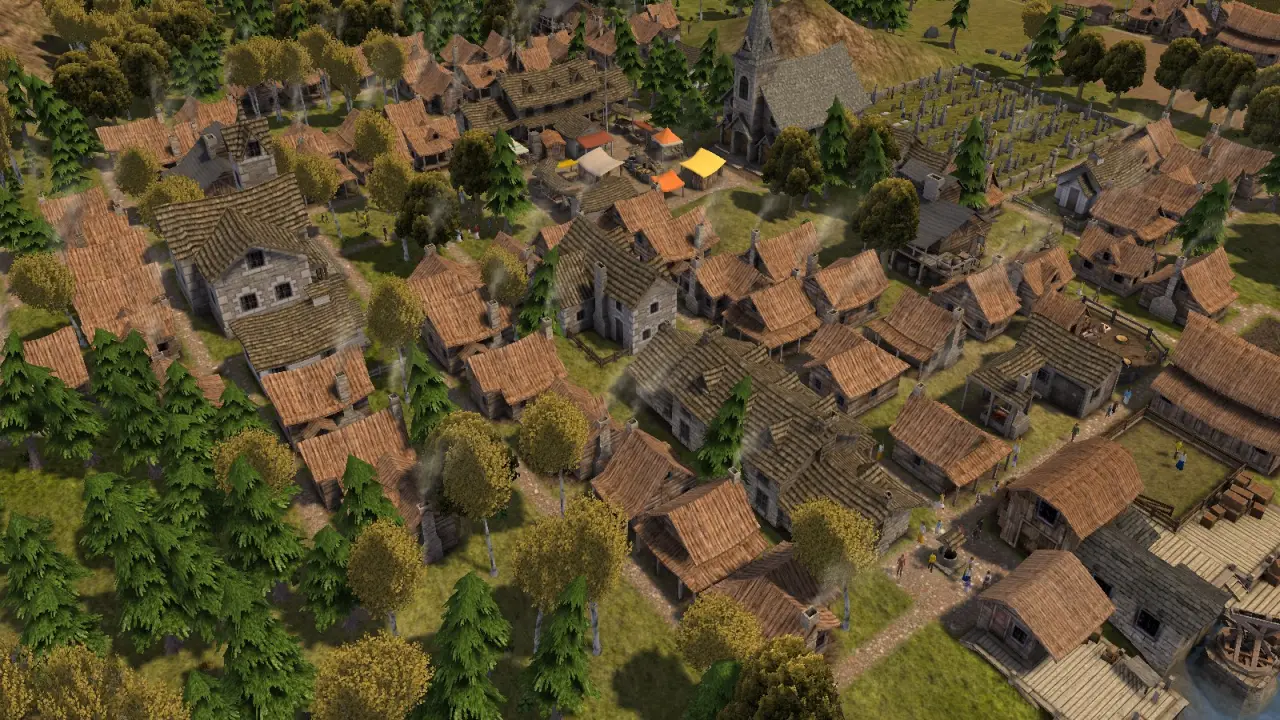
Honestly, Banished barely has a traditional story at all, and that’s exactly why this section lands where it does. There’s no real main plot, no cutscenes dragging you from scene to scene, no character dialogue trying to sell you a drama. The game just drops a group of exiles into a new land and says, “Good luck.” That sounds thin on paper, because it is thin in the usual narrative sense. But the weird thing is, the empty space turns into its own kind of story. Your town becomes the plot. The first village that freezes, starves, or gets wiped out is basically your opening tragedy. The second attempt, where you actually keep people alive, feels like the comeback arc. That’s the emotional hook here.
And that’s why the score for story sits at 5.5 / 10. If you’re judging it like a normal narrative game, it’s almost nothing. But if you’re judging the way the game makes you feel responsible for a population of living, aging, dying people, then yeah, there’s something real there. The citizens aren’t just numbers on a board. They’re the entire cast, and they’re fragile. They get old, they get sick, they freeze, they die, and when that happens, it doesn’t feel scripted. It feels earned. Usually in a city builder, growth is the reward. Here, survival is the drama.
Seasons do the talking

The best “writing” in Banished is the weather. Summer’s green, winter goes pale and dead, and that shift does more for the mood than most games manage with full-blown dialogue scenes. There’s no voice acting telling you the colony is in danger. You see it in the land. You feel it in the stockpiles. You hear it in your own head when the food starts running low and the firewood numbers look ugly. Then the first winter hits hard, and suddenly the game has told you everything you need to know without saying a word. That’s the real story structure here: spring optimism, summer expansion, autumn panic, winter punishment.
The disasters help too, because they aren’t there to create a Hollywood-style twist. They’re there to remind you that the world doesn’t care. A harsh season, a bad harvest, a resource bottleneck, a few deaths in the wrong place at the wrong time — that’s the drama. Compare that to Frostpunk, which is the obvious rival here. Frostpunk is louder, more theatrical, more obviously scripted. It pushes you through moral choices and story beats. Banished does the opposite. It strips all that away and leaves you alone with the system. That makes it colder, more austere, and honestly more open-ended. The tension comes from your own mistakes, not from a designer yanking your arm toward a cutscene.
No heroes, just survivors

If you’re looking for a memorable lead character, Banished just doesn’t play that game. There isn’t a mayor with a tragic backstory, no rival faction boss, no scripted companion to carry the emotional load. The “characters” are your villagers as a group, and that’s about it. In most city builders, that would be a weakness. Here, it’s part of the identity. The game wants you to care about logistics first and personalities never. Every person is a worker, a mouth to feed, a body to warm, and a future adult who might help or might die before that matters. That’s brutally impersonal, but it fits the design.
That also means there’s almost no hand-holding in the storytelling sense either. The game doesn’t guide you through a neat narrative arc. It doesn’t rescue you with a big second-act turn. It lets you fail, learn, and try again. For the audience that wants a clear story beat or a satisfying ending, that’s going to feel hollow. But for players who like watching a bad start turn into a stable settlement, the lack of fixed characters is the point. The emotional payoff comes from competence, not drama. You don’t remember Banished for what it says. You remember it for the town you almost lost, and the one you managed to keep alive.
Audio | 7.0/10
Sound: 7/10A quiet score for a town that can die

Banished doesn’t come in swinging with some giant orchestral theme, and honestly, that’s the right call. The music is low-key, calm, and a little folk-leaning, so it sits under the action instead of trying to hijack it. That matters, because this game is about hauling firewood, rationing food, and praying your people make it through winter. A loud, heroic score would be all wrong here. What you get instead is something restrained enough to let you stay focused for long sessions, but warm enough that the town still feels human.
There’s also not much in the way of voice-driven drama, and that silence fits the whole thing. Nobody’s barking dramatic lines at you, nobody’s trying to sell you a story beat, and the game is better for it. Banished wants you to read the colony through systems, not through speeches. The audio mirrors that perfectly: quiet, patient, and a little lonely. It gives the game that cold, deliberate feel of wrestling with a spreadsheet in the snow, which sounds unglamorous until you realize that’s exactly the appeal. Compared with Frostpunk, which uses music to push you through bigger emotional peaks, Banished leaves a lot more empty space on purpose.
Saws, hammers, and winter wind do the heavy lifting
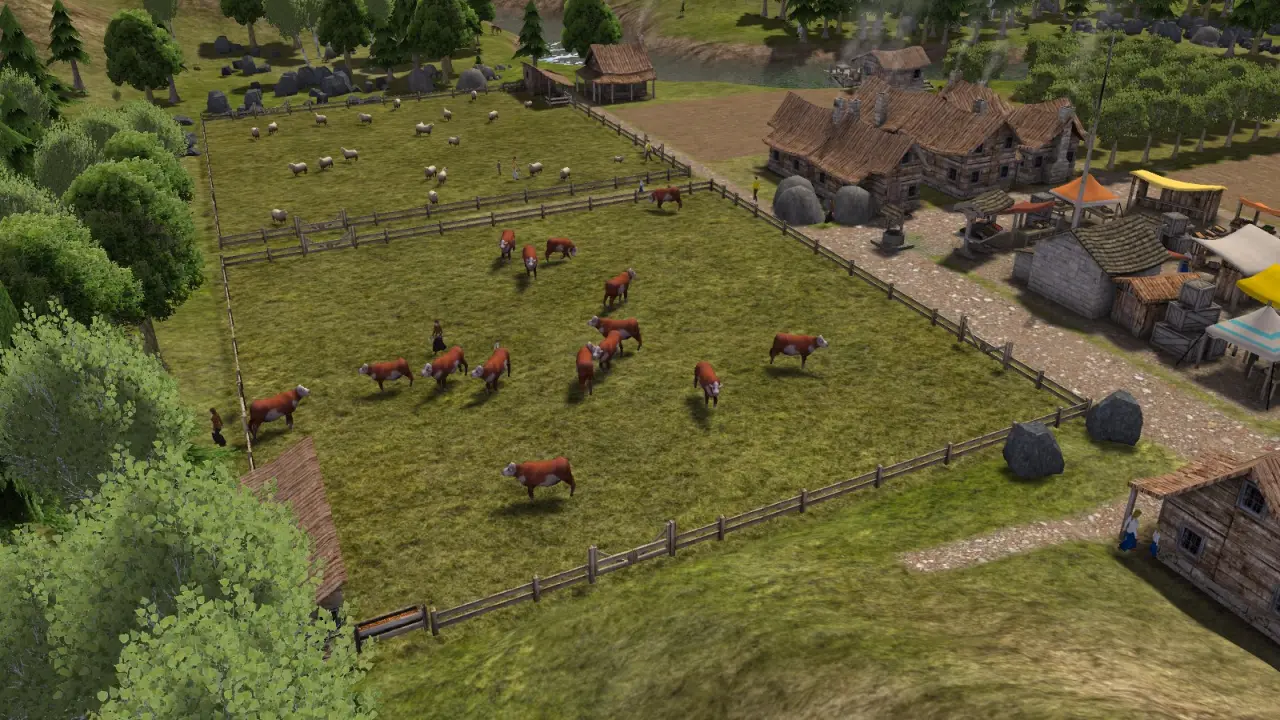
The real sound design win here is how functional everything is. You hear saws working, hammers going, livestock moving around, wind cutting through the settlement, and it all does more than just fill space. It tells you the town is alive. Or not alive, if something’s gone wrong. That’s the clever part: the audio becomes another management tool. You can almost hear whether your economy is healthy, whether the village is expanding cleanly, or whether the whole place is starting to creak under pressure.
That’s why the soundscape feels so effective even though it’s not flashy. It’s not trying to be memorable in the loud, cinematic way. It’s trying to be useful, and it nails that. When the weather turns ugly, the wind and snow don’t just decorate the map; they make the whole colony feel harsher, tighter, more exposed. It supports that quiet survivor mood the game is built on. So yeah, as a pure audio package, Banished is more solid background than showpiece. But for a game this obsessed with survival logistics, that restraint is exactly why it works.
Visuals | 7.5/10
Grafik: 7.5/10That dead-white winter is the whole warning system
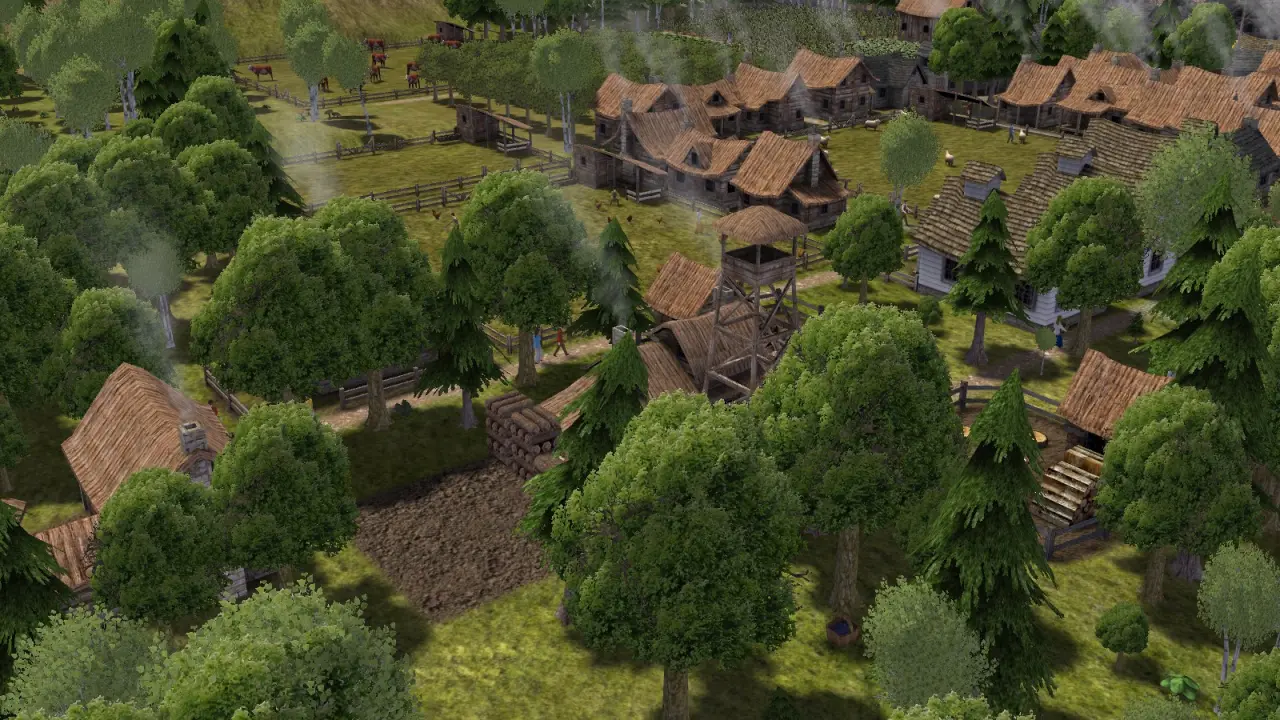
Banished is not a pretty game in the “pause and stare at the skyline” way. If you’re coming from Cities: Skylines, yeah, that game looks bigger, cleaner, more modern, and way more built for postcard shots. Banished is smaller, rougher, and very obviously from 2014. But here’s the thing: it’s also much easier to read at a glance, and for this kind of survival city-builder, that matters more than shiny glass towers.
The art style is simple medieval countryside. Thatch roofs, wooden houses, stone markets, little grid farms, dirt paths, chopped forests, barns, stockpiles. Nothing is trying to show off. Everything is trying to tell you what it is in half a second. A house looks like a house. A field looks like a field. A woodcutter’s area looks like, yeah, that’s where my firewood problem is either getting solved or quietly turning into a funeral.
The seasons do a lot of the heavy lifting. Spring and summer are calm, green, almost cozy. Then winter hits, and the whole screen goes pale and hostile. That flat, dead white snow is not just mood. It’s a visual alarm bell. It’s the game saying, “You had all year to prepare. Did you?” And because Banished is built around food, fuel, labor, and distance, that cold-looking winter actually carries mechanical weight. If your people freeze, it’s not because the game wanted drama. It’s because you didn’t have enough firewood, or your storage was in the wrong place, or your laborers were wasting time walking across half the map. So no, the visuals aren’t luxurious. They’re functional, but functional in a way I really respect: Banished understands that its job is not to dazzle you — its job is to make a dying village readable before it becomes a dead village. That’s a design priority, not a budget excuse, and it’s the lens to judge every screenshot through.
Luke Hodorowicz’s engine is plain, but it does the job
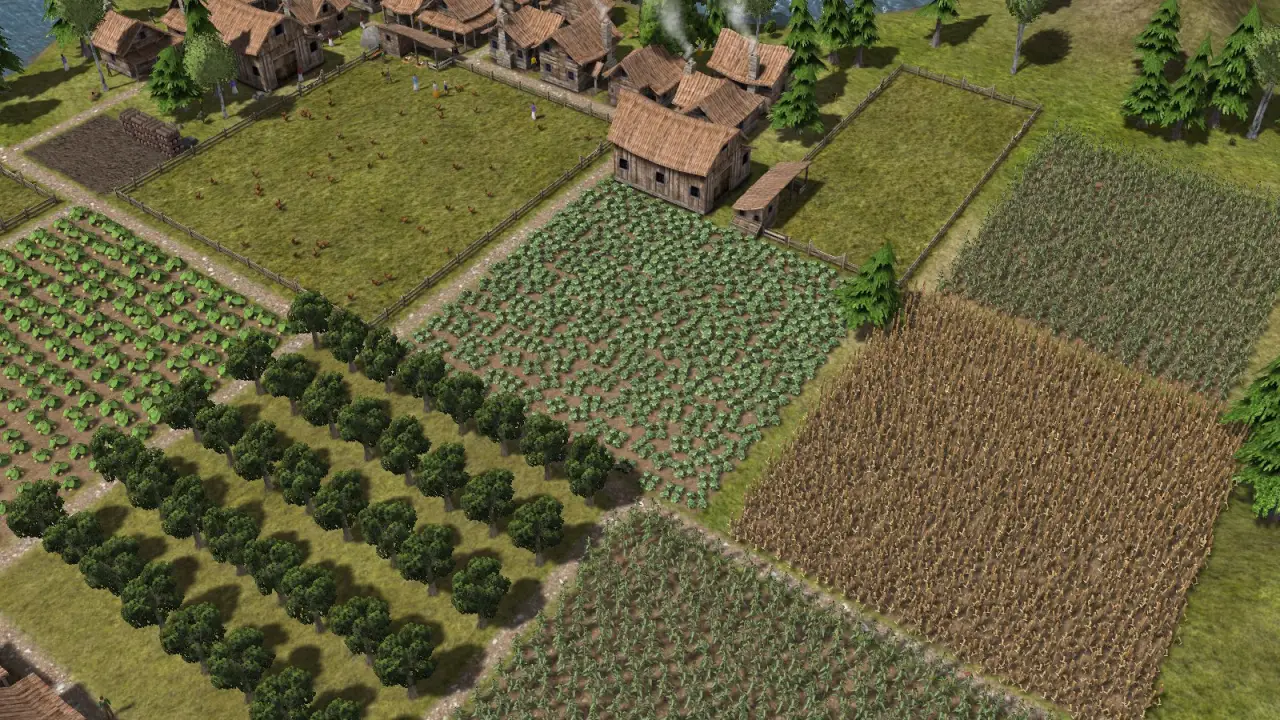
Technically, Banished is kind of fascinating because Shining Rock Software LLC was basically Luke Hodorowicz doing an absurd amount of work himself, engine included. And you can feel that in the presentation. This is not a game chasing modern rendering buzzwords. There’s no ray tracing showpiece here. No DLSS conversation. No giant stack of post-processing trying to hide weak design. It’s a lean, custom-built city-builder that wants to run smoothly and stay out of the way.
And honestly, that was the right call. Banished’s visuals are modest, but the game is stable, light, and friendly to older PCs. That matters because the real spectacle is not particle effects or reflections. It’s watching a small settlement become this living machine where every citizen has a job, a home, a route, an age, and eventually a grave. The game is simulating people, not just painting a pretty town.
The one catch is late-game scale. Once your population gets huge, the pressure moves from your graphics card to your CPU, because the game is tracking individual citizens and their behavior. That can catch up with you if you push a town far enough. But for most players and most normal colonies, performance is not the barrier. The barrier is surviving your own bad planning.
That’s why I’d rather call the graphics “smart” than “impressive.” Banished doesn’t win on visual tech. It wins by being clean, stable, and built around the systems that actually matter. For a 2014 indie sim, that’s still a good trade.
The UI is dry as toast, but it tells the truth
The interface in Banished is not stylish. Let’s be blunt. It looks like a tool. Windows, lists, resource counts, profession sliders, storage numbers, build menus. If you want slick animated menus or a modern console-friendly layout, this is not that. This is very much a PC strategy game from 2014, and it behaves like one.
But again, the dryness has a purpose. Banished is a game where one bad number can doom you. Food looks fine until winter stretches too long. Firewood looks fine until your population grows faster than your production. Tools look fine until half your workers are suddenly less efficient. The UI gives you the raw information you need, and it does not dress it up. That can feel cold, but Banished is a cold game. It fits.
There’s also no real platform comparison to make in the usual sense. This is a PC-first experience on Steam, from Shining Rock Software LLC, and the presentation is built around mouse-driven management. The bird’s-eye, isometric-style view works because you’re constantly checking routes, buildings, stockpiles, farms, and citizens. On a couch UI, with big radial menus and simplified controls, I’m not sure the same clarity would survive. Banished wants you close to the numbers.
Compared with Cities: Skylines, the difference is obvious. Cities: Skylines gives you scale, modern city lighting, bigger visual drama, and a stronger sense of urban sprawl. Banished gives you legibility. It doesn’t care if your town looks cool on a thumbnail. It cares if you can instantly see that your farms are too far away, your houses are badly placed, and your people are about to spend winter walking instead of living.
So for graphics, I’m at a 7.5 out of 10. Not because it’s beautiful. It isn’t, really. But because it understands the assignment. Banished looks exactly as sharp, plain, and readable as its survival systems need it to be.
Combat | 8.5/10
Gameplay: 8.5/10Your Villagers Aren’t a Number — They’re the Whole Machine
Here’s the thing Banished gets right immediately: population is not a scoreboard. It’s not “make number go up, feel good.” Every person in this town is a worker, a mouth, a future parent, a future corpse, and sometimes the one missing link that makes the whole place collapse.
You start with exiled travelers, a cart of supplies, and basically no safety net. That official pitch sounds simple, but in play it’s brutal. Your townspeople are your primary resource, and Banished means that literally. They get hungry. They get cold. They age. They get sick. They freeze. If you build too few homes, your population stalls because families don’t form fast enough. Build too many homes too early, and suddenly you’ve got children everywhere eating food while not producing anything. That’s the kind of cruel little tradeoff this game lives on.
And I love that. It makes the city feel fragile in a way a lot of city builders only pretend to be. Housing isn’t just housing. It’s your reproduction system. Schools aren’t just a nice civic upgrade. They slow your workforce down in the short term because students aren’t working, but educated laborers become more efficient later. So you’re always asking, “Can I afford the future right now?” That’s a great question for a survival city builder to keep poking you with.
There’s no combat system here, and honestly, it doesn’t need one. The fight is the calendar. The fight is the woodpile getting low in late autumn. The fight is realizing your only blacksmith died and now nobody’s making tools, so your workers get worse, which means food production drops, which means people starve, which means you have fewer workers, which means the spiral tightens. That’s Banished at its best: quiet, clean, and absolutely mean.
Food Looks Simple Until One Bad Frost Ruins Your Whole Plan
Banished doesn’t bury you under flashy systems. It gives you a handful of food chains and then dares you to rely on just one. You’ve got crop fields, orchards, pastures, fishing, hunting, and gathering, and each one has its own rhythm. The trap is thinking any single one of them is “the answer.” It isn’t. It’s just one bad season away from catching you completely off guard.
Farming is the obvious example. Fields can feed a town beautifully, right up until the weather turns and frost hits before the harvest comes in. Orchards take time before they really pay off. Pastures need animals and space. Fishing is steady, but location matters. Hunting and gathering are fantastic early on, but they’re tied to the forest and workers walking all over the place. So the actual gameplay isn’t about finding the best food source. It’s about building redundancy before the game punishes you for not having it.
That’s why the first winter has such a reputation. New players get wiped out all the time, and yeah, it can feel harsh. But most of the time, it’s fair. Your village doesn’t die because the game rolled some cheap disaster and laughed at you. It dies because you didn’t cut enough firewood. Or you expanded too fast. Or your storage was in the wrong place. Or you had food, technically, but your workers couldn’t move it where it needed to go in time. The lesson is simple: Banished is not reactive. You don’t fix winter during winter. You survive winter because you respected it six months earlier.
That’s a very specific kind of fun. It’s not flashy. It’s not instantly rewarding. But when a town that was one bad harvest away from extinction finally stabilizes, that feels earned. Not cinematic. Not dramatic. Earned.
No Money, No Tech Tree, No Villain — Just Your Bad Planning
What’s wild about Banished is how much it removes. No money. No tech tree. No enemy AI. No campaign pushing you from mission to mission. Shining Rock Software LLC, led by Luke Hodorowicz, built a game where the opponent is basically logistics wearing a winter coat. And if that sounds dry, trust me, it’s not. It’s dry until the food counter drops, the firewood stockpile empties, and half your adults are walking across the map because you placed everything carelessly.
That stripped-down design is why the game still works. You’re not juggling currencies for the sake of juggling currencies. You’re managing distance, labor, timing, storage, durability, and population flow. Tools wear out. Clothing matters. Warmth matters. A tiny mistake doesn’t always explode immediately, which is scarier. Sometimes the mistake sits there quietly for twenty minutes, then shows up as starvation, hypothermia, or a workforce shortage you can’t patch anymore.
But this is also where the vanilla game hits its ceiling. Once your town becomes self-sufficient, the tension drops hard. There’s no big late-game threat, no victory condition, no final exam. You can keep expanding, optimizing, and beautifying, but the knife at your throat gets dull. For some players, that’s peaceful. For me, it’s the main weakness. Banished is incredible when you’re clawing your way out of danger. It’s less exciting when you’ve solved the machine and you’re mostly doing maintenance.
Still, that clean structure is the reason community mods have had such a long life here. Colonial Charter, MegaMod, and those huge bundles with 200-plus additions exist because the base game is sturdy enough to build on. The vanilla box is small, but the systems inside it are sharp.
Frostpunk Is Louder, But Banished Lets the Silence Hurt More
The obvious comparison is Frostpunk, because both games understand that cold is a better enemy than most villains. But they feel totally different. Frostpunk is more theatrical. It has scripted pressure, moral choices, big music, big speeches, big “oh no” moments. Banished is colder in a quieter way. It doesn’t push a story into your face. It just gives you a map, some people, and enough rope to hang the whole settlement.
That freedom is both the appeal and the filter. If you need narrative highs, combat, quest markers, or a clear win screen, Banished can feel hollow. There’s no campaign climax waiting for you. No boss fight. No “congratulations, you saved civilization.” The game is single-player, bird-view, isometric survival strategy, and it is completely comfortable being a sandbox about not dying.
Replay value comes from starting conditions, map layouts, difficulty, and whatever goals you set for yourself. Can you survive a rough start? Can you build a town that doesn’t collapse when the first generation ages out? Can you avoid leaning on one food source? Can you recover from a bad winter without rage-quitting? That’s the loop.
So for gameplay, I’d land Banished at an 8.5 out of 10. It’s not for everyone, and the late game absolutely loses bite once you know what you’re doing. But when it’s working, it turns a tiny village into a pressure cooker without needing money, war, or scripted drama. It makes survival feel like planning, not button-mashing. And that’s why, even with rough edges, it still has that nasty little hook.
Content | 7.0/10
Umfang: 7/10The first winter is the whole game
Honestly, Banished is at its best when you’re just trying not to get wiped out. The whole thing is built around a tiny, brutal loop: a few buildings, a few resource chains, and one simple goal — keep people alive. That sounds plain, and it is. But that’s also why it works. There’s no money system, no tech tree to distract you, no enemy army barging in to turn it into a different genre. It’s just you, the weather, and a town full of people who age, get sick, freeze, and die. Population isn’t a score to pump anymore. It’s a finite resource, and that changes everything.
The pacing is slow in the best and worst ways. Early on, every decision matters because one bad winter can crush the whole run. Firewood, food, labor balance, storage — miss one of those, and the town just folds. And here’s the thing: when you fail, it usually feels fair. Banished doesn’t usually cheat you. It’s not some flashy game trying to surprise you with a scripted disaster. It’s more like a cold math problem that keeps asking, “Did you plan for this?” That makes the first winter memorable, especially if you’re the kind of player who likes systems more than drama.
But that same clarity can make the middle and late game feel thin. Once the colony gets stable, the pressure starts to drop off hard. You’ve solved survival, and the game doesn’t really bring in a new problem to replace it. So instead of feeling like you’re still fighting for something, you end up doing maintenance. That’s the tradeoff. The design is clean, sharp, and unforgiving — but it doesn’t have a lot of room for escalation once you’ve built the machine.
No story branch to save you
If you want side content, Banished basically doesn’t care. There’s no real story arc, no combat layer, no big set-piece goal waiting for you down the road. That’s not a bug. That’s the point. But it also means the game is pretty naked once the survival puzzle stops being scary. You’re not chasing a campaign objective or unlocking some grand payoff. You’re just keeping a town running, and if that sounds a little hollow to you, yeah, that’s because it can be.
The upside is that the game never tells you how to feel. It doesn’t shove you toward a dramatic climax. It trusts the system to be enough, and for a certain kind of player, that’s exactly what you want. If you like resource juggling, production chains, and squeezing one more winter out of a barely working settlement, Banished has a very pure rhythm. If you need narrative highs, combat pressure, or even just a clear end goal, you’re going to bounce right off it. A lot of people do. The first town getting wiped out is basically part of the learning curve, and the game is not generous about holding your hand through that.
So when I talk about optional content here, I’m not talking about side quests or hidden missions. I’m talking about the sandbox itself, and even that has limits in vanilla. The base game is intentionally sparse. It gives you the essentials, then steps back and lets the system speak for itself. That restraint is impressive for a while, but eventually it exposes how little there is beyond survival and optimization. Once you’ve seen the trick, there isn’t much else waiting behind the curtain.
Free mods do the heavy lifting
This is where Banished stays alive: not through paid DLC, but through free community mods. That matters a lot, because there’s no official expansion pipeline propping the game up. All the extra meat comes from players who kept building on it long after release. Colonial Charter 1.76 is the big one people always bring up, and for good reason. It adds dozens of production chains, buildings, and crops, which basically stretches Banished from “survive the winter” into something closer to actual town management. It gives the game more to do, more to plan around, and more reasons to keep caring once the vanilla loop starts to fade.
Then there’s MegaMod, which bundles 200-plus mods in around version 8.01. That’s the ridiculous end of the spectrum. It makes Banished feel almost endless, but it also asks more from your setup and from your patience. That’s the catch with the long-tail ecosystem here: the community has kept the game surprisingly active, but the deeper you go, the more it becomes a modded strategy sandbox that expects you to know what you’re doing. Still, the fact that a 2014 release can keep that kind of momentum is not nothing.
And a lot of that longevity traces back to the official mod toolkit support from patch 1.0.4. That opened the door for the community to do the real expanding, and it’s why the game never completely died after launch. So my take is simple: Banished itself is a lean, harsh survival builder with a weak late game, but the mod scene gives it the legs the base game never really had. If you want the pure vanilla experience, it’s sharp but limited. If you want a much bigger sandbox, the community basically built the missing DLC for free.






Kommentare 0
Wir freuen uns auf deine Meinung
Beteilige dich an der Diskussion und teile deine Bewertung des Spiels.
Noch keine Kommentare — teil uns deine Meinung zu diesem Test mit!