

















Opening
A studio's first game has no business being this assured.
Robert Robertson III used to fly. As Mecha Man he was the kind of hero a city builds murals of, until a fight turned his signature suit into scrap and dropped him out of the sky and behind a desk. Now he answers phones. He is a dispatcher at the Superhero Dispatch Network, fielding a wall of incoming emergencies and deciding which washed-up, parole-board reject of a hero to throw at each one. The people he commands are the Z-Team — a roster of reformed villains nobody else would touch, prickly, broke, and barely able to share an elevator without a fistfight.
That premise is the whole trick. AdHoc Studio, staffed by the writers and directors who made The Wolf Among Us and The Walking Dead at Telltale, has wrapped an office sitcom around a story about second chances — about a man who was worshipped learning to sit in the back and let other people do the saving. And it is a story you actually steer. Eight episodes shipped two at a time across October and November 2025, a million copies sold in the first ten days, four million by the time the credits stopped rolling, ninety-seven percent positive on Steam, a Steam Award for Outstanding Story-Rich Game, and a pair of BAFTAs for Animation and Audio. Those are not vanity numbers. In a year when every publisher swore single-player narrative games were dead, a dispatch desk full of has-beens proved the room was just empty, not the genre.
Story | 9.0/10
Story: 9/10The cleanest way to describe Dispatch's writing is this: it is a prestige animated series you can reach into and bend. That is its great strength, strong enough to make the mediocre gameplay almost beside the point.
Redemption dressed as a sitcom, and why it lands

The seed is small. Robert was Mecha Man, the city's favorite, and a single battle took the suit, the flight, the cape, the entire identity. What is left is a man who can no longer do the thing that made him matter, parked behind a console, managing a team of former villains who would rather be anywhere else. Everything grows from that drop — someone used to being looked up to, forced to learn how to sit in the back and win through other people's hands.
It resonates because the superhero coat is never the point. Robert is not staving off the end of the world; he is refereeing office politics, babysitting unstable subordinates, and nursing a grief he has nowhere to put. The cape is a costume over a very grounded story about a middle-aged failure clawing back a place to stand. Watching him curdle from a bitter ex-hero into someone who genuinely covers for these screw-ups is a slow, earned accumulation — the reason reviewers reached for words like "the emotional punch of prestige television" rather than "fun superhero game."
Choices that actually fork — the flaw Telltale never fixed, fixed

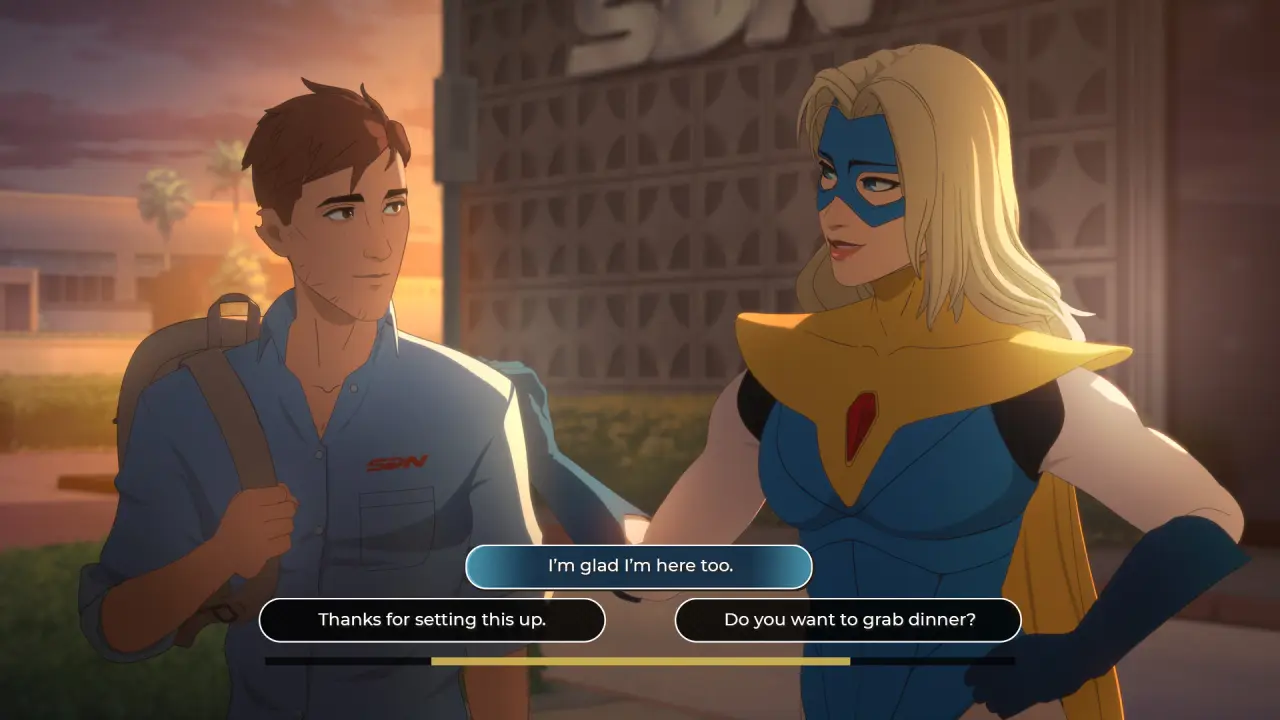
Anyone who finished a late Telltale game knows the quiet letdown: your choices converged, the road was always the same road. AdHoc is built from those same writers, and they clearly carried the scar. Here the dialogue tree genuinely rewrites your story. A throwaway-feeling call early on — cutting a Z-Team member loose, taking one teammate's side in a feud — comes back to bite, or to bless, in episodes seven and eight.
The design has a cost and a payoff. The payoff is a finale that hits harder because so many forks were buried with long fuses; you suddenly realize what an old decision was for. As bossrush put it, "your choices do matter significantly, but many of them don't become obvious until the finale." The cost is a stretch of doubt in the middle where you wonder whether any of it landed, because the feedback arrives late. Set against games where the choice was theater, though, this is a different sport entirely — and it is the single biggest reason the genre feels alive again.
A roster of screw-ups, each with an arc
The real engine is the Z-Team itself. The game refuses to write them as function-first tools; every one of them gets a "here is how I broke" backstory, and then hands the shaping of where they go to your dispatch calls and dialogue picks. That raise-them-and-write-them binding means your affection for these people is grown, not assigned by the script.
The cast lifts all of it. Aaron Paul plays Robert reserved — not a swaggering hero but a man running on fumes, a steady straight man to a circus of louder powers. Jeffrey Wright, Laura Bailey, Travis Willingham and Matthew Mercer fill out the team, with Critical Role deep in the booth, and the group banter sounds like people who have actually shared a stale office for years rather than lines recorded in separate rooms. When a teammate finishes a redemption you helped steer, the weight of that moment is carried by writing, performance and your own fingerprints at once.
To be fair about the seams: the rivalry between Robert and the villain Katon-Ur, which should be the most charged thread in the show, is underexplored, and the run to the finale ratchets up so fast it can feel abrupt. There are only two romances in a cast this lovable, which techradar flagged as a waste of obvious chemistry. None of it is fatal to the whole. It is the trade-off of a short, dense show that spent its page count on quality over quantity rather than chasing every loose thread to its end — and a fascinating contrast with this year's Clair Obscur: Expedition 33, which beat it for Best Debut Indie but is a turn-based RPG answering an entirely different hunger.
Audio | 8.5/10
Sound: 8.5/10For an interactive show, the voice booth is the line between life and death. Dispatch does not just clear it — it clears it at a height most indies cannot reach.
A cast that gives away the budget

Read the call sheet. Aaron Paul, of Breaking Bad and Westworld, voices Robert. Jeffrey Wright, an Oscar nominee, takes a seat at the table. Laura Bailey, the voice of The Last of Us Part II and Marvel's Spider-Man, is in the rotation, alongside Travis Willingham, Matthew Mercer, and a row of content creators dropping in for color. That lineup would read as lavish on a triple-A box. On a studio's debut, it is faintly absurd.
What saves it from being a poster is that nobody is coasting. Paul plays Robert dialed all the way down — not a hero chewing scenery but a man whose spark went out and who is still showing up anyway, the calm center a louder team orbits. The restraint is the point; a louder read would have turned a grieving has-been into a cartoon, and the script needs him grounded so the chaos around him can spike. It makes the rare detonations of feeling land all the harder when they finally come.
A few reviewers note he occasionally drifts close to flat, and that is fair — there are scenes where the underplaying reads less as control than as a man phoning it in. But it is a calculated risk, not a lapse: this is a performance in service of a character rather than a star's brand, and the trade pays off far more often than it costs. Wright, meanwhile, brings a gravelly authority to the table, and the content creators dropping in for color never tip into stunt-casting noise. The ensemble is cast for texture, not just wattage.
What a BAFTA for Audio actually buys you

The names are paper strength until the BAFTA for Audio Achievement makes them real. That award is not handed out for a few famous voices; it recognizes the whole sonic build — the presence of a conversation, the timing of an ensemble, how the music's pulse locks to an emotional beat.
Critical Role's hands are all over this. Improvised ensemble play is exactly what those people do best, and it shows: the Z-Team bickering, undercutting and sandbagging each other sounds like a group worn smooth by too long in the same room, not a stack of solo takes glued together after the fact. That lived-in chemistry is hard to fake and impossible to direct line by line — you either book performers who already know how to riff off each other, or you don't get it. AdHoc booked the right people.
The score and dialogue breathe in service of a binge-watch rhythm — loud when the scene wants noise, brave enough to go quiet when it does not. Localization deserves a nod too: eleven languages with full audio and subtitles is broad coverage, and for players outside English the subtitle pass keeps the jokes and the needle-drop one-liners from leaking away in translation. Audio is the second great pillar here, right behind the writing, and it is the load-bearing reason the "you are watching a series" illusion holds at all.
Visuals | 8.5/10
Grafik: 8.5/10Dispatch tells you what it wants to be in a single frame: not a graphical showpiece but a show you want to finish in one sitting. It spent its entire visual budget on style, and the bet hit.
An adult-cartoon look that earned its BAFTA
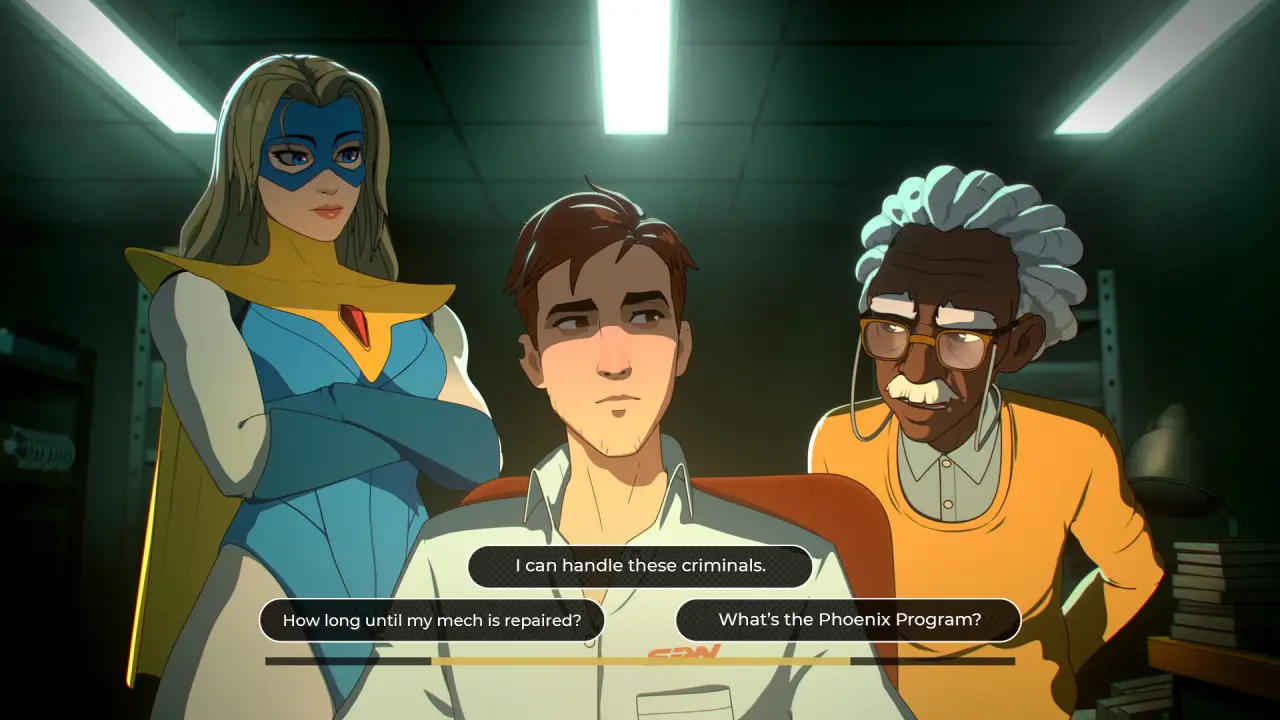
The art is a heavily stylized 2D animation that snaps your mind straight to the prestige adult-superhero cartoons of the last few years — the crisp linework of Invincible, the slightly grimy, grown-up swagger of The Boys. The character designs read instantly, the motion is clean, the cuts have the grammar of a TV episode. Watch a cutscene and you half-forget you are holding a controller; you feel like you are mid-binge on a sharp new series, which is precisely the effect AdHoc was chasing.
It is a smart bet because the alternative was a fight a debut studio cannot win. Try to out-render the hundred-million-dollar realism factories and you lose; pour the money into a singular hand-animated look instead, and you sidestep the arms race entirely while planting a flag nobody else owns.
The style also marries the material. The exaggerated silhouettes, the snappy action cutting, the comic-panel timing all hold up writing that pivots from a gag to a gut-punch and back inside the same scene. A reaction shot held a beat too long sells a joke; a hard cut to a wide frame sells a death. Those are editorial choices borrowed wholesale from television, and the 2D toolkit executes them with a precision a motion-captured cast of faces would fumble. The BAFTA for Animation is the most authoritative stamp on the call: this game was never reaching for photoreal, it was reaching for expressive, and it has expression to spare.
Two visual states: watching the show, working the desk

The game cleanly splits its look into two modes. One is the show: full-screen animated cutscenes, characters in conflict, the binge. The other is the job: you drop behind the dispatch console and the screen becomes a top-down map of the city, emergencies popping up one by one, waiting for you to assign hands. The two visual languages are kept distinct enough that a single glance tells you whether you are watching or working.
That separation is not just tidy — it is doing real labor for the gameplay. The board carries genuine information density: every hero's stats and cooldowns, every incident's threshold and timer have to read at a glance and at speed. But none of it is rendered like a spreadsheet. The data wears the same animated coat as the cutscenes, so even the "work" half stays inside the show's warmth. You are not staring at cells in a grid; you are looking at a living city and a row of expressive faces, which keeps a potentially dry strategy beat from ever feeling clinical or administrative.
Platforms, UI, and the cost of going stylized
The game launched on PS5 and Windows, with Nintendo Switch and Switch 2 versions following in 2026 and an Xbox Series port on the calendar. Because the art is 2D animation rather than a hardware-hungry realism push, it asks little of any machine — which means the gap between platforms is far narrower than the 4K-and-ray-tracing crowd lives with. For a game built to be watched two episodes at a time, anywhere, that portability is a feature, not a compromise.
On readability, the dispatch board threads "enough information" and "don't break the vibe" well: clean portraits, legible status markers, low need to consult a table. Nothing here demands a wiki tab open on a second screen, which matters for a game you are meant to play with one thumb while half-reclined on a couch.
Set it beside Detroit: Become Human, with its cinematic, photoreal branching, and you see the two roads in sharp relief. Detroit trades style for immersion through fidelity; Dispatch trades fidelity for identity and approachability. Quantic Dream's faces flirt with the uncanny valley to chase realism, while AdHoc's cartoon line never pretends to be anything but a drawing — and so never trips that wire. For a game that wants you to binge rather than gawp at pixels, the second road is plainly the right one.
Combat | 6.0/10
Gameplay: 6/10This is the part of Dispatch that deserves the most honesty. The gameplay is not here to dazzle you; it is here to fill a gap — the dead air between story beats. Grasp that and you will stop asking it for the wrong things.
The dispatch loop runs smooth, and runs shallow

The core is this: emergencies surface across the city, each tagged with a stat threshold and a duration, and you hold a bench of Z-Team heroes with different strengths, speed, stealth, social skill, and passive perks. Your job is to send the best fit to the right call within a limited number of turns, all while watching cooldowns so you never run the bench dry.
The loop runs smooth — bossrush called it "fun" and "playing well." There is a whisper of light strategy in it: certain heroes paired in the field trigger synergy bonuses, certain characters counter certain crime types, and by mid-game you have internalized an invisible roster sheet. Kotaku's reviewer noted that "by mid-game I no longer needed character sheets."
But that internalization is also the ceiling. Once you know the roster, the puzzle stops being a puzzle; you are pattern-matching, not deciding. A system asked to carry eight hours needs either deepening variables or escalating pressure, and this one supplies neither in real quantity — the same shapes of incident cycle back, and the turn economy never tightens enough to make a wrong call sting. It is competent, not deep, and to the studio's credit it never pretends otherwise. The dispatch board is a metronome to keep your hands busy between scenes, and it is honest about being exactly that.
Raising heroes and writing them — the cleverest hook

If the dispatching is merely adequate, the way it stitches to story is where the design earns its keep. After a job your heroes return to recoup, and you spend Robert's time leveling them, unlocking new stats and synergies. The trick is that this growth is not an isolated number game — how you develop a teammate, which way you push them, loops back to bend how the narrative writes them.
That is the heart of it: progression and story are bound both ways. You are never playing a side upgrade screen; every investment in a teammate is also a bet on the plot. A hero you train hard and send out often earns more screen time and deeper writing; one you neglect watches their thread dim into the margins.
It is a quietly radical inversion of how most RPGs treat a skill tree. Usually the numbers are inert — a strictly mechanical lever you pull to win fights faster. Here the lever is also dramaturgy: by deciding who you lean on, you are casting your own show, promoting some screw-ups to leads and demoting others to extras. That binding is the entire reason a not-very-deep dispatch system has a right to exist. It does not need to be hardcore, because its real function is to fix your relationship with these people in place using mechanics rather than cutscenes — to make you feel responsible for them, not merely fond of them.
The hacking minigame and the QTEs — the agreed-upon dead weight
Now the flaws, plainly. The hacking minigame bolted on in later episodes is singled out by nearly every review as the weakest thing in the game. bossrush put it bluntly: "either trivial or completely unintuitive, even after several runs." It offers no strategic pleasure and serves no story; it is filler that pulls you out of the spell.
The QTEs fare no better — the consensus is "exciting in the moment but undermined by how little they affect events." You nail the prompt, then learn that missing it changes almost nothing, a disconnect between action and consequence that quietly contradicts the game's whole "choices matter" pitch. The irony is sharp: a game whose dialogue choices carry real weight bolts on action beats whose inputs carry almost none.
Stacked together, these are the direct reason GameSpot's 8/10 was the most reserved score among the big outlets — not a denial of the game's quality, just an honest note that the playing falls short of the writing. They are also, mercifully, a small fraction of the runtime; you can grit through a hacking node in under a minute and be back inside the part that works. But they remain the clearest evidence that AdHoc's gift is the script, not the systems, and that the team knows it.
The truth about freedom — it nudges you onto rails
One last honest caveat about "freedom of choice." Your decisions genuinely fork, but at a few supposedly major junctions — the romances, who stays on the team — the game quietly steers you back onto a preset track. Kotaku's reviewer wanted to avoid romance and found that "Dispatch was going to force me into one romance or the other."
This is the old narrative-game bind: grant total freedom and the script spirals out of control; tighten the spine and the sense of agency takes a cut. AdHoc chose the latter and pays you back with finer-grained forks in the ensemble relationships — restraining the big road while handing you a pile of small choices that genuinely leave marks on who these people become. It is a defensible trade, even if the marketing oversells the steering wheel a little.
Against its own Telltale lineage, the dispatch loop at least gives you something to do, cards to play, between scenes — a long-overdue step forward for a genre that too often left your hands idle while the cutscene ran. Just set the expectation right before you start: it is the servant of the story, never the master, and judged on that brief it does its job.
Content | 7.5/10
Umfang: 7.5/10To talk about how much game Dispatch is, you have to swap rulers. It is not an open world you weigh by playtime and square kilometers. It is a show — and a show is never judged by episode count, only by whether every episode earns its slot.
Short, and short on purpose

The numbers, flat: HowLongToBeat puts the main story around 8.5 hours, the main-plus-extras run near 10.5, and a completionist sweep around 20.5. Eight episodes, thirty to sixty minutes each. For anyone trained on hundred-hour epics, that is genuinely short.
But "short" here is a decision, not a shortcut. AdHoc spent the runtime almost entirely on writing and performance density, refusing to pad with busywork sidequests, repeated traversal, or collectible checklists. The result is a game with almost no dead air — you never hit a chapter that exists to inflate a clock; every episode pushes a character or the plot forward.
It descends straight from its Telltale lineage, treating each installment as a TV episode to be polished rather than a map to be thinned out across dozens of hours. There is a discipline in that refusal worth naming, because the easy money was the other way — bolt on a fetch loop, a hundred collectibles, a New Game Plus grind, and you can advertise "40 hours" on the box. AdHoc declined the inflation and trusted that a tight thing finished is worth more than a baggy thing endured. For something built on the binge, eight hours is exactly a season's worth — any longer would drag, any shorter would starve.
The release schedule was part of the content
The most interesting thing about Dispatch is that its delivery is itself part of the experience. It launched on October 22, 2025 with only the first two episodes, then dropped two a week for four weeks until all eight were live on November 12. That cadence recreates the exact texture of following a series mid-run — you finish this week's pair and itch for the next, and a community itches alongside you.
That "watch and wait" structure is how AdHoc made the word "interactive show" literal, and it bleeds into the sales curve. When the game crossed a million in ten days, only two of the eight episodes existed — meaning a vast number of players bought in before the thing was even complete, on the strength of a beloved demo and those first two chapters.
That trust, paid up front before anyone could see the whole picture, is the hardest endorsement of quality there is, and a value no runtime figure could ever capture. It also turned the rollout into a shared event rather than a private playthrough: for four weeks the community theorized about the next pair of episodes, traded their branch choices, and argued over who to keep on the team — the kind of week-to-week communal life a game dumped all at once almost never gets. The cadence was content in its own right, a structural decision that manufactured anticipation no single-sitting release could buy.
The numbers, the awards, and what replay is actually for
If anyone still doubts the heft of this compact thing, look at the ledger. A million in ten days, two million in a month, three million by year's end, over four million all told. On Steam it sits Overwhelmingly Positive — roughly 97% across more than 160,000 reviews, with a Simplified Chinese region "Very Positive" near 89%. It took the Steam Awards 2025 prize for Outstanding Story-Rich Game and showed at the Tribeca Festival.
Those figures matter because they landed in a year everyone insisted single-player narrative games were money pits to be discounted into oblivion. A self-published, zero-microtransaction debut that rode word of mouth to four million is, on its own, an industry story — outlet after outlet cited it as proof the genre is not dead. As for replay: it is story-driven, not system-driven. You do not reroll for builds like a roguelike; you go back to fill in the branches you did not dare take. Because choices truly fork and many fuses burn to episodes seven and eight, a second run down a different relationship line genuinely pays — different fates, a different team, a different ending. That replay life is finite, but it is the right kind: a good show is worth watching twice to learn what the other choice would have meant.





Kommentare 0
Wir freuen uns auf deine Meinung
Beteilige dich an der Diskussion und teile deine Bewertung des Spiels.
Noch keine Kommentare — teil uns deine Meinung zu diesem Test mit!