























Opening
# Opening
On January 31, 2013, Wube Software launched an Indiegogo campaign from a Prague apartment, raising €21,626 in seed funding for a factory automation game called Factorio. Three years later on February 25, 2016, Steam Early Access launched. Four more years later on August 14, 2020, the 1.0 release shipped. Four years after that on October 21, 2024, the Space Age DLC launched, expanding the game from a single planet to a five-planet galactic scale.
Over 12 years, Wube grew from one or two developers to 31, accumulating over 5 million sales, Steam 96% positive across 187,000 reviews, 97% recent positive, Metacritic 90 / Space Age 92. Yunfeng, a well-known Chinese programmer and open-source middleware author, spent 300 hours playing Space Age and wrote a 5,000-word post-game summary. Shopify co-founder Tobias Lütke allows employees to expense Factorio purchases. These details together demonstrate Factorio's "phenomenal" status in the engineering community.
More dramatic is the "Cracktorio" community nickname — many players sit down and play 8-12 hours straight, unwilling to stop. Engineering students have been affected academically by Factorio. The industry has begun calling it "the training game every engineer must play." Today we open Factorio to study how Wube Software, over 12 years of dedication, pushed "automation as core gameplay" to the ceiling of industrial simulation.
Story | 7.0/10
Story: 7/10# Story
Main arc: from crashed engineer to interstellar factory baron
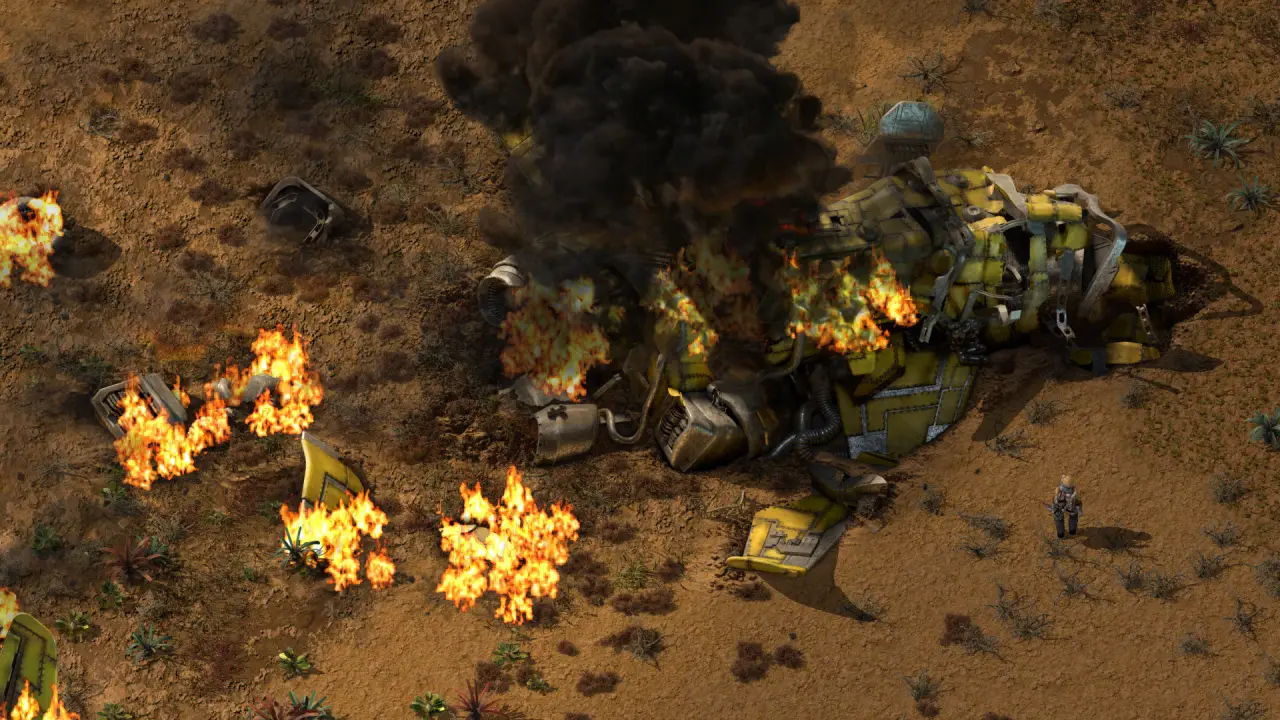
Factorio's narrative is extremely minimal — the player controls an engineer who crashes on an alien planet after spaceship malfunction. The sole objective is to build a rocket and escape. The original main story has no cutscenes, no NPC dialogue, no branching choices. All "story" is created by the player during automation construction. This "no-narrative start" is Wube Software's biggest design divergence from traditional RPG — they preset no dramatic arc, leaving everything to the conversation between "player and factory."
The main story's endpoint is launching a rocket — players research 7 science packs (red, green, blue, purple, yellow, white, space), build a complete rocket assembly line, then watch one rocket launch and earn "victory" achievement. Original complete clear averages 65 hours. For hardcore players this is just the beginning — many continue expanding their factory after victory, scaling production dozens or even hundreds of times beyond the campaign's end.
The 2024 Space Age DLC extends the story to 4+1 planets. Players no longer "build a rocket to escape" but "build space platforms, transport resources between four different planets, ultimately reach the mysterious fifth planet." Nauvis (original homeworld), Vulcanus (volcanic theme), Fulgora (lightning desert), Gleba (humid swamp), Aquilo (frozen world) each have completely different resource systems and challenges. This "DLC as sequel" expansion lifted the story from single-planet to galactic scale.
Side density: industrial novels written by players themselves
All side content is created by players. Factorio has no traditional "quests" or "NPCs," but every player spontaneously logs their factory construction journey — from the first conveyor belt to the first chemical plant to the first nuclear reactor. Steam review pages are filled with "my factory stories" — how a player designed the perfect rocket assembly line at hour 50, how a player built smart storage with circuit logic, how a player saved a nuclear power plant under bug siege.
The community has spawned countless "challenge runs" — Ironman (permadeath plus high difficulty), peaceful mode (bugs disabled), speedrun (rocket launch in 24 hours), tiny factory (smallest footprint), megabase (largest production scale), pure chemistry (oil chemistry only), Death World (map full of bugs). Each challenge lets players write their own "industrial novel" on top of base gameplay, creating Factorio's exclusive "emergent narrative" ecosystem.
Yunfeng's blog mentions he invested 300 hours in Space Age until "the system told me I won the game," but he still has "far from complete" goals. This "victory is just the start" extensibility is the core mechanism behind Factorio's 12-year longevity — every player writes their own story in their own factory, no two alike.
Choice systems: automation is the plot choice
Factorio has no traditional RPG good-evil or path divergence, but it has a deeper "choice authority" — every factory design decision is an irreversible plot decision. Do you put iron smelting at the base center or move it to the resource patch? Do you transport iron plates via belt or robot drones? Do you build a new rail line or a new chemical plant? These decisions accumulate into your factory's personality.
The community shares comparison images — same 100 hours played, but everyone's factory looks completely different. Some build "hyper-aligned factories" with all buildings strict to grid; some build "organic expansion factories" sprawling with resource patches; some build "main bus factories" with all materials converging to a main bus then branching; some build "modular factories" with each module independently detachable. This "style as identity" design is rare in indie, making Factorio the "factory architect's" canvas.
Space Age pushes this choice to galactic scale — players choose which planet to develop first. Vulcanus's lava smelting, Fulgora's byproduct processing, Gleba's time-sensitive production, Aquilo's extreme-cold logistics — each choice corresponds to completely different gameplay focus, making the four planets' development order a new plot dimension.
Characters: the player themselves are the protagonist
All "character work" focuses on the player. The on-screen engineer is just an expressionless, voiceless, personalityless pixel figure — but for 12 years countless Factorio players have projected themselves onto that pixel and treated factory construction as personal growth.
The community is filled with "my and the factory" stories — one programmer says Factorio taught him to understand microservice architecture; one engineer says Factorio trained his industrial management thinking; one STEM student says Factorio gave him first real understanding of supply chains. This "game as career training" phenomenon is rare in indie, the core value distinguishing Factorio from other simulation works.
Wube team member Earendel was originally the developer of the Factorio Space Exploration mod (with cumulative downloads exceeding 5 million on the official Mod Portal), later recruited into the official team, becoming Space Age DLC's main designer. This "player-to-developer" story is a landmark event in Factorio community culture — proving this work is not just a product, but a real-life extension of "industrial simulation training camp." Shopify co-founder Tobias Lütke explicitly tells engineering candidates the game is one of the strongest signals of systems thinking, and the Neobuthus factorio scorpion species named after Factorio in 2024 shows the engineering identity has broken out of gaming entirely.
Audio | 8.6/10
Sound: 8.6/10# Audio
Score theme: industrial electronic factory ambient
Factorio's original soundtrack is composed by Petr Wajsar, in an overall "industrial electronic plus minimalist ambient" style. The base game has 21 BGM tracks; the Space Age DLC adds another 8 hours of original soundtrack, with completely different musical themes designed for each of the 4 new planets. This "industrial ambient plus cross-planet theme" hybrid makes Factorio's soundtrack one of the rare simulation-genre scores worth listening to standalone.
BGM presence is deliberately restrained — most of the time soft industrial ambient plays in background, letting players focus on factory construction. Only at key events (nightfall, first bug raid, nuclear reactor startup, rocket launch) does the music shift briefly. This "music restraint" strategy lets Factorio avoid auditory fatigue across 100+ hour sessions.
Space Age's 4 new planet BGMs each have distinct character — Vulcanus's low-frequency lava rumble, Fulgora's electrical howl, Gleba's humid bird calls, Aquilo's frozen wind howls. Each planet's music corresponds to its visual and gameplay traits, letting players sense by ear "I changed planets." Petr Wajsar took the unusual step of mastering each planetary suite with a different reverb profile so headphone listeners can tell from the first eight seconds which world they have arrived on, and several tracks have been re-released as standalone Bandcamp singles.
No-voice design: let the player feel the factory breathing
Factorio is one of the few modern games entirely without voice acting. The on-screen engineer never speaks, no NPC dialogue exists, the entire game's "audio narrative" comes from machines, conveyors, power grids, chemical plants, and bug roars. This minimalism is not a budget limit — it's the core of Wube's design philosophy: they do not want any external narrative interrupting the player's factory-building flow.
This "no voice, all machine sounds" design gives Factorio a unique "factory breathing" feel. When the player watches raw materials flow through their own automated production line, processed into products, loaded on trains and shipped to next destination, that "factory in motion" auditory experience is something other games cannot provide.
The community has also produced voice-pack mods spontaneously — adding voice work to factory tooltips, alarms, bug roars in various creative reinterpretations. These mods total hundreds of thousands of downloads on the official Factorio Mod Portal, an extension creation by the community on the "machine sound narrative." A handful of streamers have even produced "narrated Factorio" runs where the engineer's inner monologue is voiced by the player themselves, turning the silent design into a personal podcast format that the official forums have featured in community spotlights.
Environmental sound: machine, conveyor, power industrial symphony
Environmental sound design is Factorio's most underrated layer. Every machine has independently recorded audio — drill grinding, assembler clicking, chemical plant bubbling, power grid humming, train whistles, steam engine hissing, nuclear reactor low-frequency resonance. Players with headphones can judge by sound "which machine is working, which production line is stuck, which chemical plant needs material."
Cowlevel's review notes Factorio's "industrial sound design is the most solid and outstanding across all games" — Wube's 12 years of audio refinement. Every sound is carefully tuned so dozens or even hundreds of machines simultaneously running do not produce audio chaos, but instead create an "industrial symphony" layering.
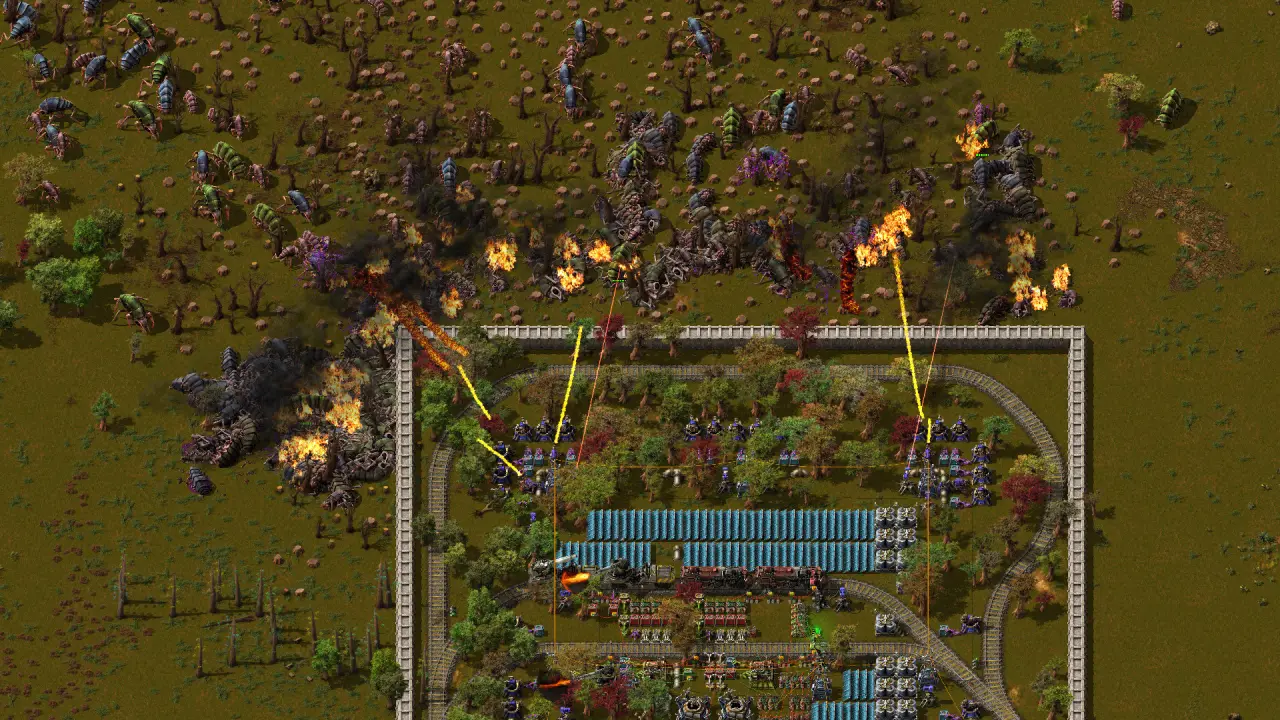
Bug combat audio is also careful — small bug screams, large bug roars, huge nest low-frequency threats. Under bug siege, players can judge enemy count, direction, intensity by ear alone, planning retreat or counterattack. This "audio hunting" is Factorio's hidden combat dimension beyond industrial simulation. Space Age introduced new pentapod and demolisher creatures with distinct sonic fingerprints, so veterans on Gleba can tell a pentapod hive is hatching before any sprite enters the screen, and Vulcanus demolishers register as a sub-bass tremor through the floor that the community has compared to a small earthquake.
Console and platform audio differences
Switch / Switch 2 versions ported by Wube themselves maintain PC audio quality, but due to handheld speaker physical limits, external headphones are recommended for full stereo stage. Switch 2's 2025-12 release supports native 4K output plus high-fidelity audio, the best for console players.
PC supports 5.1 / 7.1 multi-channel speakers by default; headphones can locate factory area directions precisely. Steam Deck Verified rating allows long handheld sessions with headphones delivering full audio experience. The community has dedicated "audio optimization mods" — adding more realistic industrial sound effects to machines, scarier roars to bugs, more obvious humming to the power grid. These mods let players tune Factorio's overall auditory experience by personal preference, forming an independent mod-scene branch. The Chinese factory player community also maintains a dedicated "Factorio audio experience guide" as standard onboarding reading for new players. Power users on Discord routinely pair the soundtrack with Dolby Atmos headphone profiles to keep the soundstage stable across 8-hour Cracktorio sessions, and engineering-focused podcasts have used Factorio audio clips as bumper music — the most concrete evidence that the sound design has crossed over from "game asset" into general engineering culture.

Visuals | 7.5/10
Grafik: 7.5/10# Visuals
Art direction: minimalist 2D top-down plus industrial steampunk
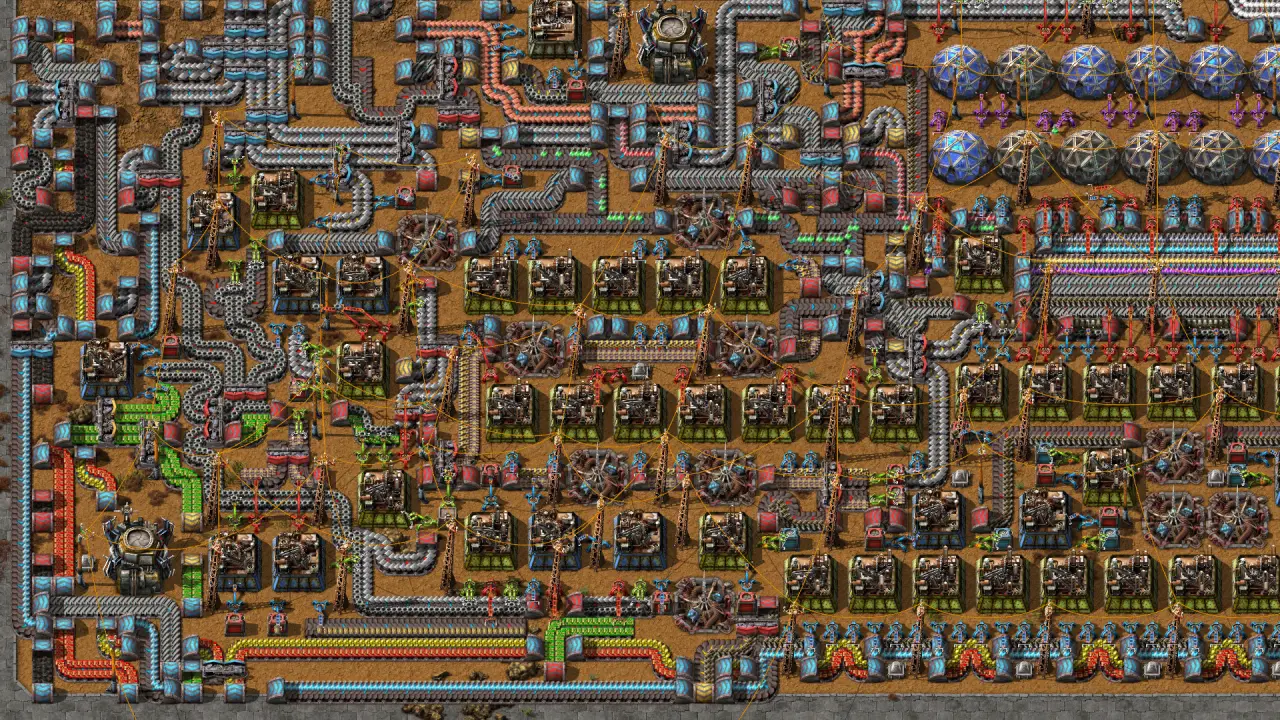
Factorio's visual style is the indie industry's rare "minimalist to the end plus industrial steampunk" path. The game uses top-down 2D perspective, pixelated textures, cartoonish machine shapes, simple colored building blocks. Players coming from The Witcher 3 or Cyberpunk 2077 will feel "this graphics is so plain" in the first 5 minutes. But Wube Software redesigned the art multiple times across 12 years of development — each redesign let players more clearly distinguish "which machine is which, what each conveyor carries."
One benefit of minimalist art is extremely low hardware requirements — Dual core 3GHz plus 4GB RAM plus 512MB GPU runs Factorio. The game runs stably on any laptop, office PC, or last-gen console. Another benefit is readability — after 100 hours, players can instantly distinguish over 100 different machines, conveyor directions, power grid states, and bug threat levels. This "information visualization priority" design philosophy is Factorio's exclusive achievement in simulation.
Industrial steampunk art style is also Factorio's visual identity core. From early wooden power poles to mid-stage steam engines to late-stage nuclear reactors, from manual mining to automated drills to robot mining — each machine has unique industrial aesthetics, letting players feel "I'm building a real factory."
Engine technology: Allegro 5 in-house plus 12 years of polish
The engine is Wube's in-house Allegro 5 graphics library. This is a well-known open-source 2D graphics library in the indie engineering scene, not Unity or Unreal. Wube chose in-house over generic engines to "fully optimize Factorio's core mechanic" — real-time simulation performance in large factory scenes.
The engine focus is not refined rendering but "stable simulation of large machine and object counts." The game supports 100,000+ items simultaneously (items on conveyors, items in machines, items carried by robots), all real-time simulated. This "high-density simulation" has been iteratively optimized across 12 years — from early 2016 EA's 20 fps stutter to 2024 2.0's stable 60 fps, an engineering precision Wube refined.
Factorio 2.0 (2024-10 launched alongside Space Age) is the biggest engine upgrade across 12 years. Wube spent 4 years thoroughly rebuilding the rendering pipeline, physics engine, network sync, and hot-update mechanism, letting all players (including non-DLC owners) enjoy the new engine's performance gains. This "DLC plus engine major version" dual-release operations is rare in indie, a Wube signature. The Friday Facts dev blog has documented every major Allegro 5 refactor in painstaking detail, turning the engine itself into an open-source-style technical case study read by engine-curious developers far outside the Factorio audience.
Platform version differences
PC (Steam / GOG / official): 1080p to 4K plus 60-144 fps, mouse / keyboard / controller / Steam Deck supported. Mac / Linux native support.
Nintendo Switch (October 2022): native 1080p 30 fps, touchscreen plus controller hybrid input. Handheld mode performs well.
Nintendo Switch 2 (December 2025): native 1080p handheld / 4K docked at 60 fps. The best for non-PC players.
Steam Deck: Verified rating, 1280x800 plus 60 fps, the best path for non-PC players.
Overall, the 2026 optimal Factorio experience path is PC plus Steam plus Space Age DLC plus 30000+ mod ecosystem. Console-only players should choose Switch 2 over the original Switch. Steam Deck is the most portable and cost-effective option. Multi-platform support lets Factorio keep pace with player hardware evolution over 12 years, a core pillar of indie longevity strategy. Whether you have a decade-old laptop or the latest 2026 console, you can find a compatible version. Cross-save between Steam and Switch 2 was announced as a Friday Facts road-map item with no fixed date, but Steam Cloud already preserves saves across PC reinstalls, and the GOG build ships with the same engine binary as Steam so version-parity is guaranteed even for offline collectors who refuse storefront DRM.
UI and accessibility
UI is the most "engineer-thinking" reflective layer of Factorio's visuals. Menus, tooltips, signal lights, status displays all follow "information density priority" — one screen can show dozens of different status indicators, letting players maintain control in complex factories. This UI style is highly favored by engineers but has a learning curve for casual players.
For accessibility, Factorio provides colorblind modes, subtitle size adjustment, full key remapping, aim assist tiers (full assist to all off), and slow-motion time speed. This accessibility framework is excellent in indie, letting action-impaired players play stably. But for fully visually impaired players it remains unfriendly (requires heavy UI reading) — Wube acknowledged on Discord that this is a long-term gap but lower priority than content updates. Chinese players also rely heavily on UI optimization mods, with traditional and simplified Chinese localization further refined by community efforts. The "Squeak Through" mod that lets the engineer walk between belts and pipes is so universally installed that the official 2.0 update absorbed parts of its behavior, and the Chinese community translation of all Mod Portal pages is now an officially endorsed effort run by long-time volunteers.
Combat | 9.7/10
Gameplay: 9.7/10# Combat
Automation trio: conveyor belt plus inserter plus assembler
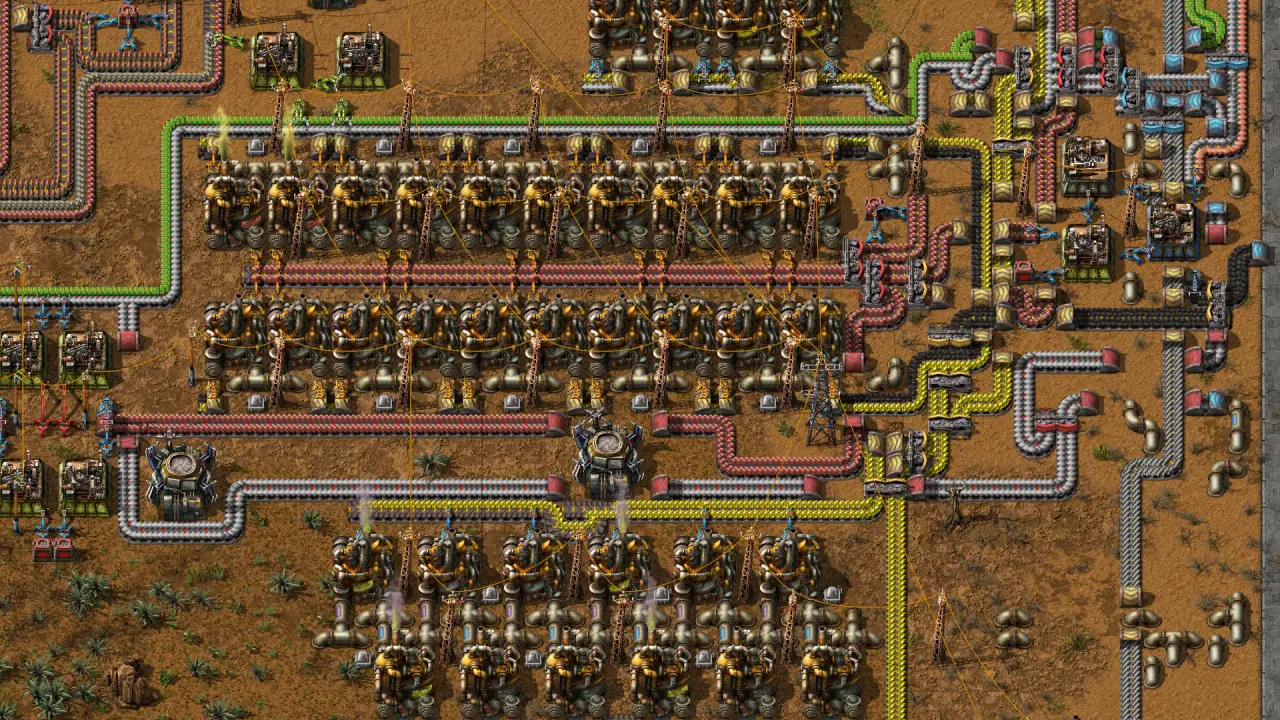
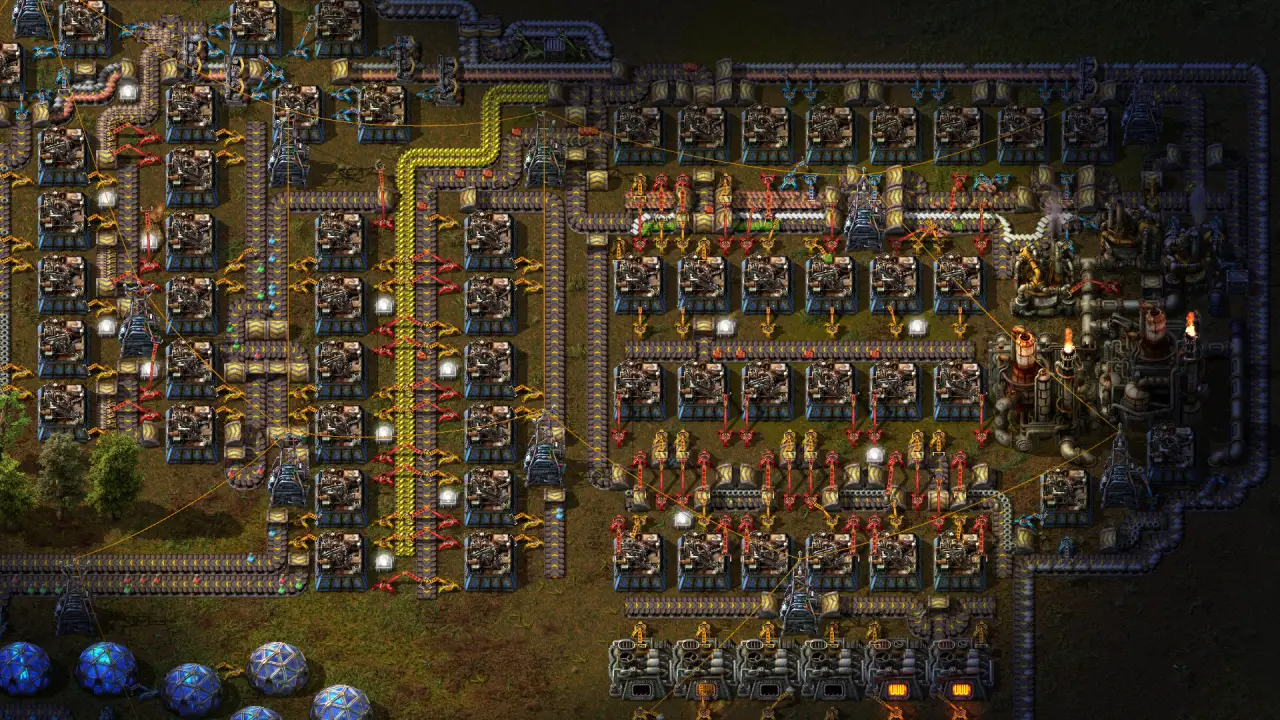
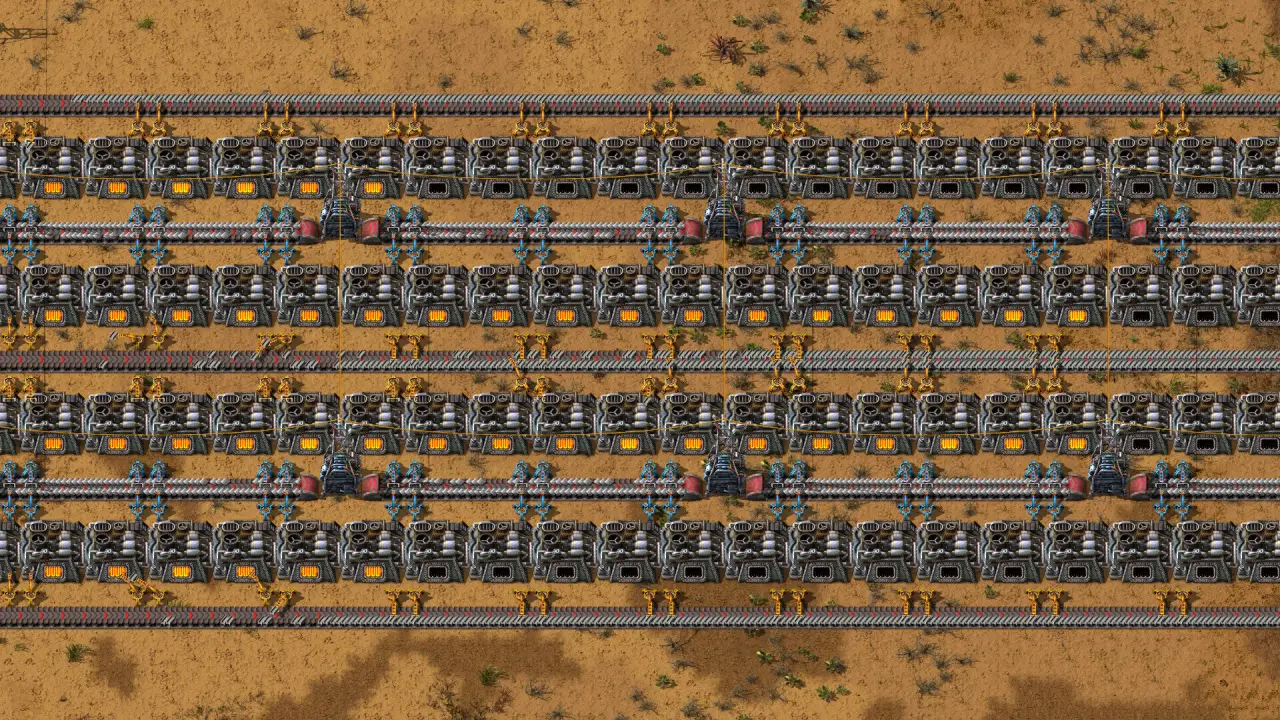
Factorio's core mechanic is the classic automation trio. Conveyors transport items (multiple speed tiers: yellow slow, red medium, blue fast); inserters grab items between conveyors and machines (multiple tiers: yellow slow, red medium, blue fast, filter-style precise selection); assemblers craft products (multiple tiers: basic level 1, mid-tier level 2, advanced level 3).
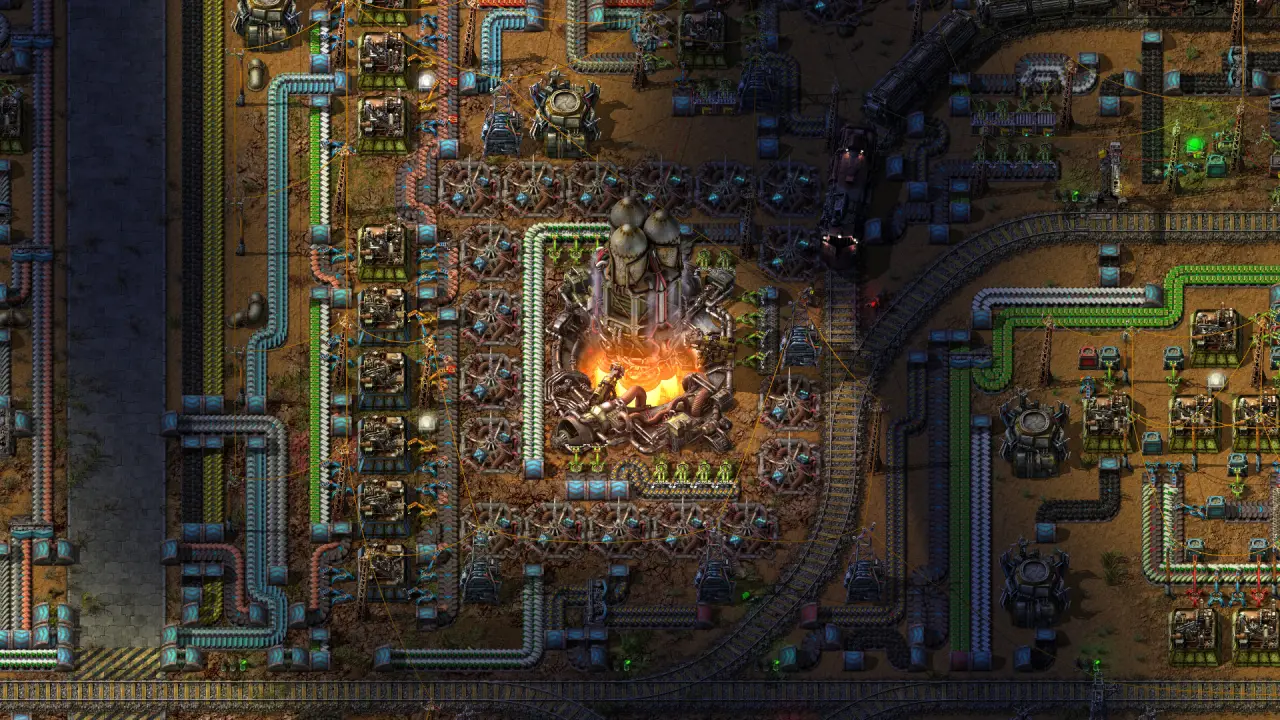
These three are the factory's grammar foundation. New players from minute one start building "miner → conveyor → inserter → assembler → inserter → conveyor → product" simplest production lines. After 100 hours players can build "main bus plus branch module" complex production lines. After 5000 hours players can build cross-planet automation networks on Space Age.
Cowlevel's review specifically highlights Factorio inserter flexibility — "can transport solid materials between many locations." This freedom from traditional input-output constraints distinguishes Factorio from 3D factory games like Satisfactory or Dyson Sphere Program — 2D top-down view gives logistic design completely different geometric freedom. The 2024 stack-inserter rework lets a single inserter swing 12 items per cycle instead of one, which collapsed many late-game throughput bottlenecks overnight and forced veterans to redesign decade-old main-bus patterns, turning even the most basic atomic of Factorio's grammar into a still-evolving system that rewards return visits.
Tech tree plus 7-color science packs: players plan their own research roadmap
Research is Factorio's core gameplay driver. Players research technology to unlock new machines, recipes, and science packs. The complete tech tree has 7 tiers corresponding to 7 colored science packs:
Red science: basic tools, craftable from start Green science: power and chemistry, requires oil processing Blue science: advanced chemistry and robotics, requires electrical engineering Purple science: production modules, requires chemistry plus robotics combined Yellow science: space technology, requires rocket assembly White science (space science pack): original endgame, requires rocket launch to obtain Space science packs (Space Age new): high-tier science packs unique to Space Age
Each color science pack requires complete production chain support. The deeper you research, the larger the factory scale and more complex the production lines. This "7-color science equals 7 production-line scales" design is the part engineers most praise — it transforms the game's growth curve from simple "level numbers" to "factory scale upgrades." The science pack supply chain design directly maps to real industrial supply chain thinking, letting many STEM students experience supply chain planning for the first time through this game. This "science pack as factory scale" design makes Factorio's growth curve itself a supply chain textbook.
Blueprint system plus robots: construction automation
Entering the mid-late game, players unlock the blueprint tool. Box-select a group of buildings to generate a copyable blueprint; robots auto-complete construction. Cowlevel's review calls this "the most solid and outstanding automated construction system across many games" — players can copy a whole factory to a new location without manually placing every machine.
The robot system executes blueprints. Construction robots place buildings; logistics robots transport items. Two robot types with limited battery and range force players to design complete "robot networks" — logistic stations, dividers, signal lights, and many control elements. This system lets Factorio shift from "hand-building factories" to "remote-commanding factories" after hundreds of hours. Blueprint automation is the core productivity tool for mid-late game factory players, compressing what used to require manually placing 1000 buildings into a few seconds. The 2.0 update introduced an in-game blueprint library that syncs across saves, and Space Age layered a five-tier "quality" system on top so the same blueprint can be re-stamped with higher-tier modules without any redesign — a workflow that makes the late game feel less like factory construction and more like industrial software refactoring.
Rail plus signal lights: real industrial railroad simulation
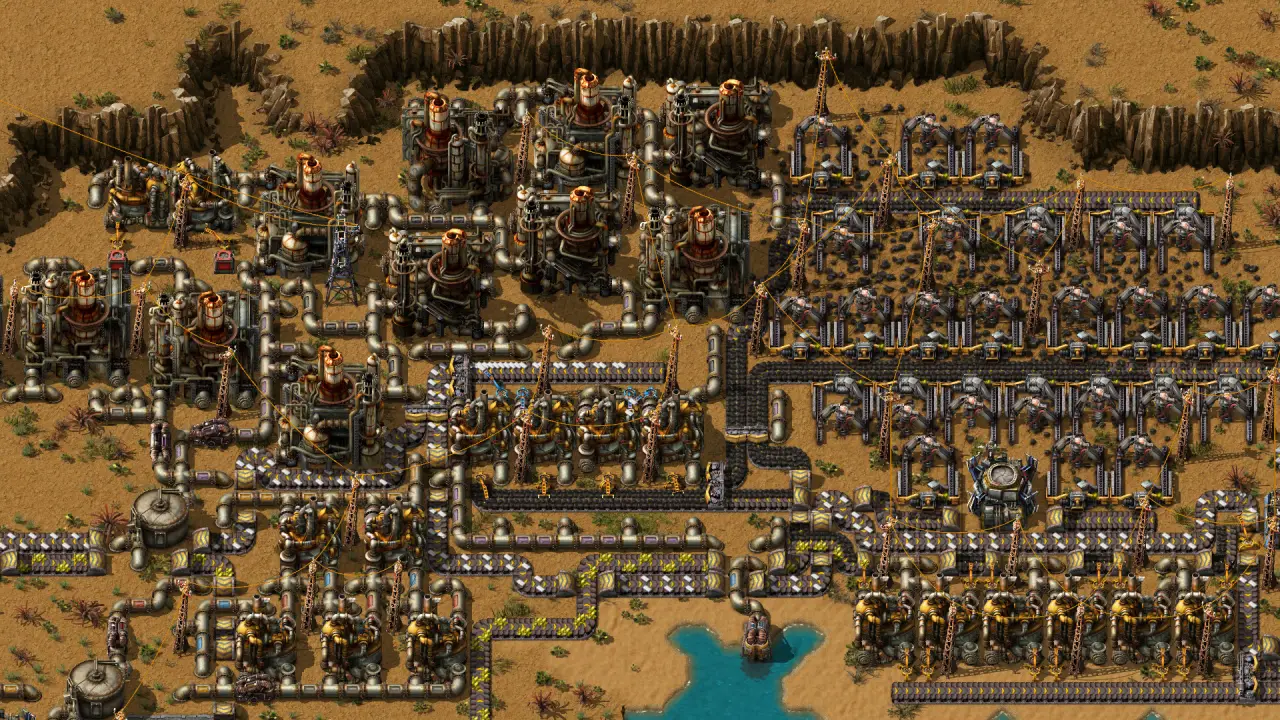
The rail system is Factorio's most industrially simulated design. The map is vast with uneven resource distribution, forcing players to connect distant resource patches with rail. Factorio's signal system models real industrial railroads — divides track into signal blocks where trains observe upstream congestion to decide action. Intersection planning, dual-direction rail design, train station scheduling all demand substantial player thought.
Cowlevel's review specifically praises Factorio's rail system as "more complex and realistic than other games." Many railroad enthusiasts treat Factorio as an "amateur railroad simulator," spending tens or hundreds of hours designing their rail networks. The community has dedicated "train factory" challenges — using only trains, no conveyors, completing all production via rail network.
Space Age extends the rail layer with elevated rails that cross over surface routes without intersection signals, opening up entire new geometries impossible in the base game. Combined with the new "train interrupt" scripting that lets a single locomotive react to fuel level, cargo state, or station signal, the rail network has effectively become a programmable transport layer rather than a static blueprint. Several long-running megabase YouTubers re-recorded their classic tutorial series in 2025 just to cover the new rail features, signaling how much the system has expanded after a decade of refinement.
Space Age 4+1 planets: cross-planetary automation
Space Age DLC extends gameplay to 4+1 planets:
Vulcanus: volcanic theme, infinite iron / copper / stone, extracted from lava. Biggest challenge is "demolishers" — sand-dune style threats, players must mine while warding off worms. Atomic bombs are effective weapons.
Fulgora: "infinite power, scarce water" world, heavy oil replaces water. Core gameplay is "byproduct processing" — 12 ore inputs require careful production line design to consume all materials. Yunfeng describes "production lines reversed here."
Gleba: most products have shelf life, expiring with spoilage. This shifts production line design from "spatial" to "temporal" — must calculate logistics time, not just bandwidth.
Aquilo: liquid ammonia frozen planet. Extreme cold requires insulated piping; all production runs under low-temperature conditions. The most hardcore of the four planets.
Mysterious fifth planet: outer edge of solar system, still shrouded in mystery. Requires complete clear of first 4 planets to unlock.
Each planet has unique resources, mechanics, enemies. Development order is also a strategic choice, letting Space Age extend the strategy layer dimension beyond base gameplay. Yunfeng's 5,000-word post-game write-up dedicated separate sections to each planet's "factory grammar," arguing that Fulgora alone is harder than the entire base game because byproduct constraints invert the usual produce-what-you-need workflow.
Cross-genre feel comparison
Across the genre, Factorio sits in the sweet spot of Satisfactory, Dyson Sphere Program, and Mindustry. Satisfactory takes 3D route with stunning visuals but logistics flexibility trails Factorio; Dyson Sphere Program is Chinese-developed with stellar craftsmanship but 12-year longevity comparable; Mindustry is Factorio-inspired open-source tower defense factory but depth insufficient. Factorio fuses "2D top-down plus flexible inserters plus blueprint automation plus 7-color science plus cross-planetary" five elements into the simulation ceiling.
In finer comparison, Factorio's learning curve is "30 minutes entry, 30 hours obsession, 300 hours optimization, 3000 hours mastery." First 30 minutes players build first conveyor; after 30 hours players understand 7-color science packs; after 300 hours players optimize each machine's output; after 3000 hours players enter "factory god" territory — using circuit logic to build smart factories, using blueprints to copy industrial parks, designing cross-planetary automation networks on Space Age. This curve lets Factorio attract casual players and retain hardcore players simultaneously. Compared to Shapez.io's abstract puzzle mode or Captain of Industry's survival overlay, Factorio's commitment to pure industrial logic without lifestyle distractions keeps it the canonical example the rest of the genre is still measured against.

Content | 9.5/10
Umfang: 9.5/10# Content
Main story length and pacing
How Long to Beat data shows Factorio's main flow averages 65 hours — the shortest path to the original "launch a rocket" ending. The full experience requires "all Space Age 4+1 planet clear plus all achievements plus multiple new saves plus mod integration," lifting average clear time to 200 hours. Yunfeng's blog confirms he invested 300 hours in Space Age yet remained "far from complete." Hardcore players accumulating 1000+ hours is standard.
For pacing, single sessions typically run 2 to 5 hours. New players go from start to first rocket launch in about 30 to 50 hours; veterans can clear the base game in 10 to 15 hours. Space Age's 4 planets each average 15 to 25 hours per planet, totaling 60 to 100 hours for all 5. This "long-span" pacing works well for working adults — can be split across multiple weekends, each focusing on a planet or new mechanic.
PC players can use the time speed multiplier to adjust pacing — early building speed at 3x to skip tedious placement, combat back to 1x for precise input, recovery period at 2x to wait for events. This "time speed" mechanic lets players control pacing freely by mood.
Space Age major DLC plus continuous free updates
Factorio's DLC matrix takes the "ultra-precise minimal" path — only one paid DLC in 12 years: Space Age (October 2024, $35). This contrasts sharply with peer works like Stardew Valley, RimWorld, and Don't Starve which have multi-DLC strategies. Wube chose to bundle all content into one complete DLC, letting players buy once rather than piecemeal.
Space Age's content equals a complete $35 standalone game — 4 new planets plus mysterious fifth planet plus space platforms plus 5-tier quality system plus elevated rails plus demolishers plus pentapods new enemies plus 29 new achievements plus 30 intermediate products plus 22 new buildings plus 8 hours of new soundtrack plus 5 new science packs plus 5 new weapons. This "overdelivered content pricing" is Wube's gift back to veterans, leading PCGamesN to call Space Age "basically a complete sequel."
Factorio 2.0 was the free update launched alongside Space Age, available to all players (including non-DLC owners). 2.0 includes network sync rewrite, engine performance optimization, signal system enhancement, liquid system improvement, and UI upgrade. This "DLC paid plus major version free" dual operations keeps Factorio's user retention extremely high over 12 years.
30,000+ mod ecosystem: official Mod Portal
Factorio does not support Steam Workshop but built its own Mod Portal — a Wube-developed official mod distribution platform from the 2016 EA stage. By 2026, the Mod Portal has cumulative uploads exceeding 30,000 mods across categories — pure additions (new machines, materials, buildings), gameplay overhauls (new research trees, production chains, mechanics), UI optimization, localization, art style replacement, balance tweaks, and overhaul mods (Bob's Mods, Angel's Mods, Krastorio 2, Space Exploration).
The most famous overhaul mod is Space Exploration — developed by indie developer Earendel as a major space-themed mod, extending the factory to multiple planets. This mod has cumulative downloads over 5 million, a Factorio "must-install mod." Wube hired Earendel into the official team in 2022, and the 2024 Space Age DLC heavily references Space Exploration's design ideas. This "player-to-developer" story is a landmark event in Factorio community culture.
The Chinese community's mod translation ecosystem is also active — virtually every English mod has a Chinese translation, maintained voluntarily by "Factorio Chinese community" and similar groups. This lets Chinese players enjoy identical mod experience to English players. Some Chinese-original mods are also famous, like "Chinese-style building pack," "Three Kingdoms theme," and "Spring Festival limited skins."
12-year longevity operations rhythm
Factorio is one of the few Steam titles holding heat for 12 years. 2016 EA launch, 2020 1.0 release, 2022 Switch port, 2024 Space Age plus 2.0, 2025 Switch 2 port — every step keeps the game fresh. Steam data: 187,000 reviews, 96% positive, 97% recent positive, cumulative sales over 5 million, Cracktorio addiction nickname deeply embedded in engineering circles.
Wube Software grew from 1-2 to 31, but holds firm on "12 years on one game" — a spirit rare in indie. Factorio is the studio's debut and only work, all resources concentrated on this one game's refinement. This "small but beautiful plus long and durable" operations philosophy is the foundation of 12-year longevity and the most representative "specialize-on-one-thing" case in indie history.
Future planning: Wube has stated repeatedly on Discord that "Factorio 2 is not happening in the short term," and they will continue adding new content via DLC. Next major DLC timeline is unannounced, but the community already anticipates a space-colony themed expansion after Space Age. The studio's hiring page emphasizes long-tenure engineers over rapid expansion, and CEO Kovarex's Friday Facts entries consistently frame Factorio as a generational project rather than a product cycle — meaning anyone buying in today is buying into a roadmap that is still actively being polished a full decade after early access first opened.





Kommentare 0
Wir freuen uns auf deine Meinung
Beteilige dich an der Diskussion und teile deine Bewertung des Spiels.
Noch keine Kommentare — teil uns deine Meinung zu diesem Test mit!