























Opening
A live-service shooter has no business being this much fun. There is no stamina meter nagging you to log in, no checklist of daily chores, not even a proper campaign with a beginning and an end. And yet it moved a million copies in three days, became the fastest-selling PlayStation game ever made, and crossed twenty million inside a year.

What lit this thing was never one finely-tuned system. It was the reaction four ordinary ingredients set off when you cram them into the same drop: the weight of the ranged loadout, the call-down Stratagems, the friendly fire that never switches off, and a war that millions of strangers are writing together in real time. Pull any of those four apart and none of them is a first in the genre. Throw them into one match and they grow a temper nobody else can clone.
Picture it. You and three squadmates hit a planet you have never seen, screaming "for Super Earth" while you fumble the directional inputs for an orbital cannon — and then watch it land squarely on your own team. Absurd, chaotic, funny enough to leave you gasping. That is the first calling card the game hands you, and it never really stops handing it.
The strange part is that the fun is built on the flaws, not in spite of them. It runs on an engine the world stopped supporting years ago. Its servers buckled for the first two weeks. Its currencies tie new players in knots. But the moment you are actually on comms, holding the last wave back-to-back, stuffing a surviving teammate and a fistful of samples into the extraction pod — none of that matters. This review starts from that contradiction: a game that had every reason to faceplant, and instead became a phenomenon.
Story | 8.5/10
Story: 8.5/10Managed Democracy, played completely straight
Helldivers 2 has no script in the conventional sense, and that turns out to be its sharpest narrative trick. You fight for a utopia called Super Earth, sent to "liberate" star systems supposedly menaced by bugs and machines. The regime it serves has a name — Managed Democracy — and the joke writes itself: you are free to vote, but only for the ballot the state hands you.

This is the bluntest and smartest possible riff on Starship Troopers and the propaganda machine it skewered. The recruitment reel, the anchor solemnly intoning "liberty" and "freedom" and "Managed Democracy," the stirring speech you sit through before every drop — all of it plays the lunacy dead straight. The game never breaks character to wink at you and mutter "this is satire." It lets you find the black comedy yourself, in the half-second between shouting the slogan and blasting a teammate off the map. The harder you perform your loyalty, the thicker the absurdity gets. That restraint is the whole craft.
What makes it land is the loop it closes between fiction and mechanics. Friendly fire is not a bug; it is the theme made flesh. When you scramble for an input in the name of freedom and bury an ally alongside the enemy, you have personally proven the irony that a democracy waged at gunpoint shoots its own. You are not watching a story about a war machine. You are a cog in one — ridiculous, dutiful, and entirely expendable.
It is the rare game whose worst-sounding mechanic is also its thesis statement. Plenty of shooters would have patched friendly fire into an optional toggle and called it player-friendly. Helldivers 2 understood that the toggle was the whole point — that a war fought for "freedom" should, by its own logic, keep killing the people sent to spread it.
A war the whole playerbase writes by hand
If the worldbuilding is the base coat, the live narrative is the moat nothing else has dug. Helldivers 2 swaps fixed plot for a Galactic War that genuinely evolves: which front is advancing, which planet has been reclaimed, where Super Earth's propaganda pivots next week — all of it bends to what the global playerbase managed this week.
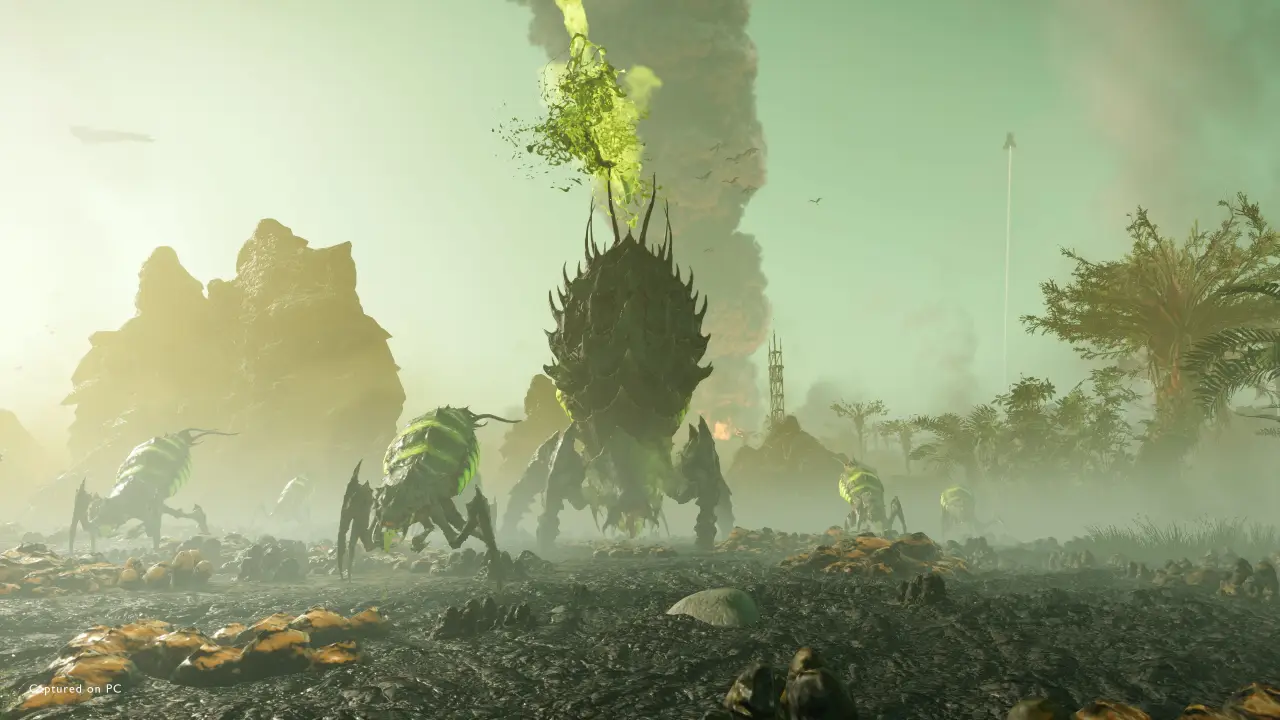
Behind the curtain sits a figure the community nicknamed Joel, the studio's Game Master. He runs the front like a tabletop dungeon master, seeding enemy offensives in real time, opening new theaters, scripting the turns. Liberate a planet together over a weekend and next week's map really does redraw. Lose a front and the lore lets it fall. The Major Order — a single objective handed to the entire server — fuses millions of players into one narrative body, each chipping away at the same goal until a campaign is won or squandered together.
Stack that against Starship Troopers: Extermination, a co-op shooter mining the very same source. That game leaves its satire at the level of skin. Helldivers 2 takes the question of how collective will gets steered by a propaganda machine and makes it playable, joinable, and co-authored. Its story score takes the hit for having no traditional throughline at all. But measured by how narrative resonates with mechanics and community, it is out ahead of its peers.
The price of the trick: no hero, no heartbeat
The honest cost of all this is worth naming. The narrative here is collective, and so it is, by design, heroless. You are not some named protagonist with an arc. You are one more conscript dropped onto the line, liable to die and be replaced by a fresh recruit within the same firefight.
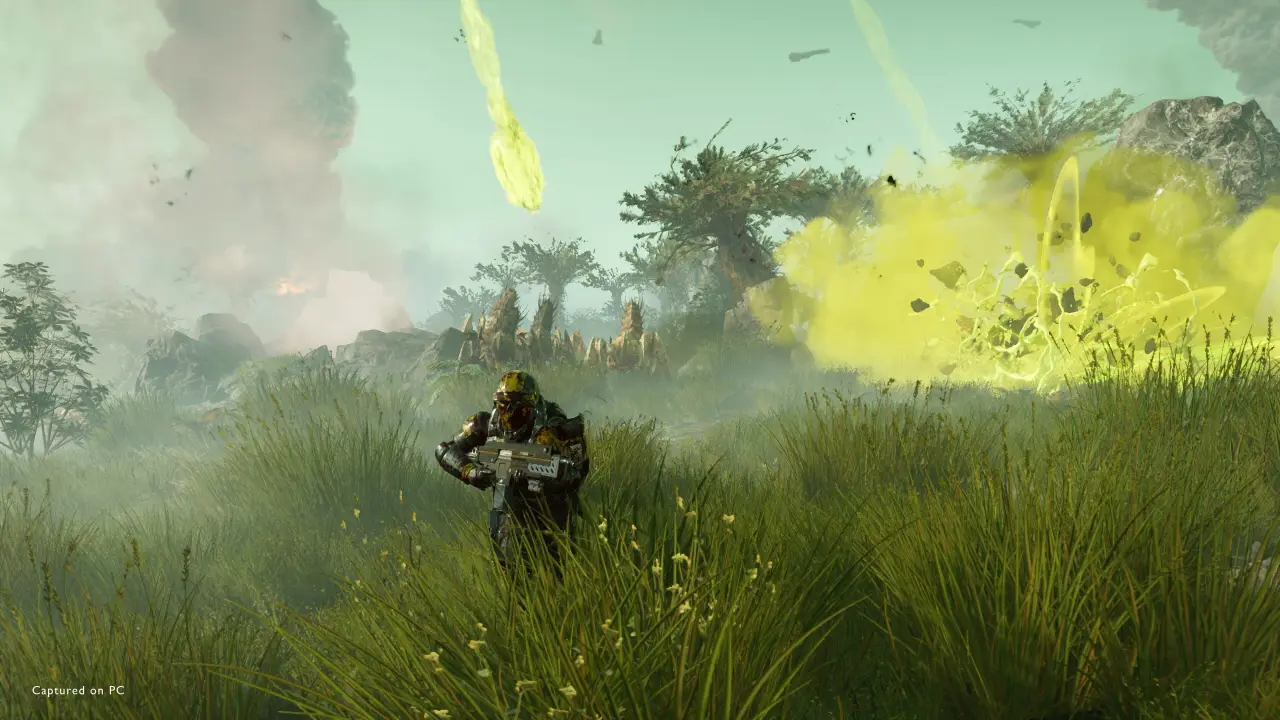
That serves the theme — the individual as a disposable part of the war machine — but it also strips out the single thing traditional storytelling leans on hardest: a face to worry about. You will not ache over anyone's fate, because there is nobody here to ache over. The story is macro, told through broadcasts and a shifting galaxy map rather than dialogue and staging. If you came wired to be hit by a character or a scene, this place will read as hollow. It bets everything on whether you will cast yourself into a ridiculous machine. Buy in and the whole war is your story. Refuse, and it is just funny slogans over a map that changes color. A ruthless trade-off, and the precise reason the story ceiling sits where it does — not for want of skill, but because it walked away from the sharpest blade in the drawer.
Audio | 8.5/10
Sound: 8.5/10The score that salutes the joke without ever cracking a smile
Wilbert Roget II wrote this music and the Nashville Scoring Orchestra recorded it live, and the result has been called a thunderously militaristic score whose main theme is heroic to the point of parody. That is exactly the point. It never hints that the war is a farce. It sings the farce as if it were holy, and the deadpan conviction is what makes the satire bite.

The main theme is literally titled "A Cup of Liber-Tea" — a pun on its face — yet it is arranged as a march that raises the hairs on your arm. The soundtrack album runs twelve tracks across roughly thirty-nine minutes, all swelling brass and hammering snare, and when that grandeur scores a shot of you accidentally launching a squadmate into orbit, the gap between sound and sight produces a comedy no other co-op shooter can manufacture.
The trick is that the music refuses to acknowledge the carnage it accompanies. A choir soars over a planet where your team has just been wiped to a man. The brass keeps its chin up while the body count climbs. That obstinate dignity is the joke, told in a language — the orchestral war anthem — that audiences have heard a thousand times and never quite like this. It is propaganda you can hum, and the better it sounds, the funnier the lie it is selling becomes.
There is a footnote that almost reads like the game's own biography. Roget nearly quit writing orchestral game music before this project, convinced players were tired of it and that scoring an orchestra was too expensive and too slow to be worth it. The score blew up alongside the game and became a turning point in his career — a small echo of a title that, by every reasonable measure, should not have worked and did anyway.
Sound design that pins you in the trench
Where the orchestra renders the absurdity as epic, the effects work does the dirty job of keeping you scared. Helldivers 2 obsesses over feedback. The throaty crack of a support weapon, the overdriven roar of an orbital beam splitting the sky, the dense skittering shriek of a Terminid swarm boiling up out of the dirt, the metal thud of a supply pod hammering into the ground — every sound is busy telling you precisely how dangerous this second is.

Stratagem inputs get the same ceremonial treatment. Punch in a directional code and a crisp confirmation chime answers back, a voice line calling the strike, turning a button sequence into something a field commander would do. That positive audio loop promotes the act of calling in fire from a mere command into a genuine spike in the action.
Set it beside Warhammer 40,000: Darktide, a contemporary co-op shooter that pulls the opposite lever — gloomy, oppressive, gothic, all in service of its grimdark dread. Helldivers 2 runs the other way, deploying a bright, swaggering, near-ridiculous heroism to throw the carnage into relief. Both make their music serve the theme; Helldivers 2 simply binds its audio to its satire more tightly. The only real blemish is that a few environmental cues can get buried when the battlefield load spikes — a small toll, easily forgiven.
Visuals | 6.5/10
Grafik: 6.5/10A dead engine, wrestled into a living warzone
You cannot talk about how Helldivers 2 looks without one faintly ridiculous fact. It runs on a discontinued engine. Autodesk Stingray — Bitsquid before it — was abandoned by its owner in 2018, a full six years before the game shipped in early 2024. Arrowhead's engineers essentially had to claw every feature out of that old skeleton with no official support to lean on.

The cost is laid out honestly. There is no ray tracing, support for upscalers like DLSS and FSR is thin, and texture and material fidelity are nowhere near next-gen benchmark territory. The studio's own boss later admitted on the record that they had underinvested in technology, hinting the next game would jump engines. Put it frame-for-frame next to a contemporary visual showcase like Darktide and the gap in material detail is plain to see. That is the root of why the graphics score lands mid-table.
But here is the interesting move. Arrowhead poured what little that old engine could give almost entirely into one thing — the immediacy of a chaotic battlefield. Sheets of smoke and fire, hundreds of enemies pouring onscreen at once, the searing blown-out white of an orbital beam coming down, destructible terrain and honest ballistic physics. Together they stack up a sense of pressure you rarely feel elsewhere. The picture is not pretty. It is frightening, and frightening is exactly what this game needs it to be.
There is a kind of engineering bravado in that choice. A studio handed a dead toolset could have hidden behind smaller arenas and thinner enemy counts, the way so many games quietly do. Arrowhead went the other direction and bet on scale — on a screen so busy that no single texture ever holds your eye long enough to be judged. It is closer to a magician's trick than a rendering pipeline: keep the hands moving, keep the explosions coming, and the audience never looks too closely at the seams. The wonder is not that it looks cutting-edge. It is that an engine left for dead in 2018 can still throw this much chaos at you without falling over more often than it does.
261 planets, where variety does the heavy lifting
The other half of the visual bet rides on sheer breadth. At launch the game offered as many as 261 deployable planets spanning 23 distinct biomes — ice fields, deserts, rainforests, volcanoes, poison-fog swamps — each with its own lighting, weather and visibility. And these settings are not wallpaper. They reach straight into your loadout, your movement, your tactics.

On a blizzard world the whiteout chokes your sightline and forces you to lean harder on radar and callouts. On a volcanic world the surface heat cooks your character continuously, pushing you to fight and seek cover in the same breath. A swamp world drowns you in fog that hides a charging Terminid until it is already on you; a desert world leaves you exposed under open sky where Automaton snipers have every angle. This "environment as mechanic" approach welds the visuals to the combat, and it cleverly papers over the modest fidelity of any single scene — you are shoved onto the next biome before you have a chance to tire of the last.
There is a strategic intelligence to the spread, too. Because biome dictates loadout, the galaxy map stops being a menu of skins and becomes a genuine planning surface: you read the weather before you read the mission. A fight you have run a hundred times reshapes itself the moment the lighting, the cover, and the sightlines change underfoot. That is variety doing real work, not decoration — and it is the cleverest answer a dead engine could have given to the problem of looking dated.
As for optimization, the old engine's limits cannot hide under heavy load. At launch, a crowded screen would stutter and the occasional crash was no rarity, and that dragged on early word of mouth. Patches steadied it over time, but the philosophy never wavered: win on atmosphere and variety, not on raw horsepower. It will not give you a screenshot to set as wallpaper. It will make you feel, in the thick of a fight, that you are genuinely standing on a hostile planet — and that is the version of "looks good" this game was always chasing.
Combat | 9.5/10
Gameplay: 9.5/10Stratagems: turning fighting-game inputs into field command
The bedrock of Helldivers 2 is a call-down system called the Stratagem, and the genius is in how you trigger it. You do not tap a menu and move on. You punch a directional sequence mid-combat, the way you would buffer a special move in a fighting game, to summon an orbital cannon, an Eagle airstrike, or an autonomous sentry from the sky. At launch the system already shipped more than fifty options across support gear, defensive kit, and entrenchment tools.

That input ritual looks like friction for friction's sake, and it is the soul of the thing. It forces you, at the most frantic possible moment — swarm in your face, teammate screaming — to spare a hand and a brain cell for a precise string of commands. A trembling thumb summons the wrong tool, or drops the right one on the wrong coordinates. It takes the supposedly easy joy of calling down fire from the heavens and turns it into a test of how cool your head stays. Land the orbital cannon clean and wipe a nest in one stroke, and the payoff is something a single button press could never manufacture.
Friendly fire: never off, always the point
If Stratagems are the skeleton, friendly fire is the soul, and it runs the entire game with no off switch in sight. Every source of damage in your hands lands on your squad just as readily as on the enemy: rounds from your support weapon, the sweep of a sentry, the blast of an airstrike, even a supply pod dropping from orbit can erase a friend on the spot. Stand inside a sentry's arc and your own hardware mows you down. Call an orbital strike and its margin of error may settle right on a teammate's head.

It is precisely this "anti-player" design that drags four-person co-op out of everyone-for-themselves and into you-must-communicate. You learn to track where your squad is standing, to call out before you toss a throwable, to confirm the line is clear before an airstrike. It sets a high bar for cooperation, and that same bar manufactures the black comedy nobody else has — the community line "spread democracy by shooting your teammate" nails the spirit of the whole thing. The toll is that solo play falls flat: strip away the chaos and chemistry of real squadmates and most of the fun deflates.
Arrowhead also layered in a pile of needless, perfect little touches. Reload before a mag is empty and your character literally hurls the half-spent magazine to the ground. Dive prone and you get a brief window of invulnerability and damage reduction. These details stack into a texture of combat you find nowhere else.
None of these flourishes change the numbers in any meaningful way. They are pure friction-as-flavor, the kind of thing a spreadsheet would cut in a heartbeat. And they are exactly why the moment-to-moment feel has a weight that slicker shooters, for all their polish, never quite reach.
Ten difficulties and three factions, the long-haul engine
There is no ending here, so the game leans on difficulty and enemy variety to hold you. The ladder runs ten tiers, each piling on, capped by Super Helldive — unlocked only once your character hits level 50. Difficulty is not just thicker enemy health. It dictates swarm density, the count of elite foes, and the resources you are handed. At the top rungs, one botched movement or one stray friendly-fire round can wipe the whole squad.

The factions are just as deliberate. The Terminids drown you in melee numbers and test your footwork and crowd clearing. The Automatons grind you down with ranged firepower and heavy armor, forcing you toward cover and armor-piercing answers. The Illuminate, added in a later update, demand a fresh tactical playbook of their own. Each faction asks for an entirely different loadout philosophy, which means no single approach ever wins across the board.
Hold it against Deep Rock Galactic, the other benchmark four-player PvE shooter. That game built its staying power on a loop alternating mining and combat, with four classes carving out clean roles. Helldivers 2 pushes the per-match unpredictability further still, through difficulty leaps, faction-specific tactics, and the constant threat of your own side. Both are standouts in the category. On the specific axis of "any given match might unravel from a single accident," Helldivers 2 takes it to the extreme.
Content | 8.5/10
Umfang: 8.5/10A game with no ending — the whole thing is the endgame
Before you weigh the content here, kill one reflexive expectation. There is no traditional campaign, and there is no ending waiting at the finish line. The entire game is one Galactic War that never closes, which makes it the endgame in its own right. The ruler you measure it by is not "hours to credits" but "how long it keeps pulling you back."

By the numbers, hitting the level-50 cap runs somewhere between 35 and 50 hours, and if you keep climbing the difficulty ladder to farm rewards and experience, your playtime sails past a hundred hours with ease. Most missions hand you a roughly 40-minute timer to clear objectives, gather samples, and sprint for the extraction pod. That "play a match, feed the result into the wider war" structure means it burns content nothing like a linear single-player game. You are not spending a plot. You are taking part in a movement with no terminus.
It is a framing that quietly rewires how you value the whole game. A linear game asks whether the campaign was worth the price; this one asks whether the front was worth defending this week, and next week, and the one after. The content is not a finite reservoir you drain. It is a stage that keeps being reset, repopulated, and handed back to you with the stakes redrawn.
Restraint and clutter, side by side
Holding that marathon up is Arrowhead's steady drip of new content. The Escalation of Freedom update is the poster child: it added that tenth extreme difficulty, seeded tougher enemies, and fixed a long-loathed griefing problem — players kicked from a session now spawn in as the new host carrying the whole team's loot, no longer robbed blind. The Illuminate faction returned in a later patch, fattening the enemy roster further. The studio is still shipping to a public roadmap to this day.
Paid content arrives as Warbonds, packed with new support gear, armor, and cosmetics. The crucial detail is that the Super Credits needed to unlock them can be scavenged off the mission map for free, no wallet required. Set against the layered paywalls of a contemporary live-service benchmark like Destiny 2, Helldivers 2 reads as remarkably restrained: put in the grind and nearly everything is yours for nothing.
And yet the currencies are also its single most contested feature. Requisition Slips, Medals, Samples, Super Credits — several systems run at once, each with its own source and purpose, and asking a newcomer to hold all of them in their head at launch is a genuine barrier. Progression management was, fairly, called fiddly. Using multiple currencies to map onto different growth tracks is a sound idea on paper; the execution is simply not kind to beginners — a real, concrete mark against the content experience.
Repetition versus novelty — what keeps you for a hundred hours
Honestly, the mission structure is repetitive at its core. Clear objectives, hold off a wave, escort, demolish, extract — it circles the same handful of verbs. Looked at as isolated matches, the novelty does start to fade after a few dozen hours. So what holds players for triple that? The answer lives in the layers it wraps around that repetition.
The first layer is the combination of difficulty and faction: the same "destroy the nest" objective is two utterly different experiences on a low-tier Terminid world versus a top-tier Automaton front — a relaxed sweep against a knife-edge brawl. The second is the why-you-fight that the live narrative supplies; when a server-wide Major Order comes down, the mission may be the same mission, but you re-enlist because the very survival of a front now hangs on it. The third is the steady cadence of fresh gear, fresh enemies, and fresh difficulty seeding new variables into a familiar loop. Stack those three and a fundamentally repetitive cycle becomes a long-haul movement people keep returning to. It does not win on the sheer quantity of content. It wins on how that content is organized — which is precisely the thing so many live-service games try and fail to imitate. They ship more maps, more modes, more loot, and still feel emptier, because they never gave the player a reason to care which match they are playing. Helldivers 2 gives you that reason every single week.





Kommentare 0
Wir freuen uns auf deine Meinung
Beteilige dich an der Diskussion und teile deine Bewertung des Spiels.
Noch keine Kommentare — teil uns deine Meinung zu diesem Test mit!