



















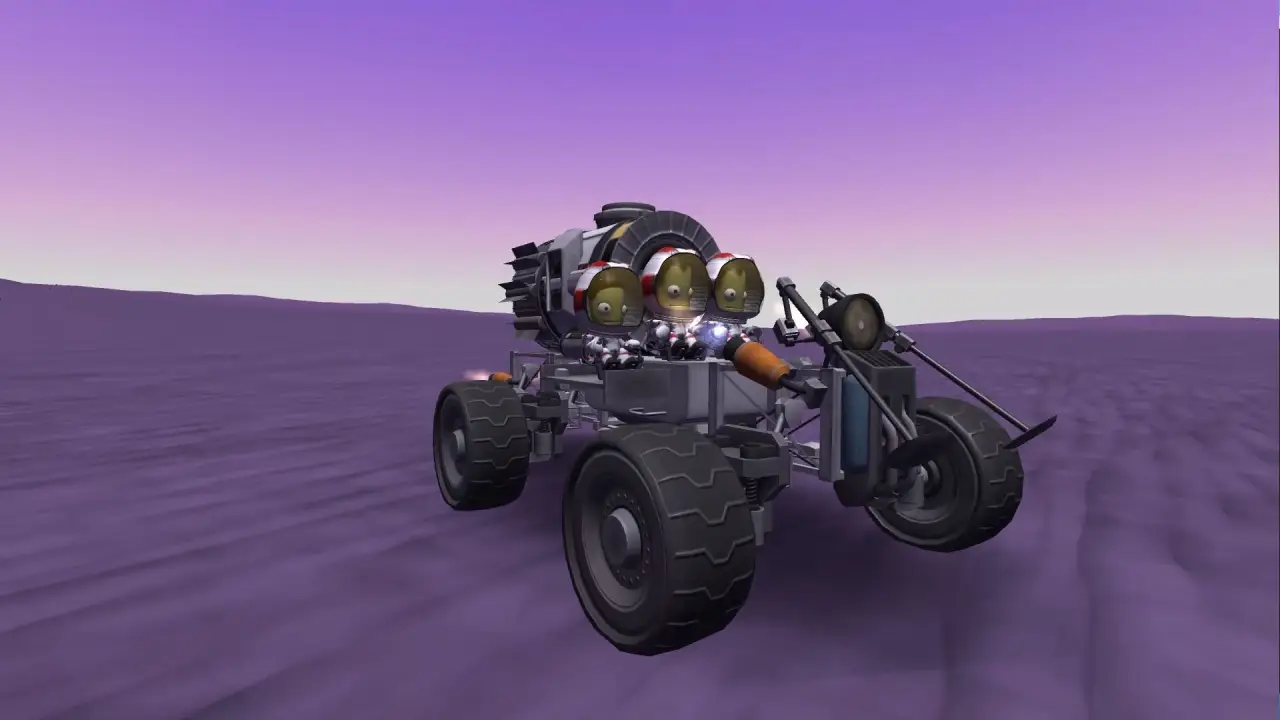


Opening
Most games teach you nothing you can take outside the launcher. Kerbal Space Program teaches you how to put a person into orbit and bring them home — and it does it while you swear at the screen and laugh at the same time.
That is the strange magic of Squad's 2015 sandbox. It hands you the genuinely hard engineering problem of spaceflight, refuses to fake any of it, then hands you a crew of grinning green goofballs to keep you company while your rockets detonate on the pad. Somewhere between the third explosion and the first clean orbit, you stop playing a game about space and start, quietly, learning the real thing.
It is not pretty. It has no story to speak of. The opening hours can be brutal enough to make you quit. But survive that cliff, fly your first capsule into a stable circular orbit and land it back on Kerbin in one piece, and you understand instantly why the press handed it a Metacritic 88 and an OpenCritic 81 'Strong', why 95 percent of its 115,000-plus Steam reviews are positive, and why NASA and SpaceX put their names behind a video game about little green men. This review is about where that magic holds, where it cracks, and why — a decade on, with the sequel in ruins — nobody has built a better mountain to climb.
Story | 6.5/10
Story: 6.5/10Come here for a plot and you will leave empty-handed. Kerbal Space Program has no main story, no script, no act breaks. And yet it is one of the most narratively memorable games I have played — because the story is the one you write yourself, one launch and one fireball at a time. That paradox is exactly why this dimension lands at 6.5, and exactly why it gets under your skin.
No screenplay — just a flight log you author yourself
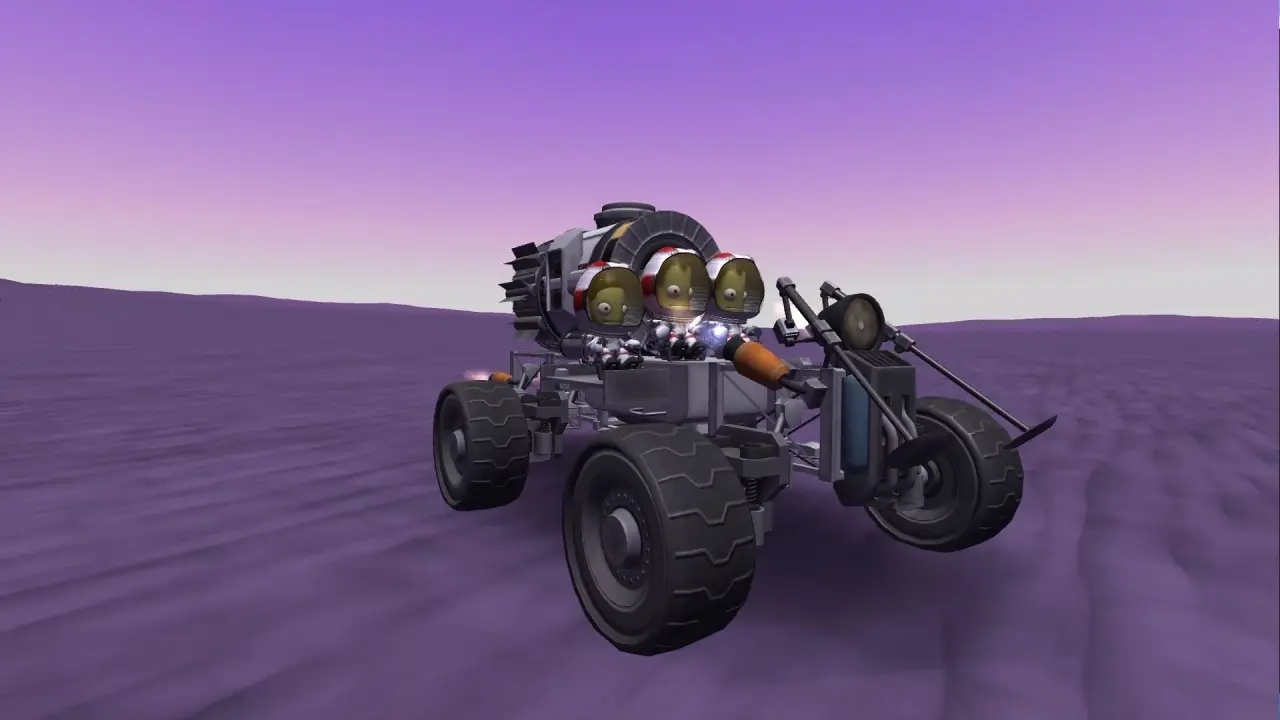
Boot the game and nothing introduces itself. No cutscene to set the stakes, no character cornering you with a quest. There is a space centre, a pile of parts, and a sky waiting to be conquered. The closest thing to a campaign is a string of firsts: first stable orbit, first rendezvous and docking, first Hohmann transfer out to the rust-red Duna, first landing on the Mun followed by a safe trip back to Kerbin.
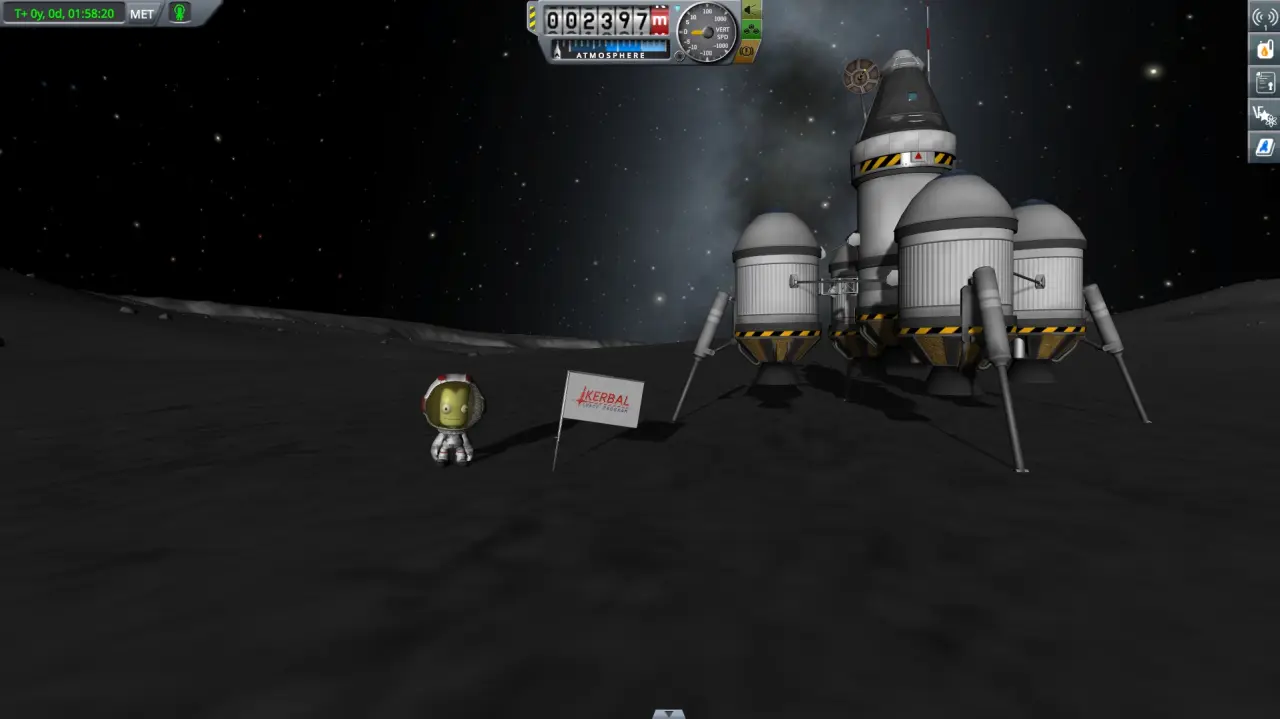
None of those milestones live in a quest log, and somehow they hit harder than any quest log ever could. When your lander touches down on the grey dust of the Mun and a green crewman clambers out to plant a flag, the satisfaction is the kind no writer can manufacture — because it was not told to you.
You solved it, you flew it, you nearly lost it, and you brought it home. Every flight is a chapter, and the author is you. The drama is real precisely because the failure was real: the run where you misjudged the fuel and stranded a crew in orbit is as much a part of your saga as the triumphant return, and you will remember it just as vividly years later.
The Kerbals: the only cast, and the best joke in the building

If this game has characters, it is these squat green Kerbals. They are round-faced and absurdly expressive, and when they sit atop a rocket you know is doomed, they grin anyway. That deadpan optimism is the emotional bedrock of the whole thing, and it is the smartest design choice Squad ever made.
Spaceflight, stripped to its bones, is a discipline about failure — the real thing was built by blowing up one rocket after another. Kerbal takes that cruel loop and wraps it in slapstick.
A booster fails to separate, a parachute deploys a heartbeat too late and pancakes your lander, the whole stack disassembles itself on the pad — and instead of throwing the controller you watch a Kerbal cartwheel through the air, still smiling, and you find yourself laughing your way back to the assembly building to try again. That black comedy is what turns a fundamentally nerdy engineering game into something anyone can fail at cheerfully, and it is the reason a punishing simulator somehow feels warm rather than hostile.
Making History: the closest thing to an actual script
The Mission Builder bundled with the Making History expansion is the one place where Kerbal flirts with authored narrative. It ships with a History Pack of pre-built missions modelled on real Space Race events, letting you re-fly Apollo- and Gemini-style journeys and replay humanity's own spaceflight chronicle on Kerbin's terms.
Better still, the editor lets you choreograph your own missions — set the objectives, chain the beats, then hand the result to someone else to play. So the community filled with player-authored 'scripts': rescue a stranded crew from a decaying orbit, reach the Mun on a strict fuel budget, sweat through a white-knuckle re-entry. Kerbal's storytelling stretches from 'the tale I lived' into 'the tales we trade'. The base game may not contain a single line of dialogue, yet this toolkit is enough to make real spaceflight history into raw material players can rewrite at will.
Step back to reality and the cruellest story of all writes itself: the sequel, Kerbal Space Program 2, limped out of early access, lost its studio, went months without a meaningful update, and got review-bombed into the dirt — while the 2015 original sits unbothered, still the reference point any conversation about space sims has to acknowledge. That old-soldier subplot, quietly playing out in the real world, lingers longer than any fiction the game itself could ever have scripted.
Audio | 7.5/10
Sound: 7.5/10Kerbal's soundtrack will never land on a year-end playlist, and that is fine — it was never trying to. The audio does one job, and it does it with quiet precision: silence where you need loneliness, signal where you need information, mumbles where you need a laugh. A 7.5 is what that restraint earns.
Kevin MacLeod's score: loneliness scored as an echo

The music comes from Kevin MacLeod. Inside the space centre it is light and slightly goofy, in step with the green crew's clownishness. But the moment your craft claws free of the atmosphere and slides into a silent orbit, the score turns spare, distant and faintly mournful. That feeling of hanging alone in the deep of the Kerbol system, a planet turning slowly beneath your feet and nothing but black on every side, is carried almost entirely by those few sad notes.
This is the cleverness of it. The music never elbows its way forward; it arrives exactly when you need an emotion and not a moment before. Send a probe skimming past the green storms of the gas giant Jool, or drift down under Duna's rust-coloured dusk, and that far-off melody makes you feel you are exploring rather than operating a pile of parts. The library is small, but it is parcelled out across launch tension, orbital calm and deep-space emptiness using variations of the same few themes rather than a wall of tracks — a less-is-more touch that suits the cold, documentary mood of the subject and keeps a thin score from ever feeling thin.
Sound as data: ignition, separation and the comedy of the boom
In Kerbal, sound is not just atmosphere — it is a readout. The roar of ignition, the thud of stage separation, the muffled snap of a parachute, the heartbreaking crunch of a craft tearing itself apart: each one maps to a specific flight event. Veterans stop watching the gauges and start flying by ear, knowing from the audio alone whether that stage fired, whether separation took, whether it is time to pop the chutes.
And that signature explosion is the punchline of the whole comedy, rendered in sound. When your rocket comes apart on the pad there is no mournful swell of strings — just a few exaggerated bangs and the indignant mumble of a Kerbal being flung clear. It shaves the sting clean off failure and leaves you happy to rebuild. Those garbled Kerbal voices work the same trick: no real words, pure charm, the whole green cast made lovable in a single syllable. Set beside the obsessively researched cockpit audio of Microsoft Flight Simulator, Kerbal's sound is plainly more cartoon, more lo-fi — and that is the point. It is not chasing realism; it is serving a silly little world where green men play at rocketry. Within that brief it is close to fully realised, with only the subject matter itself holding its ceiling down rather than any failure of craft.
Visuals | 7.5/10
Grafik: 7.5/10Nobody bought Kerbal Space Program for the screenshots. Its plain cartoon look was unremarkable in 2015 and frankly crude today. But it spends its visual effort exactly where it matters — planet recognisability, Kerbal faces, the silhouette of a rocket against the sun — and those things hold. A 7.5 is an honest number for it.
Plain cartoon, built on Unity: legible, not lavish

The game runs on Unity and wears a plain, cartoonish realism. Metal sheen, planetary texture, the gradient of an atmosphere — by the standards of its own era, never mind now, none of it is fine. Come for fidelity and Kerbal will let you down flat.
Here is the twist, though: that plainness is in perfect step with the game's soul. Kerbal was never about looking real, it was about computing real. The horsepower and the polish all went into the physics engine rather than into textures and ray tracing, and a modest look means a modest PC can still fly a contraption of hundreds of parts without choking — a trade far more valuable to a build-anything sandbox than a prettier sky. Plainness also ages slowly. Kerbal never chased the visual fads that date a game in two or three years, so it looks far less old than its peers; that clean, almost blueprint-like aesthetic still reads fine a decade on, and for a sandbox built to swallow hundreds of hours, refusing to follow fashion turns out to be a hidden strength.
The Kerbol system: a dozen worlds you do not forget
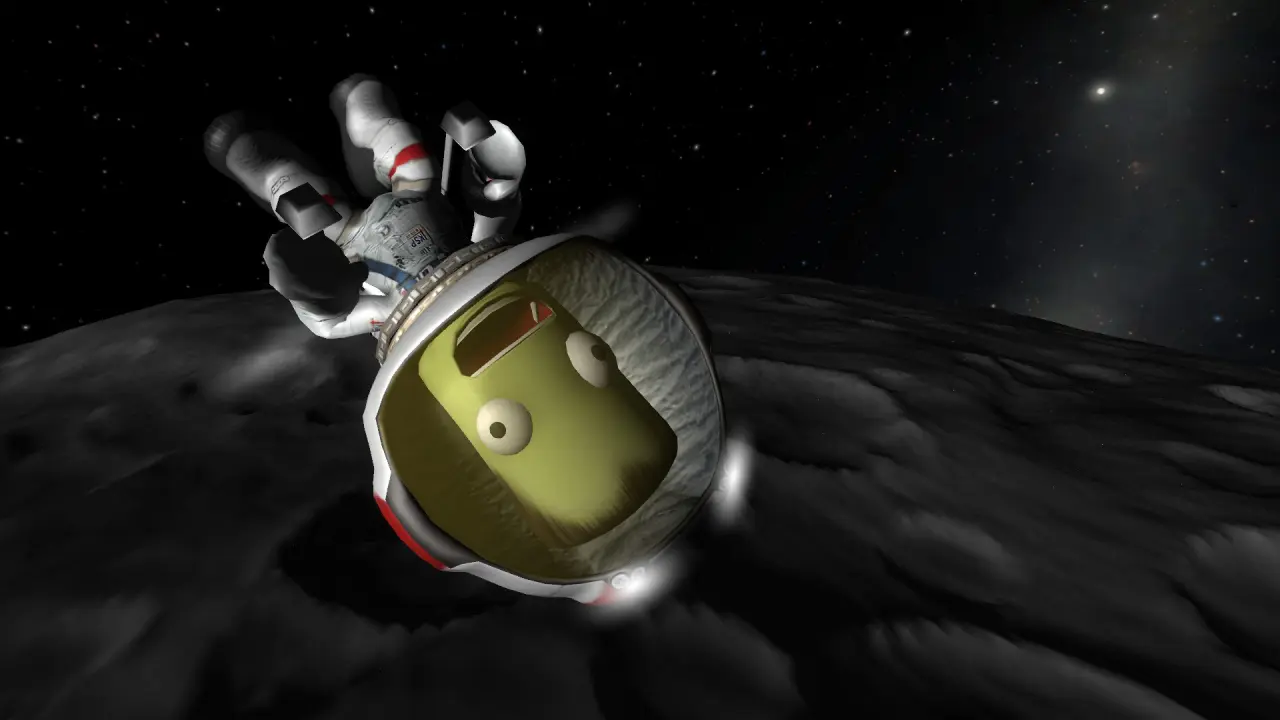
What actually carries the visual memory is the Kerbol system. From the close, grey desolation of the Mun, to the pocked and powdery Minmus, to the rust-red skies and thin air of Mars-like Duna, to high-gravity, thick-aired Eve, out to that distant olive gas giant Jool and its cluster of moons — a dozen-plus bodies, each with a sharp visual personality.
The first time your craft sweeps over Jool's churning green cloud deck, or you crack a parachute under Duna's orange twilight, the jolt of arriving somewhere new owes nothing to fidelity and everything to scene design and silhouette. The Kerbals' wildly expressive faces, meanwhile, are the strongest piece of art direction in the game — the way they rock in the cockpit with the craft's attitude, eyes flicking between terror and glee, has become this IP's calling card. Better still is the honesty of scale: stand on the Mun and Kerbin hangs overhead as a blue-white disc in a black sky; skim a planet in orbit and you can pick out the thin blue rind of atmosphere at the limb. No effects, just composition and scale, and it lands every time. Kerbal proves the space shots you remember come not from texture resolution but from the smallness and awe of being dropped into something vast.
Console ports drag, mods drag it back up
The clearest visual weakness sits on console. PC scores an 88, the console versions only 75 to 77, and the slump in framerate and stability is part of that gap — load up enough parts on screen and the consoles strain, while the camera fights you on a gamepad. Console players simply never get the smooth build-and-fly feel their PC counterparts take for granted.
On PC, by contrast, a thriving scene of visual mods yanks the ceiling skyward. There is Environmental Visual Enhancements layering clouds and atmospheric scattering onto the sky, Realism Overhaul swapping the whole Kerbol system for true-to-life Solar System scale and textures, and high-res texture packs of every flavour. Bolt a few on and that plain little Kerbin transforms into a real world of rolling cloud and sharp coastlines. This 'floor from the base, ceiling from the mods' pattern runs through nearly everything Kerbal does, and visuals are merely its most visible case: build the foundation solid, leave the interfaces open, and hand the rest to the community. The same game is a plain cartoon sandbox to a newcomer and a photoreal planet of clouds, auroras and real starlight to a veteran. The base look is the floor; the mods are the ceiling — one more reason PC has always been the version to recommend.
Combat | 9.5/10
Gameplay: 9.5/10This is the soul of the thing, and the entire reason it scores 9.5. Kerbal takes the hardest part of real aerospace work — building, orbits, delta-v budgeting — and turns it into something anyone can pick up and nobody can exhaust. From 2015 to right now, no game has truly cloned it.
The VAB: Lego where every brick is life or death
It all starts in the Vehicle Assembly Building and the Spaceplane Hangar. Here you stack fuel tanks, engines, fairings, decouplers and parachutes into a rocket the way a child stacks Lego. What you build is what you fly — no abstraction. Where the centre of mass sits, what your thrust-to-weight comes out at, how many stages you split it into, how much fuel each stage carries: every call is yours, and the game makes none of the trade-offs for you.
The brilliance is that it converts abstract engineering numbers into a tactile act of stacking. Want it to fly higher? Add fuel. But more fuel means more mass, which means more thrust, which means more engines, more structure, more stages — every decision yanks on all the others.
A working rocket is the survivor of a hundred quiet arguments between 'too heavy to leave the ground' and 'not enough fuel to get home'. That thrill of solving it with your own hands is something no scripted launch sequence can ever hand you, and it is the hook that keeps you tinkering long after the sensible thing would be to stop.
Real orbital physics: land, dock and transfer, all by your own maths

Kerbal's irreplaceable foundation is its orbital model, built on Newtonian mechanics and the patched-conic approximation. There is no 'press a key to orbit' shortcut here. To reach a stable orbit you have to time your gravity turn on the way up, cut the engine at altitude and coast to apoapsis, then burn precisely to circularise. Slip on any step and the craft either falls back and burns up or flings itself out of the system for good.
The real high-level content hides in the delta-v budget, an honest optimisation problem. Delta-v is the change in velocity a craft can still spend — read it as your total allowance for 'how much more you can mess about'. To land on the Mun and return, you work backwards through every leg — ascent, transfer, insertion, descent, lift-off, return — totting up the delta-v each demands, then design the rocket's staging and fuel loads to match. Rendezvous pushes that precision to the edge: you have to shave the relative speed of two craft down to fractions of a metre per second before they clip together. What the player learns is the genuine article — no different in substance from what a working aerospace engineer does.
Three modes and a wall of a learning curve
The game hands different players different doors via three modes. Sandbox gives you unlimited parts and funds to indulge the urge to build; Science gates progress behind running experiments and gathering data to unlock the tech tree, teaching gently and incrementally; Career layers on funds, reputation and contracts, dropping you into the role of an agency director on a budget where every launch has to be costed, contracted and earned.
But let me be blunt: the on-ramp is genuinely steep. Tutorials were missing for years before the full release, and a newcomer can easily go hours without managing a single stable orbit, watching rocket after rocket explode with no idea why. That is the single biggest reason it pushes people away, and why a game this acclaimed has never been a mass-market title. Mercifully, community mods like KER, which shows delta-v and thrust-to-weight live, and MechJeb, which offers autopilot for ascents and landings, can lower that hardcore wall to something a beginner can slowly climb.
Hold it against the competition and its strength comes into focus. Among physics-build sandboxes, Space Engineers leans voxel engineering, Besiege leans medieval siege contraptions, and SimpleRockets 2 is the lightweight imitator. Each has its own pleasures, but on the depth and completeness of turning real orbital mechanics into playable content, none of them can meet Kerbal head-on. That, in a sentence, is why it is untouchable here.
Content | 9.0/10
Umfang: 9/10On sheer volume, Kerbal is one of those games you will not finish in a lifetime. The base game's three modes and dozen worlds already run to hundreds of hours; pile on two official expansions and thousands of community mods and the content edges toward limitless. The 9.0 is for that near-bottomless depth.
Hundreds of base-game hours, and a whole system to conquer
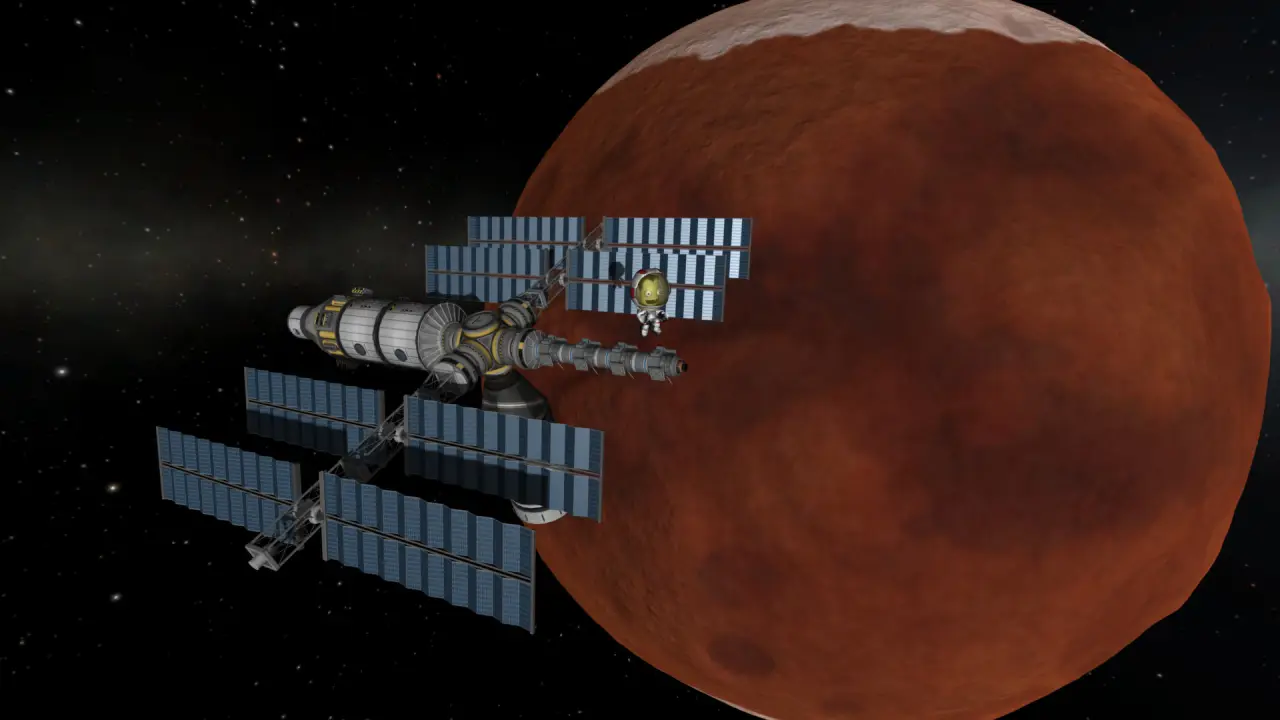
The base game alone will hold you a very long time. HowLongToBeat puts the 'main' run — read it as walking the core goals once — at a median of roughly 60 hours, with full completion, landing on every body, climbing well past 200. Those numbers undersell it, though, because Kerbal has no real 'finish', only 'I want to build a better craft and fly it somewhere further'.
The three modes each supply a different kind of long-haul pull. Career squeezes you into careful sums under the leash of funds and reputation; Science walks you up the tech tree one experiment at a time; Sandbox cuts you loose entirely to attempt the things you know are impossible but want to try anyway. Stacked together, those threads can drain a whole gaming season on Kerbin's surface. And those hours rarely curdle into repetition, because the content is not laid down as pre-built levels — it grows out of the goals you keep setting yourself. Single-stage-to-orbit spaceplane this time, a permanent station next, a no-parachute hard landing after that; each new goal is a fresh round of design, maths and trial and error, so the content stays alive rather than emptying out the moment a questline ends.
The Kerbol system: a dozen worlds, each a new exam
What truly inflates the volume is the Kerbol system. From the close-by Mun and Minmus, to Mars-like Duna that demands a precise launch window, to high-gravity, thick-atmosphere Eve, out to the far gas giant Jool and its moons — a dozen-plus landable or probeable bodies, and every one of them a fresh engineering exam.
The delta-v to reach each world, the atmosphere and gravity you fight on the way down, the difficulty of lifting off and coming home — all of it differs. Conquering the Mun does not mean you will stroll onto Eve, because Eve's murderous gravity and thick air make the return a nightmare. That 'every planet is a new dungeon' design turns exploration itself into a bottomless content well, each success paired with a real engineering gain. Push further and the system rewards multi-target voyages: veterans love plotting a single launch that visits several bodies, stealing speed from gravity assists to bank precious delta-v and string a route across half the system. The planning rivals a genuine interplanetary mission in complexity and makes the combinations of those dozen worlds practically endless — the single question of 'least fuel, most destinations' is good for a hundred hours on its own.
Two expansions and thousands of mods: ceiling removed
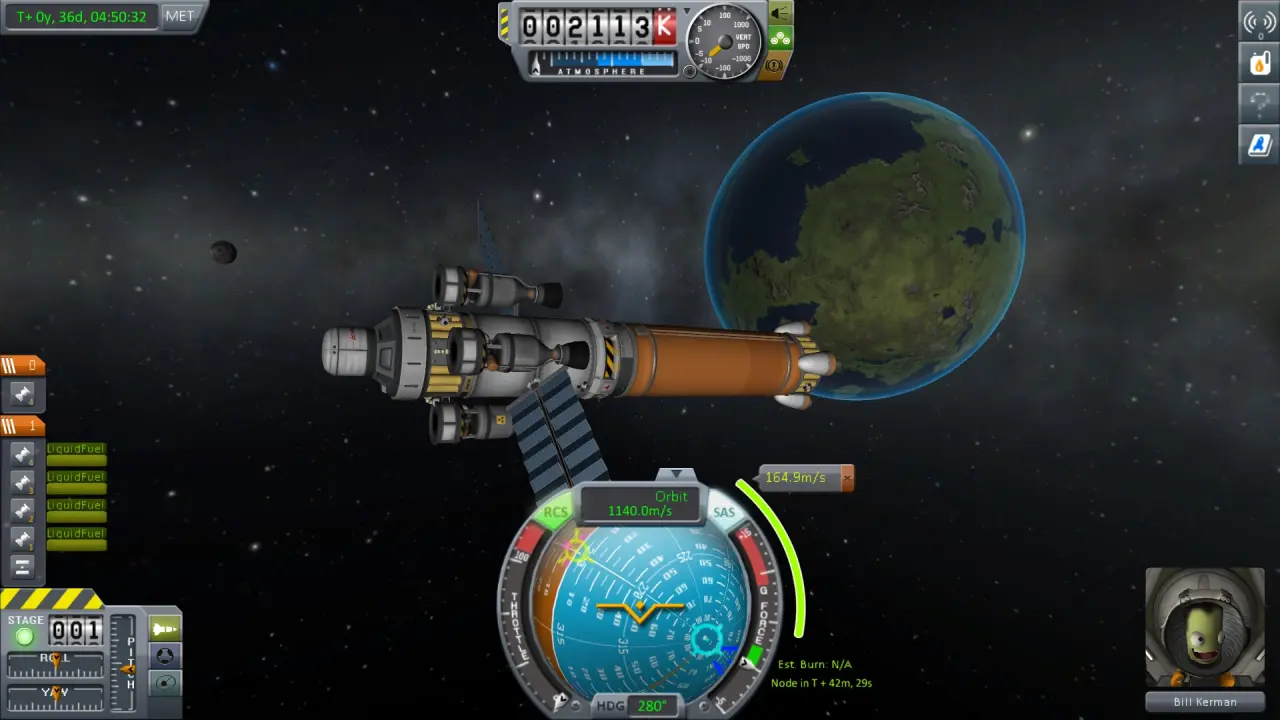
The official expansions are the advanced side dishes for veterans. Making History adds 69 new parts and a Mission Builder, letting you re-create historical flights and author and share your own missions; Breaking Ground adds 52 new parts, bringing hinges, pistons and servos that let you build folding solar panels, robotic arms and retractable landing gear, while finally giving surface science a real point — the rover, once little more than set dressing, at last has a job.
But the thing that genuinely lifts the ceiling to infinity is the mods. SpaceDock hosts over 3,000 of them, spanning visual enhancement, real-system replacement and engineering aids across the whole spectrum. CKAN, the community-maintained mod manager, collapses the old misery of manual unzipping and dependency-juggling into a tick-box one-click install, and it is the key piece of infrastructure that has kept the Kerbal mod scene alive for a decade.
Worth flagging on cadence: after 1.12 'On Final Approach', official updates effectively wound down. That does nothing to dent the completeness, though — the base game was polished rock-solid long ago, and 3DM's review went as far as to say the expansions add little to the game proper, a reminder to newcomers that the base alone carries everything. For anyone on a budget, mastering the base game's building and orbital manoeuvres matters far more than rushing to fill in the DLC.





Kommentare 0
Wir freuen uns auf deine Meinung
Beteilige dich an der Diskussion und teile deine Bewertung des Spiels.
Noch keine Kommentare — teil uns deine Meinung zu diesem Test mit!