
























Opening
Before judging Manor Lords, one thing has to be put on the table: it is an Early Access game. It was nowhere near finished when it launched in April 2024, and it still has no date for a 1.0 release.
Hold that thought, and the scoring gap between critics and players makes sense. On the critic side, 13 OpenCritic reviews give it a score of around 71, placing it in the middling "Fair" tier, with only a little over 40% recommending it. On the player side, more than 73,000 Steam reviews give it an 84% positive rating — "Very Positive." Critics are cautious not because it is bad, but because it is incomplete; judge something half-built by finished-game standards, and the score will stay low. Players love it because they know they are buying into a promising project, impressed by what is already there and willing to be patient about what is not.
And the dazzling part was made almost entirely by one Polish developer. So the rest of this review is less about giving it a grade than about answering a more practical question: is it worth buying now, and does it have a real shot at becoming what it promises to be?
Story | 5.0/10
Story: 5/10No plot, but a whole era
Manor Lords is a city-building strategy game, and it has no story in the traditional sense — no protagonist, no cutscenes, no plot thread pulling you from start to finish. That is not unusual; most city-builders are the same. But Manor Lords draws its sense of immersion from something weightier than plot: history.
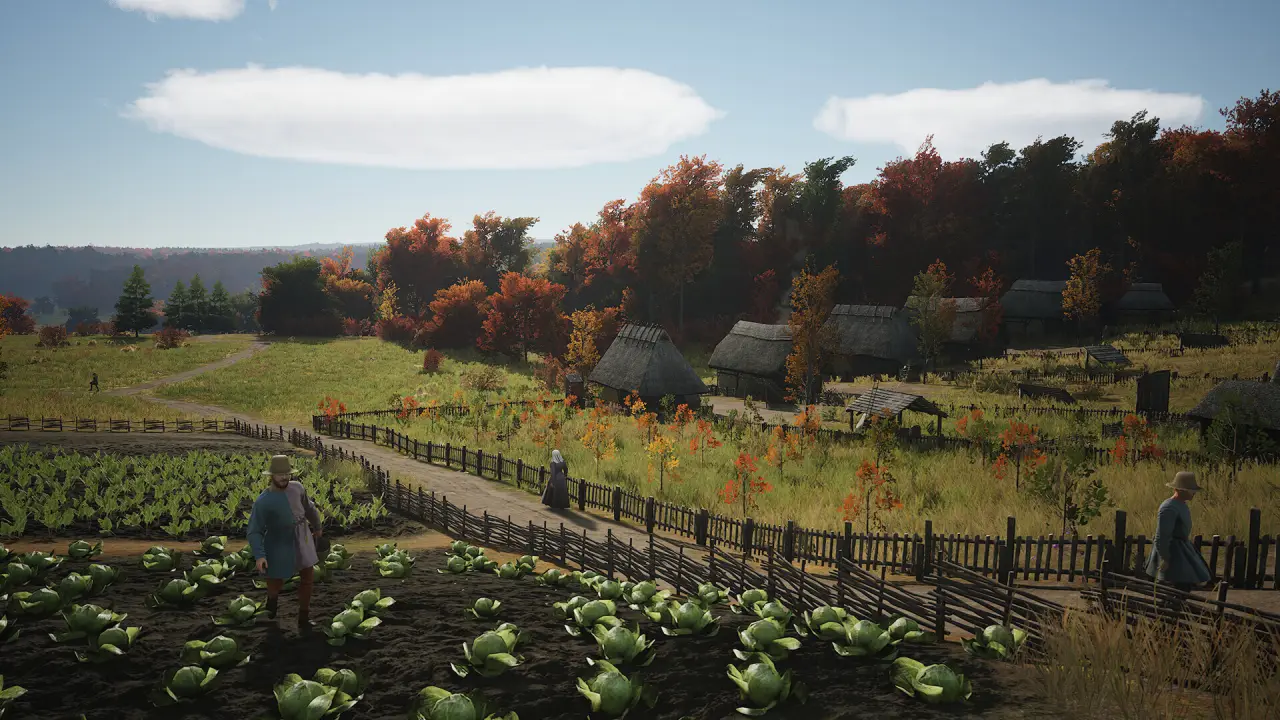
It is set specifically in late-14th-century Franconia, and from building styles and street layouts to clothing, tools, and methods of production, it tries to reflect the reality of the period. You play not an abstract "mayor" but a genuine medieval lord, putting down roots on land that feels believable. That near-obsessive historical recreation is a kind of storytelling in itself: it does not tell a specific tale, but immerses you in a whole period and lets you feel, between sowing, harvest, and stocking up for winter, how a medieval manor grows from nothing into a working settlement. In some ways, inhabiting an era has more lasting appeal than following a plot: a plot ends, but the feel of a time can be returned to again and again, a little differently each run. You are not reading a story someone wrote; you are living through a slice of carefully restored history.
A lord's rise is the game's quiet through-line
If Manor Lords has anything close to a main thread, it is your arc as a lord. The game sketches an ambitious blueprint: start with a village of a few households, expand it step by step, collect taxes, raise an army, push into neighboring lands, and eventually become a true regional power.

That sense of progression takes the place of the narrative drive you get in other games. Every step forward — surviving your first winter, seeing your taxes finally turn positive, pushing your border outward for the first time — feels like turning a page in a story with no dialogue. Its narrative is not written in text boxes; it is written in the changes you make to the land with your own hands. The story of your reign is whatever you make of it: the lean year you barely survived, the trade route that finally turned a profit, the rival you out-built rather than outfought. None of it is scripted, and that is the point — it is a story you author by playing, not one you watch unfold, and for the right kind of player that authorship is more memorable than any cutscene could be.
Why the story score is what it is
Of course, with the game still in Early Access, this lordship system is only a framework: conquest and diplomacy are thin, the give-and-take between territories is underbaked, and many mechanics still feel like a skeleton awaiting flesh. So judged on story alone, its score will not be high — city-builders rarely stand out for narrative, and Manor Lords has not even finished the lordship system that might have provided one.
But you can clearly see what it wants to be, and that period immersion alone already has more flavor than many of its peers. Compared with a mature historical builder like Anno 1800, Manor Lords' environmental storytelling may be thinner, but its focused, sincere recreation of a single era gives it a character all its own. Players looking for a game with a clear statement may find Manor Lords too quiet; but for those willing to bring their own imagination to it, this lovingly restored medieval landscape is a moving enough backdrop on its own, inviting you to fill in each chapter through the act of building. Judge it as a story-driven game and it will disappoint; judge it as a stage set with extraordinary care, on which you write your own modest medieval saga, and it quietly delivers. The low score here is not a knock on its craft — it simply reflects a game that chose, like others in its genre, to express itself through systems and setting rather than plot. Once you accept that, the lack of a traditional narrative stops feeling like a missing piece and starts to feel like a deliberate, even generous, restraint that trusts you to supply the meaning yourself.
Audio | 7.5/10
Sound: 7.5/10The sound of a living medieval village
Manor Lords' score takes the classic ambient route — gentle, restrained, touched with a little medieval austerity. It does not grab the spotlight; it simply casts a warm undertone over your settlement. That suits the game's slow management rhythm, where most of your time goes to planning, waiting, and weighing the next move. The music's job is not to heighten your emotions but to let you sink quietly into your town.

What really makes its audio shine, though, is the environmental sound. Pull the camera down to ground level and you hear more than music: firewood crackling, livestock calling in the fields, villagers rustling about their work. Taken together, these small sounds make the village feel genuinely alive, and alongside the visuals they sell the sense of a flesh-and-blood medieval settlement. None of it is loud or showy, but it accumulates: spend an hour with the camera low and you stop hearing it as "game audio" and start hearing it as a place. That is exactly the effect a slow, contemplative builder needs, and it is the kind of thing that is easy to overlook in a trailer but impossible to miss once you are living in it.
Sound that tracks your fortunes
Those sounds are not random background noise — they are tied to the state of your settlement. The more prosperous the village, the livelier it sounds; hit famine or a hard winter and that liveliness thins out. You can almost tell from the village's sound alone whether it is thriving or struggling. That care in making sound part of the feedback loop is a meaningful part of the game's immersion.
The audio also follows the seasons. In spring and summer, the village rings with the busy sounds of work; come winter, everything turns sparse, quiet, and cold. Paired with snow-covered roofs and howling wind, the audio helps sell that "winter is coming, stock the granary" urgency. It is a small touch with an outsized effect: you start to read the health of your settlement not just from menus and numbers but from the soundscape around it, the way you might gauge a real village by how busy its streets sound. Few city-builders bother to make their audio respond to the simulation at all, and the fact that Manor Lords does — even in Early Access — says a lot about how seriously it takes immersion over spectacle.
A fitting, if unfinished, soundscape
Put sight and sound together and Manor Lords has clearly done real work on atmosphere. It does not strong-arm your feelings with a grand symphony or a soaring melody; it uses plain, period-appropriate sound design to keep you grounded in this world. For a city-builder built on immersive management, that restrained, fitting audiovisual mood is exactly the right call.
It is worth adding that, as a game still in Early Access, its audio has room to grow — more event sounds and more layered musical variation are both areas it can refine later. But as it stands, its sight and sound are already enough to carry that one-of-a-kind medieval atmosphere, and on that point there is no doubt. The audio will likely never be the headline reason anyone buys the game, and it does not try to be; its ambition is to blend into the world so completely that you only notice it when it stops. By that quiet standard, it succeeds, and it does its part to make a half-finished game feel like a whole, lived-in place — which is no small feat for a solo project still finding its final shape.
Visuals | 9.0/10
Grafik: 9/10A village grown out of history
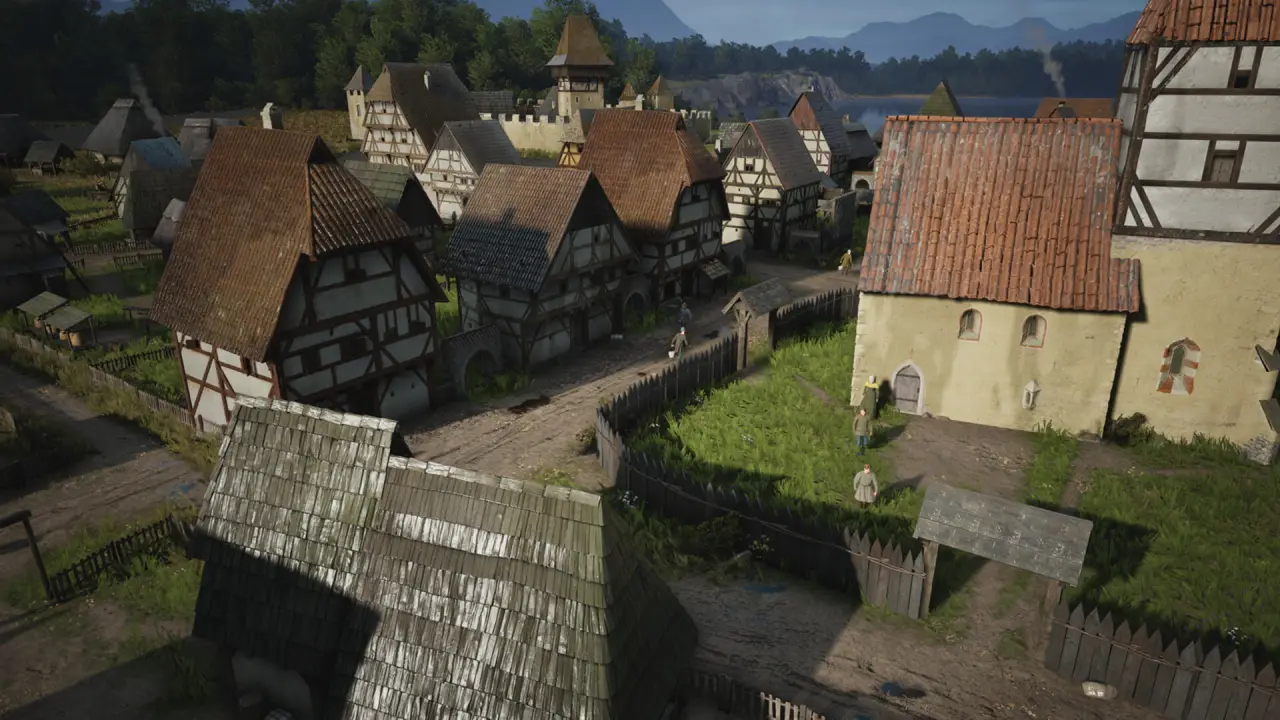
If you had to pick the one place Manor Lords dazzles even in Early Access, it is the visuals. Its recreation of late-14th-century Franconia is painstakingly detailed: the texture of thatched roofs, the muddy cart-rutted lanes, houses shaped by the lay of the land, and the tools and livestock in the fields all feel true to the period.

What stands out most is how alive it feels. Drop the camera to ground level and you see villagers going about their work — one reaping in a field, one hammering in a workshop, one driving animals down a muddy path. The town is not a heap of static models but a place where people genuinely live. That "living medieval village" sense of immersion is something many other city-builders cannot match, and it is one of Manor Lords' clearest and most immediate strengths. Better still, the detail is not decorative filler — it is tied to the systems: the figure reaping is there because you actually assigned labor to that plot; the smoking workshop is smoking because it is genuinely producing. Every bit of bustle on screen is tied to an active system, which makes the visuals feel believable rather than merely pretty.
Four seasons of quiet spectacle
The art also has an underrated strength: its seasons. Spring green, summer lushness, autumn gold, then winter's snowed roofs and cold light — each season carries its own palette and mood, and light shifts with season and weather so the same town wears a completely different face at different times of year.

For many players, Manor Lords has long since become more than just a strategy game; it feels closer to a medieval landscape painting that you can tend and admire at leisure. You will stop what you are doing just to swing the camera to the village at dusk, watch the smoke curl up, watch villagers head home after a day's work. That urge to "look a little longer" is genuinely rare in a city-builder, where most games settle for functional, readable visuals, while Manor Lords makes the view itself worth pausing for. It understands that a medieval town is not just a backdrop for spreadsheets but a thing of beauty in its own right, and it rewards you for simply looking. That generosity of presentation is part of why the game lodges in people's memories so firmly: you do not just remember managing it, you remember how it looked at golden hour, smoke rising over thatched roofs as the season turned.
One person, this much craft
And what makes all of it almost unbelievable is the scale of its development. This level of art and historical research, comparable to big-studio work, came mainly from a single independent developer. Whatever reservations you hold about how finished the gameplay is, on visuals alone Manor Lords stands firm, and it earns the highest graphics score in this review.
That level of polish, achieved by one person, says a lot about the project's priorities: the developer put limited time and energy first into the part players respond to most strongly. Perhaps because the first impression is so strong, players are more willing to overlook what is still missing later on — the art earns the game not just admiration, but time and patience. In an age when it is harder and harder for an indie game to get noticed, that visual strength is the single biggest reason it stood out from the crowd. Screenshots and short clips did much of its marketing for it, because a single frame sells the fantasy instantly. For a game that still has so much left to build, that kind of immediate, photographic appeal is worth more than any feature list — it is what turned two million wishlists into three million sales before the deeper systems were even finished, and it remains the first thing that pulls in new players and the thing they remember longest after they put it down. Few games built by hundreds of people look this distinctive; the fact that one person achieved it, and sustained it across years of updates, is frankly remarkable, and it sets a quietly intimidating bar for the rest of the indie field.
Combat | 8.0/10
Gameplay: 8/10Organic growth and a breathing economy
Manor Lords' most striking and least replaceable idea is its "burgage plot" building system. Unlike the way most city-builders drop prefab structures onto a grid, here the village grows organically along roads you draw by hand: you plan the road network first, then mark out plots of varying size along it, and houses generate to fit the shape of each plot.

The result is that every town has a unique layout, winding with the terrain and looking like a settlement that genuinely grew over time in the Middle Ages rather than a set of blocks arranged on a board. Better still, a plot is not just a house — the garden and workshop behind each one serve a real purpose, and house upgrades are tied to those spaces. So every road you draw and every plot you mark shapes the town's look and drives its economy. That blend of looking good and meaning something is the game's core appeal, and it grabs you from the first session.
And Manor Lords does not simulate a static city so much as a living settlement shaped by the seasons. It has a full season-and-weather system: you sow and reap through the year, and before winter you must stock enough food and firewood or the cold will throw your village into crisis. The changing seasons drive every production and management decision, so building is no longer just a case of "more is better" but a resource gamble that demands foresight. Underpinning that economy is household-level labor assignment: your villagers are not abstract units that magically produce resources, but families assigned one by one to logging, quarrying, farming, or workshop work, with the number of families limited by available housing and food. "Never enough hands" becomes a constant source of tension throughout the game, forcing you to weigh expanding production against keeping everyone fed. From raw material to finished good, from resident needs to tax collection, every link is chained to the next — and that layered interplay, from micro labor to macro economy, is what makes the early game so absorbing. It is the kind of system that rewards forethought and punishes complacency in equal measure: a single poorly planned winter can unravel hours of progress, and a well-judged supply line can carry your village through a famine that would have broken it. That tension — always one bad season from disaster, always one good decision from prosperity — is the engine that keeps you leaning forward through those opening hours, and it is comfortably the most complete, most satisfying part of the whole game.
Combat — the part that most needs work
But Manor Lords has one clear weak spot: combat. The marketing leads with "large-scale tactical battles," yet in practice the usual verdict is that while the battles look epic and have plenty of atmosphere, the tactical depth is still far from finished. Unit command, formation use, and terrain exploitation are all fairly shallow, and the more strategic mechanics — cavalry and sieges — are still only "planned" on the 1.0 roadmap rather than actually in the game.

Right now, combat feels like a usable but unremarkable work in progress — enough to fight a few battles and keep things moving, but nowhere near deep enough to support the kind of hardcore war system strategy fans would want to dig into. The game seems aware of this, and offers multiple modes to accommodate different players: "Rise to Prosperity" is a combat-free build-only mode, letting players who just want to build in peace skip fighting entirely. That is considerate, but it also quietly admits the truth: the combat is not ready yet. Set against the mature tactical battles of Total War: Medieval II, the gap is obvious. Luckily, its foundation is in city-building, and city-building is exactly the part it does best. Seen another way, the rough state of combat is a reminder of how to approach the game: its ambition is huge — to bring building, economy, seasons, and war together — and it has clearly chosen to polish the city-building core first and flesh out the rest over time. That is a reasonable Early Access trade, as long as you understand that, for now, the war half is still just a sketch waiting to be inked in. Buy it for the building, not the battles, and you will not be disappointed.
Content | 5.5/10
Umfang: 5.5/10A superb opening, a blurry ending
Content is the area critics scrutinize most closely in Manor Lords, and the issue is clear: it has an enormously solid opening, but no clear midgame or endgame yet.

Most players agree the early game is exceptionally well designed. Planning a village from scratch, weathering the first winter, building the first production chains — the pacing is tight, every step asks you to think, and it is easy to lose several hours to it. But the trouble is that once your village reaches a certain size, the available buildings and upgrades start to dry up: there is only so much to build, worthwhile goals soon run out, and the game stops giving you a clear sense of what to aim for next in the midgame and endgame. You quickly hit the limits of the existing content, then settle into a phase where it is still playable, but there is nothing new left to unlock. That is the real cost of Early Access: it places a superb beginning in your hands but has not yet laid the road that follows, and that is mostly where the cautious critic scores come from. That "great start, weak finish" lands very differently depending on the player. For those chasing a long-term sense of purpose it is a genuine turn-off, because you build halfway up only to find there is no taller mountain to climb; but for those who enjoy planning and tinkering for its own sake it is far less fatal — their fun was always in polishing a perfect town's opening over and over, and "what to do after it is built" was never the point.
What you're getting if you buy now
Break the content down and the imbalance is striking: building and management already have real substance, enough to keep you refining a perfect town, but once you move to combat, mid-to-late-game goals, and territorial play, it starts to feel thin very quickly. Right now, it has put most of its effort into teaching you how to build a village well from nothing, while leaving what to do once it is built mostly undefined. Happily, it has not stalled. As an Early Access game, the developer keeps investing — major updates have rolled out since launch, like December 2025's "Major Update 5," which expanded food production, reworked castle construction, and added new maps and modes. These updates genuinely help close the content gap, and the range of things you can build and ways you can play is slowly expanding.

But it must be said honestly that the update cadence is irregular, the gaps between them uneven, and 1.0 still has no firm date. So buying now still means buying a game that is unfinished — it will improve, but the price you pay for that is waiting. Whether it suits you comes down entirely to which kind of player you are: if you enjoy planning and management themselves and draw fun from polishing a perfect opening, then even with a thin late game and weak combat, its superb early hours alone can absorb dozens of yours. But if you want a complete, stable version without major changes still ahead, the wiser move is to put it on your wishlist and wait for 1.0, or at least a few more major updates. The upside is that its commitment to updates is plainly visible — the developer has not coasted on three million sales, but has kept adding to the game, and that makes "buy now, grow with it" a choice with real substance: you are not paying for an abandoned project, but backing one that is clearly getting better. That distinction matters, because plenty of Early Access games take your money and quietly stall; Manor Lords, whatever its pace, keeps visibly moving. So the low content score should be read for what it is — a snapshot of an unfinished game, not a verdict on a failed one. The foundation here is excellent; what is missing is depth, and that is exactly the kind of thing updates can — and so far do — keep adding. Whether you should wait for that flesh or enjoy the bones as they are now is genuinely the only real decision in front of you.






Kommentare 0
Wir freuen uns auf deine Meinung
Beteilige dich an der Diskussion und teile deine Bewertung des Spiels.
Noch keine Kommentare — teil uns deine Meinung zu diesem Test mit!