

















Opening
From being chased across the starting map by three bandits, to riding down an enemy king at the head of five hundred knights on the plains of Calradia — Mount & Blade: Warband hands you a medieval fantasy no other single game delivers in full. It does not tell you a pre-written story. It builds a medieval world that actually runs and then lets you write the story yourself.
This is a 2010 indie game, and the visuals are obviously dated today, with rough edges all over the interface. But its core — mouse-direction cold-weapon melee, the counter web of six kingdoms' troop trees, a complete arc from drifter to monarch, and fifteen years of accumulated mods — has still not been fully surpassed by anything since. The sequel, Bannerlord, upgraded the technology by a generation, yet Warband's mod sediment makes it harder to replace on pure long-tail value.
It asks you to endure a ten-hour learning curve, dated graphics, and a counterintuitive interface. But every ounce of patience pays off after the twentieth hour, in the satisfaction of "I personally cut down the enemy general." This is the purest medieval-warlord life simulator on PC, and a living ecosystem that, fifteen years on, is still growing inside its workshop.
Story | 7.5/10
Story: 7.5/10Warband has no story in the traditional sense — its "narrative" is woven from the choices you make across the continent of Calradia. Every run opens on the same desperate scene of a drifter being run down by bandits, and every run ends on a conquest epic or a dynastic collapse that you authored yourself. The game does not hand you a plot; it hands you the conditions for one.
From Nothing to Nobility
Character creation frames the opening as autobiography — were you born to a noble house or raised a wandering merchant, schooled in court intrigue or on the border battlefields? Those choices set your starting stats and backstory before dropping you outside some Calradian town with a single companion and a few dozen denars to your name. The first hour is usually humiliating: bandits ambush you, brigands rob you, wolves chase you down. But push through and the second hour has you recruiting your first peasant levies, the fifth hour fielding a twenty-strong mercenary band, the tenth hour serving as a captain under some border lord.
The Chinese community nicknames this opening "the Mount & Blade entry sprint" — survive the first five hours and you cross into the real medieval sandbox. Plenty of newcomers bail in the first two hours, but nearly everyone who endures becomes a long-term fan. That high-threshold filter is, perversely, exactly why the player community is so tightly bonded; the people who stay have all paid the same toll to get in. What makes this opening function as narrative rather than mere difficulty is that the story is always specifically yours — the bandit who robbed you, the lord who first hired you, and the village that fed your earliest levies differ every run, so the rags-to-power arc never reads as a script you follow but as a biography you accumulate one ragged decision at a time.
Six Factions and the Politics of Ambition
The six factions — Swadia, Rhodok, Nord, Vaegir, Khergit, and Sarranid — form the geopolitical stage of Calradia, each with a distinct culture, signature troops, and royal cast. You can join a kingdom as a lord, stay independent as a mercenary, or eventually declare yourself king and challenge all six. Joining a kingdom is the low-cost narrative path: you become a vassal, receive a castle or village, collect taxes, train a garrison, and fight the realm's wars while navigating other lords' scheming and the council meetings of state.
Declaring yourself king is the high-cost path. Once you have amassed enough wealth, renown, and soldiers, you can refuse every crown and stake your own claim — and in that instant all six factions declare war on you at once. Holding your castle against the world, conquering more territory, and finally dominating Calradia is the most complete "rags to emperor" fantasy the medieval genre has ever realized. There is no scripted ending narrating your rise; the chronicle is whatever actually happened on the campaign map.
Companions, Romance, and an Infinite Mod Library
Warband is full of recruitable companions, each with an independent backstory, personality, and web of relationships — Borcha the exiled noble, Marnid the wanted poet, Ymira the lowborn warrior-woman. Some companions naturally clash, and keeping rivals in the same army drags down morale, so you are not just leading troops but managing a cast of opinionated officers. Recruitment itself is narrative: certain companions only appear in specific taverns or after specific deeds, so the road always holds a destination.
Romance turns marriage into diplomacy. You court noble ladies through duels, poetry recitals, and gifts, and an elopement with a king's daughter can trigger that king to openly declare war — your love story escalating into a continental conflict. On top of all this, fifteen years of mods have pushed the official story capacity toward the infinite: A Clash of Kings drops the whole of Westeros into Calradia, 1257AD rebuilds 13th-century Europe, and the Chinese community's Romance of the Three Kingdoms lets you conquer ancient China. The base package is a single ticket to countless medieval stories, and the community keeps reprinting that ticket year after year. No scripted campaign could match that breadth, because the writers here are millions of players, each authoring a different chronicle on the same patient engine.
Audio | 8.0/10
Sound: 8/10By 2010 standards the audio design lands at "solid and slightly above average." It does not chase the cinematic melee of Chivalry 2 or the historical realism of Kingdom Come, but it nails the core auditory elements of a medieval cold-weapon battlefield with reliable consistency, and several of its ideas turned out to be quietly ahead of their time.

Weapons, Armor, and Music That Names Each Faction
Every weapon carries its own sound — the metallic hiss of a longsword, the heavy chop of a battleaxe, the wooden thud of a spear thrust, the sharp whistle of a couched lance, the low hum of a loosed arrow. Armor material shapes the impact: a blade rings on plate, thuds dully on leather, and slices wetly on bare flesh, so you can hear whether your hit actually penetrated. The cavalry-charge audio is especially considered, hoofbeat density rising with speed until dozens of riders blur into a low rumble that, paired with whinnying horses, gives the field a genuinely oppressive presence.
The score by Jesse Hopkins runs a classic medieval-orchestral line with one clever twist: each faction gets its own theme. Swadia is Western-European knightly horns and orchestra, Rhodok a Mediterranean string solo, Nord a Nordic male chant, Vaegir a Russian-Orthodox bass choir, Khergit a Mongolian throat-singing drone, Sarranid an Arabic oud. This "faction as genre" design means you can hear which kingdom's land you have wandered into, coupling the music tightly to the political design and acting as an invisible pillar of the immersion.
Multiplayer Positioning, Napoleonic Rework, and Platform Trade-offs
In multiplayer the audio adds spatial positioning — footsteps, weapon clashes, and hoofbeats are all placed in space so players can read enemy direction by ear, and siege maps model the echo difference between inside and outside the walls. That positional layer is the foundation of the "fight by sound" skill veterans cultivate. The Napoleonic Wars DLC rebuilds the audio wholesale into a gunpowder age — musket cracks, the low concussion of exploding shells, the high ring of bugle calls, the rhythm of war drums. The community even formed dedicated military-band guilds, scoring each battle with arranged bugle pieces and turning multiplayer into a hybrid of musical performance and battlefield command. Crucially, bugle tunes carry real mechanical effects, granting nearby allies morale or attack-speed bonuses, which makes the musician a genuinely playable role — a rare bit of engineering that welds sound directly into gameplay.
The platform versions make sensible compromises. Console audio matches PC but thins ambient density due to memory limits, and the 2016 ports never received a living-room Dolby Atmos remix, so on big home setups there is a perceptible gap from PC. Where the audio truly stays alive, though, is the mod scene: Prophecy of Pendor adds original legendary-unit themes, Viking Conquest brings Celtic harp and battle chants, and Chinese mods swap in traditional instruments. Each mod is a completely different sonic journey, and that long-tail audio library is one quiet reason longtime players still refuse to leave Warband for its newer sequel.
Visuals | 6.5/10
Grafik: 6.5/10Warband was not visually cutting-edge even at launch in 2010 — TaleWorlds was a small Turkish studio with budget and manpower far below the AAA outfits of its era. Looking back fifteen years on, dated graphics are its single most obvious weakness. But the art direction is clear and coherent; the problem is overwhelmingly technical rather than aesthetic, and that distinction matters for how the game ages.
Historically Grounded Low-Poly Armies
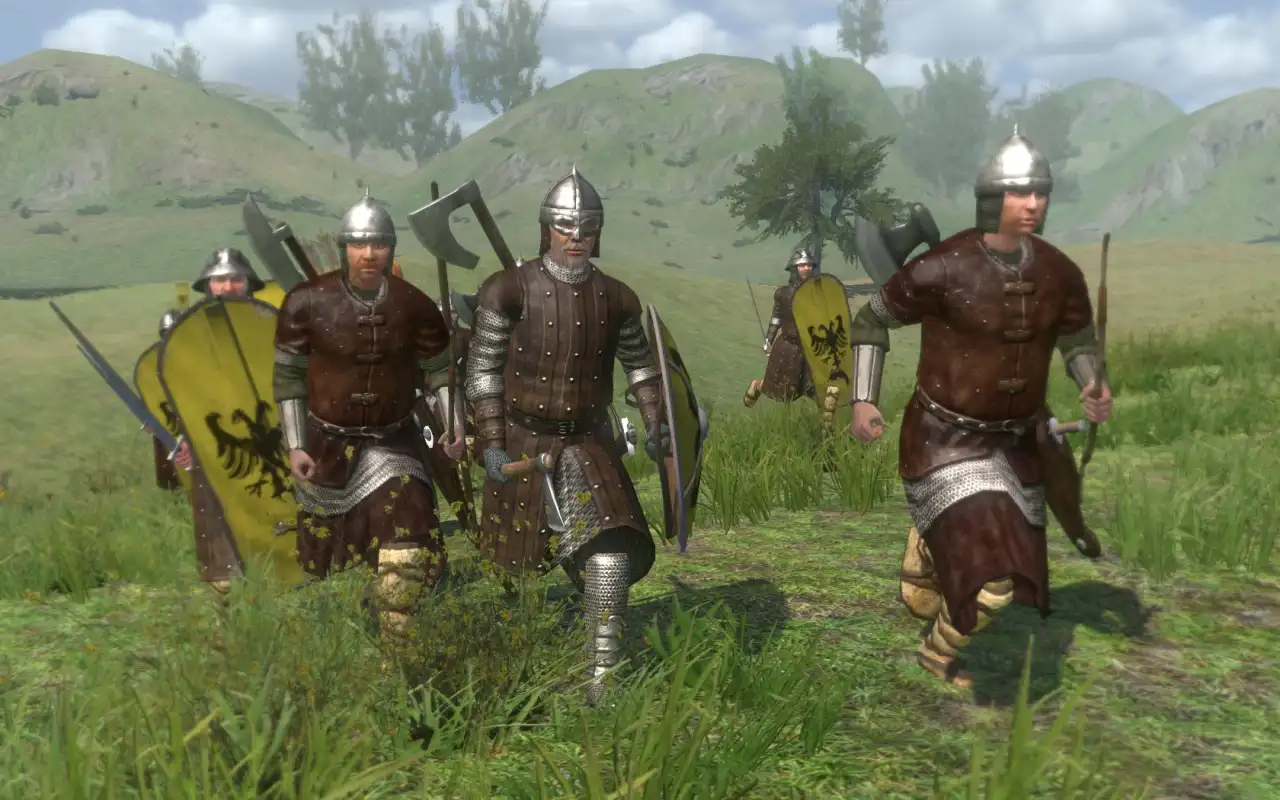
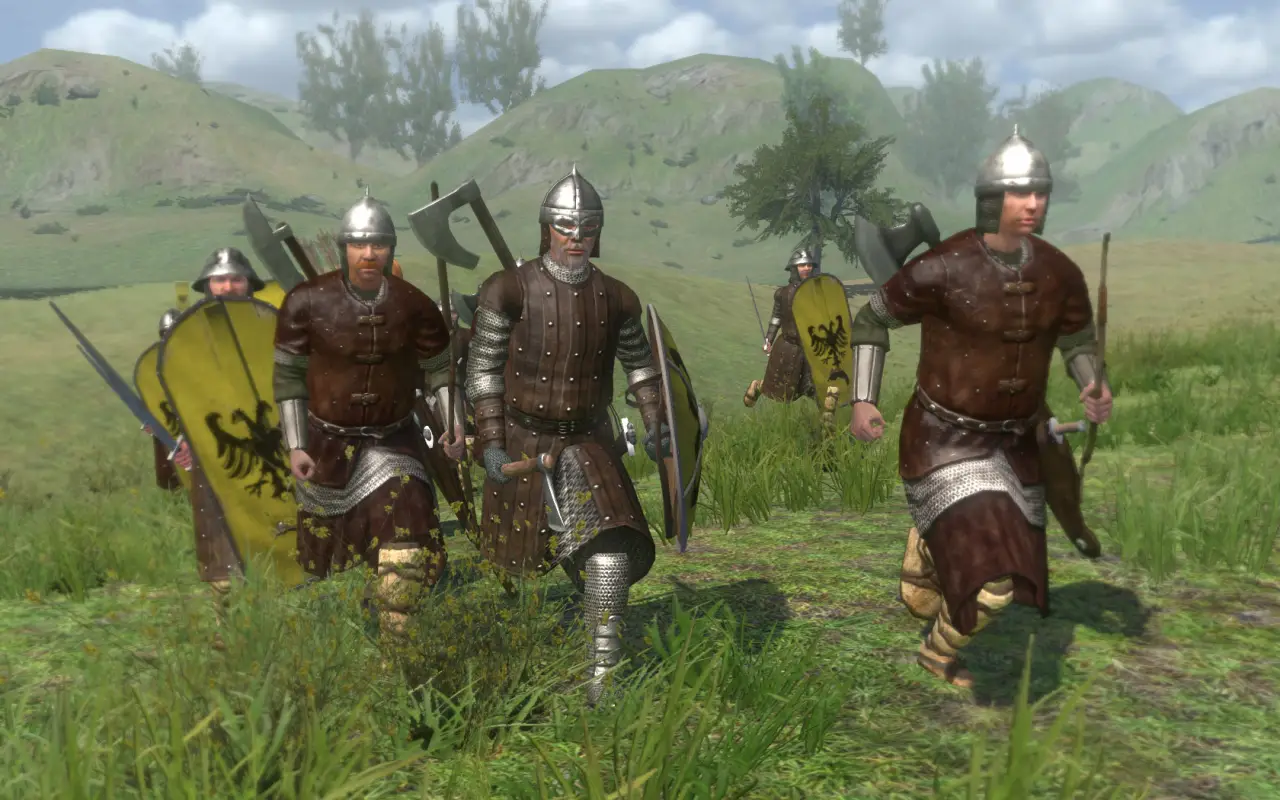
Each faction's troop equipment is rooted in real historical reference — Swadia's full plate, the Nords' mail and battleaxes, the Vaegirs' pointed helms and longbows, the Khergits' composite bows and light horse, the Sarranids' turbans and Mamluk armor. The polygon counts are low, but the styles are correct, the palettes considered, and the recognizability strong. The medieval armory is enormous — longswords, two-handers, war hammers, spears, lances, polearms, hand axes, composite bows, crossbows, torches — each with its own model, animation, and damage type, a "weapon as equipment" volume that was top-tier for the indie space.
Horses get the same treatment, with chargers, pack horses, Khergit ponies, and Sarranid desert mounts each carrying distinct speed, weight, and armor stats, plus dedicated animations for cantering, galloping, leaping, falling, and being knocked from the saddle. That cavalry-interaction detail is the signature of the whole engine, and it is the reason mounted combat still feels singular even against far prettier modern games. Crucially, the art direction commits to function over flash: a unit's silhouette tells you its faction, role, and threat level at a glance across a chaotic field, which is exactly the legibility a tactical game needs and which many higher-fidelity titles sacrifice for visual noise. The models may be coarse, but they are never confusing, and on a battlefield of hundreds that clarity is worth more than another ten thousand polygons.
A World Map That Tells Geography As Story
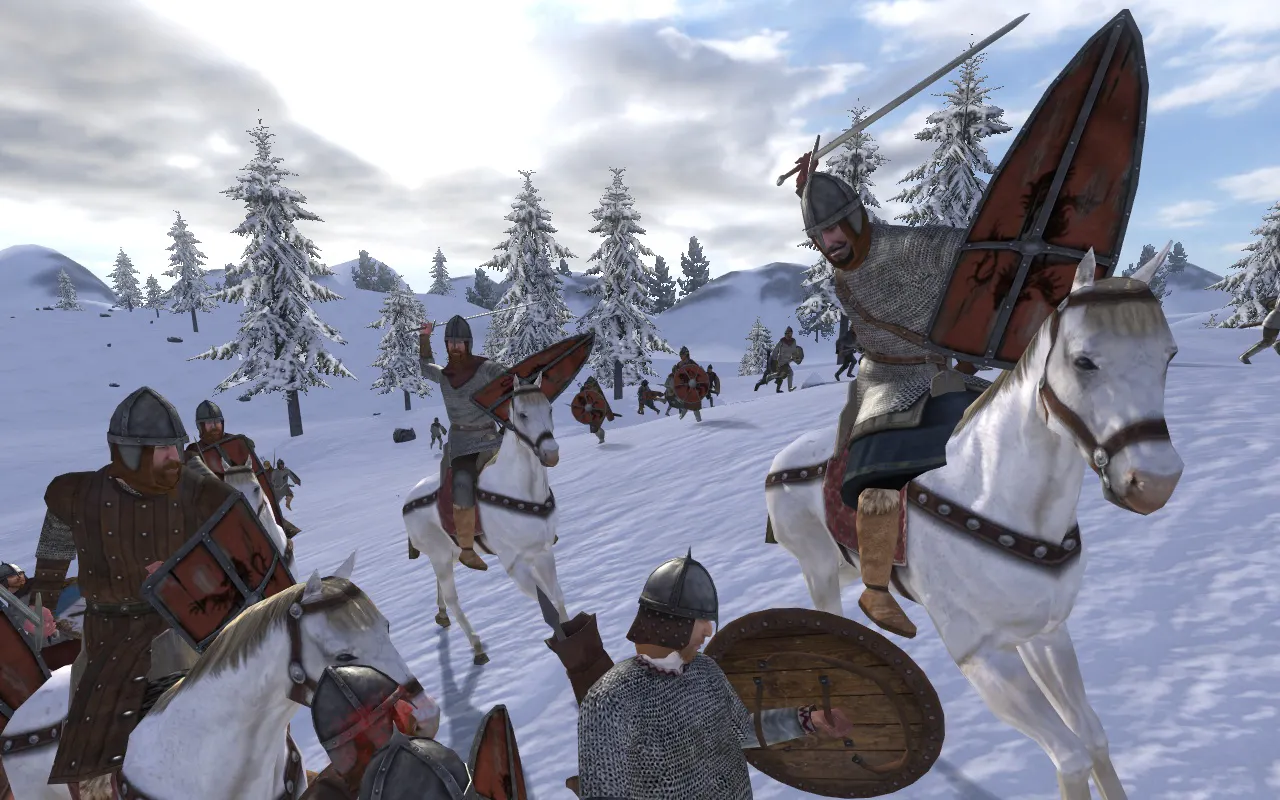
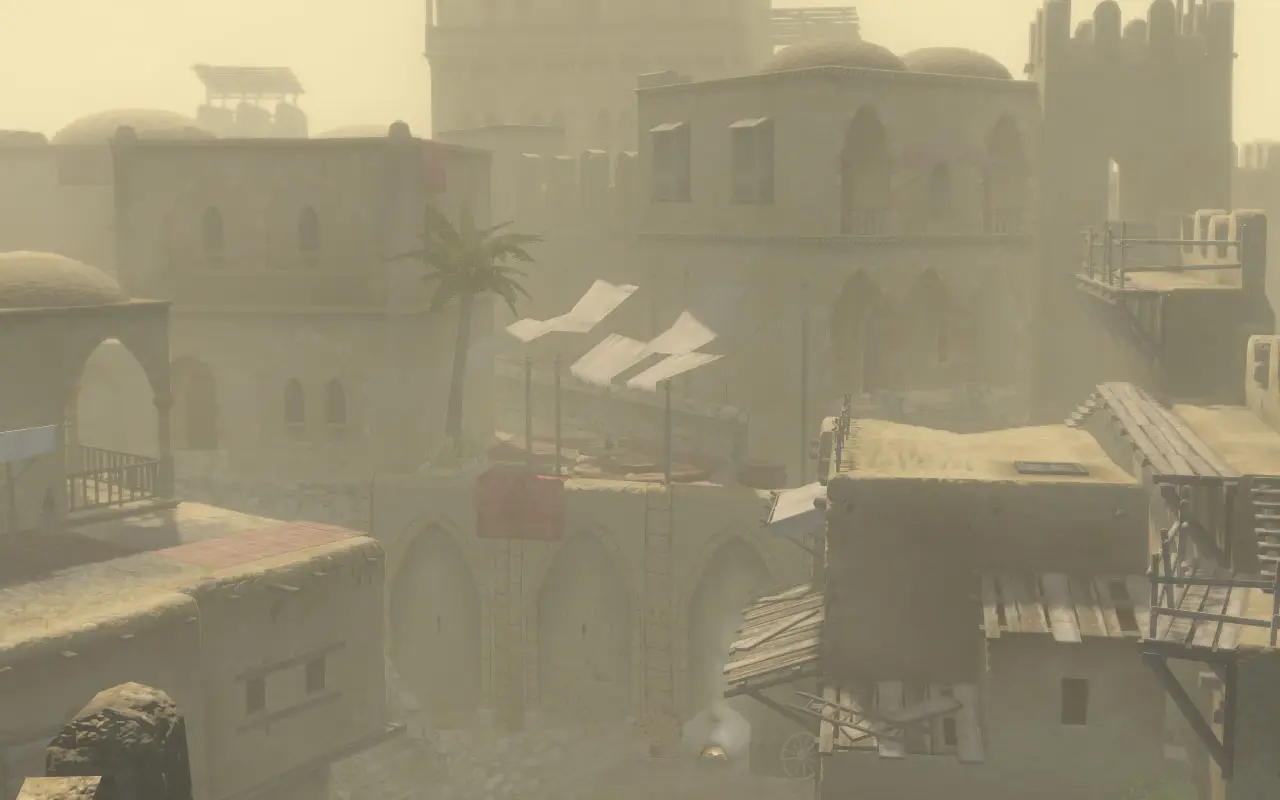
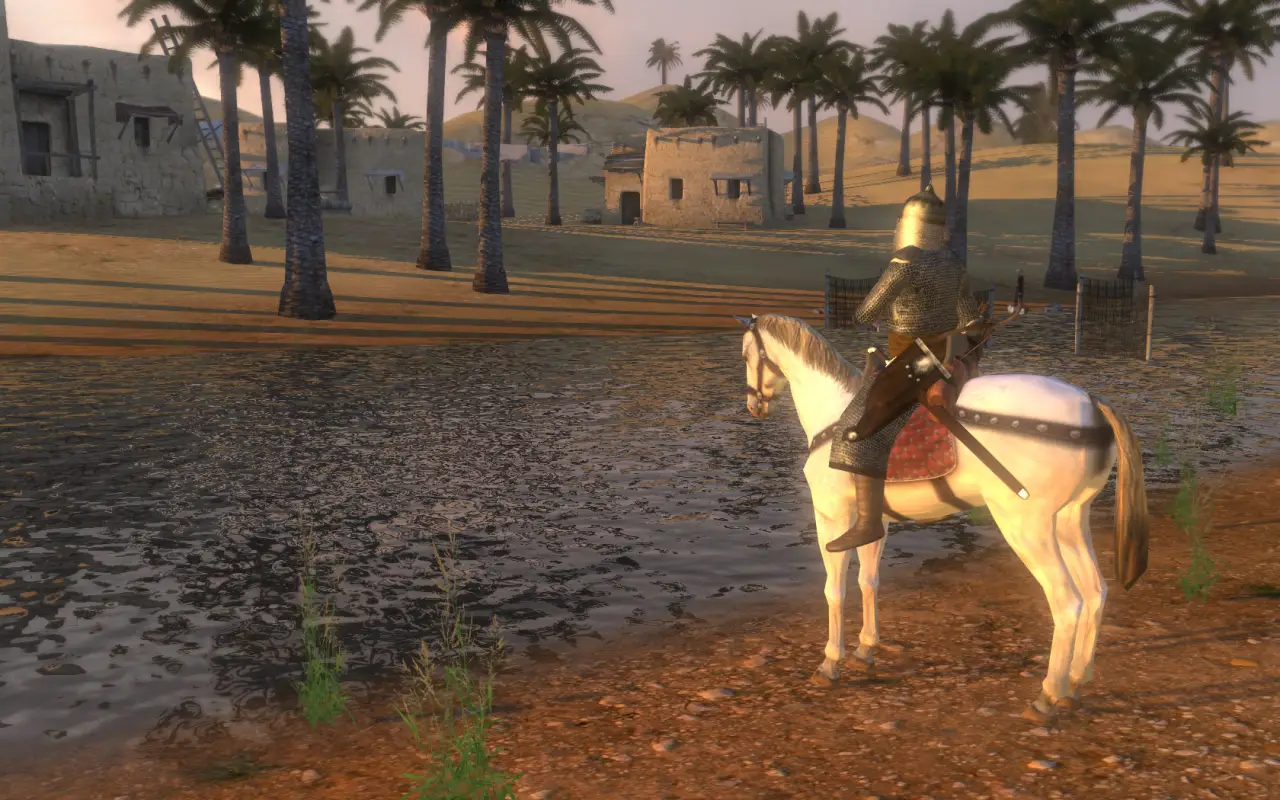
The world map is a top-down view of the Calradian continent — six kingdoms' territories, hundreds of castles and villages, mountains, rivers, forests, and deserts. The art is simple, but each region reads clearly: Swadia a European plain, Vaegir an Eastern-European snowfield, Khergit a Mongolian steppe, Sarranid an Arabic desert. Every castle, village, and town on that map is an actual visitable place — enter a castle and you see its interior, enter a village and you can speak to its elder, enter a town and you can browse the market, tavern, and arena. That "every dot is a real location" design gives Calradia a tangible solidity instead of the abstraction of a strategy map, and even the climate shifts visually, with snow in the northern winter and heat-haze across the steppe.
The battlefield is where the art reaches its soul. When hundreds of soldiers deploy across a plain, cavalry sweeps a flank, archers loose from a hilltop, and infantry grind in the center, the recreation of a medieval war tableau was the ceiling of its indie peers. Terrain shapes tactics — high ground buffs attackers, dense forest hampers cavalry, marsh slows everyone — so each fight leaves a distinct visual memory anchored in space.
The Interface Problem and Platform Limits
The interface is the most criticized part of the package. Unequipping, recruiting, shopping, and managing kingdom relations are all counterintuitive, with poor click precision, dense text, and muddled information hierarchy — typical 2010 indie failings that look especially harsh today. New players routinely cite the UI as the single biggest deterrent. Thankfully the mod scene has built extensive UI overhauls that dramatically improve the baseline experience, and the standard advice is to install one the moment you understand the mechanics; Bannerlord's wholesale UI redesign was a direct answer to this weakness. On consoles the picture is worse still — framerate dips in large battles, and a controller cannot reproduce the precision of mouse-direction attacks, which is the root reason the console versions score so far below PC. It is worth being blunt about expectations here: if you come to Warband straight from a modern AAA release, the first impression will be harsh, and the screenshots do the game no favors. The visuals are a tax you pay up front, not a reward — but they are also the one dimension where a few mods and a little patience genuinely close most of the gap, which is why this remains the lowest score on the card rather than a dealbreaker.
Combat | 9.0/10
Gameplay: 9/10If the visuals are Warband's weakness, the gameplay is its towering strength — a 9.0 that fifteen years of imitators have circled but never fully equaled. The genius is a combat system controlled entirely by the mouse, layered on top of a sandbox economy that lets a single drifter grow into a king. Few games marry twitch melee skill and grand-strategy ambition this cleanly.
Mouse-Direction Melee and the Soul of Horse Archery
The core of combat is the four-way directional attack: the direction you flick the mouse decides whether you swing overhead, thrust, or slash left and right, and you can feint mid-swing to bait an opponent's block before committing elsewhere. This sounds simple and is anything but — PvP veterans are still mining new techniques at the thousand-hour mark, reading blocks, chambering attacks, and managing footwork in a way that has more in common with a fighting game than a strategy title. It is a depth of cold-weapon dueling no other PC game has matched, and it scales from a clumsy first hour into a genuine craft.
Horse archery is the connoisseur's layer on top. Firing a bow from a galloping mount while leading the target, the Parthian shot — wheeling to loose arrows over your horse's tail as you retreat — is the signature flex of high-level play, with arc, speed, and timing all riding on raw feel rather than auto-aim. Mastering it transforms you from a soldier into a one-person cavalry wing, and it is the kind of skill ceiling that keeps people coming back across a decade. What ties melee and archery together is that both are pure player skill with almost no statistical crutch — your character sheet helps, but a veteran on a fresh save will still carve through enemies a numerically stronger novice cannot touch. That honesty about skill is rare in role-playing-flavored games, and it is a large part of why the combat has aged so much better than the graphics wrapped around it.
From Soldier to General to Sovereign
Warband constantly shifts your vantage point. You fight as a single body in first person, then pull back to a commander's overhead view to issue formation, charge, and retreat orders, then zoom back in to personally lead the decisive push. That fluid swing between "one sword in the line" and "the general reading the whole field" is the loop's secret, letting the same battle feel both visceral and strategic. Outside of battle, the sandbox economy runs the long game — fiefs generate tax, garrisons need training, kingdom relations need tending, and lords need courting or outmaneuvering as you climb from mercenary captain toward your own throne.
Those two layers reinforce each other. A campaign decision — which lord to serve, which town to besiege, when to declare independence — sets up the battles, and the battles cash out the campaign. The result is a feedback loop where a single session can swing from a duel in an arena to a siege of a walled city to a tense council vote, all under one continuous save.
Multiplayer Modes and a Notoriously Steep Curve
Multiplayer spans seven modes from deathmatch to large-scale siege, and the Napoleonic Wars DLC adds an entire gunpowder-era layer with line infantry, artillery, and the band guilds that score matches in real time. The competitive scene rewards exactly the directional-combat mastery the single-player teaches, making it one of the most skill-expressive medieval multiplayer experiences ever built. The one honest caveat is the learning curve: the first ten hours leave most players fogged, with no proper tutorial and an interface that fights you. But that steepness is also the filter that defines the community — clear it once and the systems that confused you become the systems you live inside, and the satisfaction curve from hour twenty onward is almost unmatched in the genre. The payoff is that nearly every system, once understood, feeds back into every other — your dueling skill wins tournaments that fund your warband, your command keeps that warband alive in sieges, and those victories buy the renown that lets you court lords and eventually claim a crown. There is no busywork that does not eventually matter, which is precisely the quality that turns a confusing first session into a thousand-hour habit.
Content | 9.5/10
Umfang: 9.5/10Content is where Warband earns its highest mark — a 9.5 driven less by the official package than by everything fifteen years of players and DLC have piled on top of it. The base game is generous on its own, but the real story is how completely it turned into a platform, the rare title whose content pool has grown rather than shrunk with age.
The Official Foundation and Two Flagship Expansions
The base game alone is substantial: six factions, hundreds of castles and villages, a complete arc from penniless drifter to crowned sovereign, full troop trees, tournaments, sieges, caravans, and kingdom management. A single playthrough toward conquest can run dozens of hours, and that is before any add-ons. Tournaments, arena fights, caravan trading, prisoner management, and the slow politics of climbing a kingdom's hierarchy all layer additional systems onto the core loop, so even a player who never installs a single mod has a deep, complete game in front of them. On top sit two flagship DLCs that pull in opposite, complementary directions. Napoleonic Wars is the multiplayer flagship, repurposing the base engine into 1800s great-power warfare with line infantry, cavalry, artillery, and the military-musician system that turns bugle performance into a battlefield role — it is effectively a second game bolted onto the first.
Viking Conquest is the story flagship, a plot-driven Dark Ages Britain campaign that adds something almost no other game offers: medieval naval raiding, sailing longships between coastlines to plunder and fight at sea. Between the two, the official content already spans cold steel, gunpowder, and the open ocean, covering far more ground than a single medieval title normally attempts.
The Mod Ecosystem That Made It Immortal
The third and largest layer is the mods, and this is the real reason for the 9.5. Prophecy of Pendor adds legendary units and a whole knightly-order founding arc; A Clash of Kings transplants the entire world of Game of Thrones into the engine; 1257AD rebuilds 13th-century Eurasia with historical rigor. Each is effectively a standalone medieval or historical narrative built on Warband's bones, and together they convert the base package into a permanent storytelling platform. The Chinese community deserves special mention here — Romance of the Three Kingdoms mods let players conquer ancient China, and a deep localization scene keeps the game alive for a massive non-English audience that treats Warband modding as a hobby in its own right.
This is what "base game as platform" actually looks like in practice. The official content gives you a complete game; the mod library gives you an effectively unlimited supply of new ones, refreshed continuously by a community that has never stopped building. You can spend a hundred hours in vanilla Calradia and then a thousand more across Westeros, the Three Kingdoms, and Napoleonic Europe without ever buying another base game. That is a value proposition almost no other title of its era can claim, and it is the practical reason the content score sits as high as it does.
Why It Still Outlasts Its Own Sequel
The most telling comparison is with Bannerlord, the official sequel. Bannerlord upgraded the engine by a clear generation — better visuals, smoother systems, a more modern interface. And yet, on long-tail content, its mod sediment still has not caught up to fifteen years of Warband creations. Veterans who could move to the prettier sequel often stay precisely because the mod pool, the localized scene, and the accumulated community knowledge all run deeper on the older game. It is an unusual case where the older title holds a content advantage its successor cannot quickly erase, and it is the clearest argument for why Warband, despite everything dated about it, remains worth owning today. The lesson for the industry is quietly profound: a generation of technical superiority does not automatically transfer the community, the accumulated mods, or the institutional knowledge that actually keeps a game alive. Bannerlord will likely overtake it eventually, but "eventually" has already taken years, and in the meantime Warband keeps doing the one thing a content score is supposed to measure — giving players more to do than they could ever finish. For a fifteen-year-old game to still be expanding its own ceiling is the rarest achievement in this entire review.


Kommentare 0
Wir freuen uns auf deine Meinung
Beteilige dich an der Diskussion und teile deine Bewertung des Spiels.
Noch keine Kommentare — teil uns deine Meinung zu diesem Test mit!