




















Opening
Some games you finish once and spend the next twenty years quietly building on. This is one of them — and the strange thing is, it changed everything almost by accident.
In 2005 Leon Kennedy walked into a Spanish village, and a developer named Shinji Mikami parked the camera just behind his right shoulder to fix a nagging aiming problem. That single decision rewrote the grammar of the third-person game. Suddenly you could point and shoot with real precision — knee a villager to drop him, headshot another mid-lunge — and the industry never went back. Gears of War, Dead Space, The Last of Us: every one of them is standing on that shoulder.
What you can buy on Steam today is not the glossy 2023 remake. It is appid 254700, the Ultimate HD Edition — the 2005 original itself, scrubbed up for PC, the one that scored 96 on Metacritic and a 9.8 from IGN. The textures are old and the menus are older. But that loop, the one that makes you ration every single bullet, still grips like a vice. This review is about the source — the version everything else copied.
Story | 8.0/10
Story: 8/10An old rescue plot, told in a new key
On paper the story could fit on a matchbook. Leon, now a hardened government agent six years after the nightmare of Resident Evil 2, is sent to a remote European village to bring home Ashley Graham, the kidnapped daughter of the US President. There is no plot twist waiting to ambush you, no grand narrative ambition, no thematic essay hiding under the surface. It is the oldest setup in the book: one man, one hostage, a very long way from any help that is coming. And the game knows it perfectly well, which is exactly why it spends its real energy elsewhere — on texture, on dread, on the queasy, specific feeling of being badly outnumbered in a place that has already decided it wants you gone.

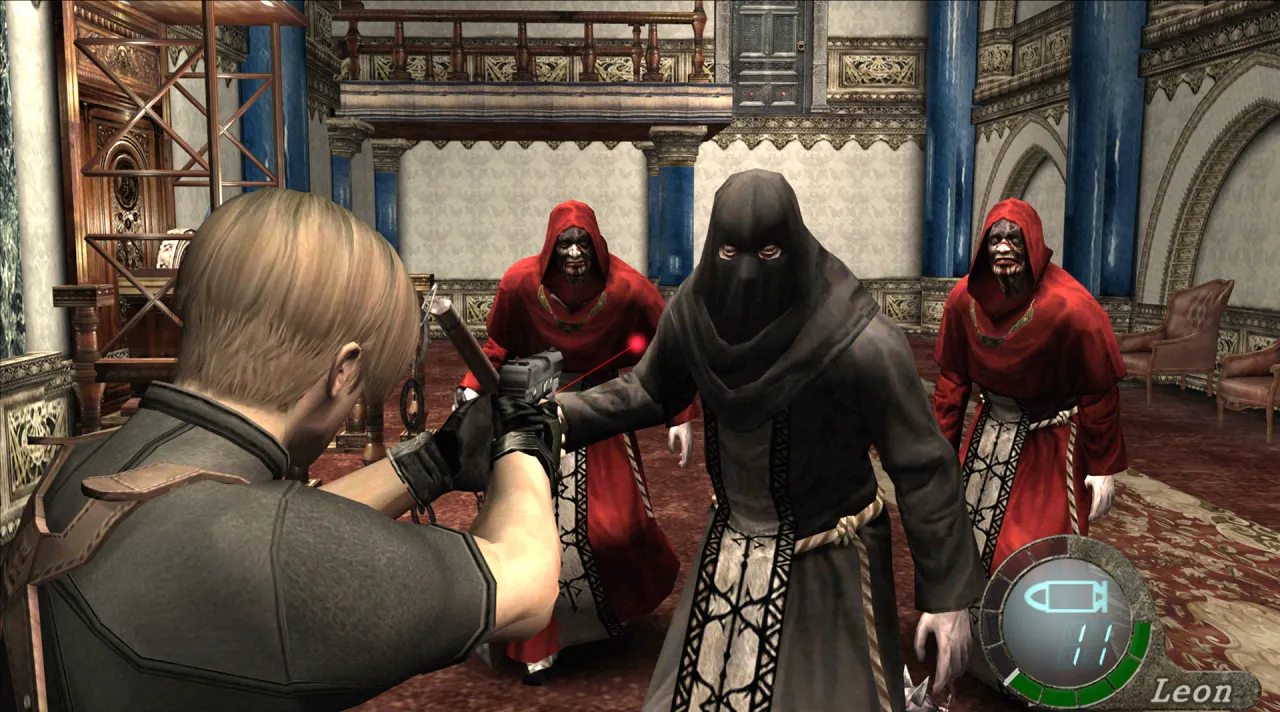
The cleverness is in the retuning. The thing hunting you is no longer a shambling virus zombie but a villager hollowed out by a parasite called Las Plagas, in thrall to a cult named Los Iluminados. That swap matters more than it sounds. These enemies still talk, still wield tools, still flank you with ugly intelligence and coordinate to cut off your exits — and a thinking enemy is far more unnerving than the undead ever were. The series trades its sterile labs and Raccoon City streets for damp, superstitious, Catholic-gothic countryside, and the whole mood shifts with it. You are not clearing out the infected anymore; you are the outsider being hunted by an entire community that has already decided you do not leave.
Ashley, and a cast that lands in seconds
Ashley is the series' first proper escort NPC, and players have spent twenty years grumbling about her. She cannot fight, gets hauled off by villagers, and forces you to spend your own resources dragging her out of trouble. Yet that liability is the point: it stacks another layer of triage onto every firefight. You are no longer just keeping yourself alive — you are babysitting someone who will get herself killed the moment you look away.
She is not the only one who sticks. Leon's deadpan one-liners in the teeth of monsters become a series signature, and they set the template for how he is written for the next two decades. The cult leader Saddler sells religious-mania-meets-bioweapon with a sliminess you almost enjoy. The diminutive Salazar is all venom and theatre — physically ridiculous, verbally vicious. And the spy Ada Wong drifts through it all with motives you never quite trust, the single most unreadable presence in the game. None of them needs a monologue to land. A line here, a glance there, a few seconds of screen time, and they are real. That is dense, economical characterisation, and it is exactly why the cast outlives the thin little plot that carries them. You do not remember the story beats so much as the people who delivered them.
Camp, dread, and the balance nobody else nails
What is genuinely hard to copy here is the tone. The game is frightening — the damp village, the chainsaw lunging out of nowhere, the Regenerador's clammy wheeze will all curl your toes. But every so often it lets the pressure off: the Merchant's gravel-voiced patter, Leon's wisecracks, the occasional gloriously preposterous set-piece. Tension and absurdity trade places in a rhythm that countless horror-action games have tried to learn and never quite managed. It is scary without being grim, ridiculous without being a comedy, and it holds both notes at once.
Set the original against the 2023 remake and the contrast sharpens. The remake pulls everything toward gravity and realism, a cohesive, grounded, thoroughly modern read with motives you can actually believe. The original keeps a faint streak of camp — lines that beg for a smack, cutscenes that border on absurd — and that "playing it straight while being completely ridiculous" energy is its own irreplaceable charm. Neither is wrong, and which you prefer says more about you than about the games. People who want restraint will lean remake; people who miss the old swagger will defend the source. But for the original, undiluted version of that swagger, this is where it lives, and nothing since has bettered it.
Audio | 7.5/10
Sound: 7.5/10Sound as a second pair of eyes
The smartest thing about this soundscape is that it does not try to be pretty. It tries to apply pressure. In action-horror, good audio is not about realism; it is about keeping you taut, and this game keeps you taut from the menu screen onward. An enemy is still off-screen and you already hear him — the drag of a tool, the shuffle of feet, that distant, skin-crawling rev of a chainsaw. The threat hasn't reached your face yet, but your ears have already flinched on your behalf.

In the big mob ambushes the sound effectively becomes a second field of vision. Screams crowd in from every direction; you cannot possibly track each villager by eye, but you can read by ear which way is thickest, where the chainsaw is, which gap to bolt for. And the game weaponises anticipation: that saw growling closer from some corner you can't see is more punishing than the moment it finally arrives. Teasing your nerves with sound before showing you anything is its meanest, most effective trick.
Gunfire, feedback, and "What are ya buyin'?"
Combat audio is layered and legible. Shots crack, hits land with weight, close-range threats get their own warning sting, so even in the thick of chaos your ears can reconstruct the situation — vital for a game built on precision. You always know, without looking away from your aim, whether that shot connected, whether something just dropped, and how many things are still breathing down your neck. In a game where survival is measured in single bullets, that constant audio read-out is not a luxury; it is part of the toolset you fight with.
The most memorable sound in the whole game, though, is probably a raspy voice. The Merchant's "What are ya buyin'?" became a cultural fixture of the series, quoted and parodied to death — a bit player who carved himself into everyone's memory on the strength of a single line reading. That is a victory of voice direction as much as sound design, full stop.
It is worth dwelling on how much work the voice acting does here, because it sets the whole tonal register. The performances are pitched somewhere between B-movie and genuine menace, and that is deliberate. Saddler's sermonising, Salazar's needling, Ada's cool detachment — none of it is naturalistic, and none of it is trying to be. It is theatrical in a way that matches the game's heightened reality, and it lands far more often than the era's reputation for clunky dubbing would suggest.
In fairness, the score leans toward atmosphere over hummable themes; there is no single melody that snaps the whole game back into your head the way a great main theme can, and that is partly why this dimension doesn't max out. But flip it around and that is the deliberate trade: it is not here to be hummed, it is here to keep you clenched, and at that narrow, specific job it is close to flawless. The music almost never wants your attention — it wants your spine. IGN handed sound a 9.0 and the game won their Best Use of Sound award, recognition that the craft here is in restraint as much as in spectacle.
One caveat the PC crowd needs to hear plainly: the Ultimate HD Edition does not remaster the audio at all. What comes out of your speakers on Steam is the 2005 mix, faithful but plainly of its era — a stereo image thinner than the surround-heavy, dynamically wide soundscapes a modern player now takes for granted. It is not broken and it is not bad. It is simply old, in the same honest way the textures are old, and anyone arriving straight from a current-gen release should set their expectations accordingly. The pressure still works; the fidelity is just frozen in time.
Visuals | 6.5/10
Grafik: 6.5/10Art direction outlives the hardware
Here is a slightly counterintuitive claim: this game looks genuinely old today, and it still looks good. Those two facts are not in tension once you understand what carries it. What carries it was never texture resolution or polygon budgets — it is art direction, the part of visual design that no hardware generation can date. The fog-choked opening village, the torchlit night sieges, the cold damp castle corridors, the hard mechanical island lab: four environments with four distinct textures, each one welded to the mood of the section it houses. The village teaches you the claustrophobia of being swarmed; the castle is all uncanny machinery and traps and candlelit dread; the island cranks firepower and tension to the ceiling at once. Plenty of modern games drown in 4K textures and somehow conjure no atmosphere at all. This one summons it from nothing more than a glance at the skyline and the colour of the light.

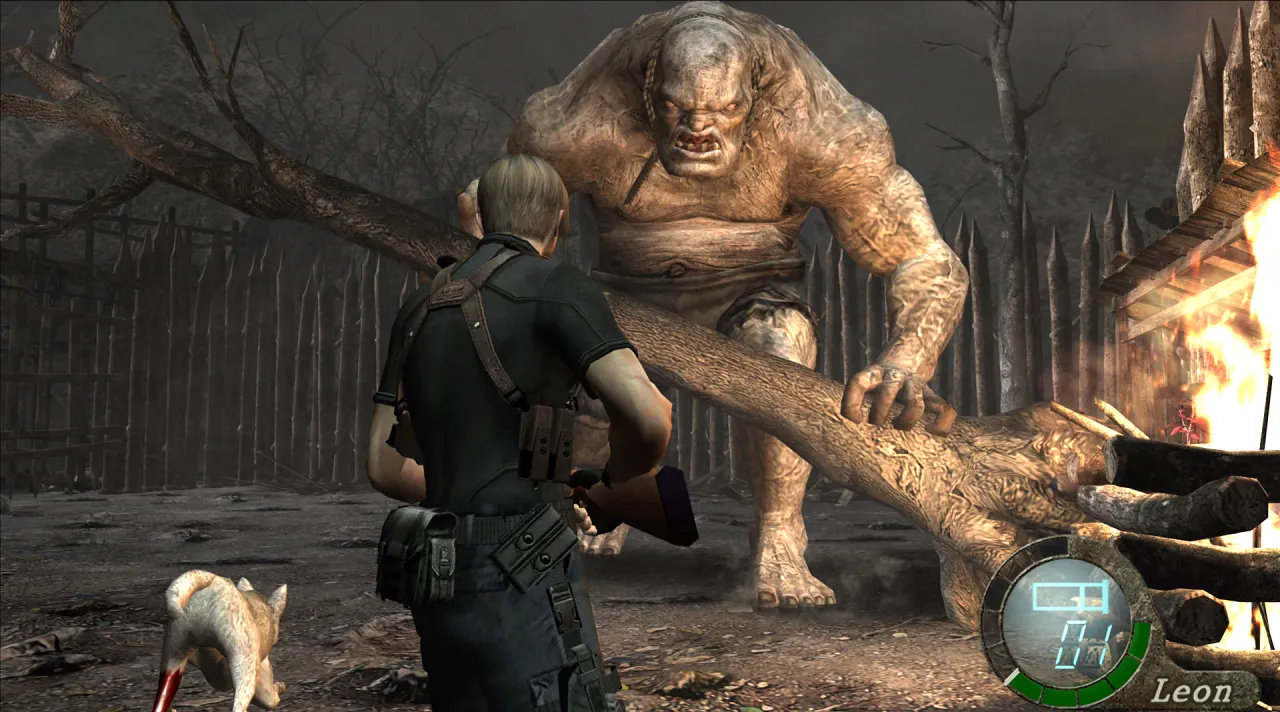
The creature design is where it really flexes. Dr. Salvador, the sack-headed butcher with a chainsaw, sends even veterans scrambling for cover the instant that motor coughs to life — a monster that is terrifying for what it threatens rather than how many pixels it occupies. The Regenerador — whose parasites you can only locate through a thermal scope — pairs a wet, sucking breath with a stretched, wrong silhouette that lodges in people's nightmares for years; you hear it before you find it, and finding it is worse. The spiked Iron Maiden, the towering El Gigante you have to clamber up to wound: each is among the finest enemy design in the medium, full stop.
None of them win on polygon count. They win on imagination, on a precise read of what actually frightens people — the silhouette, the sound, the timing of the reveal. And imagination does not age out with a graphics card. That is the through-line of this whole dimension: the parts that were authored, rather than rendered, have survived almost perfectly, while the parts that depended on raw hardware have not.
The PC HD edition: faithful, but dated
Now the honest part. The Ultimate HD Edition on Steam is a workmanlike 2014 port by QLOC, built on the 2011 HD release rather than rebuilt from scratch. It adds sharper textures, crisper UI text and full mouse-and-keyboard support, but underneath it is still that generation's geometry and scenery. On a modern monitor the hard edges, the low-poly models and the muddy distant detail are obvious the moment you stop to look.
That is exactly why it sits at a 79 on PC Metacritic — visuals are the one dimension where this landmark visibly shows its age, and no amount of fondness changes that arithmetic. A port is a port; this one is faithful and stable and entirely of 2014, which by extension means largely of 2005. If your tolerance for dated graphics is low, this is the dimension that will test it, and you should know that going in rather than discovering it an hour later.

PC at least has an escape hatch the consoles never did: the community-made RE4 HD Project, a multi-year fan effort that repaints nearly every texture and patches model detail by hand, leaving the original framing intact while making the whole thing look reborn. The fact that people have voluntarily spent years hand-painting textures for a near-twenty-year-old game is its own kind of testament — you do not pour that much love into something that is merely competent. With the project installed, the gap to a modern release narrows dramatically, and the original's art direction finally gets the resolution it always deserved.
If you want modern fidelity with zero fuss, though, that is precisely what the 2023 remake is for — a ground-up rebuild on a current engine, and the single widest gap between these two versions sits right here, on the screen. So this score lands low, and deservedly so on the technical side; I am not going to pretend a 2014 port looks current, because it does not. But it takes nothing away from environments and monsters that still haunt you two decades later. Remember this line, because it is the whole point of the dimension: technology dates, and good art does not.
Combat | 9.5/10
Gameplay: 9.5/10The over-the-shoulder camera: where precise third-person shooting begins
This is the part worth getting right, because it is the thing nothing can take from this game. Before it, third-person play was either fixed cameras and tank controls, where aiming was mostly guesswork, or a camera slung high overhead with autolock doing the work. Precision in third person barely existed. Park the lens behind Leon's right shoulder, align the reticle with his sightline, and for the first time you aim like it is a first-person shooter — headshot to stagger, knee to drop, a clean shot to knock the scythe out of a Ganado's hand.

It sounds trivial; it felt revolutionary. The mechanic fused "seeing the enemy" and "hitting the weak spot" into one act of skill instead of a button press, and how well you shoot maps directly onto how easily you survive. That conversion of skill into survival is the bedrock of why the combat is so addictive — you are never punished by an arbitrary system, only by your own aim. Every precision third-person shooter since lives downstream of this single design choice.
And the genius is that it never feels like a gimmick. The camera does not just let you aim; it changes how you read a room, where you stand, when you commit. The source is that one shoulder, and twenty years of imitators have only proven how right it was.
Melee, the attaché case, and the Merchant
Aiming alone wouldn't carry it. What makes the combat sing is the chemistry between systems. First, melee: knee a villager so he buckles, sprint in, and a roundhouse kick or suplex flattens a whole ring of them — the most economical ammo-saving combo in the game, and the line between a flailing newcomer and a fluent player. Second, the grid-based attaché case: herbs, sidearms, heavier hardware, the rocket launcher, each eating a different footprint, packed like Tetris. Every pickup forces a re-sort and a genuinely painful choice between carrying more supplies and leaving room for the big-ticket gear.
Third, the Merchant. Dead enemies drop pesetas; treasures can be combined and sold for more; that cash buys upgrades, new weapons and first-aid sprays. So thrift and firepower lock into a loop — the better you shoot, the richer you get; the richer you get, the harder you hit; the harder you hit, the calmer you fight, which means you waste less and get richer still. This economy threads combat, exploration and inventory management into one continuous spine, and it is the structural heart of the whole design. Pull any one strand and the others slacken; together they make every encounter a small act of bookkeeping you are weirdly thrilled to perform.
Dynamic difficulty, and a 9.5 well earned
There is one more piece of quiet genius: dynamic difficulty. The game watches how you play. Cruising? It nudges enemy aggression up and trims your ammo. Struggling? It eases the tempo and feeds you supplies. You barely notice it happening; you just feel that the pressure stays perfectly calibrated. No blunt difficulty wall turns players away — an invisible hand keeps everyone, at every skill level, walking the edge of collapse and just managing to hold. That "barely holding on" tension is the soul of the combat.
Add the QTE set-pieces that felt fresh in 2005 — diving clear of a tumbling boulder, trading knife slashes with Krauser in a duel that demands your reflexes mid-cutscene — and the campaign earns dramatic spikes beyond the shooting, turning "watching a cutscene" into "surviving one." Not every QTE has aged gracefully, but the intent behind them, to keep your hands busy even in the story beats, was ahead of its time. IGN's 9.5 for gameplay was no fluke; the game has an answer for almost every "how do we keep the player tense and rewarded" question a designer could ask.
And on the PC Ultimate HD Edition, mouse aiming is even sharper and snappier than the old pad. The fine control makes headshots fast and clean, quietly upgrading already-superb combat and offsetting some of the visual age. If anything, the PC is the ideal place to feel this source combat at its best: the modernised input papers over a real chunk of what the dated presentation costs you, and the loop underneath is as sharp as it ever was.
Content | 8.5/10
Umfang: 8.5/10Village, castle, island: a campaign that never sags
The campaign alone is substantial, and it is structured with real intent. It moves through village, castle and island, each leg carrying its own tone and its own unforgettable boss. The village drills you in surviving a mob and stages that frantic spear-fishing duel with the lake monster Del Lago. The castle is crammed with traps, robed cultists and catapults, dialled all the way to uncanny, a complete change of register from the rural opening. The island then maxes out firepower into a near-pure action finale, closing on the showdown with the cult leader Saddler. The through-line never pads itself for length; it tightens when it should tighten, breathes when it should breathe, and always seems to introduce its next idea at exactly the moment you have finished digesting the last one.

Crucially, it never mistakes "more content" for "more clutter." There is no filler, no busywork sidequests, no map peppered with icons demanding to be cleared. The density stays high across the whole run — every region has something to teach you or some new threat to spring, and the moment one idea has been fully wrung out, the game moves on to the next.
You feel constant forward motion rather than grinding against dead air. Set beside today's checklist-stuffed open worlds, that restraint feels almost luxurious; this is a game that respects your time precisely because it knows exactly what it wants to be. The whole thing runs roughly fifteen to twenty hours, generous for action-horror and nearly waterless from start to finish. It is long enough to feel like a real journey and short enough that nothing overstays its welcome — a length that, in hindsight, an awful lot of bloated modern blockbusters could stand to learn from.
The Mercenaries and twenty years of replay
The credits are just the start. Built in for free is The Mercenaries, a score-attack mode of timed, arena-bound killstreaks — simple, vicious, endlessly re-runnable, and still alive two decades later, with people grinding leaderboards and writing optimisation guides to this day. It is the purest distillation of the combat: no story, no escort, just you, a clock, and a shrinking margin for error. Beyond it, higher difficulties and a second playthrough aren't optional garnish; they fall naturally out of a combat system this deep, where mastery keeps revealing new layers. Knife-only runs, speedruns, no-upgrade challenges, every flavour of self-imposed difficulty prop up a community that simply refuses to disperse, because the underlying systems reward that kind of devotion instead of exhausting it.

That longevity isn't sentiment; it has hard numbers behind it. The game has shipped over 5.7 million copies and been ported to GameCube, PS2, Wii, PC, Switch and nearly every platform that can run it — re-released every console generation, and selling every single time, a privilege almost nothing else in the industry enjoys. Each of those re-releases found a new audience that had never played it and walked away converted. It proves a simple thing: a genuinely great core loop can be consumed for twenty years without going stale, no nostalgia required to make it land.
As for the PC Ultimate HD Edition, it preserves all of this and bolts on Steam achievements, cloud saves and a lively Workshop stuffed with mods — everything from the HD Project visual overhaul to a hundred sillier toys. Those conveniences alone extend the game's life on the platform in ways the original GameCube owners could only have dreamed of. The Workshop is a genuine reason to play the source here rather than anywhere else.
Against the 2023 remake, which trims and reshuffles the campaign — cutting some stretches, adding others, rebalancing the pace for a modern audience — this source version hands you the original, uncut experience, including the classic beats the remake altered or dropped entirely. Whether you want a re-edited highlight reel or the director's original cut comes down to taste, and both readings are legitimate. But they do not serve the same content. For anyone who wants the masterpiece exactly as it first shipped, in the shape that earned all those awards, the source is simply unavoidable — there is no substitute that contains the real, unaltered thing.





Kommentare 0
Wir freuen uns auf deine Meinung
Beteilige dich an der Diskussion und teile deine Bewertung des Spiels.
Noch keine Kommentare — teil uns deine Meinung zu diesem Test mit!