
























Opening
# Opening
Thirteen years ago, a 27-year-old Canadian indie developer named Tynan Sylvester, working out of a Vancouver apartment, kicked off a Kickstarter campaign for his sci-fi colony simulator project and raised $268,000. Thirteen years later, the same game has sold over 3.5 million copies on Steam, generated more than $90 million in revenue, holds 98% positive across 203,000 reviews, and players average 211 hours of playtime. That is one of the most stable "long-tail legends" the indie industry has produced in the past decade.
The game is RimWorld. It is not designed to let players "win," it is designed to generate a unique story every match — sometimes tragedy, sometimes comedy, sometimes dark humor. Tynan uses three AI storytellers (Cassandra Classic for tension, Phoebe Chillax for relaxation, Randy Random for chaos) to drive a complex simulation system woven from psychology, ecology, relationships, medicine, and trade, with 30,000+ player-made mods co-creating this "story generator" universe.
Across 12 years, 5 major DLCs (Royalty / Ideology / Biotech / Anomaly / Odyssey) have expanded the title's thematic palette from "interstellar pioneering" to "any imaginable sci-fi subject." Metacritic 87, Xbox 92, Steam user positive 98%, average playtime 211 hours, cumulative D.I.C.E. Strategy/Simulation nomination plus Indie DB Game of the Year plus Steam's highest-user-rated game. Opening it today is a study of how one person plus a design philosophy moved the entire indie simulation category.
Story | 9.2/10
Story: 9.2/10# Story
Main arc: from crash landing to interstellar voyage
RimWorld's "main story" is an open narrative with no fixed script. Opening with a short cutscene of a space colony ship suffering disaster and three survivors crash-landing on a random planet, every story afterward is co-created by player and storyteller. This "no-script start" is Tynan Sylvester's biggest divergence from traditional RPG — he does not preset any dramatic arc, leaving everything to the chemistry of random events, player decisions, and colonist interactions.
After landing, the three survivors face immediate survival: build a shelter from the wind, grow food, find water, evade beasts. Everything starts from extreme minimalism. The game randomly assigns each colonist 1-2 Traits — possibly Bookworm, Bloodlust, Ugly, Smoker. These traits define the personalities of each match and decide how players will weave their own story.
The "endgame" is also fuzzy. The base game offers one ending — research five spaceship parts, build a complete vessel, and launch off the planet. The five DLCs each add a new ending: Royalty (become Imperial Acolyte), Ideology (build a faith system to rule globally), Biotech (create new xenohumans via genetic engineering), Anomaly (defeat the monolith chaos entity), Odyssey (pilot a gravship across star systems). This means RimWorld now has at least 6 independent "main story endings," each demanding a completely different gameplay focus.
Side density: every colonist is a novella
Side content is entirely built from colonist backstories and interactions. Each colonist carries a detailed character file — birthplace, childhood profession, adulthood profession, hobbies, preferences, health, trait combination. A "noble born plus hates poverty" colonist refuses to sleep in basic beds and demands palace-grade bedrooms; a "Bloodlust plus Smoker" colonist enjoys combat but needs daily tobacco rations.
The relationship system is another side-line layer. Each colonist holds independent opinions of others — love, hate, indifference. When affinity reaches threshold, they automatically court, marry, have children; when affinity drops too low, they may fight, insult, even kill each other. This relationship dynamic turns every colony into a soap opera. After 30 hours, players remember not "what I built" but "the noble finally married the farmer."
Each random event also carries a story fragment — a falling ship brings an unconscious refugee, a caravan brings an injured wolf, an enemy raid kills the head chef, a solar flare plunges the colony into darkness. None of these events has a standard answer — every player decision (rescue or not, recruit or release, retaliate or endure) shapes the resulting story arc.
Choice systems: every pawn death is a real loss
RimWorld has no branching dialogue choices, but it has a deeper "choice authority" — every colonist death is permanent. Opening Ironman mode means no decision can be undone. A battle that kills the chef, an illness that kills the doctor, a rebellion that kills the leader — your colony is now permanently short of that role.
This "individual irreplaceability" design strengthens every NPC's weight. When a player invests 50 hours raising a colonist, watches him grow from ordinary citizen to master artist or sharpshooter or psychic, then sees him accidentally killed by a wild boar, the heartbreak is rarely matched in mainstream shooters. Community lore is filled with real player stories like "my Strong died on day 200 to a brown bear."
Tynan Sylvester's book Designing Games discusses this "individual weight" directly — he argues video games must make every NPC irreplaceable to generate real emotion. RimWorld is the most complete practice of this theory — every colonist has both quantifiable attributes (skills, traits, health) and unquantifiable stories (player-invested time and emotion). Veteran players keep notebooks of dead hunter names as memorials, and the community even has a dedicated graveyard thread that has grown larger every year since launch.
Characters: maximum personality from minimum art
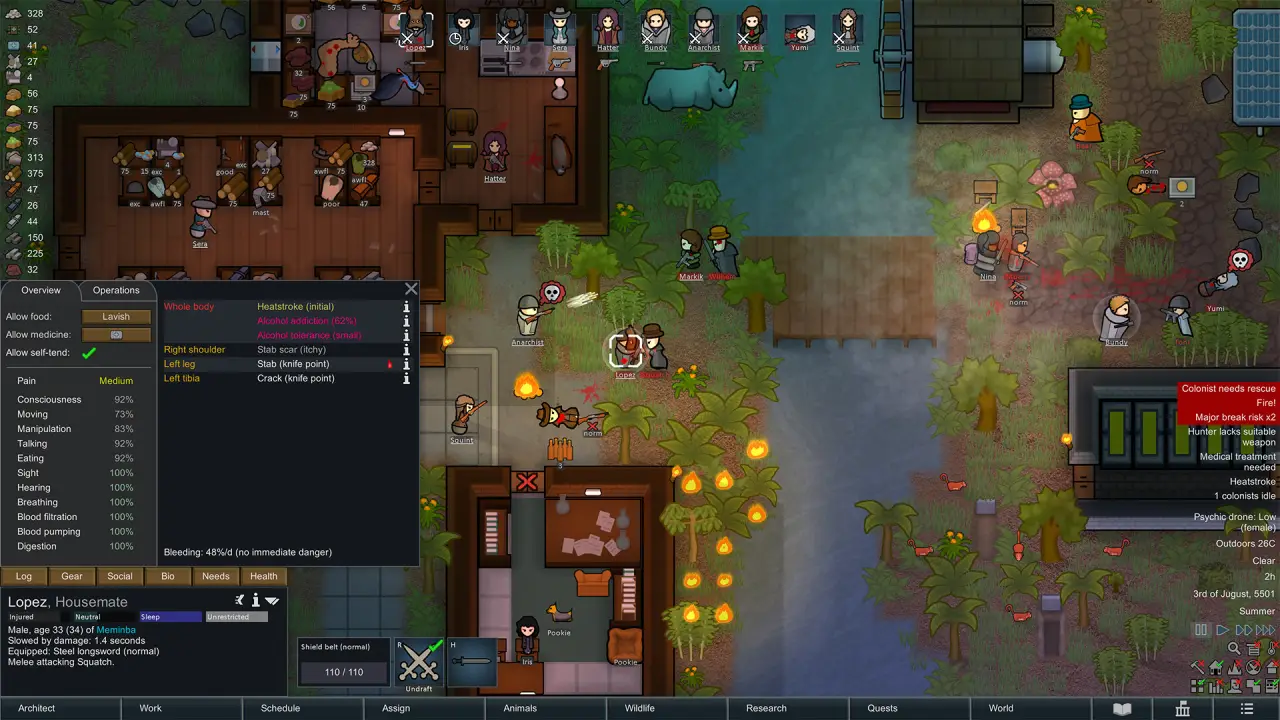
Character design achieves maximum effect via minimum means. Each colonist on screen is just a faceless, legless, expressionless little blob — but this minimalism unleashes the player's imagination. Habrador's blog specifically notes RimWorld exploits the "apophenia" psychological phenomenon (the human tendency to find patterns in randomness) — minimalist characters plus random events equals players auto-generating complex emotional narratives.
This "counter-mainstream" character design is exceptional in indie circles. Peer references: Dwarf Fortress also minimalist but ASCII art is high-barrier; The Sims goes high-fidelity 3D but sacrifices simulation depth; Oxygen Not Included takes mid-tier art but character personality is shallow. RimWorld found the sweet spot of "minimalist art plus rich personality," letting any player remember every colonist's story within an hour.
Worth noting is the $50 Name in Game Pack — players submit their own name, appearance description, and traits to appear as NPCs in random events of RimWorld globally. This "player as part of the world" meta design has run for 12 years and is one of indie's most interesting player participation mechanisms, RimWorld's exclusive "community as narrative" experiment.
Audio | 8.5/10
Sound: 8.5/10# Audio
Score theme: minimalist folk over space western
RimWorld's original soundtrack was composed by Alistair Lindsay, in a "space western" overall style — folk guitar layered over electronic synthesizer pads, creating the loneliness of "wandering alone on a strange planet." The base game has 18 BGM tracks, and the Royalty DLC added 13 new tracks with court-style overtones. This "folk plus space" hybrid lets the RimWorld soundtrack rise above typical game BGM to stand on its own as listening music.
The signature theme "RimWorld Theme" is the most widely cited — opening with solo bass guitar layered with distant electronic echoes, delivering the work's "contemplation plus drifting" tone in a single song. When players see the opening of three colonists standing beside their burning ship debris, looking up at an unknown sky, the theme rising makes empathy land immediately.
BGM presence is deliberately restrained by Tynan Sylvester — most of the time it is silent, with short melodies only triggering at key beats like "night falling," "colonist death," or "harvest season." This "music silence" strategy aligns precisely with Tynan's argument in Designing Games that "leave the player's imagination space to fill" — the game does not need to tell the player what emotion to feel at every moment.
No-voice design: let the player read out their own colonists
RimWorld is one of the few modern games without character voice acting. All colonist dialogue happens via popup text bubbles — "I am hungry," "I am cold," "Seeing the corpse upsets me." This minimalism is not just budget-saving, it is core to Tynan's design philosophy — he does not want the player's attention locked to fixed voice actor performances, he wants the player to imagine each colonist's voice themselves.
Environmental sound is, by contrast, refined. Footsteps, hammering, machinery running, animal cries, the electric howl of solar storms, the crackling of fires, the wailing of winter winds — each environmental sound is spatially processed by distance and direction. Players with headphones can locate "where the fire is" and "which side the animals are howling from" by ear.
The community has also self-produced massive "voice-pack mods" for RimWorld. The most famous are "RimSpeak" and "Voice Pack," which add independent English / Russian / Japanese / Chinese voice acting for 100+ colonist background types. These mods total over 2 million downloads, proving the strong organic demand for colonist voicing. Tynan himself said in interviews "I also want voice acting for colonists, but the official version must stay neutral," leaving the space for community to fill.
Environmental sound hunt and combat audio
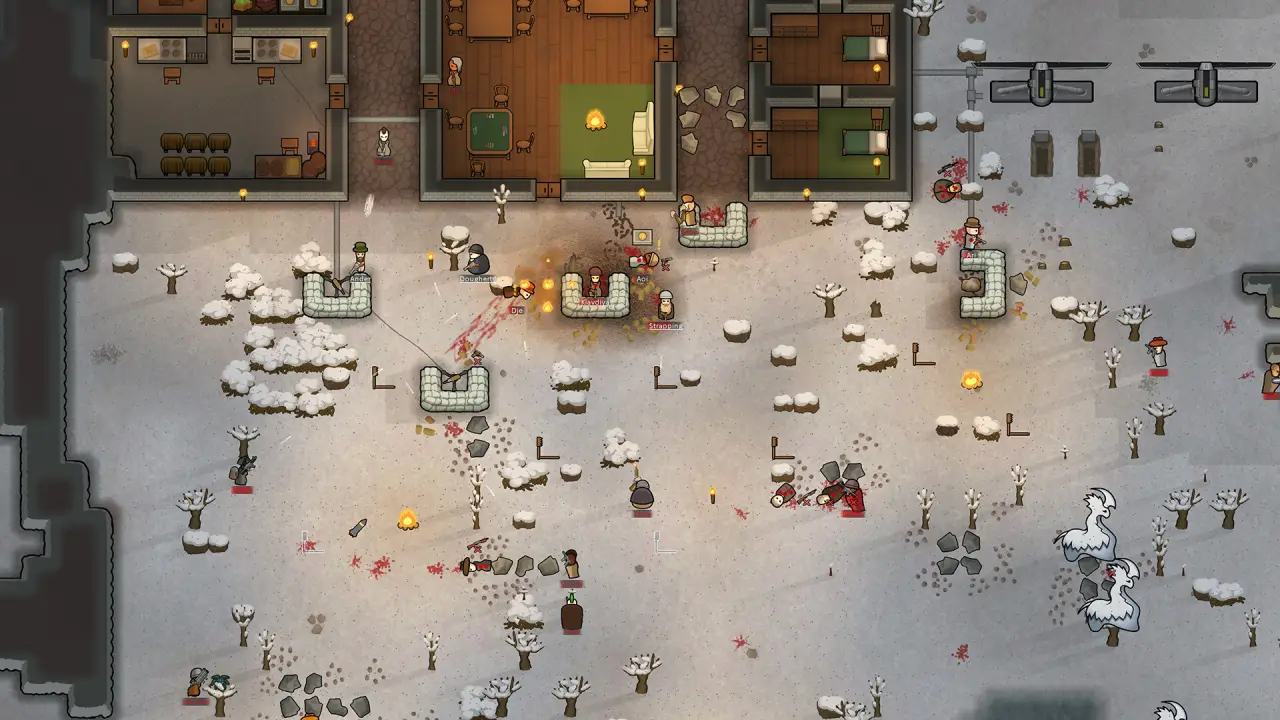
Combat audio is RimWorld's truly refined layer. Every weapon has independently recorded firing, reloading, and casing-drop sounds. M16 semi-auto rifle, Lee-Enfield rifle, double-barrel shotgun, revolver, autocannon, molotov — each weapon has an instantly recognizable "sound signature." When players are surrounded by multiple raiders, just the ear can judge "shotgun on the right, rifle on the left."
Environmental disaster audio is also carefully designed. Solar storms come with low-frequency electrical howl plus leaves rustling; fire spreads with wood crackling plus flame whoosh plus distant screams; winter brings wind howling plus tree branches snapping under snow weight. These environmental sounds let players sense the colony state not just via on-screen event prompts but also through auditory perception. Combat audio is also a key feedback loop in colony defense — without these cues, raid response times would slow noticeably for veterans. The 5.1 surround setup makes a particularly large difference during night raids when visibility is limited. Even seasoned RimWorld players consistently report that an audio overhaul can transform their colony management feel almost as much as visual mods.
Console and platform audio differences
The PS4 / Xbox One Console Edition was ported by Double Eleven Studios, with audio quality essentially matching PC. PS5 / Xbox Series players running Console Edition via backward compatibility enjoy faster load times. Steam Deck Verified rating lets players enjoy long handheld sessions with headphones delivering full stereo stage.
PC supports system audio drivers by default; 5.1 / 7.1 surround speakers or headphones yield equivalent experience. The community has produced mods adding 3D spatial audio plus dynamic music — the former improves enemy-direction sensing, the latter has BGM dynamically respond to colony state. These mods lift the originally minimalist audio system to indie industry's top tier. Multi-platform coverage lets RimWorld keep pace with player hardware evolution over 12 years. The Chinese community also maintains various audio packs for additional localization options. The Chinese community also maintains various audio packs giving local players more localization choices, ranging from completely new voice acting to subtle SFX tweaks aligned with regional taste. Overall audio gear investment yields the biggest experience boost per dollar among RimWorld hardware upgrades. The audio investment ladder also generates one of the strongest player retention curves in indie history.

Visuals | 7.5/10
Grafik: 7.5/10# Visuals
Art direction: minimalist 2D top-down is a deliberate choice, not a budget shortfall
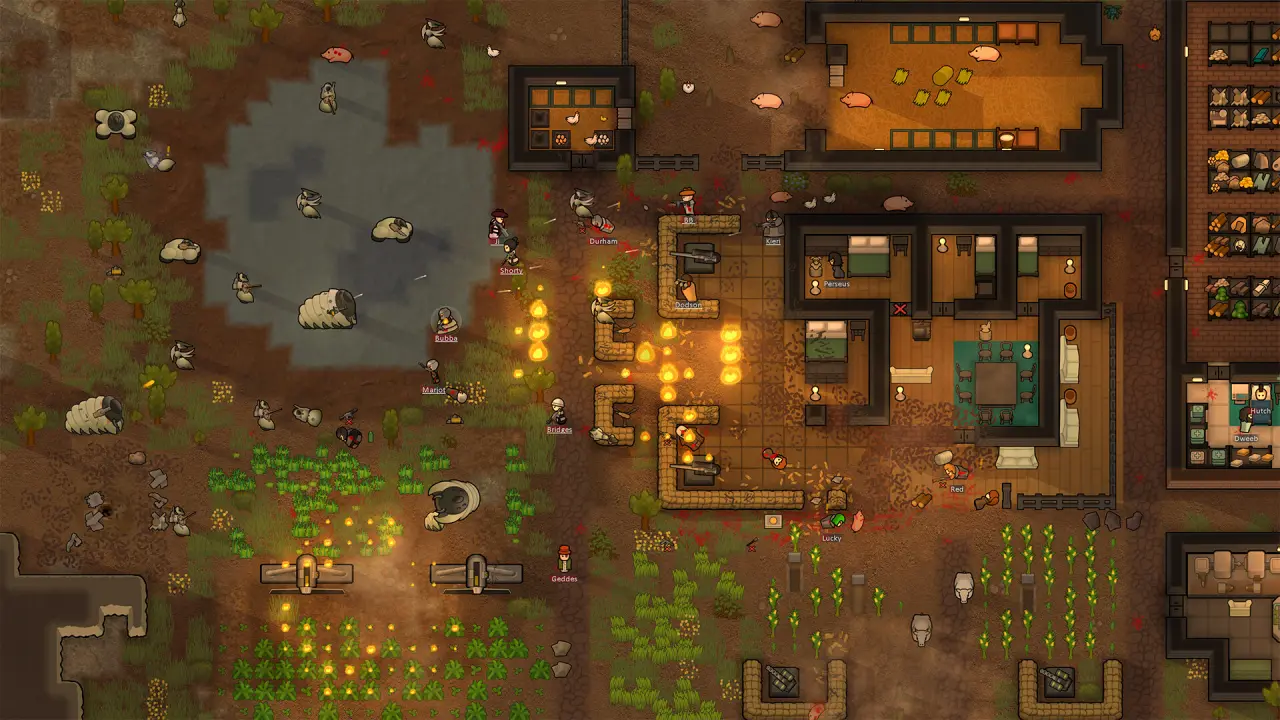
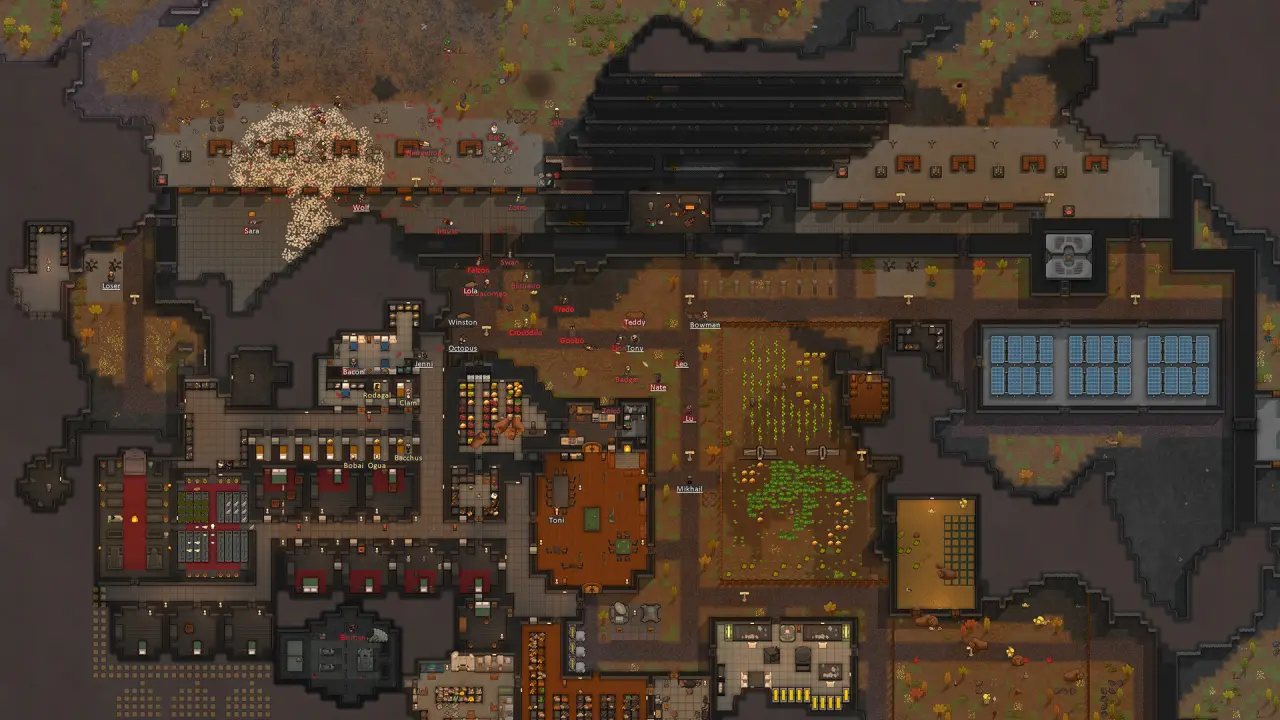
RimWorld's visual style is a rare "minimalist to the end" path in indie history — top-down 2D, pixelated textures, faceless legless colonist shapes, cartoony animal models, simple colored building blocks. Players coming from The Witcher 3 or Cyberpunk 2077 will feel "this graphics is so plain" in the first 5 minutes. But Tynan Sylvester discusses this choice explicitly in his book Designing Games — he believes refined graphics "distract the player from the systems."
One benefit of minimalist art is extremely low hardware requirements — Core 2 Duo plus 4GB RAM plus Intel HD Graphics 4000 will run RimWorld, letting it operate stably on any laptop, office PC, or last-gen console. Another benefit is readability — after 30 hours, players can instantly identify "that is a noble," "that is a pirate," "that is a mechanitor" purely from clothing color, weapon silhouette, and walking style.
Habrador's blog specifically points out: "The graphics is not distracting the player" — RimWorld trades graphical fidelity for "information density priority." Players can simultaneously track 30 pawn statuses, 20 room functions, and 10 enemy positions. This "information visualization" is simply impossible in high-fidelity 3D games.
Engine technology: Unity plus 30,000 mods co-evolving
The engine is Unity, consistent from 2013 early access through 2026. This is one of Tynan's key engineering decisions — choosing Unity over a proprietary engine to let 30,000+ mods integrate easily. Community modders just need Unity plus C# knowledge to write RimWorld mods, barrier far lower than custom engines. This "engine-friendly" choice is the engineering foundation of RimWorld's longevity.
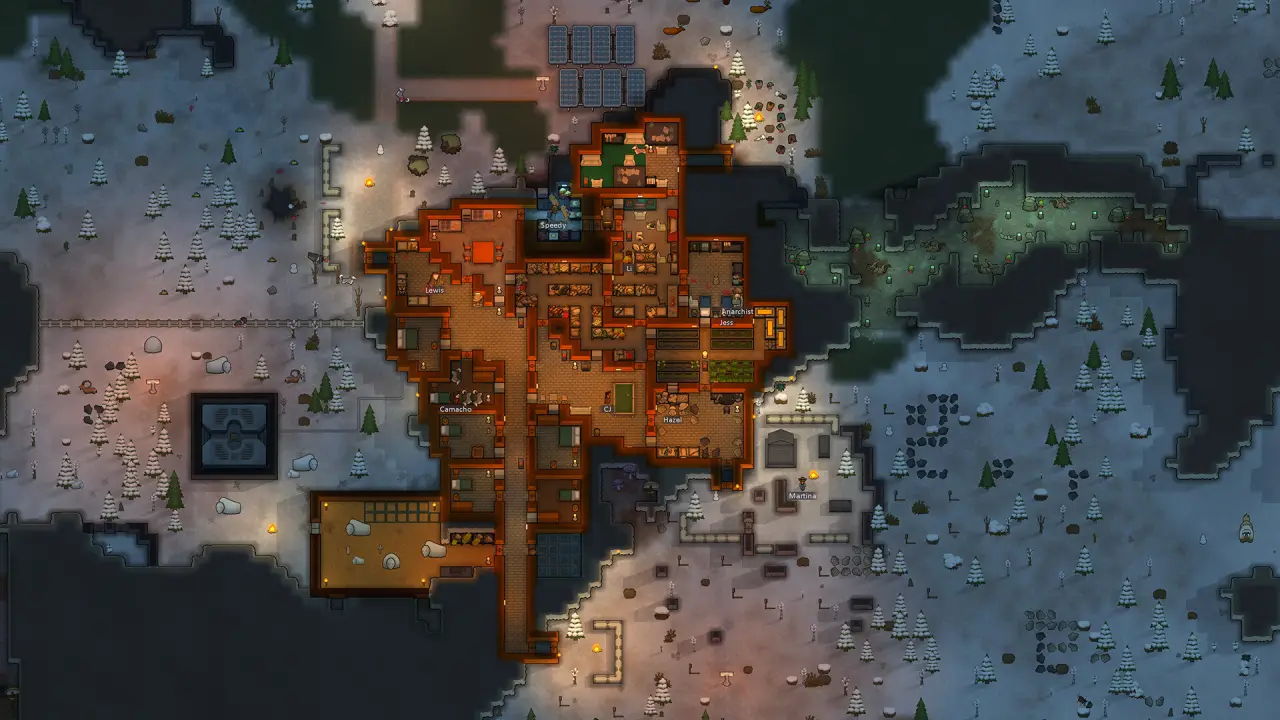
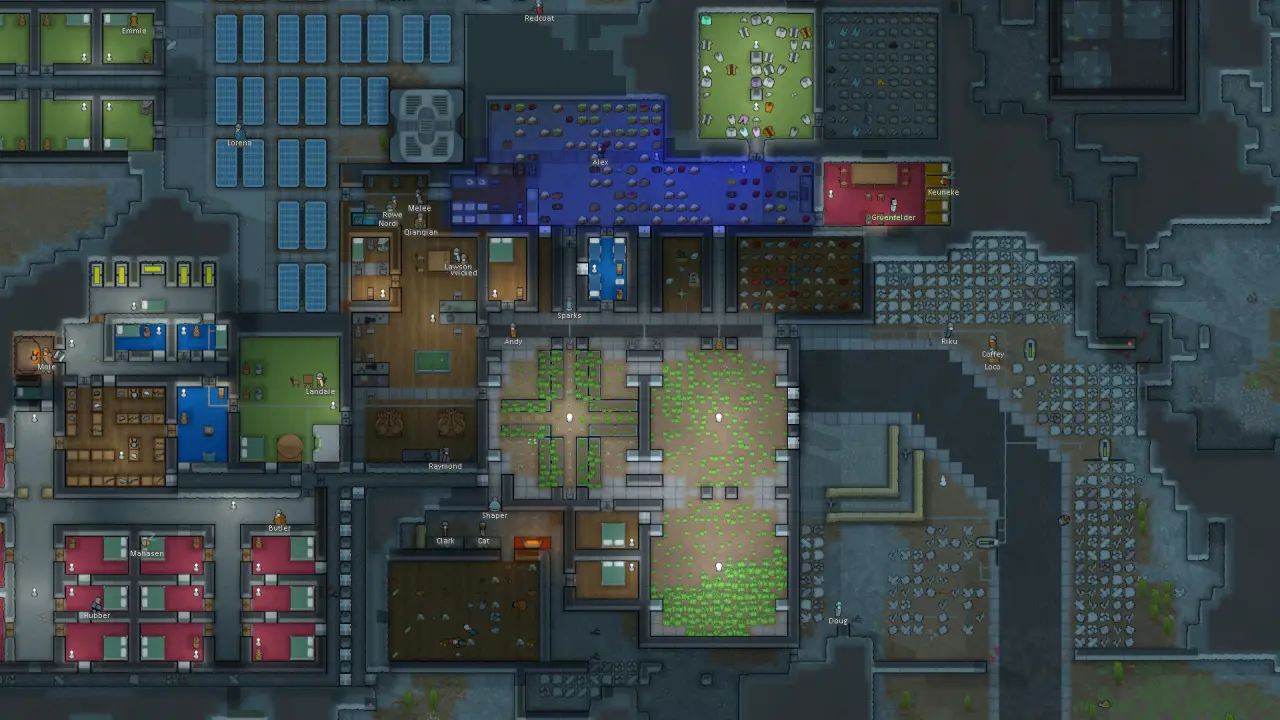
The engine focus is not refined rendering but "stable simulation of large pawn and object counts." The game supports 200+ NPCs, 500+ buildings, and thousands of items simultaneously simulated in real time. This "high-density simulation" runs stable 60 fps on Unity, a precision engineering achievement.
The 5 DLCs adding new mechanics (Royalty psychic, Ideology faith, Biotech genetic, Anomaly horror, Odyssey gravship) did not require engine upgrade — Tynan extended content purely via system design and code, avoiding "engine upgrades breaking mods" risk. This "old engine plus new content" operations model lets the RimWorld mod community keep investing without worrying about compatibility. Even the 5 DLC additions land cleanly inside this old engine, proving Tynan made the right call in 2013 by prioritizing modder accessibility over visual showcase.
Platform version differences
PC (Steam / GOG / Epic): 1080p to 4K plus 60 to 144 fps, mouse / keyboard / controller / Steam Deck support. Mac native supports M-series chips. Linux community-maintained, the first choice for simulation Linux players.
PS4 / Xbox One Console Edition: launched July 2022 ported by Double Eleven. Controller operation thoroughly redesigned — last-gen consoles natively support 4K 30 fps, PS5 / Xbox Series via backward compatibility run smoother.
Steam Deck: Verified rating, 1280x800 plus 60 fps, the best path for non-PC players. Handheld mode with touchscreen-plus-stick hybrid input lets RimWorld's complex UI ramp up stably. The community produces "Deck controller mapping mods" for hardcore feel improvements.
Overall, the 2026 optimal experience path is PC plus Steam plus 30000-mod ecosystem. Console-only players should choose PS5 / Xbox Series via backward compatibility; trial players should choose Steam Deck for the most portable and cost-effective option. Multi-platform coverage lets RimWorld keep pace with player hardware evolution over 12 years. Multi-platform coverage lets RimWorld keep pace with player hardware evolution over 12 years, and the studio has signaled continued support across these channels for years to come. Newer hardware also unlocks a few mod-driven visual upgrades that veterans now consider standard for endgame colonies.
UI and accessibility
UI is the most criticized visual layer of RimWorld. Habrador's blog explicitly notes "confusing beauty mechanics, unclear storage hierarchies, unintuitive menu structures." Newcomers spend their first 5 to 10 hours mostly reading popup bubbles and trial-and-error menu navigation. The community has produced many "UI Overhaul" mods rebuilding the entire interface, but the official version remains essentially unchanged.
For accessibility, RimWorld provides colorblind modes, subtitle size scaling, full key remapping, aim assist tiers (full assist to all off), and time speed (0.5x / 1x / 2x / 3x). These features let action-impaired players play stably, but fully-visually-impaired players still struggle (heavy UI reading required). Tynan acknowledged on Discord that this is a long-term RimWorld gap but lower priority than content updates. Chinese players' dependency on UI optimization mods is especially high — the RimHUD UI overhaul mod's Chinese version is almost every Chinese RimWorld veteran's first must-install mod. Chinese players also rely on UI optimization mods more than most regions, since the default English-centric UI assumes left-to-right text patterns that do not always align well with Chinese typography conventions.
Combat | 9.5/10
Gameplay: 9.5/10# Combat
Storyteller AI: three hosts decide the match pace
RimWorld's core gameplay mechanic is the AI storyteller system — at start, players pick one of three storytellers, and every random event, raid, and disaster throughout the match is decided by this AI. Cassandra Classic follows traditional tension-relief waveform, generating moderate crises at intervals with recovery time. Phoebe Chillax runs relaxed pacing, lower event frequency, softer crises, suited for casual players. Randy Random is completely unpredictable, possibly sending 5 refugees in the morning, brown bear ambush in the afternoon, and solar storm at night.
This storyteller system is the key design differentiating RimWorld from all peers. Peer references: Dwarf Fortress and Oxygen Not Included use fixed difficulty curves players can predict once mastered. RimWorld's AI storyteller dynamically analyzes the colony's "wealth threat points" — if your colony is richer, larger, more advanced, enemies scale up automatically. This "adaptive difficulty" means players never feel bored, but never feel fully safe either.
New players usually start with Phoebe Chillax, veterans gravitate to Randy Random's chaos. The community has produced many mod storytellers covering all styles — "absolute hell," "zen retirement," "hardcore survival," "mysterious flavors," and more. This "AI storyteller plus player-customizable difficulty" design lets RimWorld keep providing fresh experience for 12 years.
Pawn personality system: each colonist is an RPG protagonist
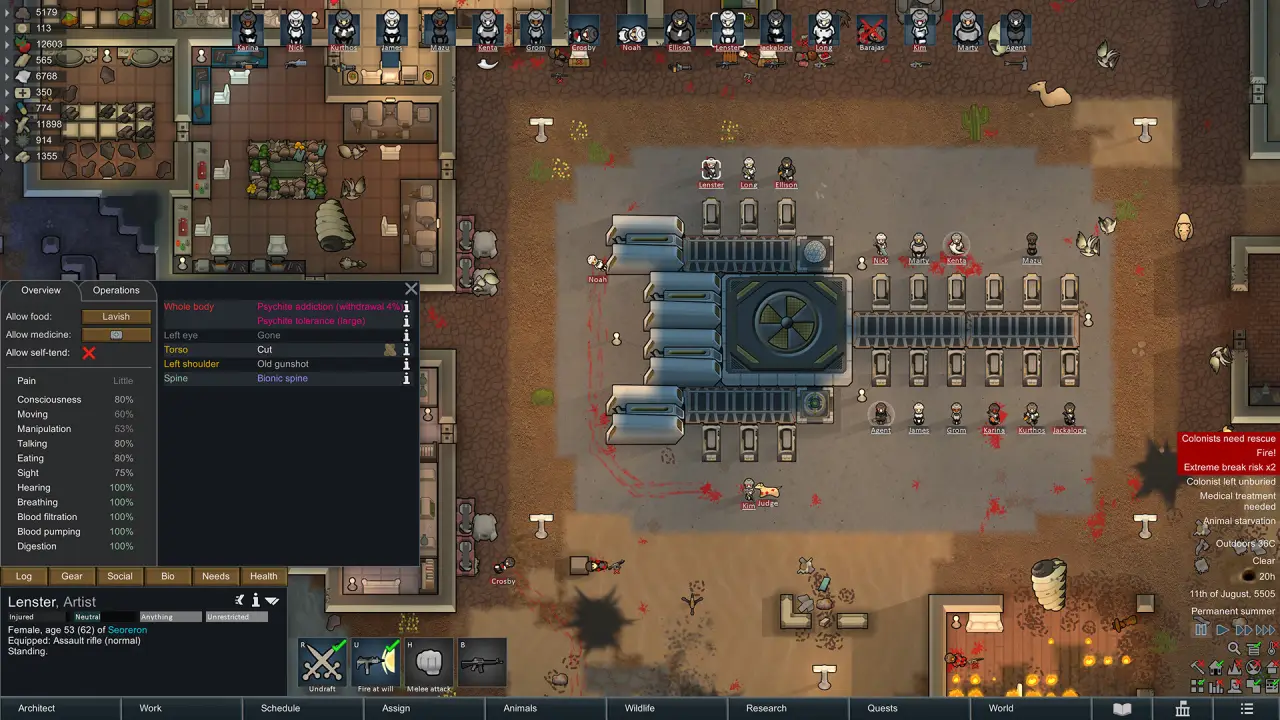
Each colonist (pawn) carries complete RPG-style attributes — 14 skills (construction, mining, cooking, research, art, medical, social, animal, plant, shooting, melee, intellectual, art, gathering), each maxing at level 20. Each colonist also carries 1-3 Traits randomly picked from a 100+ trait pool — Bookworm (research +50%), Bloodlust (melee damage +30%), Ugly (social -50%), Smoker (daily tobacco need or mood drop), Artist (artwork speed +50%), Psychic (can use psycasting), and more.
The body part system is another signature — each colonist has 14 independent body parts (left eye, right eye, left lung, right lung, heart, spine, left kidney, right kidney, four limbs, four ears). Any part can independently take wounds, infection, repair, prosthesis. A colonist losing both legs can install bionic legs to restore mobility; a colonist losing their heart can implant archotech ultimate heart for superhuman vitality. This "replaceable body" mechanic lets player colonists become increasingly "superhuman" as the game progresses, itself a long-tail progression.
The relationship system is the third personality layer. Each colonist holds independent opinions of others — love, hate, indifference. When affinity hits threshold, they automatically marry and have children; when affinity drops too low, they may fight or kill each other. Same-sex love, interspecies marriage, polyamory are all supported, turning every colony into a soap opera.
Work priority and mood: the management core
Work priority is the management core of RimWorld. The screen bottom shows 12 work categories — cleaning, medical, cooking, construction, mining, research, plant, animal, hunting, hauling, nursing, miscellaneous — each colonist assigned by priority 1-4 auto-allocating tasks. Players adjust this table to play to each colonist's strength. A shooting-18 colonist prioritizes hunting and combat, an art-15 colonist prioritizes artwork to boost colony beauty score.
The mood system is the other pillar. Each colonist's mood fluctuates from 0 to 100%, with over 50 influence factors — hunger, fatigue, witnessing corpses, witnessing death, sleeping on basic bed, fighting with spouse, artwork decoration, temperature too low, temperature too high, just escaped addiction, just married. Mood below 35% triggers a mental break — possibly fainting, arson, violent attack on others, or binge eating.
This "mood drives behavior" design lets RimWorld management transcend pure number games into "emotion management games." Letting a group of strangers coexist in the wilderness for hundreds of days demands constant attention to each person's emotional state — provide artwork, improve bedrooms, supply entertainment, isolate addicts. This fine-grained management is RimWorld's deepest design in the simulation genre.
Five DLC gameplay extensions
Royalty (Feb 2020) introduces Imperial faction and psycasting. Players can level up titles through royal quests, gaining Title ranks — Yeoman, Knight, Acolyte, and more. Each title unlocks dedicated psychic abilities, from "remote healing" to "instant teleport" to "summon meteor." This line extends the game from "industrial revolution" to "psychic superpowers." This "less but better" DLC strategy keeps RimWorld players from "DLC fatigue," every expansion launching becomes a community-hot topic, a standard textbook case for indie longevity operations.
Ideology (Jul 2021) introduces the faith system. Players design unique religious / cultural / moral memes for the colony — peace-loving, bloodthirsty, anti-alcohol, cannibalism. Each meme grants bonuses and penalties, sending differently-faithed colonies down completely different play paths.
Biotech (Oct 2022) introduces mechanitor and genetic modification. Players can learn mech control to direct mech units in combat; using gene labs to create xenohumans — from winged angels to fire-breathing demons. This line extends RimWorld from "simulation management" to "sci-fi role-playing."
Anomaly (Apr 2024) introduces horror elements. Players can activate the colony's monolith but pay the price of various supernatural anomaly events — undead invasions, hive bursts, psychic rituals, chaos entity capture. This is the series's boldest theme experiment, pushing the game into "supernatural horror" territory.
Odyssey (Jul 2025) introduces gravship and cross-stellar exploration. Players can build complete gravships, fly between planets, experiencing more expansive "interstellar pioneering" narrative. This is the largest of the five DLCs in scope.
Cross-genre feel comparison
Across the genre, RimWorld sits in the sweet spot of Dwarf Fortress, Oxygen Not Included, and Going Medieval. Dwarf Fortress barrier is extreme (ASCII text plus complex commands), Oxygen Not Included leans engineering optimization (more precise but more tedious), Going Medieval goes 3D but lacks depth. RimWorld uses minimalist 2D to make the same depth accessible while preserving "emergent narrative" randomness charm.
In finer comparison, RimWorld's learning curve is "30 minutes intro plus 30 hours mastery plus 300 hours exploration." First 30 minutes new players build first hut, plant first wheat, fight first native raid; after 30 hours players understand complex interactions among work priority, mood system, and relationships; after 300 hours players dig into each DLC's deep play or write their own mods. This curve lets RimWorld attract casual players and retain hardcore ones simultaneously. This "less but better" DLC strategy keeps RimWorld players from "DLC fatigue," every expansion launching becomes a community-hot topic, a standard textbook case for indie longevity operations. Many studios cite Ludeon as the gold standard for how indie teams should sequence post-launch content over the long haul.

Content | 9.6/10
Umfang: 9.6/10# Content
Main story length and pacing
How Long to Beat data shows RimWorld's main flow averages 75 hours — the shortest path to completing the base "build spaceship and launch off planet" ending. But the full experience requires "all 5 DLC endings plus all faction interactions plus all mod integration plus multiple Ironman permadeath attempts," lifting average clear time to 300 hours. LEVVVEL statistics further show RimWorld players average 211 hours of playtime, far exceeding The Witcher 3, Elden Ring, and Cyberpunk 2077 averages.
For pacing, single play sessions typically run 2 to 4 hours. New players go from start to first winter in 1 to 2 hours, then first large raid 3 to 4 hours, then spaceship launch 30 to 50 hours. This "long-span" pacing is unfriendly to fragmented-time players — RimWorld is not for "I have 30 minutes for a couple matches" relief, more for "I have a full weekend to seriously raise a colony" long investment.
PC players can use the 0.5x / 1x / 2x / 3x speed multiplier to flexibly adjust pace. Early building can run at 3x to skip tedious placement, combat returns to 1x for precise input, recovery periods at 2x to wait for events. This "time speed" mechanic is unique to RimWorld in the simulation genre, letting players control pacing freely by mood.
Five major DLCs plus continuous free updates
RimWorld's DLC matrix is the industry's unique "less but better" path — 5 DLCs averaging one every 1 to 2 years, each introducing complete new mechanics rather than minor tweaks. Royalty (Feb 2020) $24.99, Ideology (Jul 2021) $24.99, Biotech (Oct 2022) $24.99, Anomaly (Apr 2024) $24.99, Odyssey (Jul 2025) $29.99. All-5 DLC bundle prices around $125, plus the base game $35, full set about $160.
This pricing is considered "slightly expensive but worth it" in indie circles — each DLC adds 60 to 100 hours of completely new play to the existing colony. Tynan Sylvester has stated repeatedly on Discord "DLC will not be minor patches, only expansions that fundamentally change gameplay," letting RimWorld community accept new DLCs at high rates, most players buying on launch day.
For free updates, Ludeon has rolled out a dozen-plus 1.0 to 1.5 major version updates over 5 years, adding new buildings, animals, events, biomes, balance adjustments. Every major version is free, letting all players enjoy new content. This "DLC paid plus major version free" hybrid model keeps RimWorld retention rates extremely high across 12 years. Long-term fans often replay all five with completely different starting traits to see how dramatically the colony stories diverge.
30,000+ mod ecosystem: Steam Workshop miracle
PC players' largest content increment is the 30,000+ mod library on Steam Workshop. RimWorld's mod count ranks in Steam's top 5 across all games, alongside Skyrim, Stellaris, Cities Skylines. Mods break into categories — pure additions (new weapons, races, buildings), gameplay overhauls (new storytellers, events, mechanics), UI optimization, localization, art style replacement, and balance tweaks.
The most famous overhaul mod is "Combat Extended" — converting RimWorld's combat from abstract numbers to real ballistics plus reload timing plus ammo management. This mod's cumulative downloads exceed 5 million, an Arma-RimWorld "must-install mod" among veterans. Other essentials include "RimHUD" (UI optimization), "Common Sense" (AI improvements), and "Rocketman" (performance optimization for faster games).
The Chinese community's mod translation ecosystem is especially active — virtually every English mod has a corresponding Chinese translation, maintained voluntarily by Chinese RimWorld communities like "Huiji Wiki." This lets Chinese players enjoy identical mod experience to English players. Several Chinese-original mods are also famous, such as "Chinese-style Architecture Pack," "Three Kingdoms Characters," and "Peking Opera Costume Series." Tynan also commits publicly to keeping the modding API stable across patches so existing mods never break, which is a major reason modders trust the Workshop ecosystem.
12-year longevity operations rhythm
RimWorld is one of the few Steam titles holding heat for 12 years. The 2018 1.0 launch immediately won Steam's user-rated game of the year, and the 2020-2025 stretch produced 5 DLCs, with the game still in Steam's global top 100 sales by 2026. This "old game longevity" on Steam is matched only by RimWorld, Stardew Valley, Factorio, Terraria, and a handful of others.
LEVVVEL data: RimWorld 62,000 concurrent peak, 203,000 reviews 98% positive, 3.5 million total sales, $90 million revenue, average 211 hours. This data on any indie game would be "phenomenal," and RimWorld delivers continuously from Ludeon Studios — a small studio founded by Tynan Sylvester alone.
The core of this long-tail operations strategy is "keep delivering major DLCs to old fans plus let the mod community self-circulate." Tynan does not seek to attract new players. His strategy is to serve the existing 3.5 million hardcore players, letting them keep investing, recommending, and maintaining the community. This "small but beautiful plus long and durable" operations philosophy is the foundation of 12-year longevity and a textbook indie industry case. Chinese mod creators have also begun selling premium mod bundles via PayPal donations, building a small parallel economy on top of the free Steam Workshop system.






Kommentare 0
Wir freuen uns auf deine Meinung
Beteilige dich an der Diskussion und teile deine Bewertung des Spiels.
Noch keine Kommentare — teil uns deine Meinung zu diesem Test mit!