




















Opening
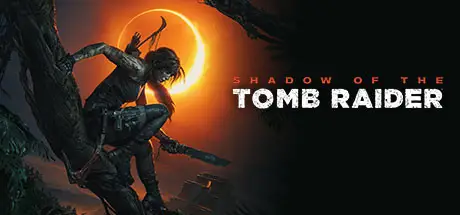
Lara Croft presses her mud-caked face against a vine-choked cliff and stops breathing. Ten metres out, Trinity mercenaries crunch through the leaf litter on patrol, and not one of them notices the wall that moves. In that single held breath, Shadow of the Tomb Raider: Definitive Edition says everything it came to say. This Lara is not the survivor clawing her way out of the rubble. This Lara is the thing in the trees.
It is the dark close of the rebooted trilogy, and the bleakest chapter of the three. Eidos-Montréal took the wheel and made a bold decision: turn whole tombs into towering three-dimensional machines, fold combat down into jungle predation, and drag exploration and puzzle-solving back to where the series name actually points. It does not chase the action crowd with flashier gunfights. It slows down and digs in instead.
That stubbornness is exactly what makes it hard to replace today. While most action-adventures race to be faster and louder, Shadow chooses to sit you in front of a wall of gears until something clicks, then chooses to make you hold your breath in the grass. The Definitive Edition packs in the full story and all seven challenge tombs, and it is the cleanest way to walk this dark road from end to end. What follows is a closer look at how that bet pays off — and where, by its own admission, it comes up a beat short.
Story | 6.0/10
Story: 6/10An apocalypse Lara lights with her own hands

Shadow opens with a mistake. Chasing operatives of the paramilitary order Trinity into a Maya tomb beneath Cozumel, Mexico, Lara reaches for a relic she has no business touching and triggers a prophesied apocalypse called the Cleansing. A tsunami swallows the harbour. A child is torn from his father's arms while she watches. That image is the moral ground floor of the entire game: the villain does not end the world here. The hero lights the fuse herself.
This premise is the hinge that swings Shadow away from its predecessors. In the first two games Lara was a victim shoved along by fate, surviving. Here the catastrophe is hers, and she has to carry the guilt while she races to undo it. The action moves from Mexico to the Amazon basin of Peru, where she hunts for the ritual that will stop the cataclysm before it fully lands. The whole spine of the story is one woman paying for her own recklessness. Less "save the world," more "clean up the mess you made."
That weight is new for the series. Human sacrifice, a Maya doomsday, a dead child in the opening hour — Shadow reaches for shades its predecessors never dared touch, and the result is a register far heavier and more grown-up than Rise managed. Lara watches too many innocents die on her account, the guilt stacks up brick by brick, and the game quietly asks who should pay the bill when an adventurer chases a legend too far.
Lara's arc finally reaches its end
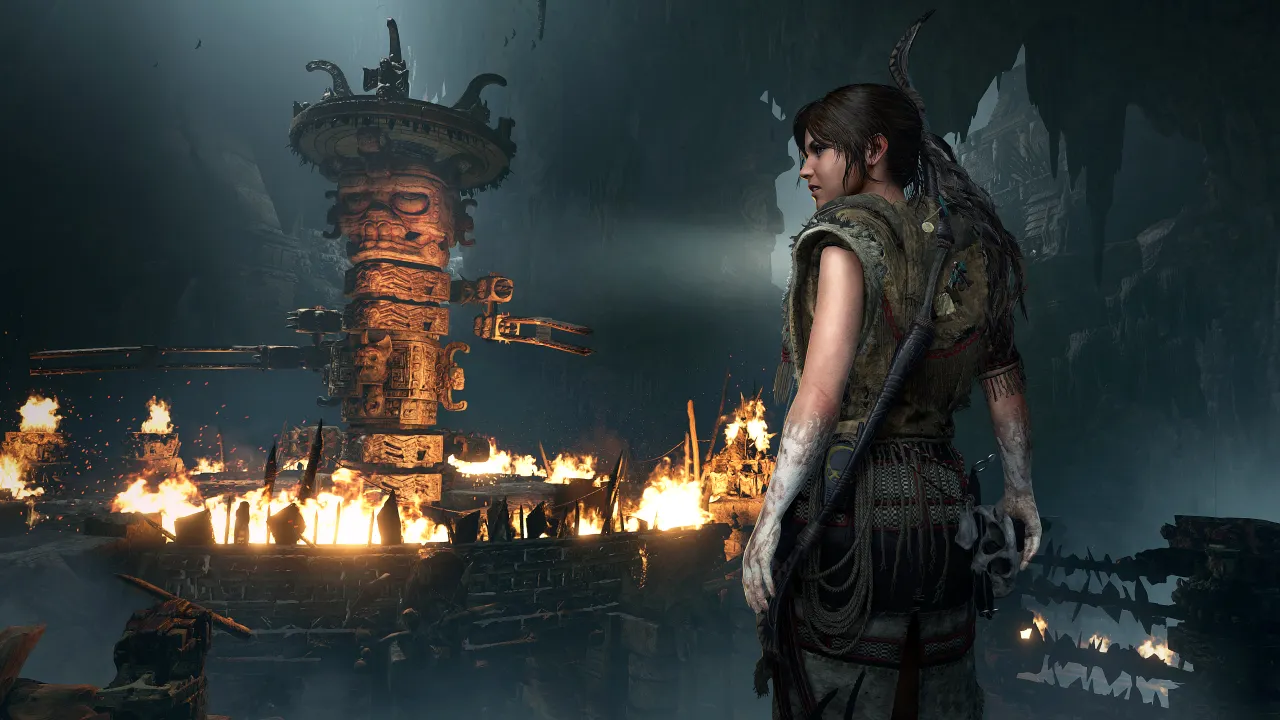
If the trilogy is the story of how a frightened young woman becomes the Tomb Raider, Shadow is the chapter that draws the line under it. Camilla Luddington returns to voice and mo-cap Lara and delivers the most assured performance of the three games. Early on she still buckles under what she has done; by the back half she walks into lethal tombs without flinching and makes cold, brutal calls for the sake of the larger goal. The panicked kid is gone. What remains is someone willing to descend into the dark alone.
Her companion Jonah Maiava, played by Earl Baylon, is the anchor for all of it. The tension between them — his quiet "I'm worried you've gone too far this time" — leaves a thread of warmth running through an otherwise grim jungle. As Lara hardens into a predator, Jonah becomes the hand reaching to pull her back, and that contrast is what lets her arc stand up. Many of the game's quietest beats are just the two of them around a fire, trading a few lines, no swelling music, slowly convincing you that Lara is genuinely changing and that someone genuinely cares whether she loses herself.
Bold in the setup, soft in the landing
The thing Shadow is most often dinged for is precisely the thread that should have been its strongest. It loads the opening with guilt, then fails to pay it off with equal force at the close. The moral heft of Lara causing the disaster and then atoning for it gets diluted by ritual and set-piece spectacle by the finale, and the themes never fully resolve. Game Informer landed on a 7.5 for exactly this reason, filing it under the headline "In the Shadow of Something Greater" and calling it a step back from the series' potential.
Held up against Rise of the Tomb Raider, the sibling that played its story safer and steadier, Shadow gambles on something more introspective and personal. It wins the bet on tone and loses it on the landing. The narrative ambition here is the largest in the trilogy; the execution comes up a beat short. That gap is why story is the most restrained score in this review. And yet — daring to hang this much guilt on its lead is worth a line in the ledger all by itself. Plenty of blockbusters would have softened that opening, handed Lara a clean conscience, and let her play the unambiguous hero. Shadow refuses, and the refusal is the most interesting thing about it, even when the back half cannot quite carry the weight it picks up.
Audio | 7.5/10
Sound: 7.5/10South American instruments that pin you to the jungle

Brian D'Oliveira scored Shadow and made one very right call up front: skip the big Hollywood orchestra straining for epic, and reach instead for pan flutes, ocarinas and hand drums — the instruments of the region itself. The music and the Maya-Inca setting lock together. Walk through the market in Paititi and what fills your ears is reedy, earthy flute over a dense pulse of drums, and for that moment you are standing in a jungle city rather than some reskinned "exotic level" template. That care in sourcing gives the soundtrack a geographic fingerprint from the very first bar.
The restraint pays off hardest inside the tombs. When Lara drops alone into a pitch-black mechanism, the score recedes almost to nothing — a drip of water, the echo of a footstep, one held string under it all — and lets the claustrophobia and isolation do the work.
Only once the puzzle yields and the sleeping machine grinds to life does the music climb back in, an emotional reward for the solve. The soundtrack never sits there as wallpaper. It breathes with your exploration, holding its breath when you hold yours, then exhaling in a slow swell of strings and panpipe the moment a buried chamber finally opens to the light. Few games this size are so disciplined about saying nothing when nothing is the right thing to say.
Drums that tighten the wire for you

Combat audio serves the same predator at the centre of everything. With Lara smeared in mud and crouched in the long grass, an enemy's footsteps drift closer and the drums tighten, beat by beat, tensing the wire before you do. The second you're spotted the music detonates, shoving you to either finish it fast or melt back into shadow. That arc — silence to eruption and back to silence — gives every held breath of the stealth its own audible answer. The tension is something you hear, not just something you see.
The voice work is the other quiet win. Luddington's delivery shifts from the early panic and self-blame to a later, settled certainty, and the change in her voice tracks the character arc line for line; Baylon's rough, warm rasp as Jonah keeps a little heat in a cold jungle. The environmental layer holds up too — the layered insect drone, the muffled thud of a heartbeat underwater, the churn of disturbed water as piranhas close in. Eyes shut, you would still know exactly where you are standing, and roughly how much danger you are standing in.
In all honesty, though, the audio is competent throughout without ever handing you a single theme you want to loop on its own, the kind that stays with you after the console is off. It fills the atmosphere fully and well, but the memorable peaks are thin on the ground — no hummable hook, no signature motif that becomes the game's calling card the way the best scores manage. That is precisely why this column lands on a 7.5 rather than something higher. The mood is impeccable; the melody you carry home is the part that goes missing.
Visuals | 8.5/10
Grafik: 8.5/10Probably the best-looking Tomb Raider yet

Plenty of reviewers called Shadow the most beautiful Tomb Raider, and it is not flattery. Foliage, skin and light get a near-photoreal pass — the jungle is wet, water beads on every leaf face, and sunlight breaks through layer on layer of canopy in dappled, shifting shafts. The ruins are old in a way you can feel: moss and vines crawl the stonework, and every block looks like it has sat there in silence for centuries. That humid, overgrown, faintly dangerous texture of Central and South America is held up rock-steady by the environment art, and you can almost smell the rainforest damp off the screen.
What is rarer is how it keeps the atmosphere coherent under all that detail. From sun-scorched open jungle to cramped, torch-lit tombs; from a mud-slicked village to a gold-drenched altar — every cut serves the single word exploration. You are not looking at a string of isolated pretty screenshots. You are wrapped inside one believable, continuous, living lost-world. That immersion is the most valuable thing the visuals do. The lighting tells stories too: a torch throws shuddering shadows across cave stone, daylight from a temple's broken ceiling gilds an altar of gold, and the wet shine of the rainforest brings every leaf alive. The art is not flexing for its own sake — it is speaking for this lost world. Even the weather earns its keep: a sudden downpour turns a sunlit clearing into a grey, hammering wall of water within seconds, mud sucks at Lara's boots, and the whole palette shifts from emerald to slate. These are not cutscene flourishes; they happen mid-traversal, and they keep reminding you that the jungle is a living thing indifferent to whether you survive it.
Paititi: a jungle city with a pulse
If you had to pick one unforgettable landmark in Shadow, it would be the lost city of Paititi. It is the largest hub in the game, and it is nothing like a notice board for quests. The city has a loud, crowded market, its own faith and its own rites, and Quechua-speaking residents who actually live around you. Walk the streets and you catch the cries of vendors, children chasing each other down alleys, small figures grinding out a living. This is a city with a pulse, not a bank of hollow, empty exploration nodes.
It is exactly that living city that keeps Shadow's exploration loop from collapsing into mechanical checklist-ticking. You linger in Paititi, drift down a few more side streets, not because a quest icon is nagging you, but because the place is simply worth wandering.
The craft of environmental storytelling hits its peak inside these walls. Murals on the temple steps hint at rituals long finished, a vendor's stall says more about the local economy than any codex entry could, and the hush that falls over the upper terraces tells you which parts of this society fear the coming Cleansing. Nothing here is narrated at you; it is built, and left for you to read.
Versions: check which machine you're on first

Under the hood Shadow runs on the Foundation engine, and on capable hardware the texture density and lighting depth are solid. It was also one of the few big releases of its day to optimise specifically for mid-tier consoles: on PS4 Pro and Xbox One X you choose between resolution priority (up to 4K), frame-rate priority (a steadier 60), and quality priority (richer effects), and that hand-the-choice-to-the-player thinking is of a piece with its difficulty sliders. The PC build opens the visual ceiling and graphics options wider still, pushing top-tier foliage and lighting on a strong rig.
One caveat, though, and it is a real one: the gap between platforms is tangible. On Metacritic the Xbox One version scored 82, clearly above the PS4's 75. The same Shadow, in other words, can play a tier apart depending on the box under your TV, so it is worth checking your platform's reputation before you commit. Set beside a same-year visual benchmark like God of War, Shadow may not win on character close-ups, but where it genuinely wins is the density and credibility of a whole exotic world laid out in front of you. It is the difference between a game that renders a beautiful face and a game that renders a beautiful place you believe people actually live in, and Shadow is unmistakably the second kind.
Combat | 9.0/10
Gameplay: 9/10A whole tomb that is one giant machine

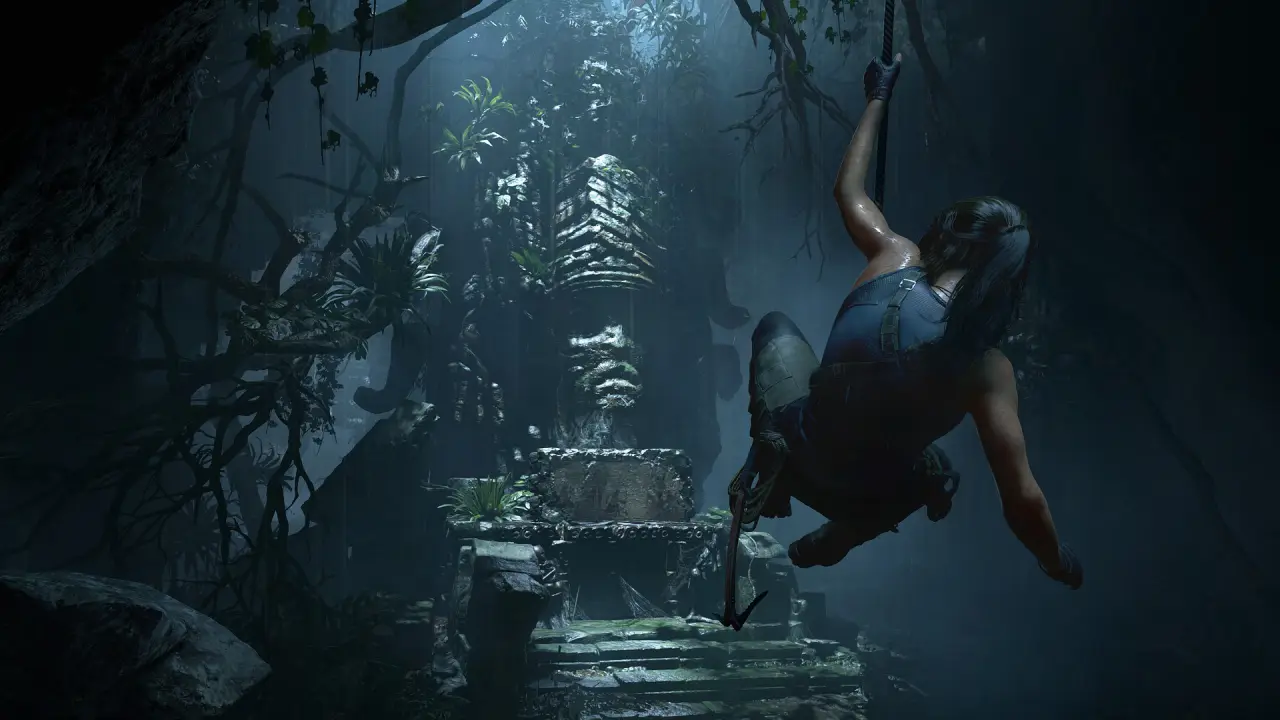
The thing most worth talking about in Shadow is the sheer scale it gives to puzzle-solving. Earlier games leaned on flatter jigsaw mechanisms; Shadow builds the entire tomb into one towering machine — water levels rise and fall, gears mesh, counterweights balance, and beams of light have to be steered to land where they belong. You work several interlocking mechanisms across a full three-dimensional space, in the right order. This is no longer "find the switch and press it." It is read how this tomb runs, then make it run for you.
That spatial scale is the largest in the reboot trilogy. A single challenge tomb is often a complete vertical riddle in itself: you circle it, climbing up and dropping down, reading the flow of water, the direction of the wind, the linkage between mechanisms, advancing on the clues the environment itself hands you, and the solve rewards a unique skill. For anyone who loves to think — who lives for that "oh, that's how" jolt of understanding — this is Shadow's biggest high, and the bedrock under its 9.0 in gameplay.
Turning combat into a lethal puzzle

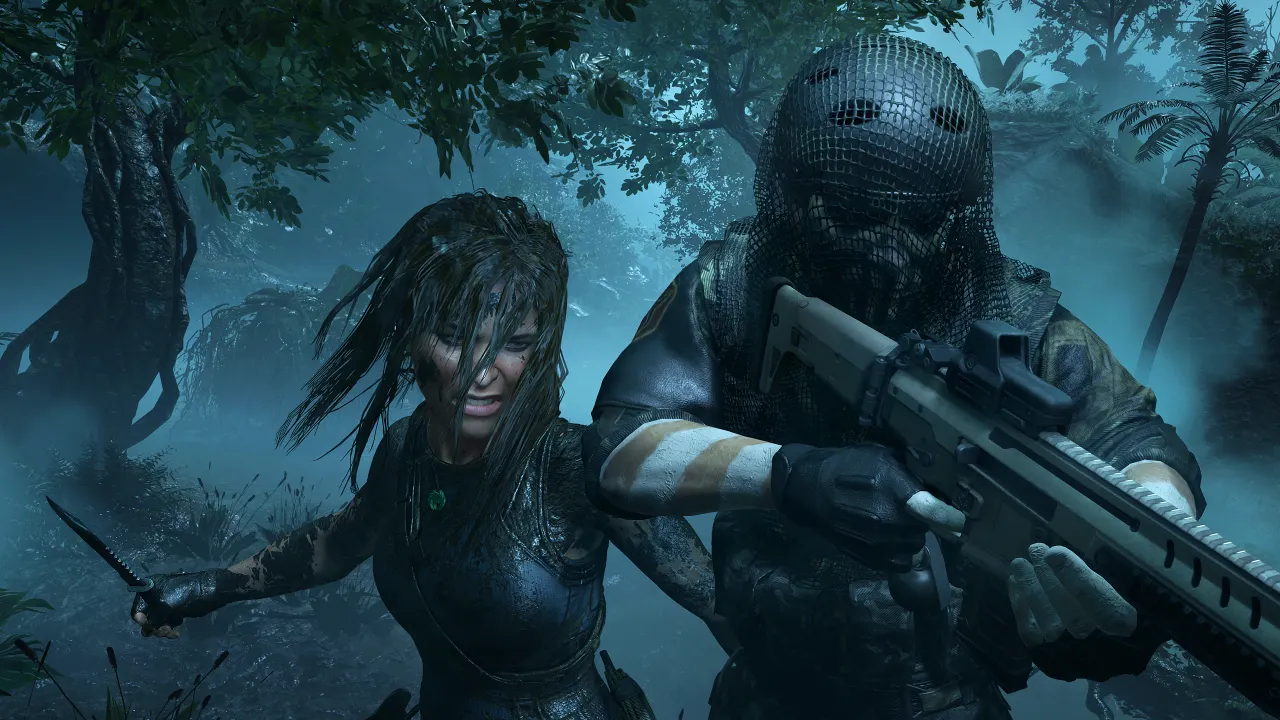
The other clear evolution is stealth. Shadow leans on concealment harder than any game before it: open gunfights are far less forgiving, Lara dies easily, and so sneaking and assassination become the optimal answer almost everywhere. You can smear face and body in black mud, vanish against a vine-covered wall, surface silent from chest-deep water, and drag an isolated enemy off into the dark. You can string a body up in a tree and let fear unravel a whole squad's nerve before they ever find you.
This jungle-predator loop treats combat in the open like a lethal puzzle in its own right: scout the patrol routes first, then decide where to start and what order to clear them in.
It rhymes neatly with the story's arc of Lara turning colder to stop the apocalypse — play it long enough and you genuinely start to feel like the thing waiting in the trees. The game even leans into the cruelty of it: tagging an enemy from a tree of mud-camouflage, watching his partner stumble on the body and break formation, then picking off the panicked stragglers one by one. It is uncomfortable in a way the series has rarely been, and that discomfort is the point. That fusion of mechanics and narrative is one of Shadow's smartest tricks.
Holding your breath underwater, and splitting difficulty in three
Underwater exploration is the fresh slab Shadow adds, and the place it salutes classic Tomb Raider. Lara pushes forward on a single held breath, dodging shoals of piranhas, hunting for air pockets in flooded caverns to refill before pressing deeper. That oxygen-bottoming, pitch-dark, surface-or-drown claustrophobia is a flavour old fans know in their bones, and it bolts a layer of vertical depth onto exploration that is otherwise built on climbing.
The genuinely clever design, though, is splitting difficulty into three separate dials: exploration, puzzle and combat, each tuned on its own. Want hardcore puzzles but you're no good in a fight? Crank the puzzles, drop the combat. Just here to drift and sightsee? Lower all three and let Lara's muttered hints and the white survival paint guide you. That three-axis split hands the question "what kind of Tomb Raider do I actually want" straight back to the player, fully and cleanly, so casual explorers and hardcore solvers can share one game and neither has to settle.
The one weak link sits in open combat itself. Against the finesse of the stealth, the gunplay and enemy AI carry over almost untouched from Rise of the Tomb Raider, with no real leap forward, and that is the main hook critics hang the "short on innovation" line on. The saving grace is that the game is already coaxing you to shoot less and sneak more, so in actual play that weakness gets quietly routed around most of the time, and it never really drags the whole experience down. By the time the credits roll you may realise you spent more of the run reading rooms and rerouting machines than firing a shot, and that ranged combat was always the least interesting tool on Lara's belt.
Content | 8.5/10
Umfang: 8.5/10Twelve hours on the main path, double that to clean it out
Shadow's campaign runs around 12 hours, and the pacing is kept admirably tight. It does not pin you to a map and make you grind copy-paste outposts the way a hundred-hour open world might. Instead a relatively lean main path carries you from a seaside town in Mexico, deep into the Amazon basin of Peru, and down into one lost tomb after another. The density of that path is high — every hour or two there is a set-piece you remember, a tomb worth chewing on, or a ruin that makes you stop just to look. It never rushes you, but it never leaves you idle either.
Want to wring the land dry, though, and the clock doubles: finish every challenge tomb, side mission, crypt and scattered collectible, and a hundred-percent run lands near 31 hours. For a largely linear action-adventure, that is a generous body of content, and crucially it is content you reach by choosing to, not content the game forces between you and the ending.
What matters more is that the filler is not actually filler. The side quests around the Paititi hub, the outfit blueprints tucked inside crypts, the artefacts and murals strewn across the map — much of it is not pure fetch work. Plenty of the side missions pull you into the history of this jungle civilisation, the lives and faith of its people, so that collecting becomes "reading a story on the side" rather than coldly crossing icons off a map.
You'll go out of your way for one more trip just to learn how a character's story ends, or to see whether a missing villager turns up alive. That blood-and-bone way of filling the world is the key to why Shadow holds up on volume — it does not pad the clock with bloated lists; it tries to make every explorable corner worth a glance. Even the optional crypts, which exist mostly to dispense cosmetic gear, hide a sarcophagus or a trap sequence interesting enough to justify the detour. The result is a campaign that feels fuller than its hour-count suggests.
The Definitive Edition's trump card: all seven challenge tombs
The biggest mark in the Definitive Edition's favour over the 2018 base release is that it folds in all seven of the DLC challenge tombs that trickled out after launch. The Forge, the Path of Huracan, the Howl of the Monkey Gods, the Sixth Seal, the Slayer's Gauntlet, Zipacna's Craving, and Mother Protector — each is a self-contained vertical riddle carrying its own small narrative side mission, paired with score-attack and time-attack modes, and several supporting two-player co-op runs. Their design philosophy runs straight from the campaign's challenge tombs: observe, reason, act, and finally make the whole tomb run for you.
For anyone who loves hardcore puzzling, those seven tombs hand you the distilled essence of Shadow's "the tomb itself is the machine" idea in one go. You no longer have to wait out a slow drip of releases and buy them piece by piece the way launch players did; buying the Definitive Edition is carrying the entire spatial-puzzle estate home in a single trip.
Factor in every outfit and weapon plus the later multi-platform ports — PC, consoles, even cloud streaming — and the Definitive Edition is the optimal version for swallowing the full story and the complete collection at once. For a newcomer it is the no-brainer default for entering this trilogy's finale; for a veteran who only ever bought the base game, it backfills every loose piece, saving hassle and working out cheaper over the long run. The word "definitive" earns its keep here — this really is the most complete way to experience Shadow as it stands. Whether you want story completeness or a clean sweep of achievements and collectibles, this version lets you walk Lara's harrowing jungle journey from end to end with nothing left behind. There is no later, fuller edition to wait for and no scattered season pass to reassemble — what you buy is the whole of it, the campaign, the tombs and the trimmings, settled into a single package that has had years to prove it holds together.






Kommentare 0
Wir freuen uns auf deine Meinung
Beteilige dich an der Diskussion und teile deine Bewertung des Spiels.
Noch keine Kommentare — teil uns deine Meinung zu diesem Test mit!