

























Opening
Slay the Spire did not just succeed; it founded a genre. When MegaCrit released it in full in 2019, the roguelike deckbuilder was barely a category — and within a couple of years it was one of the most fertile design spaces in independent gaming, populated by dozens of imitators and successors all speaking a language that Slay the Spire invented. The premise is deceptively simple: pick one of four adventurers, climb a procedurally generated spire across three acts, and build a deck of cards on the way up by choosing rewards after each battle. But beneath that simplicity is a strategic loop of such depth, balance and addictiveness that seven years later it remains the benchmark against which every game in the genre it created is still measured.
The magic is in the fusion. Slay the Spire welds the deckbuilding of a card game to the run-based, permadeath structure of a roguelike, so that every climb is a fresh puzzle: the cards you are offered, the relics you find, the paths you choose, and the enemies you face all combine differently each time, demanding that you build a coherent strategy out of whatever the run gives you. With four characters whose card pools play completely differently, a twenty-rung Ascension difficulty ladder, and a 30,000-mod Steam Workshop that makes the content effectively bottomless, it is a game measured in hundreds of hours and defined by the most famous compulsion in the genre — just one more run.
This review grades Slay the Spire across six dimensions, and the scores describe a near-perfect specialist: a 9.7 for gameplay and a 9.5 for content sit at the very top, an 8.5 for audio and an 8.0 for its clean functional graphics support them, and only a 6.5 for a story it deliberately omits brings the average down, landing on an 8.9 overall. That spread is the whole story. Slay the Spire is systemic design at its sharpest, gated only by its turn-based pacing, its reliance on luck, and the near-absence of a plot — none of which matter to the players it was made for. The next six sections explain exactly who those players are.
Story | 6.5/10
Story: 6.5/10Slay the Spire scores 6.5 for story, its lowest dimension, and the number is a straightforward acknowledgment that narrative is simply not what this game is about. There is no campaign, no characters with arcs, no dialogue to speak of — just the looming presence of the Spire and the implicit goal of climbing it. For a roguelike deckbuilder this is entirely appropriate, and the score reflects an absence by design rather than a failure of execution.
The mystery of the Spire
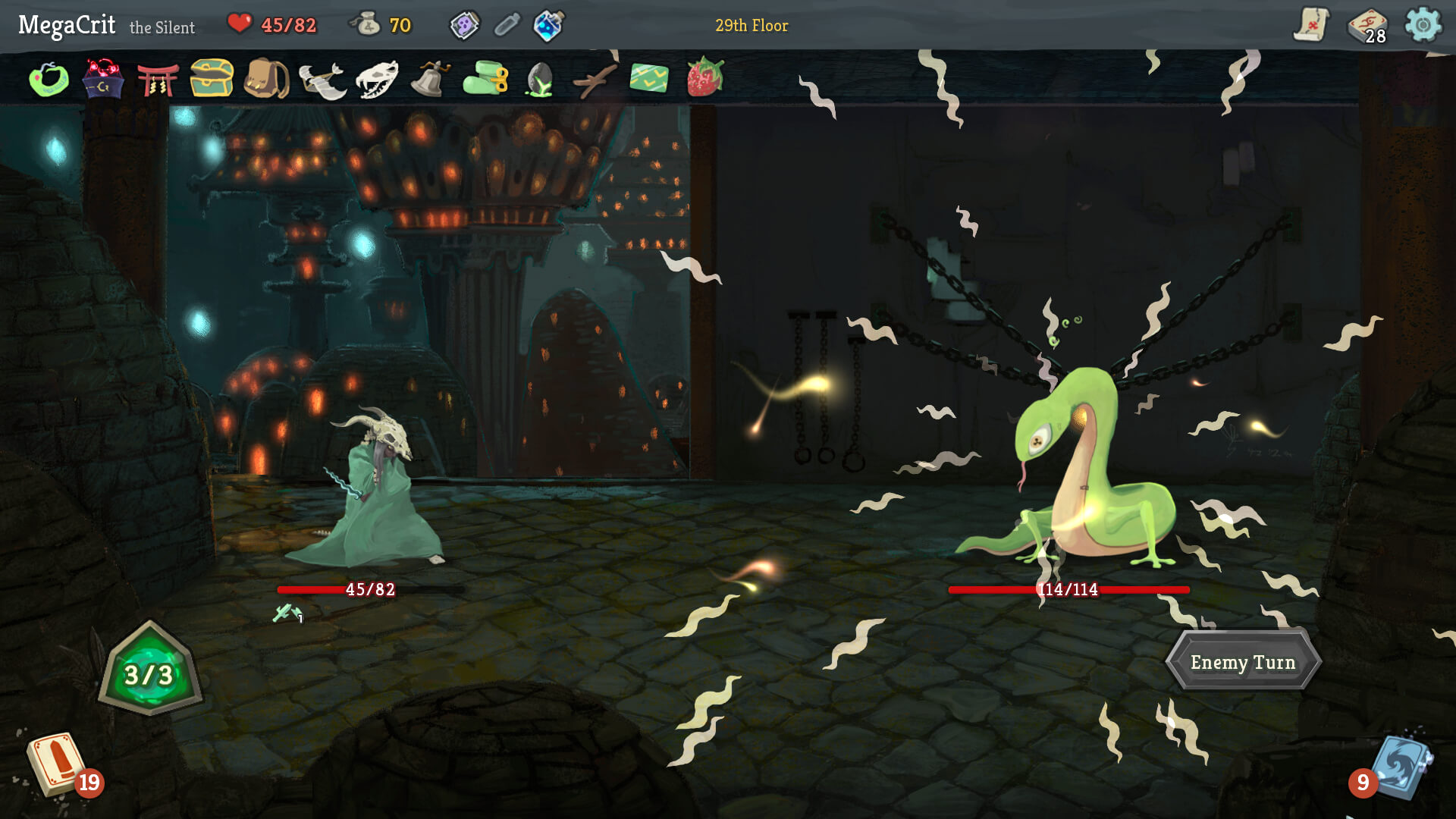
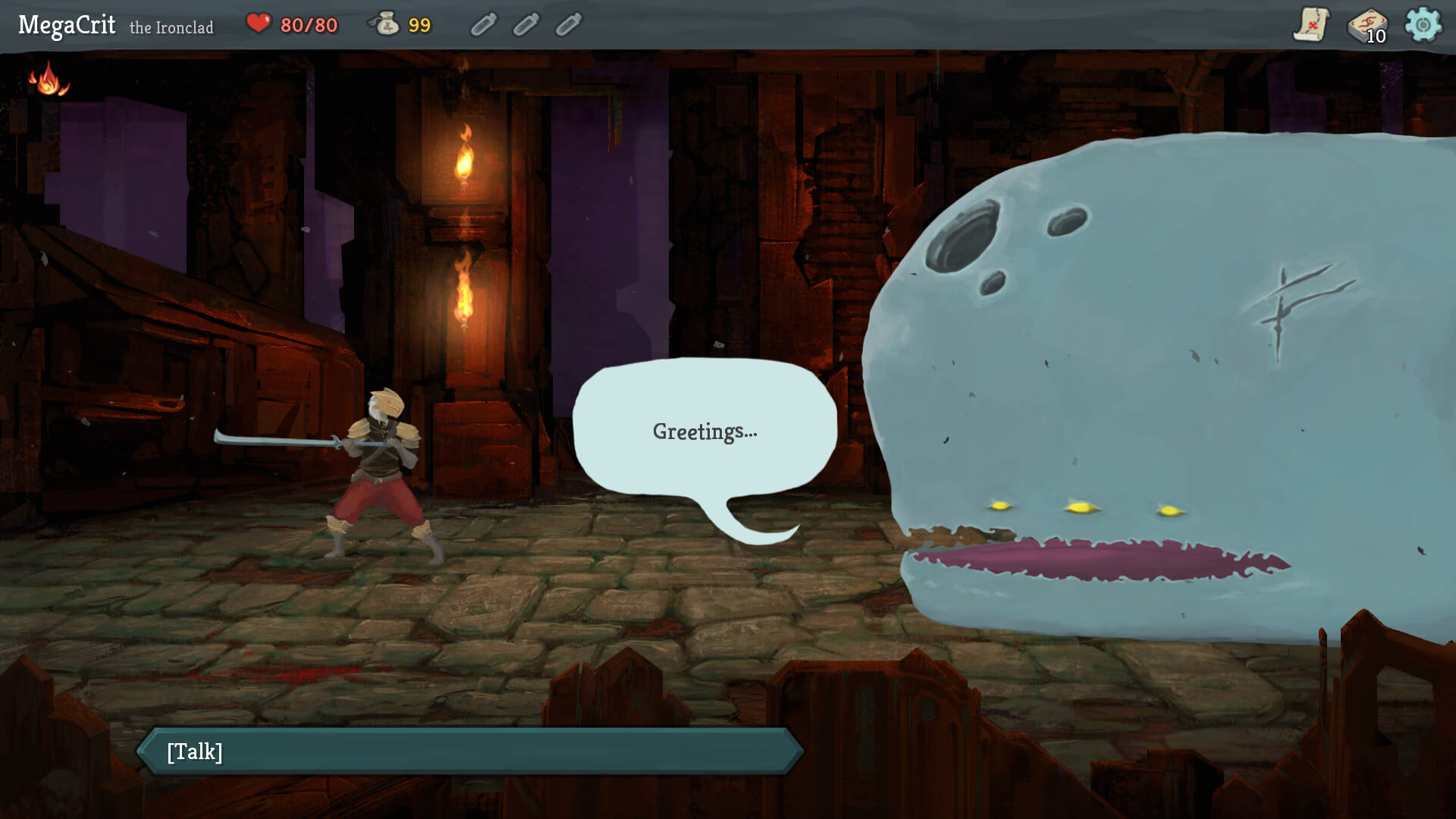
What little authored narrative Slay the Spire has is atmospheric rather than explicit. Four adventurers — a battle-hardened Ironclad, a nimble Silent, a logical Defect, and a meditative Watcher — each ascend a mysterious living Spire to reach and destroy the corrupt Heart that beats at its summit. That is the entirety of the setup, and the game offers it with almost no elaboration: there are no cutscenes building a world, no quest-givers, no plot developments along the way. The Spire is simply there, an ominous, malevolent structure to be conquered, and the act of climbing it is its own justification. This minimalism is the right call for the genre, because a roguelike's appeal lies in its endlessly repeatable runs, and a heavy story would only get in the way of a game you are meant to play dozens or hundreds of times. The Spire works as a frame precisely because it is light — an evocative premise that motivates the climb without demanding attention, leaving the player free to focus entirely on the strategy. The 6.5 grades that minimalism honestly: there is a premise, it is atmospheric, and the game builds almost nothing on top of it.
Lore for those who look
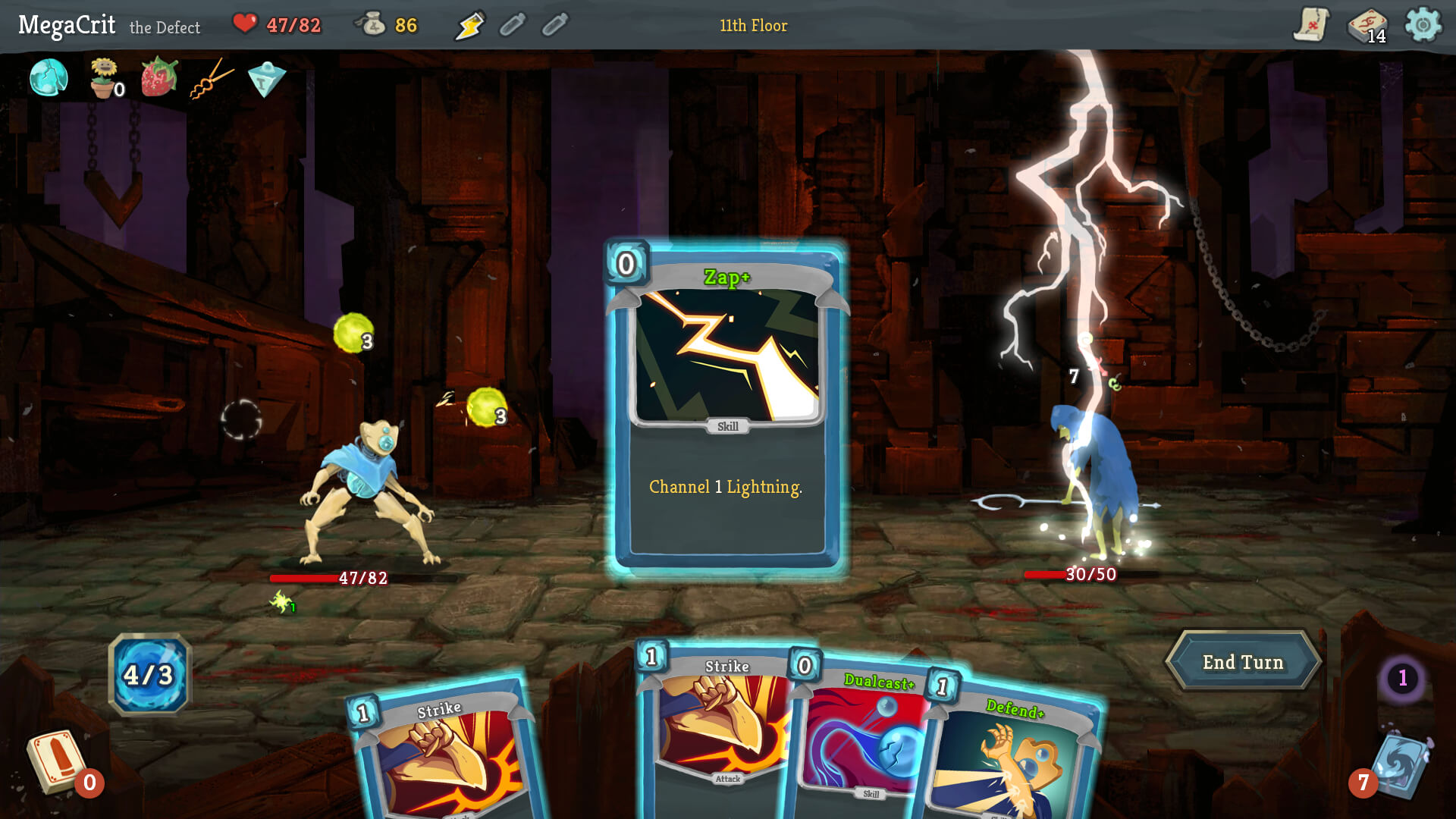
For players who want a little more, Slay the Spire does hide a surprising amount of lore in its margins, rewarding the curious without ever forcing the story on anyone. The flavor text on cards, the backstories embedded in relic descriptions, the design of enemies and bosses, and the fragmented bits of text scattered through events all hint at a deeper fiction — the nature of the Spire, the history of the characters, the source of its corruption — for those who choose to piece it together. This is environmental and incidental storytelling, the kind that exists to be discovered rather than delivered, and it gives the world a sense of depth and intention beneath its sparse surface. Dedicated players have spent real effort reconstructing the Spire's lore from these fragments, and the fact that there is a coherent fiction to reconstruct speaks to MegaCrit's care. But it is firmly optional, a layer you can engage with or ignore entirely without affecting the experience, and it does not change the fundamental reality that the game presents almost no story up front. The narrative is there for the archaeologically inclined, and invisible to everyone else, which is exactly how a deckbuilder's story should work.
The run is the narrative
As with the best roguelikes, the real storytelling in Slay the Spire is emergent, generated fresh in every run, and it is far more compelling than any authored plot would be. The narrative that matters is the story of your climb: the unpromising early cards that you somehow forged into an unstoppable engine, the relic that transformed your whole strategy, the desperate boss fight you survived with one health, the greedy decision that cost you the run, the perfect combo that cleared a room in a single turn. Every climb writes its own arc of rising power, mounting tension and ultimate triumph or collapse, and because of permadeath those arcs carry real stakes — a great run lost to one misjudgment is a genuine tragedy, and a clutch victory is a genuine thrill. This is storytelling through systems, where the drama comes from the interaction of your decisions and the run's randomness, and it produces an inexhaustible supply of personal, memorable moments that no scripted narrative could match. The 6.5 reflects the absence of authored story, and nothing more; it says nothing about the thousands of small sagas the game helps every player write, one climb at a time, which are the real reason anyone keeps returning to the Spire.
Audio | 8.5/10
Sound: 8.5/10Slay the Spire scores 8.5 for audio, and the score reflects sound design that understands its job perfectly: support a game you will play for hundreds of hours without ever wearing out its welcome. This is not a soundtrack that demands attention or shows off; it is an atmospheric, understated, functionally crisp audio design that sets a mood, sharpens the feedback of play, and then gets out of the way. For a game built on deep concentration and endless repetition, that restraint is exactly right, and it is a quietly significant achievement.
Mood without distraction
The foundation of the 8.5 is a score that builds and sustains the right mood without ever becoming intrusive. The music conjures the tense, focused atmosphere of a dungeon crawl, an ambient sense of danger and determination that suits the act of climbing an ominous tower, and it shifts subtly across the three acts to mirror the escalating threat as you ascend. Crucially, it does this without distracting from the strategic thinking the game demands — the music is a backdrop that colors the experience rather than a foreground element competing for your attention, which is precisely what a game of deep deliberation needs. When you are deep in thought, weighing a card choice or planning a turn, the last thing you want is a soundtrack pulling at your focus, and Slay the Spire's score is calibrated to support concentration rather than interrupt it. This is harder to get right than a flashier soundtrack, because the temptation is always to do more, and MegaCrit's discipline in keeping the music atmospheric and restrained is a real part of why the game remains so playable over hundreds of sessions. The mood is always present and never overbearing.
The tactile satisfaction of cards
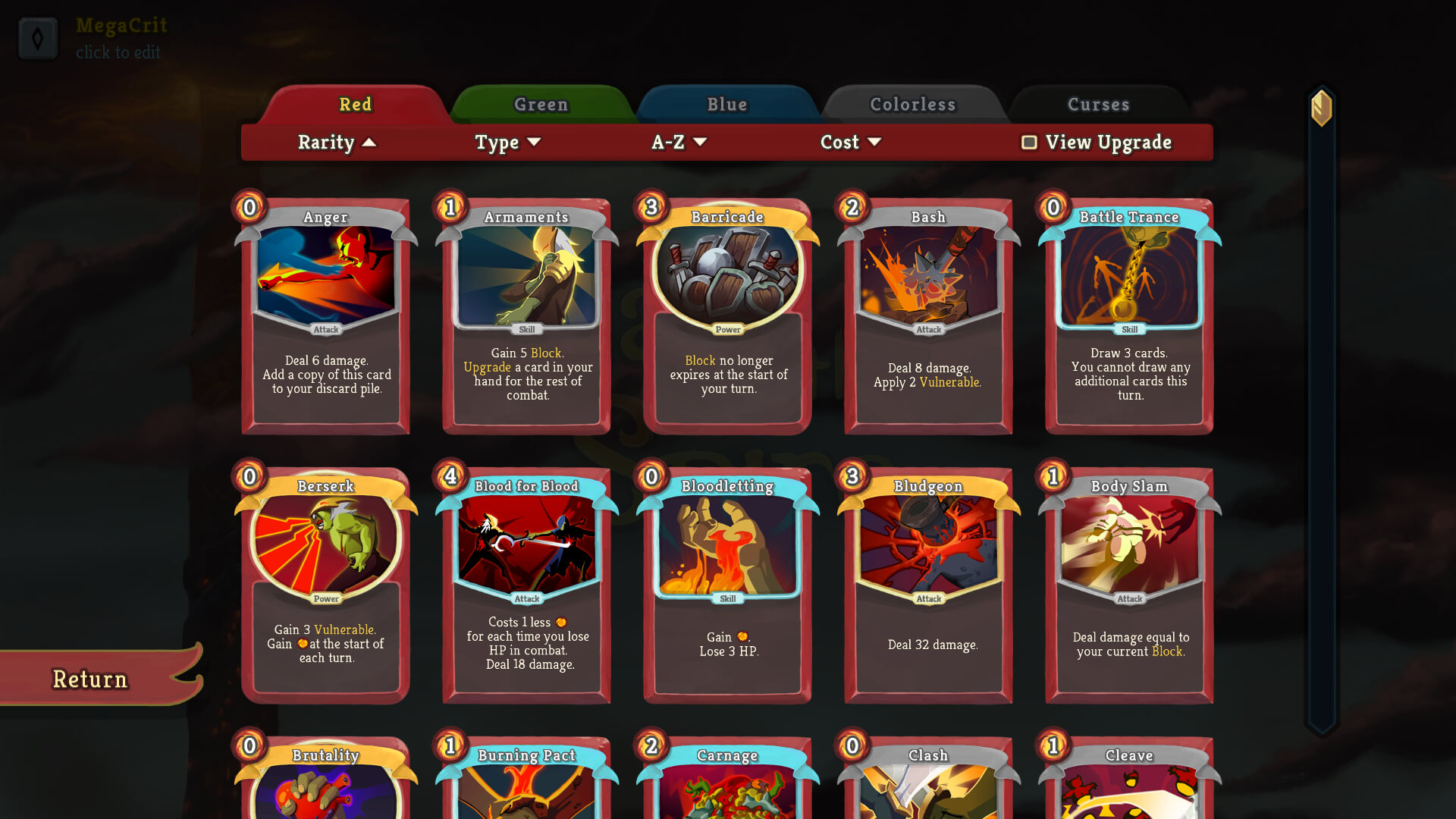
Where Slay the Spire's audio does its most important functional work is in the sound effects of play, which give the deckbuilding a genuine tactile satisfaction. Every card play, every attack landing, every block raised, every relic triggering, and every enemy taking damage is accompanied by a crisp, satisfying sound, and this audio feedback is a surprisingly large part of what makes the moment-to-moment game feel so good. There is a specific pleasure in the snap of a card being played and the audible crunch of a big combo resolving, and these sounds reinforce the sense of agency and impact that the strategy delivers, making each decision feel tangible. In a game that is, mechanically, a series of menu selections, this audio tactility is what gives the actions weight and keeps the interaction feeling physical rather than abstract. The sound design turns the dry act of playing cards into something viscerally satisfying, and over hundreds of hours that satisfaction compounds, becoming part of the loop's addictiveness. It is the kind of detail that is invisible when done well and sorely missed when absent, and Slay the Spire nails it.
Boss themes and the virtue of restraint
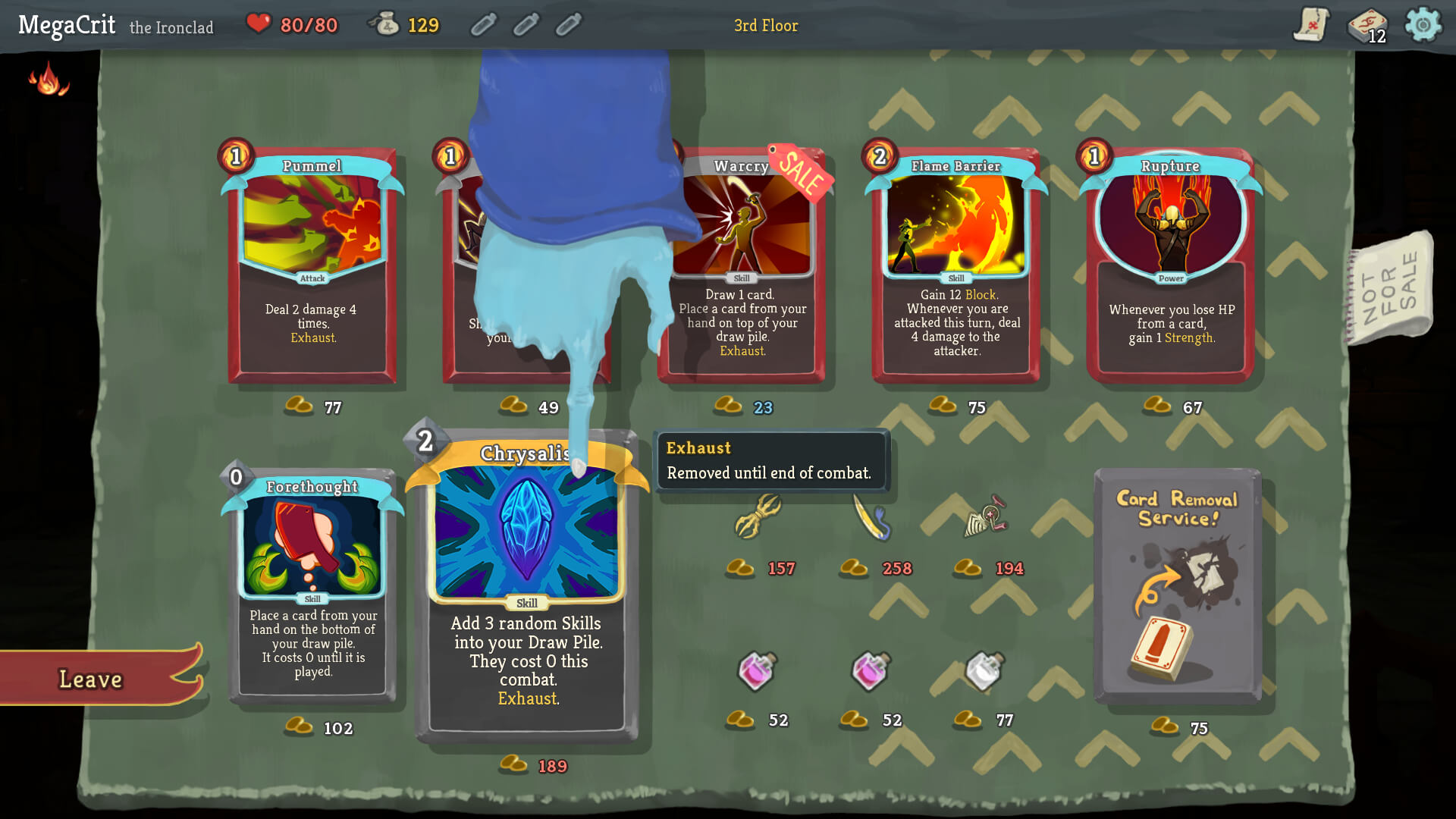
The audio rises to meet the game's biggest moments through its boss themes, which lift the key encounters into genuine set-pieces. When you reach an act boss or face the Heart, the music swells to mark the occasion, giving these climactic fights a sense of weight and drama that punctuates the run and signals that the stakes have risen. These themes are the audio highlights of a climb, the moments where the score steps forward to underscore a confrontation that could end your run, and they are effective precisely because the rest of the soundtrack is so restrained — the contrast makes them land. This is the overarching virtue of Slay the Spire's audio: it is designed for longevity, calibrated so that you can listen to it across hundreds of climbs without fatigue, reserving its emphasis for the moments that deserve it. A louder, busier, more attention-seeking soundtrack would have grated long before the hundredth run; this one remains a comfortable, atmospheric companion no matter how deep into the game you go. The 8.5 is the fair verdict on audio that knows exactly what a deeply replayable strategy game needs — mood, feedback, and the wisdom to stay out of the way — and delivers all three with quiet skill.
Visuals | 8.0/10
Grafik: 8/10Slay the Spire scores 8.0 for graphics, and the number reflects a presentation that is judged correctly not on spectacle but on function. This is a hand-drawn 2D game with a clean comic-book aesthetic, and its visual achievement is not beauty in the AAA sense but clarity — the absolute legibility that a systems-dense card game demands. Within that goal it is highly accomplished, and the 8.0 credits a game that knows exactly what its visuals need to do and does it well.
Clarity above all
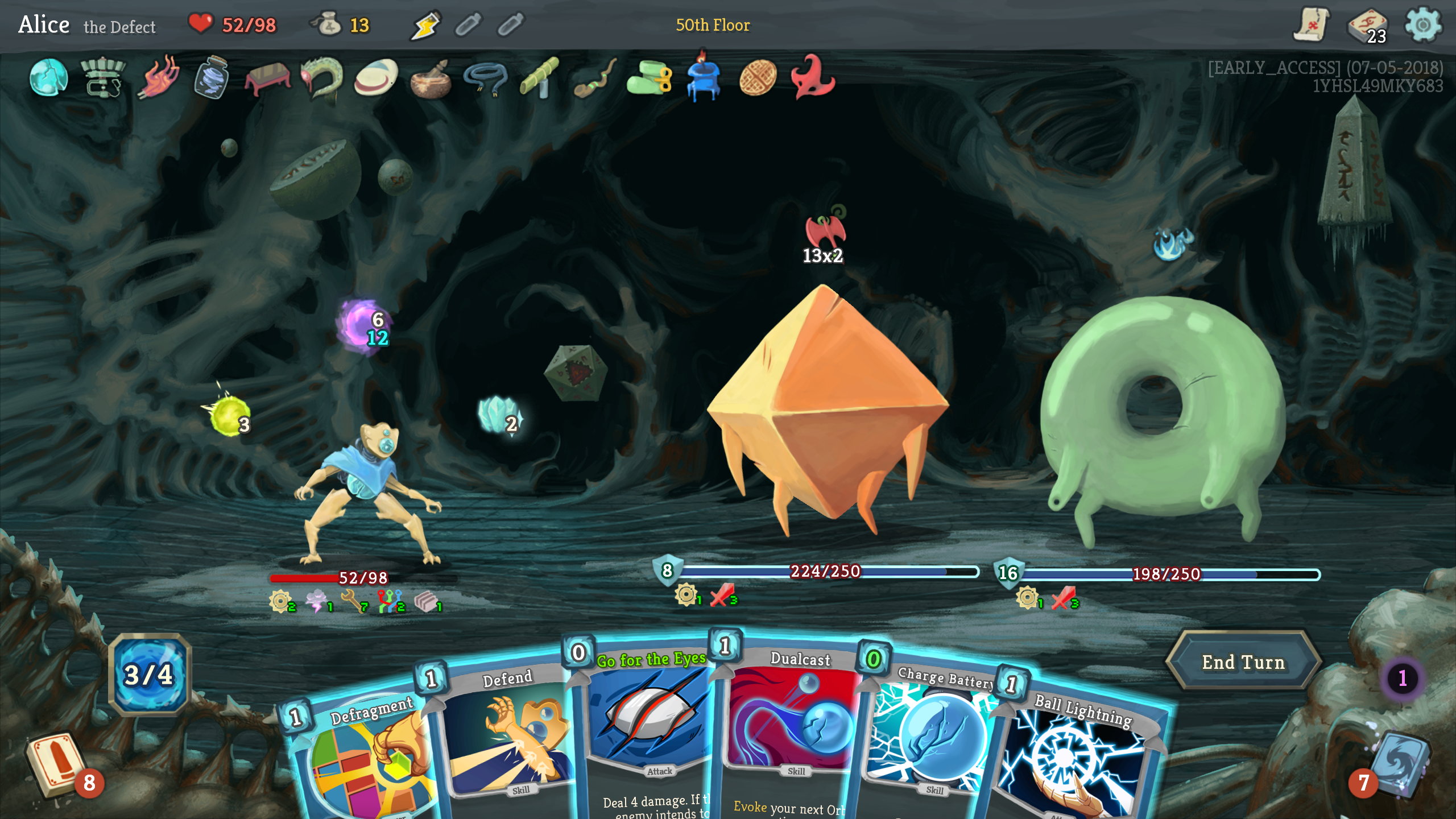
The foundation of Slay the Spire's graphics is readability, and it is paramount. A roguelike deckbuilder lives or dies on the player's ability to parse a huge amount of information at a glance — the cards in your hand and their effects, the enemy's telegraphed intent, your block and health, your relics and their triggers, the status effects on every combatant — and Slay the Spire presents all of it with exemplary clarity. Every element is instantly legible, nothing is ambiguous, and the visual design ensures that even in the most complex board state you can read the situation cleanly and make an informed decision. This is a genuine and underappreciated design achievement, because clarity in a dense strategy game is far harder to engineer than it looks, and getting it wrong would undermine the entire experience. Slay the Spire's art is in service of comprehension first and foremost, prioritizing the player's ability to think over any desire to dazzle, and that is exactly the right priority for the genre. The visuals never get in the way of the strategy; they enable it, and that functional excellence is the core of the score.
A clear comic-book identity
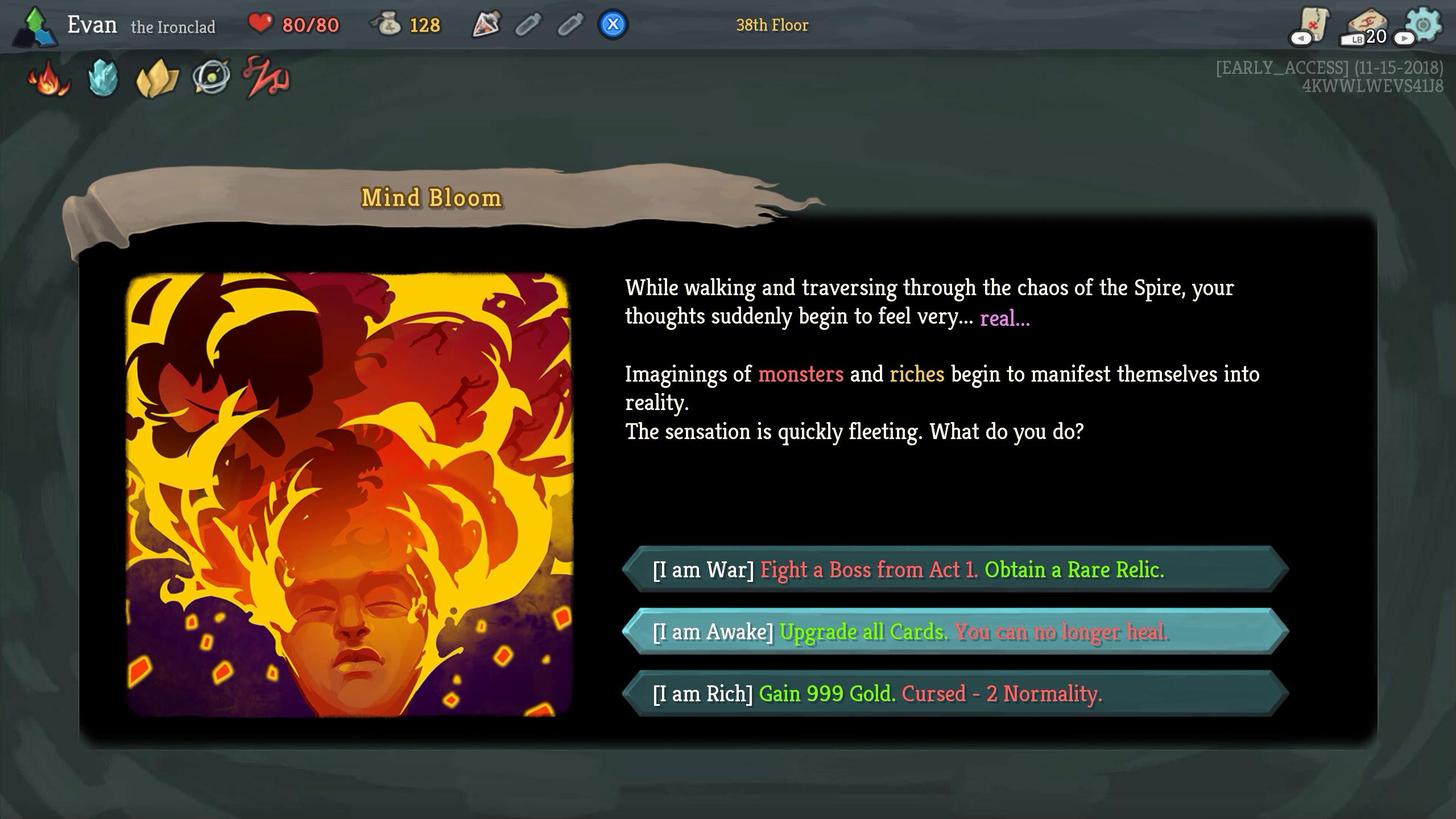
Beyond pure function, Slay the Spire's hand-drawn art gives the game a clear and appealing identity. The four characters, the menagerie of enemies and bosses, and the hundreds of cards all have a distinct comic-book style, slightly rough and characterful, that gives the Spire a consistent visual personality. Enemies are designed to be readable and memorable — you learn to recognize each one and what it threatens at a glance — and the card art, while simple, gives each card a recognizable face that aids both memory and atmosphere. This is not a generic or placeholder aesthetic but a deliberate artistic choice that suits the game's tone, a hand-crafted look that gives a systems-driven game a welcome dose of character and warmth. The art direction is cohesive across every element, so the whole game feels like a single designed object rather than an assemblage of parts, and that consistency is part of why it reads as polished despite its simplicity. It is a style that has aged well precisely because it never chased trends, and the many games that imitated Slay the Spire borrowed its visual clarity as much as its mechanics.
The honest caveat and the craft of the interface
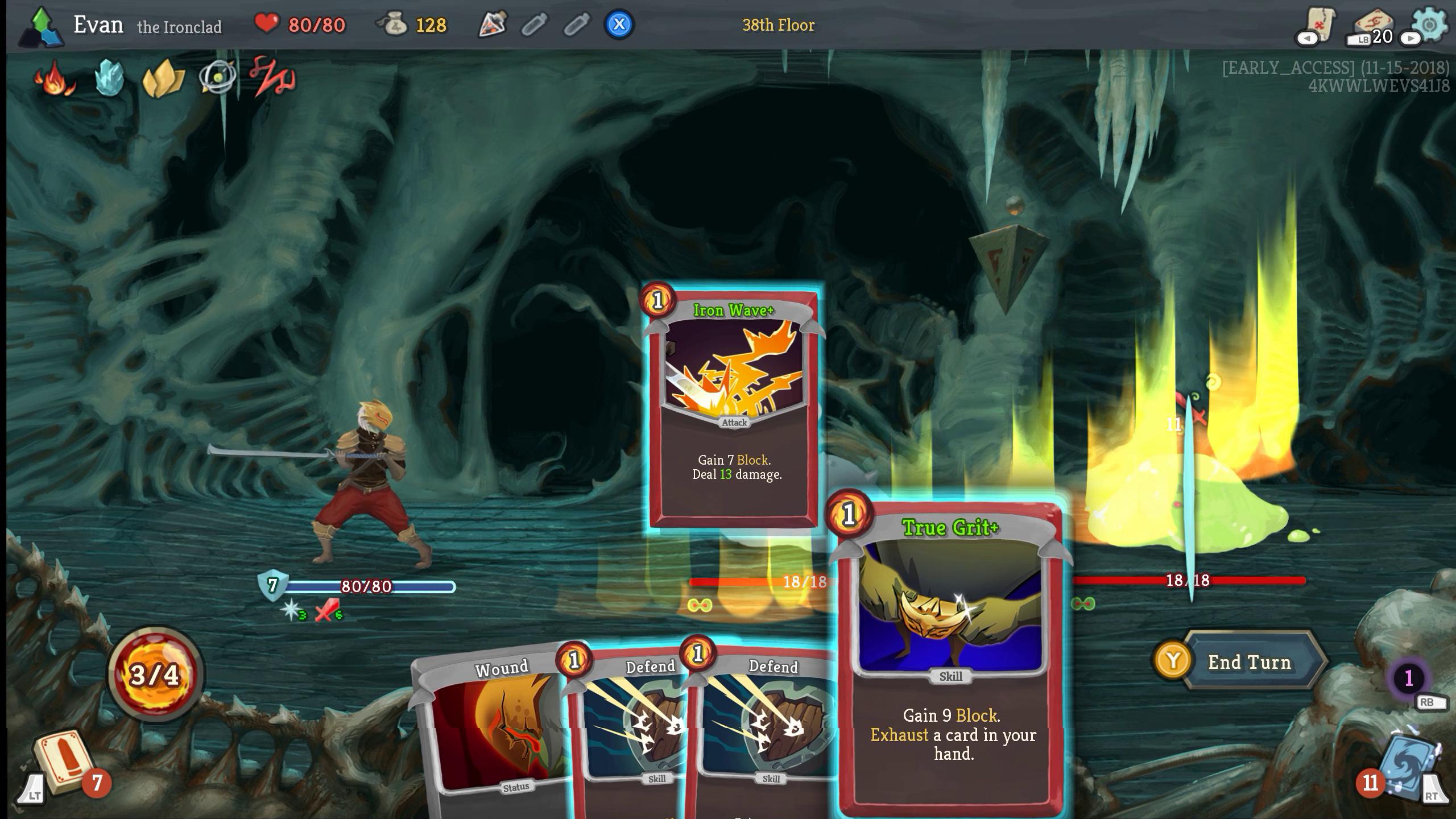
The honest caveat on the 8.0 is simply that the hand-drawn 2D presentation will strike some players as plain. A player who equates good graphics with technical spectacle, 3D rendering or photorealism will find Slay the Spire visually modest, even unremarkable, and for completeness that perspective deserves acknowledgment — this is not a game that wins on fidelity, and it does not try to. But that judgment misunderstands the game's purpose, because Slay the Spire's visuals are not competing on spectacle; they are competing on the clarity and character that a deep card game needs, and on those terms they excel. It is also worth crediting the interface design as an achievement in its own right: presenting the enormous mechanical complexity of the game — hundreds of cards, dozens of relics, intricate interactions — through a clean, navigable, never-overwhelming UI is a real feat of design, and it is a large part of why the game is so approachable despite its depth. The 8.0 is the fair verdict on a presentation that is clean, characterful, supremely functional, and deliberately unflashy — exactly what a game you will study for hundreds of hours should be, even if it will never be the reason you buy it. In a genre it went on to define, that visual philosophy became influential in its own right: the wave of deckbuilders that followed almost universally adopted Slay the Spire's emphasis on legibility over flash, proof that its clean, functional art was not a compromise but a quiet template the whole category learned from.
Combat | 9.7/10
Gameplay: 9.7/10Gameplay scores 9.7, the highest mark in this review, and it is the score of a game that did not merely master its genre but created it. Slay the Spire's loop — build a deck on the fly while climbing a procedurally generated spire — is a near-perfect strategic machine, so deep, so balanced and so endlessly replayable that seven years and dozens of imitators later, nothing has surpassed it. The 9.7 is the measure of design at its most refined, the rare game where almost every decision is meaningful and almost nothing is wasted.
The deckbuilding loop, perfected
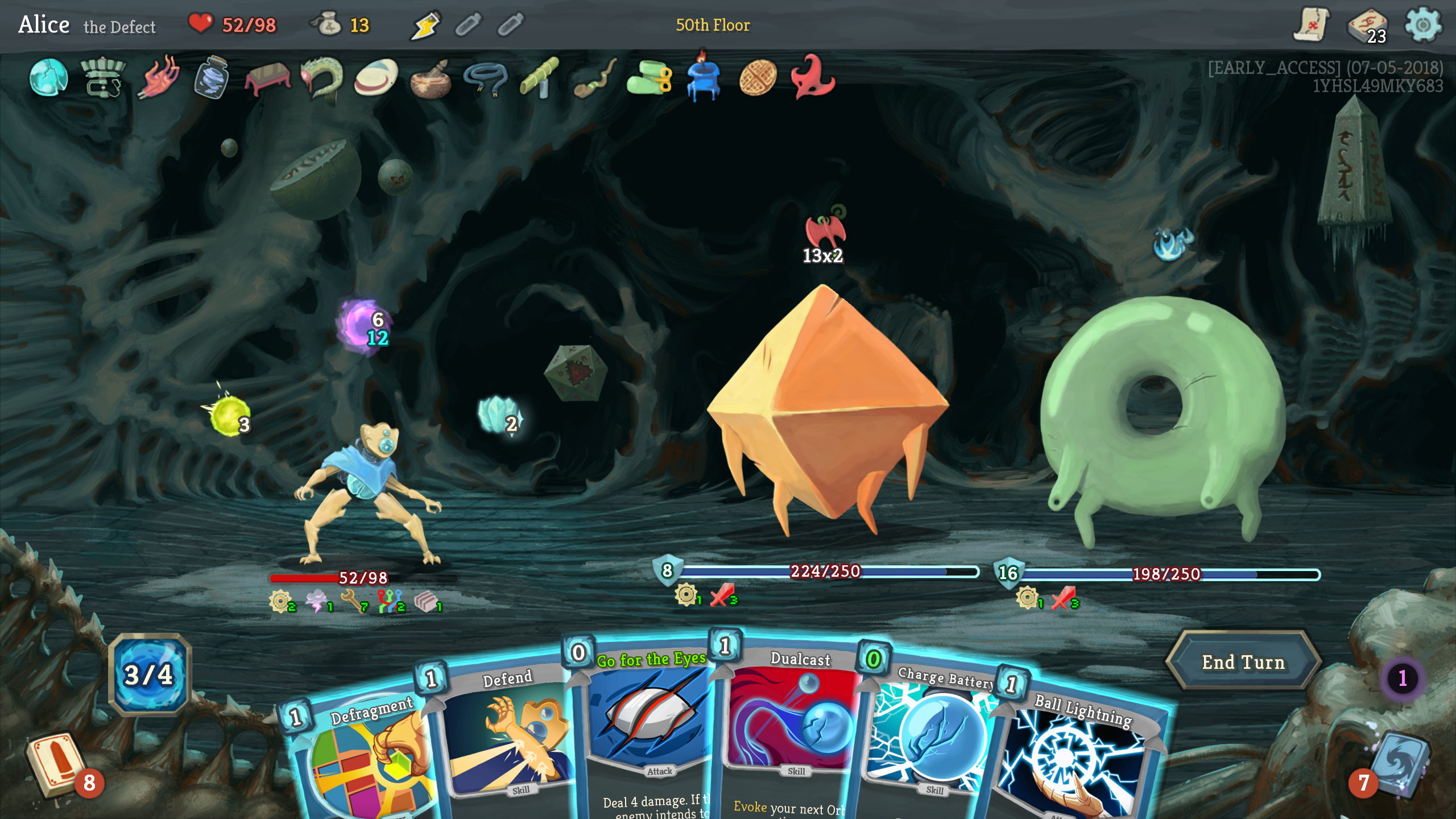
At the heart of the 9.7 is the core loop, and it is flawless. After each battle you choose one card to add to your deck — or none, since a leaner deck is often stronger — and over a run you assemble a strategy from whatever the game offers, supplemented by relics that grant powerful passive effects and potions for moments of need. The genius of the system is the constant, meaningful tension of every choice: which card improves your deck, which dilutes it, which relic reshapes your whole plan, which path on the map to take for the rewards you need. Combat itself is turn-based and, crucially, enemies telegraph their exact intentions each turn, so there is no hidden randomness in the fight — every loss is a result of your decisions, not the game's caprice, which makes the strategy pure and the mastery deeply satisfying. This transparency is what elevates Slay the Spire above so many imitators: it is a game of perfect information within each turn, where skill is everything and the only question is whether you played the odds correctly. The depth that emerges from these simple, transparent rules is staggering, and it rewards study, experimentation and mastery without limit.
Four games in one, and a ladder to climb

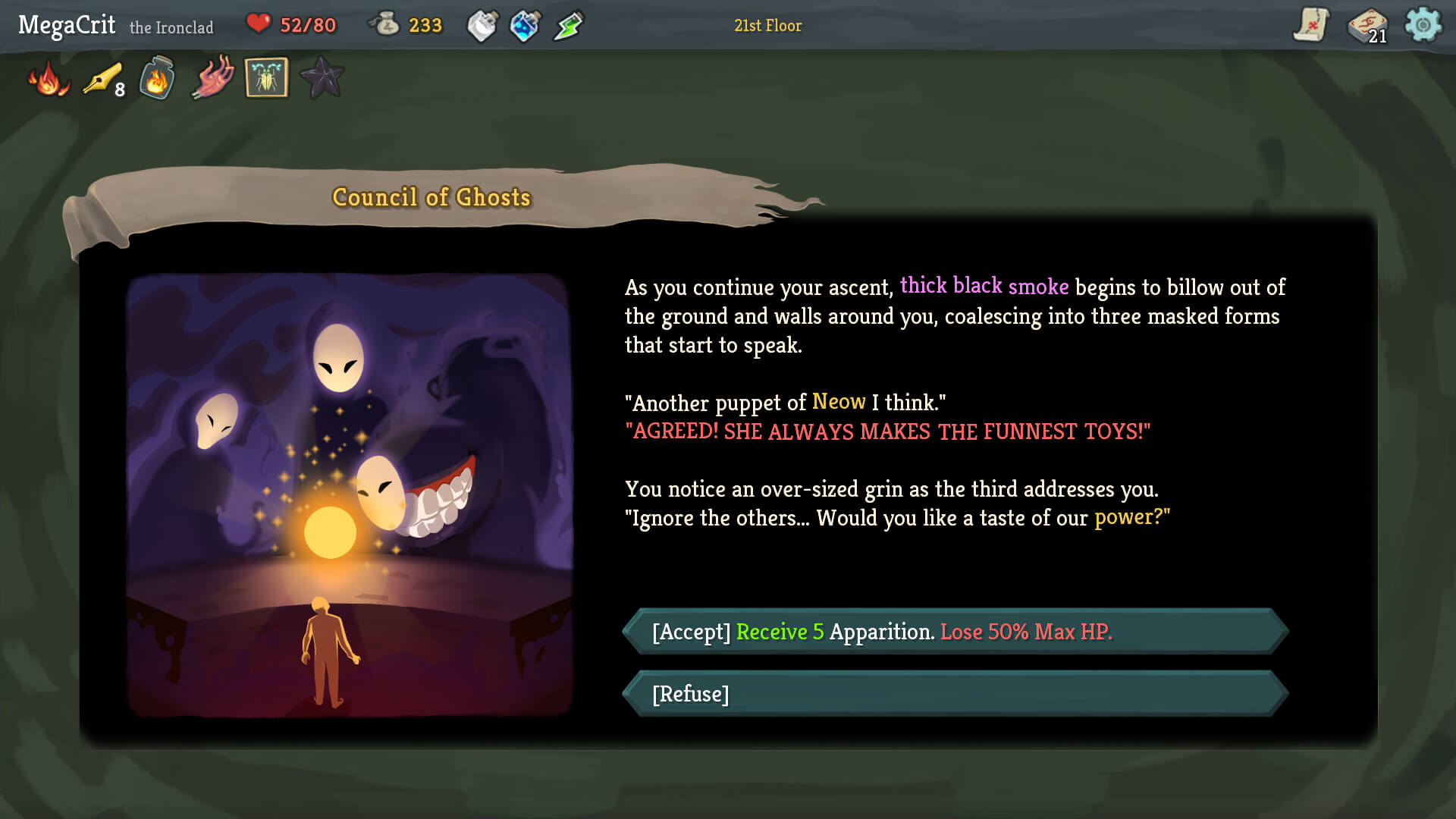
What multiplies the gameplay from excellent to genre-defining is the breadth layered on top of the core loop. The four characters — Ironclad, Silent, Defect, and Watcher — each have entirely distinct card pools and play completely differently, so mastering the game is really mastering four different strategic games that share a framework: the Ironclad's brute strength, the Silent's poison and card-cycling, the Defect's orb mechanics, the Watcher's stance-dancing. This effectively quadruples the depth, giving even veterans years of new strategies to explore. On top of that sits the Ascension system, a twenty-rung difficulty ladder that incrementally raises the challenge with each level, providing a precisely tuned progression of mastery that keeps the game compelling long after a first clear. The Ascension ladder is a masterstroke of design, ensuring that the game grows with the player and that there is always a harder mountain to climb, and reaching Ascension 20 with all four characters is a serious accomplishment that represents hundreds of hours of refined play. This combination of four deep characters and a finely graded difficulty curve is what gives the gameplay its extraordinary longevity.
The randomness, and the Monster Train contrast

The one honest cost of Slay the Spire's design is its randomness, and it is the main reason the gameplay sits at 9.7 rather than a flawless 10. As a roguelike, the game is built on chance — the cards offered, the relics found, the enemies faced, the card draws within a fight are all random — and that means a run can occasionally be lost to bad luck despite good play, which genuinely frustrates players who are uncomfortable with restart-based gameplay or who want guaranteed reward for skill. This is inherent to the genre rather than a flaw in execution, and the game mitigates it brilliantly by making mastery about playing the odds well rather than eliminating them, so that skilled players win far more often than not. But the variance is real, and for the restart-averse it is a genuine barrier. The contrast with its strongest successor is illuminating: Monster Train builds clever ideas of its own atop the formula, with its multi-floor defense and divine-power combos, but Slay the Spire remains the foundational text — the most balanced, the deepest, and the most refined expression of the roguelike-deckbuilder idea, the standard every rival is measured against. It is the game that wrote the genre's rulebook, and the 9.7 is the honest verdict on a loop that is as close to perfect as strategy design gets.
Content | 9.5/10
Umfang: 9.5/10Content scores 9.5, Slay the Spire's second-highest mark, and it reflects a game whose replayability is, for all practical purposes, infinite. Between four deeply distinct characters, a twenty-rung difficulty ladder, procedurally generated runs, daily challenges, and a 30,000-mod community, Slay the Spire offers more genuine content than games many times its size, and it has been supported and expanded for free across eight years. This is a game that rewards hundreds or even thousands of hours, and the content score reflects that bottomless depth.
Four characters and a twenty-rung ladder

The foundation of the 9.5 is the sheer scale of the base game's content, which is enormous despite its modest footprint. Four characters, each with a distinct card pool and playstyle, are effectively four different strategic games to master, and the Ascension system layers twenty escalating difficulty levels on top of each, creating a vast matrix of challenges to conquer. Clearing the game once is the beginning, not the end: there is the goal of winning with every character, then doing so on higher and higher Ascensions, then reaching Ascension 20 with all four, then chasing the true ending by defeating the Heart. Because every run is procedurally generated — different cards, relics, paths and enemies each time — no two climbs are alike, so even repeated attempts at the same goal stay fresh, and the strategic puzzle is never solved. This combination of broad character variety and a finely tuned mastery ladder gives the base game a content depth that would be impressive for a full-priced release, and Slay the Spire delivers it in a compact, focused package. The result is a game you can play for hundreds of hours and still be learning, which is the truest measure of content in a roguelike.
Daily climbs, mods, and an infinite tail

What pushes the content from enormous to effectively infinite is the combination of varied play modes and a thriving modding scene. Beyond the standard climb, the game offers Daily Climb challenges with rotating modifiers that give a fresh twist each day and a shared leaderboard to compete on, plus seeded and custom runs for players who want to experiment or chase specific scenarios. Then there is the Steam Workshop, home to over thirty thousand community mods, ranging from new cards and relics to entirely new characters and the full-expansion-scope Downfall, a fan-made mod so substantial it effectively doubles as a sequel. This modding ecosystem extends the game's content past any practical limit: whatever you eventually exhaust in the base game, the community has built more, and the game's clean, moddable design has made it a fertile platform for creators. Between the daily challenges that refresh the experience and the mods that expand it indefinitely, Slay the Spire's content tail simply does not end, and players who have logged thousands of hours still find new things to try. This is the long-tail longevity that defines the very best roguelikes.
Eight years of free support and a legendary loop

The final pillar of the content score is MegaCrit's exceptional, eight-year commitment to the game, delivered with a generosity that built enormous goodwill. The fourth character, the Watcher, was added as free content rather than paid DLC, a substantial addition that expanded the strategic game by a full quarter at no cost to players, and the studio has supported and balanced the game steadily across the better part of a decade. There has been no monetization beyond the base purchase, no paywalled content, no microtransactions — a purity of approach that puts MegaCrit among the most player-respecting developers in the business, and one reflected in the game's near-universal acclaim. Underpinning all of this is the legendary core loop and its famous one-more-run compulsion, the quality that drives the hundreds-of-hours playtimes the game is renowned for: a single climb takes only thirty to sixty minutes, but the pull to start another immediately is almost irresistible, and that addictiveness is the engine that turns all this content into time actually played. With a sequel now in development, the game's legacy only continues to grow. Between a vast base game, infinite modded and daily content, eight years of free support, and the most compelling loop in its genre, the 9.5 is the score of a game with content that, for its devoted players, never truly runs out.






Kommentare 0
Wir freuen uns auf deine Meinung
Beteilige dich an der Diskussion und teile deine Bewertung des Spiels.
Noch keine Kommentare — teil uns deine Meinung zu diesem Test mit!