 Halo: CE Mod Tools - MCCKostenlos
Beliebte TippsAlle ansehen
123456789101112
12 Best Mystery Games on PC (2026)
12 Best Space Sim Games on Steam (2026)
12 Best Story-Rich Games to Play (2026)
12 Best Turn-Based Tactics Games on Steam (2026)
12 Best Puzzle Games on Steam (2026)
12 Best Games to Play with Friends on PC (2026)
12 Best JRPGs on Steam (2026)
12 Best City Builder Games on Steam (2026)
12 Best Zombie Games on Steam (2026)
12 Best Free Indie Games on Steam (2026)
12 Best Short Indie Games to Try (2026) — Done in One Evening
12 Best Cozy Games on Steam (2026)
Beliebte ähnliche SpieleAlle ansehen
Games Like PowerWash Simulator - 12 Best Relaxing Cleaning and Restoration PicksGames Like ARC Raiders - 12 Best Extraction and Co-op Survival ShootersGames Like PEAK - 12 Best Co-op Climbing and Survival PicksGames Like R.E.P.O. - 12 Best Co-op Horror PicksGames Like Clair Obscur: Expedition 33 - 12 Best Turn-Based RPG PicksGames Like Path of Exile 2 - 12 Best Action RPG and Loot PicksGames Like Road to Vostok - 12 Best Hardcore Survival Shooter PicksGames Like Mina the Hollower - 12 Best Top-Down Action and Zelda-Like PicksGames Like Slay the Spire 2 - 12 Best Roguelike Deckbuilders to Play NextGames Like Resident Evil Requiem - 12 Best Survival Horror PicksGames Like Baldur's Gate 3 - 12 Best CRPGs and Turn-Based RPGsGames Like Monster Hunter Wilds - 12 Best Co-op Hunting and Action RPG PicksGames Like Hollow Knight: Silksong - 12 Best Metroidvania Picks (2026)Games Like Dead by Daylight - 12 Best Asymmetric & Co-op Horror PicksGames Like Final Fantasy VII Rebirth - 12 Best Action RPG & JRPG PicksGames Like Forza Horizon 6 - 12 Best Open-World Racing & Driving Picks (2026)Games Like Solarpunk - 12 Best Cozy Survival and Crafting GamesGames Like 007 First Light - 12 Best Stealth and Spy GamesGames Like Subnautica 2 - 12 Best Underwater and Alien-World Survival GamesGames Like Hell Let Loose - 12 Best Tactical Milsim Shooters
Beliebte TestsAlle ansehen

Hades II — Test

Clair Obscur: Expedition 33 — Test

Katana ZERO — Test

The Long Dark — Test

Shift At Midnight — Test

Middle-earth™: Shadow of Mordor™ — Test

The Mermaid Mask — Test

Killing Floor 2 — Test

The Outlast Trials — Test

American Truck Simulator — Test

Voidling Bound — Test

Go-Go Town! — Test

Desktop Explorer — Test

Dead as Disco — Test

Crushed In Time — Test

Beastro — Test
After Alan Wake 2, Are AAA Games Becoming More Realistic and Less Distinctive?
A recent Reddit post questions whether the AAA industry’s pursuit of photorealism is eroding distinctive art direction. The discussion points to Alan Wake 2 as a key example of realistic visuals and strong identity coexisting, while also raising concerns about ray tracing, path tracing, ultra-detailed materials, and the growing “UE5 look.” Gamersky says unauthorized reproduction is prohibited and directs readers to follow its GTA6 section.
What makes Alan Wake 2 stand out is not simply its technical fidelity, but the way it controls light and color. The game pursues realistic materials and fine detail without treating realism as the only answer. Shadows, fog, and warm-versus-cool tones remain central to its overall mood. That balance gives the game a strong identity without allowing its technology to define the entire experience.
The discussion’s most telling shorthand may be the “UE5 look.” Many games built with Unreal Engine feature astonishing detail in skin, architecture, and reflected light. Yet from a screenshot alone, it can be difficult to identify the game. Modern hardware gives developers more room to chase realism, but that freedom can also make visual choices converge.
Older hardware limitations sometimes forced developers to make stronger artistic decisions. With less technical power available, color, architectural silhouettes, lighting, and overall art direction had to do more to define a game. A constrained visual style can leave a stronger memory, much like the low-resolution presentation of Hyper Light Drifter.

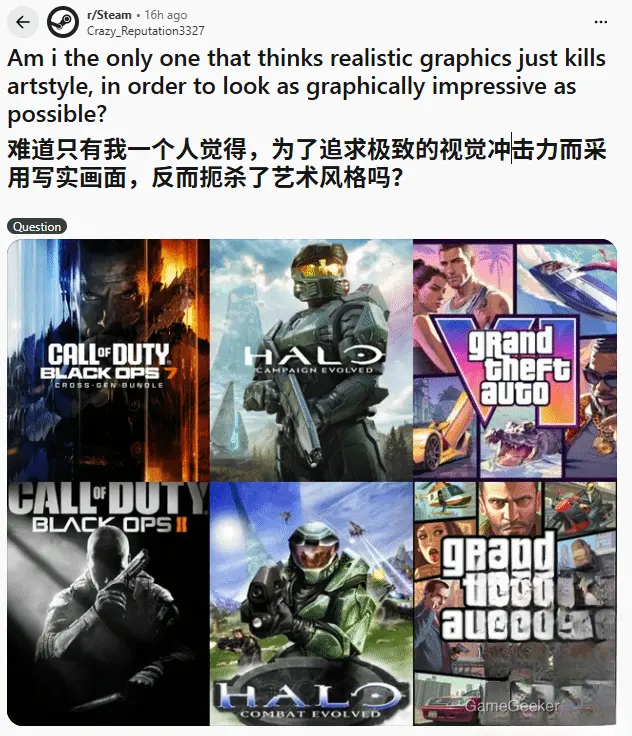
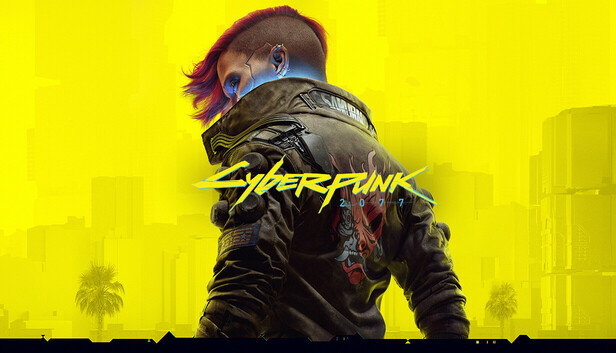
Still, blaming realism itself would be inaccurate. Cyberpunk 2077, Metro Exodus, and Battlefield 1 all pursue highly realistic visuals while using urban color palettes, environmental atmosphere, and period detail to establish clear identities. GTA, Call of Duty, and Halo make a similar point: a realistic visual approach does not mean a game lacks design. What matters is whether a game has a distinct art direction and visual language that players can recognize.

Baldur's Gate 3 shows another benefit of high-fidelity presentation. Detailed character models and facial expressions are not merely technical showcases. They can help players judge whether a character seems trustworthy during a conversation, making the game’s sense of immersion more convincing.
There are commercial reasons for the industry’s preference for realism as well. More convincing graphics are easier to present to investors, executives, and consumers as evidence of technological progress. Image quality can be measured and marketed more directly than an abstract visual identity. But when nearly every major publisher adds more realism, incremental graphical improvements become a weaker competitive advantage. Games may all look impressive while becoming harder to distinguish from a screenshot.
The more useful question for players is therefore not whether a new AAA game has ray tracing or highly precise materials. It is whether the game has a distinct color palette, a recognizable approach to composition, and a clear way of expressing its world. The most promising projects should make technology part of their style, as Alan Wake 2 does, rather than making every release look like the same high-resolution image.
Visual upgrades will matter for GTA6. The greater test, however, will be whether the game can be recognized at a glance through the series’ own visual language.






Kommentare 0
Wir freuen uns auf deine Meinung
Willkommen! Teile deine Meinung zu diesem Spiel – wer zuerst schreibt, wird vielleicht überrascht.
Noch keine Kommentare. Sei der Erste!