News
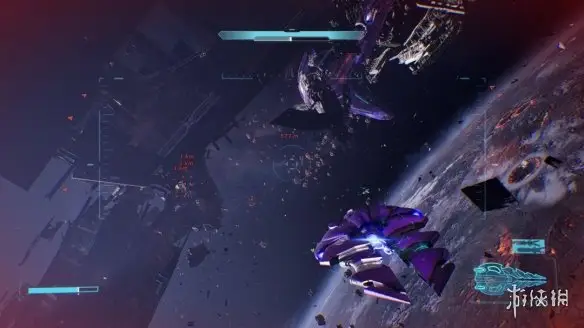
Halo Remake Screenshots Leak, Player Reactions Split
Halo: Combat Evolved remaster screenshots leaked on Microsoft's store ahead of schedule, revealing c
















More than 80 years into Batman's history as a character, it still took nearly 40 years of game-making detours to reach the later Arkham era. This retrospective traces that path back to 1986, when Ocean Software released the first Batman game for the ZX Spectrum in the UK, and argues that early adaptations were shaped as much by hardware limits and design uncertainty as by the license itself.
If you look at those early Batman games as one long experiment in platforming and puzzle design, the evolution is surprisingly revealing. The 1986 original Batman was an isometric puzzle game: Robin has been kidnapped by The Joker and The Riddler, Batman is trapped in a cave, and the player has to recover the seven pieces of a hovercraft. Hardware restrictions defined the whole thing. Movement was stiff, Batman could not even jump, and the game was built around 150 mazes. Seen today, it feels like developers had already grasped ideas such as puzzles and spatial navigation, but had not yet figured out what superhero movement should feel like.

By the time of Batman: The Caped Crusader, the design had started leaning toward side-scrolling action, but the problem was equally clear: swapping in Batman does not automatically make a game feel like Batman. For action-platform players, the real test is whether movement, attacks, pacing, and level feedback can support that identity. A lot of early licensed adaptations got stuck right there. They looked like Batman games, but played like generic side-scrollers wearing the brand.
1989 was the obvious turning point. After Tim Burton's film Batman arrived, Ocean released Batman: The Movie. It was still fundamentally a mini-game collection, but the grappling hook and the fast-paced Batmobile shooting stages were the first time Batman's gear actually mattered in play instead of sitting in background flavor text. The movie also gave developers a clearer visual benchmark, and the games began moving beyond simple name recognition toward something closer to interactive screen language.

The game that truly reinvented Batman on consoles, though, was Sunsoft's Batman on the Famicom/FC in 1989. Its ties to the film were loose, and yes, it gave Batman a spear gun, which would probably start arguments instantly if it happened now. But judged as a game, its smooth movement, high difficulty, and cinematic cutscenes were the first to make Batman feel like a real action hero who could fight, jump, and control tempo. For platformer fans, that is the crucial leap: the character's movement finally locks into the level design.
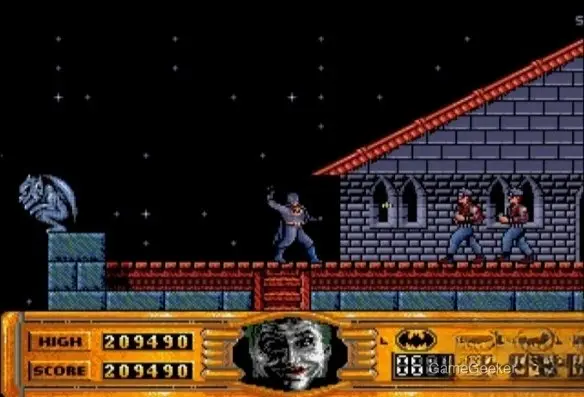
Later on, the multi-platform adaptations of Batman Returns looked more like a broad stress test of what the license could become. The Sega Saturn version leaned toward a Golden Axe-style beat 'em up, while the PC Engine version turned into a cute maze-based box-pushing game. The same film material was being split into completely different design directions. After the 1992 movie released, as many as nine related adaptations appeared within a year across platforms including MD, SFC, and PC, covering everything from platformers to point-and-click adventure-puzzle games. The result was uneven quality, but it also meant developers were testing almost every possible answer to a basic question: what kind of game actually suits Batman?
Dynamite Batman is another useful example. In 1991, Sunsoft built it as a sci-fi action game that feels close to Mega Man crossed with Contra; in the West, it was released as Batman: Revenge of the Joker. Batman carries an arm-mounted cannon, can charge up and fire red lightning, and eventually pilots a giant spaceship against a final boss with 250,000 HP. It sounds wildly off-model, but from the perspective of retro action design, it proves at least one thing: developers at the time were willing to exaggerate the character if that was what it took to preserve the fun.

That is also why later games such as Batman: Arkham Knight can feel like a kind of milestone finish rather than a sudden breakthrough. Batman games did not simply "figure it out" overnight. The pieces had already been tested for decades: puzzles, platforming, beat 'em up combat, cinematic presentation, and gadget-driven interaction. What the Arkham series did so well was recombine those once-scattered ideas into a more complete fantasy of being Batman.
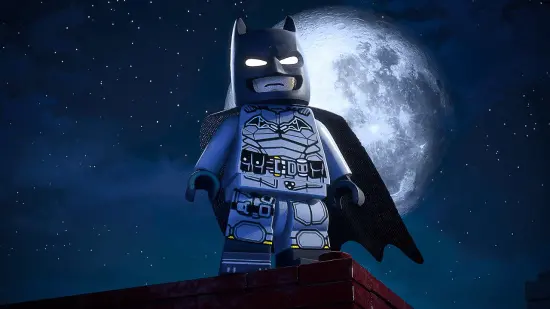
If you are going back now, the recommendation is straightforward. If you want the historical starting point, try the 1986 original Batman, but treat it more as an archival experience. If you want the versions with real retro action value, start with Sunsoft's Batman on FC and Dynamite Batman from 1991. As for the upcoming LEGO Batman: Legacy of the Dark Knight, the most interesting direction would be a mix of light puzzle-solving, platform action, and gadget interaction, because that is still the part of the Batman license with the most untapped potential: level mechanisms and tools working together.



Kommentare 0
Wir freuen uns auf deine Meinung
Willkommen! Teile deine Meinung zu diesem Spiel – wer zuerst schreibt, wird vielleicht überrascht.
Noch keine Kommentare. Sei der Erste!