
News
Bunny Garden 2 Adds Twin-Tail Lolita Roro in New Update
Bunny Garden 2's new 10-second trailer shows a twin-tailed lolita character in a sweet-yet-cutting promo. With six heroi
















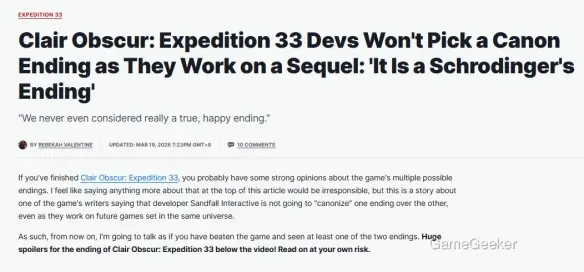
Whether a work dares to remove “happiness” from the standard answer often reveals more about its substance than how many branching paths it offers. This time, Clair Obscur: Expedition 33 makes its stance very clear: it has multiple endings, but from the production stage onward, the development team never intended to force in a traditionally happy ending.

Recently, Sandfall Interactive’s lead writer Jennifer Svedberg-Yen confirmed in an interview that the game does not have a “happily ever after” ending, and that the developers will not designate any particular route as the one true canon in the future. In my view, this is a narratively sound choice grounded in careful consideration. The reason is simple: truly weighty expeditions, sacrifices, and choices rarely resolve as neatly as they do in promotional trailers. They are more like a campaign advance with clearly defined costs—capturing the objective does not necessarily mean everyone gets to go home.
In terms of authenticity, the most important thing about this design is not whether it is “heart-wrenching,” but that it refuses to smooth over differences in the characters’ positions with one universal answer. The writer also put it very plainly: whether players ultimately see the ending as bitter or sweet depends on whose perspective they inhabit and whose idea of happiness they value more. In other words, this is not a simple binary of good ending versus bad ending, but a redistribution of value judgments. Among the multiple endings, at most one could be considered “slightly happier,” while another is clearly darker, but both come with gains and losses. That makes it far more rigorous than many games that appear to have multiple endings but in reality only distinguish between a true ending and a bad ending.
From a tactical perspective, this approach of not declaring an official canon actually benefits community discussion. Players are not “subsumed” by a single official statement, and every route can continue to be interpreted, debated, and expanded upon. This is especially valuable for story-focused players; it is far smarter than suddenly announcing a few months after release that “actually, Ending A is the real one.” That kind of move often feels like invalidating frontline reconnaissance outright—it undermines emotional investment and can easily trigger backlash.
Looking at market response, this risky narrative strategy clearly paid off. Clair Obscur: Expedition 33 is regarded as one of the most acclaimed titles of 2025. It not only shattered the outside world’s fixed impression of AA games, but also earned recognition precisely through this uncompromising mode of expression, later going on to win the 2026 TGA Game of the Year award. Reaching that point shows that the market does not only respond to “happy endings for all”; it is also willing to support stories with real backbone.
If you are the kind of player who values immersive storytelling and can accept a sense of regret and room for open-ended discussion, this game is worth watching; but if you play RPGs only for a standard HE, it is best to prepare yourself mentally in advance. My judgment is that what truly makes Clair Obscur: Expedition 33 remarkable is not how dark its endings are, but that it insists on not defining happiness for the player. In many narrative games today, that instead feels like a precise and restrained strike.





Kommentare 0
Wir freuen uns auf deine Meinung
Beteilige dich an der Diskussion und teile deine Bewertung des Spiels.
Noch keine Kommentare. Teile deine Bewertung.