News
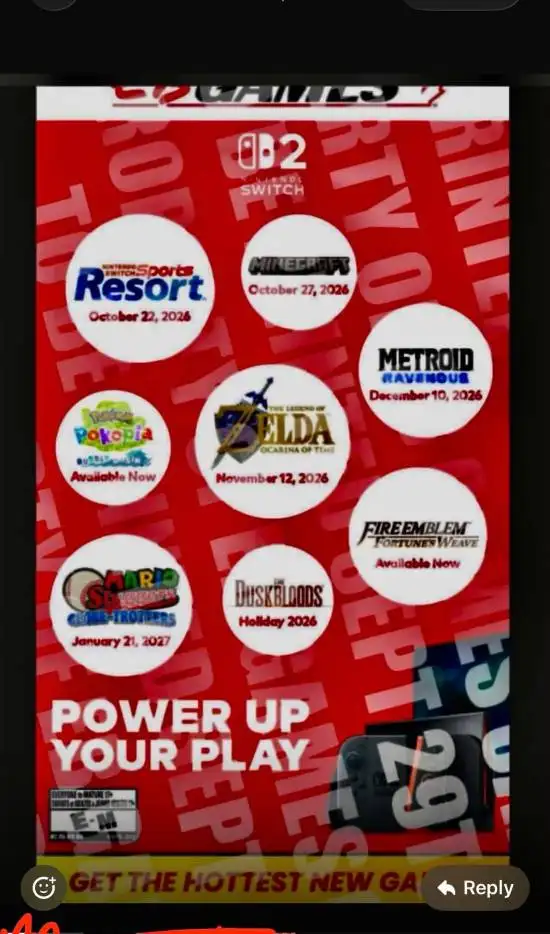
EB Games Leak Reveals Ocarina of Time Remake Release Date
A Reddit user claims an EB Games poster leaked several Switch 2 release dates, though the listing remains unverified. Ni
















They made a very typical trade-off here: first secure the project’s quality as it takes shape, then accept a further extension of the development cycle. According to remarks made by insider Tom Henderson in a recent video podcast, the internal progress of several Ubisoft titles is not consistent. The most closely watched among them is the new Splinter Cell, which is said to have officially been delayed, with its target window now moved to 2027. Looking at this news today, what truly stings players is not the word “delay” itself, but the fact that this IP has been silent for far too long. Market expectations have been raised again and again over time, and any loss of momentum will be magnified.

From a design perspective, a stealth game like Splinter Cell was never easy to make in the first place. It is not the kind of game you can ship simply by adding more depth to the action system. The core of the stealth experience lies in the precise interplay between enemy awareness, level sightlines, gadget feedback, and the cost of failure. Once that whole structure is pushed toward a modernized upgrade, the likelihood of rework is often higher than in a purely linear action game. So when I hear the project has been pushed to 2027, my first reaction is not surprise. If this kind of product still wants to preserve the brand’s identity, it is hard to take the lazy route of “release first, fix later.” Some players on forums are already joking that even if it does not get canceled, they will probably not actually get to play it until 2028. That sentiment really shows that people have already started to question Ubisoft’s delivery reliability.

On the other hand, Far Cry is said to be having a difficult time in development, and that judgment is not at all surprising from a business logic standpoint. As the article notes, it has already been five years since the previous mainline entry in the Far Cry series, whereas in the ten years before Far Cry 6, the franchise maintained a relatively steady release cadence. When a product line known for stable output suddenly slows down, it is usually not a single-point issue. It is more often a sign that gameplay iteration has hit a bottleneck: can the open-world formula still sustain sales, and at the systems level, should they move to a new-generation engine or keep patching up the old one? All of that can drag down the pace of development. To put it plainly, if the team still cannot come up with a clearly meaningful new gameplay loop, players will feel like they are just being served the same familiar recipe reheated over and over again.

By comparison, the Rayman remake is progressing smoothly, which actually fits normal production logic quite well. The main challenges of a remake project are usually concentrated in visual upgrades, tuning the game feel, and adapting it to modern platforms. As long as the project goals are clearly defined, production management is generally more controllable than for a brand-new AAA title. Combined with the information mentioned in the leak, Ubisoft’s next major release after Black Flag is planned to be a new Ghost Recon game. That indicates the company’s current production scheduling strategy is very clear: use remakes and established IPs to stabilize the pipeline on one hand, while continuing to bet on franchises that are better suited for long-term live operations or broad-market sales on the other.

From a technical point of view, what is most worth watching in this set of developments is not which specific game will definitely succeed, but the fact that Ubisoft is exposing a very typical large-studio pipeline divergence problem: some projects move smoothly, while others get stuck—and the ones that get stuck are usually the legacy IPs with high expectations, high complexity, and a lot of historical baggage. Some players in the discussion also brought up Beyond Good and Evil 2, which fundamentally comes from the same source of anxiety. People are not worried simply because things are slow; they are worried that things will move slowly and still end up without a clear direction. My view is this: if you are only waiting for Splinter Cell, the most reasonable expectation management right now is to treat 2027 as a “best-case scenario,” not a guaranteed minimum. If you are watching Ubisoft’s overall lineup, then Rayman and the subsequent Ghost Recon are actually more likely to provide clear signals first. Professionally speaking, this is not a problem with any single game; it is a sign that Ubisoft’s entire content production pipeline is going through a difficult restructuring.





Kommentare 0
Wir freuen uns auf deine Meinung
Beteilige dich an der Diskussion und teile deine Bewertung des Spiels.
Noch keine Kommentare. Teile deine Bewertung.