




The Top 3 in 30 Seconds: Hexcells Infinite is the best place to start because it gives you 36 authored puzzles and then a generator for more. Choose Tametsi if you want a longer, tougher campaign with varied tile layouts and no required guessing. Pick 14 Minesweeper Variants if changing the rules matters more to you than learning one board style.
Why These Made the List #
Choose Hexcells Infinite if you want the clearest first step into hex-grid deduction, with 36 designed puzzles before its generator and user-made puzzles open up further possibilities. Tametsi suits a patient solver looking for a longer, tougher sequence across varied tile layouts. For the biggest change in clue language, 14 Minesweeper Variants makes learning new rules the main event.
The rest of the list branches out from there. Bombe turns deductions into reusable rules, Polimines 2 brings nonogram logic into the mix, and Delete makes changing shapes part of the challenge. Globesweeper: Hex Puzzler wraps its clues around a globe, while SquareCells keeps the focus on patterns in a square grid. hexceed provides a free base game for trying hex clues, and Patterna carries the idea into networks of connected nodes.
This order reflects how useful each game’s specific rule change is for a particular kind of player. It covers familiar square patterns and graph-based adjacent variants, but the broader family also includes puzzles that move beyond classic nearby-mine counting. The games therefore share a deduction lineage without sharing identical mine rules.
Top Picks #
1. Hexcells Infinite #
 Steam¥22.00Ver precio →
Start here if you want a compact introduction that still has somewhere to go. Hexcells Infinite presents 36 designed puzzles on a hex grid, then adds a random puzzle generator and support for user-made puzzles. The fixed set gives you a clear way to learn how clues behave across six-sided spaces; the generator and user puzzles make that understanding useful beyond one prescribed collection.
| Aspect | Explanation |
|---|---|
| Why It's Ranked Here | Its combination of 36 focused puzzles and repeatable puzzle tools makes hex-grid deduction especially approachable. |
| Who It's For | It suits players who want a gentle entry into the format and more puzzles after learning the central clues. |
| Key Selling Points | It includes 36 designed puzzles, a random puzzle generator, and support for user-made puzzles. |
2. Tametsi #
 Steam¥15.00Ver precio →
For a sustained challenge, Tametsi changes the geometry beneath the clues. Its varied tilings make the relationships between tiles worth studying, while 100 increasingly difficult hand-designed levels and 60 extra puzzles provide a substantial sequence of deductions. Drawing tools let you record possibilities on the board, and automatic saving preserves your progress when a position demands a longer pause. Every level can be completed through logic alone, so the challenge comes from resolving the clues rather than taking a chance.
| Aspect | Explanation |
|---|---|
| Why It's Ranked Here | Its varied tile geometry keeps the shape of the board actively involved in each deduction. |
| Who It's For | It is a strong fit for patient players who enjoy difficult logic and like making notes while they work. |
| Key Selling Points | It contains 100 main puzzles, 60 extra puzzles, drawing tools, automatic progress saving, and levels that can be solved through logic alone. |
3. 14 Minesweeper Variants #
 Steam¥29.00Ver precio →
Some puzzle games ask you to master one elegant system; 14 Minesweeper Variants asks you to keep learning. Each of its 14 variants changes the rules and therefore changes what a clue means in practice. Four difficulties for every variant and hundreds of levels give that idea room to develop. Built-in drawing tools help with involved positions, while the hint system points toward a useful area without solving the position for you. Every level can be completed through logic.
| Aspect | Explanation |
|---|---|
| Why It's Ranked Here | The changing rule sets are the game’s central attraction, so each new variant makes you rebuild your deduction habits. |
| Who It's For | It is aimed at players who enjoy learning several puzzle languages instead of polishing one familiar system. |
| Key Selling Points | It offers 14 variants with four difficulties each, hundreds of generated levels, drawing tools, and hints that direct attention toward productive areas. |
4. Bombe #
 Steam¥42.00Ver precio →
What makes Bombe special is what happens after you solve a situation. Its board is built from regions connected by lines, and a rule can mark bombs, clear squares, or create new regions. A checker confirms that a rule is formally correct; once stored, that rule applies automatically whenever the same kind of situation returns. The result is a puzzle about generalising deductions: each successful rule reduces repeated work and leaves the harder situations in view.
| Aspect | Explanation |
|---|---|
| Why It's Ranked Here | It makes the act of turning a solved case into a reusable rule the defining part of play. |
| Who It's For | It suits players who enjoy proving a pattern once and then applying that knowledge across later puzzles. |
| Key Selling Points | It includes thousands of levels, formally checked rules, automatic reuse, and hints that identify determinable squares. Its levels can be solved through logic. |
5. Polimines 2 #
 Steam¥19.99¥39.99-50%Ver precio →
Nonogram fans should begin with Polimines 2, which combines nonograms and Minesweeper into one deduction system. That combination makes information work on two levels: the local clues help with nearby decisions, while the hidden patterns give those decisions a broader shape. Its 60 hand-crafted levels use different shapes and sizes, and the absence of timers lets you follow a chain of reasoning at your own pace. Every level can be solved without guessing.
| Aspect | Explanation |
|---|---|
| Why It's Ranked Here | Its hybrid clue system gives nonogram players a direct route into Minesweeper-style deduction without discarding pattern recognition. |
| Who It's For | It is designed for players who already enjoy nonograms and want a second layer of logical information. |
| Key Selling Points | It has 60 levels with unique shapes and sizes, no timers, and puzzles that can all be solved through logic. |
6. Delete #
 Steam¥11.00Ver precio →
Take Delete when the board itself interests you as much as the clues. The game increases the spatial dimensions of the familiar idea and uses 50 levels with different shapes. Figures show the number of unknown red squares around them, so each new layout changes which relationships are visible and which deductions remain distant. Seven different ways of playing can also be combined, giving the compact levels more than one mechanical texture. There are no time or star limits, keeping attention on the spatial puzzle.
| Aspect | Explanation |
|---|---|
| Why It's Ranked Here | It makes dimensions and level shape active ingredients instead of treating the board as a neutral container. |
| Who It's For | It suits players who prefer unusual layouts, a relaxed pace, and compact variations on the core idea. |
| Key Selling Points | It includes 50 differently shaped levels and seven kinds of play, with puzzles that can be reasoned through. |
7. Globesweeper: Hex Puzzler #
 Steam¥33.00Ver precio →
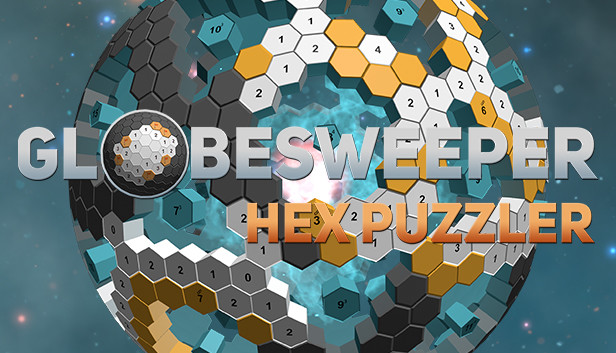
On Globesweeper: Hex Puzzler, the board curves away from the familiar flat surface. Its globe contains gaps, creating new patterns as connections disappear and reappear around the sphere. Eight new mechanics add further layers: cluster tiles count connected reactive tiles, area tiles count reactive tiles across a surrounding area, and group tiles count separate groups. As those clues combine, the player must track both shape and connection. All 92 levels are solvable through logic.
| Aspect | Explanation |
|---|---|
| Why It's Ranked Here | The globe, its gaps, and its interacting clue types create a demanding spatial system with several kinds of information. |
| Who It's For | It is best for players who enjoy following connections across an unfamiliar surface and combining different clues. |
| Key Selling Points | It contains 92 levels and eight new mechanics, including cluster, area, and group tiles. |
8. SquareCells #
 Steam¥15.00Ver precio →
Square grids still have plenty of room for a distinctive puzzle. SquareCells asks you to reveal a pattern using surrounding clues, keeping the presentation spare and the goal focused. Its 36 puzzles make it a concise choice for someone who wants a finite set built around recognising how local information shapes a larger image.
| Aspect | Explanation |
|---|---|
| Why It's Ranked Here | Its restrained square-grid format puts the emphasis on seeing the hidden pattern emerge from surrounding clues. |
| Who It's For | It is a good match for players who prefer minimal presentation and a compact collection. |
| Key Selling Points | It offers 36 puzzles centred on revealing grid patterns through surrounding clues. |
9. hexceed #
 SteamGratisVer precio →
A free base game makes hexceed an inviting way to try hex-grid clues. Numbers show how many dangers lie around a hexagon, while special tiles introduce directional lines, blocking walls, and other effects that change what information a click provides. Hundreds of levels and distinct layouts let the system unfold gradually, with additional content available through separately sold DLC.
| Aspect | Explanation |
|---|---|
| Why It's Ranked Here | It offers an accessible hex-grid introduction and uses special tiles to expand the information available during a level. |
| Who It's For | It is suited to players who want to try the format through a free base game before exploring further content. |
| Key Selling Points | It includes hundreds of levels, directional lines, blocking walls, other special tiles, and separately sold DLC. |
10. Patterna #
 Steam¥29.00Ver precio →
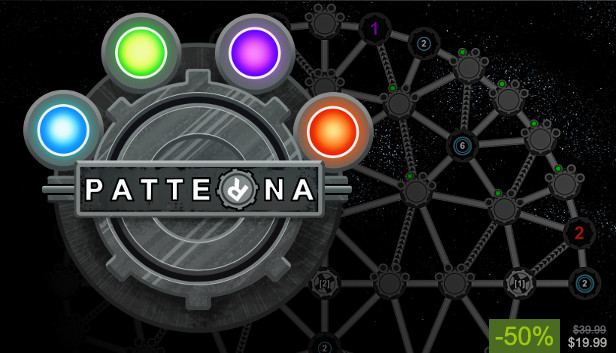
At the abstract edge of the list, Patterna replaces a regular grid with a network of nodes. Each node has one of two states, and you classify unknown nodes using distance, connectivity, and colour. Correctly classifying one node can reveal further information, so progress spreads through the graph rather than across rows and columns. More than 70 levels plus a tutorial introduce the system, while the customizable generator and level editor give experienced players control over new structures. Its puzzles require no guessing.
| Aspect | Explanation |
|---|---|
| Why It's Ranked Here | Its graph structure changes the basic geometry of deduction and makes relationships between connected nodes more important than regular adjacency. |
| Who It's For | It is aimed at experienced players who want an abstract extension, a generator, and a level editor. |
| Key Selling Points | It includes more than 70 levels plus a tutorial, a customizable generator, a level editor, and logic-solvable puzzles. |
Comparison Table #
| Game | Genre | Why It's Ranked | Play Structure |
|---|---|---|---|
| Hexcells Infinite | Hex-grid deduction | It offers the clearest first step into the wider format. | It includes 36 designed puzzles, a random generator, and user-made puzzles. |
| Tametsi | Varied tile geometry | It makes varied layouts central to a sustained challenge. | It contains 100 main puzzles and 60 extra puzzles with drawing tools and automatic saving. |
| 14 Minesweeper Variants | Rule variants | It makes learning different clue systems the main attraction. | It offers 14 variants, four difficulties for each, and hundreds of generated levels. |
| Bombe | Rule automation | It turns proven deductions into reusable rules. | It uses connected regions, formal rule checking, automatic application, and thousands of levels. |
| Polimines 2 | Nonogram hybrid | It gives nonogram players a direct bridge into this puzzle family. | It has 60 levels with different shapes and no timers. |
| Delete | Spatial boards | It makes changing dimensions and shapes part of solving. | It includes 50 differently shaped levels and seven kinds of play. |
| Globesweeper: Hex Puzzler | Spherical boards | It combines a globe with gaps and several clue types. | It offers 92 levels and eight new mechanics. |
| SquareCells | Pattern deduction | It keeps the focus on patterns in a square grid. | It contains 36 puzzles based on surrounding clues. |
| hexceed | Hex-grid progression | It provides an accessible free base game for hex clues. | It includes hundreds of levels, special tiles, and separately sold DLC. |
| Patterna | Graph deduction | It replaces a regular grid with connected nodes. | It has more than 70 levels, a tutorial, a generator, and an editor. |
How to Pick the Right One #
| Preference | Recommended Games |
|---|---|
| Learn hex-grid clue reading → | Hexcells Infinite and hexceed provide two accessible routes into hex-based information. |
| Work through harder deductions → | Tametsi and 14 Minesweeper Variants reward patience with demanding logic and changing systems. |
| Try spatial boards → | Delete and Globesweeper: Hex Puzzler make shape, dimension, or connection part of the challenge. |
| Change the underlying logic structure → | Bombe, Polimines 2, SquareCells, and Patterna alter how information is represented or applied. |
FAQ #
Which game is the best place to start? #
Hexcells Infinite is the best starting recommendation because its 36 designed puzzles introduce hex-grid deduction before the random generator and user-made puzzles extend the format. hexceed offers another accessible route through its free base game, with additional paid DLC available separately.
Do these games require guessing? #
Tametsi, 14 Minesweeper Variants, Bombe, Polimines 2, Globesweeper: Hex Puzzler, and Patterna state that their puzzles can be completed through logic. Delete describes all of its puzzles as reasoned solutions, and hexceed presents every tile as having a logical answer. SquareCells and the Hexcells Infinite generator have no equivalent statement in the supplied facts.
Which game should a nonogram fan try? #
Polimines 2 is the direct choice because it explicitly combines nonograms with Minesweeper. Its 60 levels use different shapes and remove timers, giving pattern-focused players time to follow both kinds of clue.
Which games offer more rules to explore? #
14 Minesweeper Variants changes the rules across 14 variants, each with four difficulties. Bombe stores formally checked rules and reapplies them, turning established deductions into a growing toolkit. Patterna adds a customizable generator and editor to its graph-based system.
How do the spatial games differ from a flat board? #
Delete increases the spatial dimensions and changes level shapes, so the board’s form affects which clues can inform one another. Globesweeper: Hex Puzzler uses a globe with gaps and adds cluster clues for connected tiles, area clues for wider surroundings, and group clues for separate sets. These games therefore broaden the spatial idea beyond a simple flat arrangement of nearby squares.
The Wider Minesweeper Family #
The most useful way to approach these games is to treat “Minesweeper-style” as a family resemblance rather than one rigid ruleset. Hexcells Infinite and hexceed build around hex-grid clues, Tametsi changes the tiling, and SquareCells concentrates on a hidden square-grid pattern. Delete and Globesweeper: Hex Puzzler make space itself more unusual, while Patterna turns adjacency into a graph of relationships.
Other games change the act of deduction. Polimines 2 joins local mine clues to nonogram patterns, 14 Minesweeper Variants asks you to learn several systems, and Bombe lets you preserve a solved rule for later use. That spread is why the best choice depends less on a universal difficulty label than on the kind of reasoning you want to practise: reading a compact grid, following a shape, learning a new clue language, or building a reusable theory of the board.






Comentarios 0
Nos interesa tu opinión
Participa en la conversación y comparte tu opinión sobre este juego.
Aún no hay comentarios. Comparte tu opinión.