























Opening
Arma 3 is less a game than a military simulation platform that happens to ship with a campaign. Released by the Czech studio Bohemia Interactive in 2013, it is the genre-defining ceiling of hardcore milsim on PC: a combined-arms sandbox spanning infantry, armor, aircraft and naval forces, played out across hundreds of square kilometers of open terrain, governed by realistic ballistics that account for bullet drop, wind and zeroing. There is no other game of its scale and ambition, and twelve years after release it remains the standard against which every tactical shooter is measured — usually unfavorably, because almost nothing else even attempts what Arma does.
Its influence is, frankly, staggering. Arma 3 and its predecessors were the soil from which two of the most important phenomena in modern gaming grew: DayZ began as an Arma 2 mod and founded the entire open-world survival genre, and the battle-royale format that became PUBG and then Fortnite traces directly back to mods built in Arma's editor. This is an engine that did not just succeed on its own terms but seeded billion-dollar categories as a side effect, an unmatched mother-legacy in the medium. Backed by a Steam Workshop of 160,000 mods — a top-five modded game behind only Skyrim and Stellaris — and a world-class mission editor, Arma 3 is as much a creation toolset as a product.
This review grades Arma 3 across six dimensions, and the scores describe a magnificent, jagged specialist: a 9.6 for content and a 9.4 for gameplay tower at the top, a 7.8 for graphics and a 7.5 for a genuinely authored campaign hold the middle, and a 6.5 for its widely-criticized audio marks the clear weak point, landing on an 8.5 overall. That spread is the whole story. Arma 3 is the deepest, broadest, most influential military sandbox ever made, gated behind a brutal learning curve, a decade-long performance bottleneck, and sound design that players routinely replace themselves. The next six sections explain exactly who should climb that wall.
Story | 7.5/10
Historia: 7.5/10Arma 3 scores 7.5 for story, and that number is notably higher than the survival-sandbox sims it often sits alongside, because unlike most of them, Arma 3 actually ships with a real, authored campaign. Bohemia did not have to write a story — the game's enduring value is in its sandbox and tools — but they did, and the result is a structured narrative arc that gives newcomers a way into the simulation and gives the score a foundation that purely open-ended games lack.
The East Wind: a campaign in three acts

The backbone of the 7.5 is The East Wind, the base game's three-episode campaign — Survive, Adapt, Win — that walks the player through a near-future Mediterranean conflict on the islands of Altis and Stratis. It is a genuine authored arc with a beginning, a middle and an escalation, and crucially it is built to teach: each episode introduces new mechanics, vehicles and tactics within a narrative frame, so the campaign doubles as the onboarding the rest of the game so badly lacks. The story follows a soldier drawn into a deteriorating geopolitical situation, and while it is not award-winning fiction, it is competent, atmospheric, and far more personal than the faceless scenario-stacking of most milsims. Survive in particular opens with you stranded and outgunned, an unusually intimate framing for a genre that usually treats the player as an interchangeable unit, and that personal stake is what makes the campaign land. For a game whose reputation rests almost entirely on its sandbox, having a real campaign at all is a meaningful value-add, and The East Wind is good enough to anchor the story score well above the genre floor. It is the rare milsim that bothers to tell you why you are fighting.
Expansions and the near-future world

Beyond the base campaign, Arma 3 layers on additional authored content through its expansions, broadening both the world and the story. Apex brings the South Pacific island of Tanoa and its own campaign content, while Contact takes the boldest swing of all — a first-contact scenario in which the milsim collides with an alien arrival on the Livonian map, an unexpected and genuinely intriguing detour for a franchise built on grounded realism. These expansions demonstrate that Bohemia treated Arma 3 as a living narrative platform, not just a static sandbox, and they give players who want authored experiences a real spread of campaigns to work through. Underpinning all of it is the near-future 2035 setting, a thoughtfully constructed geopolitical backdrop of factions, fictional-but-plausible technology and regional conflict that gives the fiction texture and coherence. This worldbuilding is more developed than the genre demands, and it provides the connective tissue that makes the various campaigns feel like parts of one believable world rather than disconnected exercises. The setting is a quiet strength that supports everything built on top of it, and it gives the modding community a consistent canon to extend.
The real story engine: Eden and Zeus

For all the value of the authored campaigns, the deepest storytelling in Arma 3 is the kind the developers never wrote, generated instead by the community through the game's extraordinary creation tools. The Eden Editor lets players construct entire missions and full campaigns with a sophistication rivaling a simplified game engine, and Zeus, the real-time game-master mode, lets a person dynamically direct a scenario as it unfolds, spawning enemies, scripting twists and orchestrating drama for other players live. Between them, these tools have produced an effectively infinite library of player-authored stories — milsim operations, cinematic set-pieces, comedy scenarios, sprawling community campaigns — far exceeding anything Bohemia could have shipped. Organized MILSIM units run persistent narrative operations with their own arcs and characters, and the Workshop overflows with story-driven missions. This is where Arma 3's narrative truly lives: not in a single campaign but in a creation engine that turns its entire community into storytellers. The 7.5 reflects a game that delivers both a solid authored campaign and the most powerful story-generation toolkit in the genre, a combination that earns it a story score well above its sandbox peers and honestly close to what its tools deserve. The campaign gets you in the door, and the editor keeps you telling stories long after the credits roll — and that one-two structure is exactly why Arma's narrative dimension punches harder than its reputation as a pure sandbox would suggest.
Audio | 6.5/10
Sonido: 6.5/10Arma 3 scores 6.5 for audio, its weakest dimension by a clear margin, and this is the one area where a genre-defining game genuinely stumbles. For a simulation that prides itself on realism in ballistics, vehicles and tactics, the sound design has long been considered a disappointment — IGN's review notably called it close to a complete failure — and while it is not unusable, it conspicuously fails to match the fidelity of everything around it. In a game this committed to authenticity, audio that feels like an afterthought is a real and noticeable flaw.
The soundtrack that fights the simulation
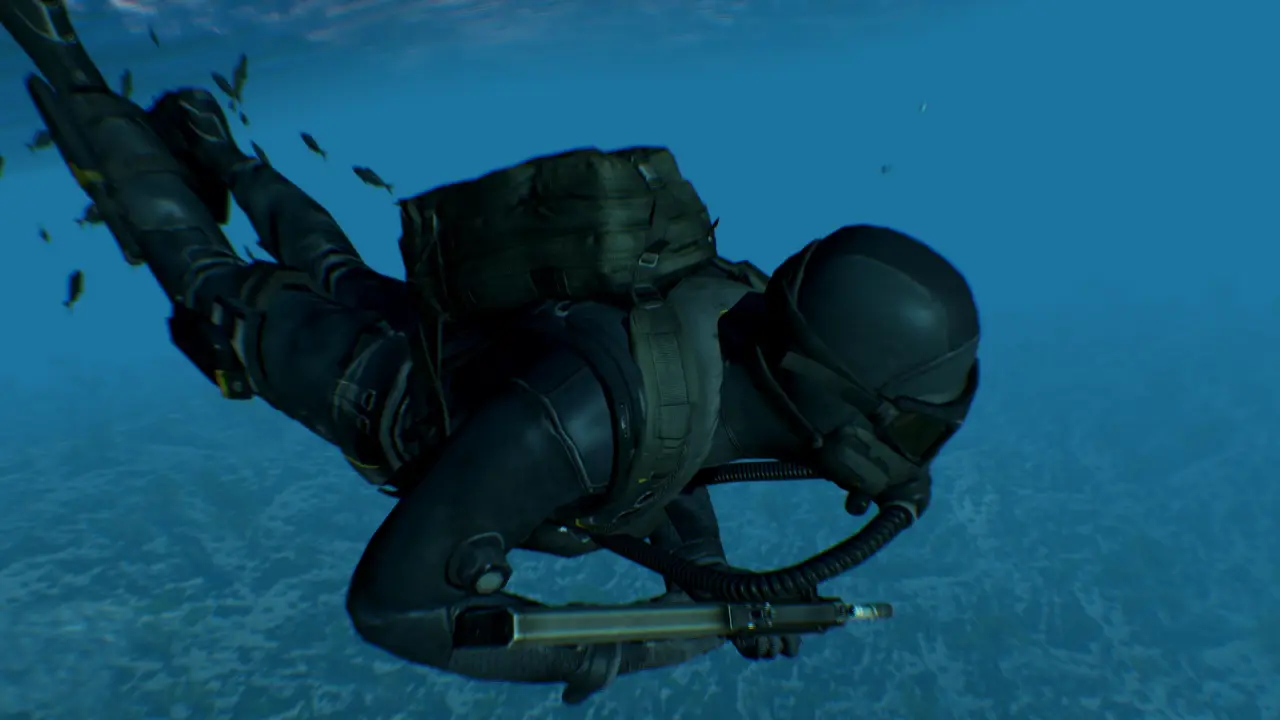
The most-cited problem with Arma 3's audio is its soundtrack, which leans heavily electronic in a way that frequently clashes with the tone of a serious military simulation. Where the game wants to convey the grim tension of a tactical operation, the music sometimes pulls toward a stylized, synthetic register that undercuts the atmosphere rather than reinforcing it, and the mismatch is jarring enough that it became a defining criticism at launch. A milsim lives or dies on immersion, on the feeling that you are really there in a dangerous, deliberate engagement, and a soundtrack that fights that feeling does measurable damage. This is not a matter of taste alone; it is a structural mismatch between the audio direction and the experience the rest of the game is straining to deliver, and it is the single biggest reason the audio dimension scores as low as it does. The contrast with the meticulous realism of the ballistics and vehicle systems makes the audio's tonal misstep stand out all the more, an odd weak link in an otherwise obsessively authentic chain. It is the part of Arma that feels least finished.
Functional but flat combat sound

Beyond the soundtrack, the core combat audio is serviceable but flat, and it does not live up to the engine's mil-sim ambitions. Weapons fire and vehicles rumble, and the sounds convey the basic information you need, but they lack the visceral weight and crisp authenticity that a hardcore simulation player expects and that the genre's best examples achieve. Gunfire can feel thin, the punch of heavy weapons underwhelms, and the overall mix does not deliver the chest-thumping realism that should accompany a 270-square-kilometer combined-arms battlefield. It is competent enough to function — you can fight, hear and react — but it is competent in a way that feels like a baseline rather than a strength, especially jarring in a game whose entire pitch is uncompromising fidelity. For a simulation that models bullet drop and wind, the relative blandness of the audio is a conspicuous gap, and it keeps the score firmly in below-average territory for the dimension. The sound simply does not carry the same conviction as the systems it is meant to bring to life.
The community fixes what Bohemia did not

The saving grace of Arma 3's audio, and the reason the 6.5 is not lower, is twofold. First, the positional audio still functions tactically: directional sound conveys where fire is coming from and how far away, and in a game built on situational awareness that functional layer genuinely matters even when the production quality disappoints, giving the audio a real if unglamorous job that it does adequately. Second, and more tellingly, the Arma community has comprehensively solved the problem itself. Audio overhaul mods like JSRS and the realism suite ACE completely replace the game's sound design with vastly superior, more authentic alternatives, and for most serious players these mods are effectively mandatory installs that transform the audio from a weakness into a strength. This is both an indictment and a redemption — the base game's audio is weak enough that the community felt compelled to rebuild it, but the moddability that defines Arma means the fix is freely available to anyone. The 6.5 grades the out-of-the-box experience honestly as the game's clear low point, while acknowledging that the platform's openness gives players the tools to repair the one thing Bohemia got wrong.
Visuals | 7.8/10
Gráficos: 7.8/10Arma 3 scores 7.8 for graphics, a number that balances a genuinely impressive achievement of scale against the realities of an aging engine and a long-standing performance bottleneck. This is not a game that competes on per-pixel fidelity with modern AAA shooters, and it never tried to; its visual accomplishment is rendering enormous, coherent battlefields at true scale, with the sightlines and detail a realistic military simulation requires. Judged on that basis it is a real success, even as its limitations are equally real.
Battlefields measured in square kilometers

The headline graphics achievement in Arma 3 is scale. The base island of Altis is roughly 270 square kilometers, and with the Tanoa and Livonia expansions the playable terrain expands further still, all rendered as continuous, seamless space with no loading screens between one end and the other. This is not scale for its own sake but scale in service of the simulation: realistic ballistics and combined-arms tactics demand long sightlines, real distances and room for aircraft, armor and infantry to operate in the same space, and Arma's terrains provide exactly that. You can engage a target across a valley a kilometer away, call in air support that actually has to traverse meaningful distance, and plan an operation across terrain large enough to demand genuine navigation. The sheer size and coherence of these environments is something almost no other game attempts, and rendering them at a stable enough quality to support the gameplay is a serious technical accomplishment that anchors the 7.8. The Mediterranean island setting is also genuinely pretty in places, with attractive vistas and convincing lighting that reward the long views the tactics require.
The single-core bottleneck

The defining technical limitation on Arma 3's graphics, and the main thing holding the score down, is performance. For most of its life the Real Virtuality 4 engine was bottlenecked by a reliance on single-core CPU performance, which meant that exactly when the action got most ambitious — large battles with many AI units, vehicles and effects on screen — the frame rate would buckle, no matter how powerful the player's hardware. This decade-long bottleneck was a persistent frustration, because the engine's enormous ambitions routinely outran its ability to run them smoothly, and it capped the practical visual quality players could enjoy in the game's signature large-scale scenarios. The long-awaited arrival of multithreading support in January 2025 finally began to address this, a genuinely significant improvement that lets modern multi-core systems stretch their legs, but it came after more than a decade of the engine struggling under its own scope. The performance story is inseparable from the graphics score: the visuals are ambitious, but for years the hardware could not always keep up with that ambition, and that tension is precisely what the 7.8 reflects.
Dated fidelity, enduring scale

The honest ceiling on the graphics is that, after twelve years, the underlying fidelity shows its age, and some of the seams of building such vast worlds are visible up close. Texture and asset reuse across the enormous maps means that non-combat exploration can feel visually repetitive, with the same buildings and props recurring across the landscape, and character models, animations and surface detail no longer match the standard set by contemporary shooters. None of this undermines the game's purpose — the visuals exist to serve the simulation, and at the scale and sightlines that tactics demand they still do their job well — but it does mean Arma 3 reads as a functional, dated-but-capable presentation rather than a showcase. What endures, and what keeps the score firmly in good territory, is the scale and draw distance that no rival matches: the ability to see and fight across kilometers of coherent terrain remains genuinely impressive, and the 2025 performance fix gives that scale new life. The 7.8 is the fair verdict — an aging engine of unmatched ambition, finally unshackled from its worst bottleneck, that prioritizes the scale its simulation needs over the fidelity its competitors chase. And as ever in Arma, the community fills the gaps the base game leaves: high-resolution texture packs, lighting overhauls and graphical mods let players modernize the look as far as their hardware allows, so the practical visual ceiling is higher than the stock presentation suggests.
Combat | 9.4/10
Jugabilidad: 9.4/10Gameplay scores 9.4, the second-highest of Arma 3's dimensions, and it is the score that certifies the game as the hardcore military-simulation ceiling. Nothing else combines this breadth and this depth: realistic ballistics, a fully combined-arms sandbox, and a pair of creation tools that turn players into designers, all operating at a scale no competitor approaches. The 9.4 is the measure of a simulation so complete that it functions as an entire genre unto itself.
Ballistics and the realism of every shot
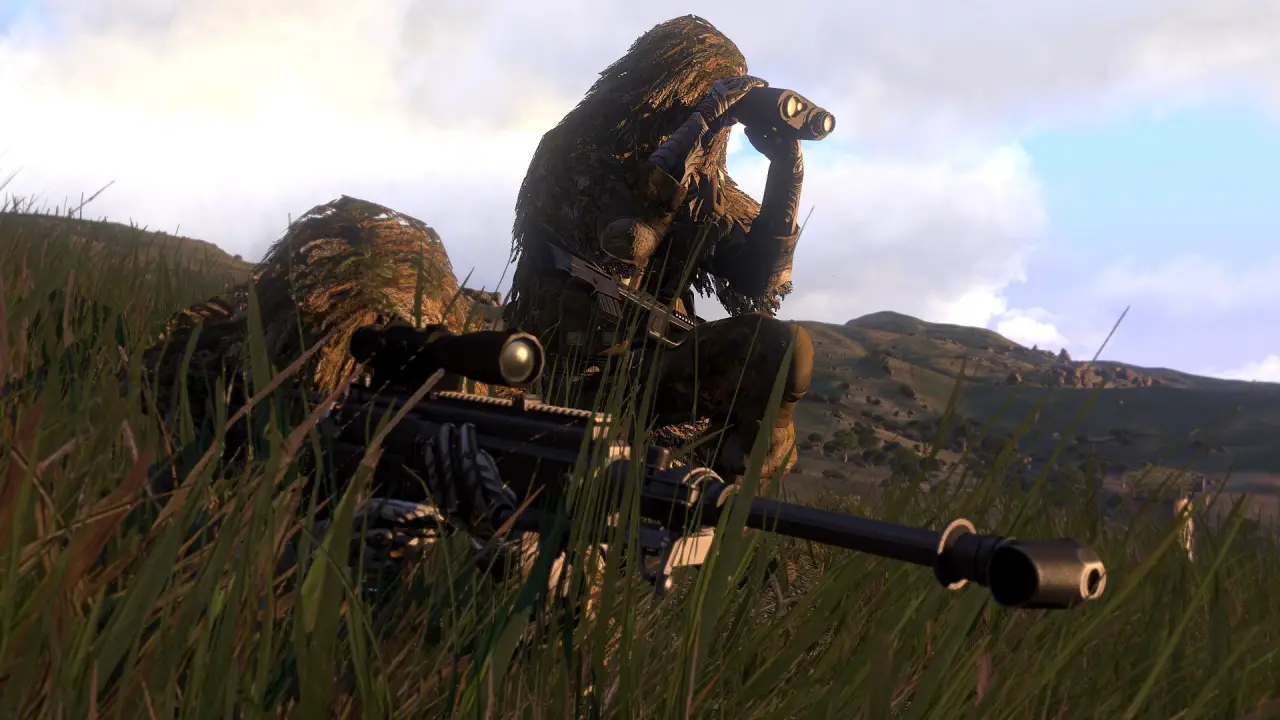
At the core of Arma 3's gameplay is a commitment to realistic ballistics that fundamentally changes what shooting means. Bullets are simulated projectiles with travel time and drop, affected by wind and range, requiring you to zero your optics correctly and account for distance and movement before a long shot will land. Different calibers and weapons behave distinctly, and there is no hitscan shortcut, no forgiving aim-assist — a four-hundred-meter shot is a genuine act of marksmanship that rewards knowledge and punishes carelessness. This realism extends to the whole soldier experience: stance, fatigue, weapon sway, suppression and the lethal fragility of the human body all matter, so combat is slow, deliberate and tense in a way that arcade shooters never approach. A single well-placed round can end you, which makes every movement across open ground a real decision. This is the foundation of the milsim fantasy — that you are not a superhero but a vulnerable soldier in a dangerous, physically honest world — and Arma 3 delivers it more completely than anything else, which is the heart of the 9.4.
Combined arms and the creation tools

What elevates Arma 3 from a great tactical shooter to a genre unto itself is the breadth of its combined-arms sandbox paired with its creation tools. This is not just an infantry game: you can pilot helicopters and jets, command tanks and armored vehicles, operate naval craft, coordinate artillery, and run operations that integrate all of these branches simultaneously across the same enormous map. Each domain is simulated with real depth, so flying, driving and fighting on foot each demand their own learned competence, and orchestrating them together is a command challenge that few games even offer. On top of this sits the creation layer that defines the platform: the Eden Editor, a 3D mission builder of remarkable power that rivals a simplified game engine, and Zeus, the real-time game-master mode that lets a player direct a live scenario on the fly. These tools mean Arma 3's gameplay is not a fixed set of modes but an open-ended toolkit, and combined with the 160,000-mod Workshop, the practical scope of what you can do is effectively unlimited. No other game hands players this much combined-arms simulation and this much creative authority at once.
The brutal wall and the Squad contrast
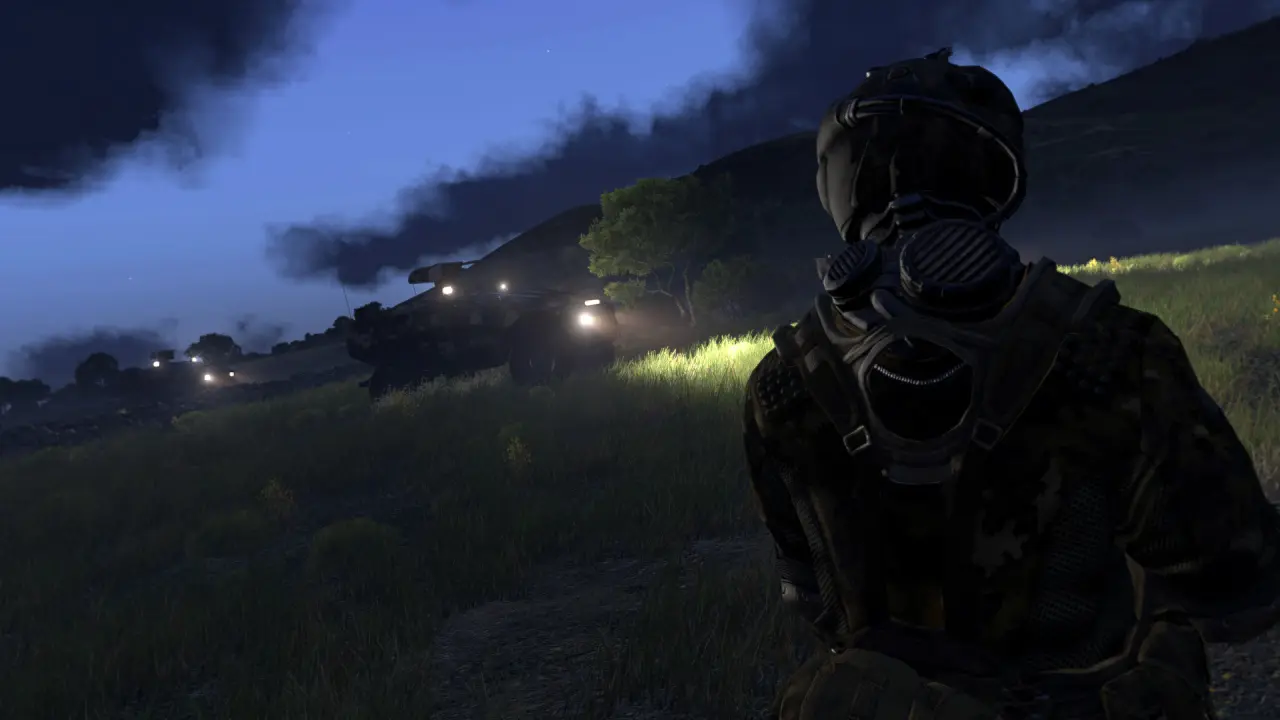
The honest cost of all this depth and breadth is one of the steepest barriers to entry in gaming. Arma 3 ships with essentially no tutorial worthy of the name, and its control scheme is famously, almost absurdly complex — dozens upon dozens of keybinds, intricate inventory and command systems, and unforgiving mechanics — so new players spend the first five to ten hours flailing, dying to things they did not understand, and wrestling with the interface as much as the enemy. This wall is the main factor keeping the gameplay at 9.4 rather than a perfect mark: the simulation beneath is sublime, but reaching it demands a genuine investment of patience that filters out all but the committed. The contrast with its closest modern rival is clarifying. Squad delivers a superb hardcore infantry experience with strong teamwork, but it is focused and bounded — large-scale infantry combat, done excellently. Arma 3 trades that focus for total breadth: all branches, any scenario, a world-class editor, and a modding scene that reshapes the game endlessly. Squad is the better game for one specific thing; Arma 3 is the sandbox that can be almost anything, and for the player willing to climb the wall, the 9.4 is more than earned. It is the difference between a sharply designed product and an open platform, and while the platform demands far more of you up front, what it gives back — the freedom to simulate any operation across any domain you can imagine — has no equal in the medium.
Content | 9.6/10
Contenido: 9.6/10Content scores 9.6, Arma 3's highest mark and one of the highest in this entire review, and the case for it is close to unanswerable. Between an enormous modding ecosystem, a pair of world-class creation tools, a deep spine of official campaigns and expansions, and a cultural legacy that birthed entire genres, Arma 3 offers more to do — and more to make — than almost any game in existence. This is content measured not in hours but in years, and not just in what Bohemia shipped but in what the platform enables others to build.
A hundred and sixty thousand mods

The foundation of the 9.6 is the Steam Workshop, where Arma 3 commands roughly 160,000 mods — placing it among the top five most-modded games on the entire platform, behind only Skyrim and Stellaris. This is not a long tail of trivial tweaks but a vast ecosystem of substantial creations: total conversions, realism overhauls like ACE, entire new terrains, faction packs, weapon and vehicle additions, audio replacements, and full-scale campaigns. Whatever experience you want from a military sandbox, the community has very likely built it, and the sheer volume means the content ceiling is effectively infinite — you could play modded Arma 3 for a decade and never exhaust the Workshop. This modding scene is not peripheral to the game but central to its identity and longevity, the reason a 2013 title remains vital in 2026, and it is the single biggest pillar of the content score. Few games support modding this deeply, and almost none have attracted a community this prolific or this committed, turning Arma into a living platform that grows faster than any one studio could maintain.
Creation tools and an authored spine
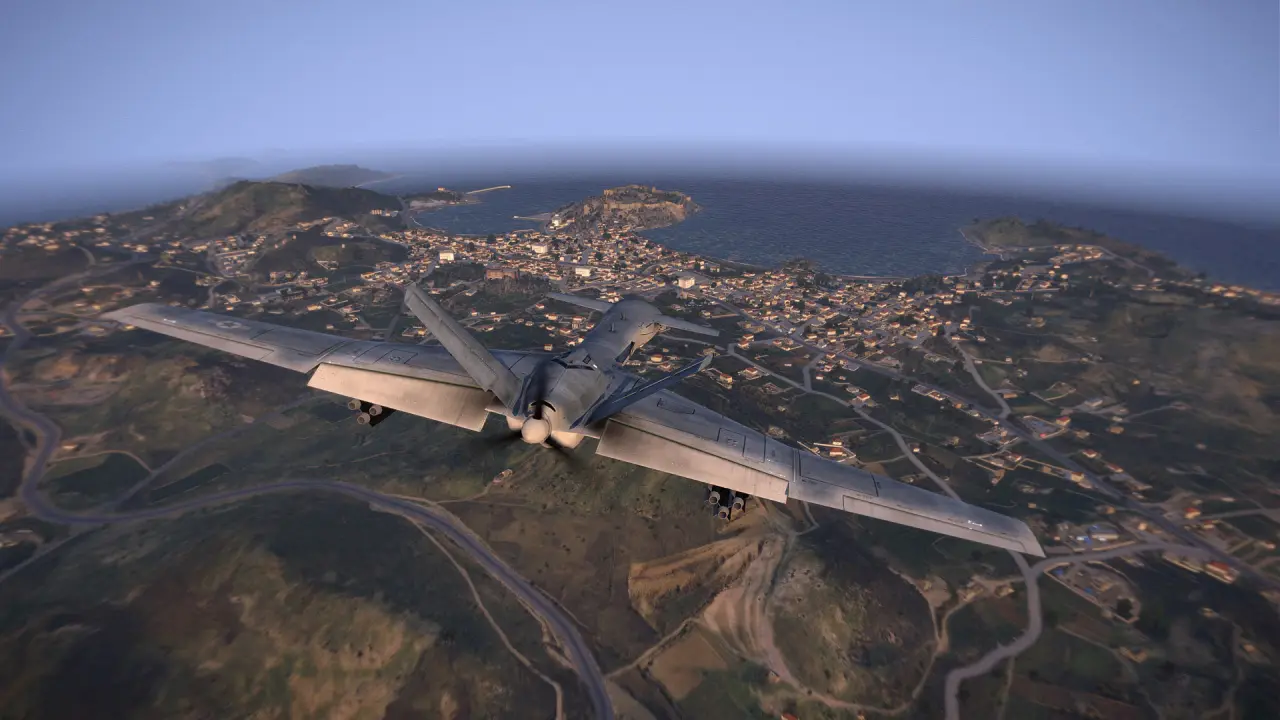
What multiplies that modding ecosystem is the creation toolset that powers it, and the official content that anchors it. The Eden Editor lets players build missions and campaigns of professional complexity, and Zeus enables live-directed scenarios, so the community is not merely consuming content but continuously generating it — every player is a potential designer, and the result is an endlessly renewing stream of scenarios, operations and experiences. Beneath this player-generated abundance sits a substantial authored spine: the base game's East Wind campaign, the Apex and Contact expansions with their own campaigns and maps, and a range of creator and content DLC like Global Mobilization and Western Sahara that add whole new theaters and eras. This combination means Arma 3 serves both the player who wants curated official content and the one who wants to build or download endless custom experiences, and the two reinforce each other — the official content teaches the systems that the community then extends. The breadth of play, from a scripted campaign mission to a 100-player MILSIM operation to a solo sandbox experiment, is simply enormous, and all of it runs on the same deep simulation.
The engine that birthed genres

The final and most remarkable pillar of Arma 3's content is its legacy, because no other game can claim to have incubated entire billion-dollar genres as a byproduct of its toolset. DayZ began life as a mod built in Arma 2, and went on to found the open-world survival genre that now includes countless titles; the battle-royale format that became PUBG, and through it Fortnite and an industry-wide phenomenon, traces directly back to mods made in Arma's editor by creators like Brendan Greene. This is an unmatched engine-mother legacy, a content footprint that extends far beyond Arma 3 itself into the foundations of modern gaming, and it speaks to the generative power of the platform Bohemia built. That power continues to pay off commercially too: with 8 million sales, a twelve-year evergreen tail, and still 700,000 copies sold in a single 2024 quarter, Arma 3 keeps drawing new players into its bottomless content. Between an infinite modding scene, world-class creation tools, a deep official catalog, and a genre-seeding legacy unlike anything else in the medium, the 9.6 is the score of a game whose content is, in every practical and historical sense, limitless. No other title in this review, and very few in all of gaming, can claim to offer this much to do while also having quietly authored the blueprints for two of the biggest genres of the modern era — that dual achievement is what pushes the content dimension to the very top of the scale.






Comentarios 0
Nos interesa tu opinión
Participa en la conversación y comparte tu opinión sobre este juego.
Aún no hay comentarios. Cuéntanos qué te parece este análisis.