

























Opening
Here is the pitch in one breath: a survival game where nothing out here is hunting you and nothing is counting down. Solarpunk hands you a sky full of floating islands, a sea of cloud underneath, and the single best idea it has — it wires the weather straight into your power grid. Solar panels go dead the moment the sun sets. Turbines sit idle until the wind picks up. Water wheels only spin if you hug them against a shoreline. You are not fighting monsters out here. You are arguing with a forecast.

This is the work of Cyberwave, a two-person German studio that spent roughly four years on it, and the payoff showed up fast: over ten thousand concurrent players on launch day, more than a million wishlists before that. It trades the old survival panic — eat or starve, build or freeze — for sunlight, drifting clouds, and an airship that is in no hurry. The only needs it asks you to manage are hunger and thirst; everything else is yours to spend on raising buildings, routing power, and watching your island slowly grow into something.
The catch is just as real. Somewhere around the five-to-ten-hour mark, a lot of players start running out of new things to chase.
That 77% Steam rating captures the split perfectly — one camp falls hard for the calm and the art, the other gets restless once the late game thins out. This review exists to draw that line clearly, so you can tell which camp you are in before you spend a cent.
Story | 5.5/10
Historia: 5.5/10The ground civilization is gone — all that's left is a few islands in the cloud
The premise fits on a postcard. Civilization on the surface vanished long ago, and the world is now nothing but islands drifting above the clouds. You arrive to rebuild a home from scratch. Your first hour is pure homesteading bookkeeping: rig a barrel to catch rainwater, plant a cotton field, spin cotton into fabric, and use that fabric to assemble a research bench. Water, food, research — the three legs of the stool, and the cozy loop opens up from there.

The mood stays loose the entire way through. No combat, no raids, no clock ticking down, just hunger and thirst to keep an eye on. That whole "coexist with nature instead of plundering it" utopia is the thing it most wants to sell you, and the soft palette and green-tech optimism do conjure a rare kind of brightness. In a genre drowning in zombies, fallout wastes, and last-stand misery, a game that deliberately picks "warm and hopeful" is genuinely scarce — that tone is its truest point of difference.
The trouble is that this worldview is more or less the entire narrative. It is a gorgeous backdrop, not a story with a hand on your back pushing you forward. You land, you build, you fly onward, and the world just lies there quietly, never producing anyone who hands you a reason you cannot refuse.
No quest text, no character arcs — the narrative needle barely moves
If you came for a plot, brace yourself: there is almost none. No quest writing worth the name, no characters who grow or change, and the animals dotting the islands read like lifeless puppets rather than living things. Everything you do is mechanical — raise a building, lay a power line, fly an airship — never in service of a mystery to unravel or a person to walk a road with.

That is exactly why story lands near the bottom of the scorecard. Set it beside the other great no-combat survival game, Subnautica, and the gap is obvious. Subnautica runs on dread — something is moving in the dark water, and that fear drags you deeper, drags you toward competence one terrified dive at a time. Solarpunk swaps every ounce of that dread for sunlight. The atmosphere is lovelier for it. But the thread that used to pull you onward is gone.
It preaches coexistence, then lets you strip-mine without a shrug
Here is the knot it never unties. The game champions harmony between people and nature with one hand, and with the other lets you industrialize that nature without a second thought — blanket an island in mining rigs and drones, with zero consequence. Clear-cut the resources, strip an island bare, and nature never bites back. "Coexistence" starts to feel like a slogan tacked to a wall.
That is the heart of the critique outlets like I Dream of Indie keep raising: there is an unfilled gap between the ecological message it wants to deliver and the free hand it actually grants you, and the game never seems aware of the contradiction. A design that took "coexistence" seriously could have made over-extraction wound an island's ecosystem and made you pay for your sprawl. Solarpunk chooses never to inconvenience the player. For anyone who values a complete narrative, or who came genuinely moved by that green premise, this gap will keep digging into you — it turns a theme with real weight into set dressing.
Audio | 7.5/10
Sonido: 7.5/10Wind, water, and a low airship hum hold up the whole sky
The sound design picks a lane and commits: serve the mood. The score is soft and unhurried, almost shy about taking the spotlight, which suits a no-pressure farming-and-exploring rhythm perfectly. While you slowly route power lines and water the cotton, the music seems to step back on purpose, leaving you undisturbed to sink into your own optimization loop. That restraint is deliberate — it never wants a swelling melody yanking your emotions around. It wants sound to be the layer you barely notice while you concentrate, the thing quietly holding everything up. For a game built to decompress you, "doesn't get in the way" is the right call.

The ambient layer is where the craft really shows. Wind threading through the islands, water rushing past a hydraulic wheel, the deep growl of an airship engine echoing across the cloud sea — stacked together, they form the acoustic floor of this whole world. Pilot a ship you built yourself from one island to the next and the shifting balance of engine and wind genuinely reinforces the sense of floating. It is an underrated piece of the immersion, the kind of thing you only notice is doing heavy lifting when you stop and actually listen. At night especially, the whoosh of turbine blades tangled with distant insect noise lands on exactly the cozy register the game is reaching for, and it is in those quiet moments that the world feels most alive rather than merely pretty.
Thunder doubles as an alarm — for your crops and your frame rate
The cleverest piece of audio here ties sound directly to a mechanic. When a thunderstorm rolls in, that rumble is not just atmosphere — it is two alarms at once. One: any crops you left unprotected by a greenhouse are about to get fried. Two: the dense effects coming next will probably drag your frame rate down.
For once, sound is not background; it is part of the decision. You slowly learn to read the weather by ear — a muffled boom on the horizon and you drop whatever you are doing to go check the unsheltered fields, eyes already darting to the forecast board. That little "listen, then react" habit is something most farming games never bother to give you, and it quietly deepens how present you feel in the world rather than just looking at it.

No voice work, no earworms — it stumbles next to Stardew Valley
The shortfall is just as plain: there is effectively no voice acting. Which tracks with the zero-narrative design — no talking characters, no quest dialogue, so the voice-driven storytelling channel is simply absent. You will never lock onto a character because of a line read, because there is no character worth locking onto.

Hold it up against Stardew Valley and its instantly memorable signature themes, and the distance opens wide. Stardew's seasonal tunes burrow into your skull; people who quit years ago can still hum them on cue. Solarpunk's music is fine, it is pleasant, it sets the mood well — but you will struggle to whistle any single phrase back. It is a competent backdrop, not a soundtrack you pull up to listen to on its own. The atmosphere is there; the hook is not. That is probably its biggest regret on the audio front.
Visuals | 8.5/10
Gráficos: 8.5/10Islands stacked over a cloud sea — the one thing nobody disputes
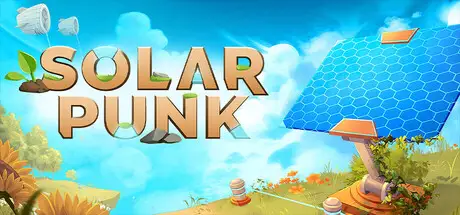
Visually, Solarpunk wins the argument before it starts. Slabs of floating island hang over an ocean of cloud, washed in a soft, bright solarpunk palette, and that sunlit, hopeful, almost vitamin-D look is the single biggest reason its wishlist blew past a million. For a two-person studio like Cyberwave to push a sky aesthetic to this level of polish is a genuinely striking achievement.

And it is not a static postcard. Once you actually move in and start dropping pieces onto an island, the look grows a personality alongside your construction. It earns the highest score in this whole review not by piling on technology, but by spending limited resources on one coherent, likable art direction.
The volume in the clouds, the way light spills over an island's edge, the small wobble of foliage in the wind — none of it is cutting-edge, but together it holds your eye, and it does not tire you out over a long session. That is the smartest budget trick a small team has: don't fight 3A on texture fidelity, win on stylistic unity instead. It is the difference between a game that looks expensive and a game that looks intentional, and Solarpunk firmly picks the second.
Modular snap-building lets you raise a sky city by hand
What makes the visuals actually breathe is the modular snap-build system. Wall and floor pieces align and click into place on their own, so you scale from a one-room cabin to an entire floating city almost without friction. The upshot is that every player's home ends up looking different — the visual freedom is high, and this is where the builder crowd loses whole evenings.

The weather system then layers dynamic light over those static structures. Day swinging into night, clear skies clouding over — each shift visibly changes the feel of an island. The same city you built by hand reads as two different moods under noon sun versus dusk overcast. That dynamism is both a visual highlight and a quiet hook back into the gameplay: the sky you are looking at is a preview of what your grid is about to produce. When the clouds press in and the screen dims, you also know your solar is about to flatline. Visuals and mechanics fuse in that moment, and that coherence is worth more than mere prettiness.
When the storms hit, the frames drop: small-team trade-offs show
Lovely as it is, the technical shortfalls deserve a straight answer. The worst of it clusters around dense weather effects: when a thunderstorm arrives, plenty of setups see noticeable frame drops, and the first post-launch patch was largely busy cleaning up multiplayer bugs. These are the fingerprints of a two-person team choosing between visual scale and optimization.
The game shipped simultaneously across a long list of platforms — PC (Steam, Epic, GoG), PS5, Xbox Series X/S, and Nintendo Switch 2 — no small undertaking for a tiny studio, and it means image quality and performance inevitably vary between them. On a tighter-spec platform like Switch 2, co-op plus heavy weather raises the odds of stutter, so if a rock-steady frame rate is your priority, PC remains the safer bet, ideally with a card that has headroom to spare when the sky turns violent.
The overall picture is a familiar one: a small team that pushed its aesthetic to the ceiling and left performance to be sanded smooth over time. It is honestly beautiful, and it still needs a few patches to file off the rough edges. None of this undercuts the core impression — for art direction alone, Solarpunk is one of the more photogenic survival games you can boot up this year. It just asks you to forgive the occasional hitch when the weather goes theatrical, and to remember that two people built this entire sky by hand.
Combat | 8.0/10
Jugabilidad: 8/10Solar dies at night, turbines wait on wind, water wheels hug the shore
The one design Solarpunk owns outright is plugging the weather straight into renewable power. Three generators, three personalities. Solar panels run hot by day and zero out the instant the sun drops. Wind turbines live on wind speed and conveniently cover the solar dead zone overnight. Hydraulic generators only turn if they are pressed up against a water source. Add battery storage and wireless distribution, and laying out a grid becomes, in essence, a negotiation with the sky.

The beauty of it is the translation. The old survival pressure — "my health bar is nearly empty" — gets rewritten as "is my island's power actually stable?" You cannot just dump every generator in one pile and call it done. You spread them out, you scan each island's conditions before committing to a generator type. Take a concrete case: on a windy, rain-starved island your best answer might be turbines as the backbone, solar topping up the daylight hours, a battery bank to ride out the overnight dips. Move to an island backed by a waterfall and the water wheel becomes your steadiest foundation. Every island forces you to run the math again, and that "read the terrain, then commit" puzzle is the most quietly addictive thing here.
A forecast board plus greenhouses turns weather into strategy
Knowing the weather has moods is not enough — the game hands you tools to answer it. A weather station pulls up a forecast so you can schedule ahead: wind tomorrow means lay down more turbines; a storm incoming means race your unprotected crops into a greenhouse before lightning torches the lot. That forecast-to-layout-to-shelter cycle is the single smartest loop in the design.

It promotes "weather" from decorative backdrop to a variable you read and calculate every single day. The greenhouse, in particular, turns a passive farm into something you actively defend — leave it off and a single storm can wipe a field you spent hours cultivating, so the forecast becomes a thing you check the way you would check a radar before a flight.
Which is precisely why gameplay holds an upper-mid score even while story and content take their lumps — the core loop has a real idea behind it. It was designed, not stitched together, and you can feel the difference in the way every system loops back to the weather.
Drones and auto-sprinklers: the joy is the optimization loop itself
What tips that loop from "engaging" into "addictive" is the automation track. You start hand-tilling and hand-watering, then gradually unlock water drones, mining rigs, transport drones, and auto-sprinklers, handing off the repetitive chores one at a time. GameBrief nailed it: the real pleasure here is "not the factory itself, it is the optimization loop." It is Satisfactory's lighter cousin — same itch, smaller scratch.

Mid-game progression rides on the airship and exploration. At the shipyard you craft a custom airship from iron, cloth, and ship parts, then fly off toward distant islands, where robot merchants in the sky trade blueprints and upgrades for goods. That exploration loop is fresh at first, but the flights run long and repetitive, and the novelty gets sanded down by the emptiness between stops.
Co-op is the other card it plays. Up to four players online, each with a separate inventory and a personal airship, so you never hit the bottleneck of one person carrying the team while the rest stand around. That design — everyone doing their own thing, then converging on one big project — is exactly why the studio was willing to delay a full year to polish multiplayer. Splitting up to gather, each owning a slice of the grid, then pooling it into one sprawling city is one of the best ways to experience this game. One cold-water caveat, though: co-op is host-based, there is no full crossplay at launch, and everyone needs identical hardware — a real wall if you wanted to pull in friends across platforms.
Held up against Satisfactory, the automation is plainly lighter; the energy chain has a theme but limited depth. Anyone arriving for that tangled deep-factory rabbit hole will likely find it thin, and the ceiling on complexity arrives sooner than a genre veteran would like. Its design identity is clear, though, and worth respecting on its own terms: it gives you the focused joy of optimizing a clean system, not a bottomless pit engineered to swallow a year of your life. Whether that is a feature or a flaw depends entirely on what you walked in wanting.
Content | 6.0/10
Contenido: 6/10A 20-hour campaign, with a loop the team claims runs 30 to 40
Start with the hard numbers. The campaign is billed at roughly 20 hours. Several reviews reckon the energy-and-automation loop can hold interest somewhere into the 30-to-40-hour range, assuming you fall for the rhythm of tuning generators and chasing a tighter grid. For a decompression-flavored farm-and-explore game, that span sounds respectable enough on paper.

The qualifier matters, though: it only holds if the loop genuinely lasts that long, and that is the part nobody can promise yet. The GameBrief reviewer was admirably honest about it — whether the loop survives 30 hours or 80, he genuinely could not yet say. That hesitation pinpoints the biggest open question on the content front. A million-plus wishlists and ten thousand day-one concurrents reflect the art's pull far more than any proof the mechanics can endure being played out over the long haul. Hype is not the same as staying power, and this is precisely where the two threaten to part ways.
Boredom by hour five to ten: strip an island and there's no reason back
In practice, player feedback runs cooler than the official optimism. A sizable chunk hits repetition by the five-to-ten-hour mark, and the root cause is structural: every floating island serves roughly the same purpose, so once you have stripped one of its resources and built what there was to build, there is almost no reason to return. It is not a survival game that pulls you back to old maps chasing fresh goals.

The deeper issue is breadth. The biomes are few and the tech tree is shallow, and those two facts directly cap any long-haul drive to explore. Once you have unlocked everything worth unlocking and seen every island type on offer, the "maybe the next island will be different" anticipation quietly burns out. Compare that to the way Subnautica uses layered ecosystems and escalating depth to keep dragging you downward — there is essentially none of that vertical pull here. Fly sideways across a few islands and the novelty decay is plainly visible, because horizontal variety asks far more of a content library than this one can supply. That is the core of its low content score: not that what it does is bad, but that there is not enough of it, and what there is rarely surprises you a second time.
Two cosmetic DLCs, and it shipped as a complete 1.0 — not Early Access
The business model, at least, is clean. Both current DLCs are cosmetic — decoration and a supporter pack — pure icing rather than content carved off and sold back to you. Anyone who wants to spend extra prettying up their home, or simply to back a two-person team, can buy in; skip them and the complete experience is untouched. In a market quick to slice the base game into season passes, "give the core in one go, charge only for cosmetics" is a player-friendly stance.
What deserves real credit is that it shipped as a full 1.0 — the studio explicitly stated there was no Early Access phase, so day one hands you everything. In a survival genre where "sell the half-built thing and patch it later" has become the norm, that is refreshing: you are not gambling on whether it gets finished. The game began as a crowdfunding project, was originally slated for 2025, then deliberately slipped to 2026 to polish its multiplayer — a restraint that, in hindsight, is defensible. Patches have followed too; the first one mainly fixed a multiplayer bug that left client inventories unusable, and added an inventory-repair function on the side. The cadence is alive, but whether you stick around long-term still hinges on whether future updates can fill the "strip it and leave" void. As it stands, this version suits a weekend you devote to it in one satisfying go far better than a game you camp on for half a year.






Comentarios 0
Nos interesa tu opinión
Participa en la conversación y comparte tu opinión sobre este juego.
Aún no hay comentarios. Cuéntanos qué te parece este análisis.