























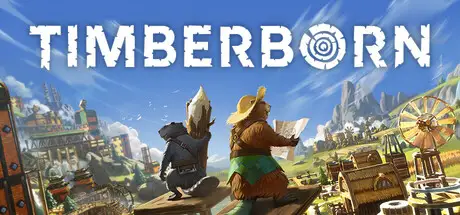
Opening
Timberborn is a survival city-builder about beavers out-engineering drought, and what it nails is making water feel like the whole reason your civilization lives or dies — yeah, if you like planning under pressure, it’s absolutely worth your time.
The pitch sounds cute. Little lumberpunk beavers, wooden platforms, cozy farms, funny little teeth.
Then the dry season hits, your river turns into a sad ditch, your crops die, your storage runs out, and suddenly you’re not decorating a town anymore. You’re doing emergency civil engineering with a population of thirsty rodents.
And that’s the hook. This isn’t just “place houses, make numbers go up.” You’re damming rivers, saving water, building upward because land is limited, and later dealing with toxic badwater that can ruin everything — or become dynamite, if you’re smart enough to turn the disaster into a tool.
Compared to something like Frostpunk, this is less dramatic, less theatrical, less “everyone is miserable and the music is yelling at you.” But as an engineering toy? Timberborn goes deeper. The catch is, it doesn’t explain itself as well as it should, and the late game can thin out. But when the water math clicks, this thing is dangerously hard to put down.
Story | 6.0/10
Historia: 6/10The setup is killer, but don’t come here expecting a plot with cutscenes

Timberborn has one of those premises that instantly tells you what kind of game it is. Humans are gone. Not “missing.” Not “maybe coming back in the sequel.” Gone. The planet they left behind is wrecked by droughts and toxic waste, and now beavers are the ones trying to build something that lasts. That’s a great hook. It’s funny, it’s grim, and it gives the whole game a weird little bite that most cozy city builders don’t have.
But here’s the catch: Timberborn is not a story-driven city builder. Not really. There’s no main campaign pushing you through big chapters. There aren’t dramatic scripted events where a named beaver betrays the dam committee or whatever. The “main story structure” is basically sandbox survival: build, store water, survive drought, recover, expand, then deal with the next worse version of the same problem. The world tells you what happened through mood, mechanics, and the constant fact that water is life. That’s the narrative.
And honestly, for this game, that mostly works. The story is in the way your settlement changes. A dry riverbed isn’t just terrain. It’s a threat. A reservoir isn’t just infrastructure. It’s hope with wooden walls around it. Badwater isn’t just a hazard. It’s the toxic inheritance of the old world, and if you’re smart, you turn it into something useful. That’s where Timberborn gets its personality. It doesn’t tell you a big post-apocalyptic epic. It makes you engineer your way through one.
So for story, I’d call it strong in atmosphere, weak in actual writing. The premise does a lot of heavy lifting, and the lumberpunk look does the rest. All those wooden platforms, stacked districts, water wheels, pipes, dams, and chunky beaver contraptions make the world feel specific. Not just “animals in a city builder.” A beaver civilization. A proper one. But if you’re asking for plot beats, character arcs, or memorable dialogue, no. That’s not what’s here.
Folktails and Iron Teeth give the world flavor, not a branching narrative

The two factions are probably the closest Timberborn gets to character writing. You’ve got Folktails and Iron Teeth, and they don’t just feel like two skins slapped over the same buildings. They play differently, they look different, and they imply two very different cultures trying to survive the same ruined planet. Folktails lean more natural and pastoral. Iron Teeth feel harsher, more industrial, more engineered. Same apocalypse, different answers.
That matters, because there aren’t really “key characters” in the normal story sense. Your beavers don’t become named heroes. You’re not following a mayor, a rebel leader, or a tragic inventor with a dead family and a secret plan. The faction identity has to carry that role instead. And it does a decent job. When you switch factions, the story in your head changes. One settlement feels like clever woodland survivors trying to live with the land. The other feels like a hard-edged machine civilization trying to dominate it.
But let’s be blunt: this is flavor, not branching storytelling. There’s no major choice system where the plot splits. No moral crossroads like Frostpunk, where the game points at you and says, “Okay, how far are you willing to go?” Frostpunk is much more dramatic on that front. It has that extreme-environment survival pressure wrapped in a sharper narrative frame. Timberborn’s edge is different. It’s less about moral panic, more about engineering consequences.
And I actually like that distinction. Timberborn’s choices are practical, not theatrical. Do you dam this river now and risk starving your farms later? Do you build upward and create a beautiful wooden tower city, or spread out and pay the cost in paths and logistics? Do you touch badwater early, or wait until you can refine it into dynamite and reshape the map properly? Those decisions don’t create story branches in a script. They create the story of your settlement. That’s cool. It’s just not the same as authored narrative.
The side stories are your disasters, your bad plans, and the dam that saved everything

Side content in Timberborn is weird to talk about, because there aren’t side quests in the usual sense. No NPC with an exclamation mark. No optional lore dungeon. No little beaver asking you to gather ten berries for his cousin. The “side stories” are the systems colliding. A drought hits earlier than you were ready for. A badtide poisons the river you thought was safe. Your carefully planned district runs out of workers because you expanded too fast. That’s the game’s version of drama.
The quality of those moments is high when the simulation is singing. Timberborn’s water physics are the star. Damming, storing, redirecting, and surviving droughts makes the whole place feel alive in a way a lot of city builders don’t. The fact that water is not just a resource number in a menu, but an actual physical presence on the map, gives every crisis a clear shape. You can see the reservoir dropping. You can see the crops drying. You can see the mistake you made three cycles ago finally come to collect.
That’s also where the game’s “story” earns most of its 6 out of 10 for me. Not because the writing is bad, but because there just isn’t much writing there. The atmosphere is strong. The worldbuilding is charming. The lumberpunk identity is memorable. But the narrative content is thin by design. If you want a clear long-term objective, big endgame revelations, or a campaign that escalates into some grand finale, Timberborn doesn’t really give you that. The endgame goals are light, and after you’ve solved the survival puzzle a few times, the story side can feel like it runs out before the systems do.
Still, when your city survives by one narrow strip of water, when your vertical wooden tower finally works, when you turn toxic waste into dynamite and literally carve a better future out of the map — that’s a story. It’s just your story, not Mechanistry handing you one on a plate. And for the right player, that’s enough. For someone who needs characters, dialogue, and authored drama? Yeah, this is going to feel pretty quiet.
Audio | 7.0/10
Sonido: 7/10The soundtrack knows when to shut up, and that’s a good thing
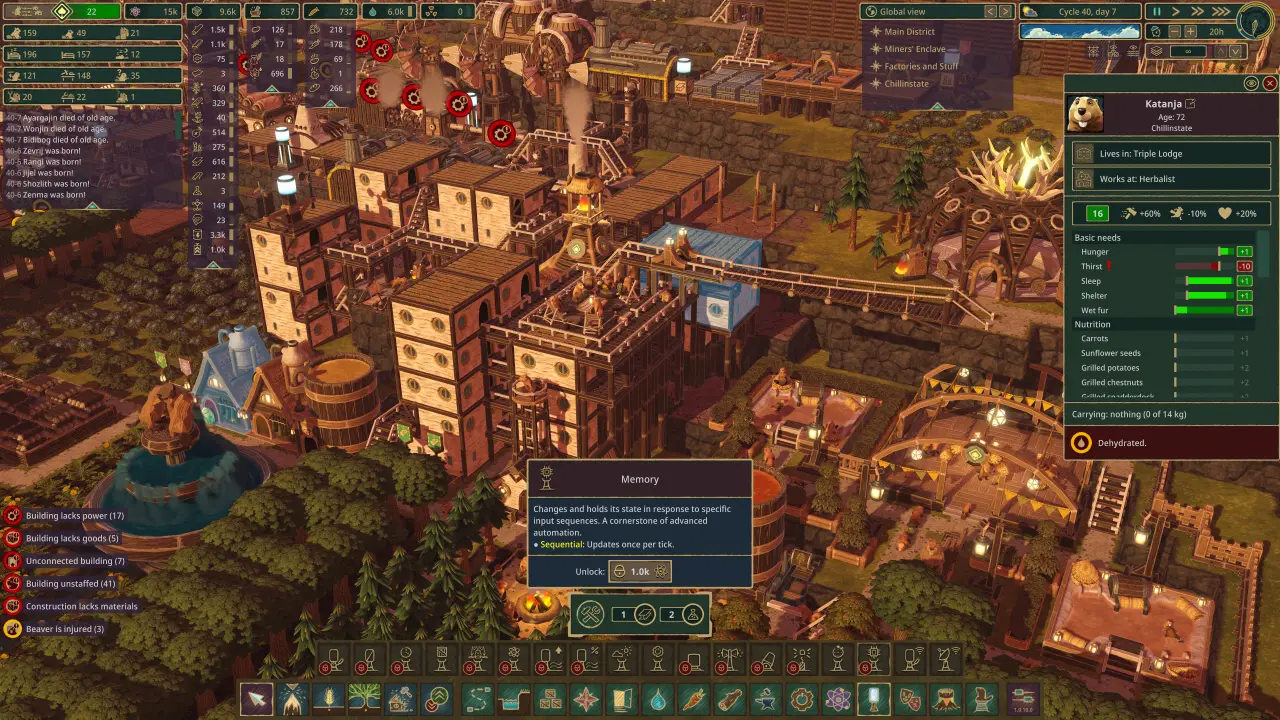
Timberborn’s music is doing the right job. It’s light, warm, and a little cozy, which fits the whole “cute beavers rebuilding civilization after humans ruined everything” setup. You’re not getting some huge dramatic score that grabs you by the collar. And honestly, that would be wrong for this game. Most of the time, you’re staring at water levels, pathing, lumber production, crops, storage, and whether your colony is about to get absolutely cooked by the next dry season. The music sits behind that. It gives the game a calm working rhythm.
That matters because Timberborn is the kind of city builder you play for long stretches. You’re not here for ten-minute bursts. You’re tinkering. You’re pausing, rebuilding, checking dam height, stacking buildings upward, and trying to squeeze one more efficient district out of limited terrain. The soundtrack doesn’t nag you while you do that. It’s easy on the ears, and it matches the soft wooden look of the Folktails especially well.
But I wouldn’t call the music memorable. It’s pleasant, not iconic. It supports the mood, but it doesn’t define the game the way Frostpunk’s colder, harsher audio identity does. Frostpunk wants you to feel doomed. Timberborn wants you to feel busy, clever, and just a little anxious. So for audio, this lands more in the “solid support system” category than the “go listen to the soundtrack later” category.
Droughts and badtides sound like the game quietly tightening the rope
Where the audio works best is when the world starts changing on you. Timberborn is built around water as the thing that keeps your whole civilization alive, so the soundscape has to sell that. And it does. Running water, construction noises, seasonal ambience, the little working sounds around your settlement — all of that helps make the colony feel active without turning into noise soup.
The big trick is that the game’s disasters don’t need jump scares or screaming sirens. When a drought is coming, or when badwater starts becoming a problem, the mood shifts. It’s not some overblown horror cue. It’s more like the world gets less friendly. And because you already know what no water means in this game, that’s enough. Your brain fills in the rest. You start checking reservoirs. You start looking at gates. You start wondering if you stored enough before the river dries up.
The sound effects also fit the engineering side of Timberborn. Building dams, cutting wood, expanding vertically, messing with terrain, turning toxic water into something useful through the badwater-to-dynamite chain — these systems feel physical. Not spectacular, but grounded. The audio gives you enough feedback to believe in the machinery of the place, which is important when the whole appeal is turning a hostile map into a working wooden machine.
Don’t come here for voice acting, because that’s not where the personality lives
There really isn’t a big voice-performance angle here, and I don’t think Timberborn needs one. This is a single-player, bird-view city builder about systems, not speeches. The beavers don’t need to monologue about the fall of humanity. They need to haul logs, build platforms, survive droughts, and make you feel bad when your water planning was sloppy. The personality comes from the factions, the animation, the UI feedback, and the soundscape around the settlement.
That said, the lack of voiced character presence does put a ceiling on the audio package. Folktails and Iron Teeth play and look very differently, and I do wish the sound identity pushed that contrast a little harder. The factions already give the game two distinct journeys inside one ruleset. Stronger faction-specific audio flavor could’ve made that split hit even harder.
So my take is pretty simple: Timberborn’s audio is a plus, but not a headline feature. It’s comfortable during long planning sessions, it supports the cute-but-hardcore tone, and it knows how to make droughts and toxic tides feel tense without getting melodramatic. But it’s not the reason you play. For this dimension, I’d put it around a 7 out of 10. Competent, clean, and well matched to the game — just not especially bold.
Visuals | 7.5/10
Gráficos: 7.5/10Cute beavers, dirty wood, and a city that actually stacks upward

Graphically, Timberborn is not trying to melt your GPU, and honestly, that’s the right call. This is a small-team city builder from Mechanistry, and you can feel that in the art style. It’s clean, readable, chunky, and a little toy-like. The beavers are cute without turning the whole thing into a cartoon gag, and the “lumberpunk” look gives the game a strong identity right away. Lots of wood, pipes, wheels, platforms, dams, and scrappy little machines. It looks handmade in a good way.
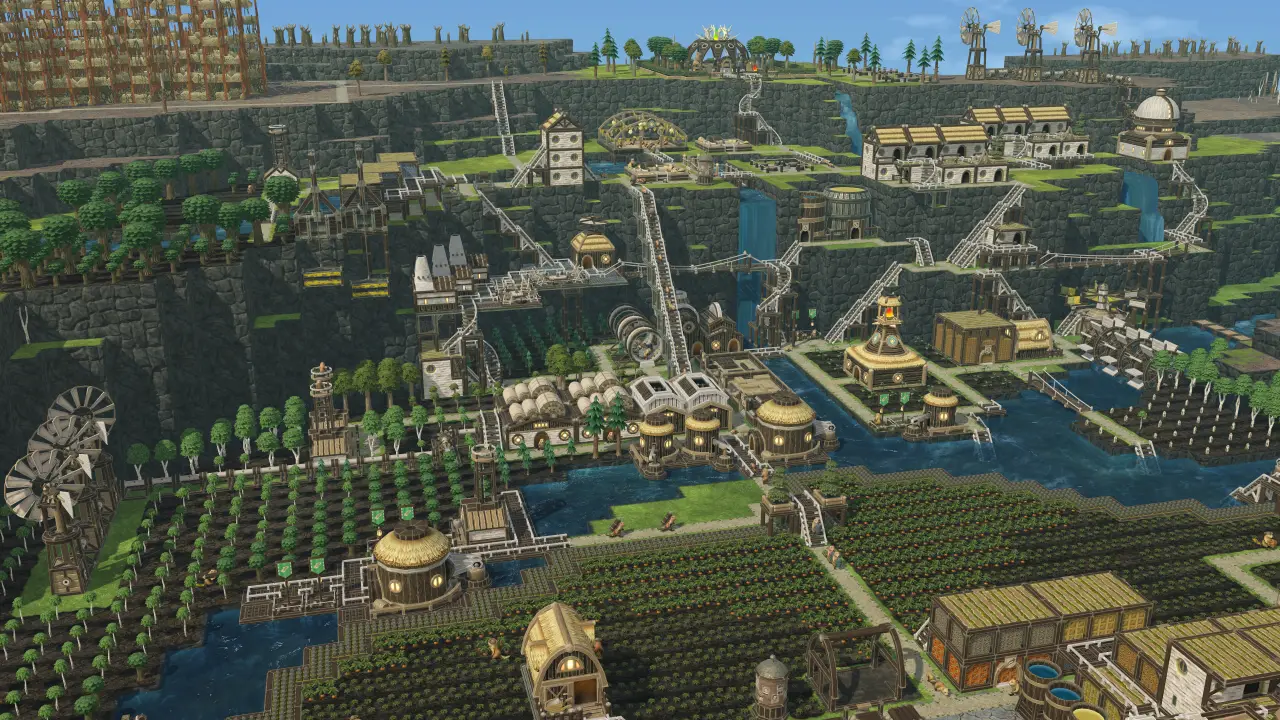
The big visual win is vertical building. A lot of city builders look nice from far away, but once your town gets big, it turns into a flat carpet of roofs. Timberborn doesn’t have that problem. Here, your settlement climbs. You get layered wooden towers, bridges over bridges, stairways, platforms, storage stacked above workshops, and whole neighborhoods hanging off cliffs like some beaver-built engineering accident that somehow works. From the bird-view, isometric angle, that gives the game a really strong silhouette. You can read your own planning just by looking at the skyline.
The catch is, don’t expect lavish detail. Zoom in and it’s not exactly rich with tiny animations or high-end material work. The textures are simple. The lighting is functional. The world doesn’t have that expensive, cinematic finish you’d get from a bigger studio. But for this game, clarity matters more than sparkle. You need to know where the water is, where the crops are, where the paths connect, and where your beavers are about to get stranded because you built carelessly. On that front, the visuals do their job.
The water is the real visual star, not the buildings

Here’s where Timberborn’s graphics get genuinely interesting: the water. Not because it’s the prettiest water you’ve ever seen, because it’s not. It’s because it’s readable, dynamic, and tied directly into how the game plays. When the river drops, you feel it. When a reservoir fills, you see the payoff. When drought hits and the land starts drying out, the map basically becomes a visual warning system. The game makes irrigation and water storage visible in a way that city builders usually don’t.
That matters because water is the whole survival loop here. You’re not just placing cute little houses and waiting for numbers to go up. You’re damming rivers, storing water, fighting droughts, and later dealing with badwater and badtides. Toxic water isn’t just a different color slapped onto the map, either. It changes how you look at the terrain. Suddenly, a poisoned flow can become part of your plan, because you can refine it into dynamite and use that to reshape the land. Visually, that’s a strong idea: disaster becomes infrastructure.
And yeah, compared to something like Frostpunk, Timberborn is way less dramatic. Frostpunk has that brutal cold, that heavy mood, that “everything is dying” presentation. Timberborn is softer and cuter on the surface. But the engineering side is deeper here, and the visuals support that. Frostpunk shows you desperation. Timberborn shows you systems. You look at a valley and you’re already thinking, “If I block this, raise that, blast this channel open, and stack storage up there, I can survive the next dry season.” That’s not flashy, but it’s powerful.
Folktails and Iron Teeth give the same map two different visual moods
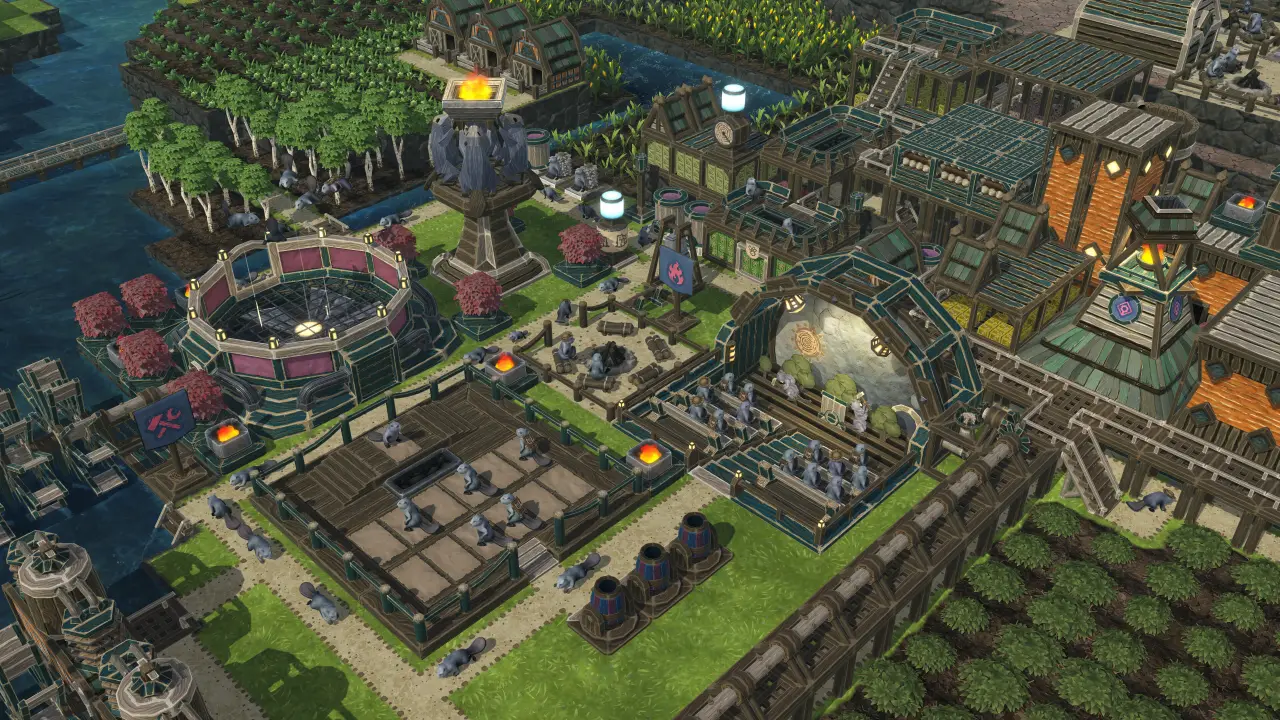
I also like that the two factions don’t just play differently; they look different enough that your city takes on a different personality. Folktails have more of that natural, agricultural, cozy beaver-town vibe. Their settlements feel closer to the land, more rustic, more “we’re going to make this wasteland green again.” Iron Teeth lean harder into the industrial side. More metal, more machinery, more harsh utility. They look like they’d solve a drought by overworking a generator and calling it a lifestyle.
That split does a lot for replaying the same core ruleset. You’re still dealing with water, food, drought, power, terrain, and vertical planning, but the visual flavor changes how it feels to build. A Folktails city can look like a layered wooden eco-village. An Iron Teeth city can turn into this compact industrial block, all function and pressure. It’s not a massive art-budget transformation, but it’s enough to make screenshots from the two factions feel distinct.
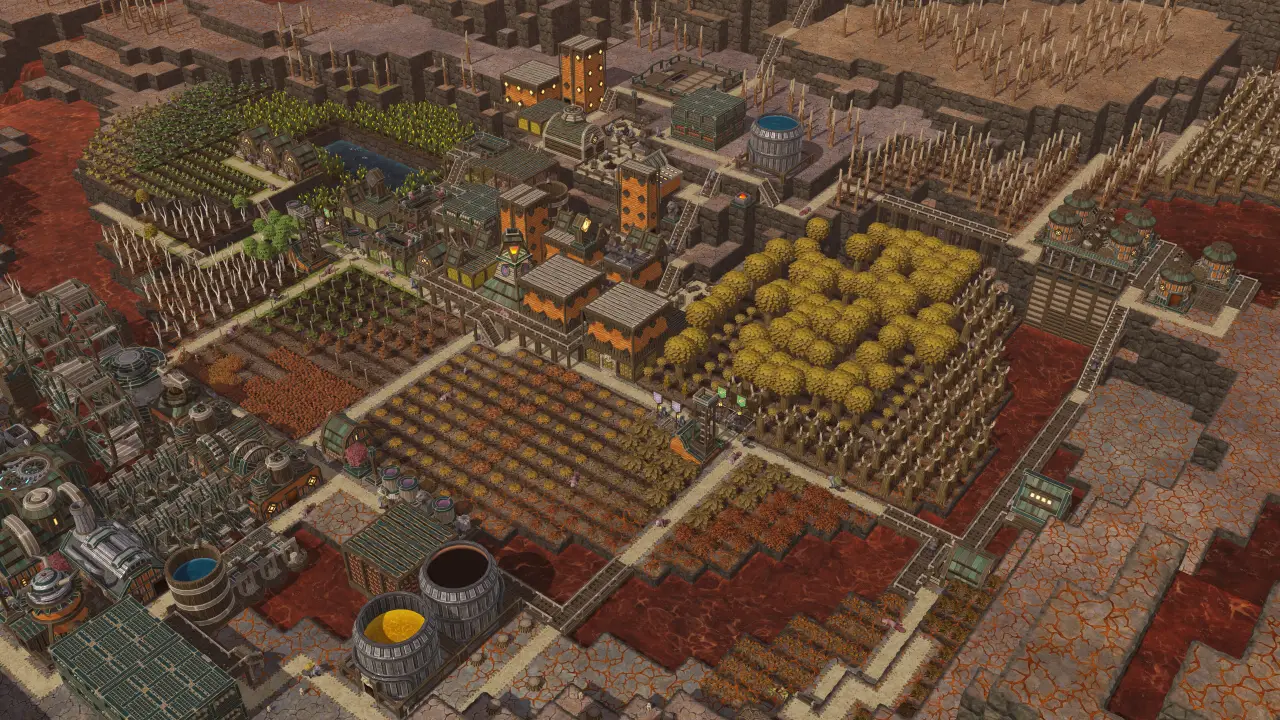
Scene design also benefits from the sandbox structure. Because the game is about reshaping land, the prettiest moments are usually the ones you created yourself. A reservoir tucked between cliffs. A tower of platforms over a drying riverbed. A green farming district sitting next to dead, cracked soil. Timberborn’s environments start fairly plain, but they become more interesting as your engineering mess grows across them. That’s the visual hook: your bad decisions have architecture.
No ray-tracing flex here, but the UI mostly understands the assignment

On the tech side, don’t come to Timberborn looking for a ray tracing showcase or some DLSS marketing bullet point. That’s not what this is selling. The game’s visual tech is built around simulation readability: water levels, terrain height, irrigation, paths, buildings, and stacked construction. If you’re judging it like a big-budget graphics demo, it’s going to look modest. If you’re judging it as a city builder where you need to understand a complicated colony at a glance, it lands much better.
I can only speak to the PC-focused information around Timberborn here, especially with the Steam release sitting at a massive 95% positive from 36,995 user reviews and a Metacritic score of 85. There isn’t a meaningful platform-visual comparison to make from the available review base, so I’m not going to pretend there is one. What I will say is that late-game scale matters. When cities get huge, especially with thousands of beavers, performance can get strained. That’s not shocking for a simulation-heavy builder, but it does keep the graphics score grounded. Pretty stacked cities are great. Chugging through them is less great.
The UI is mostly clean, and it has to be, because this game gets dense. Water management, vertical routes, production chains, storage, faction-specific buildings, and terrain tools all need to stay legible. The interface isn’t flashy, but it’s direct, and the building previews help you understand how your city is going to fit together in layers. The weak spot is that the tutorial doesn’t do enough heavy lifting. Water physics and vertical building are not instantly obvious, and early on, the screen can be telling you things without really teaching you how to think. So visually, Timberborn earns a solid 7.5 out of 10 from me: distinctive, readable, and full of personality, but simple in detail, light on premium tech, and not immune to late-game performance pain.
Combat | 9.0/10
Jugabilidad: 9/10Water isn’t decoration here. It’s the thing your whole colony is begging for

Timberborn works because it takes one basic city-builder question — “where do I put stuff?” — and replaces it with a much meaner one: “how long can I keep this place alive when the river stops?” That’s the whole hook. Your beavers don’t just need water as a background resource. Water is the spine of the entire game.
You’re damming rivers, storing reservoirs, redirecting flow, and trying to read the land like an engineer who’s had one bad drought too many.
And the droughts are what make the planning click. In a lot of builders, disasters feel like pop-up penalties. Here, the wet season, dry season, and badtide cycle keeps squeezing you. When the water’s flowing, you’re not relaxing. You’re counting. You’re looking at every tank and every canal and thinking, “Is this enough?” Then the dry season hits, the riverbed starts cracking, crops start dying, and suddenly that cute little beaver town looks like a very expensive mistake.
What I like is that the water physics are readable, but not brain-dead. You can see why something failed. A dam was too low. A reservoir was too shallow. You built too far from storage. You got greedy and expanded before the colony could support it. That makes failure sting in the right way. It doesn’t feel random. It feels like the game pointing at your blueprint and going, “Yeah, that part was a mistake.”
This is also where Timberborn separates itself from most cozy-looking builders. It looks adorable, sure. Little lumberpunk beavers, wooden platforms, busy paths, all of that. But mechanically, it’s much closer to an engineering survival puzzle. If you enjoy city builders because you like optimizing under pressure, this thing is absolutely in your lane. If you just want to plop houses down and vibe, honestly, it may annoy you fast.
Stacking a beaver city into the sky is where the planning gets nasty in a good way

The vertical building is the other big reason Timberborn feels different. You’re not just spreading a settlement across flat land. You’re building up. Platforms, stairways, paths, layered production chains — eventually your colony can turn into this chunky wooden tower where farms, homes, storage, industry, and power are all stitched together in three dimensions. And when it works, it feels fantastic. Not pretty in a polished postcard way. Pretty in a “look at this insane machine I somehow made function” way.
But here’s the catch: vertical freedom also means vertical mistakes. It’s really easy to build something that technically works, but wastes time, pathing, space, or worker efficiency. A building that looks one step away might be three staircases and a bridge away. A storage pile in the wrong layer can slow down a whole production line. And because Timberborn’s tutorial is weak, the early hours can be rough. The game gives you enough to start, but it doesn’t do a great job teaching you how all the deeper pieces snap together.
That pacing is a little uneven too. The basics are strong right away: water, food, shelter, timber, survival. But the heavier systems, especially the more factory-style automation side, arrive later. So the front half can feel a bit loose, then the back half suddenly asks you to juggle a lot more. I don’t hate that, because I like when a builder gets messy, but I do think newcomers can bounce off before they see the best version of the game.
Still, when you hit that sweet spot — a layered town, water stored, production moving, drought incoming — Timberborn has a rhythm that’s hard to put down. It’s not about one big clicky mechanic. It’s about a hundred tiny decisions adding up into a settlement that either survives beautifully or collapses because you underestimated one dry spell.
Badwater turns disaster into a tool, and that’s the smartest trick Timberborn has

Badwater and badtides could’ve been just another punishment system. Toxic water arrives, your colony suffers, you block it off, done. But Timberborn is smarter than that. It lets you treat toxic waste as both a threat and a resource. You can refine badwater into dynamite, and dynamite lets you reshape the map. That loop is great. The thing trying to ruin your colony becomes the thing you use to carve better canals, deeper reservoirs, cleaner flow, and stronger defenses for the next disaster.
That’s the moment where the game stops feeling like a normal settlement sim and starts feeling like a long engineering argument with the map. You’re not just surviving terrain. You’re editing it. Blow out a trench here. Deepen a basin there. Redirect badwater away from your crops. Build a reservoir that can actually carry you through the next dry season. Every improvement feels earned because it usually came from some earlier failure. Timberborn is very good at making you say, “Okay, next time I’m fixing that.”
The two factions help a lot here too. Folktails and Iron Teeth don’t just give you a cosmetic swap. They play and look different enough that a second run doesn’t feel like repeating the same checklist. One ruleset, two distinct journeys. That matters because the game’s long-term goals are a little thin. Once you’ve stabilized and built big, the endgame doesn’t always push back hard enough. There’s replay value, yes, but it comes more from trying different maps, factions, and layouts than from some massive late-game objective structure.
And yeah, performance can start to groan when cities get huge, especially when you’re dealing with thousands of beavers. That’s the price of pushing the simulation hard, but it’s still a real knock. The game is polished, especially for something built by Mechanistry with a seven-person team over four years, but late-game strain is still late-game strain.
Frostpunk has the drama, but Timberborn has the better toy box

The easiest comparison is Frostpunk, because both games are about building a society under environmental pressure. But they scratch different parts of the brain. Frostpunk is harsher, more theatrical, more about moral pressure and survival drama. Timberborn is less interested in yelling at you through story events and more interested in handing you a river, a drought cycle, badwater, vertical architecture, terraforming tools, and saying, “Go on then. Make this work.”
That’s why I’d also point at the kind of engineering survival pleasure you get from something like Oxygen Not Included. Not because Timberborn copies it, but because both games reward players who enjoy systems talking to each other. Water storage affects food. Terrain affects flow. Flow affects drought survival. Toxic water affects dynamite. Dynamite affects the shape of your future colony. It’s a chain of consequences, and the fun is in understanding the chain well enough to bend it.
This is exactly why the Steam response makes sense to me. A 95% positive rating across 36,995 reviews is not an accident. Metacritic sitting at 85 tracks too. People aren’t just responding to beavers being cute. They’re responding to a survival builder that has a genuinely distinct mechanical identity. The bird-view, isometric setup is familiar, but the actual play loop is not just another grid of houses and warehouses.
So for gameplay, I’m at a 9 out of 10. Not because it’s flawless. It needs a better tutorial, a tighter early-to-mid pacing curve, and more meaningful endgame goals. But the main loop is so strong that those complaints don’t sink it. Damming water, stacking a wooden city upward, surviving droughts and badtides, then using toxic waste to blast the land into a better shape — that’s the stuff that makes Timberborn special. It’s cute, yes. But underneath that, it’s a sharp, demanding builder for people who like solving problems the hard way.
Content | 8.5/10
Contenido: 8.5/10Two factions, a pile of maps, and one very angry water system do most of the heavy lifting

Here’s the thing with Timberborn’s content: it doesn’t feel big because it throws a checklist at you. It feels big because one map can go sideways in five different ways depending on how you handle water.
That’s the whole hook. You’re not just placing cute beaver houses and watching numbers go up. You’re building dams, holding reservoirs, routing canals, surviving droughts, and eventually dealing with toxic water that can either wreck your colony or become part of the plan.
The two factions are a huge part of why the sandbox holds up. Folktails and Iron Teeth aren’t just palette swaps. They play differently, they look different, and they push you into different rhythms. So even though the game is still single player, bird-view, isometric city-building, the same ruleset can turn into two pretty different campaigns. Add multiple maps on top of that, and the first dozen hours aren’t really about “finishing” Timberborn. They’re about getting humbled by the terrain, restarting, and realizing you built your whole settlement in the dumbest possible spot.
And honestly, that’s where the flow works best. Early on, the pace is slow in a good way: cut trees, grow food, store water, don’t die. Then the game starts asking nastier questions. Can you stack your city upward because land is tight? Can you store enough water before the next drought? Can you turn badwater into dynamite and literally reshape the map? That terrain manipulation is the secret sauce. Once you start blasting channels, flattening awkward spaces, and forcing the landscape to obey you, every save starts to feel personal. Not scripted. Not “mission three of ten.” Yours.
That’s also why I’d score this side of the game around an 8.5 out of 10. The volume is real, but it’s not traditional campaign volume. If you need a big authored story, quest chains, boss moments, and a clear final objective, this is not that game. Timberborn’s content lives in the engineering problem. You make the mountain behave. You make the river behave. And when you don’t, the beavers pay for it.
Four years of Early Access made 1.0 feel sturdy, but the late game still runs out of excuses

Mechanistry spent four years polishing Timberborn before its 1.0 launch on 2026-03-12, and you can feel that work. This doesn’t come across like a city-builder that just barely made it over the finish line. It’s clean, it’s readable, and the core loop has been sanded down into something dangerously easy to lose hours to. The Steam reception backs that up too: 95% positive across 36,995 reviews, sitting at Overwhelmingly Positive. That’s not a tiny cult whispering in the corner. People have clearly stuck with this thing.
The long tail has also benefited from free major updates, especially the badwater stuff. That update matters because it didn’t just add another resource icon to stare at. It changed the way disaster works. Toxic water and badtides create problems, sure, but they also feed into production, explosives, and terraforming. That’s the kind of expansion Timberborn needs: not bigger for the sake of bigger, but systems that fold back into the main fantasy of outsmarting nature with wooden machinery and questionable beaver engineering.
Now, let’s talk about the catch. There’s no paid DLC value discussion here in the usual sense, because the important content growth has been through free major updates, not some giant expansion pack you need to buy on top. That’s good for players. No argument. But it also means the current 1.0 package has to stand on its own for endgame depth, and this is where Timberborn is weaker. Once your water network is stable, your city is stacked beautifully, and the droughts stop being scary, the game can get a little too comfortable.
The late game has plenty to manage, especially once deeper production and factory-style automation pile up, but it doesn’t always have enough to aim at. The goals thin out. The game becomes more about self-imposed projects: “I’m going to reroute this river,” or “I’m going to build a ridiculous vertical district,” or “I’m going to make this awful map livable.” If that sounds exciting, great. You’ll squeeze a lot out of it. If you want the game to keep handing you escalating objectives, you may hit that wall sooner than you’d like.
The replay value is strong when you love problem-solving, weaker when you want a proper finale

Timberborn’s replayability depends heavily on what kind of city-builder player you are. If you’re the person who sees a cramped valley and immediately starts thinking about dams, stair towers, storage tanks, and future dynamite cuts, this game has legs. The vertical building alone gives it a different flavor from most of the genre. You can stack an entire wooden civilization upward, connect platforms and paths, and make a settlement that looks like a beaver fever dream. It’s cute for about five seconds, and then it gets brutally logistical.
Compared with Frostpunk, the difference is pretty clear. Frostpunk has the stronger drama. It has that freezing, desperate, moral-pressure vibe that hits hard. Timberborn isn’t trying to beat it on narrative. Instead, it beats it on engineering freedom. The water physics, vertical layouts, and terrain remodeling give you more room to invent your own solutions. It’s less “survive this authored nightmare” and more “here’s a hostile map, now prove you actually know what you’re doing.” For me, that makes Timberborn easier to return to, even if Frostpunk’s big moments are more memorable.
But I’m not going to pretend the long-term replay value is infinite. It isn’t. The tutorial is weak, so new players can bounce off before the game really opens up. The pacing is also a bit lopsided: some of the deeper automation tools arrive later than they should, which makes the early hours feel a little loose and the later hours suddenly busy. And if you push into massive cities with thousands of beavers, performance can start groaning. That’s not shocking for a simulation game, but it’s still a real late-game problem.
So the content picture is this: Timberborn has a strong sandbox body, a very polished 1.0 foundation, and enough faction-and-map variety to justify a lot of hours. What it doesn’t have is a rich endgame structure that keeps giving you new reasons after you’ve solved the big water puzzle. If you enjoy optimizing inside harsh limits, it’s fantastic. If you want a relaxing house-placement toy or a city-builder with endless official objectives, you’re going to feel the gaps.






Comentarios 0
Nos interesa tu opinión
Participa en la conversación y comparte tu opinión sobre este juego.
Aún no hay comentarios. Cuéntanos qué te parece este análisis.