
Noticia
007 First Light Drops to $24.69 in Its First-Ever Sale, Beating the Previous Low
007 First Light gets its first discount, with Green Man Gaming stacking an extra 18% off the 20% official price cut plus
















Assassin’s Creed Shadows hits its biggest design milestone not by making the map bigger, but by rebuilding how information works in its open world. As the first mainline Assassin’s Creed set in feudal Japan, it offers more than 80 hours of base-game content across the Kinki region’s nine areas, yet the real difference comes from abandoning checklist quests and maps packed with question marks in favor of an intelligence network. That shift is a smart one: it reframes progression from pure content consumption into information gathering, pushing players to actively follow clues and make judgments inside the system.

From a design standpoint, synchronization points no longer unlock the whole map with one click, and tracking a target requires sending scouts to investigate first. That structure clearly responds to one of the most common criticisms of Ubisoft’s open worlds: their assembly-line feel. Seasonal and weather systems reinforce that change. Enemies hide indoors on rainy days, frozen ponds in winter remove underwater hiding spots, strong winds reduce ranged accuracy, and heavy snow obscures enemy vision. The environment is no longer just decoration; it now directly affects play. IGN called it “one of the best versions of the open-world style in the past decade.” Not everyone will agree, but the point stands: this isn’t a superficial systems overhaul.
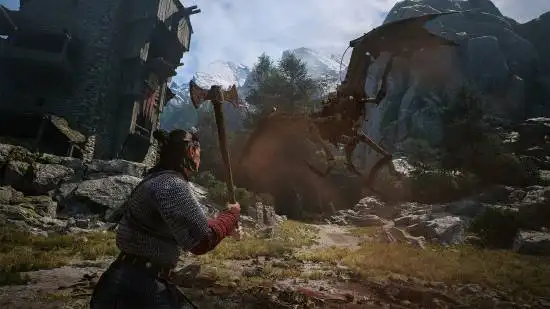
The dual-protagonist setup is another very textbook product decision. Naoe is an Iga ninja built around stealth, grappling hooks, parkour, shuriken, and smoke bombs, with a toolkit focused on light, sound, shadows, and terrain. Yasuke, by contrast, is a power-focused samurai for direct combat, using weapons such as the long katana, naginata, kanabo, and teppo. The two have separate progression paths and separate skill trees, but they share experience points. That keeps class differentiation intact while reducing the cost of leveling two characters, which is a careful balance between depth and retention. The main story also follows Naoe and Yasuke from hostility to cooperation, so the gameplay split and the narrative are designed to support each other rather than feeling like two skins.

Technically, the upgraded Anvil engine is doing more than showing off isolated visual tricks; it underpins the world’s sense of immersion. The article notes support for ray-traced global illumination, real-time reflections, virtual geometry rendering, and a fluid-driven wind system. Even all vegetation is animated through physics. On paper, those can sound like a feature list, but combined with dynamic weather and a full four-season cycle, they become world states players can actually feel. The PC version also includes a built-in performance analysis tool, 5 graphics presets, and 3 ray-tracing modes, which at least suggests the team did not take optimization lightly.

On the commercial side, Assassin’s Creed Shadows passed 1 million players on day one and reached 3 million players in 3 days, a sign that both the setting and this generation of system changes landed with the market. More importantly, the article stresses that the base game already delivers a complete experience without relying on post-launch DLC to finish the package. For a modern AAA release, that is a persuasive position. Review reception is solid rather than overwhelming: IGN gave it 8, while Metacritic sits at 82. That is not all-conquering masterpiece territory, but it is stable, and Kotaku calling it one of the most lively and endlessly watchable open-world games of this generation probably says more about how it feels over long play sessions.
The map itself uses a 1:16 scale recreation of Japan’s Kinki region, with roughly 15 kilometers in-game representing more than 250 kilometers in reality. It spans nine major regions, including Wakasa, Kii, Lake Biwa, and Himeji Castle. Beyond the main story, the base game includes large numbers of side quests, exploration across shrines, temples, and castles, plus activities such as meditation, horseback archery, and weapon-form training. There is also a hideout system that lets players customize a base and train allies. Crucially, the intelligence network means quests are triggered through spy networks, NPC information, and environmental clues, not just by sweeping icons off a map.
If you like stealth, exploration, and historically minded map design, this is an easy recommendation. If you are already tired of the Ubisoft-style open world, then the parts worth watching are the intelligence network, the dual-protagonist structure, and the weather-driven gameplay changes. Those systems point to a real shift in product thinking. Assassin’s Creed Shadows may not completely rewrite the open-world formula, but it does replace some of the old template-like busywork with more tightly interlocked systems, and that alone matters.




Comentarios 0
Nos interesa tu opinión
¡Bienvenido! Cuéntanos qué te parece este juego: ser el primero puede tener premio.
Todavía no hay comentarios. Sé el primero.