





















Opening
No Chinese studio was supposed to be able to make this game. That was the consensus right up until the morning Game Science shipped it, and then 2.4 million people logged into Steam at once to find out they were wrong.
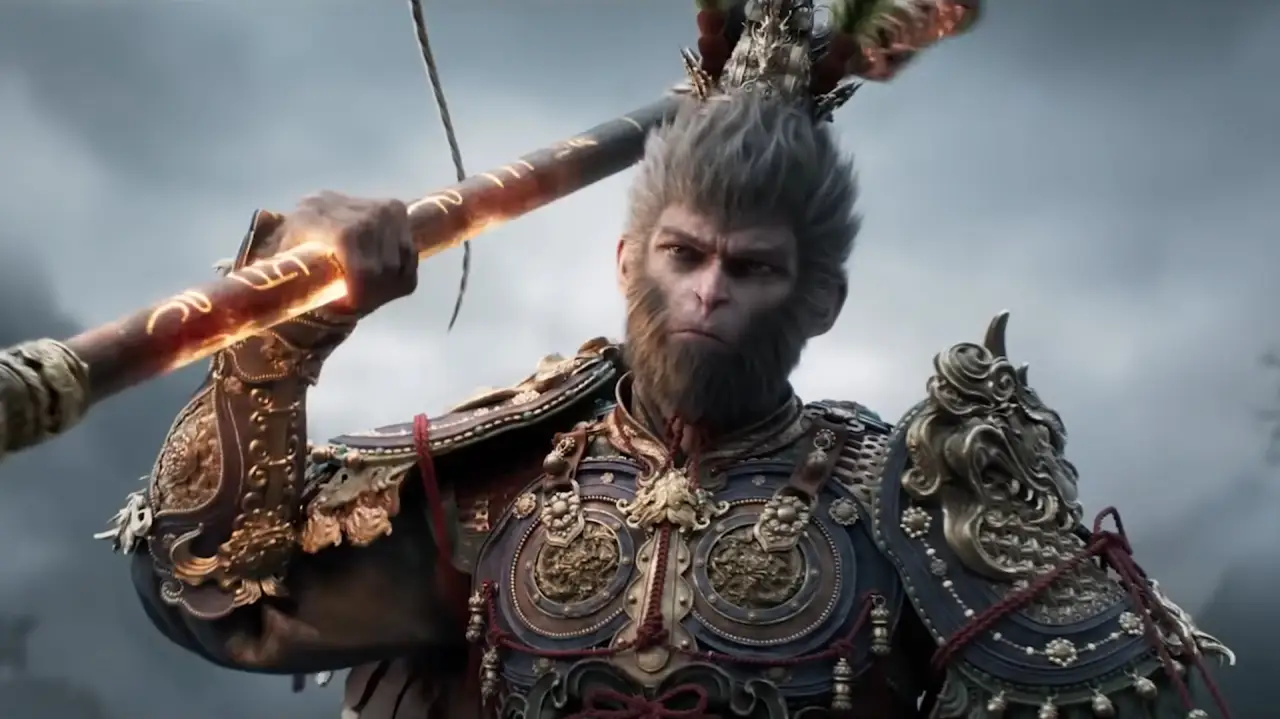
Black Myth: Wukong does not retell Journey to the West so much as walk through its wreckage. The Monkey King has already become a Buddha, walked away from the title, and been struck down for it — his six senses scattered across the world. You play the Destined One, a nobody sent to gather the pieces, and the game hands you a staff and a thousand-year-old country to swing it in. Cliff temples scanned from real Shanxi grottoes. A sandstorm on the Yellow Wind Ridge that coils a god inside it. Snowfields so quiet you hear your own footsteps land.
It is also a game with a visible crack down the middle. The levels are boxed corridors, not an open world; the full ray tracing will melt a midrange GPU; the main story says so little that anyone who skipped the source novel will get lost three chapters deep. Critics parked it at 81. Players parked it at 96 percent. That gap is the whole story this review has to tell — and the only honest way to answer whether this is the coronation of Chinese AAA, or a staggering, unfinished debut.
Story | 8.0/10
Scénario: 8/10A myth told from its own ruins

The smartest decision Game Science made was to start where the famous story ends. Everyone in China grows up on the version that finishes with enlightenment — the pilgrimage completed, sainthood earned. Black Myth opens after that ending has already curdled. The Monkey King gave the title back, went home to his mountain, and Heaven could not abide a Buddha who walked off the job, so they broke his body and scattered his six senses into the dirt. You are the Destined One, sent chapter by chapter to gather what is left of a fallen god.
That premise does something no amount of fan service could. It takes the most familiar tale in the culture and turns it sour and strange, then refuses to explain itself. Why did the greatest hero of all walk away from heaven? Why couldn't heaven let him? The game never hands you the answer outright. It shreds it and buries the scraps in cutscenes and bestiary entries, and lets you reassemble the grief yourself. The emotional arc is not triumph; it is a long, cold elegy for a hero whose pieces you keep finding in the mud. You are not collecting loot. You are collecting a corpse, one relic at a time, and the deeper you go the clearer it gets that the legend everyone agreed to remember was a lie of convenience.
The Bestiary, where every monster gets an obituary

If one feature has to carry the case for this game's writing, it is the Bestiary — the in-game record the Chinese build calls the Yingshen Tu. On paper it is a monster compendium that fills in as you play. In practice Game Science turned it into literature. Beat or even meet a creature and you unlock a short verse-laden passage, half classical and half plain-spoken, that tells you who it used to be before it slid into monstrousness, and what it could never put down.
Half the things you cut down as trash mobs turn out, in their entry, to have been a temple's faithful worshipper, a betrayed ascetic, a small life with a grievance. A few hundred words and a fight you barely registered becomes a complete miniature tragedy. You drain the health bar, then read the obituary, and realise you did not defeat a stat block — you laid to rest someone with an unfinished thought. It quietly inverts the whole moral of Journey to the West: the sutra here is not salvation but the truth that even demons had no choice. No corpse-side audio log does what this does, because the Bestiary is not optional flavour you stumble over — it is the spine of the writing, the place the game keeps its real ambition. Read enough entries and the world stops being a series of arenas and becomes a register of the wronged.
The cost of telling it sideways

Now the honest part. The main quest is thin on dialogue, and most of the connective tissue — who these figures are, why you are fighting them — lives in those Bestiary pages and in the stylised animated codas that close each chapter. For a player raised on the source novel this is a feast. For a newcomer who never met Journey to the West, it is a fog: faces without names, fights without stakes, a story that assumes a literacy you may not have. The chapter-end shorts are gorgeous — ink wash, stop-motion, Shaanbei folk storytelling, a different art language every time — but they decorate the story more than they narrate it.
The true ending makes the problem worse. Reaching it means clearing a string of side quests with no signposting whatsoever, hidden across earlier chapters, before a secret map on Flower-Fruit Mountain even opens. Most players only learn it exists from a guide. Where God of War spoon-feeds every beat through seamless staging, Black Myth picks the reticent road: it does not tell you the best story, it files it away and waits for whoever cares enough to read. There is real taste in that choice. There is also a wall, and a chunk of players will hit it.
Audio | 9.0/10
Audio: 9/10Memory as a weapon, folk art as a boss intro

Most of the score comes from composer Zhai Jinyan, and his sharpest move is to ambush you with nostalgia before you have even pressed a button. The game's arrangement of "Celestial Symphony" — the theme from the 1986 television Journey to the West — lands like a fist on the chest of every Chinese player alive. The first few bars play and thirty years of childhood ignite; the emotion arrives before the controller does. It is a high-risk trick, the kind that curdles into cheap sentiment in clumsier hands, but the game spends it carefully, dropping the old theme only at hinge moments and building the rest of the soundscape from original writing — fifths stacked into something eerie and lavish, a Journey to the West rendered in sound rather than quoted.
Then there is the Yellow Wind Ridge. Its theme leans on Shaanbei storytelling, a form on China's national intangible-heritage register, sung by inheritor Xiong Zhuying. In the chapter's opening animation a headless monk cradles a three-string lute and chants the entire region's backstory in that cracked, weather-beaten cadence. The music is not wallpaper here; it does the narrating. Before you have read a single map marker, the desolation of the place is already locked into you. Dropping a regional folk craft this deliberately into a globally-aimed AAA is both a flex of cultural confidence and a genuine expansion of what a game score is allowed to be — and plenty of overseas players met this voice for the first time through that one verse.
Impact you can hear, with one note still missing

Underneath the showpieces the working audio is sturdy. Black Myth ships with Mandarin voice acting and multi-language subtitles, with broader localisation filled in by later patches. The Chinese performances hold up, and a few of the major yaoguai kings have real presence, even if some supporting roles run thin on lines and emotional range next to a top-tier cinematic production.
The combat is where the mix earns its keep. The dull thud of a staff folding a monster in half, the wind-rip of a charged Smash coming down, the pressure-shift of a spell going off, the distinct sonic skins of sandstorm, snowfield and the furnace heat of the Flaming Mountains — a large share of this game's vaunted impact is, frankly, carried by its sound design rather than its animation. On consoles with Dolby and spatial audio, directional cues sharpen enough to matter when three enemies close at once, and you start dodging on sound before the model has even entered frame. The only real blemish is that some localised voice tracks were absent at launch and arrived only later, so the day-one package was a hair less complete than it should have been. Otherwise this is the stronger half of an already strong audiovisual punch.
Visuals | 9.5/10
Graphismes: 9.5/10Fighting demons inside the national treasury
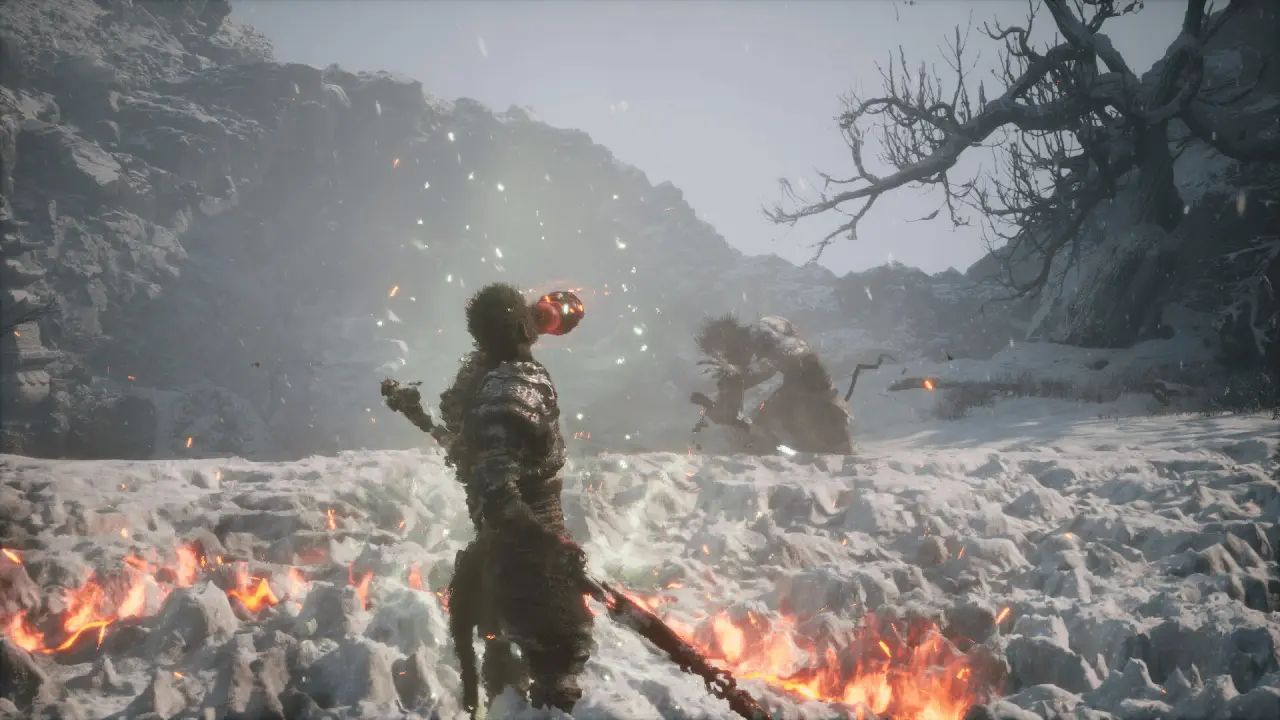
The one visual asset nobody can copy out from under Black Myth is that it dragged real Chinese heritage architecture into a next-gen engine. The team scanned roughly thirty-six sites across the country as scene references, twenty-seven of them in Shanxi province alone — Little Western Heaven, the Jade Emperor Temple, the Iron Buddha Temple — alongside the Mount Ming temple in Sichuan, the Dazu rock carvings in Chongqing, Lingyin Temple in Hangzhou.
Chapter three's Little Western Heaven draws on the Thousand-Buddha Hall in Xixian, Shanxi: a single chamber of barely 170 square metres packed with more than a thousand painted statues arranged around five central icons, a thing they call the swan song of Chinese sculpture. The game reconstructs its layout and lets you glance up between fights into that breath-stealing density of figures. Digitising real cultural artefacts and re-authoring them this way is a tech demo and a cultural export at once — a great many overseas players are seeing the splendour of Chinese antiquity for the first time, through a boss arena. The effect on the ground is strange and wonderful: you walk into what reads as a museum, and then something with too many eyes decides you do not belong there. Reverence and menace share the same room, and the architecture is doing half the storytelling without a line of dialogue.
A ceiling worth its price, at a price
The image foundation is Unreal Engine 5, and Black Myth runs full ray tracing — global illumination, shadows, reflections, caustics — with DLSS 3 frame generation bolted on. Cranked up, light pools on gilded statues and pours across the snowfields with a photoreal weight that genuinely sits near the front of the current generation.
The bill is real and it is steep. At 1440p with full ray tracing the game drags a mainstream RTX 4070 down to around 34fps; even flagship cards, at native resolution and maxed cinematic settings, land in the low forties and need upscaling to climb out. That is the double edge — a best-in-class ceiling that also demands a serious rig to reach. Black Myth's most jaw-dropping face has a cover charge, and not everyone gets to see it on their own hardware.
The console side is where the visual reputation took its knock. The PS5's Performance mode runs at roughly 1080p and looks soft for it; Digital Foundry praised the visuals and then named the problem plainly — too many technical issues. The Xbox port drew the harsher word, "bizarre": resolution could go higher than PS5, but image quality was cut and screen-tearing crept in, leaving it less stable than the machine it was meant to match. At launch, the spectacular version of Black Myth mostly belonged to well-specced PC owners. Later patches added a native 60fps Performance mode on PS5 and FSR4 on PC, and things improved — but the day-one gulf between platforms was real, and it is a direct reason the technical scores came in low.
Why a still frame is unmistakable
Set the tech arguments aside and the pure art direction is close to faultless. The sandstorm clawing across the Yellow Wind Ridge, the dead hush of the Little Western Heaven snowfield, the molten red of the Flaming Mountains — every chapter hands you a landmark or two you will not forget. More impressive still, as the Chinese outlet Gamersky flagged in its review, units of wildly different scale, from humanoid lieutenants to bosses that fill half the screen, all hold the same modelling fidelity. Nothing goes cheap up close.
That discipline is why Black Myth wins hearts on looks even where critics dock it on systems. Against the western dark-fantasy grandeur of Elden Ring, it walks a completely different road: eastern heritage architecture, rendered with a heaviness and reverence that cannot simply be lifted into another project. Glance at a single screenshot and you know it is Black Myth and nothing else, the way a frame of a Studio Ghibli film is unmistakable before anything moves. That kind of instant legibility is its own scarce resource, and no amount of raw horsepower buys it for you.
Combat | 8.5/10
Gameplay: 8.5/10One staff, three tempos
The combat lives and dies on a single weapon split into three stances: Smash, Thrust and Pillar. Smash has the smallest recovery window and can build Focus while you sprint, which makes it the answer to quick, darting enemies. Thrust is the reach option — charge it and the staff extends to plant a guaranteed hit on a distant weak point. Pillar vaults you up on the staff to dodge low attacks; you cannot move while charging, but it folds defence and offence together and shines against a crowd.
Holding the whole thing up is Focus, the staff-power resource. Light strings build it, and a charged heavy spends it all in one outsized blow. That gives the fighting a clean breathing pattern: jab to keep the pressure on and the meter climbing, then, the instant the enemy opens up, empty the gauge into its face. Chinese critics have all but canonised this as the most solid melee feel a domestic action game has ever produced, and they are not wrong — the weight and connection of the staff genuinely make you want to keep swinging it.
Reading the fight instead of trading blows
What actually opens the depth is the perfect dodge tied to the Smash stance. Slip a hit in the last fraction of a second and counter, and you trade attrition for execution: a good player does not out-HP the Yellow Wind Sage, they read every swing, break it on the dodge, and harvest with a full Focus bar. Combat stops being about who has more health and starts being about who blinks.
The spells carve a second line of depth, mostly through their cooldowns. Immobilize is the strongest opener in the game — it pins an enemy in place for a stretch — but it recharges slowly, so every hard fight becomes a wager: spend it now to delete the opening, or bank it for the boss's second-phase frenzy? Layer in the body-double evasion and the cloned hairs that fight beside you, and a single encounter splinters into a dozen valid solutions depending on whose hands hold the controller. This is the half of Black Myth that rewards study, and it runs deep enough to reward a lot of it.
The most distinctly eastern wrinkle is Transformation. Beat certain creatures and you can take their shape, complete with a separate moveset and, crucially, a separate health bar — a second life you spend on purpose. Against a chapter king like the Yellow Wind Sage, who hits a berserk phase, a veteran banks a transformation for the worst stretch and goes in swinging, or cashes it to claw back from near-death. The Azure Dust spectre form gets burned for opening burst, shaving a chunk off the bar before the fight has settled. Stack transformation, Focus and spells and you reach the ceiling of this game's spectacle: build, perfect-dodge, Immobilize, transform to finish, the whole run flowing like choreography.
What it beats, and where it bends
Drop Black Myth into the lineup of its peers and its place gets clear fast. For the clean, total purity of attack-defence reading, its perfect dodge does not go as all-in as Sekiro's parry, which makes deflection the entire game. For combo flamboyance and freeform expression, it does not reach the showpiece depth of Devil May Cry 5. Black Myth's edge sits at neither pole; it is in the eastern, theatrical burst that the Focus-and-Transformation stack throws off, a flavour of action neither of those games is even trying to serve.
And the soft spots deserve to be said plainly. The difficulty curve lurches. The strong tools — spells, transformations — unlock a touch too fast, so a stretch of mid-to-late bosses stop generating challenge through clever movesets and start leaning on fat health pools and arena-filling sweeps instead. Those later fights feel less hand-tooled than the early ones, more endurance than elegance. None of that undoes the verdict: this is a combat system of exceptional finish and top-tier feel, the best-feeling melee a Chinese action game has shipped to date. It is simply one smoother difficulty pass short of flawless.
Content | 6.5/10
Contenu: 6.5/10Forty hours of chaptered spectacle
By HowLongToBeat's count the main path runs around 38 hours, roughly 70 with side content, and about 90 to fully complete; a hardened speedrunner can compress it to twenty. For a premium-priced single-player buy-to-play, that is a generous slab of game.
The rhythm is a six-chapter escalation: one themed map per chapter, one resident yaoguai king, one bespoke animated coda to seal the mood. The opening run — Black Wind Mountain, Yellow Wind Ridge, Little Western Heaven — is polished to a shine, in both level craft and boss staging, and the care is obvious. The further in you go, though, the more the pacing starts to hurry; late chapters thin out on side-quest signposting and map complexity in a way the early ones never do. That is the familiar fingerprint of an ambitious project running low on runway: the best material sits on the stretch every player is guaranteed to walk, a pragmatic, slightly mournful trade. You feel the budget tightening in real time, and the wonder is less that the back half wobbles and more that the front half is as immaculate as it is. Most studios never reach this ceiling at all; Game Science reached it and then ran out of time, which is a far better problem to have.
Boxed in, by design, for better and worse
This needs stating without hedging: Black Myth is not an open world. It is a sequence of boxed, semi-linear chapter maps, each a self-contained diorama seeded with hidden branches, forks and side paths — but its overall freedom of exploration is nothing like the go-where-you-can-see-it sprawl of Elden Ring.
The trade cuts both ways. The win: a contained map lets the team push the art and staging of every corner to its limit, with no acreage of empty world diluting the density, so nearly every step you take has been considered. The loss: area reuse and a generous helping of invisible walls, which means players keep slamming into spots that look traversable and are not, and the immersion frays at exactly those seams. Eurogamer's three-star verdict rested squarely on this linearity and the absence of an open world — the precise fault line along which the "staging and story" camp and the "freedom and systems" camp split over this game. Which pole you weight more or less decides the number you give it.
Stories in the side roads, and a content line still growing
Black Myth does not pad a quest log to fake volume; it tucks its stories into the folds of the map. Yellow Wind Ridge alone holds Shamen Village, Soul-Snatching Cliff, the Crouching Tiger Temple. Beat the boss Kang-Jin Star and you can head to a cellar in that temple to find the NPC Xugou, a dog who trades you pills and recipes for a chat. These are quests you have to physically reach and trigger, and they pay off the player who turns over every corner. Paired with the Bestiary unlocks, almost every side thread and hidden lieutenant trails a little supernatural short story behind it, so exploration becomes the act of completing the world rather than ticking a chore. The cost is weak guidance: skip a guide and whole side arcs vanish unseen, which the marker-trained player will find unfriendly.
After launch, Game Science kept feeding the thing. The December 2024 update added a free Challenge Mode, new gear and the Journeyer's Chart, handing post-credits players fresh targets; early 2025 brought bug fixes, balance passes, the native 60fps console mode and wider localisation. More to the point, the official FAQ has confirmed multiple paid DLCs to come, with the director teasing surprises still in store. The content map was never sealed at launch — Black Myth behaves more like a platform that keeps growing than a one-and-done box, and for anyone who cares whether a game is supported long after purchase, that steady pipeline is a real mark in its favour. Weigh the runtime, the free updates and the promised expansions together, and the content column comes back with an answer that is unambiguously generous, whatever the level design does in its final hours.





Commentaires 0
Votre avis nous intéresse
Participez à la discussion et partagez votre avis sur ce jeu.
Aucun commentaire pour l'instant. Partagez votre avis sur ce test.