





















Opening
Frostpunk asks a question most city-builders never dare to: not "can you build a thriving city?" but "what are you willing to do to keep one alive?" Set in an alternate 1886 where the world has frozen over, 11 bit studios — the team behind the harrowing This War of Mine — built a survival city-builder around a single steam generator and the desperate, dwindling warmth it provides. It is a game where every decision is a question of survival, and survival always has a moral price.
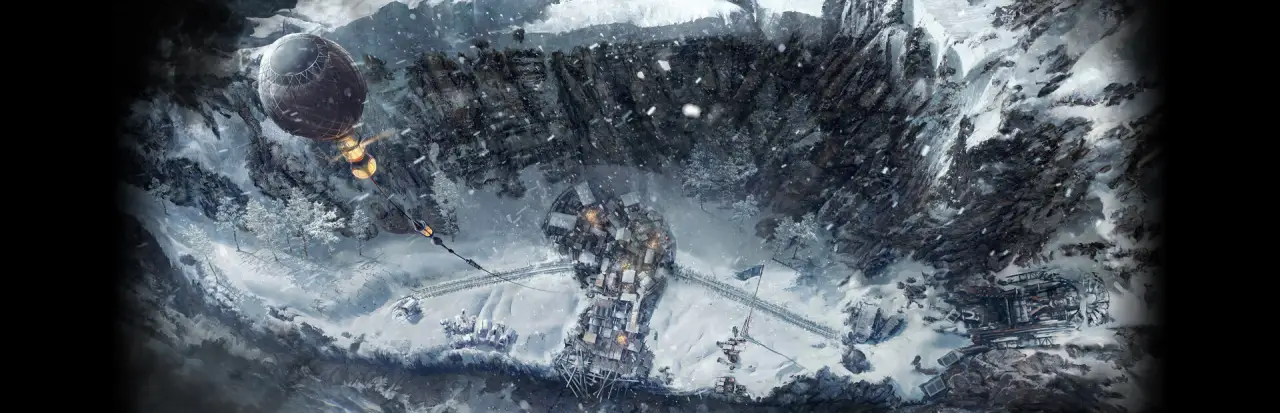
The visual premise alone is unforgettable: a Victorian-era industrial society huddled around a colossal heat engine in the heart of an endless white waste, smokestacks and frost competing for the same sky. Around that generator you arrange homes, workshops, and coal mines in concentric rings of heat, racing to outpace a temperature that only ever falls. But the genuine innovation is the Book of Laws — a system of escalating moral decisions, from rationing and child labour to the grim machinery of faith or order, that turns governance into a real experiment on the human soul.
It is demanding and deliberately uncomfortable. The base game ships with only three main scenarios, a content limit reviewers have long noted; the learning curve is steep; and its themes can weigh on you. But across eight years, generous free updates, and a celebrated sequel, Frostpunk has become one of the most important strategy games of its era. This review breaks down where its frozen experiment earns its marks, and who can stand the cold.
Story | 8.5/10
Scénario: 8.5/10Frostpunk tells its story differently from almost any other city-builder. There is no protagonist with a name, no dialogue tree, no cutscene drama — and yet it is one of the most narratively powerful strategy games ever made, because its story is the story of your decisions. Through scenario framing and the Book of Laws, it makes you the author of a moral history you will not soon forget, and the strong story score reflects how completely it weaponizes governance into narrative.

Scenarios as Moral Parables
The authored narrative comes through its scenarios, each a self-contained parable about survival and its costs. A New Home, the core scenario, casts you as the leader of the last city on Earth, racing to build a refuge before a final, catastrophic storm — a steadily tightening vice of cold and desperation that builds to a genuinely harrowing climax. The Arks reframes the challenge around preserving humanity's plant life with automatons instead of people, while The Refugees confronts you with waves of desperate newcomers and the class tensions they bring, forcing impossible questions about who deserves a place by the fire.
What makes these scenarios work as stories is that they are not neutral sandboxes; they are arguments with situations engineered to corner you. The narrative does not tell you what is right — it presents an unsurvivable problem and watches what you become while solving it. Each scenario is a different lens on the same brutal theme, and finishing one leaves you reflecting on the kind of leader the cold turned you into, which is storytelling of a rare and unsettling power.
The Book of Laws as Narrative Engine
The true heart of Frostpunk's storytelling is the Book of Laws. As your city teeters on the edge of collapse, you sign laws to keep it alive, and each one is a moral choice with real weight. Will you permit child labour to fill your workshops? Will you stretch your food with sawdust, knowing it sickens people? Will you guarantee the dying a peaceful end, or extend the working day until your citizens drop? None of these are decorative options — each carries consequences, and each forces you to decide what you are willing to trade for one more day of survival.
The genius is that the game never judges you; it simply lets you live with what you chose. The Book of Laws turns governance into a continuous, personal narrative of compromise, and players emerge from a playthrough with their own story of the lines they held and the ones they crossed. This is interactive storytelling at its most potent — a benchmark design in strategy gaming precisely because the human experiment feels real rather than performative.
Faith, Order, and the Stories We Tell Ourselves
The Book of Laws eventually forks into two escalating paths — Faith or Order — each offering powerful tools to hold society together as conditions worsen, and each sliding toward its own brand of authoritarian dystopia. Down the path of Faith, your city becomes a theocracy; down Order, a surveillance state. The narrative power here is in the slow boil: you adopt each new law for a defensible reason, a small step to stave off collapse, and only late do you look up and realize what your city has become. It is one of gaming's sharpest dramatizations of how good intentions pave the road to tyranny.
The expansions extend this thematic reach, with The Last Autumn serving as a prequel about the desperate construction of the generators before the freeze, deepening the world's history and its tragedy. For all this richness, the honest note is that the story is delivered through systems and situations rather than crafted characters, so players who need traditional narrative — people to care about, arcs to follow — may find it cold in a different sense. But for the player willing to inhabit the role, Frostpunk delivers a moral and emotional experience that lingers far longer than most authored plots, and the score reflects storytelling that punches well above its genre. It is the rare strategy game whose ending you remember not as a win or a loss but as a verdict on the leader you turned out to be, and that lingering moral residue is something almost no other builder even attempts, let alone achieves.
Audio | 8.8/10
Audio: 8.8/10Sound is one of Frostpunk's most powerful tools for making you feel the cold, the desperation, and the weight of your decisions. The audio design works hand in hand with the visuals and music to build an atmosphere of relentless, encroaching dread, and the score in particular elevates the whole experience to something genuinely cinematic. It is a near-top mark, earned by audio that is always serving the game's emotional purpose.

A Score That Carries the Weight
The soundtrack, led by composer Piotr Musiał, is the standout — more than forty tracks of mournful, orchestral, emotionally charged music that pushes a strategy game's score to RPG-tier depth. The defining quality is restraint: for much of a session the music is sparse and tense, a low atmospheric hum of strings and wind that mirrors the fragile quiet of a city clinging to survival. Then, at the moments that matter — a temperature drop, a critical law, the approach of the final storm — the score swells into something devastating, a surge of grief and grandeur that makes you feel the gravity of where your city stands.
This tight coupling of music to dramatic beats is what makes it so effective. The climate crises and moral dilemmas have their own bespoke musical cues, so the soundtrack is constantly reading the emotional state of your city back to you, amplifying triumph and despair alike. A solo cello over a freezing dawn, a full orchestra as the storm closes in — the music does as much as any mechanic to make Frostpunk land as a human tragedy rather than a spreadsheet, and many players remember the score long after the systems blur.
Ambient Dread and the Voice of the People
Around the music, the sound design builds the world with grim precision. The howl of the wind, the groan of the generator, the crunch of boots on snow, the hiss of steam and the clank of industry all combine into an oppressive ambient soundscape that never lets you forget how hostile your environment is. The audio of the city itself — busier and warmer near the generator, thinning to a deathly quiet at the frozen edges — even communicates the state of your settlement to your ears, a subtle layer of feedback woven into the atmosphere.
Most affecting of all are the voices of your people. The murmurs, complaints, and occasional protests of the population give the city a human pulse, and the swell of discontent or the chants of a crowd carry real emotional and informational weight, telling you when your citizens are breaking before any meter does. Across platforms the audio carries over faithfully, with the console versions and localized voice work preserving the atmosphere, and the soundtrack has found a devoted audience as standalone listening. It is sound design wholly in service of mood and meaning, and that singular focus is exactly what earns this dimension its high mark. There is barely a wasted sound in the entire game; every audio element, from the largest orchestral swell to the smallest creak of straining metal, exists to deepen the feeling of a fragile society holding the line against an indifferent, killing cold.
Visuals | 9.0/10
Graphismes: 9/10Frostpunk is a visual triumph, and its art direction is arguably its single most distinctive achievement. The fusion of Victorian steampunk industry with a frozen apocalypse produces an aesthetic that is instantly recognizable and entirely its own — there is simply no other game that looks like this. The near-perfect score reflects a presentation where every visual choice reinforces the game's themes of survival, scale, and human fragility.

A Singular Steampunk-Apocalypse Aesthetic
The core of the visual identity is the collision of two strong ideas: 19th-century industrial-revolution technology and an endless, world-killing winter. Brass machinery, riveted iron, coal smoke, and Victorian silhouettes stand against a palette of blinding white snow and deep frozen blues, and the contrast is electric. The result is a world that feels both historical and alien, familiar in its industrial detail yet utterly transformed by catastrophe. This is not a generic post-apocalypse or a generic city-builder; it is a fully realized artistic vision, and that singular signature is what makes Frostpunk linger in the memory long after the systems fade.
Crucially, the aesthetic is never just decoration — it is thematic. The warm orange glow of the generator against the cold blue waste is a constant visual argument about heat as life, the smoke and frost competing in the sky a reminder that your survival is purchased with industry and pollution. The art is always telling you what the game is about, and that coherence of vision is the mark of exceptional direction.
The Generator City and the Power of Scale
The central visual conceit is the generator and the city that rings it. Building outward in concentric circles of heat, with your settlement huddling toward the warmth at its core, creates an image of communal desperation that no other builder achieves — a city literally shaped by its fight against the cold. Zooming out to see your entire society clustered around a single point of light in an infinite frozen waste is a genuinely powerful image, conveying the scale of the catastrophe and the smallness of your refuge in a single glance.
The game wields scale masterfully throughout. The generator towers over everything, the storm walls loom on the horizon, and the vast emptiness beyond your city's edge presses in on all sides, so you always feel the immensity of the threat and the precariousness of your foothold against it. These compositions do real emotional work, making your achievements feel hard-won and your vulnerability constant, and they are a large part of why the game's atmosphere is so overwhelming and so hard to shake.
Detail, Weather, and Platform Notes
Up close, the game rewards attention with dense, animated detail. Citizens trudge through snow, work the coal mines, huddle for warmth, and gather in crowds when discontent rises, and watching your tiny people go about their desperate lives makes the human cost of your decisions tangible rather than abstract. The buildings, machinery, and industry are rendered with care, and the city visibly evolves as it grows and as conditions worsen, frost creeping over structures as the temperature falls.
The weather and lighting are the final, decisive layer. The particle effects of falling snow, the howling whiteouts of a storm, and the way frost and dynamic lighting shift the mood of the city across a scenario create a palpable, oppressive sense of cold that you can almost feel through the screen. The interface, meanwhile, is clean and readable, surfacing the game's many systems — temperature, resources, hope, discontent — clearly without breaking the atmosphere. Across platforms the presentation holds up well, with the console versions faithfully preserving the look, and on capable hardware it remains a striking game years on. It is art direction of the highest order, and the score reflects a visual identity few games of any budget can match. The lasting proof is how memorable a single Frostpunk screenshot is — the glowing generator ringed by a frozen city under a leaden sky is an image that has become iconic, instantly communicating the entire premise of the game without a word. That a strategy builder produced one of the medium's more unforgettable visual signatures speaks to just how completely the art direction succeeds, and it is a benchmark the sequel and its imitators have been measured against ever since.
Combat | 9.0/10
Gameplay: 9/10Frostpunk's gameplay is a masterful fusion of city-building, survival, and moral decision-making that few games have matched before or since. It takes the familiar loop of placing buildings and managing resources and charges it with constant, mounting tension and genuine ethical weight, so that every choice carries a pressure most builders never approach. The near-perfect score reflects a design that is both mechanically tight and thematically profound.

The Generator at the Heart of Everything
The core building loop is structured entirely around heat. The central steam generator radiates warmth in a circle, and you build outward within its range, balancing the placement of homes, workshops, gathering posts, and coal mines against the brutal logic of temperature. Buildings further from the core are colder, requiring steam hubs and careful planning to keep workers alive, so your city's very shape is dictated by its fight against the freeze. It is a smart, thematic twist on city-building that makes the cold a constant, physical presence in every layout decision rather than an abstract threat.
Layered on top is a tight resource economy — coal to burn, wood and steel to build, food to eat, and people to do the work — all of it perpetually scarce. The pleasure and terror of the loop is that there is never enough of anything, so you are constantly triaging, deciding which crisis to solve now and which to gamble on surviving. This relentless scarcity is what gives the building genuine stakes, and managing it well is deeply satisfying.
The Book of Laws and the Weight of Choice
What lifts Frostpunk above other survival builders is the Book of Laws, the system that fuses governance with morality. As conditions deteriorate, you sign laws to cope — but every law is a genuine dilemma, trading human cost for survival. Permitting child labour fills your workforce but extracts a moral price; stretching rations with sawdust feeds more mouths but breeds sickness; the Faith and Order paths offer ever-stronger tools of control that slide your society toward dystopia. These are not decorative menu choices but decisions with real mechanical and emotional consequences, and the game's refusal to tell you what is right is precisely what makes them land.
This is the benchmark design that defines Frostpunk. The Book of Laws turns the abstract act of governing into a continuous test of your values under pressure, where you feel the cost of pragmatism in your gut. It is a system that has influenced the entire genre, and it is the clearest reason the game is remembered as more than a clever builder — it is a machine for confronting you with hard questions and making you answer them.
Pacing, Crises, Exploration, and Content Limits
The moment-to-moment play is shaped by a deliberate, escalating pace. The temperature drops in stages toward a final, catastrophic storm, so the entire scenario is a slow tightening of the screws, each phase demanding you prepare for a colder, deadlier future while managing the dual meters of Hope and Discontent that can topple you from power if either crosses its line. Scouting parties extend the experience beyond the city walls, sending expeditions across the frozen map to find resources, survivors, and story, adding a welcome layer of exploration to the management.
This high-pressure design is glorious for the player who craves tension, but it comes with honest caveats. The pacing is unforgiving and the satisfaction cycle long, with a single scenario running eight to twelve hours, which rejects players who want instant feedback or short sessions. And while the paid DLCs meaningfully expand the play with new mechanics, the base game's three main scenarios are a genuine content limit that the gameplay's depth cannot fully disguise. But within a scenario, the fusion of building, survival, and moral weight is as gripping and thoughtful as the strategy genre offers. The systems interlock with rare precision: your laws shape your workforce, your workforce drives your economy, your economy determines whether you can outpace the cold, and the cold forces the next terrible law. Nothing here exists in isolation, and learning to hold all of it together while the temperature falls is a mastery curve that stays tense and rewarding to the very end — which is exactly what this near-perfect score reflects.
Content | 7.5/10
Contenu: 7.5/10Content is Frostpunk's lowest score, and it is the one area where the otherwise exceptional game shows a real limitation. The base experience, for all its intensity, is relatively contained, and while years of free updates and two substantial paid expansions have broadened it considerably, the game remains a focused, scenario-driven experience rather than a sprawling one. The score honestly reflects a brilliant game that is simply not enormous.
The Base Game's Focused Scope
The core content is three main scenarios plus the Book of Laws system, and that compactness is the most widely-criticized aspect of the game. A New Home, The Arks, and The Refugees each offer a distinct, intense, eight-to-twelve-hour challenge, and an Endless mode adds a freeform survival option, but a thorough player can see most of what the base game offers in around thirty hours. After that, long-tail replayability depends heavily on the appeal of optimizing your runs or experimenting with different moral approaches, which engages some players deeply and leaves others feeling the well runs dry.
It is important to frame this fairly: the content that exists is of extremely high quality, dense and authored rather than padded, and each scenario is a complete, memorable experience. This is not a game that wastes your time with filler. But measured against the open-ended, hundreds-of-hours sandboxes that dominate the city-building genre, the base package is undeniably slim, and the gap between its brilliance and its volume is real. You are buying depth and intensity, not breadth. It is the difference between a tightly written novella and a sprawling epic — Frostpunk chooses the former, and whether that satisfies you depends entirely on whether you value the perfection of a contained experience over the sheer quantity of an open one.
Free Updates and Two Major Expansions
11 bit's post-launch support has done much to address this, and the studio's generosity is genuinely commendable. Five free DLCs added new scenarios, the Endless mode, and additional content at no cost — a conscientious approach to operations that earned real goodwill and helped sustain the game's reputation over the years. These free additions meaningfully extend the base experience for everyone who owns it, and they reflect a developer treating its players well rather than nickel-and-diming them.
On top sit two major paid expansions that broaden the game considerably. The Last Autumn is a prequel scenario depicting the desperate construction of a generator before the freeze, introducing entirely new mechanics including a harbor-based production chain, while On the Edge sends you to establish an outpost beyond the city with new diplomatic and logistical systems. Both add real, substantial play, and together with the free updates they transform the content proposition from "three scenarios" into a much fuller package — though even then, the game is more a curated anthology of intense scenarios than an endless sandbox.
Platforms, Mods, and a Thriving Series
The game's reach has grown over time, with faithful console ports on PlayStation and Xbox bringing the experience to a wider audience, a Switch version on the way, and mobile versions extending it further still, though the deepest experience remains on PC. The Steam Workshop adds a modest modding layer, with community-made scenarios and tweaks extending replayability for those who seek it out, even if the scene is smaller than the sandbox-genre giants enjoy.
What truly secures Frostpunk's long-tail value, though, is its place in a thriving series. The game has sold strongly across eight years, holding a 96-percent-positive rating, and its acclaimed sequel went on to become 11 bit's best-selling title ever, carrying the series past eleven million players. That success means the original sits at the foundation of a living franchise rather than as an abandoned one-off, and for newcomers it remains the essential, formative chapter. Measured purely on its own content volume the score is fair — this is the game's one genuine weakness — but measured on the quality and lasting influence of what is here, Frostpunk gives its audience an experience that outweighs its size. The practical advice for a buyer is simple: do not come to Frostpunk expecting a forever-game to sink a thousand hours into, but come expecting thirty of the most intense and memorable hours the genre can offer, with the option to extend them through the expansions if the world grips you. On that basis, the value is genuinely there.



Commentaires 0
Votre avis nous intéresse
Bienvenue ! Partagez votre avis sur ce jeu — une surprise attend peut-être la première personne à commenter.
Aucun commentaire pour l'instant. Partagez votre avis sur ce test.