
























Opening
Some games stay with you as images. Others stay as a story. Half-Life: Alyx stays with you as a pair of hands. The empty magazine you tugged free and let clatter to the floor. The fumble at your hip for a fresh one. The small, satisfying shove as it seated home, and the rack of the slide that told you you were ready. On a flat screen those are a single keypress. Here they were things you actually did — small acts of labour that happened between you and the world, not to it.
Valve waited thirteen years to return to its flagship series, and then did the thing almost everyone assumed virtual reality couldn't carry: it built a no-compromise, full-fat blockbuster and dropped it whole into a headset. This is not a tech demo or a bite-sized novelty. It is a complete Half-Life adventure that stands on its own from first minute to last. The 93 on Metacritic and the 97.3% recommendation on OpenCritic are not a participation ribbon for "best VR game" — they are a verdict on a great game that happens to be played in VR.
Set between the first Half-Life and Half-Life 2, the game casts you as a nineteen-year-old Alyx Vance, scrambling through a Combine-occupied City 17 to free her captured father. What can't be copied here isn't the visuals or even the plot. It's the decision to split gun-handling and telekinetic grabbing across your two hands — so that every encounter demands that you actually move, actually tense up, actually be there. Over six dimensions — story, audio, graphics, gameplay, content, and the overall verdict — this review lays out why it remains the benchmark nobody in VR gets to walk past.
Story | 9.0/10
Scénario: 9/10A nineteen-year-old's rebellion, handed to you to carry

The neatest trick of Half-Life: Alyx is where it sits on the timeline: in the gap nobody had filled, between Gordon vanishing into the G-Man's grip at the end of Half-Life and his return to City 17 in Half-Life 2. The answer to what happened in between is this young woman's story. Alyx Vance is no rookie face — she's Eli's daughter, a fixture of the series, the sharpest mind in the resistance. The game opens with her and her hacker partner Russell hunched over a junkyard radio set, watching Combine patrols through a grimy window, chasing a single goal: her father has been taken, and she is going to get him back.
That motive is almost primal in its simplicity, and it's more than enough. There's no need for a sprawling lore dump, because the whole of City 17 is spread out in front of you. Combine synth-architecture metastasises across the old town like a tumour. That familiar, skin-crawling propaganda drone leaks from the speakers. In the rubble of a quarantine block you find the household junk that residents dropped as they fled. Alyx's fight isn't an abstract slogan — it's the gut-level instinct to save your dad and stay alive long enough to figure out the rest. And through VR, that instinct stops being hers and becomes yours.
The structure is unusually generous with the player's own pace. There is no breathless cold open that yanks you by the collar; instead the early hours let you settle into the rig, the gloves, the rhythm of looking and reaching, before the stakes start to bite. By the time the campaign tightens its grip, you have stopped thinking of Alyx as a character on screen and started thinking of her predicament as a thing happening to you. That slow merge of player and protagonist is the whole point, and it's the reason the back half lands as hard as it does. The opening is patient on purpose, and the patience pays off. It is a confident bet that immersion, not spectacle, is what truly hooks a player inside a headset — and that quiet, unhurried bet comes good long before the credits ever roll.
You don't watch the story here — you stand inside it

Half-Life has lived by one rule since 1998: no cutscenes, let the player read the story out of the room itself. Graffiti on a wall, a body left where it fell, half a sentence on the radio, a scribbled equation on a lab whiteboard — the world those fragments assemble is more convincing than any rendered film. Alyx pushes that rule to its logical endpoint. In VR you don't merely register these details; you are the person leaning in to look.
You can put your face an inch from Russell's whiteboard and read his notes line by line. You can pick up the framed photo on a desk and turn over a family caught in better days. You can find a Combine rationing notice tacked to a wall and parse the city's despair for yourself. That sense of objects being literally in your hands is something a flat game cannot give you — there, this stuff is set dressing; here it is matter you can lift, weigh, and study up close. The cast lands the same way. Eli, voiced by Tony Todd in that low, weary, tender rasp, becomes a real father in a handful of lines. Russell mutters in your ear the whole way through — funny, jittery, occasionally useless, a person rather than a quest log. And Alyx herself, voiced by Ozioma Akagha, is scared and brave at once: she flinches, she jokes, and she does not back down. That frightened courage is far easier to love than any fearless hard case — and it carries the back third of the game, the part where a sharp-suited man who talks half a beat too slowly offers her a choice. Without spoiling it: that ending is one of the most jolting turns in the series' history and the most-argued game finale of 2020, a narrative shockwave that relights a thirteen-year-old question about where Half-Life goes next, dropped from a VR exclusive nobody saw coming.
Audio | 9.0/10
Audio: 9/10Sound is the radar you survive by

In a flat game, audio is set dressing. In Half-Life: Alyx it is the radar you stay alive by. Put the headset on and you catch yourself scanning the room with your ears: a Combine boot crunching glass behind your left shoulder means someone is flanking; a thin shriek from the vent overhead means a headcrab is tucked up there, waiting to leap for your face. None of this is background noise. It's information you parse in real time and turn into movement — which way you turn your head, the moment you drop into cover, all of it routed through your hearing.
That design hits its peak in the chapter built around Jeff, the blind creature that cannot see and tracks its prey by sound alone. The whole section becomes a negotiation with noise: soften your steps, hold your breath, do not knock the bottles off the shelf, and when you have to, grab one and hurl it across the room to draw the thing away. It's one of the finest stealth-horror set pieces in the entire series, and it works only because VR has turned listening into an operable survival resource. The first time you slow your own real breathing so you won't make a sound, you understand exactly how ruthless this audio design is.
A score that knows when to vanish

Mike Morasky's score lives by the rule that less is more. Most of the game is quiet, just ambient tones laying down the dread of an occupied city; only when a threat closes in or the plot crests does the music surge up, electronics and strings shoving your adrenaline through the roof. That restraint is what gives each swell its weight — it never carpet-bombs your ears from start to finish. It serves the rhythm, the loop of fear and release, and never elbows the moment aside. The effect is that you stop noticing the music as music and start feeling it as a pressure gauge: when it's silent you're allowed to breathe, and the instant it stirs you know, in your gut, that something has changed in the room you can't yet see. Few scores understand this well enough to spend most of their runtime saying nothing at all, and trusting that the nothing is doing the work. In a headset, where silence has texture and weight, that trust is the difference between a soundtrack and a co-author.
Voices that keep you company

The voice work is top-tier, and its smartest quality is that it never lets up. Russell is in your ear the entire run — feeding you tips, ribbing you, bucking you up — so a long solo trek never curdles into loneliness. He fills the dead air a single-player VR game is prone to, and he does it with the timing of a real person rather than a barking objective marker. Akagha's Alyx anchors the front of the emotional register: her small intakes of breath when something scuttles past, her muttered jokes when the silence gets too heavy, sell a person who is terrified and pushing on anyway. Todd's Eli does the opposite work, grounding the whole rescue in a warmth that makes the stakes personal.
And when all of that tangles with the unsettling Combine broadcasts and the distant howls of alien things, the soundscape of City 17 is complete. It isn't a soundtrack plus a pile of effects. It's a city that breathes and has a pulse, brought to life through your own two ears — which, in a medium where you turn your head to look, matters more than it ever could on a couch. Stacked against the audio work of its VR peers, Alyx isn't just cleaner or louder; it's the rare case where the sound design is load-bearing, where pulling it out would collapse the game rather than dim it.
Visuals | 9.0/10
Graphismes: 9/10Source 2's real job isn't prettier — it's truer
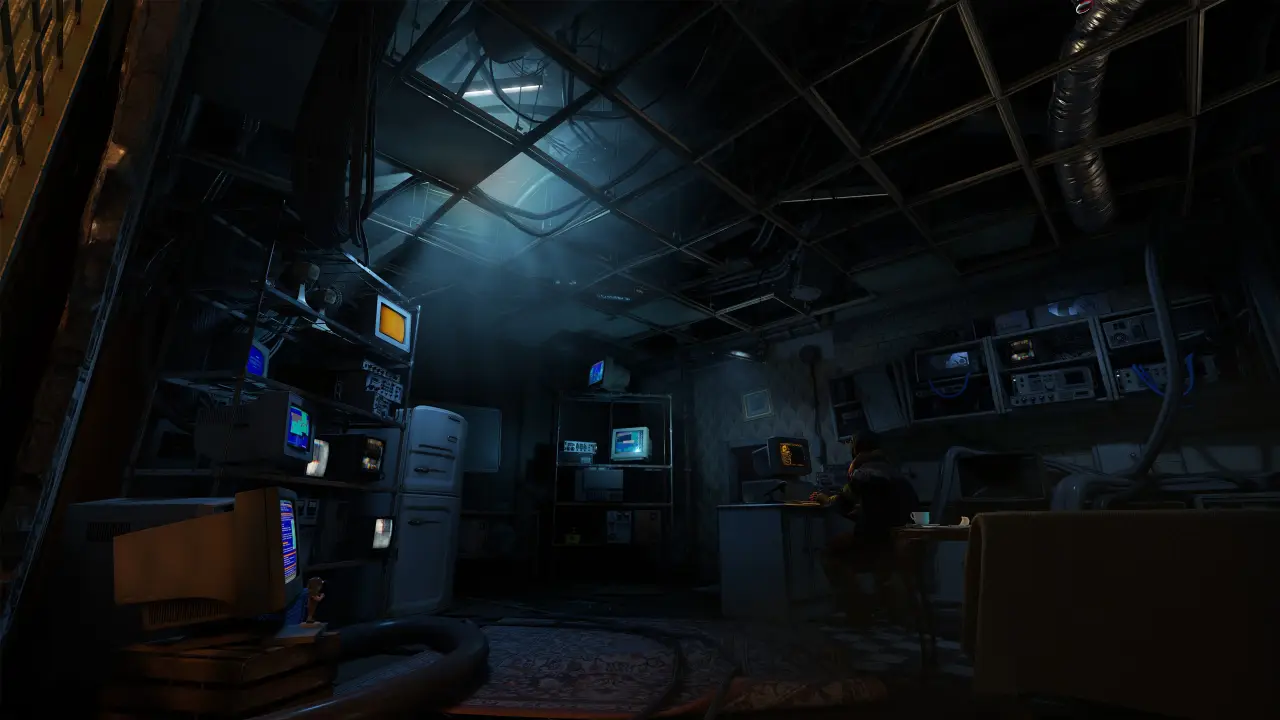
Ask most people to judge a game's graphics and the reflex is to reach for ray tracing and resolution. Half-Life: Alyx wants you to internalise a different yardstick: in VR, how good the picture looks matters far less than how real it holds up when you reach out and touch it. The Source 2 engine Valve rebuilt for this game spends the bulk of its budget in one place — making the world in front of you survive contact with your hands.
So you get details like these. A pane of glass doesn't blink out of existence; it fractures from the point you struck it, along the lines of force. A cabinet isn't a texture but a set of drawers you can pull open one by one and rummage through. The marker on the desk can be lifted and scrawled across a whiteboard; the bottles and jars can be picked up, examined, and lobbed away. That density of "everything is interactive" is the engine's true flex. It doesn't earn a "wow, gorgeous" so much as a quiet jolt of "this place actually exists" — and the second reaction is the lifeblood of VR immersion.
This is also where the game quietly outpaces its flat-screen contemporaries. A modern AAA title can render a kitchen with photorealistic worktops and cupboards, but try to open one of those cupboards and your hand passes straight through; the realism is skin-deep, a backdrop you are forbidden to touch. Alyx inverts the priority. Its surfaces may not always win a screenshot war, but the world holds together under your hands in a way that a prettier, hollower environment never could. When every drawer opens, every valve turns, and every bottle has weight, your brain stops auditing the picture for fakery and simply accepts the place as real. UI and accessibility lean on the same principle: nothing on screen is there just to be looked at; it's there to be handled, read, picked up, or pushed aside.
City 17 at one-to-one, and the dignity of letting everyone in

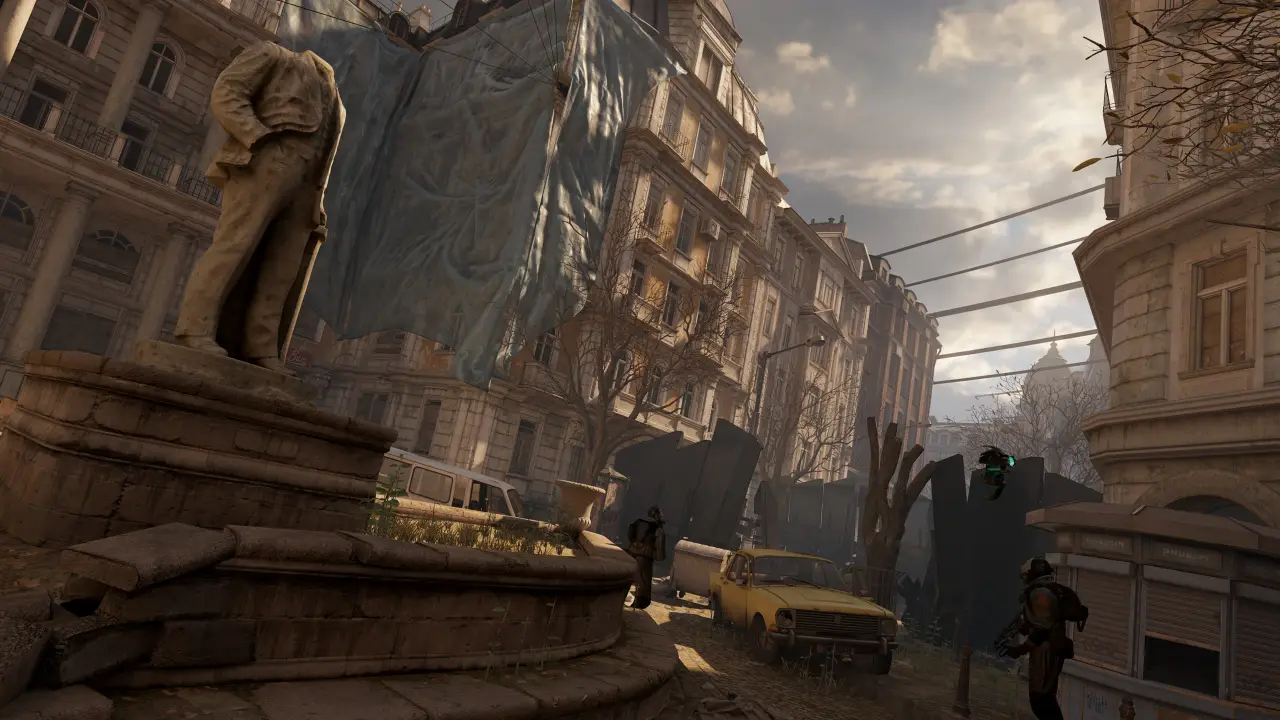
The art direction holds tight to the series' signature dystopian-industrial decay. The Combine's cold, geometric, faintly organic synth-buildings jut into the red-brick blocks of an Eastern-European old town like foreign bodies, and that clash — new against old, organic against machine — is what gives City 17 a silhouette you could never mistake for anywhere else. At one-to-one VR scale, peeling plaster, the dying glow of neon signage, and a broken skyline mirrored in standing water press down on you in a way a monitor simply can't reproduce. You don't look at an end-times city; you stand in the middle of it and have to tilt your head back to take in the synth towers. As a 2020 game inheriting the mantle of a Half-Life 2 from sixteen years earlier, that generational leap is amplified by the headset, where you can put a hand on a rusted door and watch light spill through the gap into a dust-choked room.
There are individual sights here that lodge in the memory the way the best set pieces of any flat game do: a vista of synth towers seen for the first time through a shattered window, a flooded basement where your own reflection wavers back at you, a quiet apartment frozen at the moment its owners ran. Because you experience them at true scale and on your own time — free to step closer, crane your neck, linger — they imprint harder than a scripted camera move ever could. The game trusts you to find the awe yourself, and that trust is exactly why the awe sticks.
What's rarer is that none of the comfort options come at the cost of how it looks. Switch on teleport movement and City 17's lighting, materials and detail don't drop a notch; a seated player still gets that full-scale, oppressive dead city. Valve held two things in balance that usually fight each other — let everyone in, and make sure what they see once they're inside is genuinely staggering. That restraint is itself a mark of elite craft: the visuals here aren't just good-looking, they're good-looking for everybody, which is the harder thing to pull off and the more generous one.
Combat | 9.8/10
Gameplay: 9.8/10Gravity gloves are a landmark in VR interaction design
If one mechanic captures the genius of this game, it's the gravity gloves. Early on you push your hands into a sparking rig in Russell's lab, and from then on they can pull objects to you from across a room. Line up a distant magazine, a health syringe, a bottle; a flick of the wrist and it arcs into your palm. The beauty of it is the feel curve: your first few grabs will whiff, but within minutes it settles into something close to muscle memory — and it only gets more addictive the more you use it.
The reason it's a landmark is that it solves one of VR's oldest headaches in a single stroke: how to let a player who can't freely walk reach scattered resources without breaking the spell. Valve refused the lazy fix of auto-pickup and instead turned reaching itself into a joyful micro-action. It nods to the gravity-based grab tool of Half-Life 2 while rebuilding the idea from the ground up for VR. Nearly every distance-grab system in VR since owes it a debt — it set the template, and the template stuck.
Two hands, two jobs — handling and interaction, pulled apart
The other much-debated choice is the equipment system: three one-handed devices for the whole game, none swappable, no scooping up a model an opponent dropped. It looks like a limitation and is in fact the keystone of the whole interaction philosophy. Valve's logic is to always keep one hand free. One hand holds your device to meet what's in front of you; the other is forever working — grabbing resources with the gloves, loading, hauling cover aside, steadying you. Splitting handling and interaction across two hands is exactly where the immersion comes from. Nowhere is that clearer than reloading: no press-to-refill here. You tug the spent magazine, find a fresh one at your hip or behind your back, line it up, shove it home, rack the slide. With an alien lunging in close or a Combine squad pinning you down, that scramble spikes your pulse, and you'll fumble it when you panic. That very clumsiness manufactures a tension no flat game can fake. The sparse loadout exists precisely to hand your attention back to your two hands, the real protagonists here. Lined up against Boneworks — another physics-first VR title — Alyx is a finished article where its rival is a promising sandbox experiment.
Encounters, puzzles and horror, braided with precision

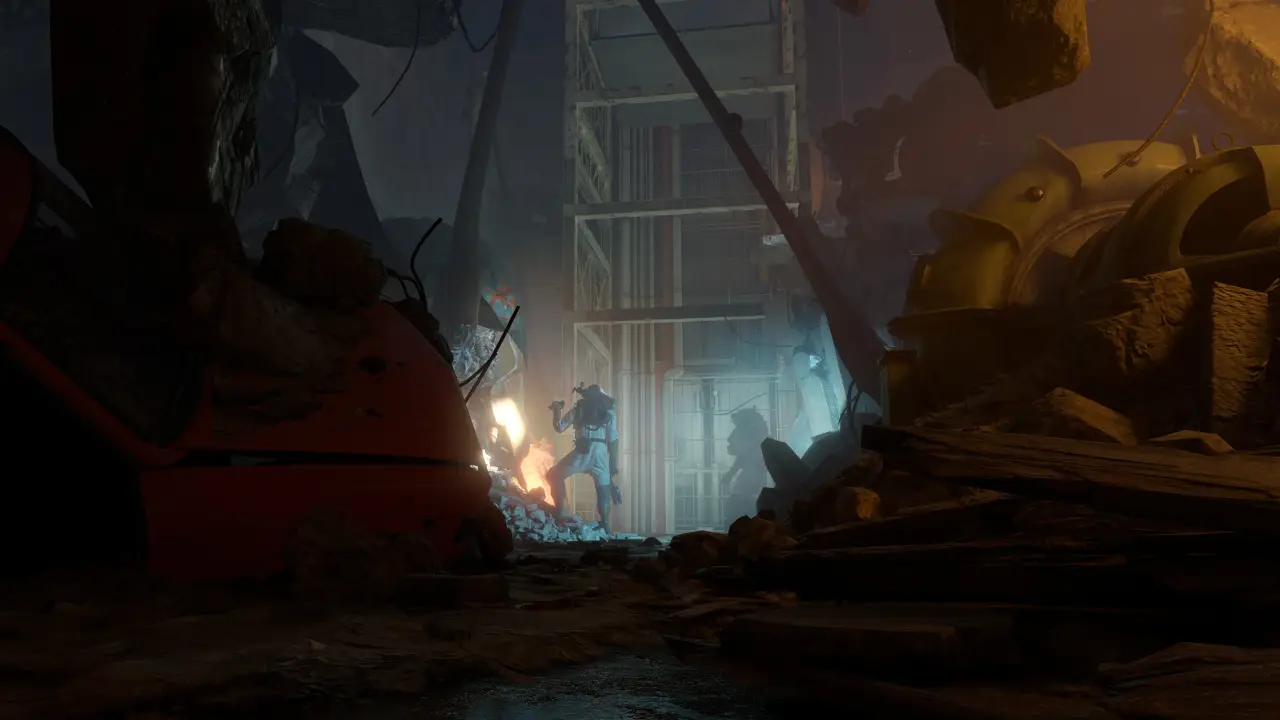
The campaign braids three kinds of experience and keeps the slack and tension finely tuned. In an encounter, Combine opponents actively hunt cover, swing around your flank and push under each other's covering fire, so you genuinely peek, drop low and angle for a better line — a contest as much for your head as your body. Valve deliberately keeps their numbers down, few but sharp, so each encounter is a problem worth respecting rather than a war of attrition, which kills the tedium of repetition at the root. Puzzles use the holographic-circuit system to vary the pace: rotate and align glowing nodes in three-dimensional space to crack locks and restore power, a fit so natural to VR's spatial input that it's easy to grasp and slow to tire of. Crucially, these aren't filler between the fights — they reset your nerves, let your hands do something deliberate and unhurried after a frantic encounter, and seed the small sense of mastery that makes the next encounter readable rather than panicked.
And the horror — the headcrab that lunges from a dark quarantine block, the barnacle dangling from the ceiling, the blind thing that forces you to creep and hold your breath — twists the nerves hard in the gaps between the other two. The genius is in the ordering: a tense encounter bleeds into a quiet puzzle bleeds into a held-breath horror crawl, and the whip-saw between modes is what keeps an 11-hour run feeling fresh from the first chapter to the last. Nothing outstays its welcome because nothing is asked to carry the game alone. That's why it's the benchmark and the rival is merely the one who got there first.
Content | 6.8/10
Contenu: 6.8/10Eleven hours — short, and every minute earns its place

Let's get it out of the way: by the standard of the mainline series, this is a short game. HowLongToBeat puts the campaign at around 11 hours, and roughly 15 if you sweep every corner and chase every achievement. Against open worlds that bill a hundred hours, that's plainly a small number. What's special about these 11 hours is that almost none of them are padding.
There's a clear-eyed trade-off behind that. A VR game can't ask you to sit through a dozen straight hours the way a flat game can — the constant standing, crouching and reaching brings real physical fatigue. So Valve didn't bulk out the runtime with side quests and collectibles. It built one linear, painstakingly sculpted run instead, where nearly every chapter introduces a fresh mechanic, a fresh setting, or a fresh threat, and the pacing is kept on a tight leash. You never hit a level that exists only to inflate a clock. Step forward and something new is waiting. Short here is a deliberate vote for density over length, and the franchise pedigree it's measured against — Episode Two and the rest — only sharpens how disciplined that choice is.
It's also a discipline the wider industry has largely abandoned. The prevailing fashion is to bury a six-hour story under sixty hours of map icons, fetch loops and busywork, then advertise the bloat as value. Alyx refuses the bargain. It is confident enough to end a great experience while it's still great, instead of grinding it down to pad a number on the box. That confidence is rarer and more valuable than another open world, and after the credits roll the thing you remember is that you weren't once bored — a sentence very few hundred-hour games can claim.
No paid DLC — but a community workshop instead

On the question of "adding value after launch", the game took an unusual road. It shipped no paid DLC to wring out further revenue and instead opened the official Source 2 Workshop tools not long after release, putting full level-editing power in players' hands. The payoff is a workshop that keeps growing: a flood of fan-made levels, puzzles and settings, from faithful tribute maps to wild original adventures, that stretches the game's life well past the credits. For anyone left hungry after the finish, the workshop is an endless resupply.
That Workshop matters more than it might sound. Because the editor is the same Source 2 toolset Valve used to build the game, the best community campaigns reach a polish far above the usual mod fare, and a handful of them are essentially full bonus chapters. For a single-player game with no multiplayer and no season pass, this is how Alyx keeps its tail of engagement alive years past launch — not through paid drip-feed, but by handing the keys to its most devoted players and letting them extend it themselves.
Worth flagging, too, is the community NoVR mod from 2023, which let a game built for the headset be played for the first time on a flat screen with mouse and keyboard. For players without a VR rig it's a kindness — they can at least walk through the story once. But nearly everyone who tries it will tell you the same thing: stripped of VR, the game loses its soul. The reloads done by hand, the encounters dodged with your body, the horror located by spatial audio all flatten into ordinary inputs. Which proves the point from the other side — how much of this game's value is fused to VR as a medium and cannot be peeled away. Set beside 2020's other VR landmark, The Walking Dead: Saints & Sinners, which chose an open, replayable shape, Alyx bets the opposite way: one unrepeatable, heavily polished line, every minute pushed to the highest finish it can reach. For players who prize experience-per-minute that polish is a luxury; if your yardstick is raw hours, the trim runtime and the limited loadout are a genuine, unavoidable shortfall. Neither verdict is wrong — they simply measure value on two different rulers, and Alyx is unusually honest and upfront about exactly which ruler it chose to be judged by.






Commentaires 0
Votre avis nous intéresse
Participez à la discussion et partagez votre avis sur ce jeu.
Aucun commentaire pour l'instant. Partagez votre avis sur ce test.