


















Opening
Most open worlds die the moment you finish them. Tick the outposts, light the towers, scrub the question marks off the map, and the world freezes into a postcard, waiting politely for you to leave. Mordor refuses. Spare a grunt here and he files your face away for later; the next time your paths cross he has earned a promotion, a name, and a grudge with your name on it. Humiliate a captain and he comes back stronger, dragging the memory of the day you knocked him flat into his opening taunt like a war story he tells everyone who will listen.
That single idea — the Nemesis System — is the gift Monolith handed to the action genre, and nobody has been allowed to copy it since.
Released by WB Games on the tenth of October 2017, a sequel to 2014's Shadow of Mordor, this is a game the press could not agree on. IGN handed it a nine; Game Informer went to 9.5 and called it a sandbox for predators. Eurogamer declined to recommend it at all, branding the Lord of the Rings fan-fiction plot bombastic nonsense. Hold both reviews in your head and you have already understood the game: a generational system idea welded to a launch that buried microtransactions in the heart of the loop and a story that takes a wrench to Tolkien's mythology.
What follows breaks the game down across story, audio, graphics, gameplay, content and the final verdict. Where it soars, where it bleeds, and why — all these years on — no other blockbuster has managed to bottle its one irreplaceable trick.
Story | 6.0/10
Scénario: 6/10A second Ring nobody asked for, and a myth bent out of shape
The campaign swings for the fences, and it swings recklessly. Picking up where the first game left off, it fuses the human ranger Talion with the wraith of the elven smith Celebrimbor into one shared body, then has the pair forge a brand-new Ring of Power in the shadow of Mount Doom — a ring meant to bend Sauron's armies to their will and rot his empire from the inside. The Bright Lord conceit sounds thrilling on paper. The trouble is arithmetic: in Tolkien's pages exactly one Ring can stand toe to toe with Sauron, and the game simply conjures a second.

For players who never cracked open the appendices, this is a brisk revenge epic with cutscenes staged at full blockbuster wattage. For purists, it borders on sacrilege. Polygon's reviewer put it plainly: anyone steeped in the legendarium is likely to find what the game does to canon distasteful. That fault line was poured the instant the first Ring cooled.
The deeper wound is tone. A tale that ought to carry the solemn, elegiac weight of Middle-earth gets played at a swaggering volume instead — villains chew scenery, twists land with a thud. Eurogamer left it unrecommended and called the writing self-indulgent. The problem is not that the story stumbles in the telling; it is that the Middle-earth it tells no longer sounds like Tolkien's at all. Strip away the brand and you are left with a competent power fantasy wearing a borrowed crown, and the borrowing is exactly what stings.
And the casualties pile up beyond the central plot. Shelob, in Tolkien's pages an ancient horror of a spider that even Sauron stepped around, is reimagined here as a shapeshifter who flits between monstrous arachnid and an alluring human woman, recast as the story's guide and prophet of fates. Writer Tony Elias defended the choice as a route to richer character interplay. Supporters grant that it lends the narrative a streak of ambiguity; detractors see a fearsome mythic symbol sanded down and sexed up into a plot device. Pick a side and the same fact holds: the script is not timid, it is reckless — it reaches for the very things the lore declared untouchable, and it pays the price for the reach.
The best story here was never written by a writer
Here is the honest verdict: the finest tale in Shadow of War is not the one in the script. It lives inside the Nemesis System. When a nameless grunt who got lucky and floored you claws his way up the ranks, clocks your face, and turns each subsequent run-in into a thickening private feud, that emergent thread — authored by your own hands, unrepeatable from one save to the next — moves you in ways the surplus Ring never manages.

Critics kept circling the same paradox. The script got savaged; the storytelling got showered in praise — because the second thing leans on the script not at all. IGN's nine was never about the main quest. It was a vote for a world that keeps rearranging itself around you. The gulf between a nine and a flat no-recommendation is really two reviewers grading two completely different things under one cover.
There is a quiet lesson in that gap for anyone who designs games. The most affecting drama in Shadow of War is not the one with a budget, a script department and a voice cast; it is the one the systems improvise on the fly, free of charge, different for every player. The scripted story is the part that ages and divides; the emergent story is the part that endures, because it belongs to you and could never belong to anyone else.
Then there is the tail. At launch the epilogue — nicknamed Shadow Wars — asked you to grind back wave after wave of Sauron's counterattacks against your own fortresses before it would surrender the true ending. That bloated coda was tethered to the original microtransactions, dragging a clean full stop into a long, fatiguing run-on. It is the most concrete strike against the story, and the one mercy is that the later Definitive Edition trimmed it down to something humane.
Audio | 7.5/10
Audio: 7.5/10A score that knows exactly what its job is
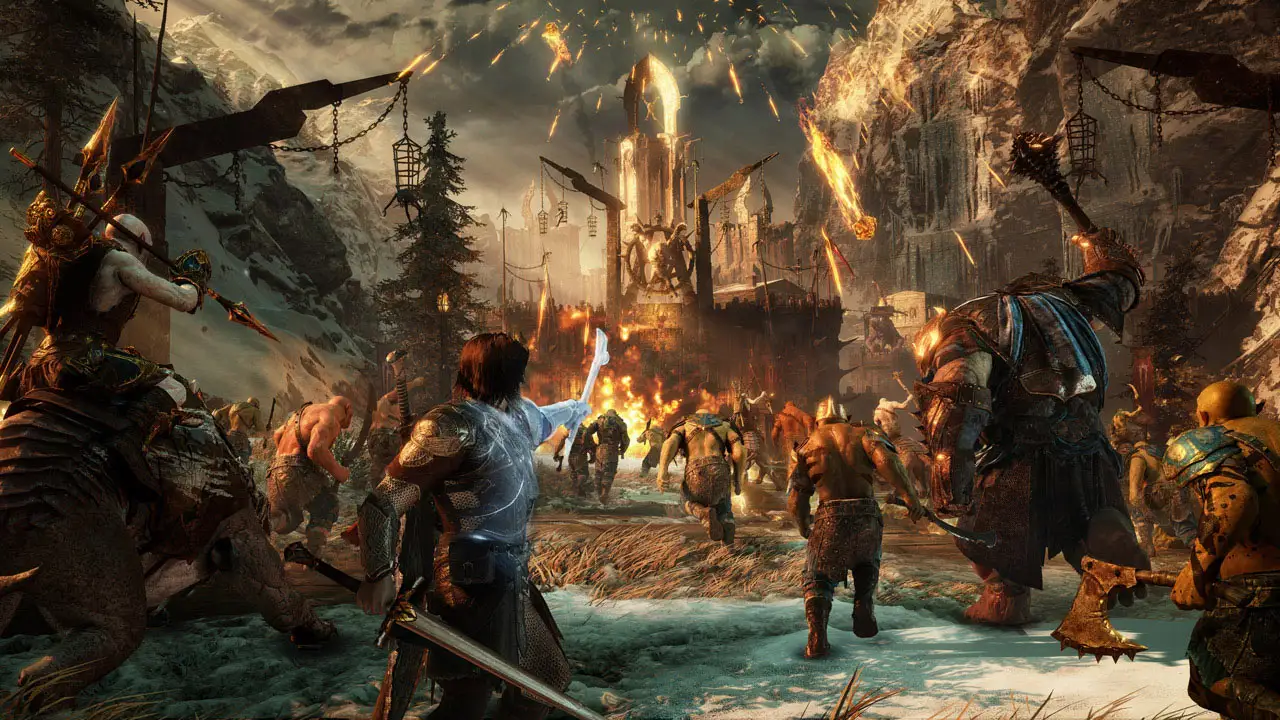
The soundtrack, handed to a pair of composers, keeps faith with the predecessor's sweeping orchestral register. It does not chase novelty; it does the unglamorous work of making "enormous" feel enormous. When a siege kicks off the main theme stacks up layer by layer, the brass climbs, and the instant a fortress finally cracks the music spikes to its ceiling. That pressure-cooker sense of an army bearing down on you — half of it is carried by the score.
It is good craft, deployed with discipline. The music never grandstands at the wrong moment, never drowns out the chatter that matters, and it shifts register intelligently between the hush of a stealth approach and the full-throated roar of an open battle. What it lacks is a single melody you would hum in the shower with the console switched off — the kind of hook that outlives the credits and becomes shorthand for the whole game. It serves the moment beautifully and leaves nothing behind to remember it by.
The real star you do not see coming: orc voices
The thing that genuinely sets this game's audio apart is the orcs talking. Every tribe carries its own accent, vocabulary and catalogue of taunts — the machine tribe cold and clipped, the beast tribe all snarl, the dark tribe oily and menacing. You can tell who is bearing down on you with your eyes shut.

This is not decoration; it is the load-bearing audio pillar of the Nemesis System. In another game a goon opens his mouth only to announce that he has spotted you. Here a single bellow might rake over your last encounter, mock the swing you whiffed, and forecast precisely how he means to put you down. Voice does narrative duty rather than ambient filler, and when a scar-faced overlord roars across the valley to settle a grudge he has nursed for hours, the land genuinely feels alive. The writing under those barks is sharp too — the orcs are cruel, vain, weirdly funny, occasionally pitiable, and the voice direction sells every register. Talion himself is voiced by the seasoned Troy Baker, and the principal performances are Hollywood-grade throughout. Tie all that to a system that remembers, and the audio stops being a backdrop and becomes a character in its own right.
Ambience and the one thing it lacks
The environmental mix sells the apex-predator fantasy hard. Steel ringing against steel, the muffled thud of a takedown from the long grass, the structural groan of a stronghold collapsing — each sound reinforces the idea that you are the most dangerous thing for miles. The audible half of the combat feedback is especially well judged: every clean finish lands with a crisp, satisfying snap that gives the spectacle a physical anchor.
Stack it against its peers, though, and it comes up a hair short of remarkable. There is no signature track here, nothing that escapes the disc the way The Witcher 3's bard ballad slipped loose and went on living on its own. The music is an excellent functional component rather than a standalone artifact you carry around afterwards. You will remember a captain's taunt long before you remember a single bar of the score, which is a strange thing to say about a game whose orchestra works this hard. A 7.5 is the fair summary of something that is on point from start to finish yet never once makes you set the controller down purely to listen — competent everywhere, transcendent nowhere.
Visuals | 8.0/10
Graphismes: 8/10Every rendering dollar spent on a face you will hate
Shadow of War runs on Monolith's in-house LithTech Firebird engine, and its two real jobs have almost nothing to do with looking pretty for its own sake. One is to hold together the fortress sieges, where dozens upon dozens of units share the screen at once. The other is to carve a recognisable face onto every procedurally generated orc captain. That second task is the whole ballgame.
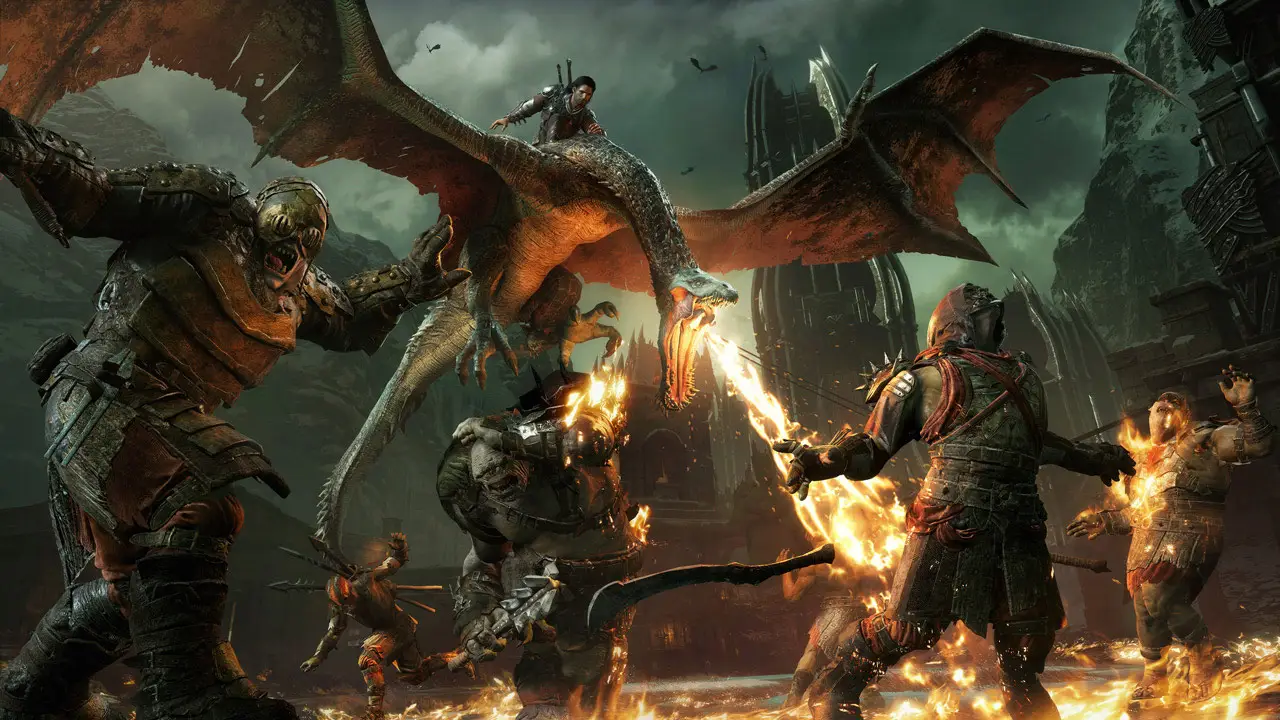
The Nemesis System only works if you can remember what each enemy looks like, so the engine has to guarantee that every randomly spun captain owns a distinct skull, a particular scatter of scars, its own armour palette, maybe a chewed ear or a milky dead eye. Run into the brute who floored you hours ago and it is the familiar gash across his cheek that does your remembering for you before your brain catches up. Character modelling here is not a flex; it is the bedrock the entire experience stands on.
What impresses most is that all this individuality is mass-produced and yet rarely betrays the seams. Body type, skin, tattoos, armour, weapon loadout recombine into a staggering number of variants, then tribal art styles layer on top, so you will struggle to meet two captains who look the same. Industrialised personality, in other words — the engine's proudest trick is not maxing out a single frame but spending a finite budget precisely where it counts: on faces you will not forget.
Consider what that demands under the hood. A conventional action game models a handful of hero characters in painstaking detail and lets the rank-and-file blur into interchangeable mooks. Shadow of War cannot afford that shortcut, because its entire fantasy collapses if the enemies are forgettable. So the technology has to treat a procedurally spawned mid-tier captain with the same care most games reserve for a named boss — distinct silhouette, readable damage, a face that survives a second glance hours later. Pull that off at the scale of an entire army and you have something quietly remarkable, even if no single screenshot screams "best graphics of the year."
A bigger Mordor, sharp menus, and an honest ceiling
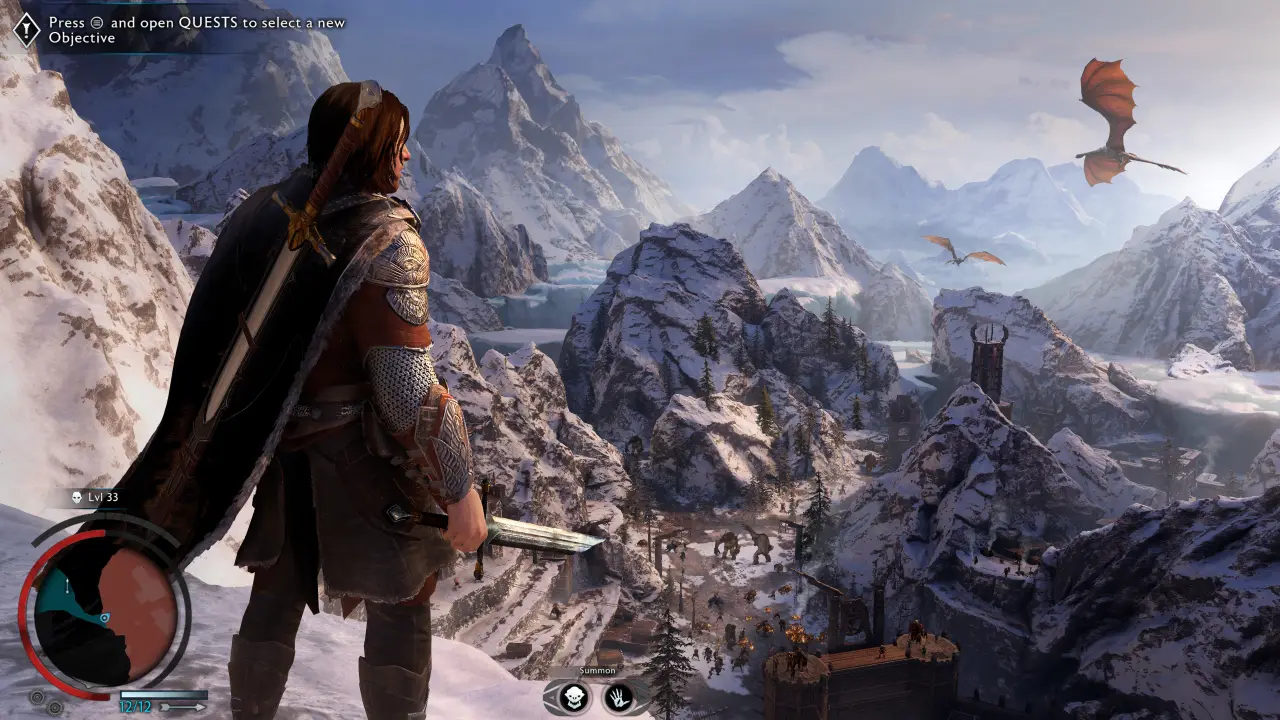
Set beside the predecessor's two drab maps, this world is vastly roomier. Mordor splinters into several wildly different regions — cracked desert, churning lava flats, and the improbably lush green of Nurnen — a visual spread wide enough to make you forget this is still the Land of Shadow. The fortresses read as genuine landmarks; sizing one up from a ridge before the assault carries a real flicker of the epic.
On PC the optimisation is a flat-out highlight: mainstream rigs hold a steady 60fps on high settings with no notable crashing or memory blowouts, and even the most crowded siege never collapses into a slideshow. That last point matters more than it sounds, because a fortress assault throwing scores of bodies at the screen is precisely the moment most engines buckle, and this one holds its nerve. On consoles the PS4 Pro and Xbox One X versions push resolution and frame rate to match the flagship hardware of the day. The menu language is sharp too, visualising the captain roster as a zoomable web of portraits, ranks and weaknesses you can plan your next move against directly — a genuine feat of making a tangled system legible at a glance.
The honest catch arrives in two parts. Peel away those orc faces and a fair amount of terrain texture and foliage density only rates as upper-mid for 2017; this is not the title you boot up to show off your new GPU. And the sheer density of overlapping systems — four skill trees, gear tiers, tribes, traits, multi-layered fortress defences — can swamp a newcomer early on, the interface clear enough to read but not always patient enough to teach. The budget tilted hard toward where the system needed it, and on balance that was the correct call. An 8 reflects a game that is smart about putting its money on the blade rather than the scabbard — striking exactly where it has to and settling for merely solid everywhere else.
Combat | 9.0/10
Gameplay: 9/10The Nemesis System: a world that finally keeps a ledger on you
If you get one sentence to explain why Shadow of War is worth your time, it is the Nemesis System. The premise is almost insultingly simple and the result has no precedent: the orc captains are not fixed encounters waiting at scripted spawn points but a web of relationships that mutates in response to what you do. Who you beat, who beat you, who you let walk, who you turned — the system books it all and rewrites the enemy roster accordingly.
Cause and effect is where the magic lives. A nobody who gets lucky and drives you off is promoted to captain for his trouble; next time he claims the history out loud and goads you with it. Lose to him again and by the third meeting he may have climbed to warchief, bristling with resistances tuned against your favourite tricks. Flip it around and a captain you dominate can be slipped into an enemy stronghold as a sleeper, ready to turn his blade the moment your assault begins. And the orcs scheme without you in the room — promotions, betrayals and power shuffles play out off-screen, so a minor captain you ignored might have duelled his way onto a throne by the time you wander back. Mordor is not a static level awaiting clearance; it is a relationship engine grinding away in the background, evolving even after you turn your back. That sensation — a world with a life of its own that keeps a ledger on everything you do — is why the system still feels singular all these years later.
Three layers stacked, and the Ubisoft loop underneath
Set the system aside and the action fundamentals still hold up. The melee descends from the free-flow framework the Batman: Arkham games made famous: build a combo with light strikes, hit the prompt when the warning flashes to counter, stack the chain high enough to unlock a heavy finisher. It is brisk, legible, and forgiving enough that a newcomer pulls off slick-looking work fast. But the depth comes from layering. The first tier is the ground combo. The second is stealth — duck into long grass, drop on a foe by rope from above, possess a beast to tear an enemy line open. The third, and the genuinely novel one, is the army: by the back half a single skirmish can be you and a dozen recruited orcs storming a fortress held by an enemy captain, a scale of staging the first game could never field.
Progression has real teeth on top of all this. The skill tree forks into four disciplines — dominion, combat, mounted, stealth — and each ability slots gems that bend it toward your build, while legendary gear sets reward the collectors who chase a full tribal-themed loadout for its set bonus. The ceiling is high enough that a skilled player and a button-masher will be playing visibly different games by the back third. It is the rare action title where mastery keeps unfolding new verbs rather than just bigger numbers.
It would be dishonest not to admit the open-world skeleton is heavily Ubisoft-flavoured — tag the enemy, unlock the region, take the outpost, vacuum up the map icons, a loop you have run a hundred times in Assassin's Creed and Far Cry. The mid-game grind of hammering structurally similar fortresses does breed a familiar fatigue. Yet the same Nemesis System makes the identical skeleton run an entirely different temperature. Clear a Ubisoft outpost and it stays cleared; the world goes still. Spare an orc here and he crawls back, humiliate a captain there and he returns with his grudge levelled up, and the map never truly empties. That is the point Shadow of War scores against its most direct rival — that year's Assassin's Creed and the wider Ubisoft sandbox: their worlds wait for you to conquer them, while this one changes alongside you, with or without your permission. A 9 for gameplay, and the Nemesis System alone earns back the asking price; everything else is a generous bonus stacked on top of the one idea nobody else gets to use.
Content | 8.5/10
Contenu: 8.5/10Twenty hours of epic, plus one exhausting tail
By HowLongToBeat's tally the campaign runs around 20 hours, with a full hundred-percent clear pushing toward 56 and beyond. On paper that is a solid blockbuster serving — not so thin you burn through it in a couple of nights, not so bloated it scares you off before you start, and roomy enough that the systems get time to bloom into their full strange complexity rather than fizzling out as a novelty. The front half is the best of it: sieges, recruitment, exploration and story beats trade off in quick succession, with almost none of the dead air and aimless busywork that plagues so many other lesser open worlds of its era.
The collapse comes at the finish. At launch the Shadow Wars epilogue demanded that you grind back wave after wave of Sauron's assaults on your own fortresses before it would cough up the true ending — a long, repetitive slog tethered to the original microtransactions, stretching what should have been a clean stop into an interminable run-on. The cynicism of it was hard to miss: the store just happened to sell powerful orcs that could shorten exactly this grind, which read to many as a paywall smuggled into the credits. The Definitive Edition later carved that down to something far smoother, but anyone playing an early build should brace for the tail. The body of the campaign was never the problem; the deliberately padded coda was, and it is telling that the single most-criticised stretch of content was the one most entangled with monetisation.
Two expansions, a clear best version, and a verdict on weight
The expansion pass bundles two story DLCs, and the telling thing is that their value lives in changing how you play rather than what story you get. Blade of Galadriel puts you in the boots of the elven assassin Eltariel, leaning on light powers that blind, heal and cloak as she picks up the thread after the main ending — but her toolkit barely diverges from Talion's, so it lands as playable yet short on surprise. Desolation of Mordor is the real find. You play the Gondorian captain Baranor, stripped of any wraith powers and unable to dominate orcs, forced to spend cold coin recruiting human mercenaries instead, so the whole loop reorganises around traps, defence and squad coordination. Losing the cheat code is exactly what makes it feel fresh; it is widely judged the stronger expansion, undone only by a narrative that fizzles out.
Together the two DLCs prove the rule that governs the whole game: the fun springs from systems, not script, so an expansion that rewires the rules beats one that merely writes more plot. Eltariel reuses Talion's familiar kit and feels flat for it; Baranor has his wraith powers torn away, which forced the designers to build a fresh loop from scratch, and the result sings. It is a neat accidental demonstration of where this game's real moat lies — not in its story beats but in the mechanical scaffolding underneath them. As for the long tail, the reception is strong — 88% Very Positive on Steam across more than 80,000 reviews, a verdict the players cast with their feet once the microtransactions were gone and the epilogue was trimmed. That shape of curve, savaged at launch and vindicated over the long haul, is rare for a blockbuster, and it tells you the core design was always sound. Pull out the self-sabotaging business decisions and what is left underneath is a loop hard enough to keep pulling people back years after release. The version question answers itself: buy the Definitive Edition. It folds in both DLCs, the free updates and the tribal packs, scraps the notorious market and tidies the coda — what you purchase today is the build that already healed every launch wound. There is genuinely no reason to seek out anything else; the edition that fixed the game is also the cheapest and most complete way in. An 8.5 for content: generous in size, sharp in its expansions, and only held just shy of higher by the microtransaction tail it once dragged behind it like a ball and chain.




Commentaires 0
Votre avis nous intéresse
Participez à la discussion et partagez votre avis sur ce jeu.
Aucun commentaire pour l'instant. Partagez votre avis sur ce test.