

























Opening
You have to apologise before you recommend this one. My Summer Car looks rough, plays awkwardly, and will spit a first-time player back out before the engine even turns over. Two hours in you may still be staring at a heap of loose parts, no idea which bolt goes where, the car a long way from leaving the garage. And then, somewhere along the line, it gets its hooks in. You find yourself crouched on a virtual concrete floor at two in the morning, torquing one more bolt, counting your kilju money, plotting a route to the petrol station that keeps you sober enough to make it home — and when that hand-built Satsuma engine coughs into life for the first time, the payoff lands harder than any prestige cutscene ever has.
This is the work of a tiny Finnish studio, Amistech Games — Johannes Rojola and his wife Kaarina, building something close to a handmade object. It sat in Steam early access for the better part of a decade before finally hitting 1.0 on the 8th of January, 2025. There is no Metacritic aggregate, no OpenCritic page, no wall of professional reviews. What it has instead is 94% positive across more than a hundred thousand Steam reviews — the textbook shape of a game the press ignored and the players adopted. Cold with critics, hot with the crowd.
The premise is simple and quietly insane. Assemble a car from hundreds of loose parts, bolt by bolt, and stay alive in 1990s rural Finland while you do it. Eat, drink, sleep, work, and above all do not die — because permadeath here means your save is gone, the whole summer wiped in a single careless night. What follows is a six-part look — story, audio, graphics, gameplay, content, and the verdict — at why a junk car in a Finnish field earns this much love and this much swearing.
Story | 6.0/10
Scénario: 6/10There is no script — the plot grows on the bolts you tighten

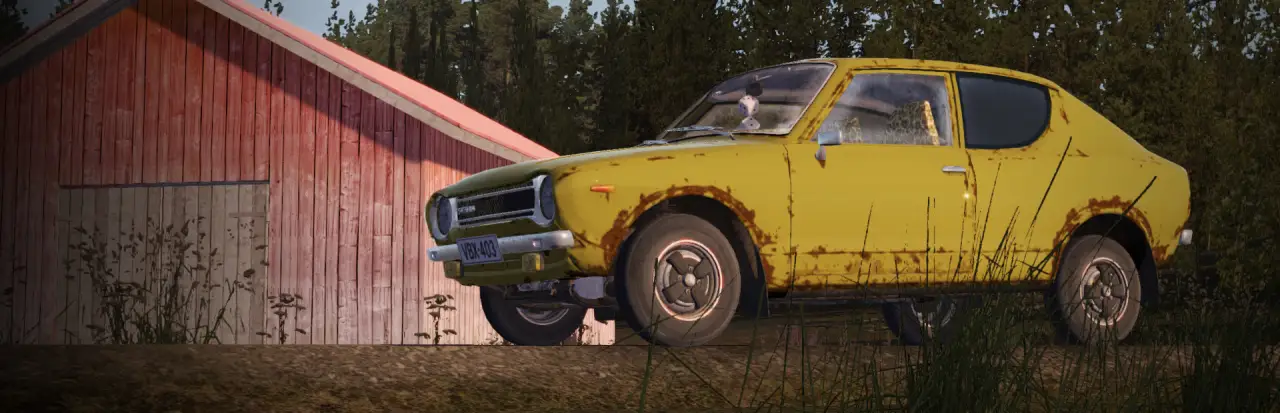
The most counter-intuitive thing about My Summer Car is that it has almost no story in the conventional sense. No cutscenes. No quest log. Not a single line telling you where to go next. All it hands you is a premise: it is the summer of 1995, you are an eighteen-year-old in rural Finland, your parents have flown off to Tenerife, and the whole country house is yours. A rust-eaten Satsuma shell sits outside the garage. Hundreds of parts are scattered inside. The rest is on you.
That emptiness is not laziness; it is a deliberate authorial choice. The story here is not written into a script — it grows out of what you do. Whether you grind for cash first or build the engine first, whether you ration the beer or risk a drunk drive to the pub, every decision is busy writing a summer that belongs only to you. The first time that Satsuma fires up and carries you down the road without falling apart, the emotional weight beats any choreographed setpiece, precisely because you earned all of it yourself. It hands the meaning of "achievement" straight back to the player.
It is worth sitting with how unusual that is in 2025. Most games spend enormous effort making sure you never feel lost. This one spends its effort making sure you do — and trusts that the dread of being lost will curdle, eventually, into the joy of finding your own way.
A summer no two players share

Because the narrative is generated entirely by your behaviour, almost no two players walk away with the same summer. One person turns it into a meticulous engineering log, assembling and tuning strictly by the book, every bolt to spec, every fluid topped up before the first ignition. Another turns it into a drunken farce, flooring a half-bolted wreck down a dirt road until it pitches nose-first into a ditch with hours of progress inside it. Same absence of a main story, wildly different flavours.
Set it beside another emergent-narrative landmark, Project Zomboid, and the contrast sharpens. Both games refuse to hand you a plot. But Zomboid wrings its stories out of apocalyptic dread — the undead are the pressure that squeezes a tale out of you — while My Summer Car wrings its stories out of boredom, drink, and the stubborn bond between a teenager and a broken car. One is a story about surviving the end of the world; the other is a story about surviving a slow, sunlit nothing of a holiday. The machinery is similar. The taste could not be more different.
A buried thread, never forced into view
The funny thing is that this loose, improvisational world does hide a faint narrative spine. The official sequel, My Winter Car, branches depending on whether you reached a particular hidden ending in the original. So there is a thread down there in the Finnish dirt — the developer planted one — but the game never once nudges you toward it, never flashes a marker, never reminds you it exists. The players who stumble onto it tend to be the ones who have already lived in this countryside for a hundred hours or more.
That restraint is exactly why the game's narrative voice is so recognisable. It does not move you with dialogue. It moves you with atmosphere and with your own accumulated history, letting a Finnish summer slowly take root in your memory until it feels less like a game you played and more like a place you once spent a season. The grief of a wiped save, the small triumph of a first clean drive, the daft comedy of a midnight ditch — these are not scripted beats handed to every player. They are yours, specifically, and that ownership is what gives them weight.
It is a bold bet for a game to make: that a story you write for yourself, out of bolts and beer and bad decisions, will stick harder than one a writer wrote for you. For the players who stay long enough to make a few of those decisions and live with the consequences, it pays off completely.
Audio | 8.0/10
Audio: 8/10The engine is the lead instrument

In a game everyone agrees looks crude, sound turns out to be the quietly excellent part. The engine work is meticulous: the two-stroke moped, the hand-assembled Satsuma motor, each shifting its voice convincingly across the rev range. The cough of a cold start, the lumpy idle, the rising snarl as you bury the throttle, the crackle and pop from the exhaust on the overrun — none of this is decorative background. It is the core stream of information you use to read the state of your wreck.
That ties straight into the design. Because no HUD prompt is going to tell you the ignition timing is off or the valve clearances are wrong, you have to listen. Whether the engine shakes, whether it pulls cleanly, whether some new rattle has crept in — your ears are doing the diagnostics. Sound takes over a chunk of the dashboard's job here, and "fixing a car by ear" is a genuinely rare sensation across the whole simulation genre.
Hold it up against a purely physics-driven peer like BeamNG.drive and the difference in intent is clear. That game chases engine and impact audio as a feat of simulation, a kind of technical showroom you can drive through. My Summer Car aims its engine note somewhere else entirely. It is not after "this sounds like a real car." It is after "this sounds like that specific clapped-out car of yours, parked in a Finnish field in 1995."
And the feedback loop runs both ways. A clean, even idle is a small reward telling you the build is good; a fresh knock or misfire is a warning you have to act on before it strands you twenty minutes from home. The audio is never ambient wallpaper — it is a gauge you read with your ears, and learning to read it is part of learning the game.
The soundscape of rural Finland

If the engine builds the mechanical truth of the place, the ambience builds the cultural truth of it. The radio in the car plays music and tango steeped in a heavy Finnish accent, and as you crawl along an empty country lane those melodies pair with a summer night that never quite goes dark, conjuring a mood that is languid and slightly lonely all at once. Footsteps, wind, lake water, the murmur of the pub — every layer of ambience reinforces a countryside that is shabby, damp, cheap, and utterly believable.
Sound is also where the black comedy lands. Get drunk and the picture blurs and sways, the footsteps turn unsteady, and the engine and ambience distort along with everything else. That fully integrated audio-visual drunkenness carries the whole absurd "I knew I shouldn't, and I did anyway" feeling better than any meter could. Countless players have driven straight into a ditch inside exactly that haze of warped sound and tilted screen.
It is the stacking of these two layers — the mechanical voice of the engine and the cultural voice of the world — that lets My Summer Car reach such a high density of immersion with no famous composer and no orchestral score anywhere in sight. There is no sweeping leitmotif to hum afterwards, and there does not need to be; the thing you remember is the texture, the specific tinny warmth of a radio in a moving wreck. It proves a small, stubborn point: good sound design does not have to be grand. It only has to be right.
Visuals | 5.5/10
Graphismes: 5.5/10Crude is honest — low-fidelity art on the Unity engine

Let me put it plainly up front: by 2025 standards, My Summer Car genuinely looks rough. Built on Unity 5, it serves up low-poly models, stiff character animation, and basic textures, none of which come within a country mile of a modern blockbuster. Open it expecting handsome lighting or fine material work and the disappointment is instant. The low score this dimension earns is grounded in exactly that honest fact — there is no point pretending otherwise.
What is strange is how nearly all of that crudeness becomes an asset inside this particular game. Rural Finland in the 1990s was itself shabby, damp, and cheap — rust-streaked car bodies, peeling furniture, muddy lanes, a garage piled with junk. The low fidelity captures that poor, real texture with uncanny precision, the way a faded photograph can feel truer to a decade than a remastered one. Picture the alternative: swap this countryside for a 4K ray-traced showpiece and the very destitution that makes a poor kid and his broken car feel real would evaporate. The grime would read as a deliberate art style rather than a fact of life. Here, crude is honest.
Two philosophies of a garage
Set against its main rival, Car Mechanic Simulator, with its spotless, brightly lit, standardised workshop, the grime and decay of My Summer Car read as a deliberate aesthetic decision. One game wants the clean, efficient satisfaction of repair; the other wants to press you into a setting real enough to be faintly uncomfortable. That fork in art direction maps onto two entirely different philosophies — one treats the garage as a showroom, the other treats it as a life.
Put another way, the visuals are a kind of "good enough" pragmatism. Every scrap of development budget went into the simulated mechanical systems and the vast web of part interactions rather than into polishing light and material. For a game whose whole pleasure is putting the car together with your own hands, that is a trade that adds up, and you can feel where the effort went the moment you start handling parts. What you actually stare at is whether the bolt in your grip seated properly — not whether the leaves on a distant tree are finely modelled. The fidelity is concentrated exactly where your attention lives.
Hiding the interface, and a map you learn by heart

My Summer Car carries its design philosophy into the interface too: hide what you can. There is barely a HUD, no quest markers, no objective dots blinking on a minimap, and even the status meters are kept understated. Hunger, fatigue, thirst — you read them more through the character's behaviour and your own judgement than through a number tucked in a corner. That near-austere minimalism hands the right to interpret every signal back to the player, the flip side of the same coin as the no-guidance gameplay.
The technical ceiling may be low, but the level design of the open-world map, Alivieska, is unexpectedly legible. Winding country roads, a lonely pub, a supply shop, septic tanks waiting to be pumped, a lake you can swim in — each landmark is crude yet functional, each with its own character, and after a few runs you can sketch the whole map from memory. That "function as landmark" approach turns a place with no graphical flourish at all into somewhere that gradually becomes home.
It should be said the crudeness does carry a real cost, and it is not all upside. The stiff animation, the occasional clipping, the slightly flat lighting can yank you out at a peak immersive moment. This is not the careful, curated jank of a deliberately retro throwback; it is the genuine ceiling of a tiny independent team, and that distinction matters. To be fair about it, a developer with deeper art resources could have kept every ounce of the shabby texture while smoothing the animation and lighting, and the experience would only have been better for it. So graphics end up the game's most contradictory and most interesting dimension: objectively threadbare, yet in the broad strokes pitched just right. The roughness is a weakness and a part of the atmosphere at the same time, and that very contradiction is the game in miniature. You stay not because it is pretty, but because it is correct.
Combat | 9.0/10
Gameplay: 9/10Every bolt counts — a depth of assembly nothing else touches

If you had one sentence to sum up how My Summer Car plays, it would be this: every bolt counts. The game opens on an empty shell and hundreds of scattered parts — engine block, pistons, crankshaft, gearbox, suspension, brakes, the electrical loom, coolant hoses, the fuel tank. Your job is to physically return each one to its correct place with the correctly sized spanner, torqued to the right tightness. Leave it too loose and the part can shake free at speed; miss one critical bolt and the engine can come apart on the road beneath you.
This depth of simulation has almost no rival in the genre. It is not the "click a part and it snaps into place" kind of model — it genuinely asks for a little real mechanical knowledge: what goes on first, what goes on after, which spanner, how far to torque it. Once the hardware is in, you still have to add oil, coolant, and brake fluid, check the battery, set the ignition timing and the valve clearances, and finally drive to an inspection. Pass it and you are road-legal; fail it and a passing police car will fine you. The car is never simply "done."
That razor-thin margin for error is the fault line between it and its main rival, Car Mechanic Simulator. The latter turns assembly into a relatively simplified, forgiving point-and-place flow, selling the clean satisfaction of a fixed car; My Summer Car insists you pay for every bolt you get wrong. Neither approach is better in the abstract, but on raw simulation depth, the rival simply does not reach the obsessive tier this game lives at. It wants you to sweat the small stuff because the small stuff is the entire point. A car that runs but pulls to one side, idles rough, or overheats on the motorway is not a bug to be patched out — it is feedback, the game telling you that somewhere in those hundred parts you made a mistake, and daring you to find it.
Permadeath, survival, and a no-tutorial Dark Souls

Strip it back to assembly alone and My Summer Car would be no more than a hardcore repair sim. What makes it a survival game is the permadeath layered on top. You are not only nursing the car; you are nursing yourself — hunger, thirst, fatigue, stress, any one of which can prove fatal if it runs away from you. Starve, collapse from exhaustion, or die in a crash, and the save wipes clean, dozens of hours gone in an instant. That permadeath is what defines the game's hardcore identity, and it is also why so many players bounce off it inside the first session.
What makes it sing, though, is that none of these systems stands alone — they are braided into a loop that polices itself. You work the odd jobs to afford parts, petrol, and food; you eat and sleep so you do not drop dead; you drive carefully and stay off the beer so you do not put yourself and the car in a ditch. Repair, income, survival, driving — four strands meshed together, and slacken any one and the whole loop buckles. And running through all of it is the design that both repels and seduces: there is no tutorial, no quest guidance, no objective glowing on the map, not even a word about which part goes where or which spanner to grab. This is exactly why outlets like Kotaku and other Western gaming press keep reaching for the Dark Souls comparison — brutal at the door, then suddenly luminous once you have fumbled, googled, failed, and finally understood the machine yourself. Pull off a full assembly with no walkthrough, pass an inspection on your own, and what you get is not just a running car but a hard, real, personally-owned sense of mastery — the kind no objective marker could ever hand you for free. That is the engine, so to speak, behind 94% positive on Steam and nine years of unbroken word of mouth from players who would not have it any other way.
Content | 8.0/10
Contenu: 8/10An economy held up by absurd odd jobs

My Summer Car has no "content levels" in the usual sense. Its volume hides inside an economy held up by gloriously absurd odd jobs. Nothing in this game simply hands you money — to afford parts, petrol, food, and beer, you go to work. And the work is earthy to the point of comedy: driving firewood out for delivery, towing junk cars to the mechanic for cash, pumping out somebody else's septic tank, brewing a homemade hooch called kilju in the back garden, picking strawberries in the summer heat, getting called out at midnight to haul a blackout drunk home from the pub.
These jobs are not set dressing; they are the load-bearing wall. They are your only source of cash and they are themselves the content — each one has its own routine, its own route, its own little snags, and strung together they are simply your day-to-day life out in Alivieska. Making the labour itself the content is what lets a game with no levels and no progress bar end up so improbably long-lived. The septic-tank run is not a minigame between the "real" content; for long stretches, it is the real content, and the absurdity is the charm rather than the filler.
Vehicles that turn travel into a decision
Beyond the jobs, the map is dotted with vehicles to drive: a two-stroke moped, a borrowable muscle car, a cargo van, a truck, a tractor, even a small boat you can launch onto the water. Each one has its own temperament and purpose — the moped is nimble but lethal, the van hauls but lumbers, the boat carries you to corners of the map no car can reach. They widen the playable edges of this rural world and, just as importantly, turn "getting around" into something you have to weigh and plan.
Crucially, the vehicles mesh with the jobs and the survival systems. You drive the moped or the van out to work, you budget the fuel and the route, you get home before dark to sleep, and you keep one eye on not drinking yourself into a ditch on the way back. What looks like scattered content is actually threaded by a single survival logic into one coherent whole — and that coherence is the root of how it holds you.
Nine years of running, plus mods and a sequel

The lifespan of My Summer Car stretches far past what the developer shipped. On the 8th of January, 2025, it closed out nearly a decade of early access with a 1.0 release that polished systems like the vehicle inspection and drew a line under the long marathon. But what makes its content close to endless is the ferociously active modding scene. Over on Nexus Mods the community has built a mountain of mods — new cars, expanded maps, satellite navigation, a radio that pulls in more stations, even a mod that reskins the whole thing for winter. Paired with the community's MSCLoader, you can pour fresh content into this countryside almost without limit, the kind of community-driven longevity many industrial blockbusters would envy.
The studio has not stood still either. The sequel, My Winter Car, entered early access on the 29th of December, 2025, moving the stage from summer to deep cold, adding a clothing system and a body-temperature meter — let it drop too far and you freeze to death — at a difficulty pitched even higher than the original.
Compared with a linear road-trip game like Jalopy, whose content is a journey with a defined finish line, My Summer Car is an open sandbox with no terminus, its volume defined in large part by the player — through jobs, vehicles, mods, and endless restarts. One is a book you read and close; the other is a small town you keep returning to live in. Which is also why its content cannot really be measured in "hours to beat." Some bounce off at twenty hours; others have lived here for a thousand and counting. What the game gives you is not a content track of a fixed length but a living system that extends itself indefinitely — and that, more than any single feature, is the most quietly impressive thing about how it is built.






Commentaires 0
Votre avis nous intéresse
Participez à la discussion et partagez votre avis sur ce jeu.
Aucun commentaire pour l'instant. Partagez votre avis sur ce test.