





















Opening
There is a specific noise a great pickup game makes — sneakers barking on asphalt, a ball clanging off a chain-link rim, a crowd losing its mind over a dunk nobody saw coming. NBA THE RUN is built to chase that noise, and for long stretches it catches it.
This is 3v3 arcade basketball, out June 9, 2026, from Play by Play Studios — a shop staffed with veterans who cut their teeth on the old NBA Street games. They clearly remember what streetball is supposed to taste like: quick, crunchy, flashy, a little bit lawless.
Ten minutes in, you will probably be grinning. A few hours in, a second feeling shows up right on schedule — the part that is fun is genuinely fun, but there does not seem to be much more game underneath it. This review is about the tug-of-war between those two truths: an eight on the court, and something a lot thinner the moment you step off it. Here is the verdict up front: it is well worth playing, but only if you go in clear-eyed about what it is and is not.
Story | 6.0/10
Scénario: 6/10Let me get the disclaimer out of the way: there is no story here. No campaign, no cutscenes, no character whose arc you will lose sleep over. NBA THE RUN is pure competition. But "no story" is not the same as "nothing to say," and what this game has to say lives entirely in the lineage it is trying to revive.
What it's really about is a genre nobody touched for twenty years

The ghost this game is chasing belongs to NBA Street Vol. 2. Licensed arcade basketball went dark for the better part of two decades — NBA Playgrounds poked at it, but the specific cocktail of official rosters plus back-alley swagger sat untouched on the shelf. THE RUN is here to pour that drink again, and it knows exactly what it is mixing. From the linework to the sound to the tempo, everything bows toward that golden era without curdling into cheap nostalgia.
Think of its "narrative" as a thesis statement rather than a plot. It is not telling you a player's coming-of-age tale; it is arguing a position — this is what streetball is supposed to be. That stance sets both its ceiling and its floor. When the atmosphere clicks, your arm hair stands up. It just cannot hand you a story you will carry around afterward.
For some players that is a non-issue — nobody hits the park for the plot. But for the slice of the audience who remember the single-player modes of the old games as a genuine reason to keep playing, the absence registers as a dull ache that never quite goes away. The game is making a bet that the loop is enough on its own, and whether that bet pays off depends entirely on what you walked in wanting from it.
Bobbito Garcia is, by himself, half a streetball history lesson

If this game has a narrator at all, it is Bobbito Garcia. He was the voice of NBA Street Vol. 2, and his return is more than a voice-over credit — he is also a playable streetball legend, emcee and baller rolled into one person. He functions like a thread stitching today's lobby to a memory that is twenty years old, and old heads will time-travel the second they hear that cadence.
The other legends on the roster — Shen Tong, Spin Cycle, El Gigante, DJ — sketch out a homemade mythology of the blacktop. These invented characters share the floor with real, licensed NBA stars, and the collision of fact and folklore gives the whole thing an oddly magnetic charge. The game never sits you down to explain who they are. You assemble their outlines yourself, out on the court, between the announcer's hollers. It is characterization by negative space, and frankly it suits the street better than a forced backstory ever would. The blacktop has always run on reputation and rumor more than documented fact, and a roster that mixes verified superstars with half-invented playground myths captures that texture better than any cutscene could.
Your win streak is the only legend it bothers to write for you

So where does the drama come from with no script? The format itself. The Run World Tournament is a four-round, win-or-go-home gauntlet, and every match is a knife fight you cannot afford to lose. That shape generates emotion on its own — the streak you are nursing, the gut-punch of a final-round collapse, the buzzer-beater that pushes you through. Those improvised, in-the-moment beats are the only "story" the game is willing to give you. It does not author a narrative; it hands you a stage and dares you to make one.
Be honest about the cost, though. Trading plot for format means no single-player career and no characters to chew on, so this whole dimension is thin by design. The NBA Street games leaned on a single-player mode as a marquee feature; this one tore that marquee down entirely. For a slice of the old guard, that is a missing piece they will feel.
The low score here is not a botched execution — it is an ambition the game never had. Walk in expecting a pure competitive product and you will not feel cheated. Walk in hoping for the story mode you remember, and the absence will sting every time you open the menu and find nothing there.
Audio | 7.5/10
Audio: 7.5/10Whether a streetball game's sound is right decides whether its whole vibe holds up. NBA THE RUN is smart about this. It knows what a dunk should sound like, and it knows whose voice still means "the street."
The thump of a finished dunk is doing real work

Start with the most immediate thing. Every dunk lands with a thump that the crowd answers in the same breath, and it is satisfying in a way that loops you back for another one. This is not decoration draped over the action — it is part of the feedback loop. Half the reason a finish feels good is that your ears confirmed it before your eyes finished processing it. Strip that thump out and the same animation would feel weightless, a poster dunk with the sound off.
It is a subtle thing to get right and an easy thing to get wrong. Plenty of sports games render a gorgeous slam and then undercut it with a thin, canned sample that makes the whole motion feel fake. THE RUN treats the audio of contact as seriously as the animation of it, and that respect is why a routine bucket here still registers as an event in your hands.
Bobbito's record scratches are the soul the 2K crowd can't buy

Then there is the entire sonic language Bobbito Garcia drags back with him. Record scratches, crowd reactions, a grab-bag of arcade sound effects — together they form a streetball texture that a straight simulation simply cannot reproduce. One previewer put it well: Garcia's involvement is representative of the overall style that defines the game. That is not flattery.
This soundscape is the part of THE RUN you could not copy-paste into a yearly sim, because the sim was never built to sound like a Saturday on Rucker Park. A 2K broadcast aims for the polish of a televised game; THE RUN aims for the chaos of a park where a guy with a microphone is roasting both teams between buckets. Garcia is not narrating the action so much as performing alongside it, and that performance is doing more for the identity than any single visual choice. It is the difference between watching a game and being at one — and being at one is the entire point of streetball.
Too few announcer lines, and no anthem you'll hum next year
The good news comes with one visible crack: the announcer simply does not have enough to say. TheSixthAxis flatly called the commentary "okay," noting it runs on only a few lines, and after a long session you will start hearing the same call recycled. For a game leaning this hard on atmosphere, that is an avoidable own goal — once repetition punctures the mood, the immersion quietly leaks out.
The soundtrack and effects, per CogConnected, do enhance the experience, and that holds up. But measured against the street-hip-hop OST of NBA Street Vol. 2 — a soundtrack you would pull up on its own — this game lacks a single anthem that becomes its calling card.
It nails the feeling. It has not yet produced the hook you would still be humming two decades from now. The mood is here; the melody you cannot forget is not. That distinction matters more than it might seem, because the games this one is consciously chasing are remembered as much for their music as their dunks, and a calling-card track is the one piece of that legacy THE RUN has not yet managed to forge for itself.
Visuals | 8.0/10
Graphismes: 8/10In a year when NBA 2K is busy rendering individual pores and sweat beads, NBA THE RUN turns on its heel and sprints the other way entirely. It picks a bold comic-book look — and, against the odds, it sticks the landing cleanly.
The comic style makes stars instantly readable, never uncanny
The rendering leans toward a comic book rather than pure cartoon, and the distinction matters. Push toward realism and you become a budget knockoff of 2K; push toward cartoon and you lose the players' likenesses. The balance THE RUN strikes lets you recognize exactly who is on the floor while coating every move in a layer of exaggerated street gloss. GamesHedge's 8.0 leans heavily on that readability.
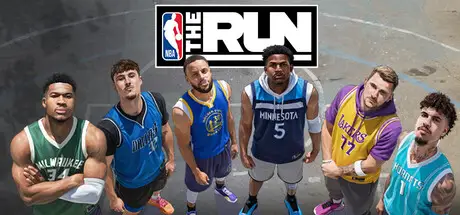
The likenesses land without tipping into the uncanny valley. Curry's baby face, Doncic's eyes, LeBron's frame — a few exaggerated strokes pin each one down, and you never need the nameplate to know who is dunking on you. That "instantly readable yet stylish" treatment was the calling card of the old NBA Street games, and this one inherits it without any awkwardness.
It is also a quietly practical choice. The rookie variant cards — Curry, Doncic, Durant, Shai Gilgeous-Alexander and LeBron each rendered as a younger self — only work because the art style can exaggerate age the way a caricaturist would, slimming a frame or softening a face with a stroke or two. A photoreal engine would have to model two separate heads; the comic line just redraws one. The look is not only handsome, it is load-bearing for how the roster expresses itself.
Subway tracks and graffiti turn each court into a place
What actually brings the visuals to life is the court design. The studio did not copy-paste a handful of generic floors; it pulled from real street locations around the world. One court sits under rumbling elevated subway tracks; another is buried in graffiti, its walls weathered with street art. Each one works to capture the flavor of the city it belongs to.
That care pays off. Throw down an alley-oop on a court caged in by train tracks and the "I am actually balling in the street" sensation arrives in a way no sanitized indoor arena could deliver.
Across all three platforms — PC, PS5, Xbox — the game holds its frame rate under fast, chaotic play, so your inputs never get taxed by a stutter. For a game built on split-second reactions, that floor is held, and it is worth saying out loud: a stylized look is no excuse for a soft frame rate, and THE RUN does not lean on one. The performance is as clean as the art is confident.
Style over silicon is the smarter, longer-lasting bet
Set against 2K's photoreal march, THE RUN chose the opposite road and proved that stylization is not the same as cutting corners. It does not win by piling on polygons; it wins on a confident, recognizable art direction, which stands out in a field obsessed with who can look the most real. A comic look ages slowly and reads cleanly years later, where photorealism dates itself fast.
The game did not fight the yearly franchises on hardware specs — it beat them on identity, and that is the cannier, longer-lived move. Photoreal sports games are locked in an arms race they can never win permanently; next year's model always makes this year's look slightly worse. A stylized game opts out of that race entirely. The blacktop courts, the inked faces, the exaggerated physics of a finish — none of it is chasing a benchmark, so none of it can be outdated by one. Five years from now this will still look like itself, and that is worth more than a few extra teraflops.
Combat | 8.5/10
Gameplay: 8.5/10If a game gets exactly one thing right, THE RUN bet on the correct one: it plays beautifully. This is the bedrock under the whole review and the single place it grabs a high score without an argument.
Fast and crunchy — the first proof it understands streetball
The first word that comes to mind is crunchy. Alley-oops, crossovers, ankle-breakers, contested layups, blocks — every move chains into the next with a crisp little snap, the same do-it-now bluntness you feel on an actual blacktop. The critical consensus lands on the same adjectives: fluid, fast, tight, with offensive flow and defensive reads both landing cleanly. It is simple enough to pick up cold and deep enough to open a real gap between a novice and an expert.
What makes it sing is the design philosophy. It dials way down on the simulation obsession with shot timing and precise dribbling — open looks are easy to drain — and relocates the real challenge to how you use style moves and passing to pry someone open. The test is your head and your chemistry, not your finger memory. That is exactly what streetball should be.
It also lowers the barrier in a smart way. You do not have to grind dozens of hours on shot rhythm before the game becomes fun; from the first match you can spend your attention on the genuinely interesting stuff — reading the defense, setting up a teammate, breaking an ankle and watching the lane open. A novice and a veteran find joy at their own tier, which is rarer than it sounds in a competitive sports title. The skill ceiling is high, but the floor is welcoming, and that gap is where the game lives.
In the Zone and random rules are its two cleverest ideas
Two systems deserve their own spotlight. The first is In the Zone: string together good plays and you briefly enter a boosted state with sharpened abilities. The balance is the clever part — it rewards the player who is cooking without getting strong enough to lock the trailing team out, sidestepping the old arcade-hoops curse where one hot run decides everything and the suspense dies.
The second, and its biggest hook, is the randomized rule set. Each match rolls its conditions before tip-off. This one wants 25 points scored by distance tiers; the next caps at 7 and counts every make as one regardless of range; a nastier variant makes dunks worth three while every other shot is worth one. That single roll rewrites your whole team's shot selection and forces an on-the-fly rethink. In the dunks-are-triple round, for instance, you and your teammates suddenly have to reorganize around creating drives to the rim, while your sharpshooter rides the bench for a possession. Layered over the four-round, win-or-go-home Run World bracket, every game tightens to the point of barely letting you breathe. It is that randomness that keeps a loop which could go stale feeling a little different every single time, and it is the closest thing the game has to a content engine — variety generated by rules rather than by modes.
Three knockout modes — all controller-first, all online
The structure splits into three knockout modes: Squads pairs you with real teammates for 3v3, Solos hands you all three players yourself, and Friends is a private bracket where you can set your own rules and mess around. A controller is strongly recommended — some actions, like shoving an opponent, live on the right stick, and mouse-and-keyboard cannot replicate that physicality. It quietly confirms this is a game built in its bones for a pad and a couch.
Line it up against the genre's elders and its place gets clearer. Where the old arcade-hoops classics won on pure exaggeration and speed, THE RUN stacks a layer of "how exactly do I play this one" strategy on top of the speed.
That extra layer is where it genuinely moves the genre forward a step — and it is the nerve it has to call out every forebear on this court. The old games were about the spectacle of the dunk; this one is about the spectacle plus the read, and asking your brain to keep up with your hands is the most modern thing about it.
Content | 5.5/10
Contenu: 5.5/10Now for what it gets wrong, and it gets a lot wrong here. If gameplay is this game's clear ceiling, then content is unmistakably its floor — and that floor has given way more than a little.
No single-player, no practice — it cut the very thing Street was known for
The most glaring line item: there is no single-player content at all. No character progression, no practice space, not even an offline mode to grind technique against the AI. For a game carrying NBA Street DNA, that is close to self-amputation — single-player and career modes were a signature of that series, and this entry hacked them off clean.
The fallout is direct. A newcomer who wants to improve has exactly one path: go online and bang heads with players who very much want to win. There is no low-stakes space to fumble through and learn the controls, so the frustration of being schooled on repeat is a real deterrent for casuals. You cannot even find a quiet corner to drill dunks or learn the random rules — you pay tuition in live matches, head down, taking your lumps. For a genre whose whole appeal is supposed to be pick-up-and-play accessibility, forcing every beginner straight into the deep end is a strange and avoidable bit of cruelty, and it is the kind of thing a single practice mode would have quietly fixed.
No couch play, no ranked, no tutorial — half-built scaffolding
The second and arguably deeper cut lands on local multiplayer. One of arcade basketball's most beloved traditions is a crowd jammed onto a sofa playing on one screen, and that most street-flavored experience is simply gone here — a genuine loss that multiple outlets flagged as major.
Dig deeper and the competitive scaffolding is plainly unfinished. No ranked ladder means winning a hundred games chases no tier goal; no tutorial means every system is yours to reverse-engineer; no in-team comms means coordinating with strangers is mostly guesswork.
None of these is fatal alone, but stacked together they make the package feel half-done. Worse, the content runs thin — TheSixthAxis bluntly noted you see most of what the game offers within a few tournaments, and novelty arrives fast and leaves faster. A competitive game can survive on a thin content layer if the ladder, the cosmetics chase, or the social hooks give you a reason to keep climbing. THE RUN has stripped most of those reasons out, so the thinness bites harder than it would in a more scaffolded release.
Zero monetization is its conscience; always-online is the sword overhead
There is one unambiguous bright spot: zero microtransactions, zero in-game purchases. Every unlockable player and cosmetic is bought with in-game currency you earn on the court — no real-money gacha, no paid roster. In the microtransaction-soaked sports landscape of 2026, nearly every review pulls this out for individual praise, and it is the hardest reputational asset the game owns right now.
Context makes it shine brighter. The neighboring annual franchise has spent years training players to accept "pay if you want a good player" as the cost of doing business, and the audience has gone a little numb to it. So when a game shows up insisting every player is earned on the floor and not one extra cent is asked of you, the posture alone wins a wave of goodwill before you have evaluated a single mechanic. It is the kind of decision that reads as respect, and respect is in short supply in this genre.
The flip side is brutal. Because there is no offline content whatsoever, the game's entire lifespan is staked on whether anyone is online. Once the hype cools, the matchmaking pool shrinks, or the servers eventually go dark, players are left holding nothing. The cautionary tale is not far off — Knockout City walked the same always-online road, and its fate rang the bell for every game in this category. Zero monetization won THE RUN its present goodwill; mandatory online play left its future dangling from a rope that is not especially strong.





Commentaires 0
Votre avis nous intéresse
Participez à la discussion et partagez votre avis sur ce jeu.
Aucun commentaire pour l'instant. Partagez votre avis sur ce test.