
























Opening
Stockholm's Axolot Games pushed Scrap Mechanic onto Steam Early Access on January 20, 2016, and nearly a decade later, on July 24, 2026, it finally crossed the finish line into 1.0. That fact alone would sink most titles. Yet more than a hundred thousand Steam reviews keep the approval rating pinned around ninety percent, an outlier almost nobody in the indie sandbox space has matched over such a long stretch. Across ten years Axolot has shipped only two updates large enough to be called milestones: multiplayer in 2017 and the Survival mode overhaul of May 2020. The rest of the time, a monthly developer log and a steady current of Workshop creations have done the feeding.
Pull the ecosystem apart and its staying power rests on three pillars. A homegrown Swedish physics engine lets four thousand parts hold a steady sixty frames per second. A library of more than a hundred industrial components, wired through logic gates, pushes construction into something close to small-scale programming. And a Steam Workshop that has stayed alive and busy for ten straight years keeps the long tail fed. The most direct rival, Trailmakers, has already launched in full with a steadier engine, but its ceiling on creative complexity and the depth of its Workshop both trail by a meaningful margin.
The six dimension breakdowns ahead lean into two questions. Why has nobody managed to replace this particular recipe of long-haul development, Workshop-driven content, and an engineer-minded player base? And if 2026 is your first contact with the game, which on-ramp should you take and which traps should you sidestep? The reality of a Chapter 2 that has slipped five years, and what that slippage has actually done to veteran trust, sits at the center of the answer.
Story | 5.5/10
Scénario: 5.5/10A Pod Crash That Is the Entire Plot
Scrap Mechanic sits in an awkward spot on the narrative axis: it has, in any traditional sense, almost no story at all. Before the May 2020 Survival overhaul, the Creative side did not even bother with a framing event. You simply spawned into an empty stretch of farmland and started bolting parts together. Survival finally introduced a sliver of setup. You play a mechanic whose escape pod tumbles out of orbit and slams down onto an agricultural planet that has been overrun by rogue farming robots. There is no cutscene, no spoken dialogue, no quest log. A single terse prompt amounts to "you crashed, now stay alive," and then the game drops you into the wreckage to figure out how to light a fire and cook a meal on your own terms.
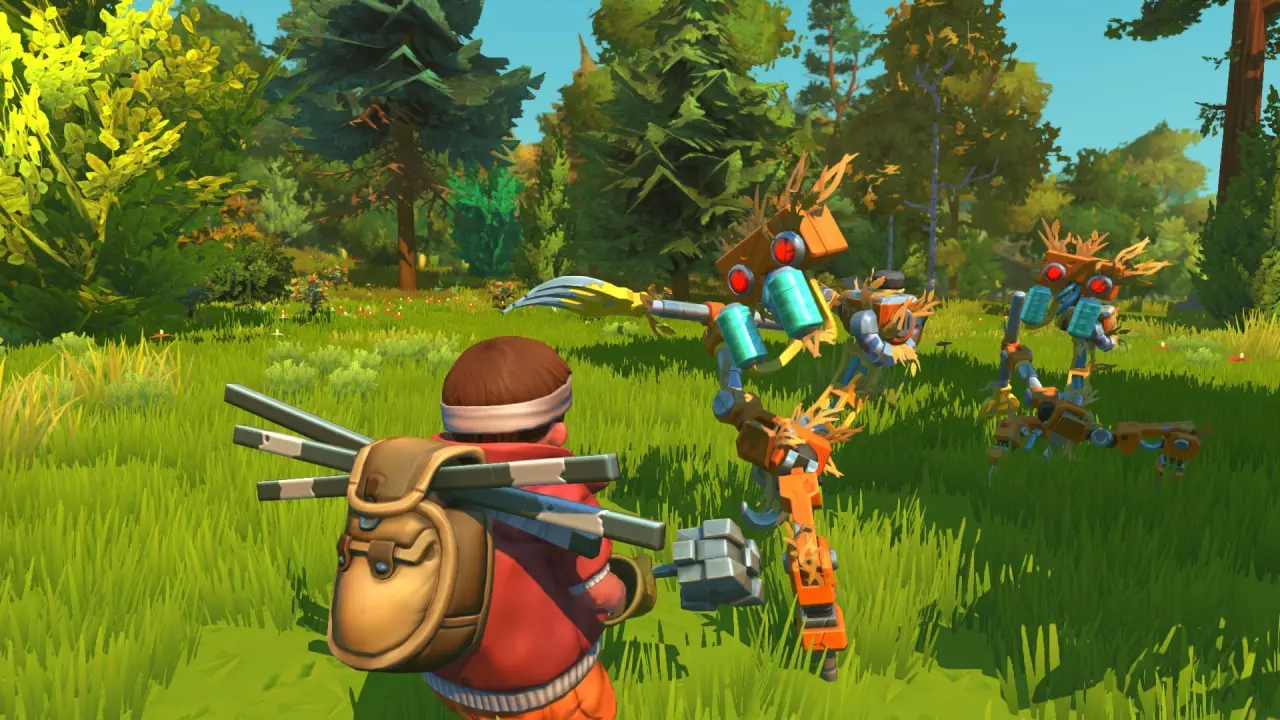
This stripped-down opening is a deliberate authorial stance from Axolot rather than an oversight. They do not want a script steering the player. They want the act of building to generate each player's personal story. Held up against 2026 sensibilities, though, the approach reads as threadbare. Look at contemporaries like Sons of the Forest or the survival sandboxes around it: each one hands you at least one central character, an opening sequence, or a clearly drawn long-term goal. Scrap Mechanic offers none of that. A player can spend thirty hours thriving on that planet and still struggle to name a single "story moment." That hollowness is the core reason the story dimension lands at 5.5 and not higher. It is worth stressing that this is not a bug or an unfinished seam; it is the intended texture of the experience, and reviewing it fairly means grading the absence as a deliberate, load-bearing choice rather than a missing feature waiting to be patched.
Five Years of Chapter 2 and the Stories Players Tell Themselves
Chapter 2 was unveiled in December 2020 as the next major build, promising underground mining, new biomes, and a fuller narrative structure. The community's excitement at the time crystallized around one hope: that Chapter 2 would finally give the game a real through-line. Then it slipped, and slipped again, for five years. The 2024 holiday post conceded that the next chapter would not arrive that year and that work remained. The December 2025 log pushed the target into 2026, and by early that year the development branch was still seeing commits every few days. "Waiting for Chapter 2" has hardened into a half-joking, half-resigned community refrain.
What fills the official narrative vacuum is the player-run roleplay scene. The Swedish-community "mechanic town" RP servers are the best-known case. Players raise an entire city inside a Creative-mode server, each taking on a different profession, sharing their own custom-built gear through the Workshop, and coordinating long arcs and character growth over Discord. This grassroots storytelling genuinely patches over some of the missing campaign, and it stands as a rare bright spot for the dimension. But it leans entirely on player investment; it is not something the game itself can reliably deliver to everyone who boots it up.
Set the game beside Minecraft's open-ended approach and the gap widens further. Scrap Mechanic lacks even the light narrative hooks of villagers or an ender dragon. Minecraft at least gives you a final objective, a structured village ecosystem, and a crafting-table progression that nudges you forward. Here, every sense of progress comes from goals the player invents; the game will never tell you what to do next. That is a deliberate design choice, but in the current climate it is plainly a weak point.
Veterans split sharply on Axolot's script-minimalist instinct. Defenders argue this is exactly what a sandbox should be, supplying only an engine and a parts bin and leaving the narrative entirely to the player. Detractors see laziness, insisting that a decade was more than enough time to author a proper main line, and that Axolot simply chose not to. From a reviewer's chair, the stance resists a tidy verdict on its merits. But the story score has to reflect the narrative volume the game itself supplies, not the extra layers that RP servers and community effort bolt on afterward. That is the objective basis for 5.5. If Chapter 2 ever lands a complete narrative structure, the figure could climb past seven. As of mid-2026, it has to be graded against what actually exists.
Audio | 7.0/10
Audio: 7/10Minimal Score, Maximal Swedish Industrial Ambience
Scrap Mechanic never shipped a formal soundtrack. The background music was written by an in-house Axolot composer, leaning toward light electronic ambience laced with Swedish folk touches. For most of any session it stays a low-presence layer, only shifting into a noticeable variation when you cross into a new biome or get overrun by a large farmbot incursion. The logic is clean: builders spend long stretches locked in on assembling parts, and a score that pushes too hard would jostle the rhythm of that thinking. So Axolot consciously chose to let the music defer to focus.

The environmental sound design is, somewhat counterintuitively, the dimension's strongest asset. The engine audio is rendered in three distinct stages and detailed throughout. A vehicle you built yourself produces a clattering ignition on startup, settles into a low-frequency idle rumble, and switches to a high-frequency industrial roar under acceleration. Different materials carry their own collision sounds: metal rings out with a clear chime, wood lands as a muffled thud, stone scrapes with a coarse knock, and rubber bounces with a springy pop. This material-by-material differentiation lets a builder effectively hear which materials a creation is made from, a rare bit of immersion support in the construction genre.
The farmbots get a unique growl and tread noise, so you can gauge a robot's distance and rough numbers from sound alone before you ever see it. Underwater scenes carry an oppressive low-frequency ambience, and paired with bubbling effects they wind the tension of submerged exploration up tight. Detail by detail, these touches add up to carry the game's environmental immersion well past what its modest scope would suggest.
Absent Voice Work and a Forgettable Theme
There is almost no voice acting to speak of. Only the challenge-mode prompts and the farmbot battle cries carry brief audio; the player character stays silent throughout, and the farmbots, if you generously call them characters, offer only mechanized noise. That fully silent approach was unremarkable in 2016. Judged against 2026 expectations, where even low-budget indie sandboxes tend to include at least simple spoken lines, the total quiet feels a little dated. This is the central reason the dimension caps at 7.0 rather than climbing higher.
Stand it next to Minecraft's iconic C418 score and the contrast stings. Scrap Mechanic has produced no soundtrack with a standalone hook. Minecraft's signature piano pieces became shared memory for an entire generation of indie players, listened to as music in their own right, detached from the game. A decade in, Scrap Mechanic has generated nothing that escaped the title that way, a long-running shortfall in Axolot's musical storytelling and the ceiling this dimension cannot push past.
The Workshop does host player-made music mods that swap the default score for a custom library, and these community patches ease the awkwardness of a thin official soundtrack to a degree. But they cannot fill the core gap of having no signature original score. For a ten-year Early Access title, never developing its own musical language is a genuinely regrettable consequence of the engineering cadence.
Visuals | 7.5/10
Graphismes: 7.5/10Swedish Industrial Cartoon and a Rock-Steady Custom Engine
Scrap Mechanic runs on an engine Axolot built in-house, sitting on an OpenGL rendering pipeline tuned specifically for voxelized modular physics. The visual identity is a Swedish industrial-cartoon hybrid. The palette skews warm orange against industrial blue-gray, the characters are drawn with slightly exaggerated rounded doll proportions, and the parts themselves keep the grounded realism of plain Swedish industrial design. Screws, rivets, and panels all carry clear texturing, and metal edges show a measured amount of wear. That blend of "industrially real detail on cartoon-proportioned figures" gives the game a strong identity within the sandbox-construction crowd. It runs directly counter to Minecraft's blocky voxel aesthetic and looks nothing like Trailmakers' cartoon-racer styling either.

The engine does not chase next-generation effects, but Axolot pushed "stable frame rates with a huge part count on screen" to an industry-leading level. At the 2016 launch, the ceiling sat around fifteen hundred on-screen parts holding thirty frames per second. Ten years of continuous optimization later, mid-range 2026 hardware can carry four thousand parts at a steady sixty. For a building game, that "more parts, still stable" hard metric matters more than any ray-traced flourish. What players need is an engine that runs a complex automated factory smoothly, not one that toggles fancy lighting.
That rising part-count ceiling is not just a number; it directly governs the upper limit of player creativity. Back in 2016, trying to build a thousand-part precision steampunk train made the game stutter in front of you. In 2026, that same train can hold sixty frames as it rolls through a city, while the engine simultaneously loads the city buildings, an active farmbot incursion, and automated farm machinery all on screen at once. This cumulative gain in engine stability is the single most important engineering result of the decade-long Early Access run.
Biome Art, Night Lighting, and the Platform Ceiling
The world is set on a planet ruled by robots, and its four major biomes each carry a distinct tonal signature. Farmland is golden wheat, orange tomato sheds, and green cotton fields. The industrial ruins are rust-streaked abandoned factories and giant pipework. The underwater biome is blue-green coral reefs lit by deep-sea glow. The mountain biome is gray-white rock walls under snow-capped peaks. This color coding gives the game a strong Swedish pastoral-industrial aesthetic even from a distance, and up close each biome carries its own visual detail to fuel the motivation to explore.
Platform coverage is the dimension's biggest shortfall. Officially the game supports only native Windows. There is no native macOS, no native Linux (though Proton compatibility is solid), no console version at all (Axolot has repeatedly stated a focus on PC plus the Workshop ecosystem), and no VR. Steam Deck is flagged Playable rather than Verified; some text is too small and the UI does not adapt to handheld mode, though the core building experience does function. This "serve only heavyweight PC players" stance is a clear-eyed call for an indie studio, but it also means most console players simply have no way to reach the game, and it is the ceiling graphics cannot push past.
The UI design is another underrated visual strength. The part-selection panel in build mode is genuinely clean: components are grouped by function into broad categories, the search box supports fuzzy matching across languages, and recently used parts float to the top automatically. This "UI in service of building efficiency" approach keeps the interface from intruding during long sessions. A built-in photo mode hides every UI element so players can capture high-quality shots of their creations to share on the Workshop.
Stack those details together and the game's visual showing runs higher than a cold read of the engine tech alone would suggest, which is exactly why graphics lands at 7.5 rather than lower. For a 2016 title that never chased next-gen effects, holding visual appeal a full decade later is real craft from Axolot's art direction. The night lighting system deserves its own mention: base floodlights, engine exhaust flares, and player-made neon signs all cast soft shadows, giving nighttime building plenty of visual layering. It is the kind of touch that rewards players who keep working after dark, turning a sprawling base into a genuinely atmospheric pool of light against the surrounding farmland, and it quietly reinforces just how much visual mileage Axolot has wrung out of a deliberately modest technical foundation over the years.
Combat | 9.0/10
Gameplay: 9/10A Hundred-Plus Parts and Logic-Gate Depth
The ceiling on Scrap Mechanic's gameplay is the depth of its parts. The base library covers more than a hundred types. Blocks, wedges, and pipes form the structural base. Batteries, engines, and fuel tanks supply power. Gears, bearings, connecting rods, pistons, and springs handle transmission. Switches, buttons, sensors, controllers, and timers make up the control layer. AND, OR, NOT, and XOR gates build out a full logic-gate system. Screens, lights, and speakers provide display feedback. Pair that with Workshop mods and the total part count expands past five hundred: a propulsion mod adds thirty-five engine parts, including a simulated SpaceX Merlin rocket engine, while a detail mod adds three hundred decorative pieces for micro-scale construction.

The physics engine is the soul of that parts library. Build an off-road truck and you have to reckon with bearing placement, suspension-spring stiffness, and engine-torque matching. Build a flying machine and you need to understand lift, thrust-to-weight ratio, and the balance point. Build an automated harvester and you have to chain sensors, timers, and logic gates in the right order. This "you need mechanics and circuits to play" depth naturally stratifies the community. Newcomers learn how to make a single wheel turn in challenge mode. Intermediate players raise automated defensive works against farmbots in survival. Veterans spend fifty to a hundred hours in creative mode building a self-patrolling quadruped walker.
The logic-gate system is the key that pushes the game up into a "small-scale programming" layer. Players combine AND, OR, and NOT gates into conditional checks, use timers for delayed triggers, take in outside signals through sensors, and pair it all with controllers to write something resembling industrial PLC automation logic. This depth lifts Scrap Mechanic's high-end ceiling well past the ordinary sandbox builder, and it is a design instinct genuinely unique to it within the genre.
Three Modes, Co-op, and the Cleanest Tutorial Around
The game splits into three major modes. Creative offers unlimited resources with every part unlocked, a pure sandbox playground for building. Survival, added in the May 2020 update, brings wildlife, gathering, farming, cooking, an underwater biome, and farmbot incursion battles for a complete fight to stay alive. Challenge mode runs forty levels from a basic wheel up to building a flying machine in three minutes, taking fifteen to twenty hours to clear and serving as the on-ramp most recommended for newcomers.
Co-op supports four-to-eight-player servers, with the default cap depending on server configuration. It can in theory be pushed past twenty players, though stability degrades as you do. The co-op scenarios are rich: large bases built through division of labor between an architect, an electrician, and a mechanic; joint farmbot defense; collaborative Workshop vehicle design; and roleplay servers. The networking code is the game's soft spot, with occasional sync lag or dropped connections, and it is the core deduction keeping gameplay at 9.0 rather than reaching 9.5.
Set against Trailmakers, Scrap Mechanic's ceiling on creative complexity is higher, with roughly thirty percent more base parts and deeper circuitry, but its physics engine is slightly less stable, and high-end vehicle suspension often leans on known quirks to bounce past what the parts officially support. "Want a vehicle that feels good instantly, pick Trailmakers; want unlimited room to create, pick Scrap Mechanic" is the community consensus. For engineer-minded players, this remains the unavoidable first choice.
The learning curve is another genuine highlight. Challenge mode's forty levels start from the most basic "make a wheel that moves" and gradually introduce bearings, pistons, sensors, timers, and logic gates, until by the fourth stage you can build something that flies a hundred meters in three minutes. The progressive guidance is remarkably clean, with none of the usual "tutorial skips a step" or "difficulty spikes out of nowhere" problems. It is the densest, most stable on-ramp in the genre. A player who has never touched physics-based building can clear those forty levels and walk confidently into survival and creative, with none of the awkward "finished the tutorial and still can't play" that plagues so many builders. It may be the single most underrated engineering result of the decade-long Early Access run, arguably a genre benchmark for how to teach a building game.
Content | 8.5/10
Contenu: 8.5/10A Playtime Curve in Three Tiers
Scrap Mechanic hands players a three-tier playtime curve. Clearing only the forty challenge-mode levels runs roughly fifteen to twenty hours, and this is the on-ramp most recommended for newcomers. The forty levels move from the most basic "make a wheel that moves," through a mid-game "design an automatic gate with logic gates," to a late-game "build something that flies a hundred meters in three minutes," walking the core mechanics through step by step. Switch to survival after that and the full arc from pod crash through farm-building to farmbot defense takes about thirty hours to unlock the base content. Produce a veteran-grade complex automation piece and a single project eating fifty to a hundred hours is no surprise, with total playtime stretching to two hundred hours or well beyond.

Challenge mode's learning curve is itself a major content strength. Axolot carved the forty levels into four broad stages. The first covers basic mechanics: wheels, bearings, simple engines. The second is control systems: switches, buttons, sensors. The third is logic gates: combining AND, OR, and NOT. The fourth is integrated application: self-driving, automated production lines, flying machines. Every level carries a clear "build goal plus time limit," and finishing one unlocks the next. This progressive guidance lets a player who has never touched physics-based building grasp the game's core way of thinking within fifteen hours, the cleanest learning curve in the genre.
Ten Years of Workshop and a Free-Update Pledge
The Steam Workshop is the core engine of the game's content volume. It has stayed active for ten years, and the most-subscribed mods read like a tour of player ambition. A propulsion mod adds thirty-five detailed engine parts, some modeled on real-world engines like the SpaceX Merlin rocket engine. A detail mod adds around three hundred decorative pieces that players use to build industrial-style creations at extreme proportional fidelity. A "More Survival" mod extends the hunger and thirst systems with disease and temperature management. A tech mod unlocks advanced electrical components like battery banks, voltage regulators, and transformers. A farm pack adds automated agriculture parts: auto-harvesters, irrigation systems, farm robots. The distribution of Workshop creations runs roughly forty percent vehicles, twenty-five percent automated machines, twenty percent buildings, ten percent combat contraptions, and five percent novelty gadgets.
More worth dwelling on is Axolot's free-update pledge. Every update across ten years has been pushed out free of charge, with no paid DLC of any kind, and even Chapter 2 will arrive free for every existing owner once it ships. This "pay 19.99 dollars up front, everything after is free" model is genuinely rare among sandbox builders, and it is one of the core reasons the approval rating has not slipped across ten years. Players never have to wonder how much more they will have to spend to see the complete game. Compared to Minecraft's base game plus assorted paid expansions plus separately purchased console editions, this minimalist economic model treats players far more kindly.
Set against RimWorld's five-year Early Access cycle and Sons of the Forest's three-year run, Scrap Mechanic's ten years is an extreme outlier. But that extreme long haul does not equal failure. The existing Creative, Survival, Challenge, and Workshop content already supports two hundred to five hundred hours, and "don't count on Chapter 2; the current content is worth the price on its own" is the mainstream community consensus. That is the core reason content lands at 8.5: the current density is plenty, but the Chapter 2 slippage drags down the room to climb higher.
One more thing deserves its own mention: Axolot's developer-log discipline. Since 2020 the studio has published a log every one to two months, now numbered past its twenty-sixth entry, covering new build parts, physics-optimization progress, biome concept art, and internal test footage. The cadence keeps a faint "still being made" faith alive among players and, to a meaningful degree, has absorbed the blow that five years of slippage dealt to community trust. For other long-haul Early Access indie studios, Axolot's log discipline has become a reference model. These accumulated cadence decisions keep the game pulling in newcomers even under the reality of Chapter 2's slippage, and the community tradition of veterans bringing new players along sustains a relatively healthy self-reinforcing content loop.






Commentaires 0
Votre avis nous intéresse
Participez à la discussion et partagez votre avis sur ce jeu.
Aucun commentaire pour l'instant. Partagez votre avis sur ce test.