























Opening
There is a yellow line painted along the floor of an office corridor, and the first time I saw it I started walking, instinctively, the way you follow any path a level designer lays at your feet. That line is the oldest trick in this medium: a quiet hand on the small of your back, nudging you forward. What makes The Stanley Parable: Ultra Deluxe so disarming is that it never settles for telling you where to go. Instead it waits for the moment you wonder why you keep doing what it says, and then it leans in close to ask the question out loud.
That sensation is rare. Nothing here is built from spectacle, and nothing is propped up by tangled systems. You walk, you open doors, you turn a corner, you occasionally talk back to the voice in the ceiling, and the whole thing behaves like an elevator that has suddenly decided to hold a conversation with you. The room has not changed. The rules have not changed. But the meaning of every step quietly inverts.
The cleverer move is that the game treats its own expansion as material. This is not a nostalgia bundle bolted onto an old favorite, and it is not a handful of extra hallways. The added content keeps circling the same uneasy questions about choice, obedience, and authorial intent, and it folds the new around the old until even the way the new arrives becomes part of the joke. You will laugh. You will also stop and stare. For a work built almost entirely on walking and listening, that density is genuinely uncommon, and it is what carries the next several thousand words of this review.
Story | 9.0/10
Scénario: 9/10The story of The Stanley Parable: Ultra Deluxe is not the kind you can casually retell to a friend over lunch. It behaves more like a magic act performed with the curtain already pulled aside: you watch the trick, you see the mechanism that makes it work, and then the performer reaches out, pulls you up onto the stage, and asks whether you feel free now. That meta-narrative nerve is the sharpest thing the game has, and it runs through every corridor and every loop.

What the game refuses to do is hand you a protagonist with a tidy arc. Stanley is a vessel, an employee who pushes buttons, and the drama lives entirely in the friction between his prescribed path and your willingness to wander off it. Calling that thin would miss the point completely. The thinness is the canvas, and the canvas is the whole show.
Endings As The Argument, Not The Reward
Most games treat multiple endings as a content checklist, a tidy set of optional bonuses you mop up on a second playthrough for the sake of completeness. Here the branching endings are the thesis itself. Every fork in the road, every choice, every petty little act of "I refuse to do what you told me" gets reabsorbed and redefined by the work the moment you commit to it. Defiance does not break the story; defiance is fuel for it, and the game seems almost delighted whenever you try.
This is why the dozens of branches feel less like alternate routes and more like a single argument viewed from many angles at once. You try to prove that you are free, and the game calmly demonstrates that your rebellion was anticipated, written down in advance, and patiently waiting for you to arrive at it. Rather than feeling like a cheap gotcha, it lands as a genuine conversation about agency, because the narrator never stops responding to what you actually did. The endings are not destinations to collect on a list. They are rebuttals to your last move.
A Narrator Who Hands You The Mirror
When the game discusses player freedom, choice, and authorial intent, it never positions itself as a lofty critic lecturing down at you from above. It plays much more like a chatty, faintly sarcastic author who keeps slipping a mirror into your hands at the exact instant you make a decision. The tone is warm and needling at the same time, and that peculiar mixture is precisely what keeps the philosophy from curdling into a dry lecture you would resent.
The whiteboard room, with its scrawled note thanking you for engaging with the "new content," is the perfect emblem of this attitude. On the surface it reads like a behind-the-scenes featurette, a small knowing wink at the audience standing on the other side of the screen. Underneath, though, it is still quietly arguing with you about remaster culture, about the appetite for more and bigger, and about the systems we use to rate and rank the games we love. The featurette is the costume. The argument is the body wearing it, and the costume never fully hides the shape underneath.
Structure Instead Of Spectacle
The writing works because it refuses to lean on traditional dramatic conflict to hold your attention through to the end. It speaks through structure instead. Through repetition. Through deliberate deviation. Through the slow dawning realization that you are not observing a story from a safe distance outside it but participating in a point of view from somewhere deep inside it. By the third or fourth loop, the patterns themselves become the plot, and breaking those patterns becomes the only real climax on offer.
There is, to be entirely fair, a genuine cost to this approach. If you arrive hoping for clear character arcs and strong forward momentum, the game will read as overly conceptual, even a little cold and remote. The emotional connection is never guaranteed; some players will admire it deeply without ever quite feeling it in the chest. Is that fatal? Not really. It was never chasing tears in the first place. It was chasing the thing that makes you turn the whole experience over in your head days later, still poking at it, still genuinely unsure whether the joke was finally on Stanley or quietly on you.
Audio | 8.0/10
Audio: 8/10The sound design of The Stanley Parable: Ultra Deluxe can be summarized in a single word: narration. The control, the humor, and above all the timing of that voice performance are the pillar the entire work rests on. Take that voice away and the game can still be walked, still be chosen through, still be branched apart, but the moment that vocal thread is gone, the relationship between you and the work, that strange tug of being guided while wanting to resist, collapses almost completely. The voice is not an accompaniment to the experience. It is the experience, and everything visual or interactive is arranged to give it something to react to.

What makes it remarkable is not how loud the emotion gets but how precise the restraint is. The voice never overwhelms; it measures every line, choosing exactly when to push and when to let silence do the work instead.
The Director On Your Shoulder
In a lot of narrative games the narrator behaves like an instruction manual taped over the picture, dutifully describing what you can already see for yourself. Crows Crows Crows refuses that mode entirely. Here the voice plays more like a director standing just behind your shoulder, sometimes earnest, sometimes mocking, sometimes letting a punchline land a deliberate half-second after you press a button. That rhythmic timing is the whole craft. The audio and the written jokes are glued together so tightly that the comedy simply would not survive being separated from the act of playing it.
The result is that the sensation of being led becomes concrete and audible. You are not abstractly aware that you are being steered through a designed space somewhere in the back of your mind. You hear the steering happen, line by line, reaction by reaction, in real time. When you defy an instruction and a fresh remark drops down to meet you, the control stops being a theory and becomes a sound you can point to directly. That is an extraordinary thing for an audio track to accomplish, and it is the reason the performance carries so much of the score.
Where The Score Goes Quiet
The shortfall is just as clear, and it deserves an honest hearing. This is not a game that stands on its musical score the way a sweeping orchestral adventure might. The soundtrack is present, atmospheric, and occasionally quite lovely, but it is rarely the thing you walk away remembering. The audio highlights live almost entirely in the narration, the writing, and the careful choreography between the voice and your input at the controller or keyboard.
For players who like to pull an OST out on its own and sit with it long after the credits, the rewards here are noticeably thinner. There is no signature theme you will find yourself humming on the walk home, no leitmotif that follows you out of the room. That absence is real, and it would be dishonest to pretend otherwise, but it is not damaging, because the game spent its energy exactly where it counts. The point was never to make you remember a melody. The point was to make you remember the precise line that fell on you the moment after you turned against the voice and went your own way.
Visuals | 8.5/10
Graphismes: 8.5/10The visual strength of The Stanley Parable: Ultra Deluxe has little to do with showing off and everything to do with restraint applied with surgical accuracy. This release is not a lazy port or a quick fresh coat of paint; it was rebuilt on the Unity engine, and the value of that decision is not that the office now looks more expensive than before. The value is that the inherently absurd spaces gain a precisely calibrated layer of plausibility, like an urban legend reprinted on better paper. You believe it a little more than you did. You also feel a little more uneasy than you expected.

That tension between the believable and the quietly wrong is the engine of the whole look, and it is worth walking through the specific spaces that carry it one room at a time.
The Quiet Eloquence Of Office 427
At workstation number 427 you find an aging computer, a telephone, and stacks of paper that manage to say a great deal precisely because they say it so quietly. None of it is exaggerated for effect. This is not a glossy modeling showcase staged to impress you with polygon counts and reflections; it is a setting that is mundane enough and dead enough to feel like a real place where nothing ever happens and no one is coming back to sit down. The ordinariness is the craft, and the craft is almost invisible until you notice how completely it has convinced you.
That restraint matters because the game needs you to accept this office as utterly normal before it can start bending the rules around you without warning. If the opening space screamed for your attention with detail and flourish, the later distortions would have nowhere to fall from and nothing to push against. By keeping the desk so plainly, stubbornly believable, the work quietly earns the right to make everything that follows feel wrong in a way you can sense long before you can explain it.
When The Building Turns Dreamlike
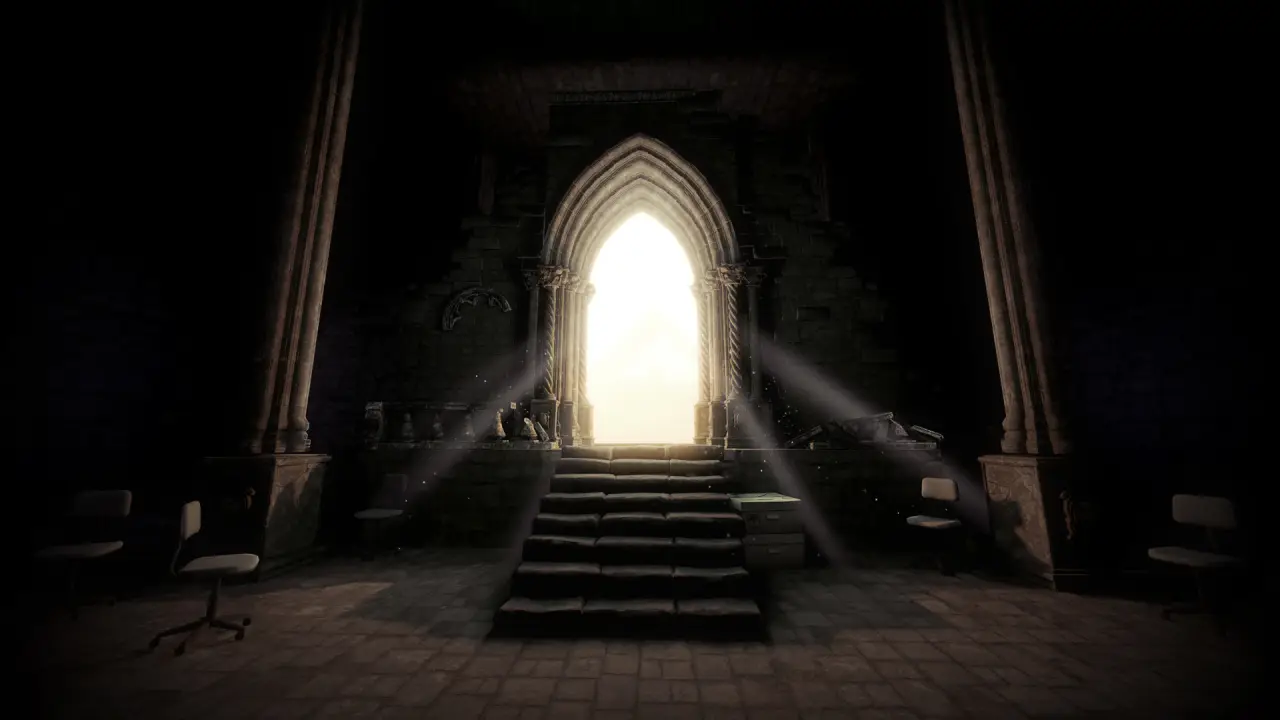
Then you reach the dim hall where harsh light pours through an arch and office chairs lie scattered across the floor, and the everyday workplace suddenly looks as though a dream has crept in and taken it over. This is exactly where the rebuild proves its worth. The lighting does not exist to dazzle you or to win a screenshot; it exists to unsettle, to make a familiar corporate interior read like a stage set abandoned partway through a performance no one finished.
The strength here is that the visual style is spare, even cold, and yet it bites down hard on the theme rather than decorating it. The absurdity is never pasted on top of the environment as an afterthought. It grows up out of the spatial order itself, out of the way corridors fold back on each other and rooms repeat and exits appear precisely where you did not expect to find one. You are not looking at decoration arranged to impress. You are looking at an argument rendered patiently in architecture, brick by brick, and that intention shows in every deliberate placement.
The Limits Of A Conceptual Look
The shortfall deserves honesty too, and there is no point pretending it away. This is not a game that leans on character performance, material spectacle, or sweeping cinematic scene transitions to manufacture visual excitement on demand. Its aesthetic pleasure tilts firmly toward the conceptual and the atmospheric rather than the immediately dazzling. If you read the word "graphics" as raw technical impact and fidelity, the very first glance may genuinely underwhelm you.
Is that a flaw worth dwelling on at length? Not at all. The spatial design here works like the set of a black-and-white film: it looks simple on the surface, but every door and every hallway is quietly in service of what the game most wants to discuss. Across all six supported platforms, from PC down to the various consoles, the appeal is the same kind of disciplined austerity rather than brute fidelity. The image is quiet on purpose, and the quiet is precisely where all the meaning has chosen to hide. Read it that way and the restraint stops looking like a limitation and starts looking like the entire point of the rebuild.
Combat | 9.0/10
Gameplay: 9/10On a first pass, The Stanley Parable: Ultra Deluxe looks like an unusually talkative walking simulator. Play it for real, though, and you discover that the core pleasure is not where you walk but why you walk there at all. Almost the entire experience is built on first-person exploration, branching choice, and that on-again, off-again sparring match between you and the narrator. It is simple in its parts. It is not, for a single second, thin in its effect.

The genius is in how the game turns the most basic habits of play into instruments, converting your own trained reflexes into both the setup and the punchline of the joke.
Basic Inputs As Stage Beats
Pressing a key, opening a door, turning left instead of right, obeying or refusing an order: in most games these are pure functions, the connective tissue you stop noticing within the first few minutes of playing anything. Here they behave like a metronome ticking on a stage, tapping out a steady beat against your slowly dawning awareness of how thoroughly and how gently you are being led around. Each ordinary input becomes a setup, and your decision to follow it or deviate from it becomes the precise timing of the gag that lands a beat later.
That reframing is what keeps a tiny verb set from ever feeling impoverished or repetitive. You are never doing much, mechanically speaking, and yet every small action is loaded with consequence because the narrator is always watching, always listening, always ready to fold your behavior back into the running bit. The interaction is minimal, but the meaning packed into each input is enormous, and that ratio between input and meaning is the actual design achievement worth praising here.
Spaces That Bait Your Instincts
Inside the bright warehouse, the towering shelves and the suspended platforms manufacture a powerful, almost involuntary sense of route. You instinctively start hunting for the "correct" path, exactly the way years of conventional level design have quietly trained you to do without thinking. And the game, naturally, loves nothing more in the world than to take a blade to exactly that instinct the moment it surfaces. The space is built specifically to provoke the assumption that there must be a right answer, so that it can then interrogate why on earth you assumed one at all.
This is where the design reveals its real discipline. The environments are not puzzles to be solved so much as expectations to be exposed and examined. Every single time you reach confidently for the obvious route, the work quietly notes your confidence and gently turns it into the subject of the very next joke. The pleasure is recursive and self-feeding: you play, you get caught out, you become a little more self-aware, and that fresh self-awareness immediately becomes the next thing the game finds to play with.
A Stand-Up Set You Trigger Yourself
Set against The Beginner's Guide, this is far less intimate and confessional in its register; set against a system-driven subverter, it relies much less on twisting traditional mechanics inside out. It plays much more like an exquisitely timed stand-up routine where the jokes do not stand on the script alone but on the simple fact that you personally trigger every last one of them with your own two hands. The branching endings give that routine enormous replay value, because you keep wanting to run it again just to see whether this time it will finally go differently.
The honest limitation is that the range of available actions really is narrow, and there is no use hiding it. A player who cannot accept narrative structure itself as the gameplay may reasonably conclude that they are simply walking around an office for an hour. The effect is immediate, and it will eject some people from the experience very quickly. Is it fatal? For the intended audience, no. As a piece of narrative adventure design, it knows exactly what it is doing from the first step to the last, and it knows precisely where to spend its limited verbs for the maximum possible return on every single one of them.
Content | 8.5/10
Contenu: 8.5/10What does a work like this fear most? It fears that the "new edition" is just a sprinkle of garnish on the rim of an old, familiar plate. The Stanley Parable: Ultra Deluxe does not fall into that trap at any point. Critics broadly agree that its added material sits well above the level of a typical director's cut or a tidy high-definition remaster, and that it offers genuine reason for returning veterans to go back and explore the whole thing again. More importantly, the way the new and the old content nest together is itself part of the statement. That distinction is everything here. It is not merely that there is new stuff to find; it is that even how the new stuff arrives is worth chewing over slowly.

This is a short game by the clock, and there is no pretending otherwise, but its content question is not really about length at all. It is about density, about recursion, and about the genuine value of going back through it once more.
Rooms That Put The Game On Trial
In the circular white gallery you find televisions, seating, and a long red carpet, and that exhibition-style space is perfectly suited to the game's instincts and habits. It reads like a museum and like a courtroom at the very same time, as though what you have walked in to inspect is not content at all but the strange spectacle of the work hauling itself up onto a platform to be judged in public. You are not a casual tourist passing through here; you are a juror who has quietly been handed the case file of the game's own reputation and asked to read it.
Over at the other end of things, the posters and the red carpet outside the theatre's backstage entrance push the meanings of performance, of re-staging, and of repackaging right out into the open where you cannot miss them. These spaces transform exploration from a simple hunt for branches into something much closer to leafing through footnotes the author left behind on purpose for you. Every room is annotated in its way. Every annotation is, underneath, an argument about why a remaster should be allowed to exist at all.
Replay Value Built Out Of Deviation
The replay value flows directly and abundantly from the sheer quantity of branches, hidden routes, and endings tucked throughout. You are forever thinking to yourself, "let me just walk it once more and see whether it goes differently this time around." That particular itch is genuinely addictive, and it is genuinely uncommon in the wider genre. Because the meaning of each path depends entirely on the paths you have already taken before it, a second or a third run is never a dull chore of completion but a fresh negotiation with the work itself.
The branching endings reward curiosity in a way that pure walking simulators only rarely manage to pull off. Each new ending quietly recolors all the ones that came before it, so the experience accumulates and deepens rather than simply extending outward in length. The more willing you are to double back on yourself and retrace a choice, the more second doors you start to notice, tucked neatly behind decisions you had dismissed as trivial the very first time through.
Where The Density Runs Thin
The honest catch is that, for all of its high density, the content still rests on the same narrow set of basic actions underneath. If text-based jokes, structural irony, and patient trial-and-error pathfinding do not light you up inside, the multi-run appeal drops off remarkably fast, especially for anyone who simply wants to clear everything in a single sitting and then be done with it for good. The effect is not small, and it is by far the clearest reason that some players bounce right off after seeing just one ending.
Is that fatal to the whole thing? No, not at all. As a genre exercise, this was always the sort of work where the reward scales directly with your patience and your willingness to linger. The more you treat it as something to revisit rather than something to finish and shelve, the more of its quiet second layer slowly becomes visible to you. The Ultra Deluxe additions reward exactly that disposition, which is precisely why the new content feels less like padding and far more like a standing invitation to come back and look at the whole thing harder.






Commentaires 0
Votre avis nous intéresse
Participez à la discussion et partagez votre avis sur ce jeu.
Aucun commentaire pour l'instant. Partagez votre avis sur ce test.