























Opening
Most survival games hand you an axe and a quota: chop wood, mine ore, grind one tier of material into the next. V Rising refuses to play along. It wakes you inside a coffin, points at a named monster on the map, and says the only way forward is to put that monster in the ground. Every spell, every weapon, every castle blueprint is locked behind a specific boss. Progression here is not a pile of resources — it is a sequence of fights won. That is the one thing rivals have never managed to copy.
Hold that idea, because it reshapes everything else. The crafting bench, the resource nodes, the tech tiers — they are all still here, but they orbit the hunt rather than replace it. You gather not to grind out a number but to suit up for the next named adversary standing between you and a new ability. The loop other survival games end with, V Rising treats as the means to its real end: the fight.
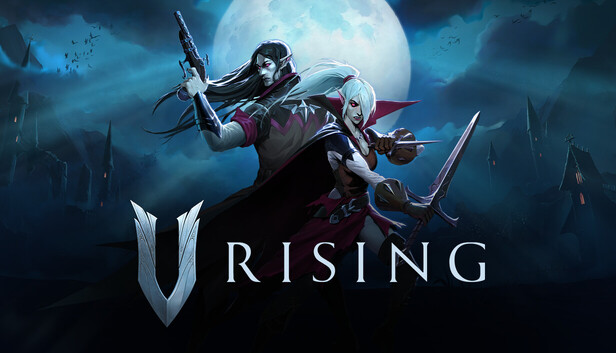
You play a freshly awakened vampire who burns in daylight and hunts by night, who builds a gothic castle to call home, who drinks different blood types to swap "classes" on the fly, and who eventually squares off against a level-ninety immortal king. It is an action-RPG wearing a survival game's crafting loop, not the other way round — a distinction that runs through everything below. This review walks through the combat, the castle-building, the day-and-night vampire rhythm, the boss-driven progression, and the multiplayer servers, and it is honest about the trade-offs: the story is thin, the late-game gathering drags, and the multiplayer slant does not suit pure solo players. V Rising is not a game that tries to please everyone. At the thing it actually set out to do, though, it reaches a height few survival games ever touch.
Story | 6.5/10
Scénario: 6.5/10Let me put the honest sentence first: if you arrive hungry for a sprawling, branching main quest, V Rising will leave you wanting. Its story is thin — the one dimension on this scorecard that deserves a clear warning label. But thin is not empty. The game chooses to tell its tale through atmosphere and enemy design rather than dialogue, and within those limits it works.
A premise, not a plot — the slow climb back into the night
The opening tells you exactly one thing. You are a vampire, freshly woken from a long sleep, stripped of power, and you must reclaim the land of Vardoran from the humans who took it. That is the whole pitch. There are no cutscene-heavy quest chains, no dialogue wheels, no morality meter ticking up and down. The narrative is closer to a sustained mood than a script: you grow stronger, more of the map opens to you, and that ascent from coffin-bound nobody to ruler of the night is the only story the game bothers to tell.

Stack it against Valheim, another survival game that strips narrative to the bone, and V Rising actually carries one extra grain of motivation. In Valheim you are a fallen soul dumped into purgatory to clear out ancient beasts — a functional errand. Here you at least have an identity to inhabit: I once owned the night, and now I am taking it back. For a survival game that is not much drama, but it is enough to keep you reaching for one more fight at three in the morning. The hook is identity, not exposition, and the game knows the difference.
Crucially, the game never asks you to care about characters it has not earned. It withholds the kind of writing it cannot do well, and spends its budget where it can — on the shape of the world and the enemies who guard it. That restraint is a design choice, not a failure of nerve. A lesser game would have papered over the gap with reams of mediocre quest text and forced cutscenes, diluting the one mood it does land; V Rising simply declines, trusting the player to feel the fiction through play rather than be told it through dialogue. The result is a narrative you experience as pressure and place — the burn of the sun, the silence of the night, the next name on the map — instead of one you simply sit through and forget.
Fifty-seven named bosses, each a shard of the world
The real narrative engine is the V Blood system. Scattered across Vardoran are fifty-seven named adversaries, from early threats like Alpha the White Wolf and Keely the Frost Archer to first-act foes like Errol the Stonebreaker and Quincey the Bandit King. Each has a name, a territory, and a sliver of backstory. You beat them, drain their essence, and read a fragment of the world's history along the way. The lore is not pushed into your face; it is buried inside the enemies you have to kill, which is a far better place for it.
It builds into something. Notice the locations, the titles, the scraps of dialogue, and a picture of Vardoran's rise and ruin assembles itself in the background. The 1.1 Oakveil expansion leans into this, framing its new woodland as the former heart of a vampire civilisation now fallen to ruin — a stroke of history that gives the title V Rising an actual rise and fall to chew on, rather than leaving it as a marketing flourish.
And then there is the ending. The built-in Castlevania crossover drags Simon Belmont's legacy into the game and crowns the whole thing with Dracula, the immortal king, as the level-ninety final boss. Think about how neatly that lands: you play a vampire, you climb, and the summit is the single most iconic name in vampire fiction. No hand-written side quest could buy that resonance. The story is thin, yes — but its aim is true. V Rising knows it is a vampire game, and it spends its one good idea exactly where it counts, closing the loop from the first coffin to the last vampire lord.
Audio | 8.0/10
Audio: 8/10The sound design carries an underrated workload: it is half the reason critics keep calling the boss fights "tough but fair." Fair does not come from weak enemies. It comes from danger announced clearly and early — and that announcement is part picture, part sound.
A score that escalates with the hunt
Out in Vardoran, the music holds back. It sits low, atmospheric, lending that lonely feeling of walking a haunted wilderness alone. Step into a V Blood's domain, though, and the score shifts gears at once: orchestral layers stack up, drums press in, and the ritual weight of stalking a named adversary is pushed right to the front of the mix.

The smart part is that this dynamic scoring does the emotional tiering for you. You never hear an epic movement while swatting trash mobs, so when that gothic theme finally swells, your adrenaline rises on the same wave as the music. It is not merely pleasant; it works as a rhythmic signal that says the next few minutes are worth your full attention. Diablo IV handles its top-down boss audio with a similar instinct, but because bosses are the spine of V Rising's progression, the trick gets pulled more often — and lands harder each time. The restraint between fights is what makes the swell land at all; an action game that blares its big theme constantly numbs you to it within an hour, whereas here the quiet stretches buy the loud ones their impact.
Spatial cues are the other leg of fairness
What truly holds the combat up is the spatial audio. A boss winding up an attack, an incoming area-of-effect telegraph — each carries a distinct cue. A seasoned player can half-close their eyes on the model and still read, by ear alone, which way the next heavy blow demands a dodge. This is precisely why reviewers land on "tough but fair." Tough, because the damage genuinely hurts. Fair, because the game never ambushes you; every strike is announced first, in sight and in sound.
This matters most in the cramped, frantic moments the genre is built around. When a V Blood chains two heavy moves and the screen fills with overlapping telegraphs, your eyes alone cannot track all of it — but the layered audio cues separate the threats by direction and timing, so you can prioritise the dodge that actually saves you. It is the kind of design you only notice in its absence: strip the sound and the same fights would feel cheap and unreadable, the difference between a death you accept and one you resent. The audio is quietly doing the work that keeps the difficulty honest, and it does it on every single hunt rather than once per cinematic.
Day, night, and a soundstage that knows the difference
The day-and-night rhythm gets written into the soundstage too. Out in the sun, a scorching pressure creeps into the ambience and nags you toward cover. By night, the field turns quiet and predatory, footfalls suddenly lighter, echoing the sleep-by-day, hunt-by-night core. Few survival games think to separate safety from danger by ear, and fewer still spend the budget to do it, yet that separation is exactly what makes the day-night cycle feel like a rule you live inside rather than a timer in the corner of the screen.
On platform parity, the console build and Steam Deck support hold audio quality steady — no version gets shortchanged, and you can read attacks by ear on a handheld with headphones just as well as on a desktop. The overall verdict: this is not a cinematic score you would single out for praise on its own, but it serves the play loop so tightly that the combat would not feel the same without it. You may not hum a single melody afterward, but you will, after some narrow boss win, realise that the dodge which saved you was a call your ears made first.
Visuals | 8.5/10
Graphismes: 8.5/10In a game whose core rule is "daylight drains your health," lighting is not decoration — it is mechanics. V Rising runs on Unity with a top-down isometric camera, and whether it is pretty is almost beside the point. What matters is whether its light and shadow can hold up that survival rule. They can, and the 1.0 release made visible strides on exactly this front.
Lighting that does a job, not just a look
The headline visual upgrade in 1.0 was lighting, and it earns its keep. Stand in an open field with no cover and the harsh sun visibly scorches your character; that "I need shade, now" urgency is communicated by the quality of the light itself. The daytime world reads as blinding, hostile to a vampire; the night reads as a safe harbour stitched from moonlight, torches, and castle candle-glow. The lighting translates an abstract rule — sleep by day, hunt by night — into something you grasp at a glance.

Set against Valheim's deliberately low-poly, style-first art, V Rising walks a more polished road. It does not chase pore-level realism, but its materials, shadows, and atmosphere are solid enough to give gothic fantasy the texture the genre deserves. Neither approach is superior; they simply aim at different palates. On the single question of whether the visuals serve the core loop, though, V Rising's lighting has a clear function — it is not merely there to look nice, it is the interface through which the survival rule is read and obeyed.
Seven biomes that refuse to blur together
The world splits into seven distinct biomes, from the sunny-but-lethal Farbane Woods of the opening hours to the cold, dead Mortium ruins of the late game. Each carries its own palette, foliage, and architectural language. Farbane is danger dressed in green; Mortium is the hush of ice; the Cursed Forest between them swaps both for a sickly, fog-choked gloom. The instant you cross into one, you know the difficulty has stepped up, and you know it before a single enemy appears — the colour grade alone has already told you where you stand.
That matters more than it sounds. A chronic open-world failing is sprawl that all looks the same — two hours in and your eyes glaze over. V Rising leans on hard visual contrast between regions so that exploring a new area stays fresh, and so that you can roughly gauge your progress from the scenery alone. The art style is quietly doubling as a progress bar, which is a clever way to braid visual design into the play experience instead of just piling on assets. It also rewards the simple act of looking around: a vista that signals "this is the late-game region" carries a small thrill of arrival, and a region you have outgrown reads as conquered territory rather than wasted texture memory. In a genre that too often treats scenery as wallpaper, V Rising makes its biomes carry information, and that turns sightseeing into orientation.
Castles, platforms, and the value of a steady frame
There is also a category of visuals the players generate themselves: castles. The building system lets you raise a gothic stronghold with real visual punch, customising everything from outer walls and towers down to the furniture, tiles, and wallpaper inside. The studio supplies enough material and lighting fidelity that even a casual build comes out looking the part, and the 1.1 update widened the decorative and functional toolkit further. The upshot is that every player's castle is a unique piece of scenery — the community is full of strongholds that could pass for concept art, from horror-film keeps to gothic-cathedral courtyards.
On platforms, the PC and console builds match, and 1.1 added handheld support. For a movement-heavy, read-and-dodge top-down action game, whether a handheld can hold its frame rate is a genuine playability metric, not a luxury — a single stutter can swallow a boss's telegraph, and a missed telegraph here usually means a wipe. That is why cross-platform consistency carries weight beyond raw fidelity: it directly governs whether you can read and dodge fairly. V Rising levels that experience out, so whether you are at a desk or curled up with a handheld, you get the same legible combat picture. For a game that will spend dozens of hours with you, "looks the same wherever you play it" is worth more than a flashy effect or two.
Combat | 9.5/10
Gameplay: 9.5/10This is the dimension that earns V Rising a 9.5, and it is the spine of the whole review. One line sums it up: the game rewrites the survival growth loop from scratch. Where others have you stockpile materials to climb tiers, this one has you put named monsters in the dirt. Read the wind-up, dodge, manage cooldowns — that is the real "mining" here.
The hunt is the build path
The core loop is the V Blood hunt. Fifty-seven named bosses are scattered across Vardoran, and each kill hands you not a heap of stats but a concrete thing: an ability, a spell recipe, a building blueprint. Want a particular dash skill? Go beat the boss that holds it. Want a weapon set? Same deal — drop the adversary guarding it first. Your kill order is, in effect, a soft progression path. Your build is not clicked together in a menu; it is won, fight by fight, on the field.

The brilliance is that growth and skill are welded together. In Valheim or ARK: Survival Evolved, enough patient gathering will eventually push you to the next tier; here the wall is never a missing material, it is a boss you cannot yet beat. Progression becomes a chain of skill checks rather than a resource chore. That is the bedrock of what critics call respectable ARPG combat — a real test, not a grind with a health bar.
Twin-stick action and six freely-mixed blood schools
On feel, the combat is top-down, isometric, twin-stick action. You aim spells and weapon arts by hand, actively dodge telegraphed area attacks, and swap between a melee set and two equipped vampire spells. Those spells are drawn from blood schools — Blood, Unholy, Chaos, Frost, Illusion, Storm — each offering its own blend of mobility, control, burst, and sustain. The feel is closer to a competitive arena brawler than a typical survival game, which is no accident: the studio's lineage in fast, telegraph-driven PvP combat shows in every dodge-roll and counter, and it gives the moment-to-moment fighting a precision most crafting games never bother to reach for.
The key word is freely. You might pair a Frost control spell with a Chaos nuke, or lean into an attrition kit built around sustain. Rebuilding before a boss to counter its specific moveset — that "prepping for the exam" pleasure — is a big part of the combat's depth. Next to Diablo IV or Grim Dawn, both fine top-down action-RPGs, V Rising's distinguishing trick is grafting that same solid feel onto a survival frame. The graft is the thing nobody else has matched.
Drinking the right blood, and surviving like a vampire
Layered above the gear build sits the blood-type system. Human NPCs carry different blood — Warrior, Rogue, Brute, Scholar, Worker, Creature — at varying quality percentages that grant different combat buffs. A swappable temporary class, in other words. Before a hard fight a sharp player will scour the map for a high-quality blood that suits their kit; ninety-percent Warrior blood and fifty-percent are a meaningful gap, so people will make a special trip for a good vintage. It stretches strategy from "what gear do I run" out to "what do I drink before I leave," and it keeps the world's humans from being mere XP — they are a flowing combat resource.
The vampire rules, meanwhile, are tactical constraints, not flavour. Sunlight chips your health, forcing daytime routes hugged to shade, caves, and the eaves of human settlements; night is the safe window to hunt. A simple cross-map trek becomes a puzzle of "how do I get there without cooking." Garlic stacks a debuff that raises damage taken and lowers damage dealt, so storming a garlic-laden outpost is a calculation. Together these turn survival pressure into a string of routing and timing problems, and they make "you are a vampire" a moment-to-moment truth rather than a label.
Castles and servers — depth and pressure in one system
Castles are the other long game. A stronghold is your production and storage hub, and its Castle Heart must be fed blood to stay powered; siting, defence, and traffic flow are all long-tail concerns. On PvE servers a castle is a pure building-and-display sandbox; on PvP servers it becomes a raidable core asset, the same system bearing entirely different pressure. That dual identity is one of the smartest structural choices in the game: a single build system serves both the player who wants a peaceful gothic dollhouse and the player who treats walls, traps, and chokepoints as a defensive engineering problem, with the server type alone deciding which game you are playing.
The multiplayer offering is complete in its own right: PvE plus standard, full-loot, and duo PvP variants span everyone from pure builders to hardcore brawlers. The 1.1 Contests feature lets players plant a dueling banner for one-versus-one or raise an arena for team fights, giving PvP folk structured, consensual bouts instead of only open-world ganking. In honesty, though, that multiplayer slant does press on anyone who just wants to hunt bosses alone — a trade-off the verdict will return to.
Content | 8.7/10
Contenu: 8.7/10V Rising earns its 8.7 here not by padding the runtime but by stacking systems on top of one another. The number that matters first is time: HowLongToBeat puts the main path — clearing the major boss line up to Dracula — at around 38 hours, and a completionist run that mops up every V Blood, every region, and a fully realised castle at roughly 90. That is a serious body of content for a top-down survival game, and crucially, almost none of it is filler.
How the hours actually fill up
Pull the 38-hour main path apart and you find it is built from density, not distance. The spine is 57 named V Blood bosses, and because each kill unlocks a concrete ability, spell recipe, or blueprint, every hour of play is also an hour of measurable progress — you are never just walking to refill a number. Around that spine sit seven distinct biomes, from the wooded Farbane to the frozen ruin of Mortium, each with its own resource tier, enemy roster, and reason to return once a new tool opens a previously locked door.

The third pillar is the castle. Building, powering, and defending a stronghold is an open-ended sink that scales with your ambition rather than a checklist that ends — some players close the main story in a tidy 38 hours, while others pour twice that into a single sprawling fortress before they ever touch Dracula. That spread between 38 and 90 hours is the honest signal: the content does not lengthen the campaign artificially, it simply rewards players who want to keep going. Set against ARK: Survival Evolved, where the runtime stretches because every tier demands another grind of stacked materials, V Rising gets its depth from boss design and construction instead of from sheer attrition — the same long playtime, a very different texture.
Free updates and a clean DLC line
What turns a strong launch package into a lasting one is how Stunlock Studios has handled the post-release content. The 1.1 Invaders of Oakveil update, released in April 2025, is the model case: a brand-new Oakveil region, three fresh weapons — the Claws, the Twinblades, and the Throwing Knives — seven new spells, the Contests PvP mode, and Steam Deck support, all delivered free to existing owners. That is meaningful gameplay volume handed over at no charge, and it sets the tone for the whole monetisation approach.
The paid side is deliberately kept off to the cosmetic lane. The Eternal Dominance Pack runs 19.99 USD and contains nothing but appearance items — no locked abilities, no gated bosses, no pay-to-win shortcut into the build economy. The principle is clean and worth stating plainly: anything that changes how you play arrives in a free patch, and anything you pay for only changes how you look. For a genre where season passes and tiered content drops are common, that clarity is a real point in the game's favour, and it means a new buyer in 2026 gets the complete mechanical experience for the price of the base game.
The Castlevania crossover as built-in endgame
The Legacy of Castlevania crossover deserves its own mention because it is not bolted-on DLC but content woven straight into the 1.0 release. Simon Belmont steps into Vardoran, and Dracula himself anchors the experience as a Level 90 final boss — a fight that doubles as both the game's thematic climax and a genuine difficulty wall that completionists will spend hours preparing for. Folding one of the most recognisable names in vampire fiction into the endgame is a thematic coup as much as a content one; it gives the long climb to 90 a marquee destination rather than a quiet fade-out. The encounter is tuned as a true capstone, demanding that players have wrung real value out of the blood schools, the gear tiers, and the castle's production chain before they stand a chance — so the crossover is not a novelty cameo but the load-bearing finale the whole 38-hour run has been building toward.
Taken together with the free updates, it means the content question for V Rising is settled: as of early 2026 the game is treated as complete, and that completeness is broad, dense, and fairly priced. A buyer arriving now inherits the full sweep — seven biomes, 57 named hunts, a free-form castle sandbox, a marquee crossover boss, and a year of free expansions already folded into the base price — with no roadmap of missing pieces to wait on and no paid wall standing between them and any mechanic that matters.


Commentaires 0
Votre avis nous intéresse
Bienvenue ! Partagez votre avis sur ce jeu — une surprise attend peut-être la première personne à commenter.
Aucun commentaire pour l'instant. Partagez votre avis sur ce test.