
Actualité
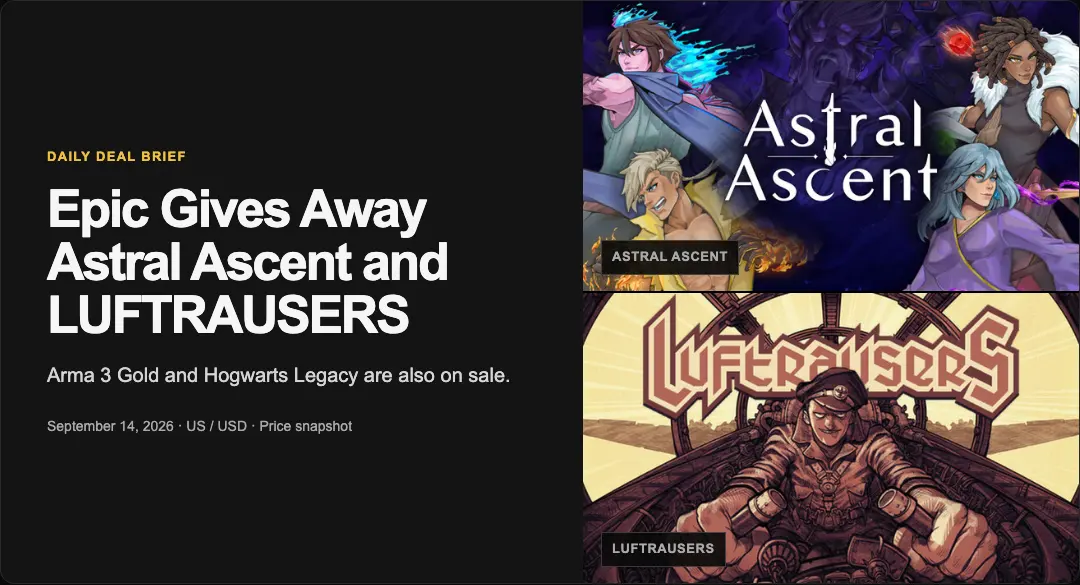
Grab two free PC games before Epic's clock runs out, while Undertale and Divinity: Original Sin 2 are 75% off
Astral Ascent and LUFTRAUSERS are free to keep today, while two of PC gaming's most celebrated RPGs cost less than $14 c
















The recent resurgence of Monster Hunter: World on Steam is quite interesting. It is not the kind of brief spike driven by a single major update, but rather more like a player-driven “return wave.” According to data cited by Gamersky, this Capcom title had remained roughly stable at around 17,000 daily active players for a long time, but since the beginning of this month, its concurrent player count has continued to climb, peaking at 36,000—almost doubling. For a game that has been out for eight years, this trend is highly worth observing, because it shows that the lifespan of older games is far longer than many people imagine.

People in overseas communities have already started asking directly: “Can anyone explain why World on Steam doubled its player count within two weeks?” If we break down this rebound as a sandbox case study, the answer is actually not complicated. The first reason is very practical: the price is low enough. During sales, the base game costs less than 10 USD, which translates to just a few dozen yuan, yet it offers a very solid experience lasting dozens or even hundreds of hours. For players who have never gotten into it before, or those who played it on console in the past and now want to start over on PC, the barrier to entry is so low that it is almost impossible to resist.
The second reason is the “reverse traffic pull” from the new title to the old one. What players mention most often in discussions is that Monster Hunter Wilds did not meet many people’s expectations in terms of PC optimization. As a result, Monster Hunter: World—already fully developed, content-rich, and more stable in performance—naturally became the alternative. Many people are not suddenly feeling nostalgic; they are simply making a straightforward choice: if the goal is still hunting monsters and grinding gear, why not go back first to the version with steadier frame rates, more familiar systems, and a multiplayer ecosystem that is still alive.
More importantly, Monster Hunter: World itself truly holds up. It is not an old game surviving purely on nostalgia, but a title that still stands on its own in terms of design, pacing, and content volume. Many veteran players still regard it as one of the high points of the series in the past decade, and that reputation gets reactivated every time a discount period comes around. On top of that, some players are currently in the gap while waiting for major future updates to Wilds, so the thought of going back to World for “just one hunt” can very easily turn into another few dozen hours of grinding.
If you are still hesitating about whether to buy it now, my advice is simple: if you want to experience the core fun of Monster Hunter at low cost, or if you want a mature co-op action game that has already been proven by the market, Monster Hunter: World is still well worth picking up. Its greatest advantage is not that it is “old,” but that it is “complete.” What you are buying is a finished product that has been polished over and over again, not a half-formed ecosystem still waiting for patches to smooth things out. In essence, this Steam resurgence once again proves one thing: compared with the impulse to pay several hundred yuan for a day-one release, many players will ultimately return to the option with better optimization, a better price, and content that stays enjoyable to grind for much longer.



Commentaires 0
Votre avis nous intéresse
Participez à la discussion et partagez votre avis sur ce jeu.
Aucun commentaire pour l’instant. Partagez votre avis.