
Actualité
Grab two free PC games before Epic's clock runs out, while Undertale and Divinity: Original Sin 2 are 75% off
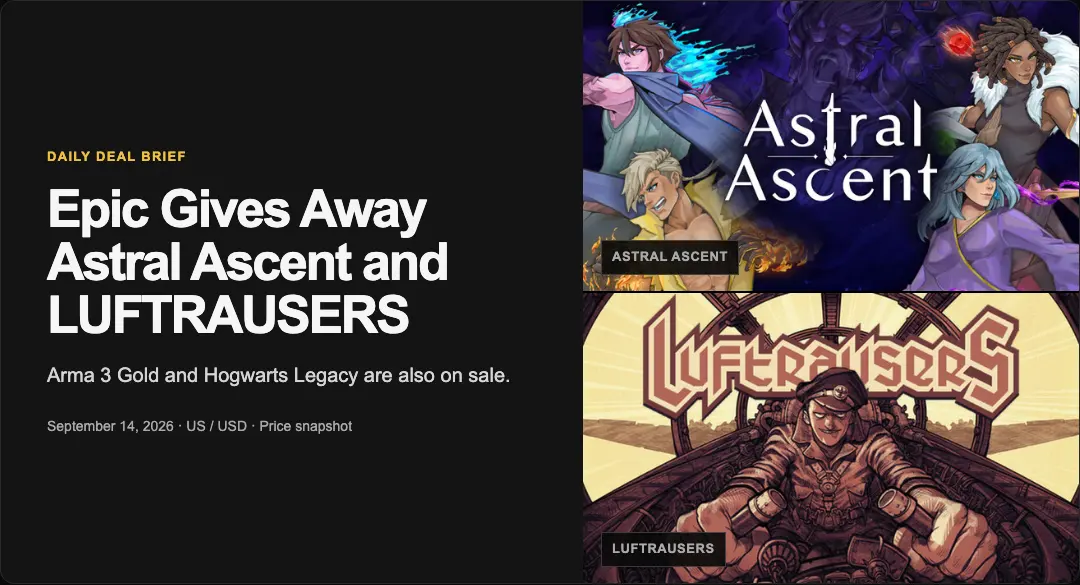
Astral Ascent and LUFTRAUSERS are free to keep today, while two of PC gaming's most celebrated RPGs cost less than $14 c













The score missed the mark.
At its core, the controversy around Crimson Desert isn’t that the game suddenly turned out amazing, nor that the media got everything wrong. It’s that the review timing and the game’s genre just didn’t line up.
First, let’s look at the hard data. The game has already launched worldwide. It sold over 2 million copies in 24 hours. Its peak concurrent player count on Steam exceeded 250,000. More importantly, among players who have played for more than 10 hours, the positive review rate is as high as 82%. Those numbers are solid. This isn’t a case of the trailer doing all the heavy lifting—people are still clicking “Recommend” after actually playing the game.

Now let’s look at where the controversy started. IGN gave Crimson Desert a 6, and when that score came out, the immediate reaction was naturally: did it flop? But here’s the issue. The 6-rated Crimson Desert is a bestseller, while Peak Guardian, which IGN scored a 7, has already announced shutdowns and refunds. Star Song Assault was even more extreme, permanently shutting down just two weeks after launch. So it’s not quite right to say review scores have no reference value at all; but if you treat them as the deciding factor, it’s like judging a match from the startup frames alone without watching the full combo—you’re bound to misread it.

PC Gamer’s later in-depth review actually got to the heart of the issue. After putting in 75 hours of intensive play, the editor concluded that Crimson Desert is not the kind of linear action blockbuster that pushes you down the main story and force-feeds constant thrills. Instead, it’s a slower-paced, immersion-heavy sandbox experience. If you rush through the early game just to meet a review deadline, it’s easy to feel that the pacing drags, the feedback is scattered, and the satisfying moments come too slowly. But once you’re willing to engage with systems like camp building and free exploration, the game starts to click.
It’s like how some fighting game characters don’t start with a 5F jab—they’re built for mid-range spacing and footsies. If you insist on getting in their face and fighting over frame data, of course it’s going to feel awkward.

On top of that, players and the media were never judging by exactly the same standards. Media outlets have to deliver conclusions within a limited timeframe, so they naturally put more weight on the first 10 hours, content density, and first impressions. Players are spending their own money, and especially those willing to play for more than 10 hours, they care more about overall immersion, how rewarding the world is to explore, and its long-term staying value. So this gap in reception doesn’t really look like a simple case of one side proving the other wrong—it looks more like two different evaluation frameworks landing on different points.
If you ask me for buying advice, it’s simple. If you like fast pacing, strong guidance, and a main story packed with constant highlights, then wait and see. If what you want is to slowly sink into an open world, and you’re willing to spend time traveling, building, and exploring, then Crimson Desert will most likely hit the mark for you. Don’t let a single 6-point score scare you off, but don’t rush in blindly just because sales exploded either.
One final point: this whole thing is also a reminder for the industry. Media scores still matter, but they’re no longer the only point of reference. Especially for sandbox games and slow-burn titles, rushed reviews can easily miss the feel of the game. Looking at Crimson Desert now, it has proven at least one thing: players will use concurrent numbers, sales, and playtime to cast their own votes.


Commentaires 0
Votre avis nous intéresse
Participez à la discussion et partagez votre avis sur ce jeu.
Aucun commentaire pour l’instant. Partagez votre avis.