























Opening
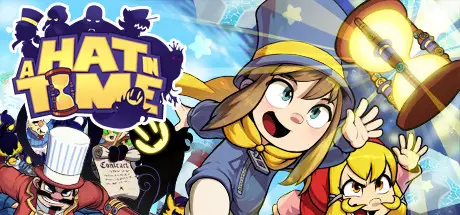
Most games are afraid to change. A Hat in Time changes its mind roughly every ninety minutes, and somehow it keeps getting better.
One chapter you are loafing around a sun-baked mob town, prying glowing Time Pieces out of rooftops and alleys. The next you are a film extra refereeing a feud between two diva movie-director birds. The one after that, a singing purple ghost in a fog-choked forest snatches your soul out of your chest and hands you a contract. Five chapters, five games that barely share a rulebook — and that restless variety is the whole pitch. It is the rare game where "what is it even about" has a different answer depending on which hour you happen to be playing.
This is a 3D collectathon, the kind PC players spent two console generations begging for. A tiny studio called Gears for Breakfast crowdfunded it in 2013, shipped it in 2017, and built it around a silent hat-wearing alien girl who knits new headwear to gain new powers. The genre had been all but abandoned outside Nintendo's walls, and here was a handful of independent developers picking it back up because they loved it, not because a focus group told them to. If you grew up on Super Mario 64 and Banjo-Kazooie and have been quietly starved on PC ever since, this is the love letter you missed. What follows is a walk through its story, sound, looks, feel, and longevity — where it soars, where it stumbles, and whether it actually deserves a permanent spot in your library or just a moment of your curiosity.
Story | 8.0/10
Story: 8/10The setup fits in a sentence. A hat-wearing alien kid is cruising home in her spaceship when a low-rent mobster demands a toll, she refuses, he punches a hole in the hull, and the Time Pieces that fuel the ship — her one way home — scatter across the planet below. So down she goes, hunting them one shard at a time. It sounds too thin to call a plot, and that is exactly the trick: the game refuses to carry one long arc, and instead loads all its emotional weight onto the specific people and places of each chapter.
Mustache Girl turns a candy-coloured romp into something with teeth

Mafia Town is where you land first, and it reads like a throwaway tutorial — beaches, sunshine, sunglasses-wearing goons too dim to be a threat. The goons are not the point. The point is the first friend you make here, Mustache Girl, who shows you the ropes and causes trouble at your side like a kid you walked home from school with. Then she sees what a Time Piece can do — rewrite the world, undo anything — and the whole register shifts under your feet. She slides from a partner who wants justice for the little guy into the villain you are forced to put down.
That undercurrent gives a story this sugary an unexpected backbone. Nobody stops to lecture you about power corrupting; you simply watch a friend follow her convictions straight to the wrong side of the line.
By the time the finale arrives, you are not swinging at a faceless final boss. You are fighting someone you genuinely liked, someone whose reasons you understand even as you wreck them. The game never asks you to hate her; it just lets the gap between you widen one decision at a time until a fight is the only thing left. For a project built on running and jumping, that kind of restraint and afterburn is a small miracle — most platformers would have given you a mustache-twirling cartoon to punch and called it a day.
Subcon Forest cranks the mood up to full horror

If the early hours are all daylight mischief, Subcon Forest ambushes you. This purple, fog-drowned woodland answers to a ghost called The Snatcher, who greets you by ripping out your soul and cheerfully shoving a stack of contracts into your hands — finish his dirty errands or stay soulless. The masterstroke is that he delivers the whole arrangement through an absurdly upbeat musical number. A grinning threat is so much creepier than a snarling one.
The chapter peaks with a hidden boss, Queen Vanessa — the forest's former ruler and, it turns out, The Snatcher's old flame. You hold your breath and creep through her frozen mansion, and the instant she spots you it becomes an instant-death chase. A cute platformer that dares to drop a genuine survival-horror stalk sequence into its third act is a game with real nerve, and that willingness to swing for a completely different emotion every chapter is the single most convincing thing about its writing.
A protagonist who never speaks, yet out-acts a hundred talkers
Hat Kid does not utter a single word from start to finish, and you will rarely think of her as a blank. She stomps when she is furious, plants her hands on her hips when she is smug, rummages through her ship's junk when she is bored, curls into herself when something scares her. Every beat lands through animation and posture, clean enough that people reach for Pixar as the comparison — those characters who can wreck you without a line of dialogue.
It is also a shrewd design call. No dialogue means no voice-acting pitfalls, no localisation that ages badly, and a charm that travels across every language barrier.
Pair that silent lead with a supporting cast that actually pops — the squabbling director birds, the pitiable forest ghost — and A Hat in Time tells a story that looked thin on paper but plays out full-blooded, almost like a great silent film. You do not walk away quoting a line. You walk away holding a fistful of specific moments.
Audio | 9.5/10
Audio: 9.5/10Hand me one thing to praise without reservation and it is the soundtrack. This is a game that looks plain and runs on humble tech, but slip on a pair of headphones, walk into Mafia Town, and the first bars tell you exactly why it lodged so deep in people's memories. The music here is not merely competent — it is the kind players rip out, loop on repeat, and slot onto their best-of-the-year lists.
One theme, fifteen variations, and a score that breathes with the room

The Mafia Town theme, "Welcome to Mafia Town," sounds at first like a lazy, sun-warmed seaside tune. The clever part is what happens to it: across the base game and two DLC packs, that single melody gets rewritten into something like fifteen variations. Day has its version, night has another, stepping indoors or climbing high or tripping an event quietly bends the arrangement. You may never consciously clock it, but your ears stay held — it always sounds like the music this exact place should be making.
What makes lead composer Pascal Michael Stiefel special is the sheer width of his emotional range. The same writer makes Mafia Town beam bright enough to make you bounce, then turns Subcon Forest oppressive and hushed enough that you instinctively soften your footsteps.
The score is never wallpaper. It does active narrative work — before you have even parsed what a chapter is asking of you, the music has already set your mood for you. That is rare even among games people praise for their soundtracks, where the best tracks often sit politely off to the side rather than steering the moment.
Roping in Banjo's composer, a tribute that runs all the way down to the notes

The reverence here for the golden age of 3D collectathons does not stop at the mechanics — it goes right down to the credits. The studio brought in Grant Kirkhope for a guest spot. The name may not ring a bell, but if you ever played Banjo-Kazooie, your ears remember him cold, because he scored that Rare classic. He wrote the theme for the spaceship hub and more, and the moment that familiar warm, mischievous melodic flavour kicks in, longtime fans grin on reflex.
That single hire says everything about the game's sincerity. It did not just grab any retro-flavoured loop to fob you off; it physically flew back the man who defined this genre's musical character in the first place. From the feel of your jumps to every note in your ears, A Hat in Time keeps quietly insisting that it understands what made that era great and means to catch every bit of it.
The sheer stylistic range is its own kind of showing off. Inside one game you get Mafia Town's loafing jazz, the gaudy awards-show fanfare of Battle of the Birds, and the cold, prickling strings of Subcon Forest that raise the hair on your arms. That ability to house half a dozen completely different musical personalities under one roof rhymes exactly with the every-chapter-swaps-the-rules design — the sound and the play are running the same playbook to keep you off balance. Which is why its full soundtrack lives, year after year, on community lists of the best game music ever written — the least disputed corner of its entire reputation.
Visuals | 6.5/10
Graphics: 6.5/10Let us be honest up front: A Hat in Time does not win on horsepower. It runs on the long-in-the-tooth Unreal Engine 3, and on polygon counts or lighting trickery it is not even racing on the same track as its big-budget contemporaries. Its smart move was to refuse that fight entirely, pour everything into art direction and scene craft instead, and come out looking nothing like a budget title — charming enough to stick in your head on the first glance.
It competes on identity, not fidelity

The look is high-saturation cartoon rendering: bright colours, rounded shapes, a hat kid who is frankly criminal levels of cute. That style ages beautifully precisely because it never chased realism, so it never gets left behind when fidelity moves on; it still feels lovely today.
The real engine of its visual appeal is how radically each chapter reinvents its mood — Mafia Town's sunny coastline, Subcon Forest's purple dread, Alpine Skyline's airy peaks above a sea of cloud. None of these places would look out of place as a postcard, and none of them looks like the one before it. Where a big-budget open world burns its whole art budget making one cohesive region, A Hat in Time spends the same effort building five wildly distinct ones, and the contrast does more for memorability than any texture resolution could.
Because every new world resets the entire palette and atmosphere, the game never visually fatigues you. You will not hit the three-hour wall where an open world's art starts blurring into sameness; here every chapter is a fresh lungful of air.
The animation work is where the budget clearly went, too. Hat Kid's idle fidgets, the squash and stretch of a landing, the way characters telegraph a mood with a single exaggerated pose — all of it reads instantly, and all of it papers over the modest textures underneath. For a game whose main story runs short, that dense churn of scenery and expressive motion turns into a genuine strength — it offsets thin tech with rich variety, and proves once again that a strong art style outlasts a strong GPU.
The price of an old engine: launch bugs and a wandering camera

That old foundation comes at a cost, and that cost is the main reason I held this score down. At launch, stability was a real problem: frame drops, occasional crashes, a camera that clipped into walls. Plenty of early adopters got burned on the day-one build. Patches cleaned most of it up over time, and the game you buy today runs far more steadily, but the launch reputation took a dent that is only fair to flag. If you are buying it now, years on, you are getting the cleaned-up version — this is mostly a historical asterisk rather than a present-day warning, but the history is worth knowing.
The camera is the other lingering gripe. In tight interiors, or when you are zipping between peaks on the hookshot, the view occasionally lags your movement or wedges somewhere it should not, forcing you to wrench it back by hand. It never ruins the experience, but in passages that demand precision — a tricky platforming gauntlet, a timed swing across a gap — it adds a layer of friction you did not ask for and have to fight against. One note on versions: the PC build is the most complete and the first to get mod support; the console ports look fine but cannot touch the Steam Workshop, which lops a huge slice off their longevity — more on that when we get to content.
Combat | 9.0/10
Gameplay: 9/10The platforming is where A Hat in Time plants its flag. Plenty of indies wave the retro-tribute banner with all the nostalgia in the world and feel like garbage to actually move — gummy on the ground, floaty in the air, and you check out within minutes. The reassuring thing about this one is that it nails the most basic act of all: running and jumping feel crisp and clean. That is the line between it and the pile of games that merely borrowed the genre's name.
Get the jump right, then earn the rest

The core verbs are classic stuff: run, jump, double-jump, air-dash, plus a hookshot that lets you swing between platforms and peaks. The combination is hardly novel, but every input — the feel, the hit detection, the landing — is polished to a shine. Aim for a tiny distant ledge and it lands where you meant it; stretch an air-dash to clip a collectible tucked in a corner and the distance and timing answer your hands. In a platformer, the player's whole joy rides on one question — can I pull off the move I pictured? — and this game does not fumble that question.
Better still, the levels are built around that feel. Every Time Piece has a deliberate route and a designed solution behind it, not a scatter of pickups dumped on a map for you to vacuum up blind.
The more fluent you get, the more you string together those clean, unbroken runs, and that loop of skill turning into reward is the soul of a good platformer. There is a real difference between a level that merely hides things and a level that asks a question, and A Hat in Time almost always asks a question — how do I get up there, what does this hat let me reach, which route turns three jumps into one. This one catches it.
Hats and badges put the toolkit in your hands

Raw movement alone would not carry it. The real wrinkle is the hats — the namesake. The kid knits headwear, each one a power: the default yellow hat focuses your search for hidden things, the sprint hat sends you barrelling forward through obstacles, the time-slow hat drags the whole world into slow motion so you can thread a hazard, and stealth-flavoured hats save your skin in the horror stretches. Swapping a hat means swapping a problem-solving frame, and the levels routinely push you to juggle them.
On top of that sits a badge system: equip different badges to tune the kid further — beef up the double-jump, auto-collect pickups, that sort of thing. The hat-plus-badge loadout makes movement personal — some players grind out steady, methodical lines, others chase the limits of a speedrun route, and the game has room for both. Set it beside Yooka-Laylee, the crowdfunded retro throwback it gets compared to constantly, and A Hat in Time clearly pulls ahead on the sheer crispness of its movement and the depth of this ability kit — which is a big part of why its reputation outran its rival's by a wide margin.
Five chapters, five rulebooks, and a couch-co-op safety net
The last and least replaceable thing: those five chapters are practically five different games. Mafia Town is open-ended exploration, Battle of the Birds morphs into stagecraft and puzzles built around shooting a movie, Subcon Forest is stealth with a horror chase bolted on, and Alpine Skyline is pure vertical climbing. It keeps resetting your expectations of what you are even doing next, so a game with a short main line stays fresh the whole way through. That is its signature trick.
To see how far it pushes that, look at Battle of the Birds. You pick a side between two feuding director birds and shoot their rival movies in a race for a film award, which means the whole loop suddenly becomes performing scenes against a brief — different pacing, different goals, even different success criteria than the carefree Time Piece hunt of Mafia Town. The instant you settle into the rhythm of playing film crew, Subcon Forest yanks you into horror stealth instead. Plenty of far bigger games start repeating themselves halfway through; A Hat in Time bets on staying short and reinventing itself every chapter, and squeezes far more variety out of its runtime than the hours on the clock would suggest.
It also runs local split-screen and online co-op, so you can drag a friend or a family member into all those chapters and collect together. For a lot of people this is a couch game, two players howling on a sofa, and that social layer widens its audience further.
It bends to flow for a solo player who wants to sink in, and to chaos for two players cracking up together. Not every platformer has that kind of give.
Content | 8.5/10
Content: 8.5/10On length, here is the cold water and here is the reassurance. The cold water: A Hat in Time's main story is genuinely short — chase the credits and you are out in roughly eight hours, and even hoovering up every Time Piece and collectible runs about twenty-two. The reassurance: that is only the sticker price. What actually keeps this game parked on a hard drive for years is everything bolted on after the ending.
Eight hours to roll credits — and that is just the opening move

Set the baseline straight. A first run of the main story lands around eight hours, which for a modestly priced indie is normal but in no way large. If you are a credits-then-uninstall player, the base game's runway really is limited, and that is the most honest knock against it on content — do not walk in expecting hundreds of hours of base game, because that expectation will sting.
The saving grace is how dense those eight hours are. Because all five chapters run on different mechanics, you never feel the grind of repetition; each one hands you something new.
So it is not a game that pads its runtime and devolves into copy-paste by the back half. It is short, but every minute counts. Whether that trade lands is a matter of taste, but at least it never fakes scale with filler — and there is something to be said for a game that respects your evening and ends before it overstays. A lot of forty-hour epics would kill for this hit rate per hour.
Two DLC packs and Death Wish stretch the lifespan

For more, the game offers two substantial paid expansions. The first, Seal the Deal, is built around Death Wish — a mode that repackages the base levels into gauntlets of brutal, condition-locked challenges (time limits, no-hit runs, buffed enemies), aimed squarely at players who finished the game and came back itching to suffer, plus a brand-new Arctic Cruise chapter. The second, Nyakuza Metro, hands you a whole free-roaming cat-mob subway network to explore. You buy tickets, ride between stations, and unspool errands across a sprawling interconnected map that a lot of players rate as the densest, most exploration-rich space in the entire game — it leans hardest into the open, poke-everything instinct that made Mafia Town click in the first place, and stretches it across an entire transit system.
Neither pack is lazy reskinned filler. Each reinvents the playstyle again, carrying forward the base game's every-chapter-is-different virtue.
For anyone who fell for the game, they are a sincere way to keep the good thing going; for the hardcore, Death Wish alone can wring out dozens of hours of challenge.
The real engine of longevity is the Workshop
If the DLC is the official second helping, mods are the bottomless buffet. The studio ships the Unreal Engine 3 level editor right there in Steam's Tools section, and players use it to build full custom chapters, mini-games, even recreations of levels from other games, then push them to the Steam Workshop with a click. The Workshop has stacked up a mountain of high-quality content, from precision-platforming gauntlets cruel enough to break a controller to story-driven fan chapters.
That official-editor-plus-Workshop pairing is what turns an eight-hour main story into a platform people sink hundreds of hours into — coming back years after the credits to sample whatever the community shipped this month is the norm. It is the same trick that kept games like Portal 2 and Trackmania alive long past their reviews: hand the tools to the people who love it most and get out of the way. The fan chapters can be startlingly polished, sometimes rivalling the official ones for craft. Add the split-screen and online co-op from earlier and the real playtime balloons to many times the main line. Put another way: its value does not come from a discount, it comes from a long tail that shaves the cost-per-hour down to almost nothing. The one caveat worth repeating: the Workshop is PC-only, so console players miss this entire layer and watch the long tail shrivel — which is the core reason I steer people toward the PC version.






Comments 0
Share your game review
Join the discussion and share your review of this game.
No comments yet. Share your thoughts on this review.