






















Opening
A game has no business being this affecting on this budget. There is no open world here, no combo trees, not even a proper weapon — just a leather sling and a frightened five-year-old who keeps falling ill in your arms. And yet this mid-budget stealth adventure pins you to the screen for a dozen-odd hours, watching two children keep each other alive across a carpet of corpses and a sea of rats.
The year is 1349. The Black Death is hollowing out France while the embers of the Hundred Years' War still smolder. Amicia de Rune, a noble girl of fifteen, is a fugitive overnight, dragging a brother she barely knows away from the soldiers of the Inquisition — and from something older and hungrier. Let the light go out, and the red-eyed swarm rises from the dark to strip the living to bone.
This review is about one thing: how far a game can travel when it locks subject, mechanic, and feeling into a single grip — and exactly where it lets go. Innocence travels much further than its price tag has any right to.
Story | 9.0/10
Story: 9/10The story is the spine of this game. When the 2019 Steam Awards handed it Outstanding Story-Rich Game, that was not a courtesy — this is a game that keeps you in your chair on the strength of a single tale, told without padding and without flinching.
Two children, one escape, and a catastrophe shrunk to human size

Most games about the plague unfurl a whole map and stuff it with chronicles and factions. Innocence does the opposite. It compresses the disaster swallowing 1349 France into the flight of one pair of siblings. Amicia begins as a noblewoman's daughter in a castle; within the first hour her home is butchered by Inquisition soldiers, her mother is gone, and she is running with five-year-old Hugo in tow.
The worldbuilding is never narrated at you. It accretes — from the bodies underfoot, the torched villages, the farmers lying dead in the furrows. You do not need to track who is fighting whom. You only need to know that everyone wants Hugo dead and you are all he has. Keeping the camera nailed to two frightened kids turns a historical apocalypse into something private and aching. The grand backdrop stays a backdrop; the foreground is always whether these two survive the next room, and that is what makes you lean in. You are not surveying a plague. You are hauling a child out of one with your own hands.
The word in the title is the thing it keeps interrogating
The game is called Innocence, and those letters are no decoration — they are the question the whole runtime keeps asking. The first time Amicia kills to protect her brother, the game withholds the satisfying thunk of a clean takedown. The act lands heavy, hesitant, with an aftertaste that lingers. The blood on her hands thickens chapter by chapter, from clumsy self-defense to decisive clearing of a courtyard, and you feel a child being dragged into adulthood by a world that gives her no other option.
That thread carries the strongest arc here. Amicia goes from a girl who recoils at this stranger of a brother — unsure how to even hold him — to someone who will kill and die for him. Hugo travels from a wailing liability into a boy who learns to trust his sister and, at the decisive moment, shields her in return. None of it is lectured at you in cutscenes. It is buried in held hands, in murmured reassurances, in the act of stepping between Hugo and a blade. You play the feeling rather than hear it — which is exactly where interactive storytelling outruns film. A movie can show you a sister protecting a brother; only a game can make you the one who decides to step in front of the blade, and that small act of authorship is what turns sympathy into something closer to love.
A vivid supporting cast, a cardboard villain, and a divisive turn
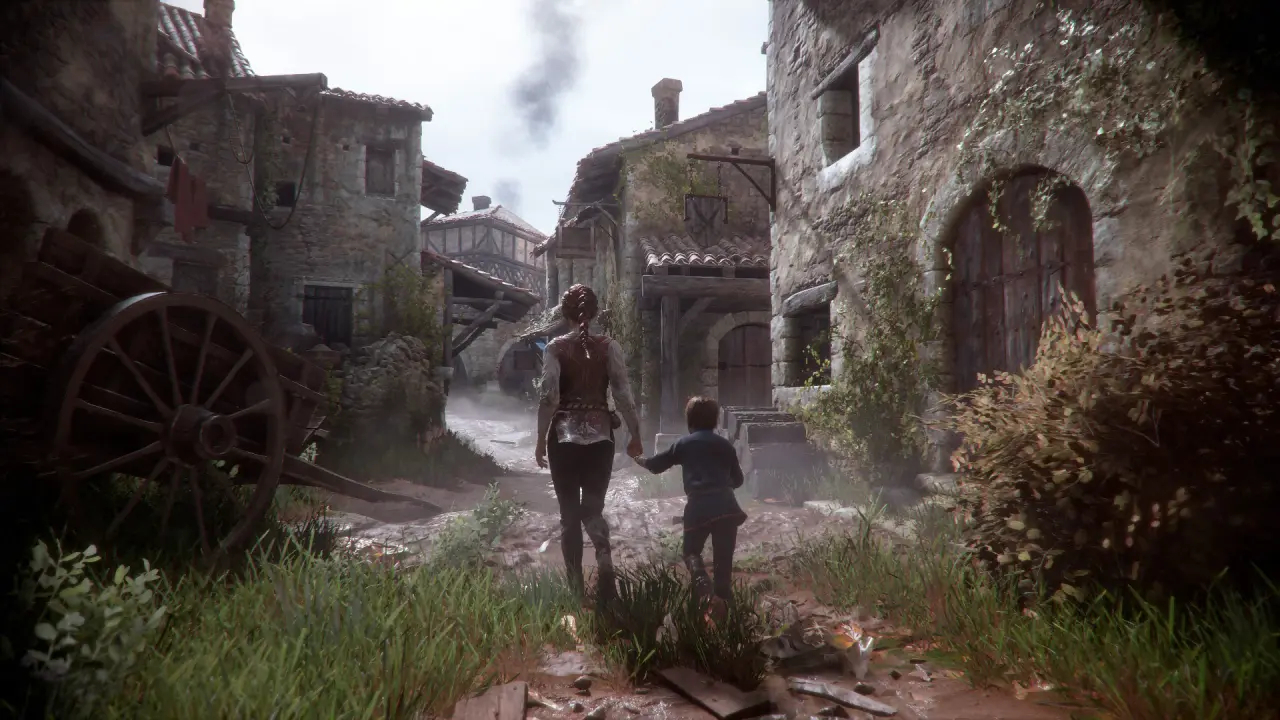
The companions who join along the road each carry their own stake. Lucas, an alchemist's apprentice, lends the siblings science and hope; Rodric, a blacksmith's son, brings muscle and loyalty; the orphaned Mélie and Arthur mirror another family torn apart by the plague. These are not errand-givers — each one has wounds and motives, a density that would hold up a good prestige drama.
The villain is the weak seam. Grand Inquisitor Vitalis Benevent is thinly drawn and cartoonish, a symbol that wants "Hugo's blood" and little else, and most critics lodge their complaints right here. The better the heroes are written, the flatter he looks beside them. Then there is the late turn: the script reveals a supernatural bond between Hugo's tainted blood and the rats, and the tone slides from cold historical realism toward fantasy. Some players feel it elevates "siblings against the world" into "siblings against fate"; others feel it betrays the grounded opening. Whatever your verdict, it baits the hook for the 2022 sequel, A Plague Tale: Requiem, and leaves you wanting to know where these two go next. Against The Last of Us, that other escort tale, Innocence reaches for the same nerve with a softer, more focused touch — it needs far less blood to move you.
Audio | 9.0/10
Audio: 9/10If the story is the game's spine, the score is its breathing. The 9 it earns here owes a great deal to sound.
Music that narrates instead of decorating
The score comes from French composer Olivier Derivière, a man whose specialty is weaving instruments, voices, and ambient noise into a single fabric that tracks the emotion beat for beat. During a chase the strings strain to the snapping point; in a rare quiet moment between the siblings the melody softens; when the swarm closes in, a low rumble climbs up from under your feet. You rarely notice "a cue has started," because the music has long since grown into the picture and into your pulse.
This is not idle praise. The craft took home Best Sound Design at the 2020 Pégases Awards. Derivière's real cleverness is that he never uses music to tell you what to feel — he lets the melody grow alongside what is happening in front of you. When Amicia first cradles her feverish brother, the cue is not a swell of weepy strings but a hush you can barely hear, and it cuts deeper for it. That restraint is the foundation under the highest score in this whole review.
Ambient design that builds a world you can hear closing in

Beyond the score, the attention paid to ambience is startling. Footsteps ring differently on flagstone, mud, and standing water; the crackle of a torch pulls you instinctively toward the light; and the tide of sound from thousands of rats is the most skin-crawling auditory memory the game offers — you hear the dark churning before you ever see it.
These sounds are not garnish. They feed directly into play.
The bearing of a swarm, the distance of an enemy's torch, the approach of a guard's boots — often your ears warn you a step ahead of your eyes. Better still, the closer and denser the rats grow, the thicker and louder that tide becomes, which makes it a danger gauge you read without ever glancing at a health bar. Letting sound replace a UI prompt to carry tension is a genuinely sophisticated idea in a game built on immersion, and it is the kind of quiet craft that separates a competent soundscape from a memorable one. You stop watching meters and start listening for your life.
Localization that keeps the feeling intact
For dialogue, the game offers English and French voice tracks paired with subtitles, and the small exchanges between the siblings — Amicia soothing a feverish Hugo, Hugo asking his innocent questions — survive the language barrier with their warmth intact. That is a real reason players see the campaign through to the end rather than bouncing off.
Worth flagging too: the marriage of music and pacing is admirably disciplined. The game knows when to fall completely silent, leaving you with your own breath and a distant squeak, and only then pushes the main theme up at the fullest emotional peak. Too many games, terrified of boredom, carpet the runtime in music and numb your ears for it; Innocence dares to leave space, dares to make silence itself a pressure, so that when the melody finally lands it carries weight. The hush before a set piece does as much work as any swell — it tightens your shoulders, makes you hold your breath, primes you for whatever the dark is about to do. That is why sound takes the top mark of all six categories — it never grandstands, yet it is everywhere, doing its job whether you notice it or not.
Visuals | 8.5/10
Graphics: 8.5/10The visuals are the first thing that grabs you. There is no top-tier blockbuster budget behind them, yet through art direction and lighting the game conjures a sheen well above its means.
A bespoke engine builds a France you believe in
The game runs on the studio's in-house Zouna engine, and the medieval French countryside it renders is unmistakable: wheat fields gone gold to the point of glare, dead-quiet villages hollowed out by plague, Hundred Years' War battlefields heaped with bodies, cellars and chapels lit by guttering flame. These are not pretty postcards. They are dirty, old, and threaded with a death you cannot shake off — perfectly fused with the subject of the Black Death.
That recognizability paid off in hardware: the game collected multiple art-direction honors, and this knack for atmosphere is what truly sets it apart visually. Almost every place you walk through is busy speaking on the story's behalf. What stays with you most is the way beauty and rot are set side by side: the poetry of a golden field shares the frame with a farmer rotting in the furrow; the solemnity of a candlelit chapel sits next to a cellar of bleached bones. That tension between the lovely and the horrific echoes the theme of guarding innocence through the apocalypse — the prettier the place, the crueler the disaster it frames.
Light and dark, the soul of the picture and the spine of the play

The cleverest thing this game does is make light double as visual language and core mechanic at once. Rats fear the light, so a circle of safety carved by a single torch through a sea of them becomes the most iconic image in the whole work — the border between bright and dark is the border between life and death. You step into a stretch of black holding your torch, the red eyes packed thick just past the glow, waiting; that pressure cannot be stacked up out of raw visual fidelity alone.
And the real-time computation of up to roughly 5,000 rats on screen at once is this art style's technical calling card. The footage of the tide surging and recoiling from light was genuinely staggering in 2019, and it is not mere showboating — it serves the expression of the Black Death directly. That is not a flock of repeating sprites but a living thing with weight and flow, crawling along walls, threading around firelight, pooling at your feet into a black current ready to drown you. Rendering an abstract idea — the plague — as something visible and overwhelming is the smartest use of that tech, and it gives the theme an impact others cannot fake.
A rough launch, fixed by the next-gen pass
Honestly, the visuals are not without cost. The 2019 launch builds on PS4, Xbox One, and PC ran poorly; plenty of players reported low frame rates, and early versions even threw out facial rendering glitches around eyes and brows that broke the spell somewhat.
The good news is the next-gen pass of July 2021 cleared that debt: the PS5 and Xbox Series builds delivered 60 frames, quicker loads, and a visual lift, and they are the best way to play it today; the PC version likewise runs high on midrange hardware. The difference is not cosmetic. A game whose whole tension hinges on reading the edge of the light, on judging exactly how far the swarm has crept, needs a steady frame rate to land — and once it has one, the dread that the rough launch muddied finally arrives clean. If you are only coming to it now, optimization is no longer the issue — what you get is this art at its finest.
Put another way, the frame-rate complaints at launch were more a limit of their era than a failure of the art itself, and the problems that once turned people away have largely faded into history. Taken whole, the 8.5 here is not earned by piling on detail but by spending a limited budget with precision on atmosphere and on selling the subject. It is the rare case of a game that looks more expensive than it was — not through brute fidelity, but through taste, knowing exactly which corner of the frame deserves the artist's hours and which can fall away into merciful dark.
Combat | 6.0/10
Gameplay: 6/10Gameplay is the most contested category here. It holds an invention almost nobody in the industry can match, and a repetition it cannot hide — a 6 is exactly fair.
One sling carries the whole offense and defense
Amicia's only weapon is a leather sling. It sounds threadbare, but the game wrings real variety from it: ping a distant metal object to pull a guard's gaze away, snap the chain holding a hanging pile of corpses so the bodies drop and draw the rats off, or line up a helmetless soldier and crack his skull with a single stone. It is a combat tool and a puzzle tool at once, one weapon doing several jobs — a genuine bit of design wit. The economy of it matters: stones are everywhere, but the alchemical pouches you sling are scarce, so every encounter quietly asks you to budget, to decide whether a problem is worth a precious charge or whether a plain rock and a little patience will do.
The aim is deliberately slow. Wind up, line it up, release — every step costs time, and a miss means the guard lunges and the swarm creeps in. That weight gives each shot the gravity of a wager, and early on it sells the helplessness of an unarmed girl facing armored men beautifully. Whether it holds all the way to the end is another matter — and that is the seed of the gameplay's controversy.
Light against the rat sea, the mechanic worth the price of admission

What truly sets this game apart is the duel between firelight and the swarm. Rats dread the light, so the whole system becomes a contest of bright versus dark: you carve a safe lane with braziers and torches, and the instant a flame dies, the rats in the dark devour you — or your enemy.
Around that core sits a full kit of alchemical ammo. Ignifer lights a distant brazier to open your own path; Extinguis snuffs the torch in an enemy's grip, leaving the unguarded soldier to be swallowed whole by the dark; Devorantis corrodes a guard's helmet, baring a weak point for the sling. Killing with the environment and the rats is the most memorable execution this game offers — you rarely brawl head-on, and far more often you set a trap that lets the light die and the swarm pour over your enemy. Watching an armored grown man vanish into the dark by your own calculation is a strange, specific thrill. This fusion of subject, environment, and combat into a single thing is so distinctive that nobody has copied it since; on that count alone, the gameplay is worth remembering.
A brother who is a key, not just a burden
Hugo is not merely something to protect; he is part of the play. You can send him to a marked spot, have him hold a mechanism, or slip him through gaps Amicia cannot fit to open a door. That makes "carrying your brother" a thing your hands do, not just a narrative weight — you must always track where he is and whether he is safe, folding his position into every puzzle. In so many escort games the escorted character is dead weight; here Hugo is both your soft spot and your key, and that double role lends the cooperation a real cleverness. Letting go of his hand to solve a room, then hurrying back before something finds him, is a small loop of tension the game returns to again and again. Later, other playable companions arrive with their own abilities — one good at ranged distraction, another at shoving obstacles — and the two-handed, sometimes many-handed, puzzling deepens noticeably, giving the back stretch at least some of the variety the core loop starts to lose.
The back half repeats — and that is the ceiling
Honestly, the cracks show in the second half. From plainly slipping past sightlines, to pinging metal to lure guards, to snuffing lights and feeding men to rats, to corroding armor for a headshot, the system stacks up layer by layer, and the early stretch is a steady drip of surprises. But past a certain point the usable combinations stop transforming; the stealth and puzzle patterns begin to repeat, and the difficulty guidance stays conservative and forgiving.
Set beside Hellblade: Senua's Sacrifice — both narrative-driven, both light on combat — Senua grips you through the subjective experience of mental illness, while Innocence loses steam down the stretch.
The trouble is not that the mechanics are shallow but that the late game stops offering enough that is new: the same snuff-and-feed solution played for the tenth time has a visible drop in novelty from the third. The gameplay is not bad; its strength simply sits in invention rather than depth. Dazzling early, coasting late — that is the one clear shortfall across all six categories, and the 6 is no injustice.
Content | 7.0/10
Content: 7/10Content is the honest category here: the game is not long and does not pad, but every minute is spent where it counts.
A dozen hours, one clean line, no filler
There are 17 chapters in all, a main run of roughly 13 hours, and about 17 if you chase everything. That heft looks slight beside today's hundred-hour open worlds, but the brevity is a virtue rather than a flaw — it tells a complete sibling escape with tight pacing, a real beginning and end, and not one stretch of busywork bolted on to inflate the clock.
The game keeps stacking new mechanics as it goes: from only throwing stones at the start to gradually unlocking alchemical recipes, the experience climbs in steps. You barely feel any water in the tank; every chapter pushes the story or introduces something fresh. For an adult player whose time is precious, "we will not waste a minute of yours" is a rare luxury. So many blockbusters today swell the runtime past a hundred hours, only to fill it with map-running, outpost-clearing, and herb-picking; Innocence runs the other way. It knows its core is the story, so it trims every spare ounce of fat and leaves only the bone and muscle that move feeling and plot. A dozen hours sounds short, yet the density is enough that you remember the shape of every chapter — the wheat field, the battlefield, the cathedral, the flooded cellar each leave a distinct mark, because none of them overstays its welcome or repeats itself for the sake of a longer bar on a marketing slide.
No paid DLC, but a free reason to return

Structurally, this is a complete single work — no paid DLC, no season pass; what you buy is the whole of it. In a climate of "base version plus season pass plus microtransactions," that reads as clean and forthright: no worry that the story has been carved into chunks sold apart, no nagging from a storefront of add-ons. Clear the campaign and the game hands you a free New Game Plus and a collectible challenge layer, a reason to come back for the second-run crowd — modest, but generous as a free extra. In a market trained to "pay for the full experience," this one-time, no-tricks purchase is itself worth a nod of approval.
The cost, of course, is that side density is low and the path is steeply linear, with almost nothing to grind. The collectibles scattered along the way — flowers, shells, and the like — are little goals for a second run more than substance that changes the experience. That is the main reason content lands at a 7: this is not a game you move into, but a journey you simply walk to the end. If you want the exploration and bulk of an open world, or a game you can sink hundreds of hours into, it is not here, and you will want to dial your expectation to "a high-quality interactive film" to avoid disappointment.
Sales and reception prove the case for focus
Numbers talk. The game has crossed one million copies worldwide, and more than 58,000 Steam reviews hold it at a 93 percent positive rating. For a mid-budget, dozen-hour linear narrative, that is a striking result, and it handed the studio the resources to make the 2022 sequel directly. In a market that broadly worships "more content equals more worth," turning a not-long story into a million sales and that much goodwill is a powerful proof that quality beats bulk. It never held you hostage with runtime, yet it left buyers eager to praise it and to wait for the follow-up. There is a lesson buried in those figures for any studio convinced that value is measured in hours: people will pay, and pay happily, for something tight and finished over something vast and hollow. A million strangers did not stay for a checklist; they stayed for two children, and they left wanting more of them rather than less of the busywork. If these siblings move you, you can roll straight into A Plague Tale: Requiem afterward and carry the journey further, into a sequel that takes the same bond somewhere darker still, and proves the studio understood precisely why the first game worked.





Comments 0
Share your game review
Join the discussion and share your review of this game.
No comments yet. Share your thoughts on this review.