

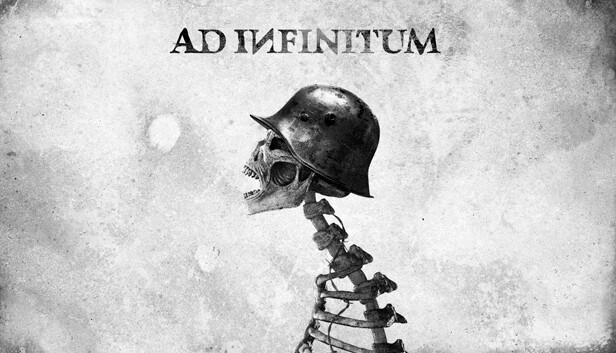
Ad Infinitum
Price History
Past 36 months · Updated dailyPrices cover Steam and 39 authorized stores; only legitimate offers are counted. The chart shows weekly market-wide lows and Steam's official price across the past 36 months.
01About Ad Infinitum
Ad Infinitum is a psychological horror game built around exploration and puzzles. As a German soldier, you move between a deserted family manor and the trenches of World War I while memories and nightmares blur together. Understand the origins and motives of grotesque creatures, escape deadly traps, and piece together clues about a family torn apart by war. The Steam PC version supports single-player play and full controller support. The interface supports English, Simplified Chinese, and Traditional Chinese. 76%% of 1,106 Steam player reviews are positive.
Credits
Lowest recorded in 36 months
$2.702026-07-30 · KinguinBase game · same records as the chart above; USD history, not a regional Steam low.Language support
| Language | Interface | Subtitles | Audio |
|---|---|---|---|
| Simplified Chinese | Yes | Yes | — |
| Traditional Chinese | Yes | Yes | — |
| English | Yes | Yes | Yes |
Show 11 more languages
| Language | Interface | Subtitles | Audio |
|---|---|---|---|
| French | Yes | Yes | Yes |
| Italian | Yes | Yes | — |
| German | Yes | Yes | Yes |
| Spanish | Yes | Yes | — |
| Japanese | Yes | Yes | — |
| Polish | Yes | Yes | — |
| Portuguese-Brazil | Yes | Yes | — |
| Russian | Yes | Yes | — |
| Thai | Yes | Yes | — |
| Turkish | Yes | Yes | — |
| Korean | Yes | Yes | — |
Steam PC edition data · 2026-10-19
02Before you buy
Mode and control
The Steam PC version is single-player and has full controller support.
Language
The interface supports English, Simplified Chinese, and Traditional Chinese. English full audio is available, with subtitles for these languages.
03Frequently asked questions
Who do you play?
You play a German soldier caught between his family home and the trenches of World War I.
What do you do?
You explore, solve puzzles, and learn the sources and motives of frightening creatures.
What themes does it cover?
The story concerns wartime trauma, family secrets, and reclaiming control of your life.
Popular Steam reviews
Native-language selection · 10 reviewsSelected helpful reviews in this language show both recommendations and criticisms. This selection does not represent the overall positive rating; opinions reflect the version reviewed.
I really wanted to like this game, but it got so painful I just ended up hating it. All boss battles are identical. Run, turn on a switch, run, turn on a switch. The game is beautiful graphics-wise, and the music was pretty. Everything else was just.. flat. Not worth the full price, unless you really like hide and seek/sneak/walking simulators that go on for hours.Show moreShow less
After 7 years of development, finally the boys at Hekate (Berlin) released Ad Infinitum. Well, it's very polished, no need of further patches after release, that's very appreciated and so rare nowadays. Graphics, sounds and animations are top notch. Interactions and mechanics could be better, but it's an indie production, so it's ok. Acting is quite good. You're adviced: it isn't an action game where you shoot and fight monsters, not at all! It is a pacifist game, against war and violence, so it's the negation of the usual war games. Sometimes they put a shotgun in your hands that apparently gives you more security but very soon you find that it's useless in front of the war horrors. A clear message from the developers. It's no survival horror, it isn't the usual horror game that makes you jump or scare; It's a psychological dark drama with horror nuances. At most it has something of Layers of Fear. When not competent reviewers cannot understand what they are playing, they use the term "walking simulator" that means nothing. It's an interactive experience like What Remains of Edith Finch, Firewatch, Gone Home, Dear Esther, The Town of Light and so on Ad Infinitum puts you in the shoes of a veteran traumatized by the horrors of war and gives a glimpse on his problematic family. You experience in first person the nightmarish memories of a traumatized mind where the horrors of war mix with family drama. The game gives its best in depicting the tragedy of First World War: the inhuman fight in the trenches, the chemical weapons, the sufference of mutilated soldiers, the air alerts, the suicide missions, the insensitivity and narrow-mindedness of the commanders, etc. A senseless war supported by patriotic fanaticism and laughable sense of superiority of the German people, forerunner of Nazism. I appreciated the criticism of the ideology of the strong and heroic german man, without physical defects, tireless, ready to sacrifice himself for his country; an ideology leading to the contempt for those who are disabled, for other ethnic groups considered inferior. Not everything is good. Story is a bit disjointed, too many narrative elements that are hard to manage and blend, especially concerning the family drama. Too many documents as main narrative mechanic. Some puzzles are dissonant with storytelling. A few interactive mechanics can be frustrating. You can see some naivety, it's the first work by talented but young developers, especially 7 years ago! Not at all a masterpiece as Edith Finch or Firewatch, however the experience does not leave you indifferent; some surreal representations of horrors of war are very effective, some scenes have the right atmosphere, they remain imprinted in your memory, they touch you deeply and make you think. You can see it's a work of passion; the young authors have something deep and meaningful to tell through the game experience. Don't miss their message, play Ad Infinitum; games are not just to have easy fun.Show moreShow less
Promising Concept, Hollow Execution Is a psychological horror game that blurs the lines between the trenches of World War I and the twisted landscape of a German soldier's. You are trapped in a relentless cycle, forced to confront the grotesque manifestations of your trauma, guilt, and fear within a nightmarish, ever-shifting version of your family home. https://youtu.be/yH5u5maF2cA Ad Infinitum fails where it matters most. Despite a compelling premise of WWI-era psychological horror, the game delivers a weak, pretentious, and ultimately empty story. The narrative is a convoluted mess, padded with repetitive gameplay and cheap horror clichés that lead to a profoundly unsatisfying conclusion. It tries to be a deep exploration of trauma but ends up feeling like a shallow walking simulator draped in a "deep" aesthetic. The plot is so bogged down by its own ambition that it forgets to be engaging or coherent. https://steamcommunity.com/sharedfiles/filedetails/?id=3518657933 https://steamcommunity.com/sharedfiles/filedetails/?id=3527317060 A tedious experience that prioritizes style over substance. The story, its core component, is a major letdown.Show moreShow less
Once again a game is falsely labeled as "Survival Horror" on Steam. Ad Infinitum is a linear, narrative driven horror game about the, well, horrors of the first world war. It's mostly a walking simulator with simple puzzles, that does provide a good atmosphere, as well as supernatural elements. Points of criticism are the following: - The game doesn't save its monitor resolution over a restart and returns to 1080p the next time - There's lots of "wtf do I go" type of walking around - The objective log doesn't update as often as it should, getting stuck on already accomplished tasks If you want to check out some gameplay, or maybe watch the whole Let's Play, where I professionally ruin the atmosphere between heart attacks, look no further: https://www.youtube.com/watch?v=T1_aWLVE0gYShow moreShow less
"Pain. The offspring of darkness and night. In living flesh, beaten by the whip. Living dead, in our homes, an eternal overnight." How a saying perludes the post-mortem essence in a contemporary insensate with hypocrisy and barbarism for a title already subjugated as the cosmic and universal positive essence of being. Thus the belief in this idiocratic parody is subjugated.Show moreShow less
A horror game that isn't scary for the majority of it's run, but has it's moments. The gameplay is boring, at the best of times, and tedious at the worst. But, it is a wonderful story telling experience that represents the trauma of war, and how it effects everyone differently, and it's beautiful. I hope no one who ever reads this has to go through the horrible experience of warfare. Or in their families.Show moreShow less
Just listen to One from Metallica and you'll get the gist of the game and not have to go through any of the mostly boring parts that comprise this horror walking simulator. https://www.youtube.com/watch?v=V4d-fn29eNk From what I can gather it gets better in the latter part of the game but I'm not spending anymore time trying to find that out. https://www.youtube.com/watch?v=xpSgFaDN_q8 Ok checked out a playthrough and let's just say the game has some merit and some interesting ways of dealing with the trauma of trauma itself and all that. Overall a way better way to experience the story than actually playing through it though.Show moreShow less
Sum-Up In-depth analysis further down. 🟩 Pros 🟥 Cons • Excellent sense of immersion at all times. Each environment is well crafted, dark and eerie; the quality sound design and solid voice acting are the cherry on top. • Several aspects of the story have to be figured out by piecing together the numerous lore files, giving you a good reason to explore accurately and read anything you can find. • The various allegories, visual metaphors and depictions of traumas and horrors are crafted with high-quality art direction. Some are rather convoluted — all, definitely horrifying. • Decent gameplay variety. Between puzzles, escape sequences, stealth and bosses, the variety is more than enough for this genre. • A few puzzle solutions are excessively obscure in their logic. These can lead to frustrating moments of tedious, over-extended trial and error. • Pacing issues with the “civilian” sections in between wartime memories. These, unlike their more interesting counterparts, prove rather tedious and unengaging. • Most animations, especially those during action sequences (QTEs, shooting, climbing etc.), are clunky and inaccurate. 🟨 Bugs & Issues 🔧 Specs • You can get stuck in the level geometry or onto specific objects in some areas. • It’s not entirely clear when the game actually saves progress; autosave only, no evident way to know when the last save was made. • i9 13980HX • 64GB RAM DDR5 • RTX 4090 • NvME SSD • 3840x2160 Follow our Curator and Website to see more high-quality reviews regularly. Content & Replay Value: It took me seven hours to complete Ad Infinitum, taking extra time to explore all locations and read the optional lore when possible. There are a few choices, during boss fights, that determine what ending you get, but most other content remains linear. The replay value is overall limited. Do I recommend it? Yes. If you’re a fan of psychological horror and WW1 settings, this is a pretty good pick. Mind that, despite its setting, there isn’t a whole lot of action even for this genre’s standards. Conclusion: A competent horror that hits the spot with its core themes. It depicts not only the horrors of war, but of wartime society as a whole, with a brutal honesty that seeps through its numerous allegories. In-Depth Writing & Worldbuilding Ad Infinitum is the story of two brothers, both inevitably involved in the Great War as their country wages an all-out offensive against its enemies. They’re, however, not average people; due to their family heritage of prestigious military service, they’re all the more compelled, their personal intentions all but inconsequential, to fight for the glory of the Fatherland — and possibly die honorably while they’re at it, too. The narrative is non-linear from a temporal perspective. With the intent of representing the broken, confused, shellshocked mind of a war veteran suffering from PTSD, the game’s levels aren’t in chronological order. At some points, you might relive the childhood of the protagonist, and find yourself on the front in the chapter immediately after. It’s a good narrative choice, as it gives a better sense of unexpectedness as to what’s next. It leaves to the player the task of interpreting the events by piecing together the numerous lore files found in each stage, instead of dumping story facts at regular intervals like most other narrative adventures do. Dialogue and lore files have some solid writing backing them up; as a bonus, most of them are fully voice-acted, too, and pretty well at that. The way Ad Infinitum depicts traumas as full-fledged levels, each with a boss that personifies said mental issue might not be groundbreaking on originality, but is done very well, and doesn’t skimp on the gore or other horrifying details when it’s necessary. Set during WW1, Ad Infinitum does a good job depicting the equipment, fortifications, uniforms and general environment of the Western Front, even down to the military jargon and technical terms like, for instance, the codenames of various gases for artillery strikes. Both the civilian and military environments are realized with good attention to detail; after all, many of said details are also necessary for environmental storytelling, as a part of the protagonist’s psyche. The general atmosphere is grim, stressful and eerie, there never really is a moment of peace or solace even, and perhaps all the more so, within the confines of the family estate — never mind the trenches proper. Exploration & Secrets You’ll explore solely on foot, across a variety of civilian and military environments. There’s no map, but you won’t need one, since most areas have, at most, just a few branching paths that mostly lead to the same destination or minor side areas. The only location I felt like a map could have been decent is the family house, a recurring zone in between chapters, whose complexity could warrant at least a simple map sketch at some point. There’s a large quantity of lore files to find, mostly in the form of documents, letters and paper sheets; these will sometimes be about inconsequential events or small side stories about other characters, while on occasion, may reveal crucial info about the protagonist or his family. This makes exploration interesting since even after the story ends, you won’t have a complete picture of the finer details unless you spent time to collect and understand as much lore as possible. The only secrets are collectibles, in the form of dog tags from either the French or German side; these only unlock achievements, and, to my knowledge, have no impact on the ending or any event. Puzzles & Stealth Most chapters include thematic puzzles, related to the trauma that specific area is about. For instance, you might be tasked with opening a series of valves and pipes in a chapter about the horrors or chemical weapons, or tasked with deciphering Morse code messages in a command bunker, taking the post of a comms officer. Most of these puzzles aren’t difficult or too complex, however, some of them follow bizarre logic that will make you say “how is that supposed to be that way? Why?” after you eventually find the solution by trial and error. Some sections contain enemies that you’ll have to evade using stealth. Despite being set in WW1, there will hardly be any shooting involved, strangely enough. The mechanics are nothing out of the ordinary: stay crouched, avoid sound-triggering devices like metal cans, and at times use trench air raid sirens to distract your enemies temporarily. Even if you do get caught, a simple QTE will allow you to get free and escape easily, with your HP going back to full in a short time. They’re hardly a challenge: I never died even once to these stealth sections, and I’ll admit I'm not the best at stealth in general. Boss Fights Each chapter has a major final boss that has two ways of being defeated: an evil one, and a “good” one; these will affect what ending you get. You’ll have to figure out on your own, based on the lore you accumulated and on the arena’s layout, which is which. Usually, the “good” way is more difficult and involves kiting the boss around for a longer time while you dodge their attacks, while the evil way skips some steps and is usually faster to get done. These fights are never about directly fighting the bosses with weapons, but rather, activating specific devices in order so that the boss can be dealt with passively.Show moreShow less
Im going to agree with some others, this is not a survival horror game, its a puzzle walking simulator, great atmosphere but not very interesting. I feel like the game suits people that like puzzles and not survival. A game needs to grip me in the first hour or I will leave it, life is too short and there is so many games out there. Steam needs to make it clear this is not a survival horror.Show moreShow less
Source: original Steam user reviews. Helpful votes are an archived snapshot, not live data. Last collected: 08/15/2026.
