

























Opening
There is a kind of game you cannot sell to a stranger by describing it. American Truck Simulator is the purest example I know. No villain waits at the end of the highway. No puzzle gates your progress. No leaderboard demands your weekend. What you actually do, said out loud, sounds faintly absurd: you hold a wheel, you point a loaded rig down an interstate, you drop the cargo on time, you collect the fee, you take the next contract.
And yet this faintly absurd thing has moved over 3.4 million copies on Steam, earned a 97 percent positive rating across more than 160,000 reviews, and kept a 2016 release pulling thousands of daily players a full decade later. Its appeal lives in the absence of stimulation rather than the presence of it — the one-note drone of the engine, the hypnotic pulse of lane markers ticking past, a kind of meditative emptiness that most games would treat as a bug to be patched out.
What this review wants to pin down is how SCS turned something repetitive, slow, and practically indistinguishable from labor into an addictive ritual of decompression — and why, ten years into its life, nothing else in the sim-driving lane has come close to taking its crown.
Story | 6.0/10
Story: 6/10Let me be blunt up front: if you came for a plot, this game will leave your hands empty. We scored its story dimension a 6.0, and the reason is plain — there is almost nothing here in the traditional storytelling sense. But empty of plot is not the same as empty of narrative. American Truck Simulator simply hands the job of telling the story over to you and the road.
No script writes your rise, because you drive it yourself

Boot the game and no cutscene greets you, no narrator leans in to explain who you are or what kingdom needs saving. You get one fact: you are a freshly licensed, broke driver-for-hire, allowed only to wheel someone else's truck. That is the entire premise, and the game wants nothing more. Its real arc is the climb from hired hand to owner-operator to the boss of a fleet — a progression no writer ever scripted, yet one you author with every delivery. There is no chosen-one prophecy, no dramatic plot twist, no final boss waiting at the end of Route 66; there is only the slow accumulation of fuel money, reputation, and rolling stock. And somehow that accumulation reads as a story anyway, because you remember the first rig you bought outright, the first garage you opened in a city you liked, the first driver you put on payroll. Your first job might be hauling produce from Los Angeles down to San Diego for a wage that barely covers fuel; forty hours later you own your first rig, you are buying garages across different cities, and you are paying hired drivers to run routes while you sleep. This inverted, quiet kind of storytelling is a deliberate choice rather than a shortcut. It swaps the emotion that other games push at you through dialogue trees for something more private — the relationship between you and the asphalt. It is the same path its sister game walks: geography and the road as narrator, never a staged performance.
Every haul is its own short story, and you can broadcast it

If the career is the novel, each individual delivery is a self-contained short story with a full life cycle. You pick a contract with a fee that suits you, drive to the loading dock, confirm the cargo type and weight, plot the route, fight fatigue and darkness across a state line, and land the freight at the drop-off inside a tight window. Mechanical as that loop reads on paper, it carries its own swell of feeling. Accept a high-value run of flammable cargo and you will catch yourself driving gentler, because one rear-end collision torches the whole trip. Roll alone down an empty Nevada highway after midnight and the dim glow of the dashboard against the far-off city lights conjures a loneliness that is somehow also peace. Watch the delivery clock tick down while you sit jammed in Las Vegas traffic and the small flare of anxiety is real too. None of these feelings were written for you by a screenwriter; they emerge from mechanics and place working together, generated by you. The game hands the authority of narrative back to the player — you are not living out someone else's designed story, you are living a string of road trips that belong only to you. That is a rarer thing than it sounds, and it is the quiet reason people stay long after the novelty of the scenery has worn thin.
To give that personal story some weight, SCS even wired in the official World of Trucks platform. You can snap your rig crossing the Golden Gate, log a brutal three-state overnight haul, and turn those private journeys into shareable, brag-worthy records. It is a clever move. When no NPC hands you a trophy and no plot climax cheers you on, the community becomes the audience for your story. So calling this game plotless is fair; calling it storyless is wrong. It just swaps the screenwriter for you — a narrative that only works if you lean in, which the right player adores and the wrong one finds hollow. That honesty matters, and we owe it to you straight.
Audio | 7.5/10
Audio: 7.5/10The sound design here is an art of restraint. It never assaults your ears with a swelling orchestra; instead it uses the most mundane, most easily ignored noises to press you firmly into the driver's seat. We gave the audio a 7.5 — the docked half-points reflect that it is genuinely not dazzling, but on the one job that counts, immersion, it lands cleanly.
The drone that other games would patch out

Most games fear monotony. This one made it the selling point. Cruise at a steady speed down an empty interstate and the engine settles into a low, constant, almost unchanging hum. In a different design document that sound is noise to be optimized away; here it is the very thing thousands of players describe as decompressing white noise. The mechanism is identical to a country drive: the engine's one-note song laid over the visual rhythm of lane markers sliding past, nudging the brain into a half-blank meditative state. Players on the forums say it plainly — after a shift, they run one long haul to shed the day, because nothing here demands a kill and no over-engineered puzzle corners them into anxiety. It is just you, the truck, the cargo, and the road, and the audio is the thing quietly lulling you into that trance.
But there is a harder, more technical half to this. The mechanical effects are inseparable from the driving model. The signature hiss of air brakes venting, the notch of gears meshing on a manual shift, the subtle change in tire friction across different surfaces, the low growl of the retarder kicking in on a loaded descent — none of it is decoration. It is driving information. When you shift a real manual the audio tells you whether the revs matched and whether you feathered the clutch right; when you crest a long grade fully laden, the brakes and retarder warn you the moment your speed starts to run away. Paired with force feedback on a wheel, the bumps in the road and the self-centering pull travel into your hands, and sound, image, and touch fuse into the convincing illusion of actually steering a big rig.
Filling the long road with life

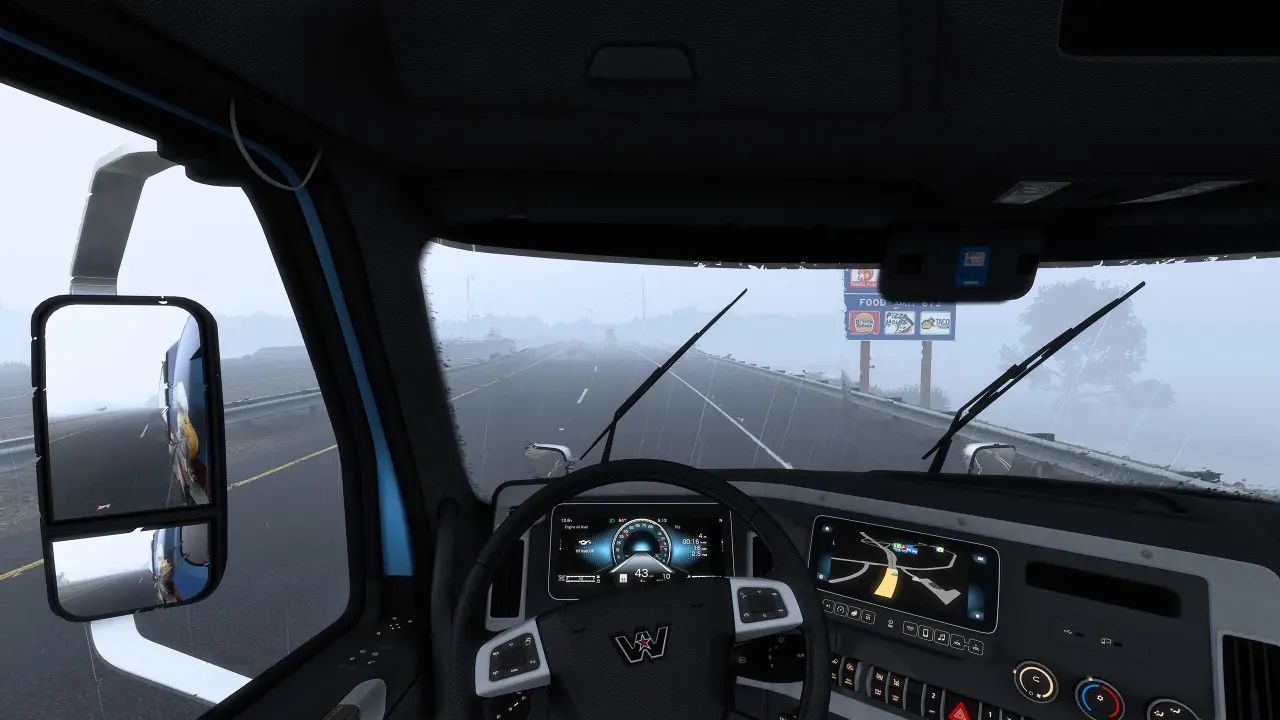
Long hauls are, by definition, long, so the game packs in a cab radio. You can run music or internet stations while you drive, and that small touch gives the once-silent cab a pulse — what real trucker, after all, hasn't leaned on the radio to outlast a long night? The exterior ambience is just as considered. City stretches buzz with traffic, rural roads carry insect song and wind, and the background murmur of gas stations and rest stops shifts as you cross different terrain. Drive through a tunnel and the mix goes muffled; punch out the far end and it opens up again. In rain, droplets drumming on the roof and windshield wrap the whole cab in an extra layer of insulation.
Set against the grander simulation ambitions of Microsoft Flight Simulator, ATS keeps its audio markedly more restrained and everyday. It is not chasing awe; it is chasing the kind of comfort you are willing to sit inside for hours. That unshowy, perfectly road-paced soundscape is the most overlooked and the most indispensable thread in the whole immersion.
Visuals | 8.0/10
Graphics: 8/10The visuals win on faithfulness, not fireworks. This game will never push your GPU to wheeze under bleeding-edge lighting, but its recreation of the American West is careful enough that you happily watch the scenery roll by for the length of a long haul. We scored the graphics an 8.0, and that number is largely a payment toward its map design and its sense of place.
A 1:20 West you can actually recognize

The biggest visual achievement is the way SCS compresses real Western geography to a 1:20 scale. That ratio is the whole trick: it preserves the identity of each state while squeezing distances that run hundreds of real kilometers down to something that won't put you to sleep at the wheel. The California stretch gives you the Golden Gate Bridge spanning the bay, a coastal run from Los Angeles up to San Francisco, the Hollywood sign and city skylines all instantly legible. These are not placeholder boxes dropped onto a grid; they are gamified renderings of real landmarks. Gas stations, rest areas, toll booths, billboards, and town skylines with regional character are detailed into the roadside, and the world flanking the highway feels alive and believable. The moment your truck eases across the Golden Gate, the sense of driving across America stops being marketing copy and becomes the picture in front of your eyes. Nevada then swings the palette hard the other way. Red-rock country reminiscent of Monument Valley burns orange under the setting sun, empty desert highway runs to the horizon, and by night the neon sea of Las Vegas sweeps the desolation aside for a wholly different cityscape. That violent contrast in terrain is the soul of how this game looks. One hour you are threading a foggy coastal cliff road with the Pacific breaking below; the next you are baking on a dead-flat desert two-lane with nothing but scrub and heat shimmer to the edge of sight. The map never lets the eye settle into boredom, and that relentless variety is doing as much quiet work as any single famous landmark on the route.
An engine built for postcards, and a platform built for everyone

Holding all that scenery up is SCS's in-house Prism3D engine, and its atmospheric rendering under sunset, weather, and dynamic light is genuinely accomplished — morning haze, a harsh noon glare, the long shadows of dusk, a wet slick of road throwing back headlights on a rainy night. Every lighting condition lets the same stretch of road read with a different flavor. You will catch yourself stopping at some unusually photogenic junction just to grab a screenshot. It is not chasing photoreal extremes; it is chasing a postcard quality you want to capture, and that restrained, precise taste is exactly right for a game that has you staring down the road ahead for hours.
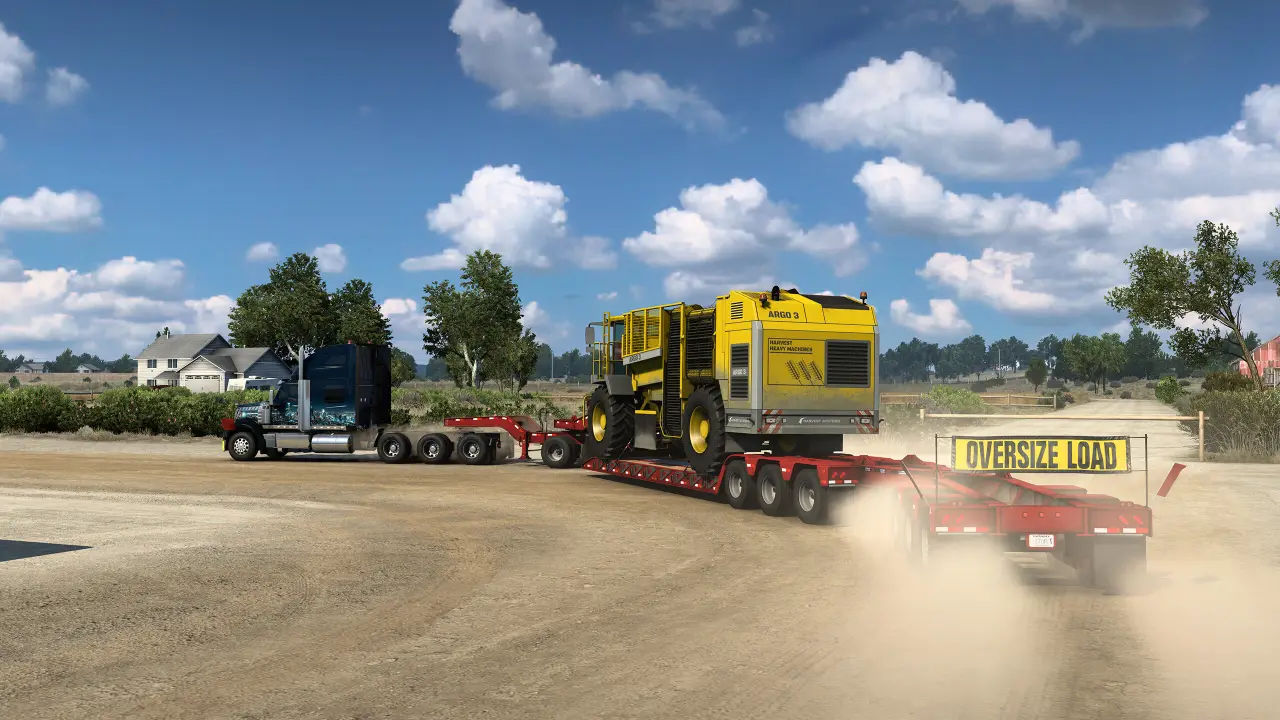
Scenery is the far view; the truck is the near one, and both have to hold up. The truck modeling is finely detailed, with licensed cabs and a deep customization suite that lets you swap cabins, spray on personal paint jobs, upgrade engines, and tune the parameters until the rig is unmistakably yours. The dashboard gauges and switches inside the cab are modeled with real care, and the first-person view carries strong presence. On the optimization front it reaches wide too: Windows, macOS, and Linux are all supported, the hardware demands are modest, and mid-range machines run it steadily. As state DLC keeps expanding — Oregon's dense forests, the broad plains of Texas, the Rockies of Colorado — every new state brings a distinct visual character, so the map's richness keeps growing. There is a practical wisdom in that breadth, too: because no single state has to carry the whole game's visual load, SCS can lavish attention on the things that actually sell the drive — the way evening light rakes across a wheat field, the silhouette of an oil derrick against a bruised sky, the specific ugliness of an industrial port that somehow still photographs well. The graphics may not be the absolute finest, but they are firmly the most rewatchable, and rewatchable is precisely the quality a game like this needs most.
Combat | 9.0/10
Gameplay: 9/10Gameplay is the soul of this thing, and it is where we handed out the highest mark on the card, a 9.0. Its core loop fits in one breath — drive freight, get paid — but underneath that breath sits a simulation of startling depth and a career ladder with no top rung in sight.
Physics you can dial from cruise to punishing

The feel of driving rests on a physics model whose difficulty you scale yourself. At the gentlest settings you run an automatic, switch off vehicle damage, skip the reverse parking, and treat the whole thing as a pure scenery cruise. At the most hardcore, you flip on a true manual gearbox, air-brake simulation, the retarder, tire slip, fuel burn, even overweight fines, and every launch, climb, and long descent becomes a problem you have to read ahead. The clearest showcase of the simulation chops is the manual H-shifter mode, which wants a dedicated shifter on your desk and which hardcore players crown the closest thing to real driving — smooth, precise, demanding that you match revs and ride the clutch to ease this colossus into motion. What separates ATS from any arcade racer in a single word is weight. Load forty tons onto the trailer and the entire feedback envelope changes: acceleration turns sluggish and you feed throttle while the revs crawl up, braking distance stretches and forces you to read the road early, weight shifts in a corner are plainly felt, and take one too fast and the trailer threatens to roll. You feel, unmistakably, that you are commanding a heavy machine that respects the laws of physics rather than a nimble sedan. Ride a long downgrade on the foot brake alone and it overheats; you have to stage your speed with the retarder. Climb a steep grade laden and you downshift early to hold the torque. These details turn driving from a simple input into a craft you learn and feel your way through. The first time you successfully crest a mountain pass with a heavy trailer, holding the right gear, staging the retarder, never once touching the rumble strip, you feel a small private competence that no arcade racer ever gives you, because no arcade racer ever asked you to earn it. And the beauty of the scaling is that the player who wants none of this can simply leave it off and still have a perfectly pleasant cruise; the system never punishes you for the difficulty you did not choose.
A career with no ceiling and no fail state

Handling alone wouldn't keep anyone for a thousand hours; the career ladder does. The economy runs on accept, haul, settle, reinvest. Early on you take jobs a freight company assigns and draw a fixed wage; as you level up and unlock skill points, you pour them into specializations — long-distance, high-value, fragile, hazmat — each carrying a fatter pay multiplier. Bank roughly 115,000 dollars, buy your first truck, and the game pivots from working a job to running a business: you snap up garages in different cities, hire AI drivers to earn while they roll, and grow one truck and one driver into a multi-state fleet. The ladder has no terminus and no fail penalty, paced entirely by you — save up and play it safe, or take a loan and expand hard. Handing the decisions wholly to the player means no two playthroughs look alike. Layer on the bonus pay and operational challenge of those high-difficulty reverse-parking jobs, plus the pinnacle immersion of a wheel, pedals, and standalone shifter, and the depth is enough to swallow hundreds of hours. There is also a subtle psychological trick at work in the absence of failure. Because you cannot lose, the moment-to-moment tension comes entirely from self-imposed standards — delivering early instead of merely on time, never scratching the paint, never paying a fine. The game trusts you to manufacture your own stakes, and most players happily do. It wraps the simplest possible shell around a core that is both genuinely hardcore and genuinely welcoming — newcomers ease in, veterans dig to the bottom — and that is the smartest thing about how it plays.
Content | 8.5/10
Content: 8.5/10Content is the most contentious dimension here, and the one that best exposes the game's operating philosophy. We scored it 8.5, but behind that number lies a decade-long sprint from thin to abundant. To talk about its content honestly you have to hold launch day and the present day apart.
A thin opening, told straight

To be fair about it, American Truck Simulator caught flak when it first shipped. The base map held only California and Nevada, and exactly three trucks were on offer. For a game built around driving to admire scenery, that was a meager haul at the time, and plenty of the review-day deductions landed right there — the core loop was magnetic, but there was too little ground to run it on. Truck choice was limited, the drivable cities could be counted on two hands, and a dozen hours was enough to know the map cold. For anyone after a buy-it-once, get-your-money's-worth package, the 2016 version genuinely fell short. But SCS plainly had no intention of leaving it there. The studio chose a road utterly unlike a one-and-done premium release: not a single transaction, but relentless expansion, growing that thin opening bit by bit until the biggest weakness — too little content — was cooked, alive, into the biggest strength. That patience is genuinely unusual. Most studios would have shipped a sequel by now, resetting the map and asking everyone to buy in again. SCS instead kept building onto the same foundation, treating the original purchase as a living platform rather than a finished product, and that decision is the entire reason a 2016 game still feels current.
Ten years of states, and a second engine in the Workshop

This is where the content dimension's real advantage lives. Across the decade since launch it has expanded at a clip of one or two new states a year — Oregon, Washington, Utah, Colorado, Idaho, Wyoming, Montana, Texas, Kansas, Nebraska, Missouri, Louisiana, one after another — until it now covers most of the American map. Each state expansion is no mere outward redraw of the map; it remodels the local road network, cities, landmarks, and pillar industries to real geography, and agriculture, mining, forestry, and oil each bring distinct cargo types and routes. Buy a new state and you receive not just more map but fresh scenery and fresh freight gameplay. Worth flagging: Arizona was given away free, a thank-you to the early crowd, while the rest are priced by content volume so you can cherry-pick only the regions you care about rather than swallow the whole set at once. Looked at another way, that slow-drip cadence actually lets players collect the regions they love at their own pace without emptying the wallet in one go.
If official DLC is the main engine of this game's content, the Steam Workshop modding scene is the second. The Workshop teems with player creations — truck skins, traffic-flow tweaks, lighting overhauls, sprawling community map expansions — and even the multiplayer the game once lacked was first built by players. That ecosystem stretches the game's life enormously and lets every player tune it to taste. Add 130 achievements, trading cards, and an official level editor, and the long-tail content piles up further. The Workshop deserves a closer look, because it is not a graveyard of abandoned half-mods the way so many are. It stays current with each game patch, the most popular map packs — sprawling community projects that stitch together regions SCS has not officially built yet — are maintained for years, and the install-and-forget integration means a newcomer can transform their game without ever reading a forum thread. That low barrier is why the modding scene actually retains players rather than merely impressing them once. Against a slow-paced management peer like Farming Simulator, ATS leans on map breadth and the capacity to keep growing rather than mission density. Its docked points sit on the fact that completing the map means stacking paid DLC, an outlay that adds up over time; the points it earns come from a decade of uninterrupted updates that made it an evergreen in the truest sense of the word, the kind of game you can put down for a year and return to find genuinely larger than you left it.





Comments 0
Share your game review
Join the discussion and share your review of this game.
No comments yet. Share your thoughts on this review.