

























Opening
Selling an eight-year-old survival sandbox back to you at nearly double the price, rebuilt in a new engine, is a bold way to make enemies. ARK: Survival Ascended made them on day one.
This is not a game the press rubber-stamped. OpenCritic carries only a handful of reviews; Metacritic still flags the PC version as "not enough reviews"; on Steam, more than ninety thousand verdicts have settled it at a 60 percent, mixed rating. And here is the strange part — the loudest voices in those negative reviews are often the same veterans who have sunk a thousand hours in and still cannot bring themselves to quit.
That contradiction, loving the game while resenting how it is run, is the truest thing you can say about this remaster. It lifted the whole stack — hundreds of tameable creatures, the deep stat-breeding, the tribe-versus-tribe multiplayer — and dropped it wholesale into a next-gen engine, then wrapped it in Lumen lighting and ray-traced water. The visuals genuinely jump a generation. The bill is a frame rate even an RTX 4090 cannot hold steady, and an early stretch of crashes and lost saves that tested everyone's patience.
So this review is not chasing a thumbs-up or thumbs-down. It is trying to pin down exactly where the game is brilliant, where it is rough, and — the part that actually matters — whether you are the person who should be paying for it.
Story | 5.5/10
Story: 5.5/10A world with no plot — the story hides in obelisks and codex entries
Open ARK expecting a narrative to carry you, and the first two hours will let you down. There is no cutscene pinning you to your chair for a grand prologue, no quest marker pointing at what comes next. You wake up barehanded and half-naked on a stranger's beach, and the only goal anyone hands you is the oldest one there is: stay alive.

What lore exists is scattered and has to be assembled by hand. The towering obelisks on the map, the explorer notes tucked into ruins, the codex entry that unlocks each time you tame a new species — those are the real vessels of this world's backstory. Piece them together and a science-fiction premise emerges: this "ark" is no natural island but a machine of some kind. The game never forces any of it on you. Read it if you want; ignore it and you lose nothing of the dinosaur you are taming or the keep you are raising. For players who treat narrative as the main course, that restraint borders on indifference. For the ones lost in the sandbox, it quietly hands them a reason to keep digging.
There is, buried in the content roadmap, a thread that runs through the whole series. The Lost Colony expansion is positioned to lead directly into the sequel, ARK 2, dangling a "this universe keeps going" hook in front of anyone playing the long game. New players will not feel it. Series fans treat it as one more reason to stick with the live-ops grind. The official story, in other words, works less as a spine and more as negative space — it never drives your experience, but it leaves a layer of depth for those who care to look.
The real story is the one you write — from a single raptor to a herd of giants
If the authored narrative is thin, the stories that actually land in ARK all belong to the player. The design leans entirely on emergence: the game hands you rules and a sandbox, and the plot grows out of every choice you make inside it.
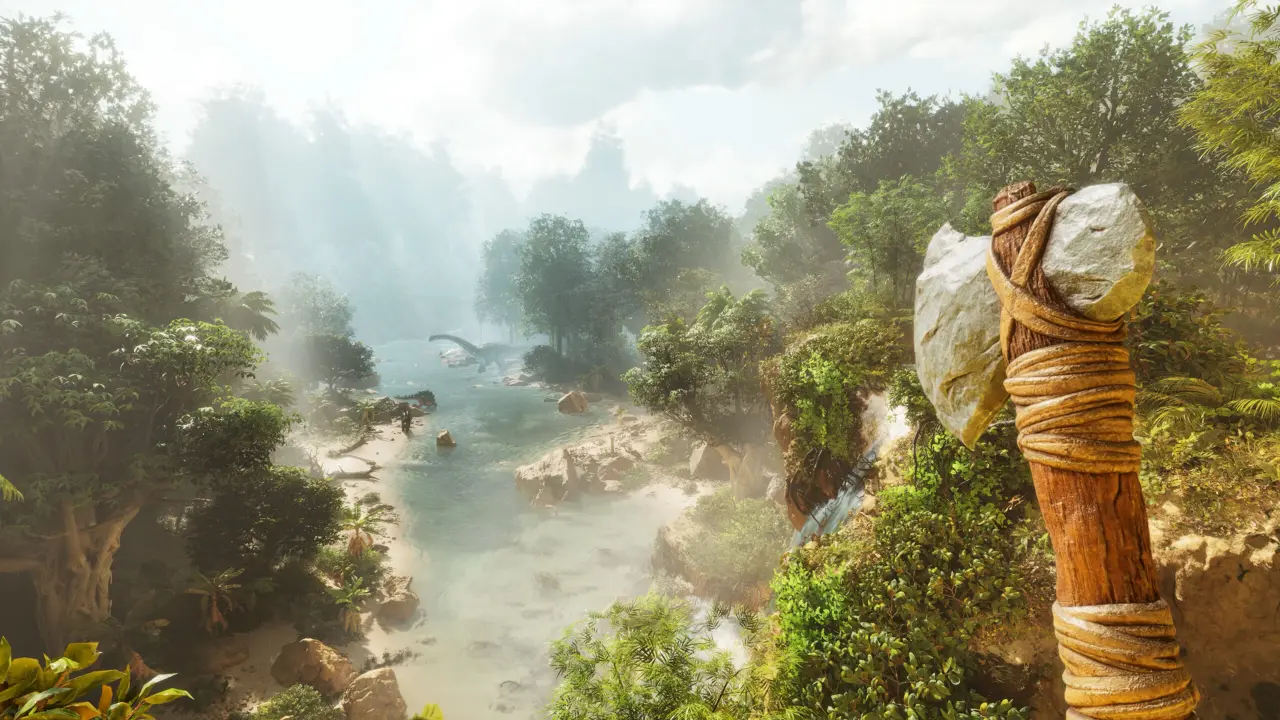
Your first real high tends to be the moment you subdue and tame a raptor to ride. Suddenly you are no longer prey fleeing on foot but a survivor with mobility, range, a way to outrun the things that used to chase you. Then comes the triceratops you raise as a gathering-and-defense workhorse, the first base siege your tribe actually wins on a PvP server, the quetzal you finally tame so you can ferry a whole squad across half the map. None of these moments is scripted. Every one of them sticks harder than any cutscene, because you made it happen.
That "your story, not ours" instinct draws a sharp contrast with Valheim. Valheim is just as light on plot, yet it strings a line of bosses across the journey to give the run a clear cadence — clear one, unlock the next phase, momentum intact.
Ascended hands the pacing entirely to you. The sense of direction is looser, the freedom wider, and the most memorable arcs are the ones nobody planned: the night your tribe lost a base and rebuilt it bigger, the expedition that went wrong and turned into a legend you still retell. The cost of all that openness is real, though. Anyone who needs an external goal to chase, who tends to drift in an open sandbox, will find ARK's steep and unguided opening genuinely off-putting, and no amount of emergent magic will paper over those first frustrating hours.
It is a design that asks something of you in return for what it gives, and not every player is willing to make that trade. So a low score on story here is the honest call. The authored narrative really is slim, and the opening really is harsh. But if you grasp that ARK's story was never in the script — that it lives in every survival scramble and long-haul expedition you share with your dinosaurs — then the "weak plot" label stops being the dealbreaker it looks like.
Audio | 7.0/10
Audio: 7/10Ambient sound is the invisible scaffolding of immersion
The most underrated thing in ARK's audio is not its score but its ambience — a soundscape that pins you into survival tension rather than something you would queue up to listen to on its own.
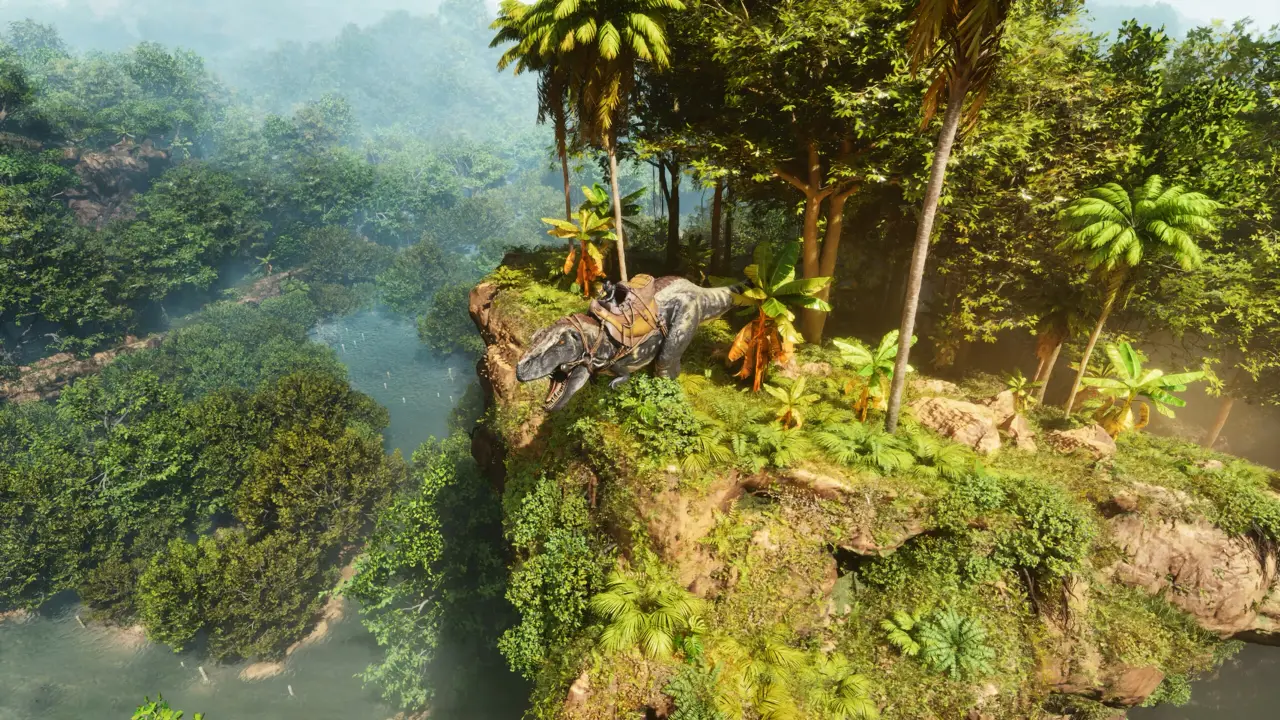
By day the jungle hums with insects, birdsong and wind raking the canopy, a deceptively peaceful floor of noise. Then a low roar rolls in from somewhere in the trees and the whole field of sound tightens — you stop gathering on reflex, gauge how far off that thing is, whether it is heading your way. Night rain cranks the dread higher: footsteps land heavy in the mud, the rain curtain shrinks your sight lines, and your ears become the main instrument for reading what is around you. That ability to build dread through sound alone is ARK's quiet immersion engine, and the part of its audio that is genuinely first-rate.
The Unreal Engine 5 rebuild brings real gains here. Dive underwater and light scatters through the water while sound goes muffled; duck into a cave and the reverb layers more convincingly than the original ever managed. The improved spatial audio gives the "unseen but heard" moments — the crawling thing closing in through a black cavern — a sharper sense of direction, and a sharper edge of fear.
Creature voices carry the identity — and the tactical read in multiplayer
Almost all of ARK's recognizable audio rides on its animals.
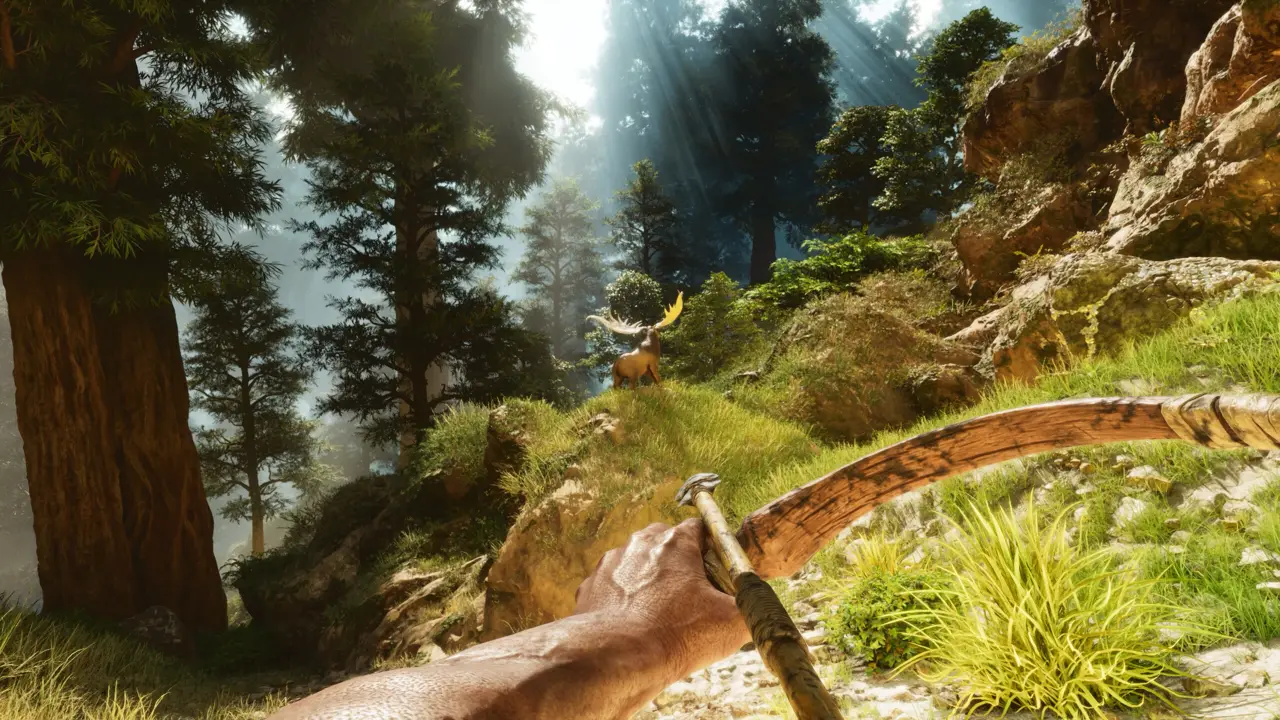
That signature low growl from a Tyrannosaurus is not set dressing; it is a threat warning. Hear it in the wild and a veteran instantly weighs whether they can handle it or should pull their tamed creatures back. The wingbeats of a quetzal, the cries of a beast startled or pushed into a standoff — all of it carries real information. This "danger level through sound" design lets you read the situation around you without staring at the screen, which is wildly practical in a survival loop.
On servers, and especially in PvP, audio is upgraded into outright tactical intel.
Reading a rival tribe's approach by sound, catching someone chipping at your wall by the noise of it, hearing the distant thump of a mount before you ever see its rider — these are real edges in high-level play, the kind of detail that separates a tribe that survives a raid from one that wakes up to a ruined keep. Sound here is not atmosphere; it is a source of intelligence on par with sight, and the players who win consistently are the ones who learn to listen.
Pull back to the whole, though, and ARK's score itself leans toward atmospheric wallpaper, missing a single strong theme that snaps the game to mind on first hearing. Set against the bright melodic hooks of Valheim's soundtrack, Ascended's music is more competent backdrop than memorable centerpiece — it serves the tension without stealing a scene. That is why the audio dimension lands at merely solid: ambience and creature sound are both dependable and useful, but there is no signature melody to call its own.
Visuals | 8.5/10
Graphics: 8.5/10Lumen and Nanite — a generational jump in light and distance
The most immediate pitch Ascended makes is a visible leap in fidelity. This is not a texture pack bolted onto old geometry; it is a ground-up rework of lighting and geometry built on two of Unreal Engine 5's core technologies.
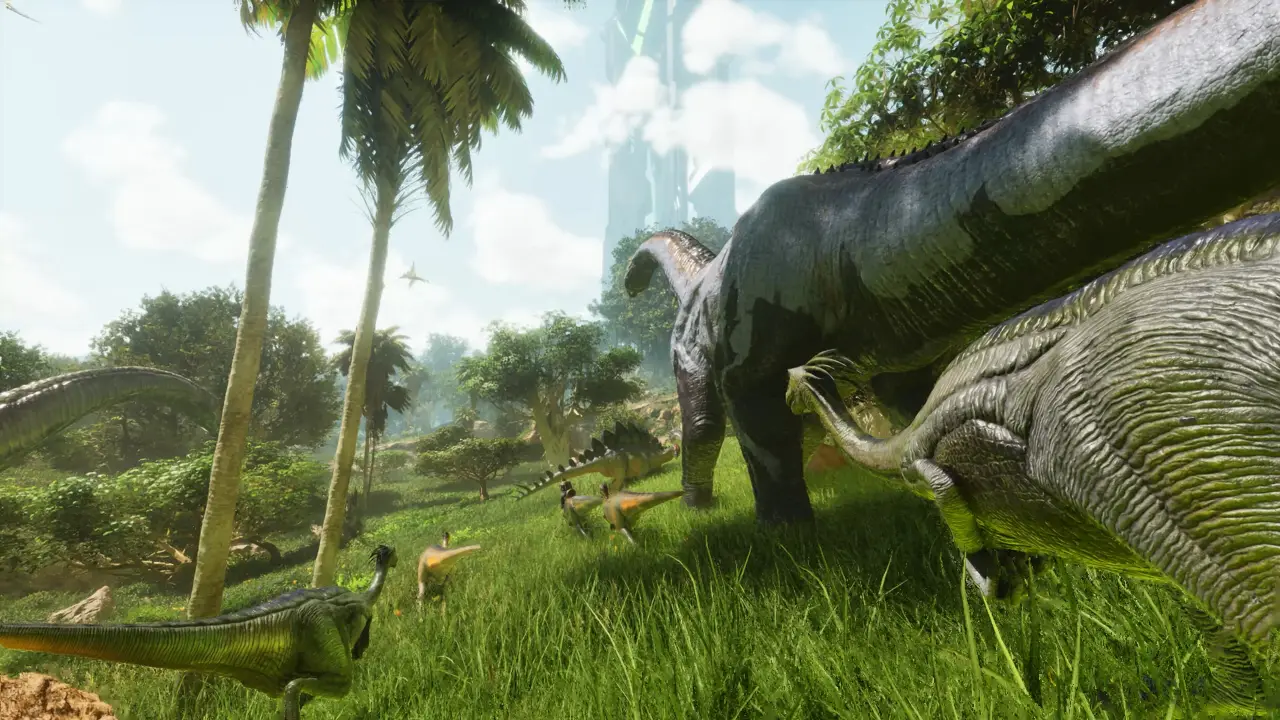
Lumen's global illumination shows its hand most clearly at dawn and dusk. Sunlight slants through the canopy and dapples the ground; a torch warms a cave wall at night, and the bounce of that warm light and the soft gradient of its shadows is something the old game's baked lighting simply could not produce. The world's light now moves and reacts, so jungle, cave and coastline each take on a completely different mood depending on the hour.
Nanite fixes the middle distance. The model pop that used to plague the original — a far hillside or a clump of foliage suddenly sprouting detail as you approached — is essentially gone. Stand on a ridge and look out over the island and the treeline reads as solid and continuous, the whole landscape gaining real depth. Stack the two technologies together and ARK finally has a foundation that earns the word "next-gen."
Ray-traced water and the rebuilt creatures
If you had to pick the single most convincing showpiece in this remaster, it would be the water.

The swell of the waves, the refraction in the shallows, the way light scatters through the column when you dive — paired with ray-traced reflections, it is the visual centerpiece critics keep coming back to. Watch a sunset spread across the surf from the shoreline, or sink beneath it and look up at the shafts of light cutting through the layers, and this water beats anything in the genre. It is also the clearest answer to where the money went.
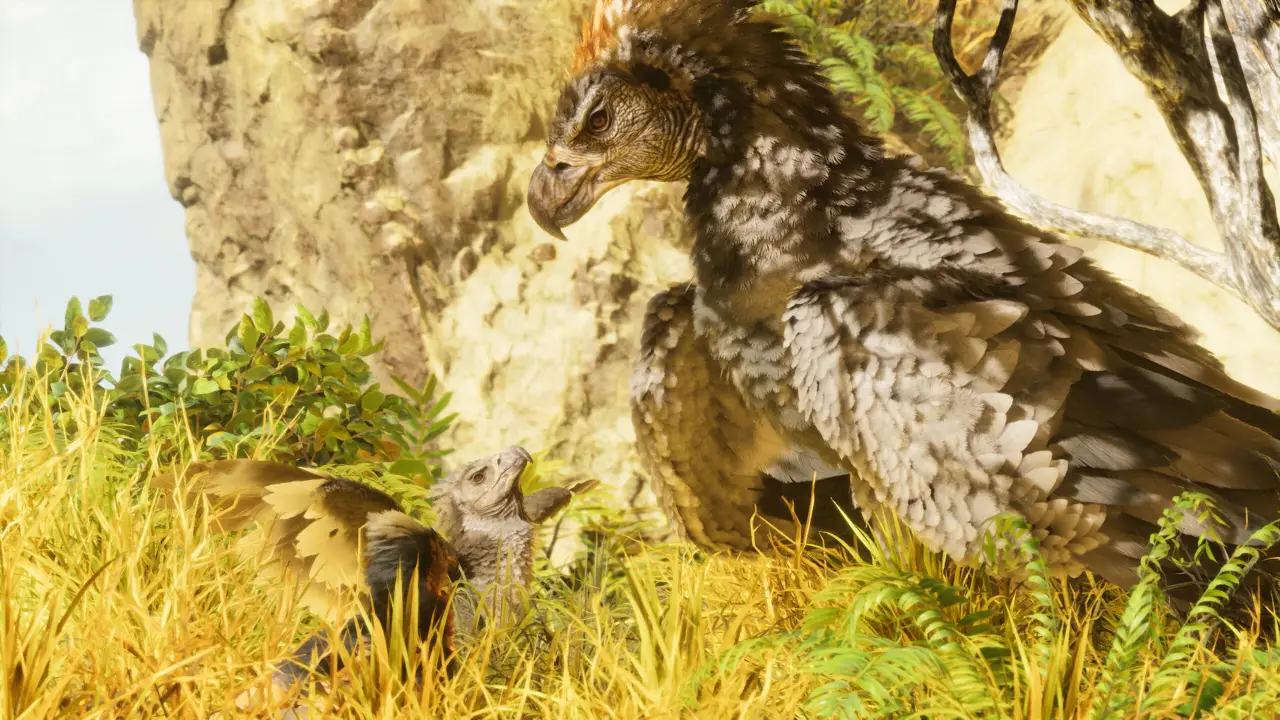
The rebuilt creatures are the other core upgrade. In a game whose entire premise is taming prehistoric animals, how the dinosaurs read matters enormously. The major species have been remodeled — the play of muscle, the detail in the scales, the way skin catches the light all carry a next-gen weight. Stand nose-to-nose with a tamed Tyrannosaurus, or ride a quetzal out over the map, and those details quietly reinforce the fantasy that you are taming something real.
Optimization is the price — a high bar and a stability problem
Every bit of that spectacle comes at a brutal hardware cost, and this is where Ascended draws its heaviest fire.
Outlets have measured even a flagship RTX 4090 failing to hold a steady 60fps at 4K on mid-high settings; native 4K only clears 60 once you drop to low. Consoles fare worse, landing in a 20-to-40fps band with visible screen tearing whenever you move fast or fly a mount. Eurogamer flatly called it the worst-optimized Unreal Engine 5 game it had seen on console. Worse than the low numbers is their instability — a single scene can lurch from smooth to stuttering with no warning, and that lurch hurts more than a consistently low frame rate ever would.
The frustrating part is that the community largely lays this not at UE5's feet but at the studio's implementation. Early on, granular quality settings were missing; many performance-critical options were buried or absent, so mid-range card owners could not trade specific effects for a stable frame rate and had to crush the overall preset instead, throwing away the very visual edge they came for.
It is a stark inversion of Valheim, which runs on almost anything and plays the moment you launch it, while Ascended plants a tall hardware wall in front of everyone who wants to see what it can do. Stacking large bases and dozens of high-detail creatures into one scene only compounds the load — the prettier your world gets, the harder the engine has to work to keep it moving, and a thriving tribe base is often where the frame rate buckles worst. By 2025 the studio had pushed the engine to 5.5 and shipped a run of performance patches, easing things from the launch lows. Still, "optimization" remains the blade hanging over this remaster's head, and no patch has fully sheathed it yet.
Combat | 9.0/10
Gameplay: 9/10Taming — the actual soul of the whole thing
To understand why anyone sinks a thousand hours into this game, start with its taming system. This is the soul of ARK and the thing that sets it apart from every other survival game on the shelf.

Taming a creature is nothing like pressing a button. First you size up how dangerous the target is — some are placid, others reflexively turn on you the instant you provoke them. The usual route is a knock-out tame: drop the target into an unconscious state with tranquilizer darts or a blunt tool, then feed it the right food repeatedly before it comes round. What it eats, how long it takes, how hard it is to put down — all of it varies wildly by species, and the whole time you are standing guard, keeping it from waking early while chasing off scavengers that smell an easy meal. A high-grade tame can be a small operation that demands preparation and constant babysitting.
The payoff is enormous. A raptor is an early-game mount, a triceratops a steady gathering-and-defense workhorse, a Tyrannosaurus a mid-game powerhouse, a quetzal a long-haul transport that carries a whole squad, and a Giganotosaurus a late-game line-breaker. Every species has its own role and its own use, and the act of taming is, in itself, assembling a herd of complementary specialists.
Stat-breeding — the hundred-hour deep end for hardcore players
If taming is the entry point, stat-breeding is the magnet that drags hardcore players into a hundred-hour deep end.

Wild-caught creatures roll random stats. Through the breeding system you pair two high-stat individuals, hatch the offspring, then imprint on the juvenile to strengthen its growth. Select across generations and you can raise a bloodline whose stats outclass anything in the wild.
The depth here approaches a dedicated raising-sim: logging stats, planning pairings, managing a sprawling pipeline of hatching and care is the engine that burns the time of serious tribes. For these players ARK long ago stopped being a "survival game" and became a numbers game about optimization, planning and long-term husbandry — you build a pedigree, you track where every stat came from, you cash potential into power one imprint at a time. A truly elite creature can be the product of weeks of careful pairing, and watching it dominate where its wild ancestors would have folded is a payoff few other games even attempt. That long-haul reward is the deepest moat ARK has.
Building and tribes — from a lean-to to a sea fortress
ARK's other load-bearing pillar is building, and the remaster sharpens it in concrete ways.

The system supports free-form, multi-material construction from wood huts to stone keeps to metal fortresses and floating sea platforms. In the remaster the snap logic between pieces is smarter, walls and ceilings mate more tightly, and even artifact pedestals can clip onto a half-pillar, opening up base layouts. These look like fiddly tweaks; in practice they slash the trial-and-error rage of raising a large base and make "build a place that is mine" far smoother than in the original. The upgraded grinder lowers the bar on parts of the taming chain too, letting non-egg-laying animals like mammals produce feed.
Building and tribes together are what blow solo survival up into a social contest. On servers you form a tribe, members share tamed creatures and build permissions, and the base offense and defense of PvP play is where the system peaks. It bears stressing: because your assets carry genuine risk in multiplayer — one crash can cost you a base defense, a painstakingly bred bloodline, even your whole tribe keep raided in the gap — the optimization and stability problems above stop being a mere "experience blemish" and become a hard flaw that decides outcomes and assets.
A steep curve with plenty of flexibility
ARK is famously unkind to newcomers.

You open barehanded and exposed, juggling day-night temperature swings, draining hunger and thirst, and predators that can appear at any moment; dying and restarting over the first few hours is basically a rite of passage. But clear the turn in that curve — your first mount tamed, your first lockable shelter raised — and the positive feedback compounds fast, the play stack unfolding from "barely survive" all the way to "rule the food chain" and "own the server." The steepness drives off players chasing something relaxing, and it is exactly what hooks the hardcore.
The contrast with Palworld makes it plain: Palworld is also creature-collection plus survival-craft, but its overall tempo is lighter and friendlier; ARK's taming chain is harder and carries more weight, every high-grade creature backed by real hours. Worth noting, too, ARK offers deeply configurable server multipliers — taming speed, harvest rates, experience gain are all tunable, so a solo player can dial the pace into whatever fits. That give is what separates it from most linear survival games and keeps it alive in the mod and community-server ecosystem.
Content | 9.0/10
Content: 9/10Hundreds of creatures and many maps — the heaviest payload in the genre
If one word sums up Ascended's content, it is heavy.

The world is home to hundreds of tameable prehistoric creatures, from dodos to Tyrannosaurs, from quetzals to Giganotosaurus, spanning an enormous range of size and function. None of them is mere scenery; each is a play unit with its own niche, its own use, its own taming method.
Multiply those hundreds of creatures by the depth of taming, breeding and stat selection, then layer on the exploration space of several themed maps, and the sheer volume lands at the top of the survival-sandbox field. That heft is the moat hardest to copy — no competitor offers this many playable dimensions inside a single framework. And the creatures relate to one another ecologically: predators hunt herbivores, different regions host different species, and the whole thing knits into a food web where you are both hunter and hunted. A coastline that feels safe at noon can turn lethal after dark when nocturnal hunters wake, and learning that rhythm is part of mastering the island. Just taming the full roster and learning what each animal is good for can burn hundreds of hours on its own.
Rebuilt classic maps and a steady DLC cadence
The volume is not only at launch; it is in the steady drip of long-term releases.

The remaster promises to rebuild the series' classic maps and expansions in Unreal Engine 5, and the themed maps veterans know by heart — Scorched Earth, Aberration, Extinction — have rolled out one after another, each bringing a fresh biome, exclusive creatures and its own exploration content. Some arrive free; others ship as paid DLC in installments, like Genesis Ascended Part 1 and the Lost Colony expansion set to lead directly into the sequel's story. Where the line falls between paid and free is itself one of the community's running arguments, but there is no denying the studio has kept up a brisk cadence — new creatures, new maps, new engine revisions trading off in turn.
That live-ops rhythm turns "build a base over the long haul, raise a herd over the long haul" into a journey measured in months, even years. Which is precisely why you cannot judge this game by its launch-day snapshot alone; you have to read it in the context of an ever-evolving live-service survival sandbox.
Configurable difficulty and a community ecosystem — what stretches the lifespan
ARK's other pillar of longevity is its staggering configurability.

The game exposes deeply adjustable server multipliers — taming speed, harvest efficiency, experience gain are all yours to set — which means the same content can be played as wholly different games. Players who want a slow hardcore grind run default rates; time-strapped players crank the multipliers to push through fast.
Pair that give with a lively mod and community-server ecosystem and ARK's content reaches far past the official offering. Player-made modes, total-conversion maps and bespoke server rules stretch its lifespan dramatically, and for many players the official content is just the starting point — the version of ARK they actually fall in love with is one a community built on top of it. That openness is a large part of why the game still has a pulse years after launch.
The upshot shows in the scale of its Steam footprint: more than ninety-seven thousand reviews. That number alone tells the tale — mixed reception or not, drawing a player base this large to keep coming back and weighing in over and over is the surest proof of content stickiness and long-haul vitality. Against Valheim the positioning is obvious at a glance: Valheim runs lean and disciplined, less content but every piece finely tuned; Ascended does the opposite, betting on heavyweight volume — a vast roster, many maps, deep numbers systems built into a wall. Neither path is superior, and which one suits you comes down to temperament as much as taste. But if what you want is a survival sandbox you can play for hundreds of hours and still not exhaust, then on raw content volume Ascended has almost no rival anywhere in sight.





Comments 0
Share your game review
Join the discussion and share your review of this game.
No comments yet. Share your thoughts on this review.