























Opening
Some games say one thing on the box and are something else entirely underneath. Assassin's Creed IV: Black Flag is the clearest case of all — it wears the "Assassin's Creed" label, but what made it legendary is the word "pirate."
And that's not an exaggeration. Critics and players are unusually aligned here: on OpenCritic, 48 reviews give it an average score of around 85, enough for the top "Mighty" tier, with 91% of critics recommending it and a place in the top 5% of all games. On Steam, more than 71,000 reviews give it an 88% positive rating. It launched in 2013 and sold more than 11 million copies within a year.
More than a decade later, it is still passed down from one generation of players to the next, widely held to be one of the very best entries in the whole series.
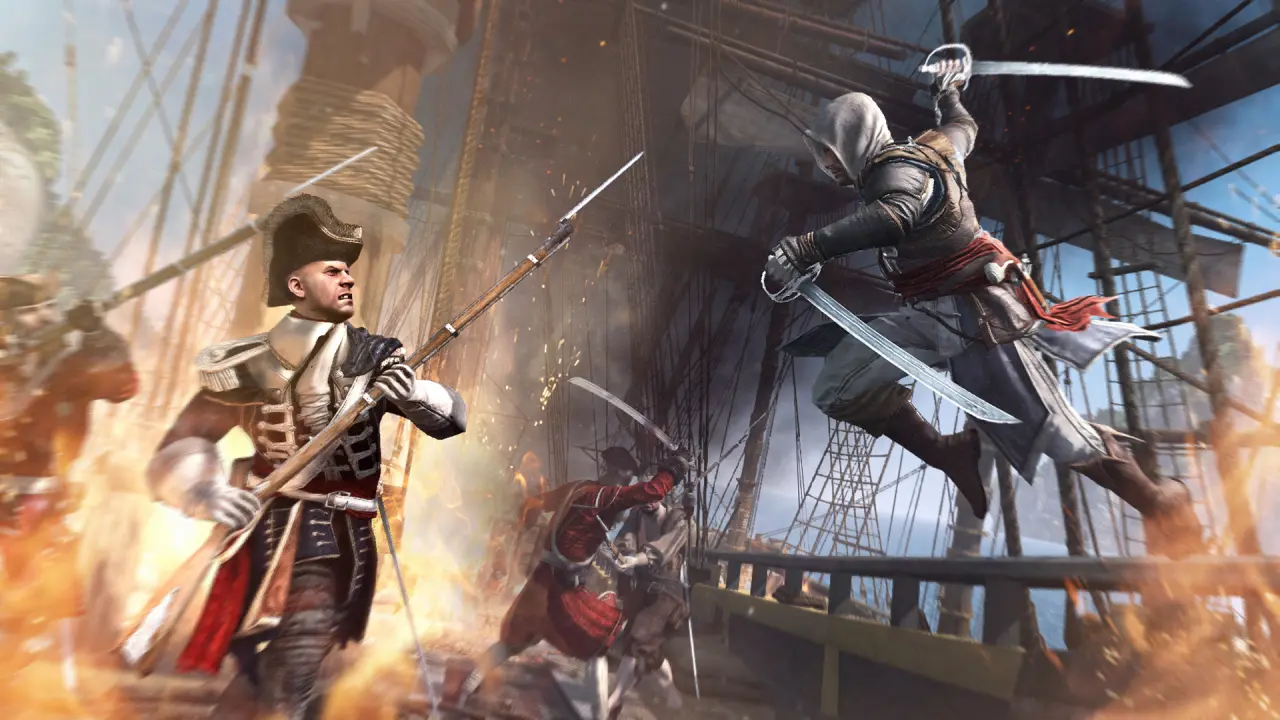
And what got it there was a seemingly risky choice: rather than clinging to its stealth-assassination roots, it boldly shifted its center of gravity to sailing and naval combat. You play Edward Kenway, a profit-hungry Caribbean pirate above all else, who only gradually gets pulled into the war between Assassins and Templars.
So this review is less about judging an Assassin's Creed game than a first-rate pirate adventure wearing an assassin's coat — what it does brilliantly, and which age-related flaws it can no longer hide.
Story | 6.0/10
Story: 6/10A hero who doesn't act like one
The best thing about Black Flag's story is its lead, Edward Kenway. He is not the kind of hero born to carry a grand mission — quite the opposite. When the game opens, he is neither Assassin nor Templar, just a poor young Welshman determined to make his fortune. The only thing he is truly loyal to is the band of brothers on his ship, and for profit he plays both factions against each other, taking what he can from each.

That setup — "a pirate first, only slowly dragged into a larger game" — makes Kenway far more vivid and grounded than many characters in the series. You are not playing the embodiment of an ideal but a real man with selfish wants and flaws, someone who will go to the wall for gold and for his crew. The supporting cast brings the golden age of piracy to life, with Blackbeard and a parade of real and invented legends passing through, while the tension between freedom and ambition, ideals and reality, runs throughout. The game does not simply romanticize piracy; it shows the cost of that "freedom" — broken loyalties, loss, and the fragility of ideals in a cruel world — giving the story a bitter edge that makes it richer than a straightforward adventure romp. Set against the series' usual cryptic grand mythology, Kenway's more personal, more direct arc is far easier to get invested in.
He grows from a reckless boy who only wants to get rich into someone who starts valuing things more than gold, and while that arc is not especially profound, it is sincere and affecting enough that you genuinely come to care about his fate rather than seeing him as just a vehicle for the plot.
A narrative dragged down by an old frame
But it has to be said honestly: Black Flag's storytelling is not as strong as its protagonist — and the trouble mostly comes from the aging "Assassin's Creed" frame draped over it.

The most obvious culprit is the modern-day strand. Every so often, the game yanks you out of Edward's memories and dumps you into a comparatively dull present-day office setting to handle some fiddly, uninteresting busywork. Each of those switches is like someone hauling you back to reality just as you were lost in the Caribbean wind, and that jarring, mood-killing break is a shared grievance among many players.
The deeper issue is how it tells its tale. Many land-based story missions still reuse the series' years-old formula: tail a target, hide in a bush to eavesdrop on a conversation, assassinate under fixed conditions. Those beats already felt dated then, and they grow tiring with repetition. They flatten what should be a rising, dramatic campaign into a formulaic and repetitive series of missions. So even though Kenway remains a strong character, Black Flag's narrative scores low here — not because it lacks a good story, but because the way it tells that story is clearly held back by the series' old habits. Put another way: if Black Flag could have shed the baggage of that old frame and placed a good character like Kenway inside a structure as free and fresh as its sailing, its story could have been better still. That sense of being held back by old habits is the real reason its narrative score is low: the ceiling is high, but the game never quite reaches it. It is a strange thing to praise a game's character so warmly while marking its narrative down, but that is exactly the split Black Flag forces: the man at the center is one of the series' best, and the machinery around him is one of its most tired. You leave remembering Edward, not the missions that carried him — and a story you remember in spite of its structure, rather than because of it, is precisely a six, not a nine. Give Kenway more modern mission design and the score would climb several points; saddled with what he has, the game cannot quite get there, and that gap between the character and the missions built around him is, in the end, the whole explanation for the score it earns here.
Audio | 9.0/10
Audio: 9/10Sea shanties you'll remember forever
Ask players what they remember most about Black Flag and the answer is surprisingly uniform: not some white-knuckle naval battle, but the shanties the crew sing together as you sail. These collectible sailors' songs are the single most inspired touch in the game's audio design.

Their genius is in turning the potentially dull business of long-distance sailing into a pleasure all its own. As you steer the Jackdaw across the Caribbean, the crew on deck strike up one rough, stirring shanty after another, and the sea wind, the wash of the waves, and the singing all blend together to heighten that feeling of being out at sea with your brothers. Years on, when players recall Black Flag, the first thing they hum is often one of those melodies. That memory, rooted in the experience rather than the plot, says everything about how well the audio works. It cleverly turns a functional design — go collect songs around the map — into an emotional one: each new shanty enriches the playlist you hear while sailing, which in turn nudges you to explore farther waters. Music, gameplay, and sentiment, all stitched together by song.
A sweeping score and a breathing sea
Beyond the shanties, Black Flag's overall music is excellent too. The game brought in the noted composer Brian Tyler, who wrote a suite of sweeping, ocean-soaked themes that perfectly underscore both the grandeur of setting sail and the tension of cannon fire.

What truly brings its sea to life, though, is the dynamic environmental sound. As conditions shift, so does the soundscape: in calm seas you hear the hull cutting through the water and birds in the distance, but a sudden tropical storm can make the sea roar in an instant, with wind, waves, and thunder colliding as a leisurely voyage turns into a struggle against nature itself. That shifting soundscape hugely deepens the realism and drama of sailing. You learn to read the sea by ear as much as by eye — the rising howl of wind warns you of a squall before the sky fully darkens, and the sudden hush after a storm passes feels earned. It is the kind of audio work that does not announce itself, but quietly convinces you that this ocean is a real, living thing rather than a textured backdrop, and that conviction is half of why the game's world feels so inhabitable.
Why the journey itself sings
Taken together, the score, the shanties, and the environmental sound make Black Flag's audio one of the strongest pillars of its immersion, and a big reason it remains unforgettable more than a decade later. In an open-world game, players spend a great deal of time simply travelling — and Black Flag uses its superb audio to turn that potentially tedious travel into the most relaxing, most atmospheric part of the whole experience.
That care for the act of sailing itself is something many comparable games overlook, and it is exactly where Black Flag pulls ahead. It teaches you that a good journey can be its own destination — which is, fittingly, about as romantic a tribute to the pirate spirit as you could ask for. Plenty of open worlds treat travel as dead time to be skipped with a fast-travel menu; Black Flag makes the travel the point, and its audio is the single biggest reason that works. Long after the missions blur together, the sound of a crew singing into a Caribbean wind is what stays with you — and a soundtrack that becomes a memory is the highest compliment a game's audio can earn.
Visuals | 8.5/10
Graphics: 8.5/10A Caribbean you want to linger in
Even by today's standards, Black Flag's rendering of the Caribbean is striking. Clear blue water, a sky stained gold and red by the setting sun, lush tropical islands, the bustle of Havana's harbor — this early-18th-century West Indies is drawn with both historical weight and the romance of adventure. At the time, it was the largest setting in the series, big enough that critics described it as having "enough content to last you for days." From noisy port towns to deserted islands to ancient ruins buried in the jungle, each place is given its own color and character, so there is always a fresh sight on the horizon. That visual richness is itself a powerful lure to explore — you will turn the wheel toward the unknown simply because you want to see what that far island looks like.

Rarer still, this sea is not just a pretty, static postcard but a living world that constantly changes. Weather and sea state shift dynamically: one moment it is calm with sun across the deck, the next a tropical storm can sweep in, black clouds pressing down and towering waves turning a leisurely sail into a fight for survival. That ever-shifting weather not only makes the scenery more dramatic, it also greatly deepens the sense of what sailing feels like — you are up against not just enemies, but the sea itself. It is exactly this sense that the weather can turn at any moment that gives Black Flag's visuals a rare vitality: a golden dusk cruise and a desperate struggle through black rain present two utterly different, equally unforgettable versions of the Caribbean.
The age that shows
Of course, it must be said honestly: Black Flag is a 2013 game.
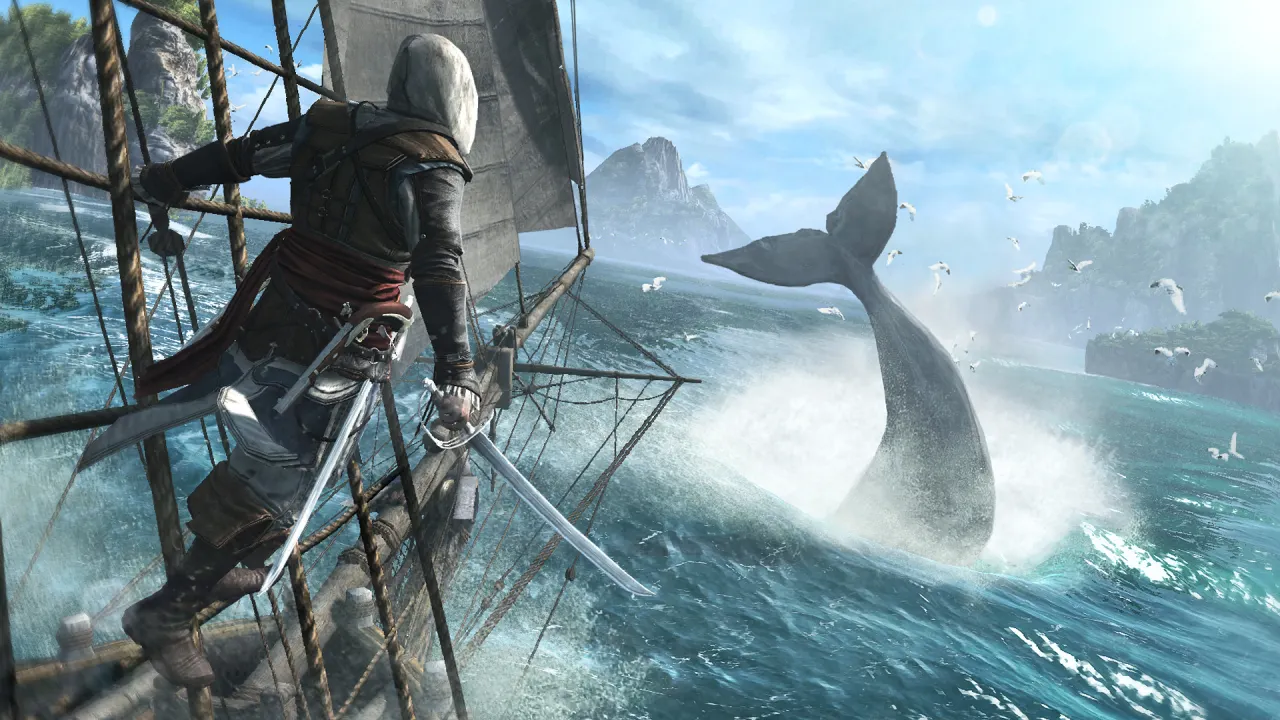
By today's standards, its image quality, character models, and technical polish naturally cannot match recent blockbusters built with the latest technology. Up close, the textures and lighting of some land scenes show clear age, and character animation occasionally has the stiffness particular to that era. That is simply a reality for older classics, and you should set your expectations accordingly before going in. Faces can look waxy in close cutscenes, foliage and crowd density are modest next to modern hardware, and the occasional pop-in or dated effect will remind you which console generation this was built for. None of it is egregious, but if you are coming straight from a 2020s open world, the gap is there and worth knowing about before you buy. The water, at least, has held up remarkably well — it is the people and the towns up close that betray the years most, while the open ocean still looks close to timeless, proof of how well a strong art direction outlasts raw horsepower.
Why it still holds up
What is striking, though, is that the game's age rarely spoils the experience. The reason is that Black Flag's visual appeal comes far more from its overall artistic mood and the shaping of that sea than from any one technical spec. The way the sea and sky seem to merge, the menace of an incoming storm, the silhouette of sails against a sunset — that visual language still works, regardless of resolution.
So even with technology from more than a decade ago, the game still sells the romantic fantasy of "being a Caribbean pirate," and it still grabs you the moment you set sail. That is also why so many players who have spent years with higher-fidelity games are still moved by its sea when they come back to it — good art was never a contest of resolution, but of mood and feeling, and when it comes to conveying the romance of piracy, Black Flag still has few rivals. When the sun sinks below the horizon, the Jackdaw's silhouette glowing gold and the crew's shanty rising on the wind, the power of that image is something no spec sheet can measure. That is the real power of Black Flag's visuals — what moves you is never the technology, but the way it makes you believe you are standing on the deck, out on that storied sea.
Combat | 9.0/10
Gameplay: 9/10Naval combat — its true soul
If you want to know what made Black Flag legendary, the answer is obvious: its naval combat. In the previous game, Assassin's Creed III, sailing was just scattered side content; in Black Flag it was expanded into a full core loop of exploration, discovery, and battle.
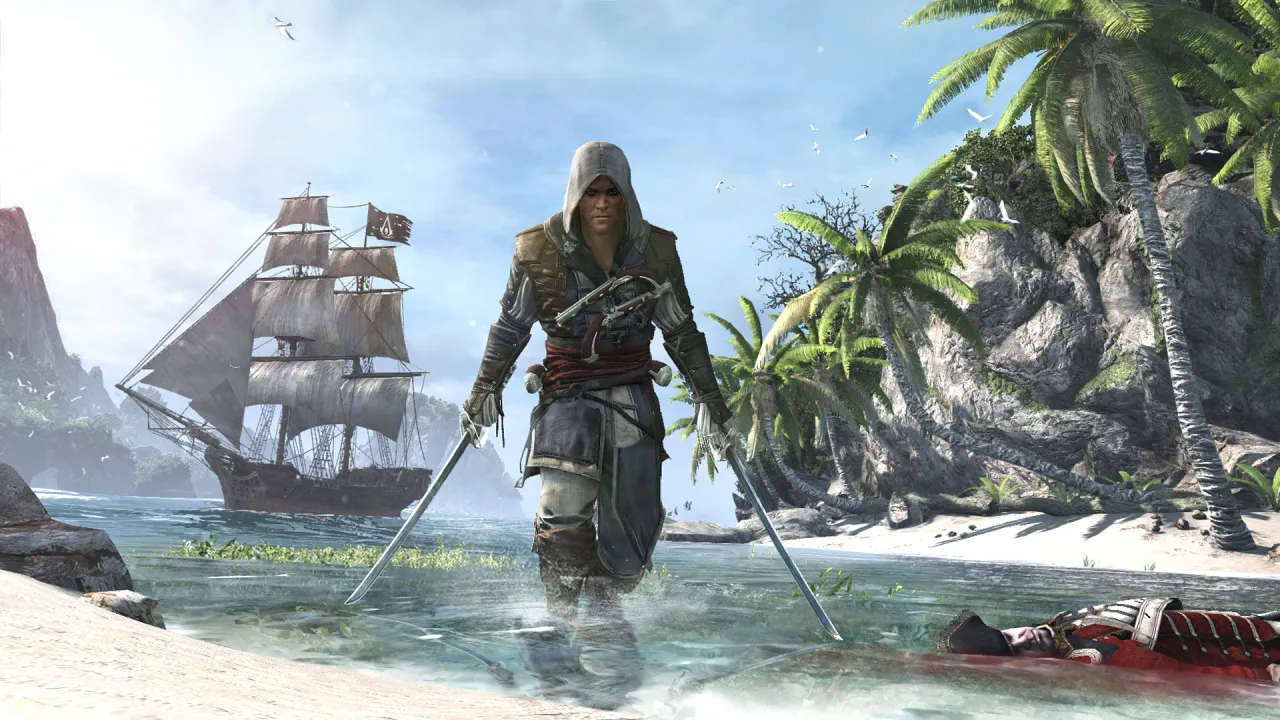
You steer your pirate flagship, the Jackdaw, into one exhilarating clash after another across the Caribbean: trim the sails to take the wind, smash an enemy's broadside with a salvo, snap their masts with chain-shot, then — as the enemy ship drops to a sliver of health — give the order and send your crew swarming aboard for a short, savage melee on the deck. The whole thing is layered and tense, giving the fantasy of "being a Caribbean pirate" real mechanical depth and emotional peaks. Critics broadly held this naval system to be among the best of its kind at the time, and it remains a thrill today. What makes the combat so impressive is that it's both easy to enjoy and rewarding to master: a newcomer can quickly feel the thrill of sinking a ship, while a veteran can dig into the interplay of wind, shot type, and positioning to take on legendary man-o'-wars far stronger than their own. That "easy to pick up, hard to master" balance is the key to why it can absorb dozens of hours without growing stale.
Sea and land as one, and a fleet of your own
One of Black Flag's most dazzling designs is the near-seamless transition between sea and land. In many games "sailing" and "going ashore on foot" are two separate modes joined by a loading screen; Black Flag all but erases that line — you can steer the Jackdaw toward an island, leap into the water before it even stops, swim ashore, and plunge into the jungle to explore Mayan ruins or hunt a target, then swim back and set sail again, all in one flowing motion. Around the Jackdaw, the game also builds a whole growth-and-management system. Every naval victory brings plunder: you gain wood, metal, and other resources to upgrade the ship's armor and cannons step by step, turning the Jackdaw from a small vessel into a terror of the seas. Enemy ships you board can be added to "Kenway's Fleet" and sent along trade routes worldwide for extra income. From single-ship battles to running a fleet, that interlocking system makes the fantasy of commanding your own pirate force feel real, and gives long voyages a steady sense of purpose — there is always another hull to upgrade, another strong foe to challenge.
That said, Black Flag's gameplay does have weak spots, and most of them lie on its more traditional "Assassin's Creed" side. Leave the sea and head ashore for a main-story assassination, and you can feel the game change — that old routine of tailing a target, eavesdropping from a bush, and killing under fixed conditions was a formula the series had used for years, and it already felt dated and repetitive even then. It clashes with the free-spirited naval play, as if two games of completely different temperaments had been crammed into one shell. Luckily, Black Flag is smart enough to stake the vast majority of its fun on the sea it does best, and the staleness of the land missions, while real, never overshadows the exhilaration of being out on the water. Set it against Ubisoft's later Skull and Bones — naval-only, hollow, and dull — and Black Flag's rarity becomes even clearer: its strength lies not in naval combat alone, but in how it stitches sailing, exploration, story, and land combat into one complete, self-consistent world. Skull and Bones had the ships and almost nothing to do between battles; Black Flag understood that a pirate fantasy lives in the spaces around the fighting — the diving, the hunting, the shore raids, the quiet sail home at dusk. That is the lesson the genre keeps relearning, and the reason a decade-old game still outdoes its would-be successors at the very thing they were built to surpass it in. Depth of systems matters, but context matters more, and Black Flag gave its cannons a world worth firing them in.
Content | 8.5/10
Content: 8.5/10A sea overflowing with things to do
Black Flag is a game absolutely packed with content. Beyond the naval combat and main story, the Caribbean is packed with things to do, and nearly every stretch of water and every island gives you a reason to stop.
You can dive to the seabed for lost treasure among shipwrecks and reefs, holding your breath while avoiding sharks. You can hunt whales, sharks, and jaguars at sea and on land and use their hides to upgrade your gear. You can also storm coastal forts, free oppressed slaves, chase down legendary ships, collect shanties and blueprints scattered across the map, and take on timed assassination contracts. Simply clearing most of the map can absorb dozens of hours. After launch, it also received extra content such as the emancipation-themed expansion Freedom Cry, making an already huge game even bigger. That strong main campaign, combined with the sheer volume of worthwhile side content and the high replayability of the naval combat, gives Black Flag staying power far beyond that of a typical action game. For many players, it is not a "finish it and move on" kind of game, but a Caribbean playground they keep coming back to, always with something left to do. Its 11-million-plus sales owe a lot to just how much there is to do.
Plenty to do, but not without repetition — and is it still worth buying?
Of course, lots of content also means some repetition is unavoidable. By the time you are storming your tenth similar-looking fort and slogging through yet another tailing mission, the sense of filler does start to creep in. Ubisoft's habit of carpeting the map with icons is already visible in Black Flag — its side content spans many types, but repeat any single type enough and the novelty fades. Fortunately, the two core pillars — naval combat and exploration — remain compelling enough that you can overlook the repetition. More importantly, most of Black Flag's side content is optional — you can stick to what interests you, and no one is forcing you to clear every icon on the map. That freedom of choice helps offset the repetition, making the game feel more like "play what you want" than "work through a checklist."
So back to the most practical question: as a 2013 game, is Black Flag still worth buying today? The answer is clear — very much so. Its core appeal — naval combat, exploration, and pirate atmosphere — has barely aged and remains a thrill to play, and as an older game that is frequently discounted, it often sells for very little. If you want to live out the fantasy of being a Caribbean pirate and enjoy open-ended sailing and naval battles, Black Flag is almost a blind buy, and many consider it one of the best entry points to the series. The only real caveat is the dated feel of the land missions and the dull modern-day storyline — but if you are here for the pirate fantasy, it most likely will not let you down. Among older classics still worth buying today, Black Flag is one of the safest bets: its core appeal has stood the test of time, and its flaws are mostly the harmless, avoidable kind. A few dozen hours of Caribbean piracy for the price of a milk tea is a bargain by any measure. Few games from its era have aged this gracefully, and fewer still can be recommended to a newcomer in 2026 without a long list of caveats. Black Flag needs only one caveat: come for the sea, forgive the land, and you will find a pirate adventure that fully deserves its enduring reputation. There is a reason it still shows up on "best in the series" and "best pirate game ever" lists a decade later, and a few hours with the Jackdaw will make it clear why. It is, quite simply, one of the safest recommendations among modern older games, and a near-perfect entry point for anyone even slightly curious about pirates or the Assassin's Creed series itself, and a game that rewards that curiosity far more than it ever taxes the player.






Comments 0
Share your game review
Join the discussion and share your review of this game.
No comments yet. Share your thoughts on this review.