























Opening
There is a telling detail about Assetto Corsa: the studio that made it, Kunos Simulazioni, has its offices inside an actual racetrack, the Vallelunga circuit outside Rome. That is not a marketing line — it is the whole philosophy of the game. When the developers want to check whether a corner feels right, they can walk outside and drive it. The result is a racing simulator so committed to physical truth that real professional drivers use its physics engine as a training tool.
This is not a game about flashy events or open-world cruising. It is a precision instrument. Fifteen official tracks are laser-scanned to one-centimeter accuracy — the Nordschleife, Spa, Monza, Silverstone all reproduced bump for bump — and its cars, 230 of them across the base game and nine DLCs, are calibrated against real manufacturer data for suspension, tires, and aerodynamics. Every input you make is translated into feedback through the wheel with a fidelity that borders on the uncanny.
It is also, frankly, demanding and a little austere. Without a steering wheel you will miss most of what makes it special, the tutorials are nearly nonexistent, and the base game is light on entertainment by design. But a decade after release it broke its own concurrent-player record, kept alive by one of gaming's great mod ecosystems. This review lays out exactly where Assetto Corsa earns its near-perfect driving marks, and who needs the gear and the patience to appreciate them.
Story | 7.0/10
Story: 7/10Assetto Corsa has no story in any conventional sense, and it does not pretend otherwise. There are no characters, no campaign, no narrative arc — just racing. Its "story" score reflects a game that replaces authored fiction with the structure of a racing career and the emergent drama of competition, which is enough to give the experience shape but never enough to make it feel like a tale being told.
A Career Structure in Place of a Plot
In lieu of a story, Assetto Corsa offers a Career mode and a set of championships that provide progression through structure rather than narrative. You work through a ladder of events and series, earning your way up, accumulating a racing résumé that is your story only in the loosest sense — the sequence of races you won and lost, the records you set. It is a scaffold for play, not a fiction, and it is deliberately bare-bones; Kunos clearly spent its energy on the simulation rather than on dressing it in a campaign.
That bareness is honest but limiting. There is no rival to defeat, no team to build, no arc of triumph or failure beyond the lap times themselves. For players accustomed to the narrative trappings of modern racing games — the manufactured drama of a Forza or a Need for Speed — Assetto Corsa can feel cold and structureless, and that absence is the single biggest reason this dimension scores where it does. It is a game that assumes you already love driving and simply hands you the keys, with none of the connective fiction that other racers use to give a session emotional stakes. For the right player that purity is a feature; for anyone hoping the racing will be wrapped in a reason to care beyond the stopwatch, it is a genuine gap.
The Cars and the Studio as Story
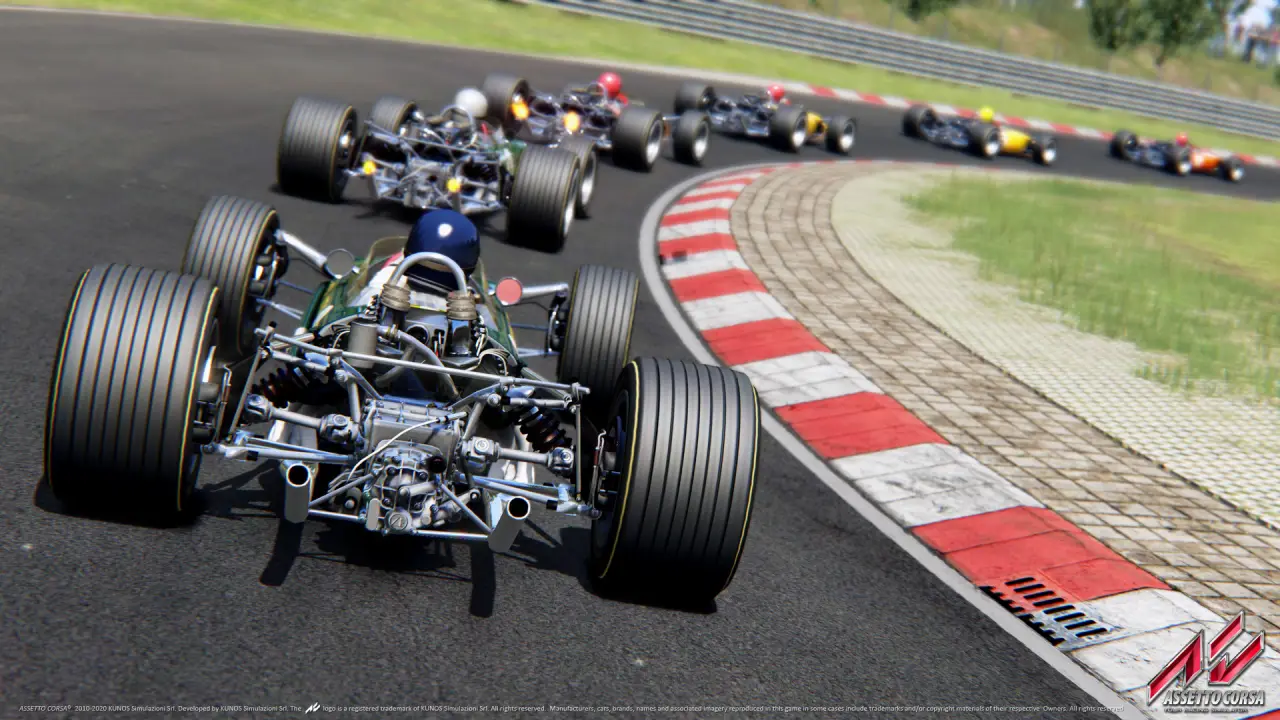
What narrative the game does possess lives in two unexpected places. The first is the cars themselves. Because the physics model is so faithful, each of the 230 vehicles has a distinct, almost characterful personality — a vintage open-wheeler is a nervous, twitchy thing demanding constant correction, a modern GT car is a planted, confident machine that goes exactly where you point it, a road car wallows and pitches in ways you learn to read and trust. Driving the collection becomes a kind of automotive storytelling, each car telling you who it is through the wheel within the first corner, and learning their distinct voices is a genuine reward in itself.
The second is the studio's own story, embedded in the design. Kunos built its offices inside the Vallelunga circuit, and that fact suffuses the whole game — the development itself was a narrative of obsessive fidelity, of people who could test their work by walking onto a real racetrack. You feel that authenticity in every laser-scanned bump, and for sim enthusiasts the knowledge of how and where the game was made is part of its meaning, a backstory of craft that the racing constantly reaffirms.
A Decade of Community-Authored Continuity
The longest-running "narrative" of Assetto Corsa is the one its community wrote. Over ten years, modders have built out the game far beyond its official scope, and in doing so created a kind of living continuity that keeps generating new contexts to race in. Full historical Formula 1 seasons recreated car by car, the entire Le Mans 24 Hours grid across every class, fantasy tracks and legendary real circuits absent from the official roster — the community supplies an endless stream of new scenarios, each carrying its own implicit story of a championship, an era, or an event.
This is emergent, player-authored meaning rather than crafted plot, and it is real: a decade after launch the game broke its own concurrent-player record, sustained entirely by this self-renewing ecosystem. But it must be said plainly that none of it amounts to storytelling in the traditional sense. Assetto Corsa is, at its heart, a driving instrument, and the score reflects a deliberate, near-total trade of narrative for simulation — a choice that defines the game as much as any of its strengths, and one this dimension is right to weigh honestly. You do not play Assetto Corsa for a story; you play it to drive, and it never once pretends the priorities lie anywhere else.
Audio | 9.2/10
Audio: 9.2/10Audio in a driving simulator is not atmosphere — it is data, and Assetto Corsa treats it that way. The sound design is among the finest in the genre, not because it is bombastic but because it is accurate and informative, feeding you a constant stream of feedback about what the car is doing through your ears as much as your hands. It is a near-top score, and it is earned through fidelity rather than spectacle.
Engine Notes and the Sound of Grip
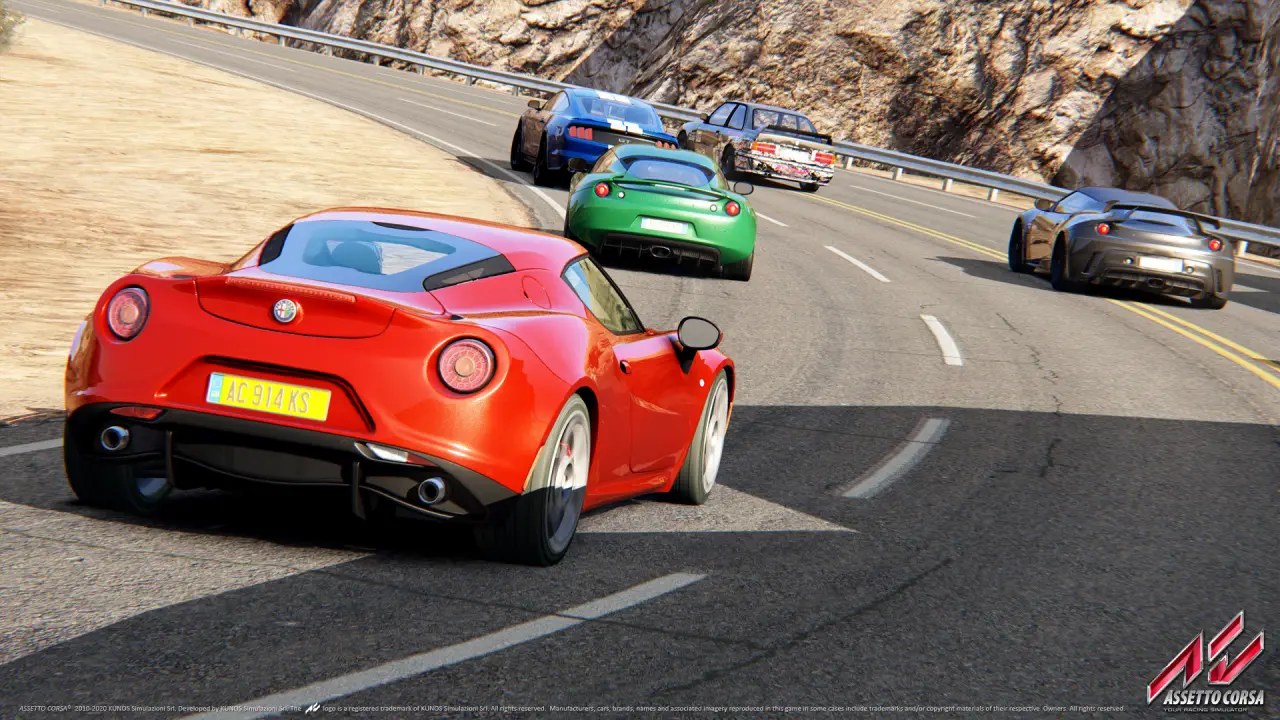
The engine sounds are the showpiece, recorded and modeled per car to capture the real character of each powertrain. A flat-six wails, a V8 burbles and barks, a turbocharged four spools and chirps on the overrun — and crucially, the sound tracks the simulation precisely, rising and falling with revs, load, and gear so that you can shift by ear alone. For drivers who race without constantly glancing at the tachometer, the engine note is the primary instrument, and Assetto Corsa's is detailed enough to drive by. The differences between cars are pronounced enough that experienced players can often identify a vehicle blind, just from the sound of it accelerating away.
More important still is the sound of the tires. The subtle shift from grip to slip — the faint chirp that becomes a squeal that becomes a howl as a tire loses traction — is reproduced with enough nuance that it functions as a genuine driving aid. You learn to hear the limit of adhesion before you feel the car break away, and in a simulation this precise, that auditory early-warning system is the difference between catching a slide and spinning. The sound is not decoration; it is part of the control loop, and that integration is the heart of why the audio scores so highly.
Immersion, Hardware, and Platform Reach
The environmental and ambient audio rounds out the package with restrained authenticity. The whoosh of passing a rival, the doppler shift of a car going by in the pits, the rumble of running over a curb, the wind at speed — all are present and accurate without ever crowding out the information you actually need. It is a mix tuned for the cockpit, prioritizing legibility over Hollywood drama, which is exactly right for a game about precision.
That care pays off most dramatically with the right hardware. In VR with a proper wheel-and-pedal rig, the spatial audio places every sound in a convincing three-dimensional cockpit, and the sense of sitting inside a real, roaring machine becomes total — the audio is a huge part of why the simulator setup is so immersive. The standard caveats are platform-bound: the console versions are more constrained and lack the community audio mods that PC players use to swap and enhance car sounds, and without good headphones or a cockpit audio setup, much of the spatial nuance is lost. But within its intended environment — a PC, a wheel, and a decent set of speakers or a headset — the audio is functional sound design at its best, every cue doing real work to make you a faster, more connected driver.
Visuals | 8.4/10
Graphics: 8.4/10Assetto Corsa's visuals are a fascinating case: a 2014 game that should look dated, yet in 2024 still holds a place near the top of the genre. The base engine is competent rather than dazzling, but the obsessive accuracy of its content — and a community that refuses to let it age — combine to make it one of the most convincing-looking driving experiences available, even a decade on.
Laser-Scanned Tracks and Manufacturer-Accurate Cars
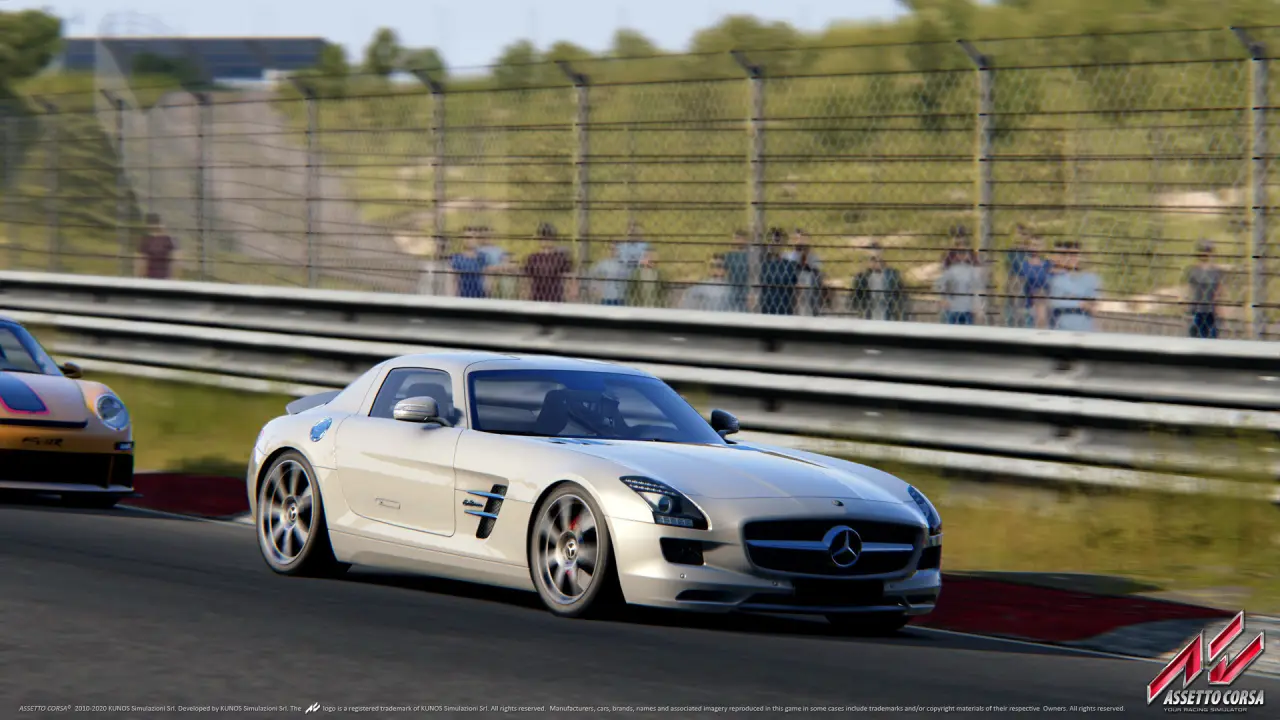
The foundation of the visual fidelity is accuracy rather than artistry. All fifteen official tracks are laser-scanned to one-centimeter precision, which means the surfaces you drive are not artistic impressions but exact reproductions — every bump, curb, camber, and elevation change of the Nordschleife, Spa, Monza, and Silverstone faithfully captured. The visual payoff of this is subtle but profound: drivers who know these circuits in real life recognize them instantly, and the way the car moves over the surface looks right because the surface is right. It is realism earned through measurement, not through rendering tricks.
The cars receive the same treatment. The 230 vehicles are modeled with manufacturer cooperation and real-world data, so their proportions, details, and surfaces are faithful to the actual machines. They are not the highest-polygon models in racing games, but they are accurate, and accuracy reads as authenticity in a way raw fidelity sometimes does not. A car in Assetto Corsa looks like that specific car, captured correctly, and for an audience that cares deeply about these machines, that correctness matters more than spectacle. The cockpit interiors deserve particular note, modeled in enough detail that the view from the driver's seat — the dashboard, the gauges, the wheel rim turning in your hands — sells the illusion of sitting in the real thing, which matters enormously given how many players experience the game from exactly that perspective.
The Community Trio That Keeps It Modern
The reason a 2014 game still looks first-tier in 2024 is almost entirely the community. The trio of Content Manager, the Custom Shaders Patch, and the Sol weather system together perform a near-total visual overhaul of the base game, and installing them is practically a rite of passage for PC players. The Custom Shaders Patch rebuilds the lighting, reflections, and material rendering far beyond what the original engine offered, while Sol layers in a dynamic weather and time-of-day system with skies, clouds, and lighting transitions that rival or exceed modern commercial racing games.
The result is genuinely striking. A modded Assetto Corsa at sunset, with volumetric light raking across a wet, laser-scanned circuit, looks like a contemporary release rather than a decade-old one. This is the visual equivalent of the game's whole philosophy — an open foundation that the community endlessly improves — and it means the graphics are not a fixed quantity but a living, upgradeable thing, which is why they refuse to fall behind. It is worth being honest that this brilliance is gated behind setup: the vanilla game looks its age, and the stunning version is something you assemble yourself.
Dynamic Lighting, Weather, and Platform Limits
With the community tools in place, the dynamic lighting and weather become a real visual strength, transforming the mood of a session from a crisp dry morning to a tense, spray-blinded wet evening, each with its own distinct look and feel. These conditions are not just pretty; they change how the track reads and how the car behaves, tying the visuals back into the simulation. A damp surface at dusk, with the low sun glaring off standing water and headlights beginning to matter, is both a visual showcase and a genuine driving challenge, the two halves of the game reinforcing each other exactly as they should. The interface, meanwhile, is functional and information-dense, prioritizing the telemetry and timing data a serious driver needs over visual flair.
The major limitation is platform. The console versions cannot run the community visual mods at all, leaving them stuck with the more dated base presentation, and they lack the upgradeability that defines the PC experience. Cross-platform play is absent, and the console builds are clearly the lesser way to see the game. On PC, properly equipped, Assetto Corsa is a visual standout that has outlasted its own generation; anywhere else, it shows its 2014 roots — and the score reflects that remarkable, if conditional, achievement of a decade-old game that still looks the part.
Combat | 9.5/10
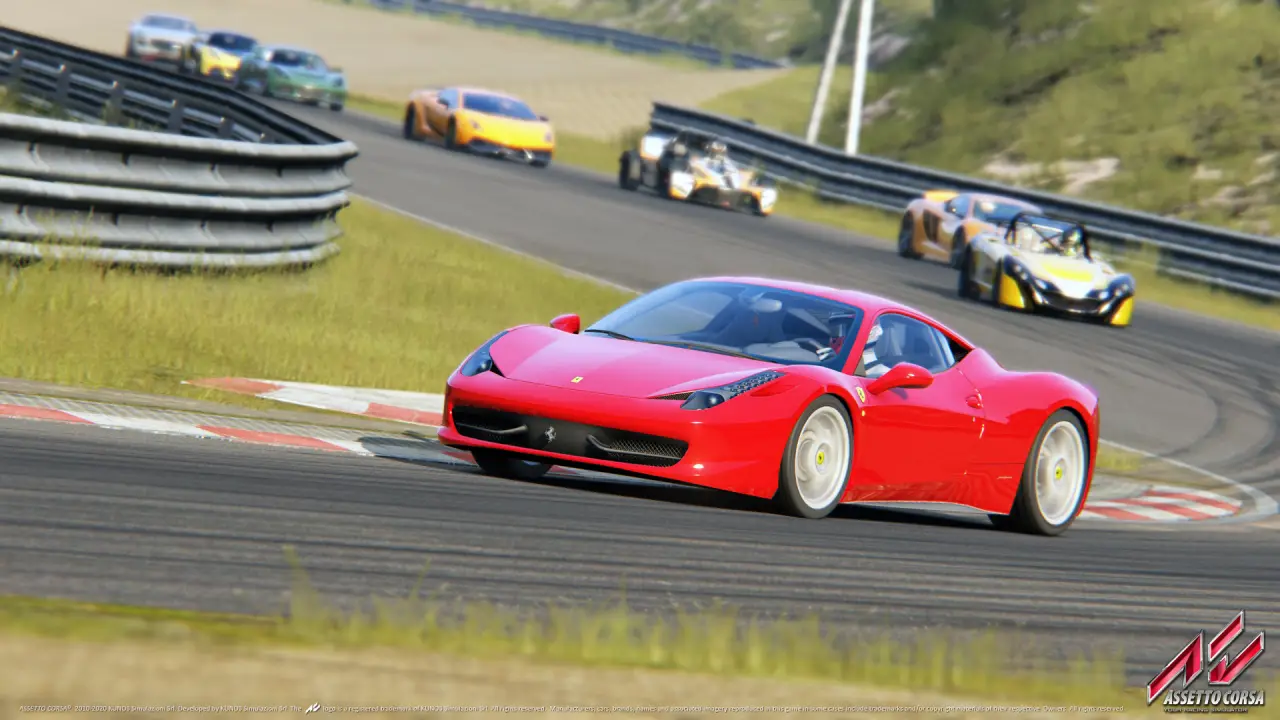
Gameplay: 9.5/10This is the heart of Assetto Corsa and the reason it is revered. The driving is as good as the genre gets — a physics model of such fidelity that professional drivers use it to train, delivering a depth of feel and mastery that almost nothing else matches. It earns its near-perfect score on the strength of one thing done better than anyone: making a car feel real through your hands.
The Physics Engine, the Game's Beating Heart
Everything in Assetto Corsa flows from its physics. The simulation models suspension, tire behavior, weight transfer, and aerodynamics with a fidelity calibrated against real manufacturer data, and the result is a driving feel that communicates the car's state with extraordinary clarity. You feel the front tires load up under braking, the rear go light over a crest, the grip build and fade through a long corner — and because it is modeled rather than scripted, the car responds to your inputs and the track surface in ways that are consistent, learnable, and deeply rewarding to master. This is why pro drivers adopted it as a training tool: the transferable skill is real, the muscle memory genuine.
What makes it sing through a wheel is the force feedback, which translates the contact patch of the tires into resistance and texture in your hands. A good wheel turns Assetto Corsa into something close to telepathy with the car — you feel the road, the slip, the kerb, the limit — and it is in that channel of communication that the game's greatness fully reveals itself. It is the most direct, honest driving feel available, and once it clicks, lesser games feel numb by comparison.
Setup Depth and the Community Toolchain
On top of the raw driving sits a deep tuning system. Dozens of parameters — tire pressures, suspension stiffness, differential settings, downforce, gearing, brake balance — can be adjusted, and on this faithful physics model those changes produce real, feelable differences in how the car behaves. Dialing in a setup for a specific car and track is a satisfying engineering puzzle in its own right, a layer of strategy that rewards understanding and experimentation, and at the competitive level it becomes as important as the driving itself, where finding the last tenth of a second often lives in the setup sheet rather than the steering.
The PC experience is completed by the community toolchain. Content Manager replaces the clunky default interface with a vastly better launcher and mod manager, while the Custom Shaders Patch and Sol overhaul the visuals and add weather; together they are effectively mandatory, and learning to install and use them is part of becoming an Assetto Corsa player. This open architecture is the gameplay's force multiplier, the thing that turns a great driving sim into an endlessly extensible platform you assemble to your own taste.
Hardware, Immersion, and the Barriers to Entry
At its fullest, Assetto Corsa is played in a cockpit. The game fully supports VR headsets and wheel-and-pedal rigs, and assembled into a proper sim setup it becomes one of the most immersive experiences in gaming — sitting inside a faithfully modeled car, on a faithfully scanned track, feeling every input through the wheel while your head moves naturally around the cockpit in VR. For the hardcore audience this is the entire point, and nothing else delivers it quite so completely.
But that ceiling comes with real barriers, and they are the reason this otherwise flawless dimension carries any caveat at all. Without a wheel, much of the magic is inaccessible: controller and keyboard play simply cannot communicate the physical fidelity the whole game is built to convey, and a newcomer on a gamepad may wonder what the fuss is about. The tutorials are nearly nonexistent, so early players must turn to YouTube and community guides to learn the fundamentals, and the base game is deliberately light on entertainment and structure. None of this dents the quality of the driving itself — it is sublime — but it does mean the gameplay reveals its brilliance only to those who bring the gear and the patience, which is exactly the trade this score reflects. The gap between a frustrated newcomer and a devoted veteran here is wider than in almost any other game, and which side you land on depends almost entirely on whether you arrive with the right equipment and the willingness to climb the curve. Cross that threshold and the driving is simply unmatched.
Content | 9.0/10
Content: 9/10Content is one of Assetto Corsa's great strengths, but the official package is only the beginning of the story. The real volume — and the reason the game is still thriving a decade after release — comes from one of the largest and most dedicated mod ecosystems in gaming. Layer by layer, Assetto Corsa builds from a solid official base into a practically bottomless library of cars and tracks.
The Official Foundation and Nine DLCs
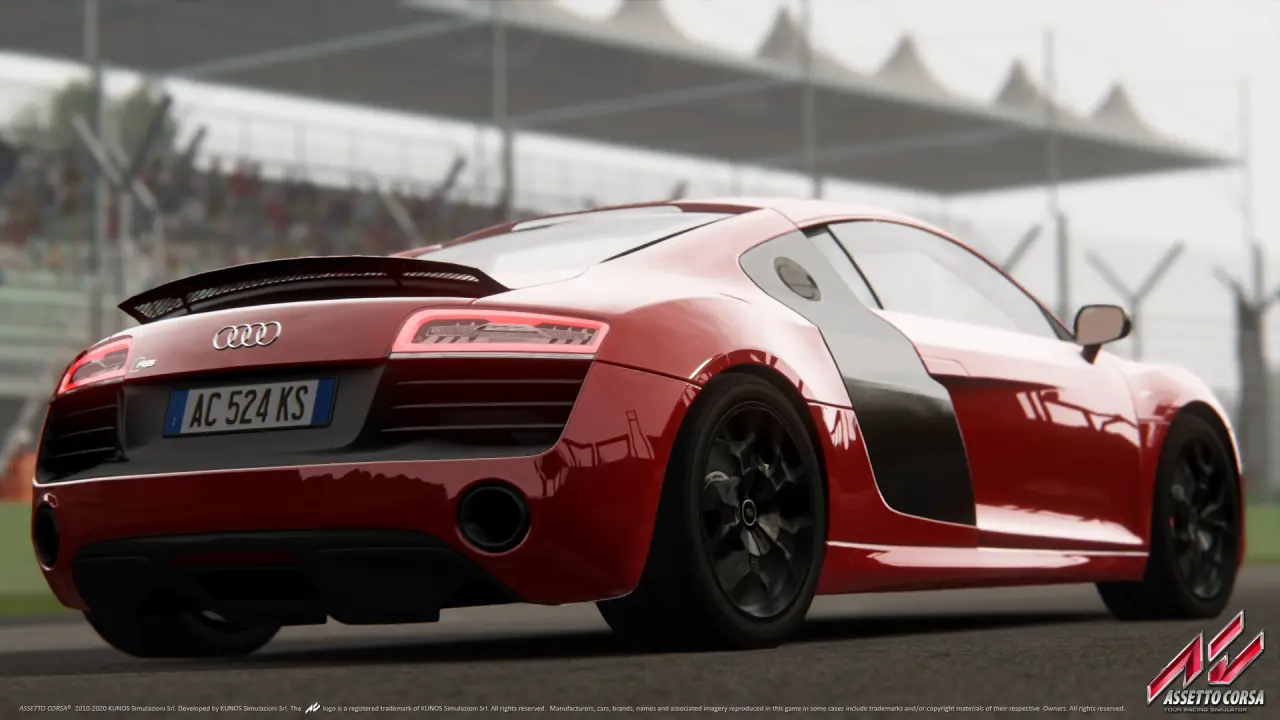
The first layer is the official content, and it is substantial in its own right: the base game ships with around 130 cars and fifteen laser-scanned tracks, a roster that already covers a wide span of road cars, vintage racers, and modern competition machinery on some of the world's most famous circuits. It is enough for hundreds of hours before a single mod is touched, and every piece of it is built to the same exacting standard of accuracy. The official roster is also curated with a clear love of motorsport history, mixing iconic road cars with legendary race machines, so even the base game feels like a thoughtfully assembled collection rather than a random grab-bag of licenses.
On top of that sit nine official DLCs that expand the garage to roughly 230 cars. The Dream Pack series, the Japanese Pack, the Porsche packs spanning the marque's history, and a Lamborghini-focused expansion add carefully modeled, manufacturer-licensed vehicles across a huge range of categories. These are not throwaway add-ons but the same high-fidelity content as the base game, and together they make the official package alone one of the more complete driving sims available. For a player who never ventures into mods, there is more here than most will ever exhaust.
The Mod Layer Is the Largest of All
The third and by far the largest layer is the community. The mod ecosystem dwarfs the official content, offering an estimated five thousand community cars and eight hundred community tracks — a scope so vast it is hard to overstate. Whatever you want to drive, someone has almost certainly built it: full historical Formula 1 grids recreated season by season, the entire Le Mans 24 Hours field across every class, rally stages, drift tracks, fantasy circuits, and meticulous recreations of real-world roads and tracks absent from the official roster. This is the content that makes Assetto Corsa effectively infinite, transforming a great driving sim into a universal driving platform onto which the entire history of motorsport has been recreated.
The quality varies, as it always does with community content, but the best mods rival or exceed the official cars and tracks in fidelity, and the toolchain for finding, installing, and managing them is mature. For the player willing to engage with it, the practical content here has no meaningful limit — you could drive a different car on a different track every day for years and never run dry.
A Decade of Support and a Professional Tool
What ties it all together is longevity. Ten years of continuous community modding and ongoing interest have kept Assetto Corsa not just alive but growing, to the point that it broke its own concurrent-player record long after release — an almost unheard-of feat for a decade-old game, and a direct testament to the depth and renewability of its content. The open platform Kunos built has proven far more durable than any closed, finished product could be, because its content is supplied by a community that never stops.
Beyond sheer volume, the content carries a professional dimension that few games can claim. Assetto Corsa is used in esports and, more strikingly, as a genuine training tool by real racing drivers and teams, who rely on its accurate cars and tracks to prepare for real-world events. That a piece of consumer software is trusted at that level speaks to the seriousness of what is on offer here. Measured against its peers, the content matrix is among the deepest in the genre — and the score reflects a game that, between official rigor and community abundance, gives its audience more than they could ever finish. The only honest deduction is that this abundance is gated behind the effort of curating and installing it, and that the console versions, cut off from the mod layer entirely, experience only a fraction of what makes the content so deep. On PC, for the player willing to dig in, it is as close to limitless as the genre offers.






Comments 0
Share your game review
Join the discussion and share your review of this game.
No comments yet. Share your thoughts on this review.