





















Opening
If you could pick just one game to answer "is VR worth buying," a lot of people would give the same answer: Beat Saber.
It is the acknowledged "killer app" of VR — plenty of people buy a headset specifically to play it. Its reputation is staggering: 93 on Metacritic, around 86 on OpenCritic across 34 reviews (the top "Mighty" tier, 91% recommending it), and an Overwhelmingly Positive 95% across nearly 70,000 Steam reviews.
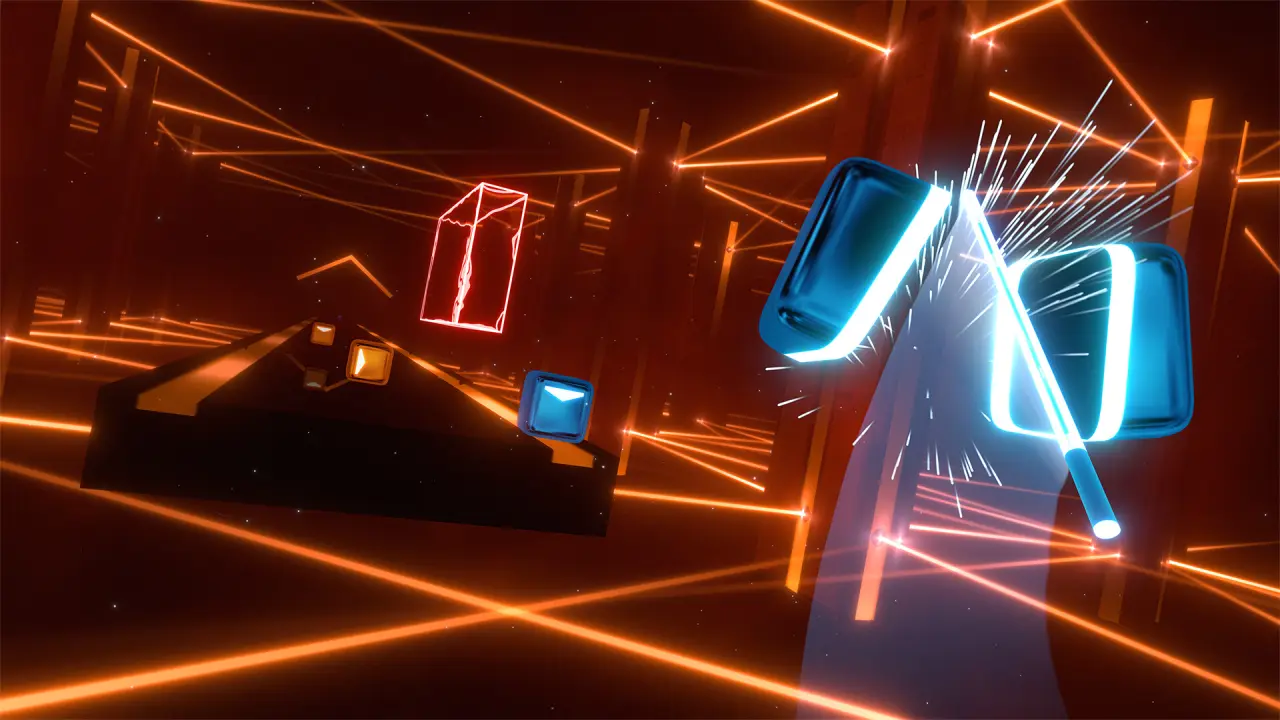
The gameplay is simple enough to sum up in a sentence: hold a saber in each hand and, in time with the driving music, slash the incoming blocks according to their color and direction.
From that simple core, it becomes something close to perfect — easy enough to learn in seconds, but hard enough that you may never truly master it. That gap between instant accessibility and a sky-high skill ceiling is the whole magic trick, and it is one almost no other game pulls off this cleanly.
Better still, it is not only fun; it makes you sweat, lets you play the rhythm with your whole body, and gets you a workout in the bargain. This review explains exactly why it became legendary, which caveats and shortcomings you should know about first, and whether it is the game that finally convinces you to buy into VR.
Story | 6.0/10
Story: 6/10A game with no story — and it doesn't need one
Let us say this up front: Beat Saber has no story in any sense. No protagonist, no cutscenes, no plot thread, no single-player campaign. There is no world to save, no villain to beat, no truth to chase. From start to finish, it is you, two sabers, and one song after another. If you come in hoping for a narrative and a few characters to meet, you will realize right away that none of that is here — only pure gameplay.

But that is not a flaw — at least not for a pure rhythm game. Beat Saber's design philosophy is to focus all of your attention on the sheer satisfaction of slashing blocks; any narrative would only be a distraction. Its clean, abstract future world exists to set a mood and frame the rhythm, not to tell a tale. Here, "no story" is a deliberate trade-off, not a case of cutting corners.
In fact, most all-time classics in the music and rhythm genre have no real plot either — the appeal was never what they "say," but what they make you do and feel. Forcing a story into a rhythm game often gilds the lily, breaking that pure, thoughtless joy. Beat Saber clearly understands this, dropping storytelling from the outset and putting all its effort into making the act of slashing blocks feel better. There is a discipline in that choice that is easy to underrate: it would have been trivial to bolt on a flimsy sci-fi framing story about saving a digital world, and it would have added nothing but loading screens and menus between you and the next song. By refusing even that, the game keeps the distance between "I want to play" and "I am playing" as close to zero as any game gets.
Who it isn't for — and why this dimension scores neutral
Because of that, "story" is a peculiar entry among this review's six dimensions. We cannot hold it to the standard of an RPG — it never set out to compete on that track. So its score here is more of a "neutral" marker: it has no narrative achievement to speak of, and no narrative failure either, because narrative is simply not where it puts its energy.

That said, if you especially value story-driven single-player content and are used to being led by a plot, Beat Saber may feel "empty" to you. It offers no emotional arc and no narrative payoff at the end; instead, it delivers an immediate kind of joy rooted in movement and rhythm. That joy is intense, but it is something different. Seen another way, Beat Saber's lack of narrative also lowers the barrier to entry — you need no backstory, no characters, and no lore to remember; put on the headset, pick a song, and you're instantly in. That "zero-baggage, pick-up-and-play" quality is, for a game meant to show everyone the magic of VR, actually an advantage. It never puts anything in your way; it simply hands that joy straight to you. So rather than call "no story" a weakness, it is better to say this is what the game deliberately gives up for the sake of purity and directness — and for the vast majority who play it, that trade is very much worth making. Treat this score, then, less as a verdict on quality and more as a category label: Beat Saber is not a game that fails at story; it is a game that opts out of story entirely, and judging it otherwise would be like marking down a sport for not having a plot. Go in knowing that, and the dimension simply stops being a question. The only people genuinely ill-served are those who specifically wanted a single-player journey with a beginning, middle, and end; for everyone else, the absence is invisible within seconds of the first song starting, swept away the instant the first block flies toward you and your arms start to move in time with the beat. For a rhythm game built entirely on feel and movement, that is exactly as it should be, and it is a kind of focus worth admiring.
Audio | 9.0/10
Audio: 9/10Playing the music with your whole body
For a music game, the music is its soul, and Beat Saber's achievement here is fusing "listening" and "moving" to an almost instinctive degree. When you cut a block, the stroke lands right on the beat; as a melody builds, the density and rhythm of the blocks build with it. You are not swinging your sabers while listening to music — you are playing that music with your entire body.

That synchronization of body and rhythm creates a level of immersion that traditional rhythm games struggle to replicate. The built-in original tracks are mostly high-energy electronic dance music, with clear beats and sharp rhythms well suited to slashing. Paired with carefully designed maps, you slip into a flow state without noticing, cutting harder and harder with the music. What makes the experience unique is that it engages more than your ears and fingers — your arms swing, your torso turns, your breath rises and falls with the beat. When it all lines up, you get the strange, wonderful illusion that the music is not carrying you, but that each of your movements is playing the melody into being.
The one weak spot inside a strength
That said, as a music-first game, Beat Saber has one repeatedly noted weakness in its music: its built-in library is fairly narrow in style.

The vast majority of its original tracks are electronic dance music. That kind of music certainly has crisp beats well suited to slashing, but after a while it can feel one-note and short on variety. If your favorite genre — rock, pop, classical, anime songs — falls outside that range, the novelty of the official library may fade fairly quickly. Critics, while praising the gameplay, almost all point to the limited song selection and lack of stylistic variety as a real shortcoming. For a game whose entire loop is built on music, that matters more than it would elsewhere — the songs are not a backdrop here, they are the levels themselves, so a narrow library is, in effect, a narrow content pool. A player who lives for EDM will barely notice; a player who wanted to slice through rock anthems or orchestral scores out of the box will feel the ceiling fast.
The cure, hinted at
Fortunately, this weakness has a near-perfect cure: its powerful custom-song ecosystem — but that is something we will save for the "content" section. Judged purely on its built-in music and sound design, it is more than competent and plenty exhilarating; it just falls a touch short of "flawless" for lack of stylistic breadth. So your mileage with its stock music depends heavily on whether your taste aligns with its strong EDM bent: if it does, you are in heaven; if it does not, you will be wishing for more variety. Either way, what is here is mixed and presented with real polish — the issue is range, not quality. The tracks that do exist are tightly mapped, their charts choreographed to the music rather than slapped on top of it, so even the stock songs feel authored rather than generated. That craft is precisely why the narrowness stings a little: you can hear how good the game is at turning a song into a level, and you simply wish it had more songs, and more kinds of songs, to work with. It is a complaint born of wanting more of a good thing, which is the best kind of complaint a soundtrack can inspire.
Visuals | 9.0/10
Graphics: 9/10Minimalist, but extremely classy neon-future
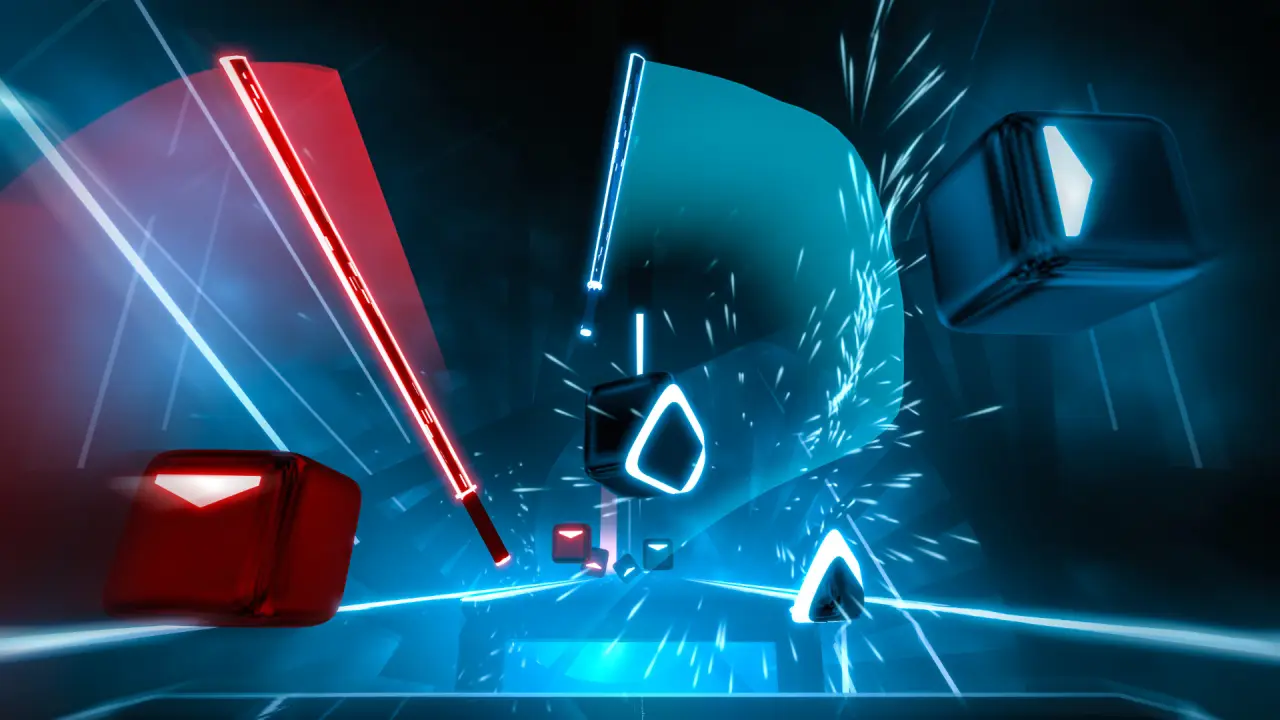
Beat Saber's visual style takes a minimalist yet extremely classy road. Its setting is a clean, abstract vision of the future: deep dark backgrounds, glowing neon lines, and lights that pulse with the beat, all combining to create a stage with a strong technological sense of ceremony. It avoids elaborate detail, but that spare, sharp sci-fi mood grabs you at first glance. It does not try to "trick" you into a virtual world with photoreal graphics; it openly presents an abstract, stylized stage, and that itself creates a distinct, almost ritual immersion — you know perfectly well you are in a game space, but that very purity lets you throw yourself into the rhythm without any baggage.

That minimalism isn't laziness; it's a carefully considered trade-off. For a rhythm game that demands split-second reactions, any extra visual element risks becoming a distraction. Beat Saber keeps anything that might distract you to an absolute minimum, letting you focus entirely on the incoming blocks and react with precision. The red and blue sabers and blocks stand out sharply against the dark background, with excellent readability — even in the densest maps, where blocks come at you like a downpour, you can clearly tell each target's color and direction. This is functional visual design taken to an extreme.
While many games chase realism and dense detail, Beat Saber goes the other way, cutting away everything inessential and leaving only the clearest visual elements so your full attention stays on slicing the blocks. That restraint is itself a kind of high design intelligence. It is also a quietly difficult thing to pull off: an empty black void could have felt cheap or unfinished, yet Beat Saber makes its minimalism read as deliberate, even luxurious, through confident lighting and a strong sense of rhythm in the environment itself. The stage feels designed, not absent.
A virtuous loop between sight and thrill
What is especially clever about Beat Saber's visuals is the way they become part of the thrill. As you slash blocks in a row and your combo climbs, the lighting and effects of the whole scene grow more dazzling — sabers leave gorgeous light trails, and the background neon brightens and intensifies with your performance.

That design forms a wonderful virtuous loop: the better you cut, the prettier it gets, and the prettier it gets, the harder you throw yourself in. The visuals are no longer mere decoration but a direct participant in the fun. It proves a plain truth that is often overlooked: good visual design is not about how much detail you pile on or how expensive the tech is, but about whether it precisely serves the core experience. Beat Saber's visuals may be simple, but their identity, immersion, and seamless fit with the gameplay make the game one of the best showcases of "less is more." Because it does not rely on demanding graphics technology, it is relatively easy on hardware, and even modest standalone headsets can run it smoothly without the visuals feeling compromised. Whether you play on PC VR, a Quest standalone, or PlayStation VR, this sharp, eye-catching visual language reliably delivers the same pure thrill — good-looking, easy to read, easy to run, with almost nothing to fault. That hardware-friendliness is no small thing for VR specifically, where heavy graphics can mean dropped frames and, worse, motion discomfort; by keeping the visuals clean and the frame rate rock-steady, Beat Saber stays comfortable to play for long sessions, which is exactly what a game you return to daily needs. The art direction, in other words, is not just pretty — it is engineered for the way people actually play it. Comfort and clarity are not glamorous selling points, but in VR they are the difference between a game you can enjoy for an hour and one that gives you a headache in ten minutes. Beat Saber lands firmly on the right side of that line, while still looking sharp enough to make onlookers want a turn the moment they watch someone else play it on a nearby screen. Few games manage to be this comfortable to play and this fun to watch at the same time, and that dual appeal is no small part of why it spreads so easily from one person to the next.
Combat | 9.5/10
Gameplay: 9.5/10Easy to learn, hard to master — a simple core, perfected
Beat Saber's gameplay is simple enough to explain in a sentence: hold a saber in each hand and slash the blocks flying at you by the color and direction they show. Red blocks go to the left hand, blue to the right, and each block carries an arrow telling you which way to swing. From that simple core, the game polishes the experience to near-perfection.

Its brilliance lies in the fact that it is easy to learn but hard to master. Anyone who puts on a headset can be playing within ten seconds, immediately feeling the thrill of carving blocks to the beat; raise the difficulty, though, and the blocks come in dense, devious patterns that demand crossed hands, full-body coordination, and a great deal of practice and muscle memory. That vast space between "anyone can play" and "experts only" is the key to gripping VR newcomers and hardcore players alike — newcomers grin instantly, veterans obsess over beating their own limits. Rarer still, the path from novice to expert is unusually clear and satisfying — you can feel yourself improving, from early flailing and missed cuts to smoothly keeping up with faster and faster rhythms, with each jump in difficulty bringing a real sense of achievement. That visible growth is a powerful reason to keep coming back and pushing higher. More than anything, Beat Saber's edge is how good the act of cutting feels, built on an almost obsessive level of polish. The instant your saber meets a block, the game delivers a layered burst of feedback — controller rumble, a crisp sound, and the block exploding in a visual flourish — so every swing feels solid. The hit detection is tuned just right: not so loose it loses challenge, not so strict it frustrates. The trail a saber leaves through the air, the rush of a climbing combo — these small details stack into a feel that nothing else replicates, and on a platform that demands presence as much as VR does, that rock-solid feedback is what turns a simple idea into a classic you cannot stop replaying.
More than a rhythm game — dodging, dueling, and sweating
Beat Saber's depth also shows in the fact that it is not only about cutting. In higher-difficulty maps you must constantly duck and lean to dodge the obstacle walls rushing at you, putting your whole body in motion. That quietly turns it into a surprisingly intense workout — one authority has even rated its exertion as on par with tennis. Beyond single-player runs, it offers online multiplayer where you can compete with friends in real time to see who can cut more accurately and build higher combos, while global leaderboards give hardcore players a place to chase scores and compete.
Set against rhythm-shooter peers that fold the beat into on-rails action, Beat Saber wins on the purity of its design and the sheer level of its polish — it never tries to be more complex; it takes the single act of "slashing blocks to music with sabers" and does it better than anyone else in the genre. Many games try to do too much and end up doing nothing well enough; Beat Saber goes the other way, focusing on one thing and doing it almost flawlessly. That restraint and focus — perfecting something simple — is both the hardest thing to do and the most admirable, and it is the main reason Beat Saber still sits atop the VR rhythm throne years later. It is worth stressing how unusual that longevity is: most games built on a single mechanic burn bright and fade, their one idea exhausted in a weekend. Beat Saber's idea, by contrast, seems to deepen the more you play it, because the skill ceiling and the music keep giving you new reasons to swing. A simple game that stays compelling for years is not an accident — it is the mark of a core loop tuned with extraordinary care, refined to the point where there is simply nothing left to trim. Every element that remains is load-bearing, and that economy is the quiet signature of great design.
Content | 7.5/10
Content: 7.5/10The built-in library's biggest practical drawback
If Beat Saber has a real weakness, it is almost entirely a content issue — more specifically, the limits of its built-in library. Although the game has added plenty of free tracks through updates, the base song count still feels a bit small for something this popular, and the selection is not very varied.
That means if you only play the stock songs, you may get through them and grow tired of them fairly quickly once the novelty wears off. To expand the library, the developer has released many paid music packs in collaboration with well-known artists and bands, featuring plenty of familiar hits — but those packs cost extra, and buying them one by one adds up over time. In other words, unless you use some other option, you either have to live with a fairly limited official library or keep paying for new packs to get fresh music. That is a real problem a content-driven rhythm game like this cannot escape. Critics, while praising the gameplay, almost always point to the limited built-in track count and lack of variety as its main drawback. After all, for a rhythm game, "how many songs there are to play" is a core metric, and on that count, judged only by what is officially provided, Beat Saber is not exactly generous.
Custom songs — the factor that changes everything and gives the game its longevity
But there is one factor that can completely change the verdict on Beat Saber's content: its powerful custom-song ecosystem. On PC, Quest, and similar platforms, players can use community tools like ModAssistant to import a huge volume of player-made maps — by some counts the community has produced over 50,000 custom songs, and almost any pop tune, anime track, or game score you can think of has a map for it. That basically removes the small-library problem; you can slash blocks to almost any music you love, and the song library becomes practically endless. An estimated 65% of active players use custom songs — a big reason so many never put the game down. But a clear warning: this perk is not for everyone. PlayStation players currently cannot use mods or custom songs and are limited to official tracks, so how much you get out of Beat Saber depends heavily on which platform you play on.
Taken as a whole, Beat Saber's content situation is a study in extremes: a limited baseline, but an almost limitless ceiling. Trapped in the official library, its content does look a bit thin; but the moment you can use custom songs, its playable content is all but inexhaustible. Add years of steady free updates from the developer and a very active custom-mapping community, and Beat Saber no longer feels like a dated first-generation VR game — it is still one of VR's most enduring hits, near the top of sales and activity charts across platforms. For a player who just got a headset today, it remains the safest, least disappointing starting point. So whether the game's content feels substantial depends largely on you: are you willing to put in a little effort to set up custom songs, or do you just want to jump in and play the official content? The former gets a library that feels almost endless; the latter may run out of options quickly. The gap is so wide that, depending on the player, the game's "content" score can feel like two completely different ratings. It is genuinely hard to assign a single score to a game that can feel either unusually content-starved or extraordinarily content-rich, depending entirely on the platform and whether custom songs are available. The fairest approach is to judge the official experience as it ships — good, but limited — while making it clear that, for most PC and Quest owners, the true ceiling is far higher. Few games have value that swings this wildly based on how much setup you are willing to do, and that is worth knowing before you judge it. The practical takeaway is simple: if you are on PC or Quest and even mildly willing to tinker, treat the content concern as nearly moot; if you are on PlayStation or want a strict out-of-the-box experience, weigh the official library carefully, because that is the whole of what you will get.




Comments 0
Share your game review
Join the discussion and share your review of this game.
No comments yet. Share your thoughts on this review.