
























Opening
After the crash, the protagonist does not walk back into the sunlight. He is taken down, beneath the surface, into the dark. The first time the name Rapture surfaces on screen, it does not read like a sanctuary at all. It reads like a manifesto that has already begun to rot, an idea so confident in itself that it forgot ideas can decay. Andrew Ryan built his utopia under the sea, and the city that greets you is not safe, not proud, only haunted by a residue of "this place used to be respectable." That residue is the most unsettling thing here, more than any enemy in the corridor ahead.
What BioShock does best is not the shooting, and it is not the survival pressure it wraps itself in either. The finest thing it does is keep reminding you, level after level, that what you are exploring is not a ruin. It is the autopsy of a failed conviction. You walk through the consequences of a belief, and the architecture itself testifies against the man who designed it. Playing this game well over five years past its release, you can feel the age in your hands. The controls, the pacing, the interface logic, none of it fully escapes the wear of time. Pretend otherwise and you are lying to yourself.
And yet Rapture keeps its grip on you, a stickiness that is genuinely rare. You already know the road ahead will not be kind, and you still want to descend one more layer, open one more sealed door. It is like turning over an old record that has gone moldy in storage. There is a hiss across every groove. The surface noise never quite leaves. But underneath all of it the melody is still there, still legible, still capable of catching in your throat the next morning when a single word floats back up: control. This review is about whether that pull is worth your hours in 2026, with eyes that have seen everything that came after.
Story | 8.5/10
Story: 8.5/10BioShock's narrative is powerful not because the main plot is intricate, but because it performs a quiet sleight of hand: it makes the city itself the protagonist. You arrive in 1960 by accident, the survivor of a crash, and from that opening descent the story stops being something you are told and becomes something you walk across. The themes on paper are not new. A genetic-enhancement dream, a utopia curdled, a will imposed on others. Pull any one of them out and you have read it before. But pressed together inside Rapture, they gain a density that few story-driven shooters ever reach.

A city that testifies against its founder
The opening hours hand you Rapture's first impression through pure exploration, and that impression sets the tone for everything after. You are not handed a lore dump; you are dropped into the residue of one. The smartest move BioShock makes is refusing to let dialogue argue the author's point for him. Instead the collapsed order speaks for itself. Why does an ideal city rot into this? Why does a place that calls itself free eventually need to control the people inside it? The game is in no hurry to answer. It lets you keep walking until the smell of the place reaches you on its own. Cold. Briny. Threaded with rust. Andrew Ryan's utopian conviction is not delivered as a thesis statement; it is reconstructed from the wreckage of his own promises, and the reconstruction is the experience. By the time you understand what Ryan wanted and what it cost, you have already lived inside the consequence, which is a far heavier thing than being told about it. The genius of the approach is that it never lectures. A poster, a sealed office, a length of corridor arranged just so, each one is an argument made without words, and the cumulative weight of those small arguments is what gives Rapture its moral gravity. You are not persuaded; you are implicated, walking the proof of a thesis you never consented to test.
Manipulation as the thematic detonation
The mid-game turn around personality manipulation is where the whole structure pays off. The themes of genetic alteration and the bending of a human will, abstract on their own, suddenly land with real weight because the game has spent hours earning your trust in your own choices. The protagonist's arc is not built on tearful character close-ups; it is built on the slow, queasy realization of how a will can be steered. This is the moment that converts a moody atmosphere into a genuine thematic detonation. It is also where BioShock most clearly separates itself from the story-shooter pack of its era. The deranged inhabitants of Rapture are not just obstacles in a hallway; they are the visible cost of a philosophy that promised liberation and produced compulsion. The game asks you to sit with that cost rather than resolve it cleanly, and the discomfort is intentional. What makes the turn so durable is that it reframes everything you did before it. Choices you thought were yours acquire a second meaning, and the city you thought you were exploring reveals itself as a machine that was reading you the whole time. That retroactive shock is the kind of writing that survives the years even when the surrounding production does not, and it is why the moment is still cited as a high-water mark for the medium. It does not depend on a cutscene or a swell of music; it depends on the player having believed, and then being shown the shape of that belief from the outside.
A noir parable, not a character drama
There is a real limitation here, and it is worth naming plainly. By current standards the narrative packaging is not always smooth. Parts of it read more like a concept being exhibited than like characters growing organically. The consequence is clear: you will remember Rapture, but you may not remember the emotional arc of every figure who lived there. Is that fatal? It is not. The core appeal of this work was never "who cried, who was lost." It is the spectacle of an ideal forcing itself into a monster. If you compare BioShock to film, it is not a character drama that wins through close-ups. It is a noir parable where art, sound, and theme all press down on you at once. You may not feel elated when the credits roll. You will feel something colder, and the next day a single word will surface unbidden. Control. That is enough. That is what earns the score, and that is why the ending's reckoning over Rapture's fall stays with you long after the old-fashioned parts of the game have faded from memory.
Audio | 5.5/10
Audio: 5.5/10Audio is the hardest dimension to come down hard on, because the effective sources do not fully unpack the music, the sound effects, or the voice work. What can be reasonably inferred from the overall reception is that the oppressive, uncanny atmosphere requires sound to participate. Without it, Rapture would not press on you the way it does. But inference is not the same as sufficient evidence, and this section has to leave room for that gap rather than paper over it.

Sound as the humidity in the air
In experiential terms, BioShock's audio value behaves like the damp in the environment. It does not necessarily stand up every second to make you memorize a melody. What it should do, continuously, is remind you of three things: you are underwater, you are not safe, and people once lived here. Good audio design of this kind is not about turning the volume up. It is about tapping lightly on the wall right when you were about to relax. One tap is enough. You turn your head. That is the register Rapture's soundscape seems to be working in, a constant low pressure rather than a showcase, the audio equivalent of the water leaning on the glass. In the opening descent especially, the sense of confinement is something you hear before you can name it, and that early conditioning is what lets the dread accumulate as you go deeper into the city. Think of how much of Rapture's unease is carried by things you do not consciously register: the groan of stressed metal, the distant drip, the way a space sounds sealed rather than open. Those cues are doing constant load-bearing work on the atmosphere, and the proof of their importance is the thought experiment of removing them. Mute the game and the oppression largely evaporates, which tells you the soundscape is not garnish but structure, even when no single cue is showy enough to demand a paragraph of praise on its own.
Why the score stays conservative
The problem is that without directly citable media assessment, it cannot be inflated into a decisive strength. In all probability the sound complements the environmental construction, but it is hard to pull out on its own and pit against top-tier audio works. The experiential consequence is that it can support the atmosphere while not necessarily becoming the part you hum to yourself years later or replay on purpose. At least from the existing material, the evidence does not support a higher rating. So this score leans deliberately conservative. That is not to say the audio is weak. It is to say its verifiable highlights are not concentrated enough to claim more. For a game like BioShock that leans so heavily on spatial oppression, sound is certainly not decoration; it is simply that, within the scope of this review, it behaves more like a pipeline hidden beneath the waterline. You can feel it working. You would struggle to point at one spot and say, there, that is worth an eight. This is the difference between effective design and quotable design. A score wants a standout, a theme you carry out of the building, a piece of voice work people clip and share. The evidence here does not let me promise any of that. It lets me promise competent, atmospheric, purpose-built audio that knows its job and does it without applause, and a responsible review has to grade what it can actually verify rather than the reputation it assumes the game must have earned somewhere off-page.
Where it sits among its peers
Measured against its immersive-sim relatives, BioShock's audio likely holds the line rather than leading the field. The genre's strongest entries treat soundscape as a primary tool for selling a sealed, hostile space, and Rapture clearly belongs in that conversation even if the available evidence stops short of crowning it. The fair conclusion is a careful one: the audio is almost certainly doing essential atmospheric labor, the kind you notice only when you imagine the game without it, but the documentation simply does not let us promote it from "essential support" to "standout achievement." That restraint is why the number lands where it does, and it is the most defensible read the evidence allows. It is worth being explicit that a conservative number is not a dismissive one. The dimension is held back by a documentation gap, not by an audible flaw, and a different evidentiary picture could easily justify a higher mark. If anything, the safe reading probably undersells the craft, because games that sell confinement this well rarely do so with weak sound. But a review trades in what it can show, and on the available material the most honest position is a careful one: present, essential, and quietly accomplished, yet short of the concentrated, citable excellence that a higher score would require me to demonstrate rather than merely suspect.
Visuals | 7.0/10
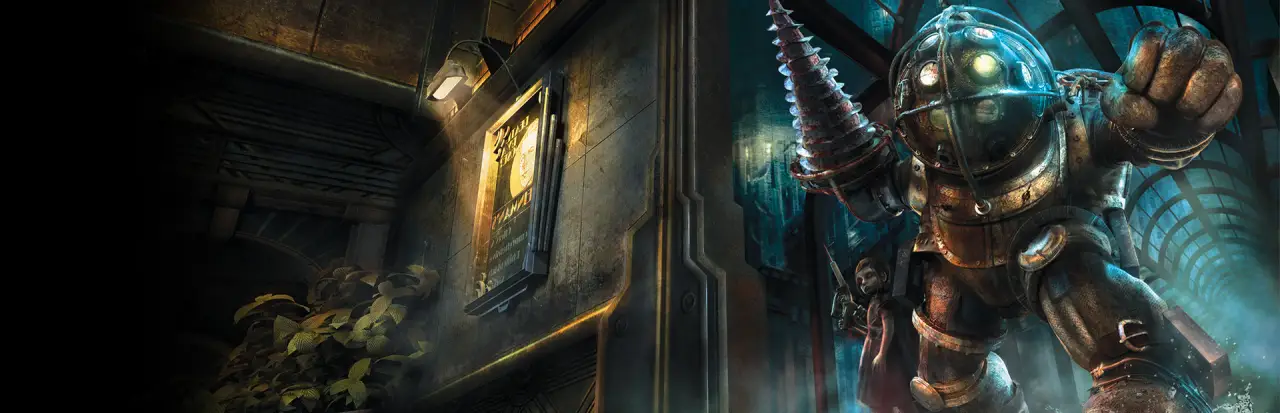
Graphics: 7/10The most magnetic thing about Rapture is that it refuses to photograph itself like a tourism advertisement. The undersea city is dark, oppressive, carrying a kind of grandeur that has been bent out of true by the water pressure around it. The visual character that effective reviews keep circling back to still holds up today: it does not rely on brightness, and it does not rely on density. It relies on a sense of direction. One glance and you know this place is wrong, that something here broke and never healed.

Style that serves the theme, not the spec sheet
Art saves a great deal in BioShock. Rapture's visual pull is not merely that it looks good; it is that the look serves the theme. The darkness of the city is not a filter slapped over the frame. It is the skin of a failed utopia. Those cramped, pressurized spaces make exploration uncomfortable on purpose, and that discomfort is exactly the effect the game is chasing. You did not come here to check off landmarks. You came to witness a collapse. Related screenshots make the point cleanly: the gloomy environments and the sealed, claustrophobic interiors illustrate where the art direction puts its weight. It is not showing off technique. It is pressing you down into the atmosphere until you stop noticing the seams and start noticing the dread, the dread that this design wants you to carry from room to room. The art-deco vocabulary is doing thematic work too. Every curved brass fixture and water-streaked mural is a fragment of the optimism Rapture was built on, now soured, and the contrast between the elegance of the design language and the decay laid over it is the whole emotional point. You read the ambition and the failure in the same glance, and that doubled reading is something a prettier, more neutral art style could never deliver.
Aging technology you cannot pretend away
The PS3 version preserved as much of the original's full visual experience from other platforms as it could, and for a port of that era that mattered. But seen with current eyes, the technical aging cannot be fully sidestepped. Material work, the layering of light and shadow, the granularity of scene detail, all of it reminds you that this is not a new game. Do not pretend you cannot see it. It is old. The honest read is not that the visuals are bad but that they are dated, and the gap is widest for players raised on modern high-spec rendering. First contact may require a moment of adjustment, a recalibration of expectation before the style can do its work on you. The available cross-verifiable information about the graphics is also limited, so it would be irresponsible to nail down every technical detail as fact. The safer judgment is this: the visual style still carries a distinct identity, while the technical execution is clearly marked by its age. The distinction matters because the two age at different rates. A texture resolution dates the moment a newer card renders something sharper, but a silhouette, a use of negative space, a willingness to let a room sit in near-darkness, those choices barely age at all. Rapture leans on the second category far more than the first, which is why screenshots from it can still stop you even as the surface detail looks plainly old. The direction outlives the hardware that rendered it, and that is the kindest thing you can say about a game's visuals nearly two decades on.
Rapture against Columbia, gloom against glare
It helps to set Rapture beside its own family. The main rival here, the floating city of Columbia from the series' later entry, is brighter, more ornate, almost luminous by comparison. Placing the two side by side is what makes Rapture's particular achievement legible. Columbia dazzles; Rapture broods. The undersea city's cramped, humid, water-warped corridors create a sense of confinement that the brighter sequel deliberately trades away. Neither approach is wrong, but they are aiming at opposite feelings, and BioShock's original wager on gloom is the one that gives this game its lasting visual signature. Does the technical aging affect the experience? Yes, especially for newcomers expecting contemporary fidelity. Is it fatal? No. Because the art's goal was never to be pretty. The goal was to make you uneasy, and on that single metric Rapture still succeeds with an ease that newer, prettier worlds rarely match. The score lands where it does because identity and intent survive the years even as the pixels show their wear, and because the atmosphere does more heavy lifting than any modern lighting pass could.
Combat | 6.5/10
Gameplay: 6.5/10BioShock's gameplay skeleton is first-person shooting fused with survival-flavored progression. Stated that plainly it sounds direct, but in the hand it plays more like a slow dive than a sprint. You do not blast straight through; you hunt for resources, routes, and the next sliver of truth while the pressure of the city tightens around you. The clear upside is that combat and exploration are never split into two separate skins. The further you push, the more it feels like Rapture is consuming you, layer by layer, breath by breath.

Two hands, two systems
The signature design is the dual-hand combat: a conventional weapon in one hand, a special ability in the other. This is the structural choice that separates BioShock from an ordinary shooter. You are constantly improvising combinations, reading a room and deciding whether to lead with a gun or with something stranger. The deranged inhabitants you face are not bullet sponges to be cleared on a timer; they are problems that reward a player willing to mix and match the two hands. That improvisational layer is where the moment-to-moment combat finds its identity, and it is the part that has aged the most gracefully. Even when the raw feel of the shooting shows its years, the decision space around it, the question of how to pair tool with talent, still produces small bursts of cleverness that a pure shooter of the same vintage simply cannot offer. The system rewards experimentation rather than punishing it, which keeps the fights from collapsing into rote. There is a real tactical literacy that builds over the hours, too. You learn which talent softens a target so a weapon can finish the job, which environmental feature can be turned against a group, which opener buys you the half-second you need. None of this is spelled out for you; it accrues through play, and the accrual is satisfying precisely because the two hands keep the decision space open instead of funneling you toward one optimal answer. That openness is the quiet reason the combat still holds interest long after its raw shooting feel stopped being state of the art.
Building yourself through gene tonics
Progression is driven by ability construction. Through plasmids and gene tonics you reshape what the protagonist can do, and that reshaping gives both combat and exploration a build-craft depth that was uncommon for shooters of the period. You are not just getting stronger on a fixed curve; you are choosing a flavor of capability, leaning into one approach and accepting the tradeoffs of another. This is the matter-energy interaction at the heart of the design, the sense that your loadout is a set of tunable systems rather than a static arsenal. It also feeds back into the survival pressure. Because resources are doled out with restraint, every enhancement you commit to is a small wager, and the build you grow becomes a record of the choices you were willing to make under scarcity. The depth is real, even if the surface presentation is dated. And the build system folds back into the exploration loop in a way that keeps the two halves of the game talking to each other. A new capability does not just change a fight; it changes what you can reach, what you can open, what corner of Rapture suddenly becomes legible. That feedback between getting stronger and seeing more is what stops the progression from feeling like a numbers treadmill. You are not grinding toward a stat ceiling; you are unlocking new ways to read the city, and that framing is far closer to an immersive sim than to a conventional shooter's upgrade tree.
Old-fashioned feel, and a port with a little extra
Looking back with today's standards, the contradictions in the gameplay grow sharper. The setting, atmosphere, and progression structure still carry flavor, but the instant feedback of the first-person shooting may not satisfy players accustomed to modern handling. The problem is specific: when the narrative and the spaces are pulling you forward, some encounters can feel like thresholds you simply have to clear rather than fights you savor. The experiential cost is not trivial; you start anticipating the next room, the next piece of information, more than the next firefight. This is not a fatal wound, because BioShock's gameplay value comes from fusion: shooting supplies the pressure, survival supplies the restraint, exploration supplies the temptation. Judged on action feel alone, it is not especially fresh. Taken together, it still stands. The PS3 version is not a lazy port either; it folds in extra exclusive content. That addition does not rebuild the skeleton, but it is the kind of small, well-judged side dish that proves the port was served with care rather than indifference, and a careless port is the thing players fear most.
Content | 6.0/10
Content: 6/10BioShock's content engine is clear about what it wants from you: explore Rapture, and gradually peel back the truth of how the city fell. It does not stuff the map with side markers, and it does not bury you under exhaustive checklists. It pulls you forward with one persistent question. What, exactly, happened here before you arrived? That kind of pull is old-fashioned. It is also remarkably effective, the sort of hook that needs no quest log to keep working on you.

A drive built on "what happened here"
The content is propelled by the slow reconstruction of a catastrophe rather than by volume. You move through the city's themed districts, and each one adds a piece to the picture of how an ideal slid into ruin. There are no side quests sprawling across a minimap demanding completion; instead there is environmental storytelling, the scattered detail, the recording, the way a room is arranged, all of it doing the work that a quest objective would do in a more conventional game. This is the structure that keeps exploration meaningful even when the literal content count is modest. The deranged inhabitants and the wreckage they leave behind are not filler encounters; they are evidence, and gathering that evidence is the real activity. For a player who enjoys piecing a world together, every advance feels like filling in another corner of the map's hidden history, and that feeling is the content's true currency. It is a deliberately authored kind of density, not a procedural one. Nothing here is randomly generated to pad a runtime; every recording was placed, every tableau was staged, every district was given its own chapter in the city's decline. That authorial fingerprint is what makes the modest scale feel intentional rather than thin. You are not consuming content so much as reading a designed argument, and the pacing of revelation, what you learn and when, is itself a form of content that a quest counter would never capture.
What we cannot responsibly claim
Caution is required here. In the available information, the content volume, the replay durability, and the side-mission structure all lack stable consensus. It would be dishonest to assert a fixed number of hours, a fixed count of branches, or a fixed amount of hidden material. What can be confirmed is that the PS3 version adds extra exclusive elements on top of the original, which genuinely strengthens that version's appeal. But that strengthening reads more like a top-up than a renovation. Do not expect it to transform the game into something else. The honest framing is that BioShock offers a focused, curated quantity of content rather than a sprawling one, and how generous that feels will depend entirely on what you walked in wanting. Setting it next to its immersive-sim relatives makes the calibration clearer: this is a tighter, more authored experience than the systemic sandboxes some of its peers chase. Where a more systemic peer might hand you a toolbox and a wide space and trust emergence to generate your hours, BioShock keeps a firmer grip on the route, trading breadth for a curated sense of inevitability. That is a defensible design choice, not a deficiency, but it does set a ceiling on the raw quantity of things to do. The honest reviewer's job is to name that ceiling without pretending to know its exact height, because the sources simply do not provide a reliable figure to quote, and inventing one would undermine the very caution this dimension demands.
Who it rewards, and who it leaves wanting
Experientially, exploring Rapture is closer to reading a waterlogged, wrinkled archive than to chasing a completion percentage. You do not turn the pages for a trophy; you turn them to assemble how a city slid from ideal to collapse. That structure still holds real appeal today, especially for players willing to slow down and look. The flip side appears just as quickly: if you care more about explicit rewards, long-term progression systems, and map density, BioShock may feel less than generous. There is flavor here. There is not a feast. The impact of this design is genuinely person-dependent. Lovers of environmental narrative will feel every step completing the worldview; players chasing modern open-ended fill may find the consumable content restrained. Is it fatal? No, but it will shape whether you want to replay. This is not the "one more loop is irresistible" kind of game. It is the "I want to see this whole city to its end" kind, and that distinction is exactly what the content score is trying to capture.




Comments 0
Share your game review
Join the discussion and share your review of this game.
No comments yet. Share your thoughts on this review.