
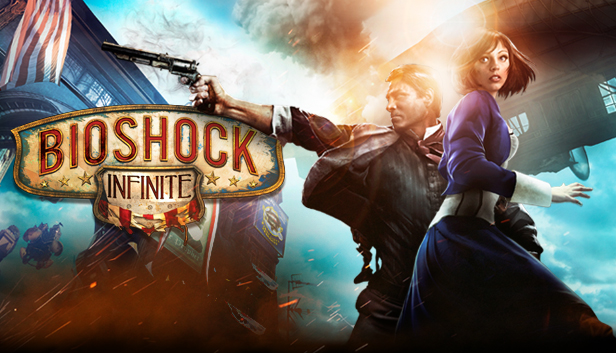

BioShock Infinite
Price History
Past 36 months · Updated dailyPrices cover Steam and 39 authorized stores; only legitimate offers are counted. The chart shows weekly market-wide lows and Steam's official price across the past 36 months.


01About BioShock Infinite
As Booker DeWitt, fight through the floating city of Columbia to rescue Elizabeth. Combine weapons and Vigors, zip along Sky-Lines, and open Tears in space and time to bring useful resources into combat. Player rating: 93% from 109,878 reviews. The Steam PC version lists German interface support and German subtitles.

Credits
Lowest recorded in 36 months
$1.652026-07-30 · KinguinBase game · same records as the chart above; USD history, not a regional Steam low.Language support
| Language | Interface | Subtitles | Audio |
|---|---|---|---|
| Traditional Chinese | Yes | Yes | — |
| English | Yes | Yes | Yes |
| French | Yes | Yes | Yes |
Show 8 more languages
| Language | Interface | Subtitles | Audio |
|---|---|---|---|
| German | Yes | Yes | Yes |
| Italian | Yes | Yes | Yes |
| Spanish | Yes | Yes | Yes |
| Polish | Yes | Yes | — |
| Portuguese-Brazil | Yes | Yes | — |
| Russian | Yes | Yes | — |
| Japanese | Yes | Yes | Yes |
| Korean | Yes | Yes | — |
Steam PC edition data · 2026-10-16
02Before you buy
Play and control
The Steam PC version lists full controller support and a single-player mode.
Language
English is listed for interface and full audio. The supported language list also includes German subtitles.
03Frequently asked questions
What is the story about?
Booker DeWitt must rescue Elizabeth from the flying city of Columbia.
What shapes the combat?
Combat combines weapons and Vigors, while Sky-Lines and Tears that bring resources into the battlefield add options. Completing the game unlocks 1999 Mode.
Can I play solo?
Yes. Single-player is listed for the Steam PC version.
“A utopia adrift in the sky that pushes world-building and ending into series territory few reach, with merely serviceable combat as the trade-off”
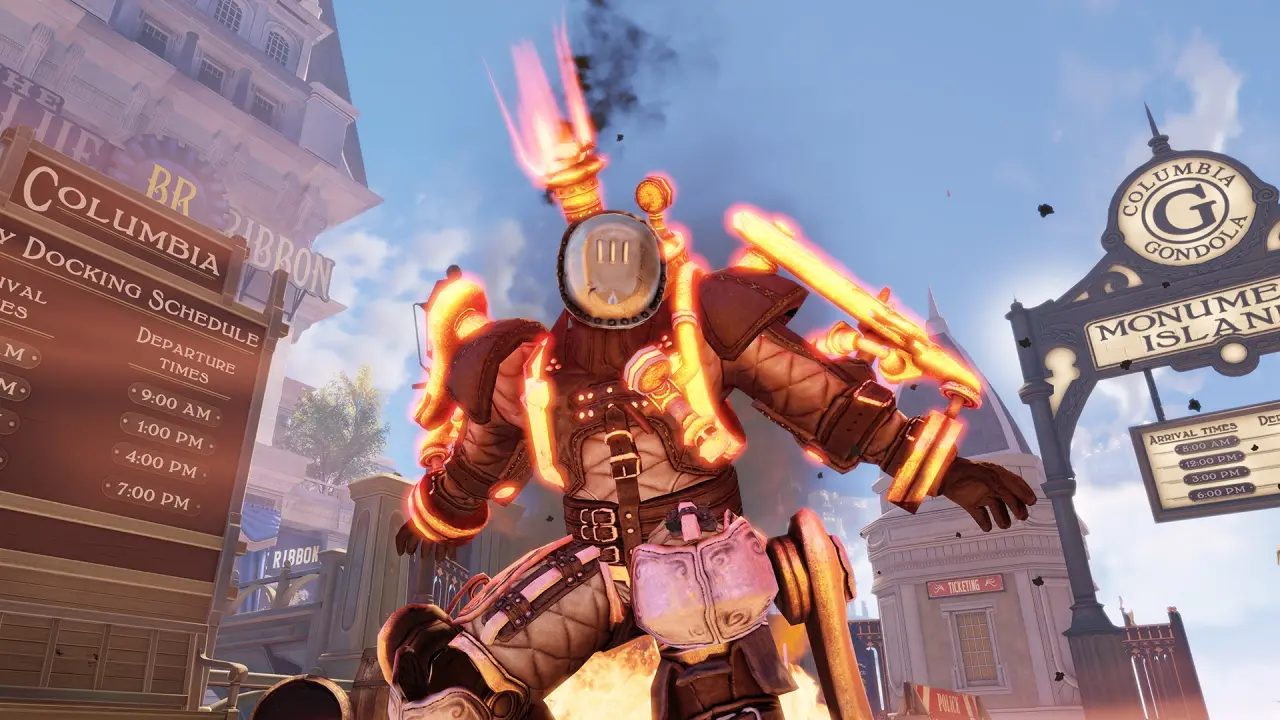
Our Verdict
A trophy case that filled itself, and who it is actually for

Back at its release coordinate, Infinite swept nearly every prize that mattered. It took Game of the Year from a long roll of outlets and all but cornered the year's Best Shooter awards; its Metacritic average landed at 94, parked in the top tier of critical acclaim. Whatever year-end list you dig up, its name sits near the front. And that haul was never the product of one standout metric — it was world, story, art, score, and mood pulling together. More than a decade on, the raw technical numbers have been overwritten many times over, yet its achievement at the hardest thing — being remembered — still stands without fading. It has stopped being merely a good game and become a cultural reference point, the kind of work that gets cited in arguments about whether the medium can carry real ideas. That is a status no resolution bump or frame-rate chart can confer, and it is the truest measure of what Infinite pulled off.
Whether you should buy it turns on what you actually want from a shooter. If you want narrative density and atmosphere far above pure combat thrill, and you will gladly spend time on an ending built to be turned over and over, this game is close to tailor-made for you: a city you want to study, a companion you will not forget, a journey that lingers. If instead you are after hardcore combat feel, deep weapon progression, and a high-freedom action sandbox to grind, and the fiction leaves you cold, it will likely let you down. The shooting is only fine. Knowing that up front spares you a mismatched purchase and lets the right player walk into Columbia with clear eyes.
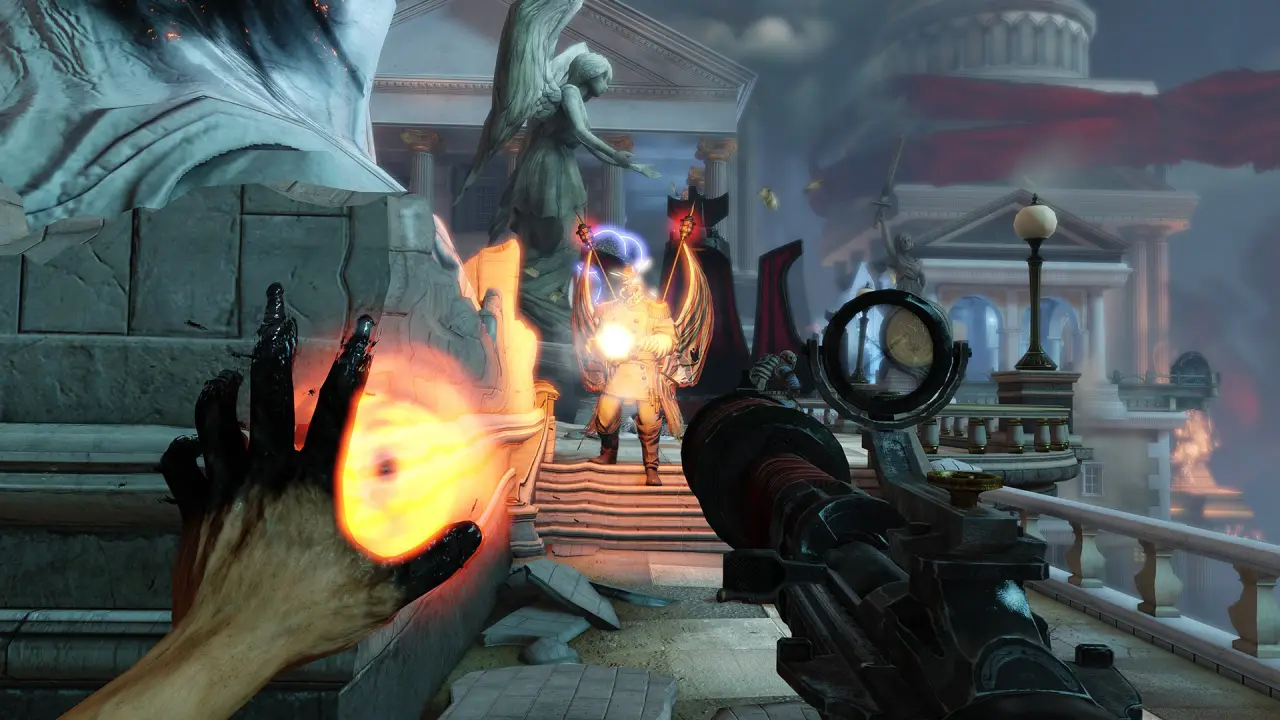
Which version, and where it sits in the series

Of every edition, the Complete one is the version to own. It packages the base game with Clash in the Clouds and both Burial at Sea episodes in a single buy, and since Burial at Sea is indispensable to the meta-narrative, there is little reason to skip it unless you only ever intended to sample the core. As series history, this is the capstone Irrational Games left for the whole BioShock saga before the studio was reorganized. Burial at Sea explicitly threads Infinite's multiverse back to the franchise's first undersea city, so the Complete Edition effectively functions as the period's full stop.
And the thing it cannot be copied on still holds. The first ascent from a lighthouse into 1912 Columbia — together with that intact world and that ending — is a wonder no sequel has managed to reproduce. Set against its most direct rival, Dishonored, the contrast is clean: Dishonored wins on systemic freedom, but it never reaches what Columbia achieves in world-completeness, companion writing, and the emotional weight of its finale. That, in the end, is why this game remains without a replacement.
Popular Steam reviews
Native-language selection · 10 reviewsSelected helpful reviews in this language show both recommendations and criticisms. This selection does not represent the overall positive rating; opinions reflect the version reviewed.
Basic information Title: BioShock Infinite Developer(s): Irrational Games Publisher(s): 2K Games Genre(s): Action, First-Person, Shooter Singleplayer: Yes Multiplayer: No Numerical Impression Overall */10 AI 8 Atmosphere 10 Gameplay 9 Graphics 10 Characters 10 Optimization 9 Originality 10 Sound 10 Soundtrack 9 Story 9 Ratings 94/100 General Impression Bioshock Infinite was originally going to be more of an open world game with a variety of features but with disagreements in development accompanied with the limitations the product was facing on other platforms, they decided to scrap most of what they were working on to create the version you see before you. The product Irrational Games showcased at E3 2010 is significantly different compared to the product that's available to the consumer. Not every game has to have more than one ending, stealth mechanics, weapon customization, a third person player view, character customization, a variety of meaningful choices, manual save mechanics, modification development tools or have no scripted moments to be a decent game. Sure, any one of these features would have been great additions and dispite of the downgrade, I can absolutely recommend Bioshock Infinite if the price is right.Show moreShow less
The game is great, but ruined by the random inclusion of 2K launcher and DRM with today's update. REMOVE IT NOW, 2K!! It's a single player game that's over 10 years old, ffs!Show moreShow less
Well, I just wanted to shoot things, but the game gave me feels instead.Show moreShow less
Bioshock Infinite is essentially an overhyped hallway shooter. At first the atmosphere and city seem full of potential, but as you proceed through the game, all of it disappears and is replaced by mixed feelings of boredom and dread. This isn't because the enemies or environment are frightening or intimidating, but because playing the game quickly goes from 'a promising Bioshock sequel' to 'tedious mob-killing chore oh god let me finish this game already'. Progress in Infinite is akin to cutting through thick vegetation in the jungle while waist deep in giant python-infested waters, only without the danger, suspense, and adventure that would come with such an expedition. One would imagine that such a setting as a floating city would be an incredible feature on it's own, but alas, even the very world you play in falls flat on it's face and doesn't bother getting up, opting to roll awkwardly to it's destination instead. It is entirely forgettable that you're in a floating city once you begin to proceed through the game. Perhaps it's because rather than being able to explore the city and be reminded that you're miles in the sky, you end up just walking through one straightforward area filled with bullet sponges to the next. Where the Bioshock games allowed the player freedom of movement around whatever section of Rapture they were in, Bioshock Infinite instead holds the player's hand and leads them down one corridor to the next; the game's map design is basically a big, fat, straight line. Previously it would take some degree of exploration and attention to move onwards. Infinite, meanwhile, decides that it's done with all that non-linearity business, and makes sure there's an abundance of giant doors with comically oversized flashing locks on them so you know exactly which end of the hall goes to the next area. After you kill all the enemies there, get ready to fight more of them. Waves after waves of them, until the end of the game. Perhaps the worst part of all is that all of the main features that people were pumped for were instead revealed to be nothing like expected: Those cool sky-rails that seemed to have so much potential? Almost exclusively used to circle around whatever area you happen to be mowing down baddies in. Elizabeth having fun and dynamic interdimensional powers capable of smashing bad guys with items or having offensive and/or interesting combat use? They instead spawn in robots, skyhooks, cover, and guns/health/salts in a few predetermined places. Those giant handymen that seemed like they'd be fun replacements for Big Daddies? Get ready to fight two of them in the entire game. The giant bird that was anticipated so much and seemed like you'd have an amazing showdown with? You never fight it. Expecting a pit-in-your-stomach feeling as you plummet towards the earth after walking off an edge? You simply teleport back to where you stepped off. Having any choices in the game that could impact the ending or your overall power (like Big Daddies and harvesting/saving Little Sisters)? Don't expect anything even remotely similar, this game has no meaningful choices at all and has a hilariously stupid excuse for it (as well as the previously mentioned teleporting) that comes with the ending. What else do you expect from a game that Levine admitted they had to rewrite 6 months before release to accomodate the ending he came up with? It's hard to go into detail about some things (like the lame explanation for tonics existing) without spoiling the hastily assembled story, but all you need to know is that despite the mildly charming and well crafted environment (one of the few good things in this game), Infinite is a very poor successor to the Bioshock series, and an incredibly mediocre game overall.Show moreShow less
Step 1: Finish Game. Step 2: Stay speechless for a while. Step 3: Find a wizard. Step 4: Tell wizard to erase memory of game in head. Step 5: Repeat Cycle. It's one of those games that once you finish it, it's too hard to repeat. Too bad there are no wizards and I can't unsee this game. Crazy great plot and gameplay. 10/10 would do Elizabeth...er...the game again.Show moreShow less
Bioshock Infinite isn't a horrible game, it isn't anywhere close to being the worst I've ever played, but it highlights the unhealthy mindset game developers have today. This game has received so much praise that it physically pains me, because I know in the back of my mind people with no concept of consumerism are buying into this hype train wreck. Bioshock Infinite has repetitive gunplay with unsatisfying weapons that are better than their successors that appear later in the game when upgraded. It has horrible hostile A.I. that uses no form of logic other than aggressively running into the open and mindlessly attacking the player. There is also a lack of unique enemy types to freshen up the combat, and any uncommon enemy that is in the game can still be killed by simply shooting at them. No enemy types require any form of special strategy or apporach to defeat them, so the unique enemy types serve no purpose, and may as well be normal generic enemies. The vigors lack variety, and often just replace functions that mixed up the gameplay in previous installments of the series. Many of the combat vigors are simply grenades with fancy skins and a tripmine feature. Also the enemy A.I. hardly makes use of vigors, only the flame and crow enemies use any type of Vigor. Splicers in previous Bioshock titles used plasmids very often, and made enemy encounters more varied, plus with vigors taking the same role as plasmids, should they not be a commonly used tool among the citizens of Columbia? The tear feature is extremely under-utilized, and doesn't alter the game environment during combat nearly enough to really keep the experience fresh. So every fight narrows down to shooting at bullet sponge enemies and throwing vigor grenades. Escort missions have always been things players dread, but many games have achieved amazing escort mechanics such as Yoshi's Island, Resident Evil 4 and Ico. Instead of actually trying to be inventive, and making escort mechanics seem less of a chore, Irrational Games decided to remove the gameplay element of escorting Elizabeth from the equation entirely (either to pander to the feminists, or avoid the risk of adding something idiots may think is too hard). Elizabeth is unarmed the entire game in the middle of gunfights, there's no way she can, "Take care of herself," without having a weapon or some line of defense. Despite the enemy's main objective to be capturing Elizabeth, they make no efforts to do so during combat. In Ico and Yoshi's Island, the goal of the enemy faction is to capture your partner, that's why preventing them from being captured is an element to the gameplay. Why is Elizabeth in the game? Answer: To pander to Tumblr psuedo feminists who want capable female characters instead of good gameplay, and neckbeards who want to be together with Elizabeth forever. Elizabeth is a useless friendly A.I. that doesn't aid but rather wastes the players time spawning ammo, health, money or other items (due to the previously mentioned bullet-sponge enemies draining you of your ammo, and the enemies dropping ammo for guns randomly, instead of based on the weapons you are currently using) and stripping control away from the player or clouding the screen with a button prompt to receive the item you could have simply picked up yourself, and in no way takes part in combat. While she can pick locks, there is no reason Booker himself couldn't have been given this abilty during development. Either way, you still have to command her to pick the locks, so you might as well be doing it yourself, her doing it for you also removes the possibility of having lockpicking being an aspect to Infinite's gameplay. The tear ability still requires you to command Elizabeth to utilize it, therefore the ability might as well be Booker's. If Elizabeth had an A.I. that utilized tears based on which would be more advantageous to you at any given time, this would have actually given Elizabeth a purpose in the game; too bad that would require work on Irrational Games's part. Infinite is also highly praised for its atmosphere, but I disagree with this claim. Attention to detail on the player's part will immediately remove them from the environment they are meant to be immersed in. This game's visuals are praised to be groundbreaking, but only because they used the trite orange-blue contrast everywhere they could instead of the color brown. Level design clashes with the gameplay. Now, the first Bioshock was closterphobic, cramped, tightly packed, consisting of small arenas or hallways. This compliments the more simplistic, arcade-y FPS elements of the game, where you can avoid exposing yourself to many enemies, and reveal yourself to make a quick offensive. In Infinite you have a two weapon limit, so you can't pull out a sniper (you might not have one) and make an offense in the open, you have to approach your enemy, expose yourself, and be forced to take damage. Even the enemy design clashes here, where they'll run at you with melee weapons and be slaughtered by you in the wide open spaces. The melee weapons were useful in Rapture, where enemies could ambush you and get solid hits on you, here it's assanine. Most of this game's "atmosphere" should be credited to fancy skyboxes, and bloom. Whenever I started to take in the environment, something stupid would completely spoil everything. The biggest of all being the first person cutscenes, where the game makes you watch your character do things you didn't command him to do in first person view, the main display mode of the gameplay. When playing a platformer, cutscenes don't play from the stock camera angle, or else you'd be still be in the mindset of trying to control your character, and being surprised to find out that conrol of them has been stripped from you, immediately taking you out of the game.The same rule applies here, the first person view is reserved for the gameplay, so transitions from gameplay to cutscenes are less jarring. Another huge video game sin is where the game presents choices to you through button prompts. These decision making moments aren't presented in the gameplay's format, the gameplay is stopped so you can press a button and watch your decision unfold. One should be prompted to make a decision without being removed from the actual gameplay; the whole Half Life 2 "pick up the can." scenario is a perfect example where you are presented with choice without removing you from the gameplay. The setting of Infinite is nowhere near as compelling as Rapture, where you'd wander the deserted hallways and wonder what life was like before it all fell apart. Instead, Infinite seems to prefer shoving controversial issues like racism or patriotism in, and never actually do anything intellectual with the themes presented. The game's focus on narrative is problematic as well, simply because it takes importance over the game's gameplay; the most important part of any game. People seem to think writing has to be "cerebral" or "deep" to be good, but a simpler story that's charming, horrifying, campy, epic, joyful, or heart-breaking is just as, if not more compelling. Story is something that can be enjoyed on the side. Games shouldn't have to confrom to movies or literature, they are unique in that the player experiences them instead of watching or reading them; the events of the game are happening to you, so you are already invested in the adventure. Video games are about the actions you perform while playing them, the lessons you learn and the the emotions you have while perfoming them, and the sense of accomplishment you experience from overcoming the challenges the game made you face along the way. This game isn't worth your time or money, because it forgets the fact that video games are about the experience of playing them. Anyone willing to look at this game critically will know that buying it is a huge mistake, and a vote for games going further in the wrong direction.Show moreShow less
Like the first game, Bioshock Infinite is a very thematically ambitious game. One that begins to elevate storytelling in gaming. There will surely be a lot of discussion to follow with this one. There's a lot of care taken with the world in which it takes place in, as well as with some of the themes it handles. And Bioshock Infinite opts to hold very little back. Here you'll be tackling themes such as racism, religion, false prophets, gender roles, even moments that will test your own morals. It's got a lot to say. The story and the world also come to life in the same way that Rapture does. While Columbia is not as dazzling as the trip into the underwater world, it does have a pulse just the same. You'll find Voxphones scattered throughout. These, like the original Bioshocks audio diaries, add a lot more to the tale at hand. They add to the story, the world and the atmosphere. To ignore them is to miss out on a considerable portion of the game. For those very curious about the world they're playing in, they will most certainly want to pick these up. The world of Columbia is wider and more open than the claustrophobic and enclosed Rapture, gun fights involve more enemies than the original Bioshock. The problem with this is that it devalues the fights itself. In the original Bioshock, enemies were something to fear. Even the most basic ones could do damage to you if you're not prepared. In Infinite, most enemies are just faceless guards who you just simply have to shoot in order to progress to other parts of the story. Most fights just end up repetitive, and though the game allows you to use various methods such as vigors and skyhooks to defeat enemies, rarely do you ever need to. Most of the game you're grossly overpowered, even if you're not upgrading your vigors or weapons. Another thing, though admittedly it's a nitpick, the dissonance between the beautiful story and the violent shooting is something worth mentioning. Sometimes the dialogue and the "breather" scenes seem to be slightly disrupted by the high amounts of adrenaline shooting that follows. It's not enough to ruin the experience, but it's certainly something that could be done better. Less emphasis on gunplay and maybe some more exploration elements could benefit this game. Bioshock Infinite isn't a perfect game, but it is a great one. A thematically ambitious game with a well told story, Bioshock Infinite is sure to delight fans who fell in love with the original back in 2007. It is a game that not only delivers well from a gameplay standpoint, but from a narrative one as well. If you enjoyed exploring the world of Rapture in 2007, then you'll love going through the land of Columbia, here.Show moreShow less
Very pretty game with an interesting story, and my praise ends there. This game oversimplifies the mechanics of the first two BioShock games, removing a lot of features entirely. Vigors are a dumbed-down version of Plasmids that are not tangential to the plot of the game like Plasmids were to BioShock (though this is cheaply tied together in the last DLC). Hacking is gone entirely. Tonics have been replaced with a much smaller variety of equipable clothing. Vending machines are horrendously expensive. Skylines are pretty silly for methodically dispatching most enemies at ease. The game also treats the player with an innovative and never-before-seen regenerating shield on top of their standard health bar. Does not have the same sense of wonder and discovery of the previous games, mostly because Infinite is, dare I say, a completely different genre from the other BioShock games - it's an action FPS, and as far as I am concerned, the only thing that makes it remotely similar to BioShock is a brief tie-in with Rapture, and "BIOSHOCK:" being in the title of the game. I'd recommend it for a $10 Steam sale, not much more than that. The Burial at Sea DLC brings you back to Rapture in the most awful way possible - playing with the same terrible, console-treated mechanics that you had to deal with in the main campaign of Infinite. UPDATE 3/25/14: BoS Episode 2 does a little better in this regard, forcing the player to adopt a stealthier style of play unlike the running and gunning of Infinite and DLC 1. I honestly don't get the critical circlejerk about this game. It is easily the least fun entry in the series. For reference, I had played the first and second BioShock games within a period of 72 hours prior to playing Infinite. Update 3/25/14: Burial at Sea Episode 2 fills a lot of holes and ties a lot of plotlines together, almost to the point where it feels like filling plotholes was the only reason this DLC was created. Nevertheless, playing as Elizabeth is a lot more interesting than Booker's chapter of the Rapture DLC, and the storyline of the second episode is a lot more important than the first. Considering that the second DLC offers a "recap" of Booker's DLC, only purchasing Episode 2 is entirely feasible.Show moreShow less
1. Extraordinary plot 2. Remarkable graphics 3. Great combat experiences, and 4. Elizabeth I thoroughly enjoyed every minute in this game and strongly recommend trying it. 10/10Show moreShow less
While the game has a decent storyline and nice environments, it provides very little freedom as to how you can interact with the world. It feels very on-rails and doesn't allow enough freedom to truly get immersed in its otherwise amazing setting. The game is a bit of a disappointment and not worth picking up at the full price, though probably a good deal if bought on a sale.Show moreShow less
Source: original Steam user reviews. Helpful votes are an archived snapshot, not live data. Last collected: 08/14/2026.
