























Opening
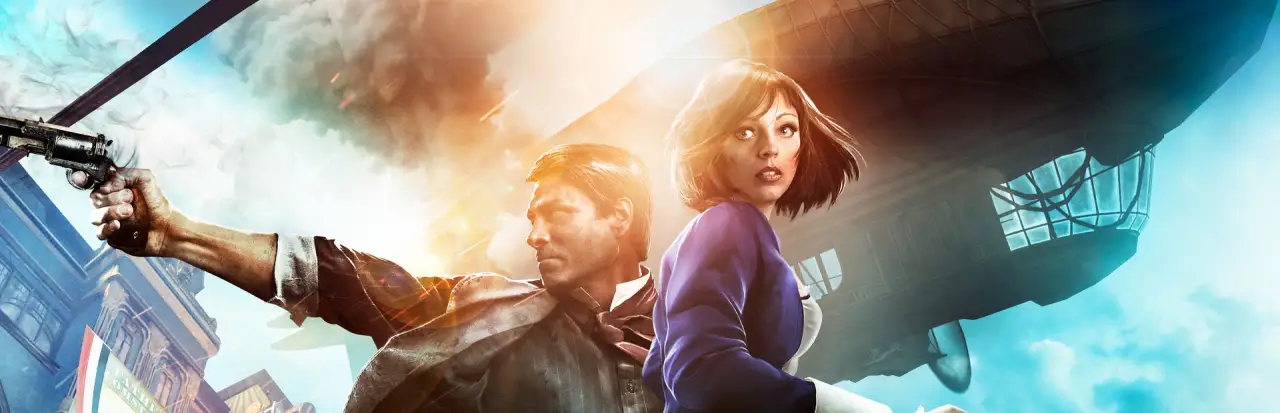
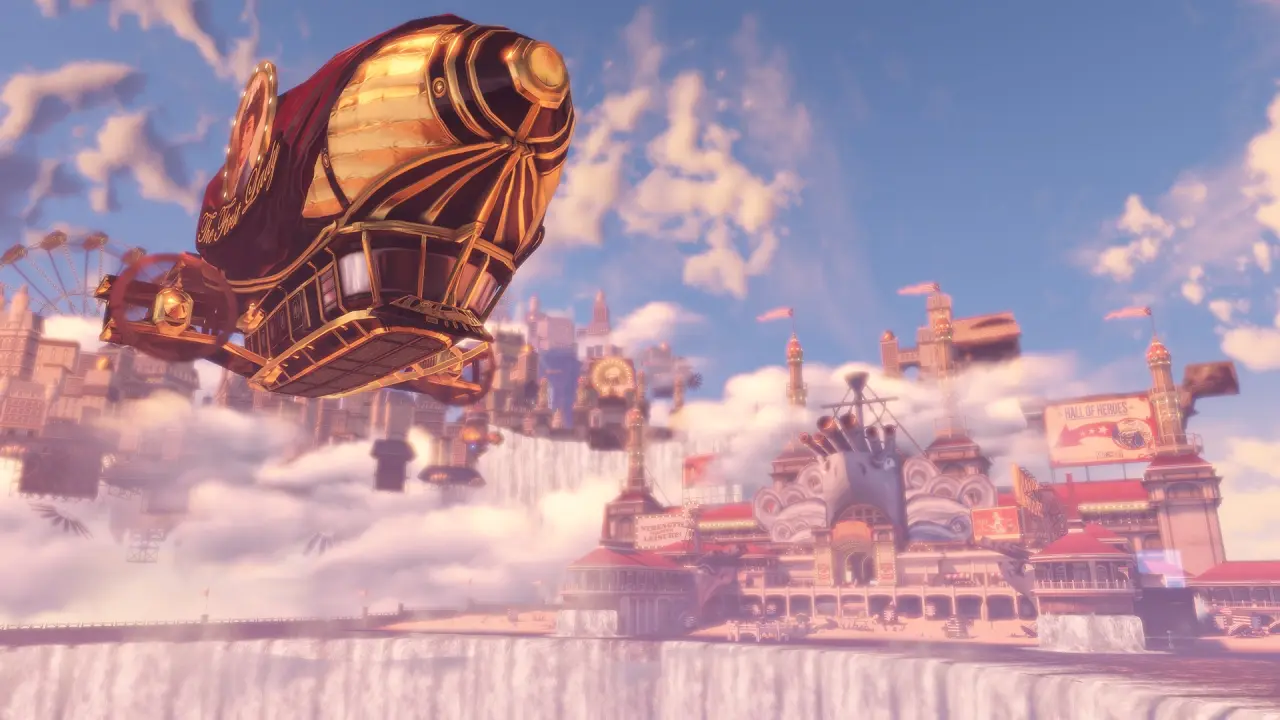
Some games you remember not for a firefight, but for the moment they first made you look up. BioShock Infinite: The Complete Edition is one of those games. It drops you into a lighthouse, lets you assume you know this opening, then fires you skyward without warning. When the pod cracks open and Columbia spreads out in the sunlight — a 1912 city floating in the clouds, all white chapels and drifting banners and barbershop choirs — almost nobody keeps walking. You stop. You just look.
The trick is that the postcard is the threat. You play Booker DeWitt, a cavalry veteran turned hired enforcer, sent to this gleaming utopia to find a girl named Elizabeth, locked away in a tower since childhood, and bring her out to wipe away a debt. It reads like an escort job. It is nothing of the sort. Columbia is too bright, too serene, and that excess of calm hides the sharpest thing the game has to say.
So here is the question this review exists to answer: more than a decade on, with shooters out-rendering and out-scaling it every year, why has nothing replaced this one? The answer was never in the combat. It lives in the city, in the companion walking beside you, and in an ending people are still arguing about. The combat is merely fine. The world and the story reach the top of the series. That is the trade, and it is still worth making.
Story | 9.5/10
Story: 9.5/10An escort job that turns into a trial of the man sent to carry it out
The premise is plain enough to be a con. Booker DeWitt owes the wrong people money, and he is told the slate clears if he simply finds the imprisoned girl, Elizabeth, and delivers her elsewhere. Every other game has run this errand. But the deeper you go, the more the city and the girl start studying you back. Why were you chosen? Why does Columbia's self-styled prophet flinch at your arrival? The escort objective curdles into something personal, and you realize the job was never the point.
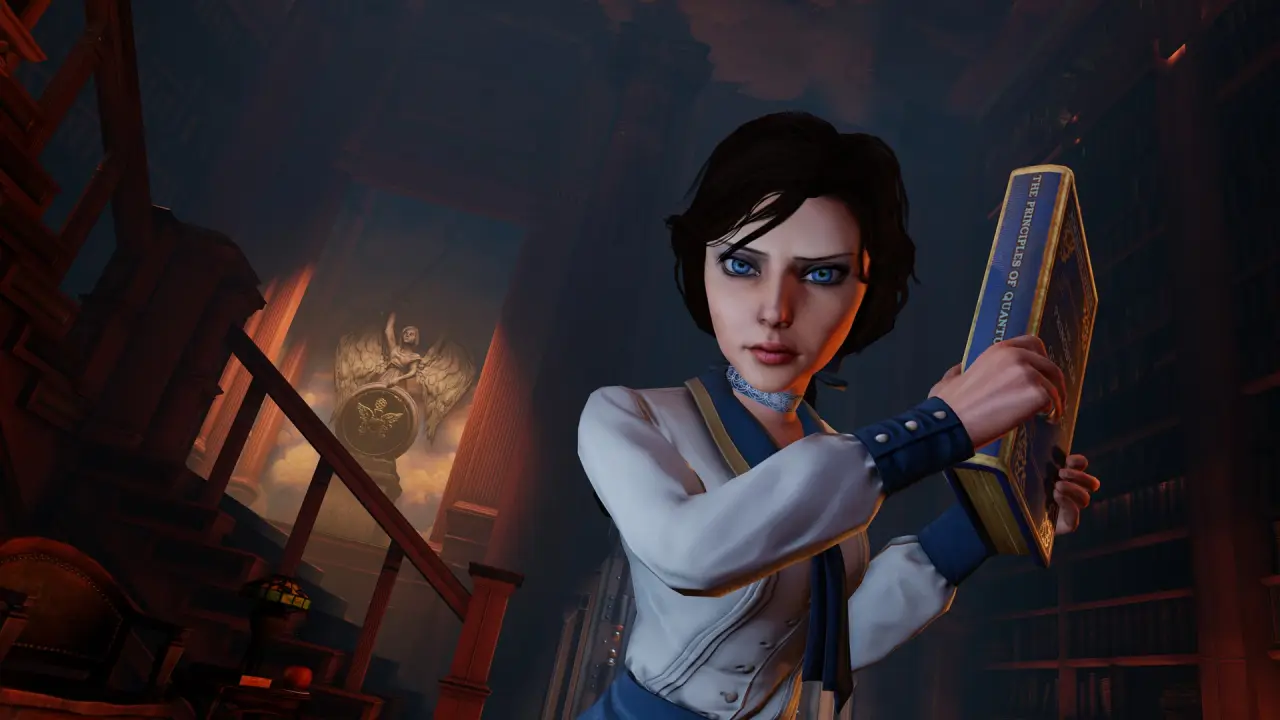
Elizabeth has spent her life caged in the city's monument tower, watched over by a vast mechanical guardian. Pull her out and the engine of the whole thing finally turns over. The flight that follows — two strangers testing each other, slowly building trust, hauled together into a past neither fully understands — is the emotional spine of the campaign. You are not clearing a quest log. You are walking a person through her first real look at the world, and getting dragged into her history and your own.
What lifts it is the way a linear chase peels back, layer by layer, into a question about identity and atonement. By the final stretch you are not watching a story so much as being implicated in one. When the truth lands, your first instinct is to go back and re-read every line of dialogue you breezed past. That backward pull is the surest sign of writing that knows exactly what it is doing.
A multiverse premise, folded into one man's reckoning
If Columbia is the game's first calling card, the ending is where it becomes untouchable. The whole narrative hangs on a hard parallel-worlds conceit. Elizabeth can tear open doorways between realities, and by the close that power is turned on a truth about Booker himself — a truth that loops back around an enormous circle to land exactly where it started. The genre furniture is cold science fiction; what the game does with it is anything but.
The pivot is a choice at a baptism. In one world Booker refuses the baptism; in another he accepts it, sheds his old name, and becomes the very prophet who twisted Columbia into a theocratic cage. Hero and villain are one man at a fork. To end the loop, the Elizabeths must end Booker at the source, because no decision down any single branch ever stops the cycle from beginning again. It is dizzying, but it never forgets that the dizziness is in service of a person's regret.
This is why the finale is treated as a touchstone of the medium. It is not clever for the sake of clever. It takes a frigid lattice of alternate timelines and lets it fall back onto guilt and the hope of release. You replay it to catch the seeds planted hours earlier. You argue about it with a friend. More than a decade later the conversation has never really stopped, and that endurance is its own verdict.
Theme without a tidy answer
Columbia is not an invented fantasy backdrop. Its roots sit in real early-twentieth-century America. The creators put American exceptionalism, religious zealotry, and the institutional prejudice of the era squarely in front of the player. The ruling class venerates the nation's founders as religious icons and threads the exclusion of outsiders into ordinary life, until bigotry reads as routine, almost as wallpaper. The depiction is the subject of critique, not endorsement; the game refuses to romanticize what it shows.
Against that order stands the resistance, led by a woman hauled into the city for forced labor, fighting at first for the dignity of the oppressed. And here the writing earns its reputation: it declines a clean moral binary. As the story advances, the rebels, once they hold power, begin to mirror the violence they set out to overthrow. The game never claims prejudice can be solved by defeating a single antagonist. It forces a harder, truer proposition — that power, even when it begins in justified anger, slides easily toward corruption — and it offers you no comfortable place to stand. That refusal is what keeps scholars and players returning to it.
Audio | 8.5/10
Audio: 8.5/10A bright surface with a wire pulled taut underneath
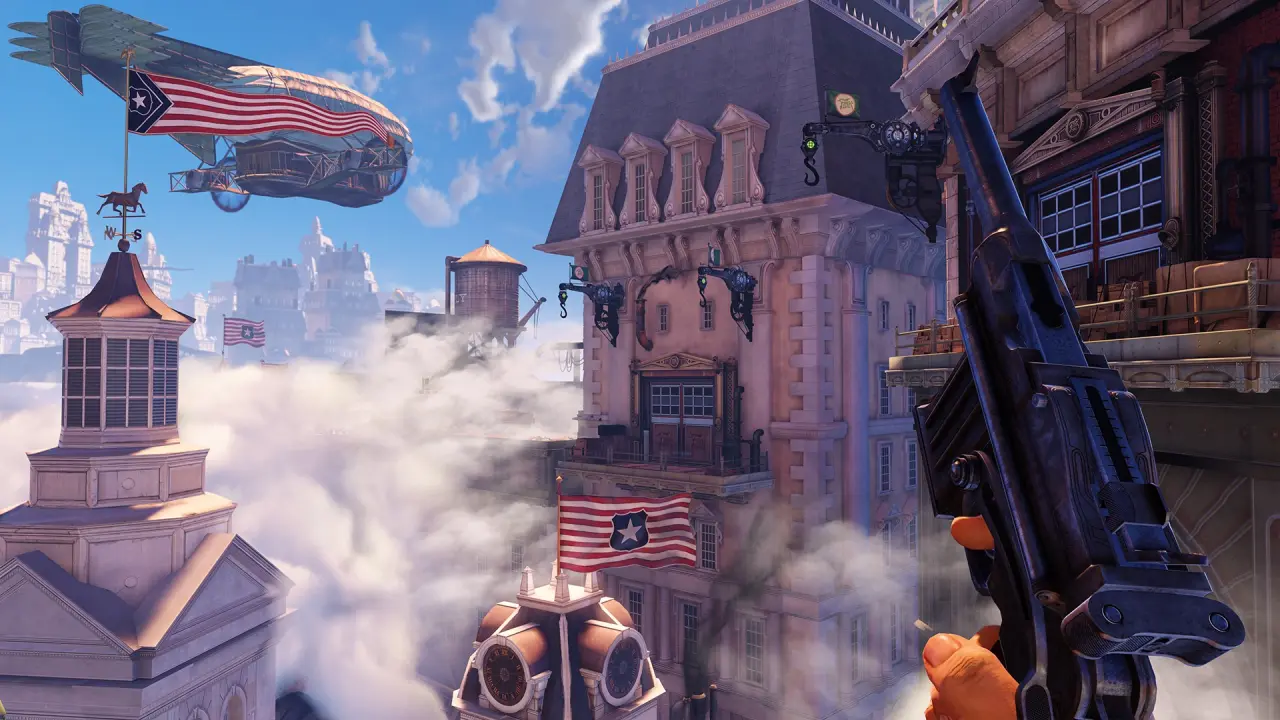
Garry Schyman wrote the original score, carrying his ear for this series from the earlier games straight into this one. Columbia looks radiant; Schyman insists on threading low strings and sour, dissonant colors underneath all that light. The city charms your eyes while the music quietly tells you something is off — and that unease is, more often than not, the score sensing the rot before you consciously do.
The deliberate gap between what you see and what you hear is the point. It promotes the music from background to narration.
Once you finally understand the truth under Columbia's serenity, the taut wire in those early cues snaps into focus: Schyman was handing you clues the whole time, and you simply hadn't learned to read them yet. That is why the soundtrack rewards a second pass. The first time through it is atmosphere. The second time it is foreshadowing, sitting in plain hearing — the same notes, suddenly heavy with everything you now know about the city and the man walking through it. Composers rarely get to write a score that means two different things on two different listens, but that is exactly what this one does, and it never tips its hand too early.
Anachronistic songs, and two voices that hold up a city
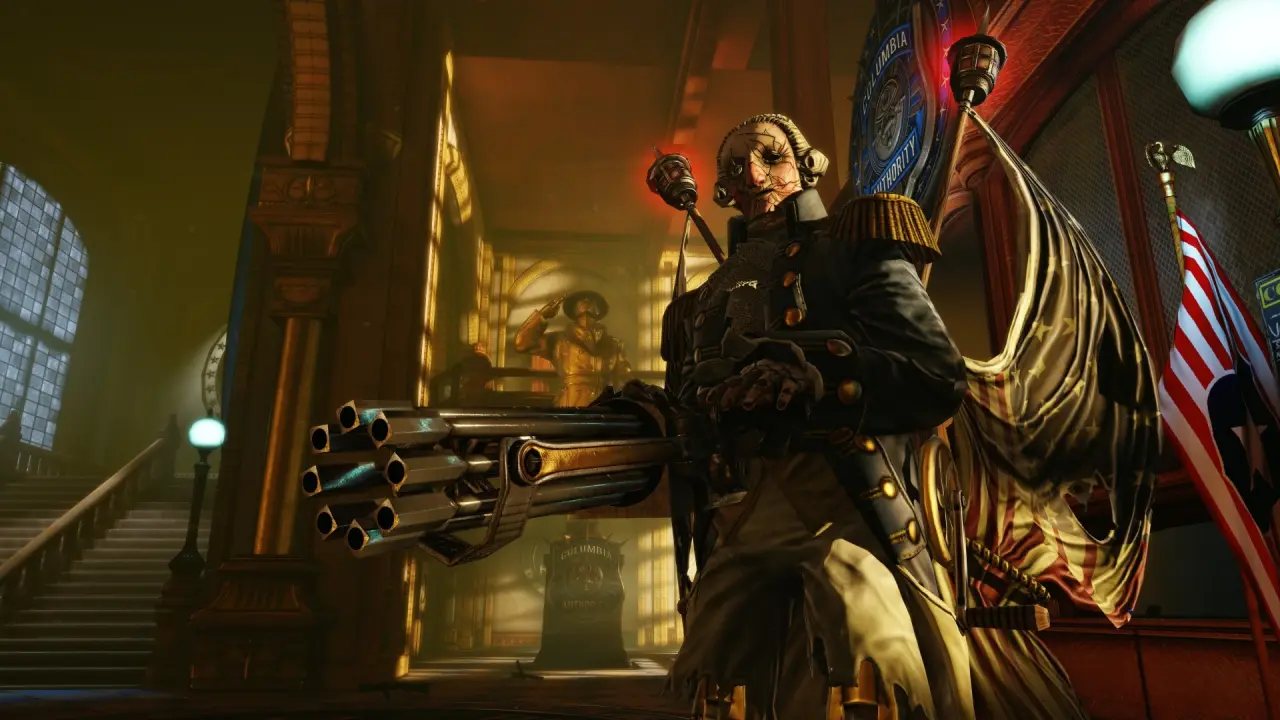
The audio flourish people talk about most is the anachronistic licensed music. Barbershop quartets and choirs drift from the city's corners, warm and orderly, seemingly perfect for 1912. Then you clock where the tunes actually come from — they are later pop songs, rewritten to sound like the past — and the warmth curdles into something faintly wrong. The music is itself a clue that the city's clock is broken. A diegetic hymn and the street performances rank among the game's standout audio moments precisely because they whisper "the time here is off" into your ear long before the plot says it aloud.
The lead performances are a generational benchmark, and the reason is craft. Booker and Elizabeth were recorded together in the booth far more than apart, so their bickering, their testing of one another, their silences and slow-earned trust all breathe like a real conversation rather than two actors reading at empty air. Ambient sound pulls the same direction: looping patriotic broadcasts, market crowds, the hum of machinery, all of it laid thick enough to seal Columbia's false calm airtight. Where Portal 2 builds tension through dry narration and long pauses, Infinite weaves a soft net out of an entire city's noise — and then lets you discover, slowly, what is caught underneath it.
A score that pays off on the second playthrough
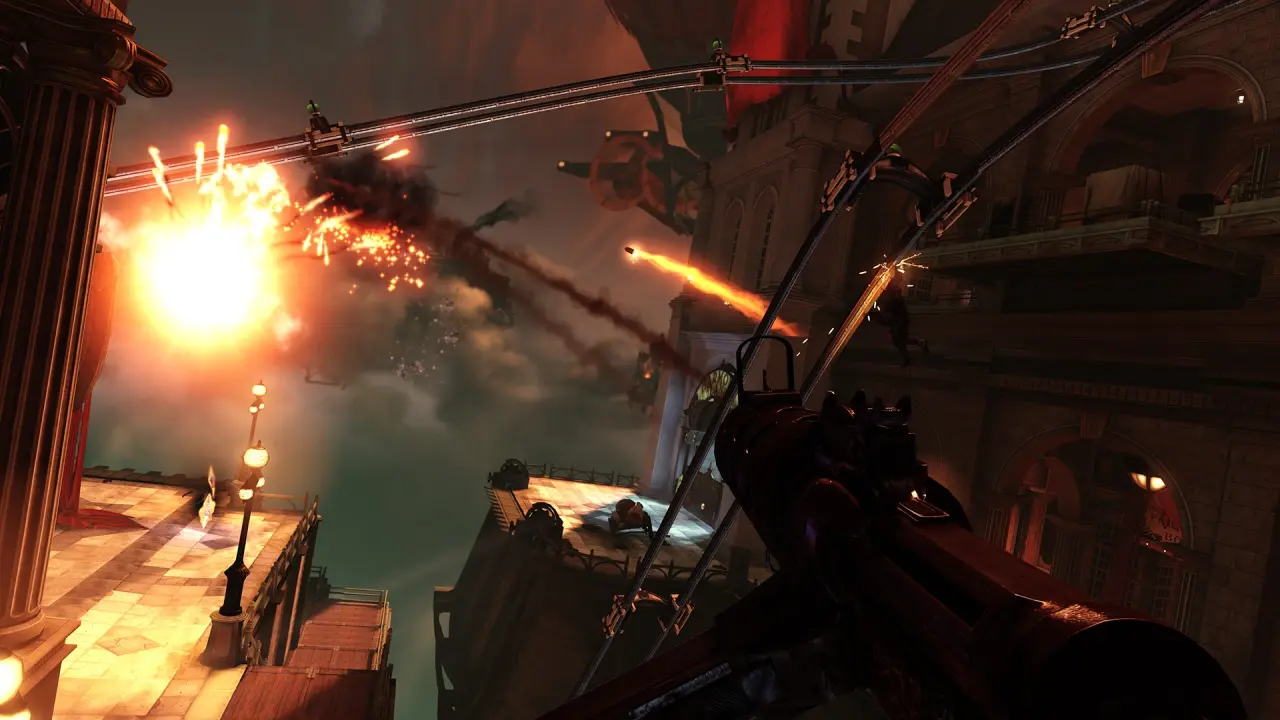
What ties all of this together is how reusable the audio is in memory. Schyman's themes are not just accompaniment; they are tagged to ideas — the prophet, the resistance, the girl in the tower — so that hearing a motif return carries narrative weight rather than mere mood. The score knows when to swell and, just as importantly, when to drop to near-silence and let a single voice or a distant hymn do the work. That economy is why the music never feels like wallpaper, even across a twelve-hour run where lesser soundtracks would blur into a wash.
Play it again after you know the ending and the whole sound design reorganizes itself. The cheerful street tunes read as menace. The patriotic broadcasts read as propaganda you were always meant to distrust. The hymn that once felt like background becomes a thesis statement about cycles and return. Few games reward a replay on the audio track alone, but this one does — the second listen is a different, darker album playing over the same streets, and it is arguably the better of the two.
Visuals | 9.5/10
Graphics: 9.5/10Steampunk, painted the color of sunlight
If one word has to carry Infinite's visuals, make it legibility. The art direction is bright, ornate steampunk-meets-dieselpunk, distinct enough on its own terms, but its real cleverness is how it answers the original game. The series began in the gloom of an undersea city; this one flees upward into full sun. One franchise, two visual temperaments pulled in opposite directions — and that contrast is itself an act of storytelling, a thesis stated in palette before a word is spoken.
Columbia's buildings carry industrial heft yet wear candy-bright tones; the floating structures, the snapping flags, the parading bands and the noise off the boardwalk add up to a place you genuinely want to stop and read — every shop window, every poster, every leaflet on the ground. This is not run-past wallpaper. It is a city that holds up to a long, deliberate stare, where even the slogans on the walls quietly broadcast its values. That care is why Columbia is not merely pretty but believable. You come away certain that people once lived, worked, and prayed here.
The palette does more than dazzle, too. Bright as it is, the color work is always seeding dread: a parade that looks joyous until you read the banner it celebrates, a beach resort whose cheer sits a few steps away from a cruelty the city would rather you not notice. The art never lectures. It simply trusts you to keep looking until the postcard starts to crack on its own terms, and that restraint is rarer than any amount of polygon count. It is a place designed to be misread first and understood later.
The lighthouse ascent, and an old engine that aged well
You cannot discuss these visuals without the opening so many list among the medium's best. You leave a lone lighthouse, step into an unremarkable, cramped pod, and are launched at the clouds with no warning. When the shell peels away and Columbia unfurls in golden light, the awe is textbook — not because a cutscene tells you to feel it, but because you physically arrive, stepping onto the boardwalk as an outsider for the first time. Ask people for a single image years later and this is usually the one that surfaces.
Technically the game runs on Unreal Engine 3, ancient by today's standards. Resolution, texture density, lighting — none of it competes now. Yet sharp art direction wrings the engine dry, and the result is that the work's artistic lifespan vastly outruns its technical one; it still looks comfortable to sit with. The Complete Edition spans PC, PlayStation 3, Xbox 360, Linux and macOS, with the PC build leading on fidelity and performance and standing as the way to play today. Crucially, the art keeps serving the story: the calm of the surface and the prejudice beneath it are staged as a deliberate visual rift. Set beside Dishonored, another generational standout built on art and world, Columbia wins on sheer completeness — it is not only handsome, it is lived-in. Dishonored's Dunwall is a triumph of mood, all plague-grey stone and oppressive vertical sprawl, but it asks to be admired more than inhabited. Columbia asks to be believed, down to the price tags in the storefronts and the chalk on the schoolroom board. Years later, when you try to recall what a generation of shooters looked like, this is the city that surfaces first — proof that a strong art direction outlives the hardware that rendered it, and that taste, not transistor count, is what truly endures.
Detail as a delivery system for the story
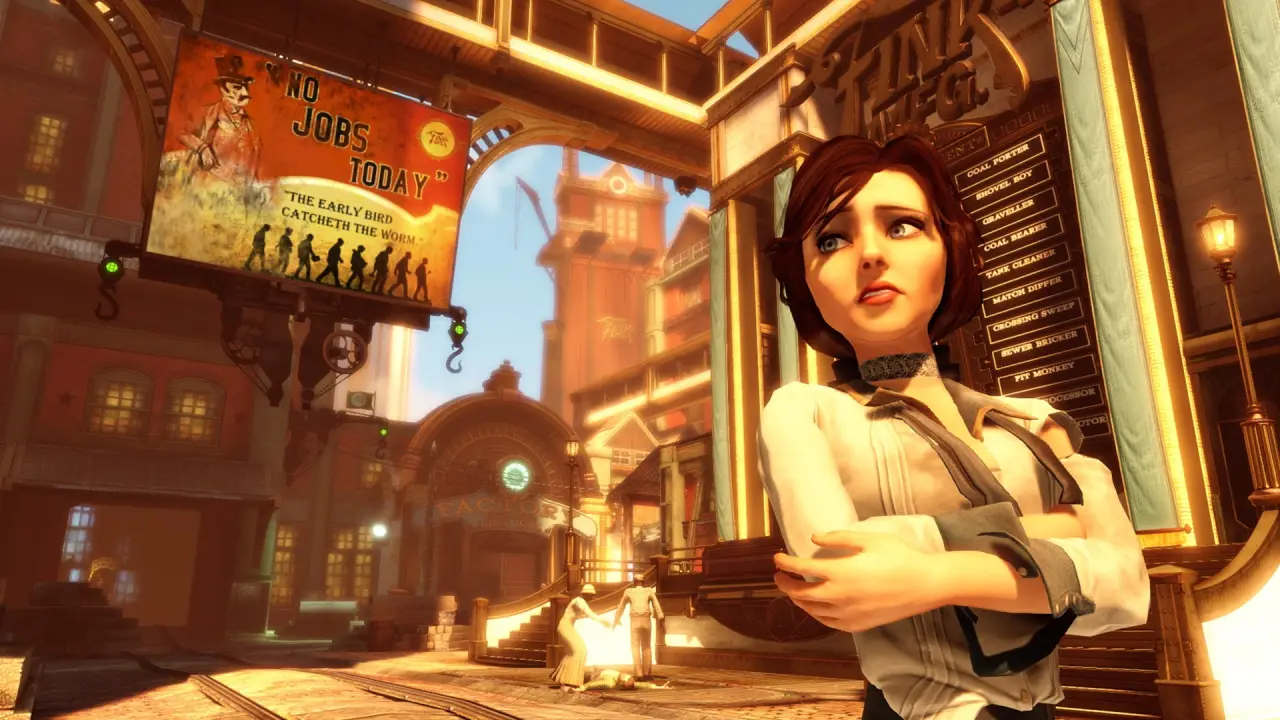
The most underrated part of Columbia's look is how much of the plot it carries without a line of dialogue. Walk slowly and the walls do the writing: campaign posters canonizing the founders, signage that quietly draws lines between who belongs and who serves, a fairground attraction whose cheer turns your stomach the second you understand what it is celebrating. The art direction is not decoration laid over a story; it is the story's primary delivery system, and it trusts you to assemble the picture from fragments rather than spelling it out.
That trust is what separates Columbia from the many handsome, hollow game worlds that followed it. A lot of later titles matched or exceeded it on fidelity and missed the harder lesson entirely: that a place becomes unforgettable not when it is detailed, but when its details mean something. Every poster here is an argument; every billboard is a worldview. By the time the surface cracks, you have already absorbed the city's ideology through your eyes, which is exactly why the reveal hits as hard as it does.
Combat | 6.5/10
Gameplay: 6.5/10Vigors: the real depth lives in the combinations
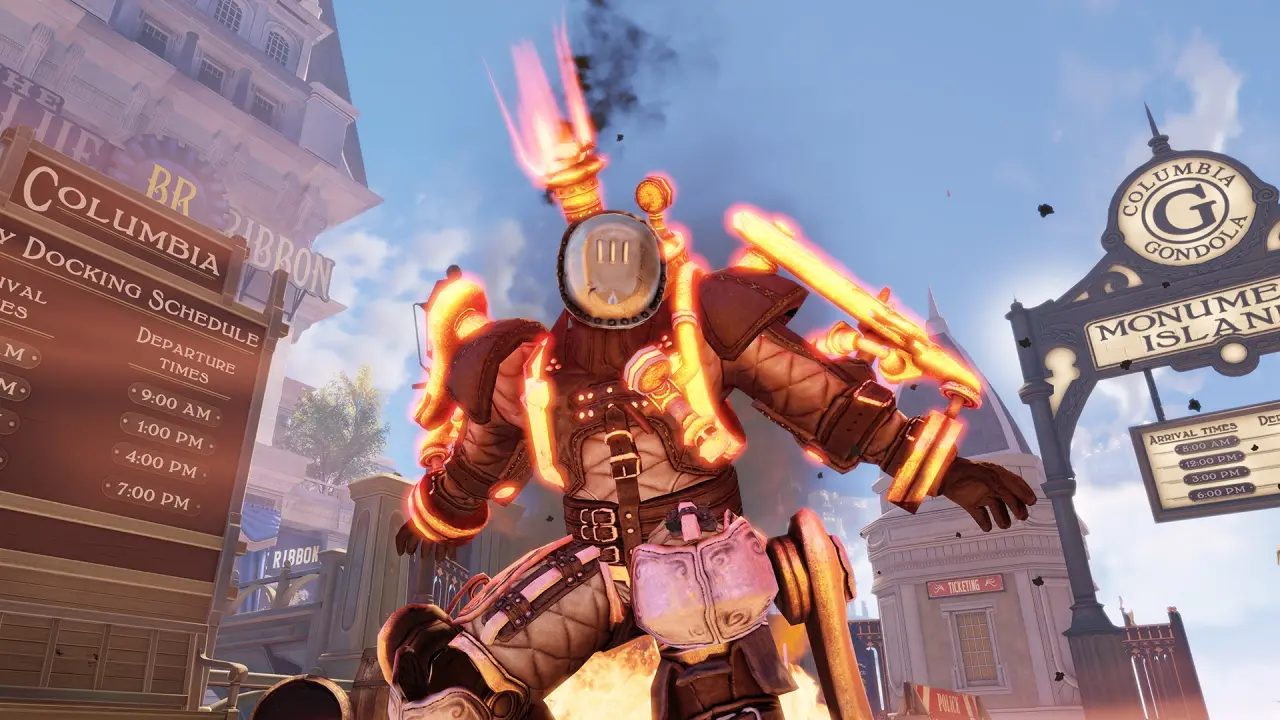
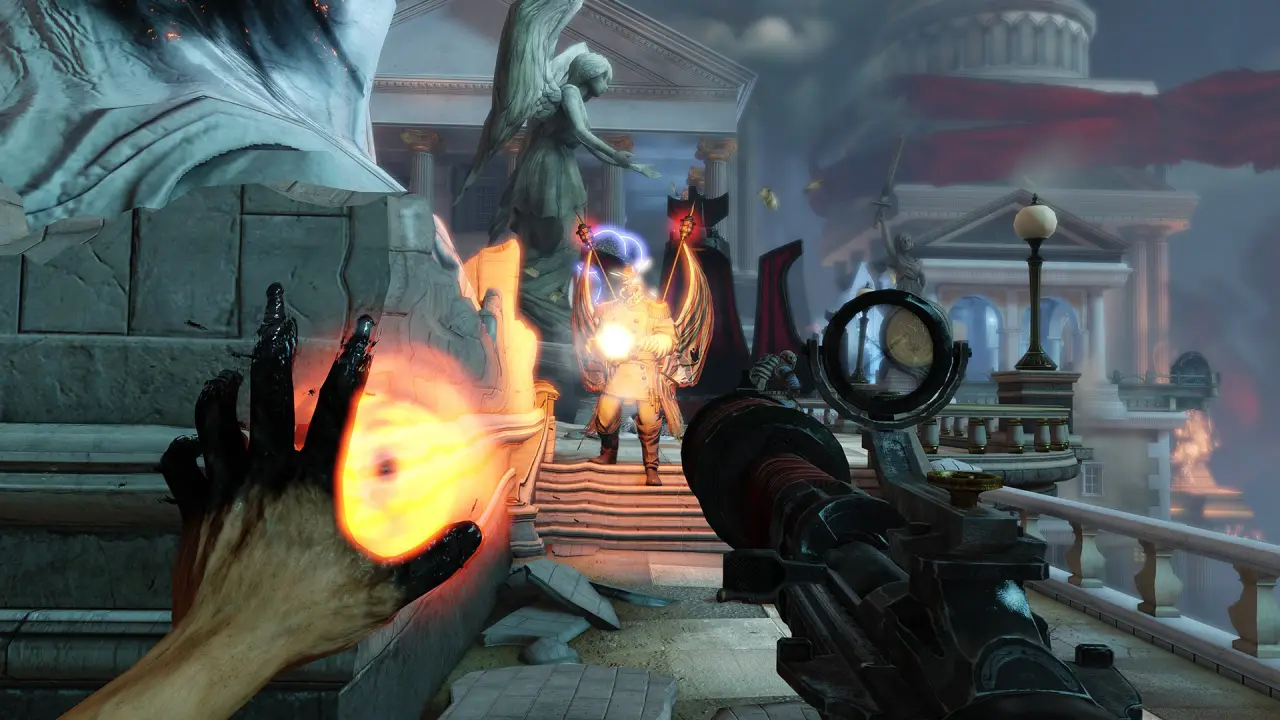
Combat is built on eight special powers called Vigors, and the menu is genuinely varied. Devil's Kiss hurls fire; Murder of Crows summons a flock that staggers and pins enemies; Possession flips a foe or a machine to your side for a stretch; Bucking Bronco flings targets into the air and exposes them; Shock Jockey throws current and can wire up traps in the environment. Each Vigor carries two upgrade tiers, bought and improved at the city's vending machines as you scrape together currency.
The actual pleasure is in chaining them. Loft a cluster of enemies with Bucking Bronco and clean them up before they land; or trip Shock Jockey across standing water and watch the current fan out into a rolling field of control. Layer a Possession on a heavy trooper and let it thin the room while you reposition. That combinatorial layer is the ceiling of the combat, and it is where the game flirts most openly with its immersive-sim lineage. Played with intent, the sandbox has more to say than its reputation suggests — the trouble is that nothing in the game's pacing ever insists you reach for that ceiling, so plenty of players coast through on a single favorite Vigor and never see how deep the toolset actually goes.
Sky-Lines and Tears: flat firefights pulled into the air
If Vigors supply depth, the Sky-Line supplies speed. The hook is a magnetic, three-pronged tool that doubles as your traversal across the city's aerial rails and your only melee option, capable of executions on weakened foes. You leap on, drop off, and swap between rails at will, firing one-handed weapons mid-slide. The system drags a flat exchange of fire up into a vertical, kinetic loop around the arena — the single design stroke critics most often singled out as bringing something genuinely new to the first-person shooter.
Elizabeth's Tears round out the tactical layer. Directed mid-fight, she rips open little doorways into other realities and conjures usable resources: a slab of cover, a supply cache, a friendly turret or a sniping perch. She tucks herself away on her own, never asking to be defended, and periodically tosses you health, ammo, and Vigor salts. In a firefight she reads as a true partner, not an escort liability dragging on your sleeve. It is a quietly radical bit of design: most companion characters of the era were a tax on your attention, a body to babysit, and Elizabeth inverts that entirely, becoming the reason an encounter swings your way rather than a reason it goes wrong. The studio's confidence in letting an AI ally simply work, without a defend-the-NPC failure state, is one of the most copied ideas the game produced.
The two-weapon limit, and an honest gap against Dishonored
And yet the moment-to-moment shooting is the most contested thing about the game. The loudest grievance is the two-weapon carry limit. The city is strewn with varied, separately upgradable armaments, but you may hold only two at a time, which makes that whole overlapping arsenal and its upgrade trees feel at once bloated and beside the point — the weapon you carefully invested in often gets stranded because you cannot bring it along. In fairness the limit has its logic: supplies are plentiful, a discarded weapon you pick up is usually ready to use, and there is always a suitable one nearby, so you are never truly left without options. For players chasing weapon depth, though, the compromise still stings.
The deeper dissonance is pacing. The restrained, precise storytelling up front gets interrupted by encounters that grow denser and louder in the back half, and the tonal seam shows. The unlockable 1999 Mode, named for the era of hardcore PC shooters it salutes, turns out to be a numbers-heavier hard mode rather than a real systemic rethink. Set against 2012's Dishonored, the gap is candid: Dishonored offers more stealth, more route freedom, more ways to solve one objective. Infinite's combat is a vehicle for story and mood, not a sandbox to be studied for years — which is exactly why this is the dimension that drags its overall score down. It is competent. It never reaches the heights its writing and art do.
Content | 8.0/10
Content: 8/10Twelve hours, with no padding
The base campaign runs around twelve hours, and for a linear, story-first game that is a disciplined, well-judged length. It does not pad to inflate a number; every stretch is pushing the plot or laying in atmosphere, paced tightly enough that you struggle to find a clean spot to set the controller down. It never feels short, because those twelve hours are dense — the lighthouse ascent, the long flight with Elizabeth at your side, the chilling reveal at the close — with almost nothing you would want to skip.
For players steeped in hundred-hour open worlds, that point-and-stop restraint is its own kind of luxury. It respects your time, spends every hour where it counts, and never asks you to grind map markers or scavenge crafting junk.
That economy is not an accident of a small budget; it is a stated value. By the end you understand that the tightness is what locks the emotional concentration in place; a baggier game would have let it leak out. There is a real argument that the back half overstays slightly, leaning on combat to fill rooms the story has already finished with — but even at its loosest the campaign never approaches the bloat that defines so much of its contemporaries' running time. It knows when it is done, which is a discipline a surprising number of acclaimed games never learn.
The Complete Edition: the whole thing, handed over at once
The Complete Edition's real weight is in its add-ons. Released in November 2014, it bundles the base game with every piece of downloadable content: the wave-based combat arena Clash in the Clouds, and the story-driven Burial at Sea, Episodes 1 and 2. Counting those, the total lands somewhere around twenty to twenty-five hours — long enough to let you comb every corner of Columbia and listen to every recording, short enough never to sag.
Clash in the Clouds is the lighter inclusion — a score-attack arena that strips the game down to its combat sandbox and dares you to master the Vigor-and-Sky-Line interplay the campaign lets you ignore. It is a curio rather than a reason to buy, but it quietly proves the combat has more depth than the main game ever forces you to find. The piece you should not miss is Burial at Sea. It loops Infinite's narrative back to the series' original undersea city, letting the two games' worlds intersect and inviting longtime fans to reassess the whole arc. Episode 2 in particular reviews strongly, with an OpenCritic average near 83; it pivots boldly to stealth-leaning design, plays at a markedly different rhythm from the base game, and finally stitches the mythology shut. For anyone serious about the meta-narrative it is an indispensable piece, not an optional one. Beyond the campaign and DLC, the city is salted with recordings, gear, and sightseeing spots — not filler checklists but genuine connective tissue, where much of what you learn about the prophet, the resistance, and the leads' histories actually hides. The game has sold north of eleven million copies, a clear commercial success, and the Complete Edition is the best shape that success takes: a lean core plus the chapters that truly matter, delivered whole, in one box.
Collectibles, replay, and what is left for the curious
Strip away the headline content and there is still a quiet layer for players who like to linger. Audio logs scattered through the city fill in the history a main quest has no time to spell out; gear pieces tweak how your Vigors and weapons behave, encouraging a second run built around a different loadout; sightseeing spots simply ask you to stop and take the view. None of it is the open-world busywork the genre had already grown addicted to. It is optional in the best sense — there to deepen the world for anyone who wants more, ignorable for anyone who does not.
Replay value here is not measured in procedural variety or branching endings; the story is fixed, and that is by design. What pulls you back is comprehension. A second pass with the finale in hand turns the whole campaign into a different experience, every overheard line and background detail recolored by what you now know. For a game this tightly authored, that is the truest form of replayability — not more content, but a deeper reading of the content already there. The Complete Edition simply makes sure that, whichever way you come at it, the full text is in front of you from the start.





Comments 0
Share your game review
Join the discussion and share your review of this game.
No comments yet. Share your thoughts on this review.