
























Opening
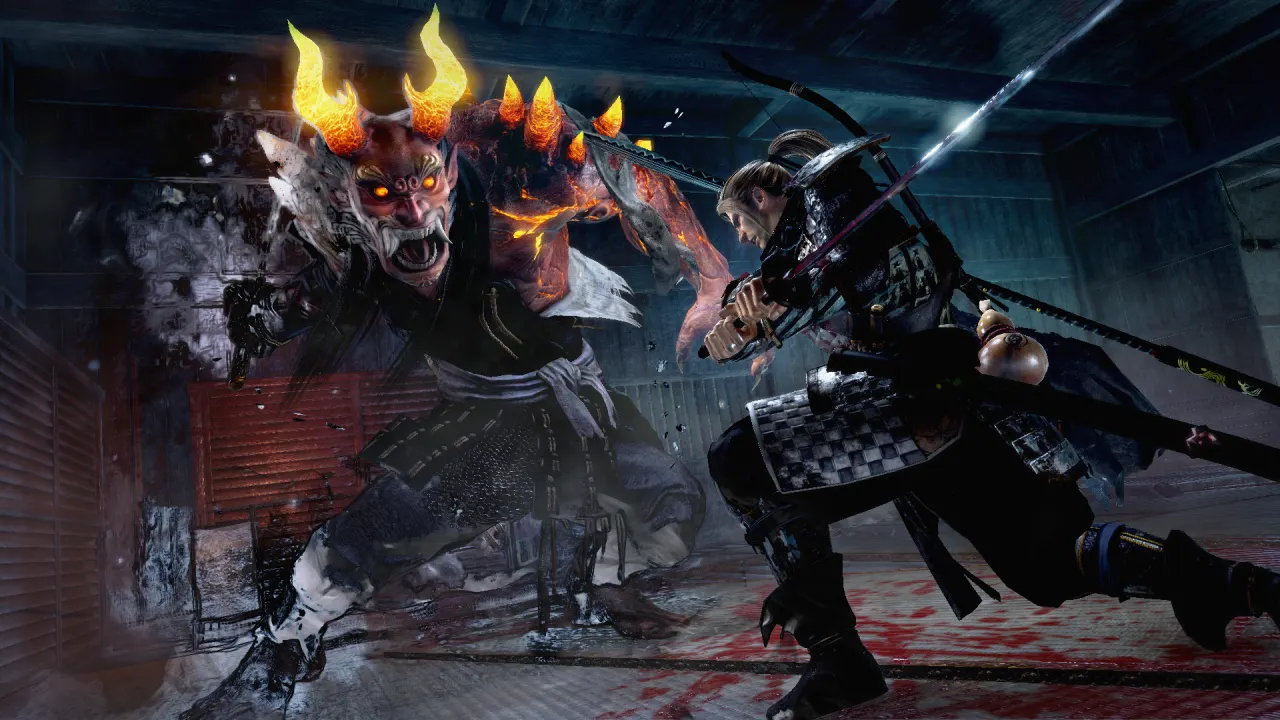
A room full of flame, fire baking the wooden beams until they glow, and a towering blazing yokai that nearly fills the entire space. There is not much room to retreat, and even less room to slip up. The best thing about Nioh Complete Edition is not simply that it stitches Sengoku Japan together with yokai folklore — it is that the mashup genuinely grows out of the way you play.
Mountains, villages, and battlefields do the work of dragging you into that era, while the yokai, the bosses, and those punishingly unreasonable stages keep reminding you that this is not a history textbook. This is a survival scene. Spend a while with it and you understand it is not the kind of game that pushes you forward on the strength of big spectacle. It plays more like a tightly edited period weird-tale film: oppressive when quiet, rhythmic the moment a fight breaks out, and every so often touched by something genuinely epic.
It is not flawless. The protagonist's personal presence is muted, and the audio is not exactly a memory bomb either. But if you are willing to hand your time over to the combat and the exploration, what it hands back is solid, concrete, and earned. This is a sharply honed blade of a game: concentrated strengths, a strong personality, awkward for the wrong hands and hard to put down for the right ones.
Story | 8/10
Story: 8/10Nioh's story is not carried on the shoulders of its lead alone. That is the single most important thing to understand about how its narrative works — and where it stumbles.
A Lead Who Stays at Arm's Length
The protagonist, William, is comparatively thinly drawn, and that thinness shaves a little off your emotional investment. You will struggle to remember him the way you remember certain legendary characters, and the problem is precise: with a weak character center, the emotional grip of several story beats stays limited. You register what happens without quite aching over who it happens to.
The downstream effect is direct. You end up caring more about the journey and the events themselves than about "what becomes of this person next." William is a vessel you move through history rather than a figure you bond with, and the game rarely asks you to. Is that fatal to the narrative? It is not, because Nioh has other ways to hold the room — but it does cap how high the storytelling can climb, and pretending otherwise would be dishonest.
It is also a strange tension for a game this mechanically expressive. The systems give you a hundred ways to express yourself in combat, while the protagonist at the center of it stays curiously fixed and quiet. Your character grows enormously in capability and barely at all in personhood.
History and the Weird Tale, Stewed Together
Where Nioh genuinely shines narratively is in fusing Sengoku historical figures with a fantastical frame. The historical backdrop supplies thickness and stakes, while the yokai elements supply the off-color strangeness, and the combination gives the whole work the texture of a stock that has simmered a long time. The entrance is epic, the aftertaste carries a thread of dread, and every so often it cuts to a lighter register entirely.

That tonal switching is genuinely hard to pull off. Lean too light and the whole thing scatters; lean too heavy and it turns airless and dour. Nioh manages it with a fairly steady hand. You may not weep over any single character, but you will want to keep going, curious where this trip — threaded through history, war, and a persistent uncanny chill — finally lands. The momentum is curiosity-driven rather than character-driven, and it works because the world is interesting even when the man at its center is not.
The Complete Edition's three expansions — Dragon of the North, Defiant Honor, and the closing campaign chapter — extend this arc rather than simply tacking extra hours onto it, pushing the same blend of recorded history and invented dread into new chapters instead of repeating beats.
What It Can and Cannot Promise
So if what you are after is top-tier, character-driven storytelling with dialogue that cuts, Nioh cannot hand you that full a serving. The lead is too light and the writing too functional to compete with the genre's narrative high-water marks. Set that expectation accordingly and you will not feel cheated.
But if what you want is a story with a clear identity, a unified tone, a supporting cast that holds its weight, and a journey whose scale carries you to the end, Nioh clears the bar comfortably and then some. It is not the dazzling kind of narrative. It is the durable kind — the sort you keep watching not because you are desperate to know one character's fate, but because the world it has built is consistently, atmospherically worth following all the way through.
There is also a quiet honesty to how Nioh frames itself. It never pretends to be a character study, never strains for tearful set-pieces it has not earned, and never asks you to carry emotional weight the writing has not laid down. That restraint keeps it from the embarrassing kind of failure where a game reaches for profundity and grabs only melodrama. Nioh stays inside its lane — a tonally assured historical weird-tale with a strong sense of place — and by knowing exactly what it is, it ends up more satisfying than a more ambitious narrative that overreached and fumbled. You leave it remembering the journey and the mood far more vividly than any single line of dialogue, and for this particular game, that is the right outcome rather than a shortfall.
Audio | 7/10
Audio: 7/10On the audio front, Nioh behaves like a dependable drummer. It does not steal the scene, but it is always there, keeping time underneath everything else.
A Score That Knows Its Job
There is no especially loud complaint to be made about the sound design, and in a game this demanding, that quiet competence is itself worth something — it tells you the audio is at least never dragging the experience down. More to the point, it clearly understands where its job lies: heightening tension and yokai dread, serving the high-pressure combat cadence, and lending an audible weight to dangerous zones and boss arenas.
The value of this kind of sound design is rarely "how lovely is it in isolation." It is whether you tighten up when you hear it, whether you sense danger a half-second sooner because of it. By that measure, Nioh almost certainly does its job. In a fight wound this tight, the better the auditory feedback locks onto your strikes, the pressure, and the mood of the moment, the more easily you slip into that narrow band of total focus. Short. Precise. Punchy. The audio rarely announces itself, but it is constantly shaping how alert you feel.

You can hear this most clearly in the boss encounters, where the layered cues telegraph the shift from a lull into a burst of pressure. The music does not narrate the fight so much as it raises your pulse alongside it, and that synchronization is the real craft on display.
Functional Over Unforgettable
The catch sits right at that same spot. The sound is more functional than memory-bomb. The experiential consequence is that you may readily admit it is effective without being able to summon a single melody the moment you shut the game off. There is no leitmotif that follows you out of the room. Is that fatal? No. For a work built around combat and level design, an audio layer that steadies the foundation is already doing a great deal of important work, even if it never produces a standout track.
If you crank your soundtrack expectations up to "I want to go search the OST the instant the credits roll," Nioh will not satisfy that every single time. The composition is built to support rather than to dazzle, and judged against the wrong yardstick it can feel anonymous. But if your standard is instead "can it hold up the pressure of the combat and the weird-tale atmosphere," then Nioh clears the line. The audio is the salt rather than the main dish — easy to overlook, impossible to remove without the whole thing tasting flat.
It is also worth crediting the spatial side of the mix, which does real work in a game where danger so often arrives from off-screen. Footsteps, the scrape of a large foe shifting its stance, the low swell that precedes an ambush — these cues feed your situational awareness as much as anything on the screen does, and in cramped interiors they frequently warn you a beat before your eyes catch up. That kind of audio is invisible when it works, which is precisely the point. You do not notice it carrying you; you only notice the times it is absent in lesser games. Nioh's sound never wins the spotlight, but it earns its place by making the combat read clearer and the world feel more dangerous, and that is exactly the job a score like this is supposed to do.
Visuals | 8/10
Graphics: 8/10The first time I saw Nioh place Sengoku Japan and yokai fantasy inside the same frame, my reaction was not "how lavish" but "how fitting." That distinction is the whole story of its art direction.
Knowing Where to Spend the Effort
Nioh's visual strength is not that every frame wants to arm-wrestle the genre's absolute best. It is that the game knows where to spend its effort. Mountains, villages, and battlefields are shaped with real pull, and the historical skeleton underneath them is stable and convincing. Then the yokai design presses down on top of that grounded foundation, and the world instantly acquires its own recognizability.
That layering is deliberate. A purely historical Sengoku game would look handsome but familiar; a purely fantastical one would float free of any anchor. By keeping the human world believable and reserving the visual strangeness for its yokai, Nioh makes the supernatural land harder, because it has something ordinary to violate. The art is not chasing maximalism — it is chasing legibility and tone, and that choice pays off across dozens of hours far better than a wall of effects would.

You see the same restraint in how environments are presented. Spaces read as lived-in and period-appropriate rather than theme-park ornate, which keeps the eye trained on what matters in a fight instead of drowning it in decoration.
Atmosphere That Reads at a Glance
The snowfield duel against the giant flame yokai is the clearest showcase of Nioh's atmospheric muscle. A cold, desaturated backdrop cradles a high-heat foe, and the danger is readable in a single glance — you do not need a tutorial prompt to understand that the burning thing in front of you is the threat. The art is doing combat communication, not just decoration.
On the other end, the standoff where a warrior draws a weapon and closes on a giant spider-yokai chief presses historical weight and weird-tale dread into one image. The composition holds the human and the monstrous in the same beat, and that tension is exactly the mood the whole game trades in. The visuals here are not "good enough to exist" — they actively serve the combat and the level experience. You grow tense because of spatial pressure, and you enter the zone faster because the scene is legible. That is far more useful than piling on spectacle for its own sake.

This is the through-line of Nioh's art: it communicates the things that must be clear — the foe, the danger, the path, the mood — and trusts that clarity to do the heavy lifting.
Solid, Not Screenshot-Defining
It is worth being honest that Nioh sits a notch below the very top of its peer group. Against the open-world grandeur of an Elden Ring or the curated set-pieces of the genre's showcase titles, Nioh's overall presentation skews durable and dependable rather than the kind that gets canonized off a single still. There is no one shot you frame and call a masterpiece.
What is the experiential cost of that? Mostly that you will not stop often to simply admire the scenery, the way you might in a game built around vistas. But is it fatal? Not in the slightest. Because the things that most need to be spelled out — where the foe is, where the danger lives, where the path runs, what the air feels like — are all delivered plainly and consistently. Nioh's art trades postcard moments for functional clarity, and for a game this combat-forward, that is the smarter trade nine times out of ten.
It also ages more gracefully than flashier contemporaries precisely because it leaned on art direction over brute technical muscle. A title that bets everything on cutting-edge fidelity starts looking dated the moment the next hardware generation arrives, while Nioh's deliberate palette, its readable silhouettes, and its confident sense of place hold up regardless of resolution. Years on, the snowfields still read cold, the yokai still read wrong in the right way, and the battlefields still feel like places people fought and lost in. That durability is the quiet dividend of designing for legibility and mood first, and it is a big part of why the Complete Edition still looks like itself rather than like a relic of its release year.
Combat | 9/10
Gameplay: 9/10This game is a little vicious early on. Genuinely vicious. The high difficulty is not a scary label slapped on the box — it is the premise the entire system runs on. Everything else only makes sense once you accept that the game expects you to lose, study, and come back sharper.
Ki Is the Premise, Not a Side Stat
Combat is built on a stamina frame, and in Nioh that frame is called ki. Attacking spends it, guarding spends it, dodging spends it, and the instant the gauge runs dry you are left exposed and unbalanced. That single rule reshapes how every exchange feels, because aggression is never free. You are constantly budgeting a resource while a foe is actively trying to make you overspend it.
What lifts this above "watch the timing, then swing" is the Ki Pulse. Land the recovery window right after an attack string and you reclaim a chunk of ki instantly — and in yokai-tainted ground, that same pulse purifies the pooled corruption that otherwise drains you. So rhythm control stops being defensive housekeeping and becomes an offensive resource. The tension you feel is not numbers stacked against you; it is the immediate payoff of "I just handled that exchange correctly." Give in to the urge and you stall. Time it and you flow.

Stance switching layers on top of all this. High stance trades safety for raw output, low stance buys speed and mobility, and mid stance sits balanced between them. Flipping stances mid-combo, mid-dodge, mid-pressure, is where the system opens up. Two players can clear the same encounter with completely different shapes of play, and that breadth is the heart of what build-crafting means here.
The Stage Fights Alongside the Foe
Nioh is at its smartest when the environment stops being a backdrop and becomes part of the combat mood. Trading blows with a flame-wheel yokai in a cramped, burning room compresses sightlines, distance, and pressure all at once — you are not just reading the foe, you are reading the box you are trapped in. The danger is legible the moment you step inside, and the room itself dictates how much room for error you actually have.
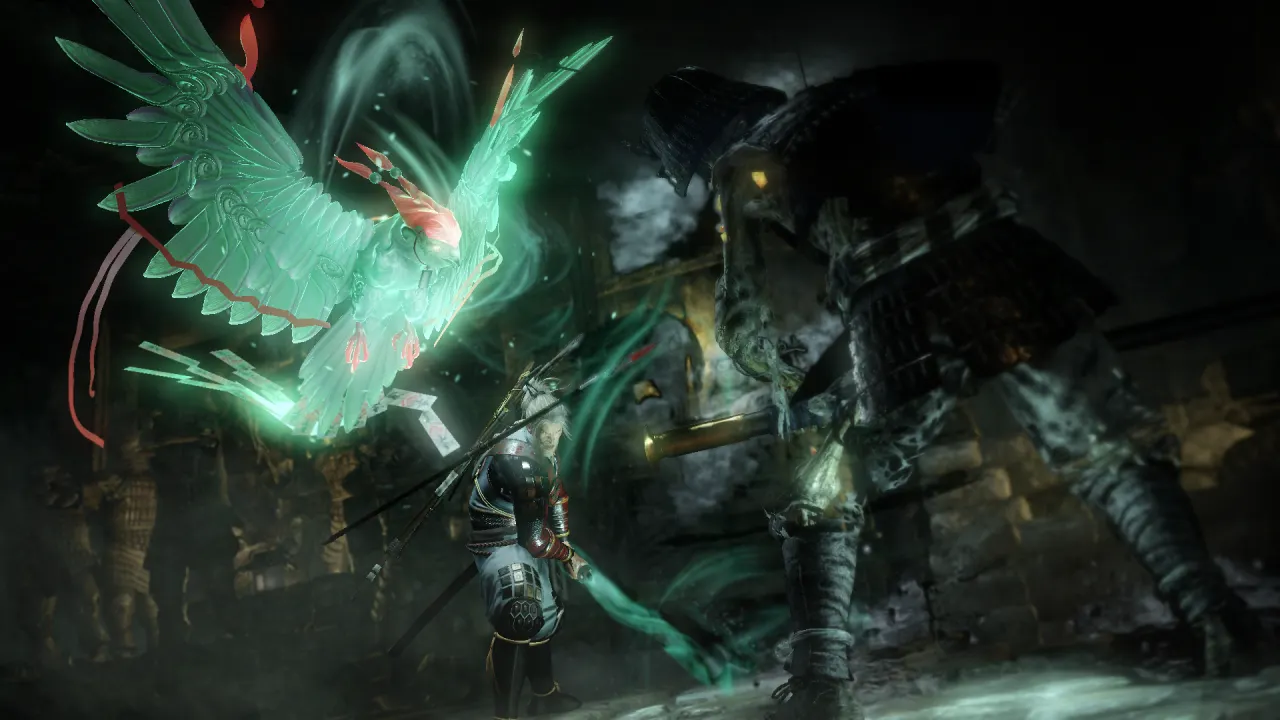
Then the storm-soaked battlefield arrives and the rhythm inverts completely. Out in the rain, long-reach weapons turn into lunging, leaping strikes, and a large foe's body, animations, and the open footing force you to rewrite your whole approach. The single strongest thing the moment-to-moment combat does is keep this variety coming. Today you cleared a stage on cautious, patient reads; tomorrow the same wall demands more aggressive, committal judgment. It is irritating. It is also addictive, in the way a very spicy hotpot is — the first bite stings, and then you cannot stop.
Crucially, this never collapses into a single optimal answer. Foes and bosses shift their patterns enough that yesterday's solution rarely carries over wholesale, and that churn is what keeps the loop fresh hour after hour instead of curdling into rote execution.
Exploration and Combat Feed Each Other
The strongest feedback loop in Nioh runs between staying alive and poking around. Stages are dense with both danger and secrets, and because survival forces you to scout routes and read sightlines, you routinely stumble into hidden elements as a side effect of simply trying not to be defeated. You go looking for safety and walk out with a shrine, a shortcut, or a stash of gear.
That gear is where the build economy really shows its teeth. Randomized loot affixes and set bonuses pour out of the world, the yokai shift form lets you tap your accumulated spirit power for a burst of pressure, and guardian spirits hang active and passive bonuses off your loadout. None of it is decoration — it is the reason a system-driven player keeps rerolling approaches, chasing the next affix, the next stance synergy, the next route. The build space is wide enough that "what do I run next" stays an open question deep into the run.
The honest catch is that this high-pressure cadence filters people. If you dislike repeated trial and error, the first few hours will hand you more frustration than fun, and that is a real cost rather than a footnote. But it is not fatal. Once you clear the adaptation hump, the rewards this system pays out are about as clearly defined as they come — and that clarity is exactly why it sticks.
Content | 7/10
Content: 7/10This is not a dozen-hour game that evaporates the moment the credits roll. The portion on offer is genuinely hefty, and more importantly, it is hefty in a way that keeps giving you reasons to stay rather than just numbers to clear.
The Main Line Is Only the Floor
The critical path alone runs long, and on top of that, foes, bosses, abilities, and gear systems all bite into one another so tightly that longevity gets propped up almost automatically. The key distinction is that "lots of content" here does not mean stuffing the map with icons. It means you always have a concrete reason to go tinker with the next style of play, the next piece of gear, the next hidden route.
That interlocking quality is the real engine. Abilities feed into stances, stances feed into weapon affixes, affixes feed into guardian-spirit synergies, and guardian spirits loop back into how aggressively you can play a given encounter. Because the systems reference each other, pulling on one thread tugs three others, and that is what turns a long main line into something you actively want to keep pulling apart rather than grind through.
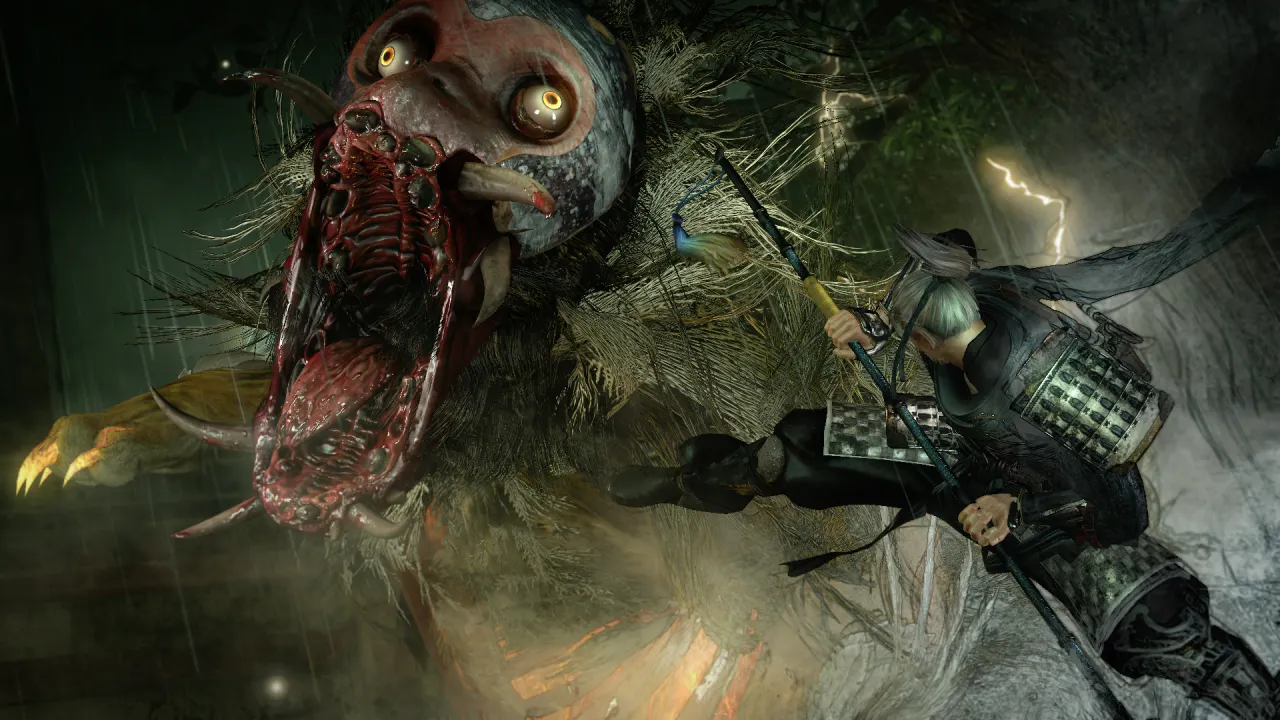
The dark-dungeon moment where you summon a green spirit bird to face a giant samurai foe captures this character well. It is not a reskinned wall of enemies; it is the system handing you a new relational puzzle — a new set of tools meeting a new kind of threat — and asking you to solve it with what your build already does well.
Scale, Repetition, and the Pull to Try Again
The other face of Nioh's content is sheer scale, and the fire-sea scene where three warriors besiege a giant yokai chief pulls it straight out into the open. The size of the encounter, the pressure of being one careful read away from disaster, and the nagging "I want one more attempt" instinct all stack together. This is content measured not in hours-to-completion but in willingness-to-repeat.
Complete Edition matters a great deal here, because it folds in all three expansions — Dragon of the North, Defiant Honor, and the final campaign chapter. That turns the whole trip into something closer to a full course with the appetizers and mains already plated, rather than a base game waiting on add-ons. The expansions extend the arc with new regions, foes, and gear rather than simply padding a number, so the longevity they add feels continuous with the core rather than bolted on.
The genuine strength is that the extended material beyond the main line never wears an obvious "filler" tag. Hidden elements and secrets naturally raise replay value, while gear and abilities make both a fresh start and a deeper dig into the same character meaningfully different runs. Restarting is not a chore; it is another build hypothesis to test.
Who Actually Gets Their Money's Worth of Time
There is a real caveat, and it is about temperament rather than quantity. If you are not a systems-driven player and you instead live for strong narrative momentum, this flavor of longevity will not all convert into interest. The mid-game is where that shows up: a stretch where fatigue can set in if the loop of foes, gear, and build-tinkering is not the thing pulling you forward.
Is that severe? It depends entirely on the player. People who love studying builds will read this density as the game's longest pole — the very reason they keep the disc in. People who do not will feel a little over-served, as though the plate kept arriving long after they were full. The content does not fail; it simply asks a specific kind of appetite to show up. Bring that appetite and Nioh has an almost embarrassing amount to chew on. Bring a different one and the abundance can read as too much of a good thing.
The smartest thing the Complete Edition does on this front is package everything so the decision is binary and clean: you are not weighing which expansion to buy or worrying about missing a chunk of the experience behind a paywall. The full course is on the table from the first hour, which lets the systems-driven player sink in without friction and lets the story-first player bail at a natural stopping point without feeling cheated out of content they paid for. For a game whose longevity is its single most divisive trait, removing the purchasing math is a genuinely thoughtful piece of design — it means the only question left is the honest one, whether this particular loop is for you.





Comments 0
Share your game review
Join the discussion and share your review of this game.
No comments yet. Share your thoughts on this review.