
























Opening
After more than a decade of waiting, Devil May Cry 5 arrived in 2019 and did something rare for a long-dormant series: it didn't just live up to the legacy, it perfected it. Director Hideaki Itsuno and Capcom poured eleven years of accumulated craft into a single game, and the result is widely regarded as the finest stylish action title ever made — a flamboyant, demon-hunting spectacle built on combat so deep that players are still discovering new expression in it years later.
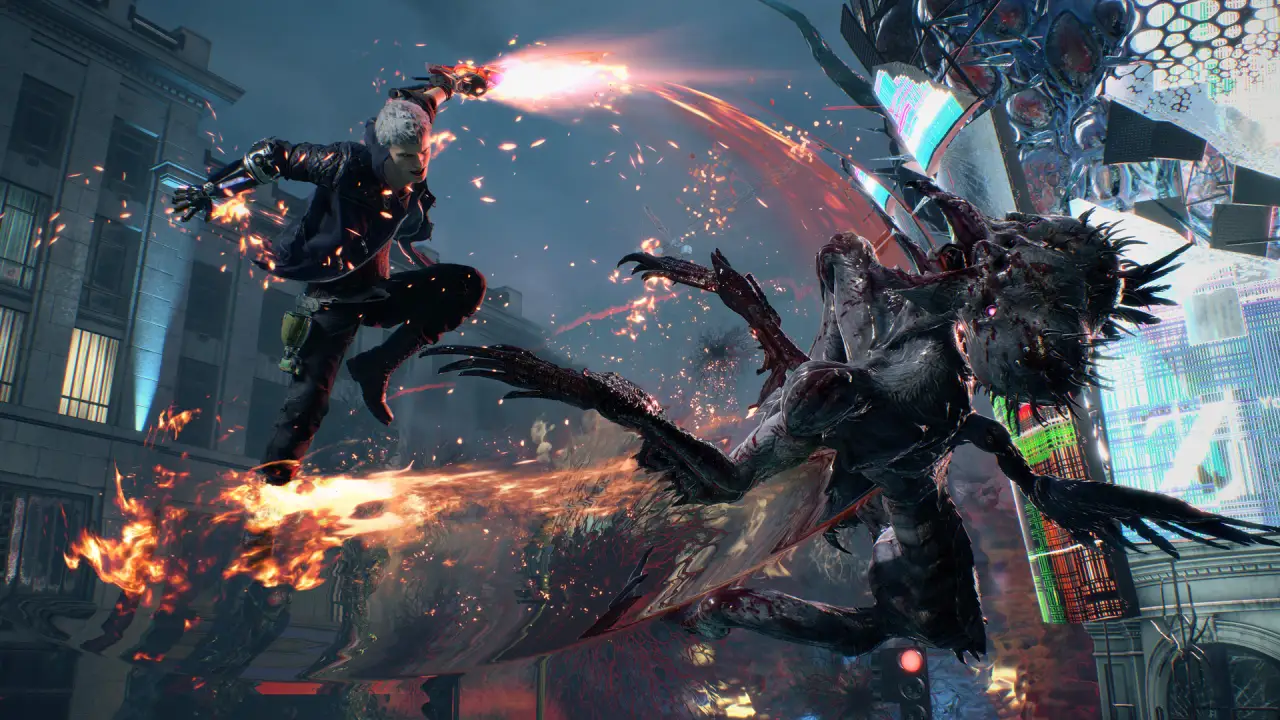
The premise gathers the series' threads into one explosive finale. A colossal demon tree erupts in the heart of Red Grave City, draining its citizens, and three hunters converge to stop it: the young, brash Nero with his swappable mechanical Devil Breaker arms; the legendary Dante, switching between four wildly different combat styles on the fly; and the mysterious V, a frail summoner who commands three demonic familiars to fight in his place. Three protagonists, three completely different combat philosophies, all united by the series' signature SSS stylish-rank system that turns every fight into a performance.
It is, by design, demanding. The combat rewards practice and punishes button-mashing, the rating system can intimidate, and its breakneck pace is not for everyone. But powered by the gorgeous RE Engine and crowned with The Game Awards 2019's Best Action prize and the series' best-ever sales, Devil May Cry 5 is a triumph. This review breaks down where its action spectacle earns its near-perfect marks, and who it is truly for.
Story | 8.0/10
Story: 8/10Devil May Cry has never been a series you play for the plot, and yet Devil May Cry 5 tells the most satisfying story it has ever managed — a stylish, earnest, fan-pleasing finale that pays off eleven years of dangling threads. It is not deep literature, and it knows it, leaning into operatic melodrama and pure cool. But as a culmination, it lands with real emotional weight, and the strong story score reflects how well it rewards the players who stuck with the series.

The Sons of Sparda and a Brotherhood's Reckoning
The emotional core is the long, tragic rivalry of the twin brothers Dante and Vergil, a conflict that has simmered across the entire series. Devil May Cry 5 finally brings it to a head, and it does so with a maturity the earlier games only gestured at — these are no longer just rivals trading taunts but brothers carrying decades of grief, and the game grants their confrontation a genuine sense of weight and, ultimately, a hard-won catharsis. For longtime fans, seeing this relationship reach its climax is the payoff of more than a decade of investment, and the game treats it with the gravity it deserves while never losing its sense of fun.
This reckoning gives the whole story its spine. Everything else — the demon invasion, the new hero's journey, the mystery man's agenda — orbits the gravity of these two brothers and the wound between them. It is melodrama, unabashedly, but it is melodrama executed with such conviction and affection for its characters that it works, delivering the kind of earnest emotional climax the series had been building toward since the beginning.
Nero's Lineage and the Mystery of V
Two intertwined mysteries drive the plot forward. The first is the question of Nero's parentage, a thread the series had teased for years and which the game finally answers in a way that recontextualizes his place in the family saga and raises the personal stakes of the central conflict. The second is the identity of V, the enigmatic summoner who hires Dante at the outset — a frail, poetry-quoting figure whose true nature is the game's biggest twist, and one that reframes the entire narrative once revealed.
The V reveal is the story's masterstroke, a genuinely clever piece of plotting that ties the mystery man directly into the brothers' conflict and the demon invasion. It is the kind of reveal that sends fans back to reconsider everything that came before, and it elevates what could have been a simple monster-hunt into a tightly woven family tragedy. These mysteries are what give the breakneck action a reason to care, threading real narrative tension through the spectacle. They also reward attentive players with a story that holds together far better than the series' reputation for nonsense would suggest, the disparate threads of three protagonists converging into a single coherent climax that feels earned rather than contrived.
Red Grave, Pacing, and Honest Limits
The backdrop is Red Grave City, overrun by the Qliphoth, a monstrous demon tree feeding on human life, which provides a suitably apocalyptic stage and a ticking-clock urgency that pushes the three heroes together. The setting is more a vivid canvas for the action than a richly developed world, but it does its job, lending the game an escalating sense of scale as the three storylines converge on a single climactic confrontation.
The honest limitations are matters of pacing and depth. The story is told in brief, punchy cutscenes between combat missions, prioritizing momentum over slow character development, so players seeking a contemplative, narrative-driven experience may find it rushed and thin. The plot is also unapologetically over-the-top, full of anime-style bravado that will not land for everyone. But judged as what it is — a stylish, heartfelt capstone to a beloved series — it succeeds beautifully, giving its action a genuine emotional engine and its fans the resolution they waited a decade for. That is exactly the balance this score reflects. It helps that the game is in on the joke — it knows its dialogue is corny and its posturing absurd, and it commits so wholeheartedly to that tone that the sincerity becomes endearing rather than embarrassing. The result is a story that earns genuine emotion not by pretending to be serious literature, but by loving its characters so openly that you cannot help loving them too.
Audio | 9.3/10
Audio: 9.3/10The audio of Devil May Cry 5 is not just excellent — it is mechanically integral, woven directly into the combat in a way few games attempt. The soundtrack, the character themes, and the punchy sound design all work together to make every fight feel like the action set-piece it is, and the result is one of the most exhilarating audio experiences in the genre. The near-top score reflects sound that is as much a gameplay system as an aesthetic one.

Music That Rewards Your Performance
The standout idea is the dynamic battle music, which ties the soundtrack directly to your performance via the stylish-rank system. As your combat rating climbs from a quiet baseline toward the coveted SSS, the music escalates with it — vocals kick in, the track surges to full intensity, and your skill is rewarded with an audible, adrenaline-pumping crescendo. Take a hit and lose your rank, and the music drops back down, so the soundtrack becomes a live feedback loop that pushes you to fight better and stay stylish. It is a brilliant marriage of sound and mechanics that makes mastering combat feel like conducting your own theme song, and it is the single cleverest thing the audio does.
Each protagonist gets a distinct musical identity to match their combat style. Nero's driving, anthemic battle theme is a genuine highlight that became a fan favorite, Dante's swaggering track suits his cocky bravado, and V's moodier, more atmospheric score fits his sinister elegance. These themes do real characterization work, reinforcing who you are playing and what their fighting philosophy feels like, and they are catchy enough to lodge in your head long after you put the controller down.
Impact, Voice, and Platform Polish
Beyond the music, the sound design delivers the visceral, satisfying impact that a stylish action game lives or dies on. Every strike, gunshot, parry, and demonic flourish lands with a crisp, weighty punch, and that crunchy audio feedback is essential to the feel of combat — you hear the connection of every hit, which makes pulling off a long combo as sonically satisfying as it is visually. The variety of weapon and ability sounds across the three characters keeps the audio fresh as you switch between their wildly different toolkits, each with its own sonic signature.
The voice acting and presentation round out the package with real conviction, the cast selling the series' melodrama with the right mix of sincerity and self-aware cool, so the story's emotional beats and its over-the-top bravado both land as intended. Across platforms the audio is consistently strong, and the next-gen versions preserve every layer of the mix intact at higher performance. The soundtrack has had a life well beyond the game, with its battle themes streamed and covered endlessly by a devoted fanbase, which is the clearest testament to its quality. It is audio engineered to make you feel like an action hero, and that singular purpose is exactly what earns this dimension its high mark.
Visuals | 9.2/10
Graphics: 9.2/10Devil May Cry 5 is a stunning showcase for Capcom's RE Engine, and it is one of the rare action games whose visuals have aged barely at all in the years since release. The combination of photorealistic character work, lavish demonic spectacle, and a rock-solid high frame rate makes it both beautiful and functional, and the near-perfect score reflects a presentation that serves the lightning-fast combat as well as it impresses the eye.

Photorealism Meets Stylish Excess
The foundation of the visual achievement is the RE Engine's rendering of its characters. Built in part from photogrammetry, the human faces and bodies reach a level of detail and realism that grounds the game's outrageous action in something tangible — Nero, Dante, and V look like real people, their expressions and skin convincing enough to sell the story's emotional beats. That photorealistic base then collides with the series' trademark stylish excess: flowing coats, gleaming weapons, and flamboyant character design that revels in cool. The contrast between grounded realism and over-the-top flair is the game's visual signature, and it is executed with enormous polish.
The demon and enemy design provides the other half of the spectacle. The creatures are grotesque, inventive, and varied, from small fodder enemies to towering, screen-filling bosses, and the bombastic special effects of your abilities — the glow of a Devil Trigger, the crackle of energy, the flourish of a finishing move — fill the screen with colour and motion without ever becoming an unreadable mess. It is maximalist spectacle kept legible, which is exactly what the combat demands.
A World of Demonic Scale
The setting of Red Grave City and the monstrous Qliphoth tree at its heart gives the game a canvas for genuine scale. The demon-infested city, the writhing organic interiors of the tree, and the increasingly hellish environments as the heroes ascend toward the climax all convey a mounting sense of apocalyptic grandeur. While the level design is fairly linear and the environments are more a backdrop for combat than an explorable world, they are richly detailed and atmospheric, escalating in spectacle to match the rising stakes of the story.
That escalation is deliberate and effective. Early areas ground you in a recognizable, ruined city; later ones plunge into surreal, biological nightmare-scapes that would not be out of place in a horror game, so the visual journey mirrors the narrative's descent toward its final confrontation. Each character's campaign also recolours the same spaces with a different mood, keeping the shared environments from feeling repetitive across the three intertwined storylines. The boss arenas in particular are staged for maximum spectacle, framing each towering adversary against backdrops that emphasize its scale, so even within a linear structure the game keeps delivering memorable, screen-filling visual set-pieces right up to its finale.
Performance as a Feature, and Platform Tiers
Crucially for an action game built on precise, high-speed inputs, the visuals never come at the cost of performance. The base game targets a smooth 60 frames per second at up to 4K, and that rock-solid responsiveness is itself a visual and gameplay feature — in a game where reading and reacting to attacks at the frame level matters, the fluidity is essential, not optional. The clarity of the presentation, with readable enemy tells and a clean rank display, supports the combat rather than obscuring it.
The next-gen Special Edition pushes this further, adding ray tracing for richer lighting and reflections, a 120fps Turbo Mode for an even faster and smoother experience, and the visual flourishes of playable Vergil, making the PS5 and Xbox Series version the definitive way to see the game. The trade-off is platform exclusivity, as those enhancements never came to the PS4 and Xbox One originals, leaving last-gen players on the still-excellent but less feature-rich base presentation. Across every version, though, this remains a gorgeous, high-performance showcase, and the score reflects visuals that have genuinely stood the test of time. The art direction's secret is that it never sacrifices clarity for spectacle: no matter how many enemies, effects, and flourishes fill the screen at once, you can always read the action — where the threats are, what they are about to do, how your combo is landing. In a genre where a single missed visual cue can break a flawless run, that disciplined legibility is as much an achievement as the raw fidelity, and it is a large part of why the game feels so good to play and not just to look at.
Combat | 9.5/10
Gameplay: 9.5/10This is the reason Devil May Cry 5 is celebrated, and the reason it sits at the summit of its genre. The gameplay is the deepest, most expressive, and most replayable stylish-action combat ever made, offering three radically different protagonists whose toolkits could each anchor a game on their own. It earns its near-perfect score on the strength of combat that rewards mastery more richly than almost anything else in the medium.

Three Heroes, Three Combat Philosophies
The masterstroke is that you do not play one character — you play three, each a complete and distinct combat system. Nero is the accessible-but-deep entry point, built around his swappable mechanical Devil Breaker arms, consumable prosthetics that each grant a unique ability, encouraging you to manage a loadout and improvise as you burn through them. Dante is the maximalist's dream, able to switch on the fly between four combat styles — swordsman, gunslinger, the defensive Royal Guard, and the trickster's teleports — while juggling multiple weapons, creating a system of near-limitless freedom that is the highest expression of skill the series offers. And V is something the genre had never seen: a frail summoner who does not fight directly but commands three demonic familiars, directing them in battle before personally delivering the finishing blow, a completely different rhythm that demands positioning and management over raw execution.
This breadth is staggering. Three characters with three entirely separate philosophies means the game effectively contains three different combat systems to master, and the variety keeps the lengthy campaign endlessly fresh as it rotates between them. Few action games offer one combat system this deep; Devil May Cry 5 offers three, and that is the core of its greatness.
The Stylish Rank System as Engine
Tying it all together is the SSS stylish-rank system, the genius mechanic that transforms combat from a means of clearing enemies into a performance art. Your rank climbs as you chain varied, creative combos without repeating yourself or taking damage, rewarding expression and improvisation over brute efficiency. This single system reframes the entire game: it is not enough to win a fight, you want to win it beautifully, and that pursuit of style is a bottomless well of self-directed challenge. The dynamic music that escalates with your rank closes the loop, turning a great combo into a full-body rush.
The result is a combat ceiling so high that the community is still pushing it years later, with top players producing combo showcases that earn tens of millions of views — a living testament to the depth on offer. The game is approachable enough to enjoy on a first run and deep enough to study for a thousand hours, which is the hardest balance in action design and one Devil May Cry 5 strikes perfectly.
Modes, Replay, and the Practice Curve
The combat is wrapped in a structure built for replay. The campaign spans twenty missions across the three characters, but the real longevity lives in the higher difficulties, the ranking chase, and the Bloody Palace, an endless survival gauntlet that is the ultimate test of combo skill and consistency. The Special Edition extends this further with playable Vergil, the brutal Turbo Mode, and the punishing Legendary Dark Knight difficulty that floods the screen with enemies, giving mastery-focused players an enormous amount to chew on.
The honest caveats are inseparable from the design's ambition. This combat rewards practice and punishes mashing, so newcomers can hit real frustration in the first several hours before the systems click, and players who actively dislike rating systems will find the SSS framework, which is so central to the experience, a poor fit. The breakneck pace, too, is a deliberate filter. But for the player willing to invest, the gameplay is a near-bottomless masterpiece of expression and mastery. What separates it from even its closest rivals is the sense that the game is a canvas rather than a test — there is no single correct way to clear a fight, only your way, and the system is generous enough to make almost any creative idea you have actually work on screen. That freedom of self-expression, backed by mechanics deep enough to support a lifetime of experimentation, is the rarest quality in action design, and it is precisely what this score reflects.
Content | 8.8/10
Content: 8.8/10Content is a strong score for Devil May Cry 5, reflecting a generous, replay-focused package whose value compounds the more skilled you become. While its core campaign is a defined length rather than an open-ended sandbox, the game is built from the ground up for repetition — higher difficulties, the ranking chase, endless modes, and substantial post-launch additions give it a long tail that few action games match.

A Campaign Built for Replay
The main story runs roughly twenty to thirty hours across its twenty missions, a healthy length for the genre, but that figure badly undersells the real content because action games of this kind are designed to be replayed, not just completed. The campaign rotates between Nero, V, and Dante, so a single playthrough already delivers three distinct combat experiences, and the game's many difficulty levels — escalating from the approachable up to brutally demanding tiers — fundamentally change how you must play, turning a second or third run into a genuinely different challenge rather than a repeat.
This is the crucial framing: replayability is the content. A player chasing mastery will return to the same missions again and again to improve their rank, experiment with new combo routes, and conquer harder difficulties, extracting hundreds of hours from a campaign a one-and-done player might "finish" in a weekend. The depth of the combat is what makes that repetition compelling rather than tedious, and judged on that basis the package is far more generous than its raw mission count suggests.
Bloody Palace, Vergil, and the Special Edition
Beyond the campaign, the dedicated endgame modes are where the most committed players live. The Bloody Palace is the centerpiece — a free post-launch addition that pits you against an endless, escalating gauntlet of enemies in a pure test of skill and consistency, the ultimate proving ground for combo mastery and the mode that defines the long-term challenge for high-level players. It is exactly the kind of distilled, replayable content the combat was built to support, and it adds enormous value at no extra cost.
The post-launch support deepened the package considerably. The hugely requested playable Vergil was added as paid DLC, giving fans a fourth, distinct character to master with his own moveset and demon transformation, while the next-gen Special Edition bundled him alongside the punishing Legendary Dark Knight mode, the high-speed Turbo Mode, and ray-traced visuals. Together these additions meaningfully expand both the roster and the modes on offer, rewarding the players most invested in the combat with even more to chase. Vergil in particular is a content event in his own right, a fourth combat philosophy with the depth of a full character, and his addition gives even players who had wrung the base game dry a compelling reason to return and start the mastery climb all over again.
Mods, Platforms, and Genre Standing
On PC, the game enjoys a healthy modding scene that extends its life further, with the community producing new characters, costumes, visual tweaks, and gameplay changes that add variety and replay value for those who seek them out. This grants the PC version an edge in longevity, layering player creativity on top of an already deep foundation, though the core experience is excellent on every platform.
The one real division in the content is platform-based: the Special Edition's enhancements — playable Vergil included at base, Turbo Mode, Legendary Dark Knight, ray tracing — are exclusive to the PS5 and Xbox Series versions, leaving original PS4 and Xbox One owners with the still-substantial but less feature-rich base game. Measured against its peers, Devil May Cry 5 offers a content proposition perfectly suited to its genre: not the sprawling breadth of an open-world game, but a deep, endlessly replayable core that rewards skill with effectively limitless playtime. For the audience it is built for, the well runs as deep as your dedication, and the score reflects a package that gives far more than its length implies. The simplest way to put it is that a casual player and a dedicated one are buying two completely different games at the same price: one gets a thrilling twenty-five-hour ride, the other gets a years-long obsession, and both are getting their money's worth from the very same discs.





Comments 0
Share your game review
Join the discussion and share your review of this game.
No comments yet. Share your thoughts on this review.