






















Opening
The protagonist stands on a high ledge of a blue data space, a digital metropolis spread out below like an enormous circuit board. A breath later you are back in a detective agency, facing a glowing portal, ready to take on the next case. That gap between worlds is the whole pitch. It tells you that the most fascinating part of Digimon Story Cyber Sleuth: Complete Edition is not the word "detective" at all, but the way it stitches everyday city life to a virtual otherworld with a distinctly JRPG temperament. Bundling two games together does not dilute that quality; it amplifies it. Not through a bigger map, not through louder spectacle, but through a battle, raising, and collection loop that is solid enough to slowly drag you into the interlocking rhythm of EDEN and Tokyo.
That rhythm is the thing reviewers tend to undersell. On paper the premise reads like a procedural about cybercrime; in practice it is a monster-raising RPG that happens to file its progress under case numbers. The detective framing supplies a reason to keep moving between worlds, while the systems underneath supply the actual hook, and the two complete editions stacked together give that hook room to deepen instead of merely repeating.
It is not new. You can plainly see its PS4 and PS Vita roots. Yet precisely because of that, you get a feel for its temperament within the first few hours: there is a lot of text, not much actual deduction, and the thing that truly refuses to let you put it down is the addictive pull of team building, that constant urge to raise one more, to evolve one more time. If you are after the dense character theater of a flagship modern JRPG, or the breezier forward momentum of a mainline monster-collecting blockbuster, this may not be your dish. But if you want a Digimon-raising RPG that can comfortably eat dozens of hours, even a hundred-plus, the heft of this complete edition is genuinely there for the long haul.
Story | 6.8/10
Story: 6.8/10Its worldview lingers longer than its main plot. The setting is the part you carry away, and the part most likely to keep you nodding along.
A shared world with a complete foundation

Cyber Sleuth and Hacker's Memory share the settings of Tokyo and the virtual world EDEN, and that shared bedrock gives the whole story a complete foundation. The parallel-narrative approach in particular plays like a crime film edited along two timelines: you see the outcome first, then fill in the cause from the other side, and certain events that read one way in isolation take on a different taste once the second thread recontextualizes them. When a character looks out over the digitized metropolis from a high data ledge, that sensation of reality and the virtual overlapping each other is exactly what props up the world's appeal. The foundation is sturdy enough that even when individual scenes wobble, the overall architecture holds, and you stay oriented inside a fiction that always knows where its two halves connect. That coherence is rarer than it sounds in a sprawling JRPG, where setting often frays the longer a story runs. Here the dual structure actually tightens the world rather than loosening it, because each campaign is constantly auditing the other for consistency, and the EDEN-versus-Tokyo duality gives every revelation a clean place to land. The premise of a city layered over a virtual mirror of itself is the kind of conceit that rewards a long runtime, since the more time you spend in both spaces, the more the seams between them start to feel intentional rather than convenient. By the time the two threads converge, the setting has earned its scale, and the world reads as a single coherent place rather than two adjacent backdrops sharing a logo.
Visual-novel delivery and its trade-offs
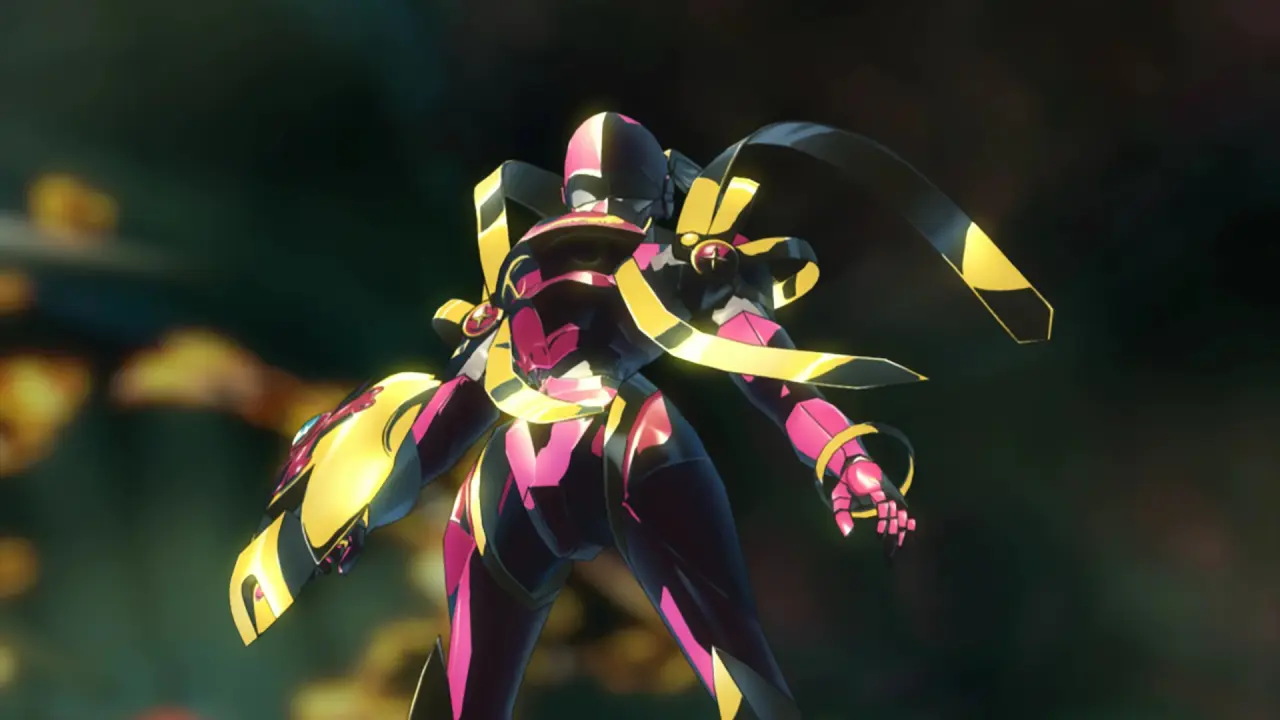
Yet if you judge it purely on how well it tells its tale, it does not reach a standout tier. The point of contention raised across coverage is accurate: the text volume is enormous, and the delivery skews toward visual-novel presentation, which is not to everyone's taste. You spend a great deal of time reading, following threads, and absorbing setting. The upside of that approach is dense information; the downside is that the pacing is not always crisp. When a humanoid Digimon in a black-gold-and-pink palette makes its close-up entrance, the character presence lands for a beat. But after a long stretch of reading, the moments that actually stick with you are not necessarily proportional to the sheer word count. Density and memorability are not the same currency, and the game spends generously in the former while hoping it converts to the latter. Sometimes it does, when a setpiece earns the buildup the text has been quietly funding. More often the writing simply asks for patience, trusting that the cumulative weight of detail will leave an impression even if no single line does. Whether that bargain pays off depends almost entirely on how much you enjoy reading for its own sake, because the game will not shorten the trip on your behalf.
Why systems players still find enough here
The problem is clear: the delivery leans toward watching rather than deducing. The impact is just as clear. If you expect high-density dramatic conflict, or the way a flagship modern JRPG keeps tugging you forward through relationship beats, this will feel flat by comparison. Compared with Persona 5 Royal, its character drama and narrative packaging plainly come up short, and it never quite musters that propulsive, can't-stop pull. Is that fatal? For systems players, no. The world completion and the parallel narrative still offer plenty worth seeing; it simply behaves more like a very long, setting-collection-style JRPG than a tightly plotted serial you binge in one sitting. Approach it as lore to inhabit rather than a thriller to race through, and the writing finds its proper level, supporting the loop instead of trying to outshine it. The world is the souvenir here, not the plot, and that is a perfectly respectable thing for a long monster-raising RPG to offer. You will remember the texture of EDEN, the logic of its two-timeline crime, and the particular Digimon you carried through both campaigns long after the specific case beats blur, which is exactly the kind of memory this genre tends to leave behind.
Audio | 6.2/10
Audio: 6.2/10The sound is competent, but it rarely steals a scene. It does its job well and then steps back, which is both its merit and its ceiling.
Atmosphere over showmanship
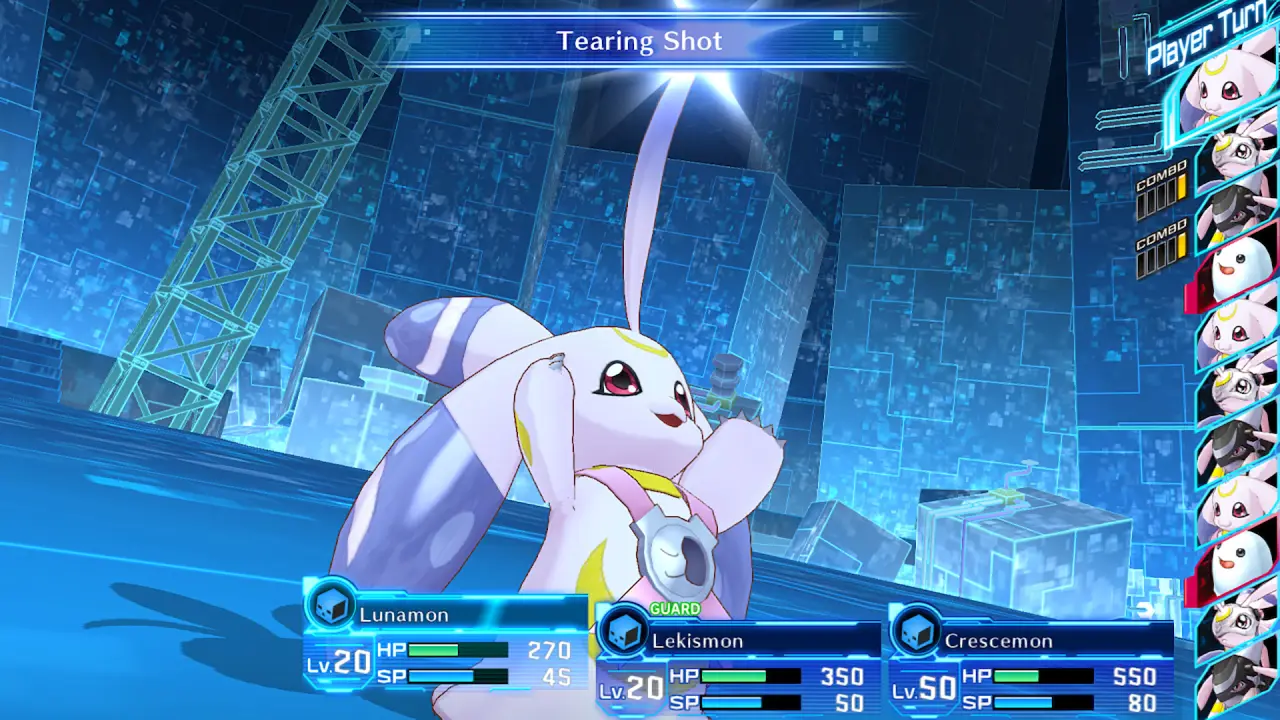
The audio work concentrates on one thing: laying a stable atmosphere. Japanese sci-fi and an urban electronic space do not call for a flamboyant score; they call for a layer of underscore that glues real Tokyo to virtual EDEN. From the coverage, the audio clearly accomplishes that task. It never breaks immersion, and it nudges the overall style in the right direction. That restraint is a deliberate choice rather than a failing of ambition, and within its lane the sound design holds the mood steady through long stretches of reading and exploration, doing exactly what an ambient-leaning soundtrack is supposed to do without ever overreaching. A score that fought for attention every minute would actually undercut a game built on text and slow accumulation; the point is to keep you immersed, not to keep interrupting. So the music breathes underneath the menus and the dialogue, coloring the digital cityscape without ever announcing itself, and that invisibility is closer to success than failure for the kind of experience this is.
A muted presence with few memory hooks
But the problem sits right there too: its presence is relatively limited. Set against combat, raising, and sheer content volume, audio is not a focus of discussion, which usually signals that it does not visibly drag anything down, yet also lacks the kind of hook that makes you want to pull a single track out and listen to it on its own. The impact is grounded and real. While you play, everything feels smooth enough, but once you have cleared it, what stays lodged in your head is more likely the image of some Digimon or the shape of a particular team-building idea than any melody. The score keeps the lights on without ever turning into the reason you stayed. There is a real difference between music you notice and music you remember, and this soundtrack lives almost entirely in the first category. You register that the ambience suits the scene, you appreciate that nothing grates, and then it recedes the moment your attention returns to the battle or the build. For a long game that is a defensible design, but it does mean the audio will never be the thing that pulls a lapsed player back for one more session.
Solid enough for a systems-driven JRPG
None of this counts as a serious defect. For a systems-driven JRPG, sound only has to stay steady to have done most of its job, and on that measure the game passes cleanly. The trouble only appears if you place a high premium on soundtrack identity. If you want music that becomes the work's calling card the way a flagship modern JRPG's score can, this cannot offer satisfaction at the same tier. It is a supporting instrument, not a headliner, and it knows it. Measured against its own brief, binding two worlds together and never pulling you out of them, it succeeds, and that quiet competence is ultimately enough to keep the dozens of hours feeling coherent rather than hollow, even if you will not be humming any of it on the way out. The fair verdict is that the sound clears the bar a systems-driven JRPG sets for it and declines to reach for any higher one. That is neither a triumph nor a misstep, just an accurate measure of priorities. The studio poured its energy into the creatures and the loop, and the audio was content to keep the room warm while they did the heavy lifting.
Visuals | 6.5/10
Graphics: 6.5/10The best-looking thing about it is design, not technology. Judge it as art direction and it sings; judge it as raw fidelity and the years show.
Recognizable designs that drive the urge to raise
Start with the strengths. Digimon themselves carry extremely high silhouette recognizability, and in a collection-raising game that matters enormously, because it directly decides whether you want to raise this one. When a black Agumon variant erupts a fireball to unleash its signature blast, the instant conveys familiarity and a sense of ownership; you may not gasp at the technical muscle, but you recognize it at once, remember it, and want to slot it into your party. That pull is the whole point of the art in a game built on collection. The roster's legibility does more work than any post-processing pass could, turning each new capture into something you can instantly place on a mental shelf and start scheming around. Decades of consistent creature design pay dividends here, because every silhouette carries an implicit promise about how it fights and what it evolves into. You do not need a stat screen to feel the difference between a hulking brute and a nimble caster; the art tells you before the numbers do, and that fluency is what keeps the collection loop emotional rather than purely spreadsheet-driven. There is also a generational pride at work in the roster, since the designs span eras of the franchise and reward anyone who grew up with the series with a steady stream of recognition. That nostalgia is not a crutch but a genuine asset, because attachment is half the engine of any collection game, and a creature you already loved as a child is one you will happily grind for as an adult.
A unified Japanese-animation visual language
Cutscenes and character portraits are likewise easy on the eye, with a clearly defined Japanese-animation style. When a golden Digimon unleashes a dazzling slashing technique in electronic space, the image lifts that anime-leaning, sci-fi-leaning flavor, and the visual language stays unified throughout. It is like an old restaurant that has been open for years: the plating may not be trendy, but the moment the signature dish arrives, you know the flavor profile has not drifted. Consistency is the quiet virtue here. Nothing clashes, nothing feels bolted on from a different art bible, and the steady tone lets the monster designs stay the star without competing for attention against the backdrops or the interface. The environments know their job is to frame, not to upstage, so the neon geometry of EDEN and the grounded textures of Tokyo each read clearly without fighting the creatures for your eye. That discipline is why the presentation ages gracefully where it matters: even when the technology shows its years, the compositional sense holds, and a well-staged battle still looks deliberate rather than dated.
The era it cannot quite hide
The shortcomings are just as plain. The overall visual specification is inherited from the original PS4 and PS Vita era, so the technical showing is not advanced. Viewed today, scene detail, model precision, and the scale of staging are nowhere near leading. The impact is that first-glance appeal will not be especially strong, and lined up beside recent JRPGs, the sense of its era is hard to hide. Is that fatal? Not at all. This game leans on systems and content to hold its runtime; the visuals simply cannot pile on extra points. Given that the work shipped more than five years ago, this visible-age feeling is objective and present, and the experience asks you to apply a small time filter of your own. Do that, and the designs that genuinely matter, the monsters, keep carrying the load just fine. The honest read is that fidelity was never this game's argument, and pretending otherwise would set up the wrong expectation. What it offers instead is a roster you want to look at, presented in a style that never wavers, and for a collection RPG that bundle of legibility and consistency outlasts raw polygon counts every time. Judge it by whether you want to raise these creatures, not by whether the backdrops would survive a side-by-side with this year's marquee release, and it holds up.
Combat | 8.5/10
Gameplay: 8.5/10The sharpest cut this game lands falls squarely on its systems. The title says "detective," but the actual skeleton is a very traditional, very chewable turn-based raising RPG, and that is where its real strength lives.
A traditional turn-based frame that rewards patience

The turn-based combat itself is not revolutionary. It runs on a familiar frame of attributes, type matchups, and party positioning, the kind of structure veterans of the genre can read at a glance. What makes you willing to stay for a long stretch is not novelty but cohesion: combat, raising, and collecting bite into one another so tightly that no single fight feels isolated. You do not win a battle merely to win. You win to set up the next formation, the next evolution, the next stat patch for a slot your party is missing. The instant a mechanized Garurumon snaps into a battle pose in the data space, the reaction is not only that it looks cool. It is that you instinctively begin asking which lineup it belongs in. The frame is plain on the surface, but the calculations stacking on top of it are where the depth quietly accumulates, fight after fight, until you realize you have been optimizing for an hour without noticing.
Team building pull that ramps instead of dumping
The genius of this system is that it does not blast you with complexity from the opening minutes. Early on you will feel like you are simply pushing through dungeons at a normal clip, clearing encounters, nudging the story forward. Only several hours in does it dawn on you that the gravitational pull of team building has already taken hold. You start caring about evolution branches, about reverse-evolving to reroll stats, about which support Digimon plugs the hole your front line keeps leaving open. Packing two titles together thickens this layer rather than padding it. It is not that a fistful of extra system names get bolted on; it is that you are handed a far longer runway to understand the loop, to tinker with it, and to sink into it. When an Omnimon unleashes its full-blade finisher in a turn-based exchange, the staging is certainly worth watching, but the more important truth is that these Digimon themselves are the engine that keeps you playing. The escalation is psychological as much as numerical: every new evolution unlocks a fresh question about role coverage, and every answered question opens two more. By the time the systems are fully exposed, you are no longer pushing dungeons to reach the next story beat; you are pushing them to fund the next build, and the campaign quietly becomes a delivery system for your own optimization habit. The reverse-evolution mechanic deserves special credit, since it turns raising into something closer to deck-building: a Digimon you outgrew is never wasted, only repurposed into a better-rolled version of a future form. That loop of pruning and regrowing is where dozens of hours quietly disappear, and it is the clearest evidence that the systems, not the story, are the real reason to keep the controller in your hands.
Where the detective label and the play diverge
The problem is real and worth naming plainly. This is simply not a game that builds its "detective" play into a core selling point. Genuine deduction is thin on the ground. You take a commission, you advance a sliver of main plot, and then you wander straight back into another systems hook. For a slice of players that creates a tangible expectation gap. The impact is direct: if you came for puzzle-solving and case-cracking, you will notice around the midgame that what you are actually playing is a systems-driven JRPG wearing a detective coat. Is that fatal? Not really. The precondition is that you accept the game's center of gravity has always sat in combat and raising, never in brain-burning investigation. Read it for what it is, a deep monster-raising loop with a crime-fiction wrapper, and the divergence stops feeling like a flaw and starts feeling like an honest description of the genre underneath. The mismatch only stings if the marketing set a different expectation than the design ever intended to meet. Once you recalibrate, the cases become a pleasant connective tissue between encounters rather than a promise the game fails to keep, and the hours you sink in stop being measured against detective fiction and start being measured against every other monster-raising RPG, where it competes far more comfortably.
Content | 8.3/10
Content: 8.3/10The value of a complete edition is concrete here, not aspirational. Collecting Cyber Sleuth and Hacker's Memory into one package already decides, from the outset, that this will not be a quick snack.
Two campaigns that are no quick snack

The twin campaigns run somewhere around 90 hours combined, and that figure only covers finishing the main course. The moment you take an interest in side content, collection, and party raising, the clock keeps climbing, and it climbs naturally rather than through padding. The image of the protagonist standing in the detective agency, interacting with a glowing portal, captures the structure perfectly: accept a commission, push the main thread a step, then reach almost absentmindedly into another system hook. That rhythm of just one more errand, just one more evolution, is exactly how dozens of hours evaporate. Crucially, this volume is not a pile of empty hours. It is paced so that progress and distraction feed each other, and the loop never quite hands you a clean stopping point. That is the difference between a long game and a padded one: here the runtime is a consequence of how many threads stay live at once, not a deliberate brake on your momentum. You finish a commission and three new reasons to keep playing have already queued themselves, which is exactly why a session you intended to keep short keeps drifting past midnight.
Parallel narrative that reflects rather than repeats
What matters more than raw length is how the two games relate. They share the settings of Tokyo and the virtual world EDEN, and then deploy parallel narrative to fill in each other's background and events. So what you are playing is not a simple front-half and back-half. It is a mutually reflective unfolding, where an episode that read one way on its own takes on a different flavor once you see it from the other side. When your party threads through subway-station-style scenes to keep exploring, the mindset of I am only going a little further forward is the engine that quietly stretches the playtime. The structure rewards attention: details seeded in one campaign pay off in the other, and the back-and-forth gives the bulk a reason to exist beyond a runtime number. It is the rare collection where the second half retroactively improves the first, so the volume is not just more to do but more to understand. A player who treats the two campaigns as a single braided story, rather than a sequel bolted onto a predecessor, gets the most out of the design, because the parallel structure was clearly built to be read together rather than back to back. The shared cast and overlapping incidents mean that recognition becomes its own reward: spotting a familiar face from a new angle, or watching an offhand event from the first campaign acquire weight in the second, is the kind of payoff only this twin structure can deliver. That cross-referencing is the strongest argument for the bundle existing at all, and it is what separates the complete edition from a pair of games simply sold in the same box.
The cost of bulk, and who it is for
Of course, large volume carries a price. Lots of text and a long flow mean it makes demands on your patience; not everyone is willing to sit inside a cadence like this for the full stretch of dozens of hours. The impact is straightforward. If all you want is an RPG you can satisfyingly finish over a weekend, this will feel sticky and slow. Whether that is fatal depends on the person. For someone who loves long-term raising, the heft is precisely the appeal, the thing that lets the loop breathe and the collection deepen. For someone who only wants a taste, it does land on the heavy side. The package does not pretend otherwise, and it does not try to be brisk. It is built for the player who treats a hundred hours as a feature rather than a warning, and it is honest about asking for that commitment up front. There is no fast-forward button hidden in the menus, no campaign-skip toggle for the impatient; the length is the product, take it or leave it. For the right buyer that candor is reassuring, because the value proposition is plainly stated: pay once, receive two full games' worth of monster-raising, and expect to live inside them for a season rather than a weekend.






Comments 0
Share your game review
Join the discussion and share your review of this game.
No comments yet. Share your thoughts on this review.