



















Opening
Some games you finish and quietly wonder how they were even allowed to be this good. Divinity: Original Sin 2 is one of them. It doesn't win you over with a single headline spec or a marquee feature. It wins because it took one idea — let the player author the solution — and pushed it to a depth nobody in the genre has reached since.
You begin as a Sourcerer in chains, hauled into Fort Joy with a collar clamped around your throat, marked as a threat the moment your power woke. The prize dangled in front of you is divinity itself, the right to ascend and replace an absent god. But the hook isn't that premise. The hook is the first time you pour a slick of oil across the floor, lob a fireball into it, and watch the whole battlefield go up in a chain of fire. That is the moment it clicks: every square of ground here is a board you are allowed to scheme on.
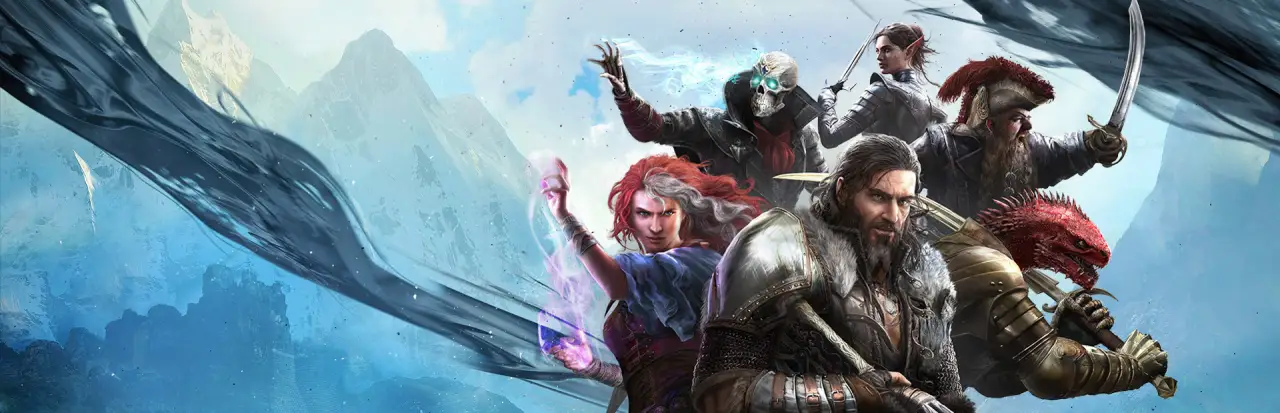
Larian Studios built this thing out of elemental turn-based combat, six origin characters with real interior lives, drop-in co-op you can betray, and a Game Master mode that lets you stage your own campaign like a tabletop night. The result has been called one of the finest role-playing games ever made, over and over, and the scores back it up: a 93 on Metacritic, a Mighty 92 on OpenCritic, north of 160 industry awards. The Definitive Edition folds all of it into a free package — a gentler opening, a tighter story — and carries an experience once treated as hardcore PC-only straight onto the couch and the handheld.
There's a reason that pour-oil-then-fire moment keeps getting cited. It is the cleanest possible demonstration of the game's thesis: the rules are consistent, they belong to you as much as the enemy, and the designers would rather hand you a sandbox than a script. Most RPGs ask you to pick the correct answer from a menu. This one hands you a chemistry set and a problem and trusts you to invent the answer yourself — and then it remembers what you did with it.
This review is here to settle one question: where it's brilliant, and exactly who it will leave behind.
Story | 9.5/10
Story: 9.5/10Six private lives propping up a war over godhood
The main thread reads like classic high fantasy on paper. You are a Sourcerer, feared by the Divine Order, shipped off to the prison island of Fort Joy, while the ultimate temptation hangs over every Sourcerer alike: ascend, become Divine, take the throne a missing god left empty. Power, faith, sacrifice — the usual heavy chords. The depth lives somewhere else entirely. It lives in who you decide to be.
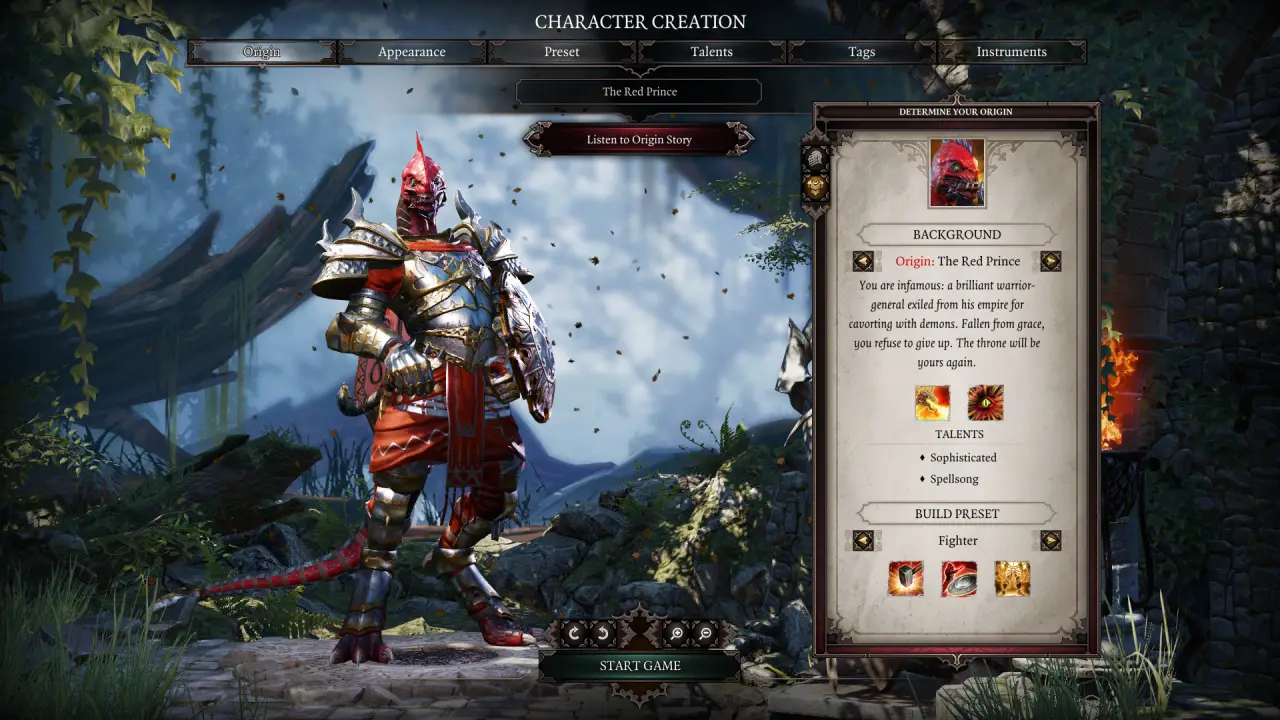
The game hands you six origin characters, and each one is a finished character script rather than a reskinned intro screen. The Red Prince is an exiled lizard royal who can think of nothing but reclaiming his crown and his dignity. Sebille is an elven assassin who slipped her chains and now carries her former master's scars like a debt she intends to collect. Lohse is a musician sharing her own skull with a powerful demon, and her entire arc is a tug-of-war with the voice she can't evict. Pick one, and their grudges get stitched into the spine of the story — private dialogue, private quests, a private ending all unlock with them, and the party banter shifts to match the company they now keep.
What's clever here is the inversion. You are not a spectator watching a hero. You are a person with a past, a debt and an agenda, dropped into a world where everyone else is running their own.
You can, of course, refuse all six and roll a blank custom protagonist instead. But once you've tasted the court intrigue threaded through the Red Prince's bid for his throne, or marched alongside Sebille as she settles the account with her old master one body at a time, the odds are good you'll start over to become one of those six. Their stories are written too full — full enough that a hand-built character feels thin by comparison. That density, character-as-script rather than character-as-blank-slate, is the part of this narrative most worth remembering. It is the difference between a quest log and a cast.
A world that remembers every move you make
If origin decides who you are, the tag system decides how the world reads you. Lizard, elf, dwarf, undead, noble, outlaw — these tags rewrite dialogue on the fly, so the same exchange splinters into different questions depending on whose mouth it comes out of. Stand your party in front of one NPC and each member hears a different conversation; in co-op, two players can disagree so hard they turn on each other on the spot.
The weight of choice is real, and it is physical. Spare some bystander who looks irrelevant and you may rewrite a questline forty hours later. Kill a merchant and you may slam a door on a key item permanently. Act 2's Driftwood is where this design peaks: side quests pour out all at once, each written densely enough to rival the main story, easy to lose the thread in without a guide — and that is precisely why no two players walk away with the same campaign.
Compare it to Pillars of Eternity, the era's other revival standard-bearer. Obsidian's prose is every bit as sturdy, but its consequences mostly resolve in a line of narration or a tilt on a hidden meter. Original Sin 2 prefers to make the aftermath something you can see and touch. The bridge you burned actually collapses. The man you saved actually speaks up for you in some far corner later. The relic you greedily pocketed actually drags a squad of Magisters down on your head. Because the fallout is concrete and can't be undone, you genuinely hesitate at the fork — and that hesitation is the hardest texture an RPG can manufacture. It isn't testing your morality so much as forcing you to stand behind your own judgment, with no quicksave-shaped escape hatch waiting if the call goes wrong. The Definitive Edition reinforced all of it, rewriting Act 2 and re-recording over 150,000 lines of voice so the muddled middle finally holds together. Swap your origin and you don't replay a route; you live a different life, see a different slice of Rivellon, and carry a different set of regrets to the credits.
Audio | 9.0/10
Audio: 9/10Seven themes, one per soul, and the score follows whoever you steer
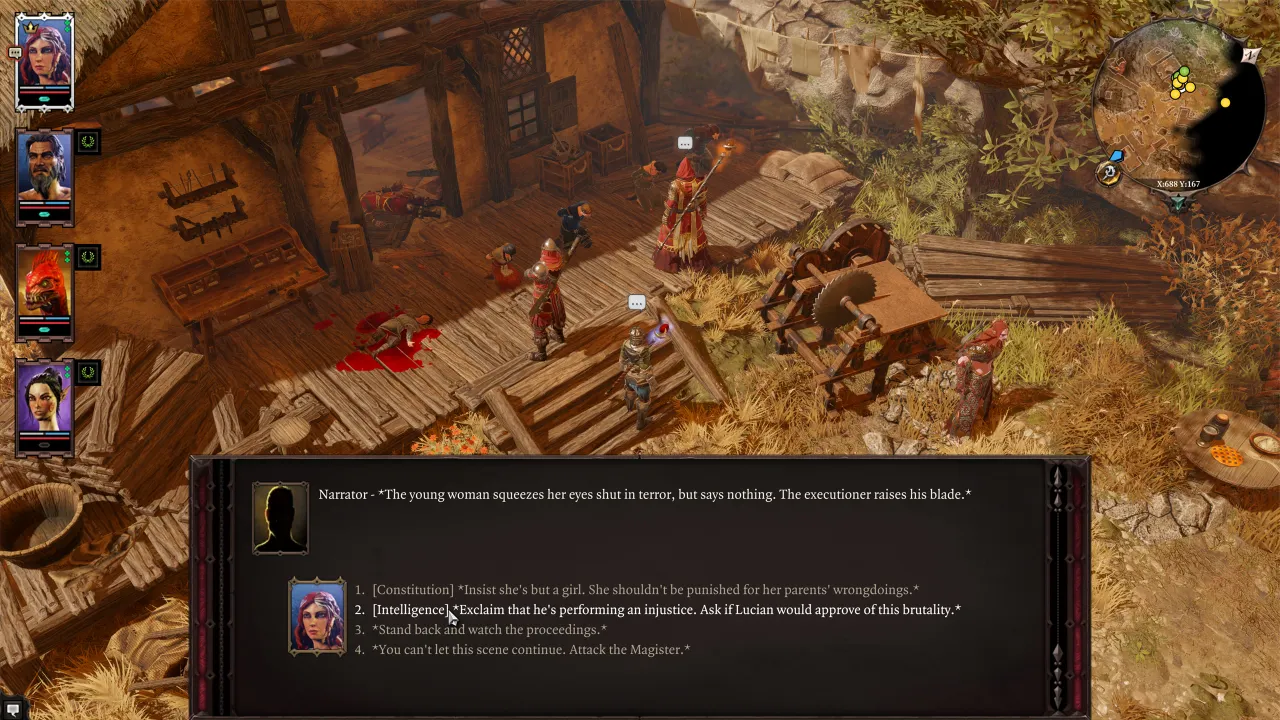
Plenty of games loop a single theme until it wears thin. Original Sin 2 took the harder road. Composer Borislav Slavov reasoned that if six origin characters each carry their own history, the music should too — so he wrote seven themes, one for each of the six and a master theme tying them together. The soundtrack becomes characterization. Steer one of them and, in some quiet beat, their melody rises to say what their dialogue won't.
The trick is that this score is adaptive, not switched. It grows out of your situation instead of cutting between fixed tracks: a low bed while you explore, drawn tight while you sneak, flooded in once a fight breaks, then lifted higher at a story peak — and you can barely hear the seams between those states. Rivellon keeps a living emotional temperature this way, never collapsing into background filler.
Worth flagging: this whole sprawling score is a relay. After the series' original composer Kirill Pokrovsky died in 2015, Slavov shouldered the work and saw it through. The vocal arrangement of the main theme later spread through the community until it became one of the most instantly recognizable sounds the series owns — a composer inheriting a score after a death and turning it into the franchise's calling card is no small footnote.
A hundred and fifty thousand lines, and combat you can hear
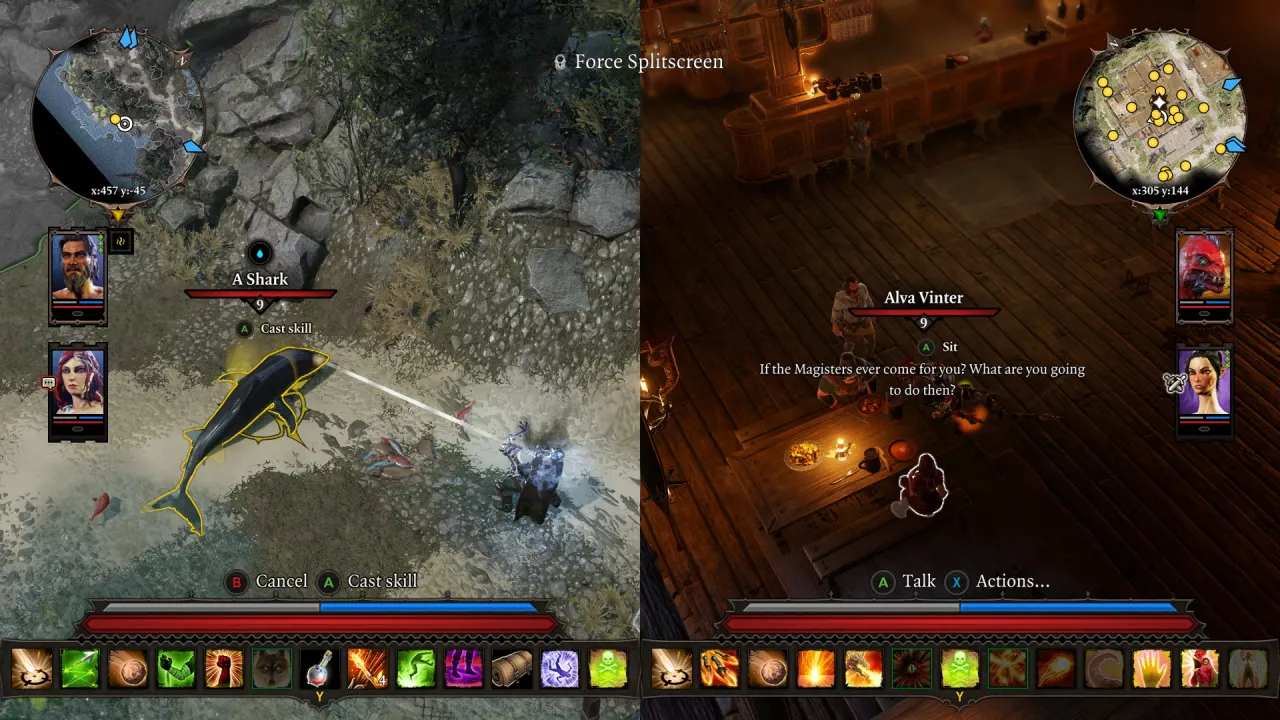
The most tangible audio upgrade in the Definitive Edition is the re-recording of over 150,000 lines of voiced dialogue. Nearly every character you meet is fully voiced now, so long conversations stop being dry text on a wall and start being scenes that are actually performed. For an RPG with this much writing, that density is a luxury, and it hands those skippable side conversations a reason to be heard out.
Sound effects, meanwhile, are welded to the combat system. The roar of oil catching, the crackle of a current racing across a flooded floor, the brittle snap of ice giving way — these aren't atmosphere, they are how you read the state of the battlefield. Hear the fire spreading and you already know next turn's positioning has to change. Hear the electricity arc and you instinctively haul a teammate out of the water. The audio carries a slice of the tactical information, so even without staring at every status icon you can feel which way the elemental reactions are tipping.
That ear-as-instrument idea runs further than it first looks. In a four-player session, when nobody can keep eyes on the whole board, those cues do real coordination work — the hiss of spreading poison or the snap of an electrified surface tells a distracted teammate to move before a status icon ever could. Folding the ear into the playbook like that is the quieter, equally solid half of its sound design, and it's the kind of detail that only shows up when a studio sweats the small stuff.
Visuals | 6.5/10
Graphics: 6.5/10A stylized Rivellon that leans on design, not horsepower
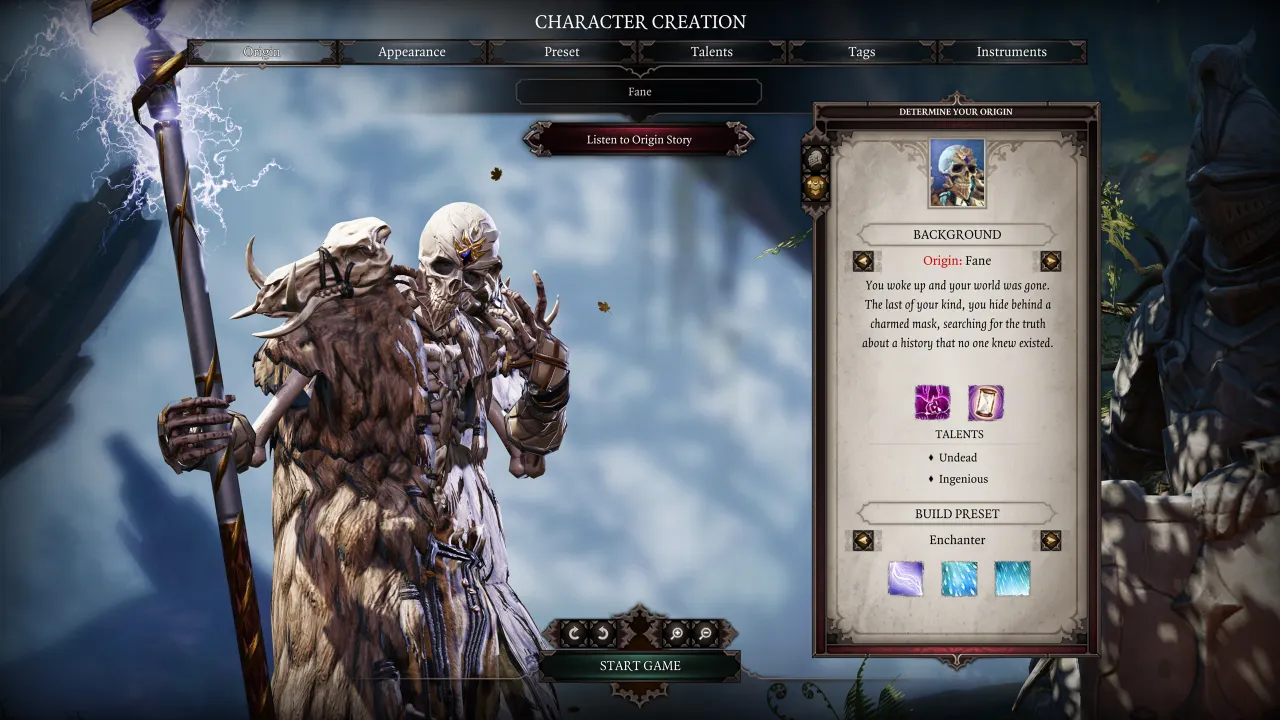
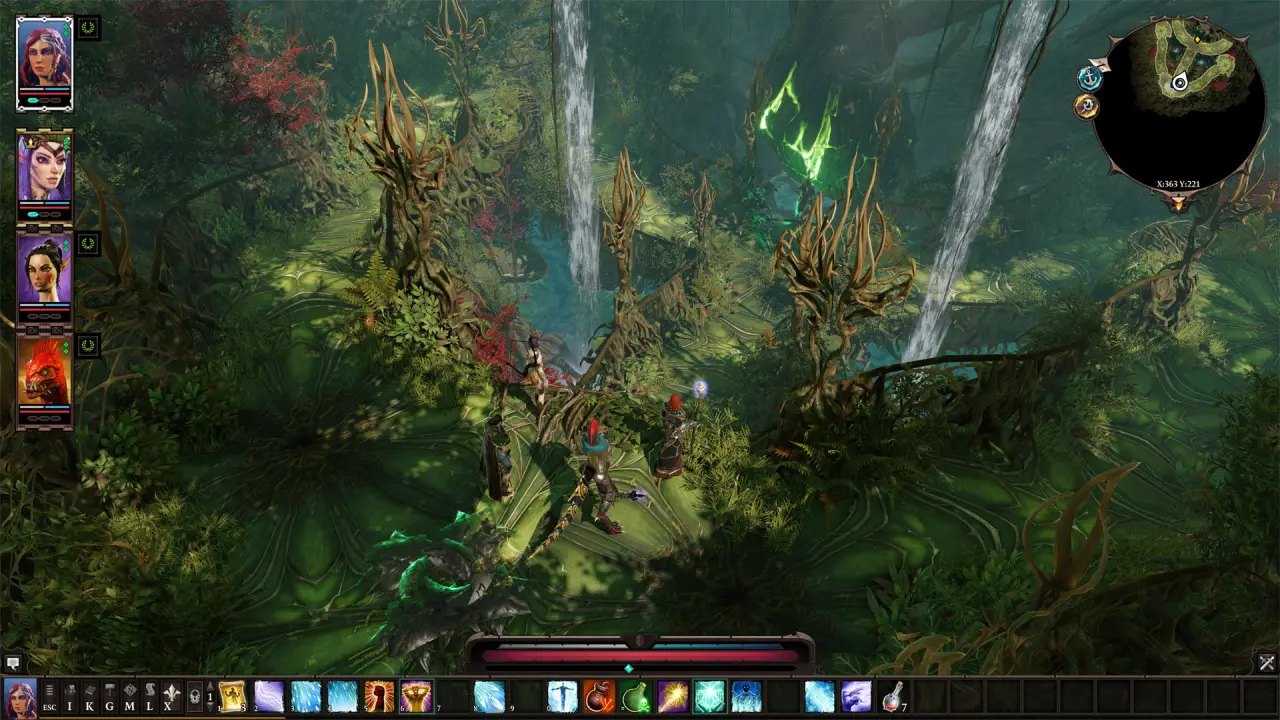
Let's be upfront: if you came hunting a graphics showcase that melts your GPU, this isn't it. Original Sin 2 plays out from an isometric overhead view, a fairly traditional way to frame an RPG, and its art is stylized and saturated rather than photoreal. Fidelity was never the goal. Legibility was.
Inside that brief, the environment design is genuinely strong. The oppressive grey of Fort Joy, the lived-in market bustle of Driftwood, the stacked elevation of every region — all of it reads at a glance. And that layered terrain isn't decoration; it's the stage the elemental combat performs on. A ledge, a slope, a puddle, each one shapes how your next turn plays. Art and mechanics are fused here. Every height difference on the map is a square laid down for that turn-based fight.
The part worth dwelling on is the lighting and the clarity. Isometric games live in fear of the mush — pile up spell effects, elemental clouds and surface states and the screen turns to soup. Original Sin 2 invests in visual hierarchy instead: fire reads as fire, poison cloud as poison cloud, an electrified pool glowing a clean blue. Even with five or six elemental states live at once, you can usually tell at a glance which tile is safe to stand on and which one will end your turn badly. For a game that treats terrain as core, that ordered-chaos legibility matters far more than texture resolution. So you can't judge this game's visuals on material detail alone. Its strength is style and layout in the service of play, not spec sheets meant to stun the eye.
It helps to think about what the camera is for here. The isometric pull-back isn't a nostalgic affectation; it's the only angle from which you can actually parse a battlefield with this many overlapping surfaces. A first-person or over-the-shoulder view would bury half the floor and turn the elemental sandbox into guesswork. The art direction follows the same logic — saturated, readable, deliberately uncluttered where it counts — because the whole presentation exists to keep the rules visible. Once you see the visuals as a delivery system for tactical information rather than an end in themselves, the choices that look modest on a screenshot start to look exactly right in motion.
Information overload — the real wall newcomers hit
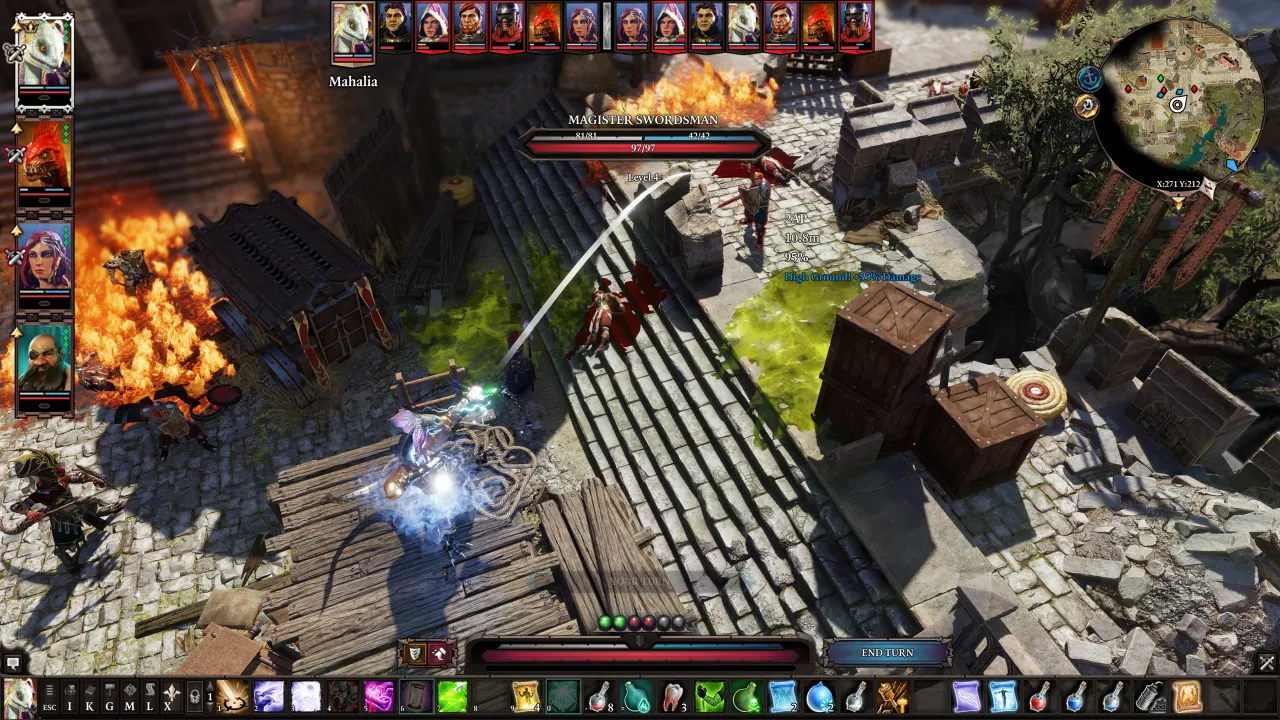
What drags this score down is not the picture; it's the interface and the on-ramp. Original Sin 2's systems are staggeringly large: twelve skill schools, hundreds of skills, a flood of items you can grab and craft and combine, two separate armour pools, and an entire layer of environmental elemental interaction on top. All of it has to fit inside an isometric frame, and the consequence is a UI dense to the point of hostility toward beginners.
A new player drowns easily. Just working out which damage runs physical and which runs magic, which armour layer to strip first, and which of a dozen tooltips actually matters in this fight eats real time before you even reach the inventory wrangling and the gear tinkering. This is a genuine bounce point, and it's the widest experience gap between this game and anything you can simply pick up and play.
The Definitive Edition pushed back here. It rebuilt the UI and the controls for consoles, added a radial menu and shortcuts so the once-PC-only complexity is at least workable on a pad, and local split-screen co-op lets two players adventure on one screen. After the late-2025 arrival on PS5, Xbox Series and Switch 2, load times and frame rates climbed another notch. These ports genuinely shaved the barrier down a little — but in fairness, for someone who has never touched the genre, the interface learning cost stays high. One clarification, though: that wall has nothing to do with the visual quality itself. The art holds up for its era; what trips people is how the information is presented, not how it's drawn. Understanding that is understanding why this dimension's score reflects onboarding cost, not aesthetic merit. The picture isn't the problem; the problem is how much the picture is asking you to learn before any of it makes sense.
Combat | 9.5/10
Gameplay: 9.5/10The elemental sandbox — the whole arena is your chemistry bench
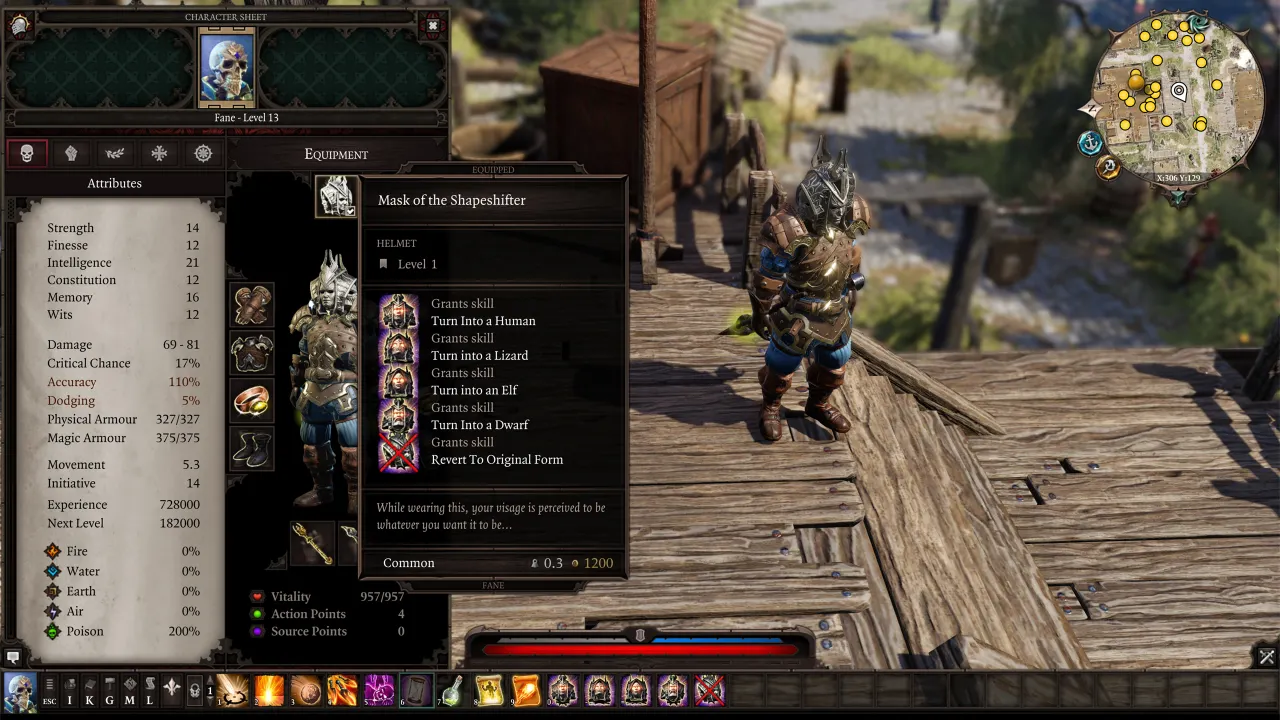
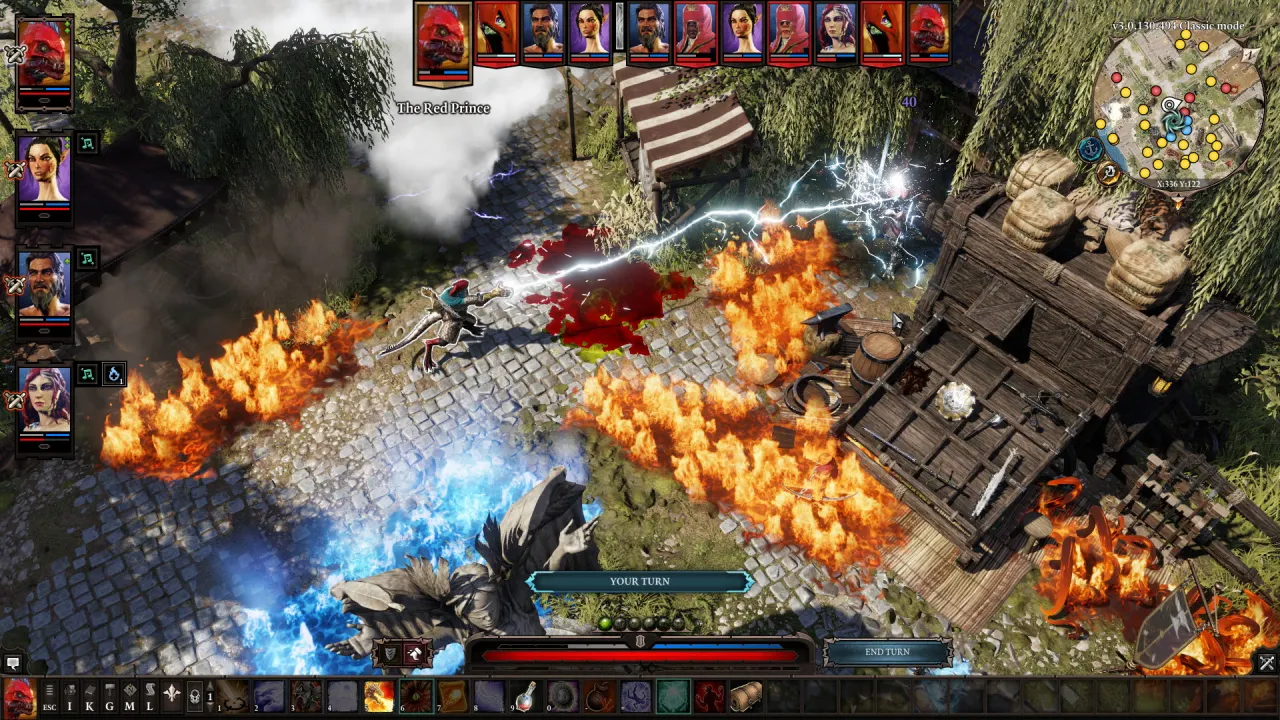
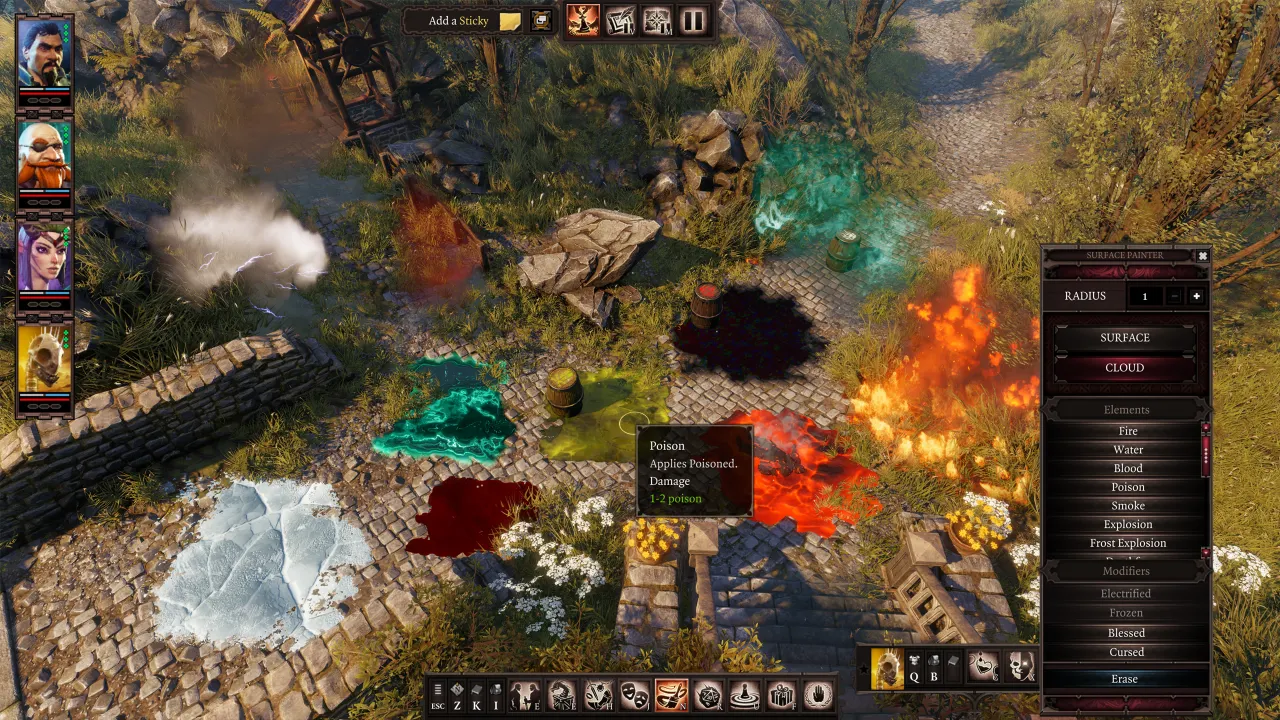
This is the part nobody has managed to copy. The turn-based combat runs on action points: each turn you spend AP to chain several moves until the pool runs dry. Sounds ordinary. Then Larian writes an essay across the floor itself. Water, oil, fire, poison cloud, electric field, ice — all of them are physical surfaces that react with and stack on one another.
Pour out a slick of oil, drop a fireball, and the whole sheet erupts. Call down rain to drown the flames, then run a current through the standing water and everyone wading in it locks up, paralyzed at once. Ice sends bodies sliding. A poison cloud meets a spark and detonates. None of this is scripted theatre — it's a ruleset that's always running, and both sides get to use it. So every fight becomes an open question: the same enemies, ten entirely different elemental chains to dismantle them with, the battlefield doubling as your lab.
This is exactly where it pulls clear of the field. Pillars of Eternity fights solidly, but it lacks this surface sandbox you can fiddle with at will. Even XCOM 2, the gold standard for turn-based tactics, trades cover and hit percentages without ever letting the terrain itself react.
Height matters just as much as surface. High ground buys you accuracy and range, so a fight isn't only about which elements you chain but where you stand to chain them — a vantage point on a ledge can flip an encounter before the first cloud even ignites. Nobody has gone deeper on elemental interaction. They still haven't.
Armour and builds — two layers that force you to commit
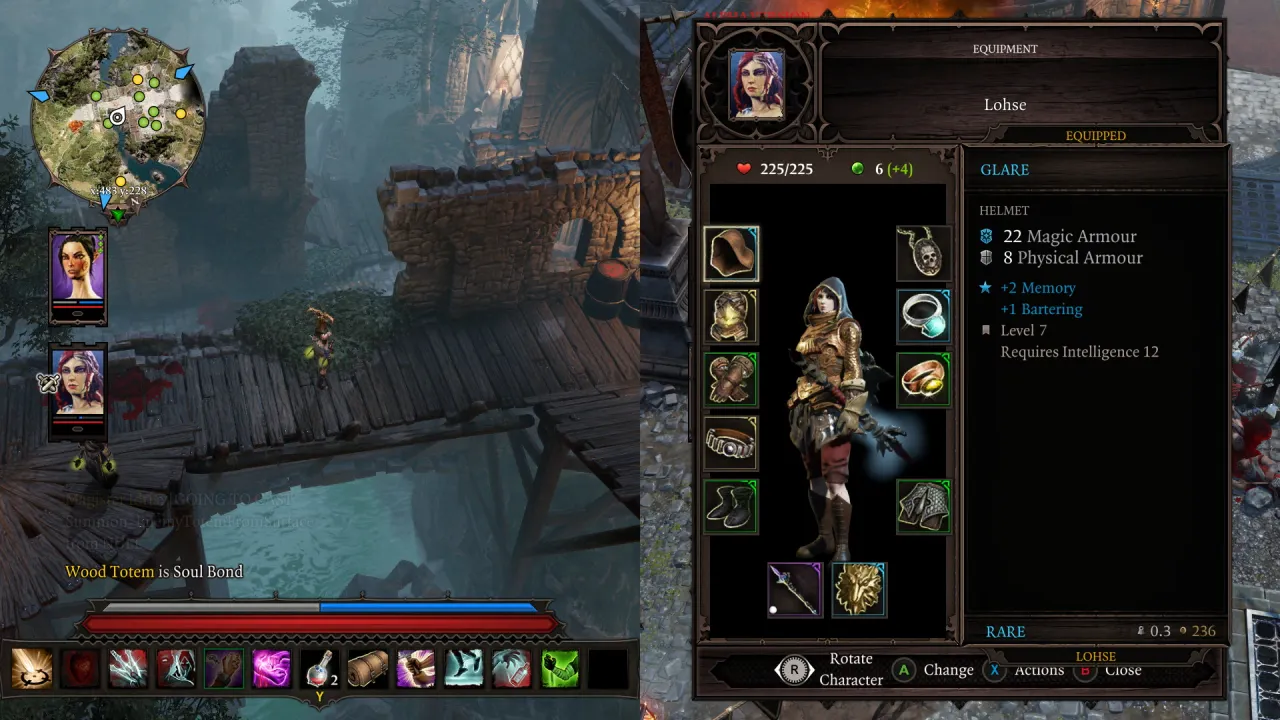
Elements alone weren't enough, so Original Sin 2 stacked an armour system on top and raised the strategic bar again. Beyond health, each character carries two armour pools: physical armour blocks physical crowd control — knockdown, bleed — while magic armour blocks magical control: stun, burn, freeze. The pivotal rule is that your control spells only land once the matching armour layer is gone.
That single rule rewrites party building. A squad mixing physical and magic damage spreads itself thin, struggles to crack either layer fast, and gets controlled before it can control anyone. A party that commits to one damage type concentrates fire, breaks armour quickly, and seizes the crowd control first — an entirely different rhythm. The mechanic turns "how do I compose a party" into a problem with a right answer that still invites stylish solutions; build forgiveness runs low, but the depth runs deep. It forces you to settle the whole team's damage direction at character creation rather than cobbling it together mid-run, and that front-loaded thinking is one of the genuine sources of the combat's depth.
Four-player co-op and the GM mode — tabletop, ported in
If single-player combat is already this deep, the multiplayer is where the tabletop DNA goes all the way to the wall. Up to four players drop in and out of Rivellon together, each steering one origin character. Because every character hides their own agenda and secrets, conflict is baked into the cooperation: one player wants to spare an NPC, another wants them gone, and the system allows party votes, dialogue snatching, even openly turning on a teammate — so the multiplayer route keeps coughing up emergent stories no script ever wrote.
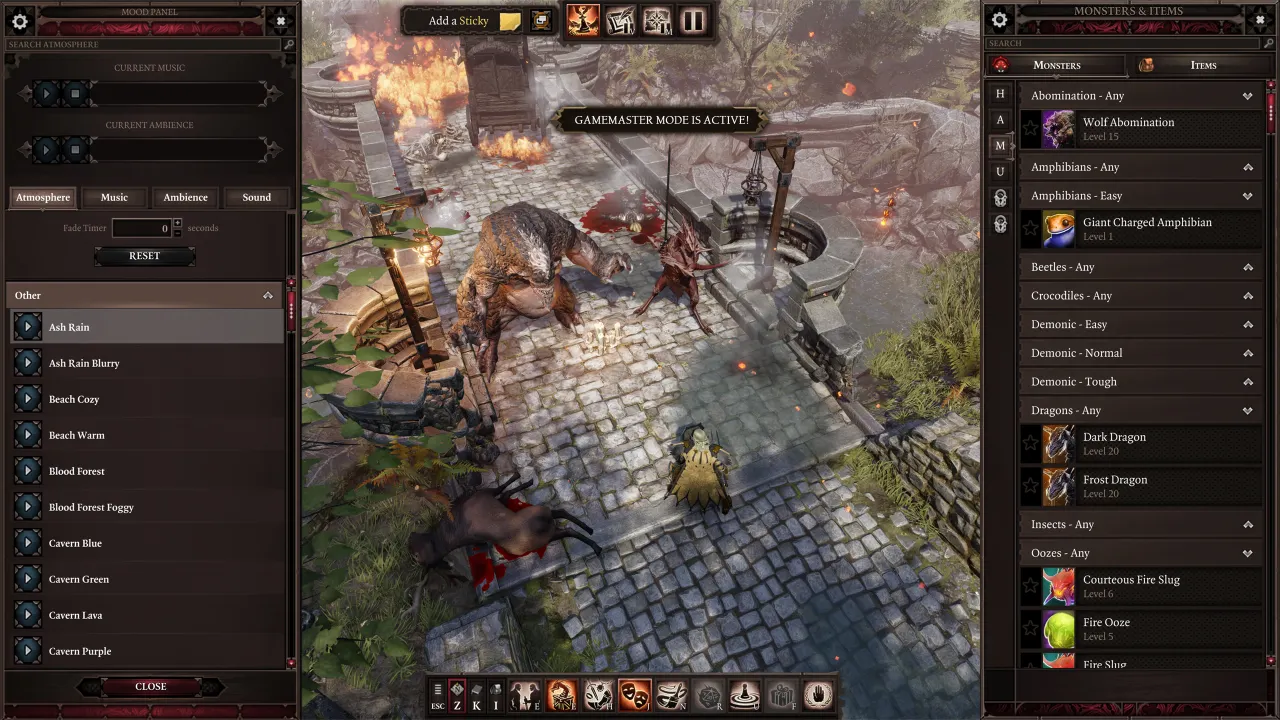
The arena PvP mode extracts that same combat engine into a pure tactical match, two teams trading turns, its balance and depth praised by critics as a peer to XCOM. The most ambitious piece is the Game Master mode: at heart a digitized tabletop toolkit where a host builds maps live, places monsters, plays any NPC, and rewrites encounters on the fly, the players running a Dungeons & Dragons night as if they were really seated at the table. Critics rated it above its rivals, and the reason is a kind of humility — it doesn't cling to its own rules. Use that excellent combat engine if you like, roll dice and adjudicate by pen-and-paper if you prefer, or just improvise. From the first Original Sin through to Baldur's Gate 3, this instinct for porting tabletop into a video game is the through-line that runs all the way down Larian's spine.
Content | 9.0/10
Content: 9/10Sixty hours is just the warm-up; the replay is the real text
Start with the hard numbers. The main story runs roughly 59 hours, and if you mean to strip every side quest, collectible and hidden corner bare, a completionist run pushes toward 130. This is an unambiguously large RPG — but the trick isn't the length, it's that almost none of those hours are padding.
The four-act structure opens with the prison break out of Fort Joy and rolls on from there, each act a sprawling open region stuffed with content. Act 2's Driftwood is the densest of the lot, dumping a mountain of quests in one breath, every cranny hiding a room, a passage, a chest, a puzzle. That fill rate means you can linger a dozen hours in a single region without ever feeling like you're jogging across empty map, and the moment-to-moment density rarely dips into busywork.
What actually doubles this scope is the replay. Take a concrete case: a first run as the Red Prince, an all-physical armour-breaking party, killing your way through without flinching; a second as Sebille, a full magic crowd-control build, sparing whoever you can. Those two routes alone diverge wildly in the private dialogue you trigger, the quest branches you unlock, the ending you steer toward. Fifty-nine hours is the figure for a single line — and this game was never designed to let you run only one. Multiply six origins by a fistful of build schools by the branching endings, and the real thickness of the content sits far past that surface clock.
It's worth being precise about what makes those hours hold. A lesser RPG hits 59 hours by stretching travel and recycling fetch quests; Original Sin 2 hits it by packing decisions. Almost every quest has more than one resolution, and the resolutions feed each other — solve one in Driftwood a certain way and you've quietly altered who's alive, who's hostile, and which door is open three regions later. That web is why the completionist figure balloons toward 130 without ever feeling like grind. You aren't ticking boxes; you're pulling threads and watching the pattern shift. It's also why a guide is a double-edged tool: follow one and you'll see more content, but you'll trade away the disorientation that makes the world feel genuinely yours to untangle.
Free upgrade, custom campaigns, content with no ceiling
The Definitive Edition itself deserves a paragraph. It isn't a paid expansion; it's a free upgrade aimed at everyone who already owned the game, folding in nearly every meaningful improvement: a Story difficulty built for the narrative crowd, a rewritten Act 2, over 150,000 re-recorded voice lines, and a tutorial deck added below Fort Joy's opening to smooth the newcomer's first hour. What you're buying is the most complete and most approachable version of this game to date, no extra purchases required, no season pass, no fragmented release to chase down later.
Its content ceiling, though, is the one players prop open themselves. Game Master mode plus the Steam Workshop let the community build and share entire custom campaigns — meaning that once the official route is done, there is, in theory, an endless supply of player-authored scenarios waiting. A first-rate combat engine wired to an open authoring toolkit makes this game's "amount of content" almost impossible to pin to a fixed runtime, and years after release the Workshop is still feeding it.
One honest caveat, though: this density asks something of the player. It is not the log-in-for-dailies, clear-a-quest-in-half-an-hour fast food structure; every side thread assumes you're willing to read, to chew, to think two steps ahead about a choice. Driftwood's avalanche of quests is treasure for the curious and a burden for anyone who just wants a waypoint to follow. That's the two-sided nature of its content philosophy — it gives an enormous amount, on the condition you're willing to catch it. Players who can will get a thickness rare even for its era; players who can't will find it long and unfocused. Saying that up front is more honest than just selling the hour count, because the same density that thrills one player is exactly what exhausts another, and the runtime alone can't tell you which one you are.




Comments 0
Share your game review
Join the discussion and share your review of this game.
No comments yet. Share your thoughts on this review.