






















Opening
The first time someone wiped the floor with me on an 8-key chart in a versus room, my eyes didn't settle on the words "you lost." They drifted to the background, where an animation was unspooling like a music video, every special effect snapping perfectly onto the beat. Even getting flattened looked kind of cool. By the time the next song started, it clicked: this isn't the sort of rhythm game that treats effects like fireworks set off at random. It choreographs the visuals and the judgment as if they were the same song.
The best part of DJMAX Respect V has nothing to do with how many tracks it crams in, or how long the mode list runs. What actually gets under your skin is the immediate rapport — the sense that the moment you load a chart, you already understand how it wants you to play it. You press each key, the screen detonates once, the judgment bar answers, and your brain nods along, like you're jamming with a band you've rehearsed with for years.
Of course it carries the baggage every veteran key-based rhythm game shares. The story might as well be air. The song packs and modes look intimidating from the outside, and the small slice that genuinely fits you takes a while to dig out. But give it a few evenings and, well before your fingers blister, you've already quietly decided this is the game you're playing this week. What follows is a dimension-by-dimension breakdown of why that pull is so hard to shake.
Story | 6.5/10
Story: 6.5/10As a rhythm music game, DJMAX Respect V was born without a traditional main storyline, and that isn't a misstep so much as genetics. You don't expect a curated CD to tell you a sprawling novel — what it can do is conjure a certain atmosphere through cover art, track sequencing and style. So instead of plot, the right lens for this dimension is the catalog itself: how it's composed, what lineage it carries, and how it has been collected.

A Catalog as the Narrative
The game's approach is exactly that compilation logic. Some tracks, MVs and character designs carry faint, half-there connections, like little notes scattered through a playlist. Series fans will read "tribute" and "throwback" out of pack names and crossover content, and that familiarity sparks small surprises — oh, so this song is related to that one. If you're a new player, those beats are just garnish: ah, so there's this style of thing too.
The licensing lineage matters here. As a modern culmination of the DJMAX series, the catalog functions as a record of what the franchise has gathered over the years, and reading that lineage is the closest thing to a story the game offers. The packs aren't chapters, but they accumulate into something that feels archival, a shelf where each entry quietly references the ones before it. Long-time players treat the song list almost like a timeline, recognizing which pieces trace back to older arcade and portable releases and which ones were composed fresh for this collection. That sense of continuity — of songs migrating across a decade of releases to land here, re-charted and remastered — is its own kind of plot, even if no cutscene ever spells it out. The composition of the catalog, in other words, carries more meaning than any individual lyric, and decoding it is a pastime the game rewards without ever requiring.
Atmosphere Without Text
Atmosphere is built through visuals and music rather than text. Certain characters recur across MVs, leaving the impression of a main thread that was never fully told; certain packs orbit a single theme — the same city, the same worldview — and that compositional habit means that, dozens of songs in, you faintly piece together a "world" that belongs to this game. It's loose narrative, closer to a film-score collection than the feature itself.
That looseness is deliberate, and it's also the dimension's ceiling. The world is suggested, never stated, so it rewards attention without ever demanding it. You can spend a hundred hours here and the lore stays in your peripheral vision — present enough to flavor a session, never present enough to anchor one. The recurring faces and themed packs work like the booklet art tucked inside a deluxe vinyl pressing: a layer of intention you can study or ignore entirely, with no penalty either way. Some packs lean hard into a unified visual language, a shared palette and a recurring motif, and after enough sessions those motifs start to feel like landmarks in a city you've never been told the name of. None of it resolves into a single readable arc, and the game is clearly at peace with that, trusting the music and the imagery to carry whatever sense of place it wants to leave behind.
The Fan Bonus, and the Limit
The problem lives right here. For players used to Cytus II's explicit worldview and character lines, DJMAX Respect V's sense of narrative comes off thin. You can call it "purely focused on music and play," or you can call it "lacking a story you'd remember." That absence isn't fatal for a rhythm game, but in a decade where narrative and atmosphere keep getting their bar raised, it does come off a little conservative.
On balance, the story dimension is best read as a fan bonus. If you're a series veteran, the clues hidden in these packs and crossovers will earn a knowing smile, and might even send you back to dig out the older entries. If you're a passerby, they don't get in the way, and they're unlikely to be the main reason you stay. The catalog's history is a gift to the people who already love the series, and a pleasant footnote to everyone else. Scored against rhythm games that lean on a written world, DJMAX comes up short on paper, but it would be a mistake to read that score as a failure of ambition rather than a difference of intent. The game decided, deliberately, that the music and the lineage behind it would do the talking, and on those terms it succeeds — it just succeeds at something quieter than a story.
Audio | 9.5/10
Audio: 9.5/10There are two tracks that keep looping in my head long after I've closed the game, and with rhythm titles that's usually my cue to pay closer attention. In DJMAX Respect V, the count doesn't stop at two. Electronic, pop and rock take turns at the front, like a compilation that has already done the hard work of picking the good songs for you. The urge to skip ahead keeps losing to a quieter urge: run it one more time and see if I can land a few more Perfects.

A Catalog That Earns Repeat Listens
The library's strength sits on two layers. The first is the completeness of the songs themselves. The rhythmic lines are clear, the sections rise and fall with real shape, and almost any of these would survive on a streaming playlist as a stand-alone loop. This is not functional music written to justify a chart — it's music that happens to chart beautifully. You feel composers writing songs first and charts second, which is the opposite of the template-stamping you get from weaker catalogs.
The second layer is how arrangement marries feel. So many of the small drum fills, the little syncopations buried in a track, have a clear "answer" inside the chart. You can sense a charter sculpting around the actual song rather than dropping notes onto a grid. That correspondence is what turns a good track into a chart you want to re-run a dozen times, hunting the pocket where your hands and the music finally lock together. The best charts here feel less like a test laid over a song and more like a transcription of it, so that nailing a run is indistinguishable from playing the music itself. That is a high bar, and the catalog clears it often enough that you start trusting the charters by default, loading an unfamiliar track with the quiet assumption that whatever you hear, your hands will get to play.
Mixing, Clarity and the Long Session
Production and mixing pull their weight too. The drums hit crisp, the vocals aren't over-compressed, and even during high-intensity bursts you can still pick out the instrument layers. That clarity matters enormously over a long session, because nothing fatigues you faster than a muddy mix you have to fight through. Not being tiring is the simplest, most direct kind of good, and this catalog is good in exactly that way.
Put on a decent pair of headphones and the low-end impact shoves your appetite for the chart from "I'd like to play" straight to "I have to play this." The OST has the kind of weight that makes practice feel less like a chore and more like turning the volume up on something you'd choose to listen to anyway. There's a practical consequence to that, too: because the mix never grates, you can grind the same handful of charts for an entire evening without the audio wearing you down, which is precisely the condition a rhythm game needs if it wants you to log serious hours. Cheaper soundtracks fatigue you into quitting long before your hands give out; this one keeps the ears comfortable so the only thing that eventually stops you is your own wrists.
The Honest Limits
The problems exist, naturally. However wide the stylistic spread, the bulk still leans electronic and its close derivatives. For someone who lives for live bands or classical, plenty of it will register as "listenable but not stirring." And with veteran composers sharing the stage with fresh new talent, there's an honest gradient in quality — every so often you'll hit a track that's just okay, and it lands like an ad jingle dropped into an otherwise premium playlist. The ratio stays low, though; skip it and move on, and the overall impression survives intact.
Hold it next to Cytus II and its all-enveloping, themed-soundtrack vibe, and DJMAX Respect V's edge is that it doesn't strain for a concept — its individual songs are simply more listenable on their own. Hold it next to Beatmania IIDX and it sheds a little of that thoroughly hardcore character in exchange for being friendlier to mainstream ears. That's not a downgrade in craft; it's closer to a remastered album in rhythm-game form — comfortable to listen to, and still no slouch on the technical side.
Visuals | 8.5/10
Graphics: 8.5/10Talking about graphics in a rhythm game invites an easy misreading — that flashy charts are the whole story. What DJMAX Respect V actually does is find a delicate balance between "clear information" and "performance style," and it holds that line more carefully than most of its genre.

Clarity Under Pressure
Two anime girls flank the logo on the title screen, and that single glance sets the tone plainly: this is a party with a bit of an ACG flavor, not a cold practice rig. When you're actually playing, the chart area carries a high information density, but it never reads as cluttered. The judgment bar's position, the combo numbers and the judgment feedback are all placed in the zones your eyes naturally sweep across, so they neither cover the next note nor hide in a corner where you have to hunt for them.
At high frame rates, the smoothness of scrolling notes and triggered effects becomes critical, and this is where the game stays steady — as long as your machine can keep up, the visuals never get in the way of your hands. That reliability is the unglamorous heart of good rhythm-game presentation: the screen does its job and then disappears, leaving you alone with the chart. It's an easy thing to take for granted and a brutal thing to get wrong, because a single dropped frame at the wrong moment can cost you a note you would otherwise have hit cleanly. DJMAX Respect V earns trust by simply not flinching under load, and once you stop worrying about whether the presentation can keep pace, you're free to push your own speed as far as your reflexes allow.
Every Song Its Own Stage
The MV or background animation paired with each song is the game's visual personality. Some tracks run a pixel-art style, some a cute little-devil-girl aesthetic, and some are simply edited like a full music video. The upshot is that you rarely fall into the "every chart looks the same" kind of aesthetic fatigue. It's like a music festival where every band gets its own stage lighting — you may not remember the details of the stage, but you remember the mood each act left behind.
That variety does real work over the long haul. Because no two songs share a visual identity, the catalog never blurs into a single texture in your memory, and returning to an old favorite feels like cueing up a specific video rather than reloading a generic level. Over hundreds of plays, that distinctiveness is what keeps the experience from flattening into rote repetition — your mind tags each track with its own imagery, so a song you've cleared fifty times still arrives wearing a recognizable face. It also gives the artists room to surprise you, since a new pack can swing from a moody, cinematic sequence to something deliberately silly and cartoonish without breaking any visual rulebook. The screen becomes part of the variety the catalog is selling, not just a backdrop the notes happen to fall against.
Modern UI and the Limits of Spectacle
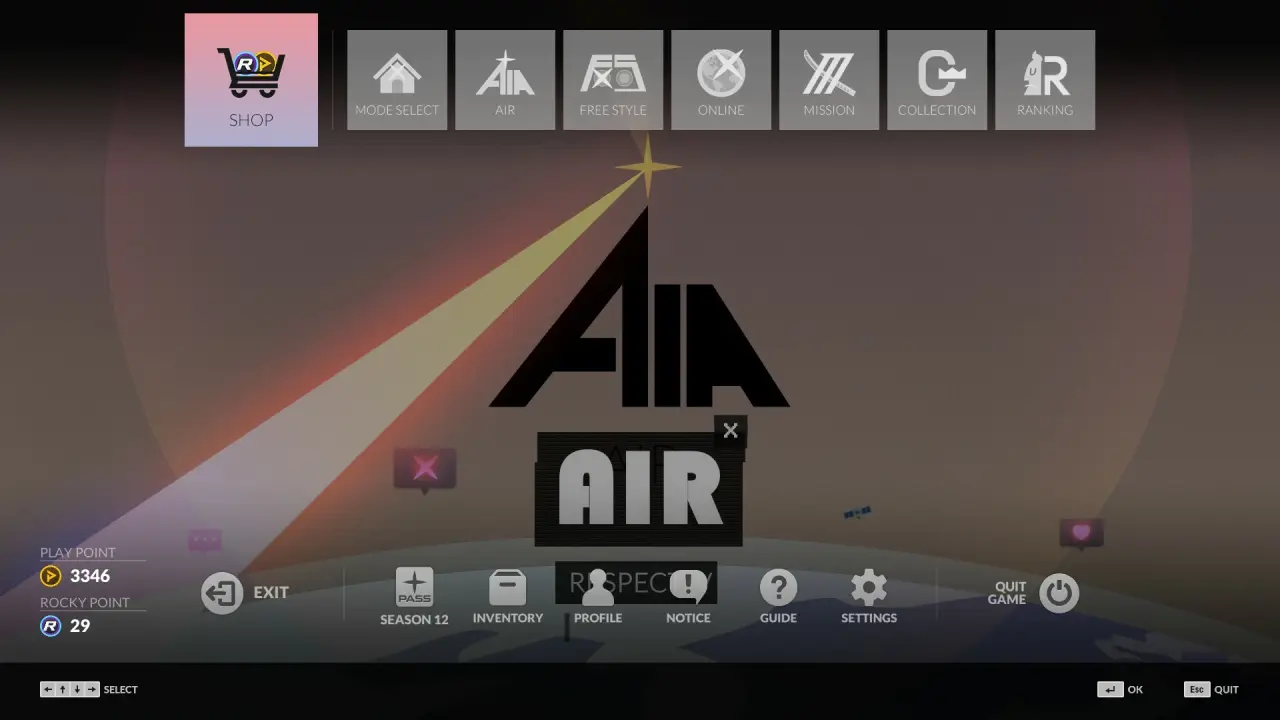
The UI overall is modern and unambiguous. The main menu lays out AIR mode, the store, versus and the rest in a single row with no detours — click in and you're there. The player profile screen compresses level, rank and personal card into one screen, convenient both for showing off and for honest self-assessment: how much time, exactly, have I poured into this rhythm game again.
The shortcomings sit in two spots. The performance effects occasionally try a little too hard to dazzle. For players used to minimalist charts, the motion in some MVs and background animations becomes a distraction, and you may need to manually dial down the performance intensity in the options. The other is an aesthetic bias: the whole thing leans ACG and leans bright, so anyone who prefers a cool, high-tech austerity or a pared-back minimalism might find it a touch "too busy." That said, these fall squarely under matters of taste, nowhere near the level of affecting usability — and the option to tone things down means even the skeptics can shape the screen to their liking.
Combat | 9.0/10
Gameplay: 9/10When you first sit down, 4-key, 5-key, 6-key and 8-key are lined up in front of you like the first time you walk into a gym surrounded by machines — you want to try every one, and you're a little afraid you can't lift any of them. The saving grace is that this game's judgment and difficulty gradient are genuinely good at coaching you through it.
A Judgment System You Can Feel
The solidity of the judgment system is the kind you recognize instantly the moment you come back from playing a few rounds of something else. Keypress feedback is crisp, with no drag or mush to it. Re-run the same song a handful of times and you can plainly feel your scores climbing because your hands got sharper, not because the game loosened up and handed you the points.
To put it in harder terms, it leans toward the rigor of Beatmania IIDX, but without that game's full severity, so newcomers don't get talked out of it on the first try. The judgment never feels arbitrary, which is the foundation everything else rests on: you trust that a miss was your fault and a clean run was your own mastery, and that trust is what keeps you re-running charts instead of blaming the engine. A loose, forgiving judgment window would have quietly poisoned the whole loop, because every improvement would carry an asterisk — did I actually get better, or did the game just let me off the hook? DJMAX never lets that doubt creep in. The timing is tight enough to be honest and generous enough to be fair, and that narrow, well-tuned band is exactly where a key-based rhythm game lives or dies.
The Multi-Key Growth Curve
The multi-key design hands you a very clear growth curve. 4-key plays like a basic music-theory class, mostly there to confirm your sense of rhythm is online. Add keys on top and it's like bolting extra rows of black keys onto a piano — at first you panic, and once you adapt you can't go back. For the strong players, the 8-key charts are the main course; for newcomers, 4-key and 5-key already deliver the genuine rush of a rhythm game, and that range of tolerance is rare.
What makes the curve work is that no rung feels like a dead end. Every key count is a complete game in itself, so you're never grinding a tier purely as a tax to reach the "real" one. You graduate when you're ready, on your own clock, and the jump up always feels like an invitation rather than a wall. That self-paced structure is quietly generous, because it lets two very different players share the same catalog without either feeling shortchanged — the newcomer treating 4-key as the destination gets a full, satisfying game, while the veteran chasing 8-key clears gets a ceiling high enough to spend years under. The keys aren't difficulty settings bolted onto one mode; they're parallel disciplines, and discovering you've fallen in love with a layout you once found terrifying is one of the most reliable pleasures the game has to offer.
The Loop, and Where It Frays
At the mode level, solo practice, mission challenges, online ranking and multiplayer versus string together into an addictive loop: practice a song, climb the ranks, get knocked back to square one, go back and practice something harder. The pressure from online ranking and versus isn't cruel, but it's enough to make you say "just one more" right before bed.
The friction concentrates on two points. First, for completely new players, the freedom to choose between 4/5/6/8-key is almost too free — there's no especially clear "officially recommended route," so it's easy to wander onto a chart you can't control early and take a discouraging hit. Second, the high-end experience for hardcore players leans heavily on matchmaking quality and song-pool filtering; once that gets shaky, you can spend hours repeatedly meeting opponents far outside your level, and the frustration stacks up.
Stacked against its peers, this set of systems already sits in a confident tier. Next to Cytus II's touch-and-slide groove, it leans toward the precision of traditional key-based rhythm; next to Beatmania IIDX's arcade feel, it sheds a little mechanical barrier and gains a lightness, the feeling of treating a keyboard like an instrument. DJMAX Respect V is the kind of game you'll curse for being hard, but you won't question that the system underneath is a good one.
Content | 8.0/10
Content: 8/10The concept of a main story campaign simply doesn't exist for DJMAX Respect V. Its "content volume" hangs almost entirely on the song catalog, the mission mode, the challenge mode, and various versus modes. Put simply, it's the kind of game where you think you've played for ages, only to find your completion sits at half.

A Catalog You Can't Finish
The base catalog on its own is already substantial, every style mixed and matched, and even without touching any DLC, the simple goal of clearing each song once and earning a respectable grade is enough to carry dozens of hours of play. Add the DLC and the whole experience jumps from "a series best-of" to "an entire record shelf." For rhythm-game lovers that's obviously good news; for the wallet, the pressure climbs right alongside it.
You won't "burn through" it in a week, and you almost certainly can't ever truly "finish" it. The catalog's strategy is dig-deep-and-go-long rather than short-term burst, which is exactly the point: this is a game designed to be a standing fixture, not a weekend you check off. The sheer breadth means that even after you've cleared everything once, a second pass aimed at higher grades or harder key counts effectively resets the mountain in front of you. There's always a song you've only barely passed, a chart whose top tier you've never touched, a personal best sitting just out of reach. For the right player that bottomless quality is the whole appeal; the catalog isn't a checklist to complete so much as a gym you keep coming back to, and the lack of a finish line is a feature rather than an oversight.
Modes With Actual Goals
On the mode front, it doesn't lean on "free play" alone the way some rhythm games do. It offers mission mode and challenge mode, the sort of content with a real sense of objective. Missions force you to practice under specific rules — capping the key count, restricting the song list, or setting special conditions — like a music teacher handing you small assignments. They're annoying, but doing them genuinely helps. Challenge mode sits closer to a proving ground, reserved for the people who find ordinary charts not stimulating enough.
Online versus and the ranking system thread all of this into a long-term loop. You might grind a couple of modes' limited song pools to climb a particular rank; you might be pushed to practice songs you never cared about just so you don't get out-picked into the floor in a versus room. Said unkindly, it's positive coercion; said kindly, it's content-driven self-improvement. Either way, the social layer does something the solo modes can't: it gives the content a reason to keep expanding beyond your comfort zone. Left to your own devices you'd happily loop a dozen favorites forever, but the pressure of a ranked ladder and a room full of strangers nudges you into corners of the catalog you'd otherwise never visit. That's how a song you initially dismissed ends up becoming the one you practice obsessively for a week — the competition turns the back half of the catalog from dead weight into live territory.
When Abundance Becomes a Wall
The catch is that the larger the catalog and the modes grow, the easier it is for newcomers to get lost. For someone unfamiliar with the series, the moment you enter the main menu — AIR, challenge, mission, store, versus — it reads like opening a sprawling, feature-overloaded app, and you need a stretch of time to work out which button to press right now so you don't waste it. Further in, once you realize the songs you actually keep playing are just those few dozen favorites, the rest of the content tends to gather dust in the list.
Compared with its peers, DJMAX Respect V's content strategy favors depth and the long game. If you enjoy logging hundreds of hours in a single rhythm game and watching your rank slowly change color, this configuration is exactly your flavor. If you only occasionally want to pull up two songs to unwind, it can feel a little like over-equipment — more apparatus than the moment calls for. The honest read is that the volume is a filter as much as a feature: it sorts the audience into the people who want a lifelong project and the people who wanted a quick playlist, and it serves the first group far better than the second. None of that surplus is wasted on a dedicated player, but a casual one is paying, in both money and menu friction, for a shelf they'll only ever use a corner of. Knowing which of those two players you are tells you almost everything about whether this content model is a gift or a burden.




Comments 0
Share your game review
Join the discussion and share your review of this game.
No comments yet. Share your thoughts on this review.