
























Opening
The alarm goes off, and suddenly I am sprinting back uphill through the dark. There is a freshly mined block of resource still dragging behind me, the tunnel is long, my movement is slow, and somewhere above my head a dome is about to take a beating from a wave of approaching creatures. That single moment captures what makes Dome Keeper special. The best thing about it is not the mining, and it is not the defending either. It is the way the two are twisted together into one wire that stays taut the whole time you play.
The wire is thin. It is also very tight. Every extra block of ore you grab down below might cost you another round of damage up top, and every early retreat leaves you feeling like the trip was wasted. The risk-reward push of the wave countdown is not an abstract design note here; it is the nervous, bargaining-with-the-clock feeling that colors every single descent.
This is not a complicated game. It is a sharp one. It plays less like a sprawling sandbox and more like a short song with an unusually precise drumbeat: simple in structure, but the rhythm gets in your head and refuses to leave. Across roughly ten to fifteen hours, that loop of appetite and retreat keeps pulling you back for one more run.
Story | 5.5/10
Story: 5.5/10Dome Keeper's story is light. How light? It functions more as a premise than a plot: you crash on an alien world, you mine to survive, you fend off waves of creatures, and then you dig deeper. It holds together. And that is about all it does. The setup gives you a perfectly serviceable backdrop, but it almost never pushes you forward out of a desire to know what happens next. Like many rogue-lites, this game has no real narrative spine, and judging it by one would be the wrong lens entirely.

A premise, not a plot
It is worth being precise about what a game like this is even trying to do with story, because the rogue-lite form distributes its narrative weight differently than a linear adventure. There is no scripted arc, no cast you grow attached to, no twist waiting at the end of a campaign. What exists instead is a situation, and Dome Keeper commits to that situation cleanly. You are alone, the surface is dangerous, the depths are dangerous, and the only fixed point in your world is the dome you are sworn to keep standing. That premise is enough to justify every action you take, which is really all it needs to do.
This does not mean the game is devoid of atmosphere. There is atmosphere here, but it runs cold. It comes from the predicament itself rather than from characters or escalating events. The surface is not safe and the underground is not safe, and you persist through mechanical repetition to stay alive one more wave. The worldview leans toward survival pressure, not character study or plot momentum, and the loneliness of that lone dome on an empty horizon does more atmospheric work than any cutscene could.
In-run progress as the real story
If there is a narrative in Dome Keeper, it is the one you generate inside a single run. The story of a session is the story of your decisions: how deep you dared to dig, the moment you pushed your luck, the frantic haul back when the alarm went off, the wave you barely survived with the glass cracking around you. That in-run progression is where tension and meaning actually live. You will vividly remember a particular hair-raising retreat. You are far less likely to remember anything the world itself said to you.
This is a deliberate trade, and it is typical of the form. The drama is emergent rather than authored. Each descent writes a small, disposable arc that resolves the moment the wave ends, and the next run begins the cycle fresh. The reward is immediacy: the stakes are always personal because you set them yourself, run by run. The cost is that none of it accumulates into a larger tale you carry with you after the credits. It is storytelling by lived experience rather than by script, and for a loop-first game that turns out to be the right call, even if it leaves the wider fiction feeling like wallpaper rather than a reason to continue.
Meta-unlocks and the urge to dig again
The closest thing to long-form narrative comes from the meta layer of unlocks. Different keeper types and the steady search for relics give the game a quiet sense of progression that spans runs, a soft thread of advancement that stands in for plot. Discovering a new tool or unlocking a different keeper is the rogue-lite version of a story beat, a marker that you have moved forward even though the world's fiction has not.
The trouble is that the narrative presence is so faint that many discoveries which could have carried real weight end up serving only the next upgrade and the next defense. A relic that might have meant something becomes, in practice, just another input to your build. The experience effect is direct: you remember the close calls, not what the world was trying to tell you. Is that fatal? For a game built around its loop rather than its lore, no, it is not. But it does cost Dome Keeper one layer of staying power, the kind that keeps a game lingering in your mind long after you have stopped playing. The runs you remember are the ones you authored yourself, not the ones the world handed you, and for a design this devoted to its loop, that is a trade worth making with eyes open.
Audio | 6.2/10
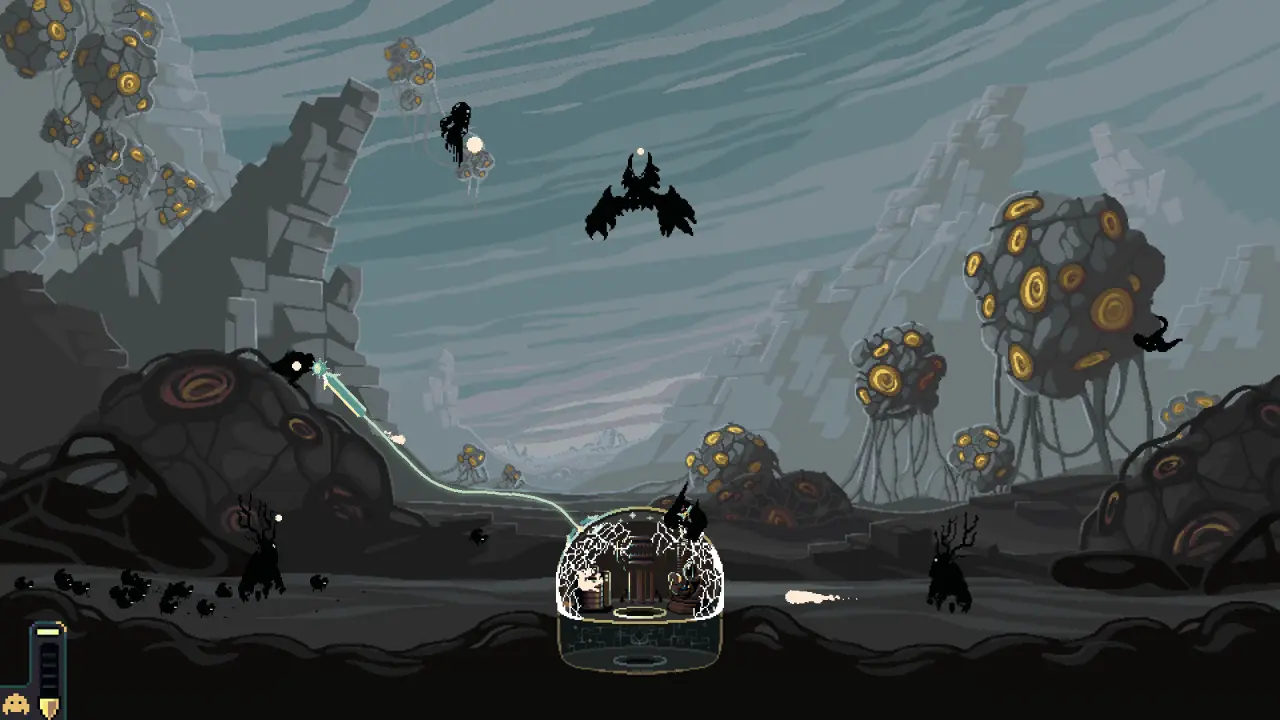
Audio: 6.2/10Audio is the easiest part of Dome Keeper to overlook. It is not bad enough to break immersion, but its presence is genuinely faint. Public discussion of the soundtrack and the finer sound design is sparse, and the one element people can point to with confidence is the alarm that sounds before an enemy assault. That alarm is intensely practical. You could even call it a gear in the entire pacing system.
The alarm that runs the rhythm
The value of that alarm has nothing to do with whether it is pleasant to hear. Its value is that the instant it goes off, your body reacts before your brain does: time to pull out. That reflex is the audio doing real mechanical work, and it is the clearest example of sound serving play rather than decorating it.
This kind of functional audio helps the loop directly. It ties the appetite of the underground to the crisis on the surface with a single auditory thread, so the moment you hear the cue, the whole risk-reward calculation snaps into focus. You do not have to glance at a timer or read a warning; the sound is the warning, and it is woven so tightly into the rhythm that it effectively becomes part of the controls. For a game built on countdown pressure, that is a meaningful contribution, even if it is a quiet one. Over enough runs you stop consciously hearing it at all and simply respond, which is arguably the highest compliment a functional cue can earn. It has dissolved into your muscle memory, and the loop is faster and tenser because of it.
Competent, but rarely memorable
The problem is just as clear. Beyond that functional layer, the audio lacks the kind of texture that would let it be remembered on its own. The music and the finer effects fill the space without ever demanding your attention, and almost nothing in the mix would survive in your head after you stop playing. The tension you feel comes overwhelmingly from the mechanics themselves, not from sound pushing the emotion any higher.
That has a direct effect on the experience. In a game where atmosphere could have done real lifting, the audio settles for staying out of the way. It supports the loop, it never undercuts it, but it also never amplifies it. A more characterful score, or a richer set of underground effects, could have turned the descent into something that gnaws at you even in the quiet stretches between waves. Instead the soundscape stays neutral, and the pressure has to come from elsewhere.
Is any of this fatal? Not really. The audio completes its basic assignment of cueing you and keeping step with the rhythm, and that alarm alone justifies its place in the design. It simply never turns itself into a bonus. It is the most replaceable layer of an otherwise sharply tuned machine, present and functional, but content to be furniture rather than a feature you would ever bring up unprompted. If the rest of the game is a precision instrument, the sound is the plain wooden case it ships in: it protects the contents and gets the job done, yet no one buys the instrument for the case. A little more ambition here, a motif that swelled as the wave drew near or an underground hum that deepened with each layer you breached, would have lifted the whole experience a notch. As it stands, the audio is the one part of Dome Keeper that asks for nothing and gives back exactly that much in return, which in a game this tightly wound is a genuinely missed opportunity rather than a fatal flaw.
Visuals | 7.7/10
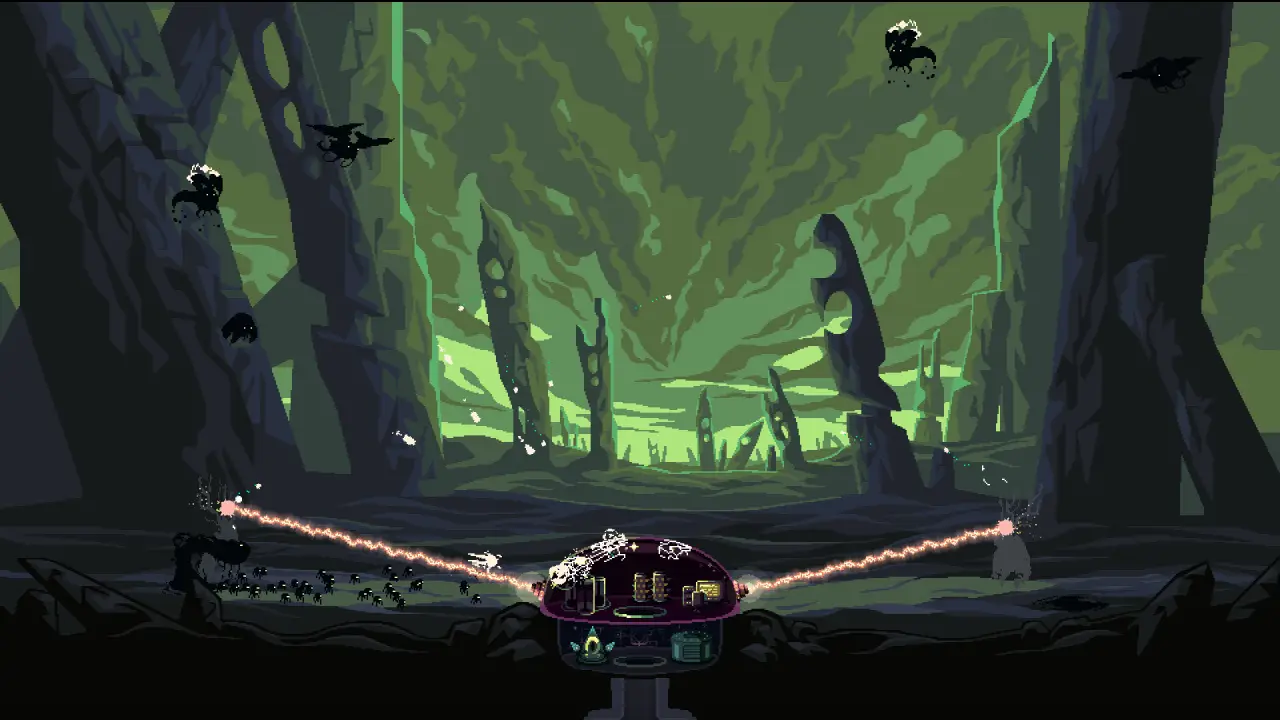
Graphics: 7.7/10Dome Keeper's pixel art does not try to win you over with density of detail. It wins on legibility and on how cleanly it communicates information. The underground mine, the alien surface, and the dome itself read as three distinct visual layers, and the relationships between them are never muddy. Resource nodes, your character's position, and the dome's current state are all easy to parse at a glance. You will never lose track of the situation because the screen got too busy. The whole presentation is restrained on purpose.
Reading the screen at a glance
That restraint is not a limitation; it is the entire design thesis of the art direction. In a game where decisions arrive on a countdown, the worst thing the visuals could do is obscure the state of play. So the palette stays clear, the silhouettes stay readable, and the three layers stay separated. When you drop into the shaft, you instantly know where you are relative to the surface. When a wave begins, you instantly know how the dome is holding. The art is doing the quiet, unglamorous work of keeping you oriented while the pressure mounts. There is a real discipline in that restraint, because it would have been easy to clutter the screen with mood and lose the very readability the game depends on. Instead every visual element earns its place by helping you make a decision faster, and nothing is there purely to look busy.
The lone dome sitting at the center of the surface is itself a piece of effective visual storytelling. You understand what you are protecting and why you need to hurry back, all from a single image of a structure standing alone against an empty horizon. It anchors the whole experience without a line of dialogue. That is an economical kind of art, and it fits a game that values clarity over spectacle at every turn.
Feedback you can feel
Where the visuals earn real points is in feedback. The dome's glass cracks as it takes damage, and that single touch sharpens the sense of danger more than any number could. You do not need to check a health bar; you see the structure you are sworn to protect begin to fracture, and your stomach tightens accordingly. It is a small effect that carries a lot of emotional weight, precisely because it is tied to the thing you care about most.
The upgrade interface does similar work in the other direction. The tech tree for the twin laser cannon and the visible stat changes make the experience of growing stronger refreshingly direct. You can see your kit improving, layer by layer, and that legibility turns abstract numbers into something you actually feel. The art does not lean on big spectacle to pressure you; it uses a small number of clear, well-placed signals to ratchet up the tension and the satisfaction in equal measure. That economy of feedback is the whole trick. A cracking pane here, a lit-up upgrade node there, and your emotional state is steered without a single flashy effect getting in the way of the decisions you have to make.
Where the art hits its ceiling
The weakness lives in the same place as the strength. The art's memorable hooks are more functional than dazzling, and the sense of awe is limited. If you are coming in expecting layered, escalating visual spectacle, this game simply does not have much of that to offer. Compared to the busy pixel mining of its closest underground cousins, Dome Keeper deliberately walks a more minimal path, and that choice trades grandeur for clarity. You will not find sprawling vistas or richly drawn biomes that beg to be screenshotted, and players who collect games partly for their art may come away unmoved. The aesthetic is purposeful rather than beautiful, and it never reaches for the wow moments that flashier titles use to sell themselves.
The impact of that ceiling, though, is small. This was never a game that carried itself on the strength of how it looks. Its visuals are like the lighting in a black-and-white film: not realistic, but pushed right up to your face so the important thing is impossible to miss. The art's job is not to make you stop and stare. Its job is to make you see clearly, and then decide immediately, and on that count it succeeds completely.
Combat | 8.5/10
Gameplay: 8.5/10The smartest decision Dome Keeper makes is structural. Resource mining, relic searching, and dome defending are three activities that most games would happily develop as separate systems, each with its own screen and its own pacing. Here they are compressed into a single loop that comes around every few minutes. You dig downward not only to find ore, but to prepare for the next assault. You return to the surface not only to clear monsters, but to buy yourself a few seconds of breathing room before the next dive. The rhythm is tight, and there is almost no wasted motion in it.

The loop that compresses three games into one
What you feel, minute to minute, is a constant negotiation between appetite and safety. Hauling a resource block through the pixel mine shaft produces that specific pressure of being almost there and somehow more anxious for it. The closer you get to the surface, the more aware you become of how much you stand to lose if the timing slips. Then the surface itself pays everything off: the dome stands alone against an entire wave, and the consequences of how far you pushed your luck a moment ago are laid out plainly in front of you.
This is where the comparison to a relaxed underground stroll falls apart. Some mining games let you wander down and explore at your own pace, and the descent becomes a pleasant ritual. Dome Keeper is more like watching a pot on the stove while you chop vegetables: leave the burner unattended too long and something scorches. The loop never lets you fully settle, and that refusal is the point. Every dive carries an implicit countdown, and the game trusts you to feel it rather than spelling it out. You internalize the timing within a handful of runs, and from then on the pressure is self-imposed, which is a far more durable kind of tension than any on-screen meter could manufacture. The game does not nag you. It simply hands you the rope and lets you decide how far out on it you want to crawl.
Upgrades that keep the loop honest
A loop this tight would collapse without growth to back it up, and the upgrade system gives it exactly the scaffolding it needs. Drills, movement speed, carrying capacity, turrets, and detection abilities can all be strengthened, and the tiers are laid out clearly enough that you always understand what the next investment buys you. The sense of getting stronger is steady and direct rather than flashy, which suits a game built on repetition. You are not chasing a single overpowered build; you are tuning a kit so the same loop runs a little smoother each time.
The choices matter because resources are finite and the wave clock is unforgiving. Do you sink this run's ore into a faster drill so future digs are quicker, or into the dome's defenses so the next wave hurts less? There is no universally correct answer, and that ambiguity is what keeps the upgrade screen from becoming a formality. Each decision feeds back into the central tension, which is the mark of a system designed to reinforce the loop rather than distract from it.
Friction, mastery, and the urge to run it again
The controls are intuitive, but Dome Keeper does not coddle you. Misjudge a route, overreach for the wrong vein, and the punishment arrives immediately. Early on this can feel clumsy, and the first few runs are genuinely a bit frantic as you fumble the balance between digging and defending. Is that annoying? A little. Is it fatal? Not at all. In fact, that flustered early phase is doing important work, because the friction is what makes mastery feel earned.
The wave countdown and the retreat pressure manufacture a clean risk-reward decision every single cycle, and learning to read that decision well is the entire learning curve. You start memorizing the layout of your shaft, planning your hauls, and recognizing the exact moment you should stop digging and cut your losses. That growing competence is what fuels the most dangerous sentence in the whole game: one more run, and I will definitely do better this time. The loop is short enough that the cost of trying again is trivial, and tight enough that you genuinely believe the next attempt will be cleaner. That belief, far more than any single mechanic, is what gives Dome Keeper its lasting and surprisingly stubborn grip.
Content | 7.8/10
Content: 7.8/10Dome Keeper is not the kind of game you finish once and shelve. Its longevity comes mostly from its rogue-lite bones: a structure built on repeated openings, restart mechanics, and the variables introduced by different maps and growth builds. Every run shares the same core objective, but the route choices, resource allocation, and upgrade order shift around it. The differences are not earth-shattering. They are, however, enough to keep each session feeling like a fresh problem to solve rather than a rerun of the last one.
What actually changes between runs
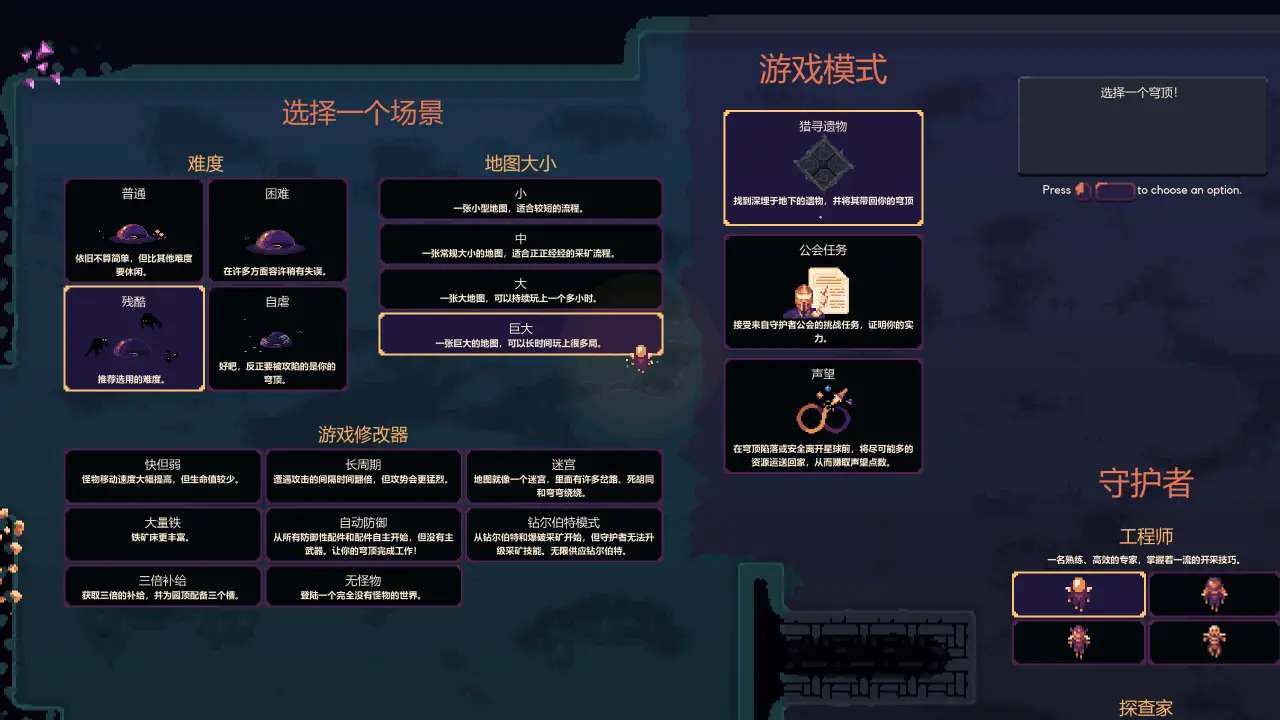
The selection of difficulties, maps, and keeper types reminds you, right from the opening of a session, that this is not a fixed-answer process. You are choosing a starting posture, not following a script. The underground digging and resource gathering then give your curiosity a natural handhold: there is always a reason to push a little deeper, because the next pocket of ore could change how the rest of the run unfolds. That pull is quietly powerful, since the cost of one more tunnel is a few seconds and the payoff could be the resource that finally lets you afford the upgrade you have been eyeing. The game keeps dangling that small carrot, and you keep reaching for it.
The keepers themselves are the clearest lever. Swapping between a laser dome and a sword-and-shield dome reshapes how an entire session plays out, pulling your attention toward different threats and rewarding different mining habits. Layer difficulty and map variety on top of that, and a fresh run rarely feels identical to the last, even though the loop underneath is unchanged. The variety is real, but it is variety in service of one tight idea rather than a buffet of new systems.
Where it sits against the giants
It helps to place Dome Keeper next to the obvious neighbors. It does not spread its content into a vast self-serve buffet the way the biggest sandbox crafters do, and it does not hand you the keys to total freedom the way the most open building games do. Those are different appetites entirely. Dome Keeper is closer to a small restaurant with a short menu and a couple of reliable signature dishes. You know what you are ordering. The question each visit is only whether you want it a little spicier this time, or with a different side.
That focus is a genuine strength for the right player and a genuine ceiling for the wrong one. If you love optimizing a single style of run, refining your route and your build until a session hums, the short menu is a feature. You will go one more round, then another, comparing this attempt to the last and shaving off the rough edges. The game rewards that mindset generously, and it does so without padding, busywork, or artificially stretched objectives designed only to inflate a playtime number.
The repetition ceiling
The honest limitation is that the variation mostly serves the same central loop, so over a long stretch familiarity starts to outweigh freshness. The escalation keeps things tense, but it does not fundamentally reinvent what you are doing. If you specifically depend on a steady drip of new mechanics to stay engaged, the mid-to-late stretch may start to feel repetitive, and you will likely have seen the game's whole hand somewhere around the seven-to-eight hour mark.
Whether that is a dealbreaker depends entirely on what you came for. Players who enjoy perfecting a single loop will treat that ceiling as a non-issue and keep stacking runs. The official Lost Tools update softens the edge somewhat, folding in new tools and mechanics that extend the core loop and give returning players a fresh reason to dig. It does not transform the game into something sprawling, but it does buy meaningful extra mileage, and it signals that the developers understood exactly where the repetition pressure would land. That awareness matters, because it shows the content ceiling was a known quantity rather than an oversight, and the post-launch support has been aimed squarely at the players most likely to bump against it. For anyone still enjoying the loop after the base content runs dry, the update is a genuine reason to keep coming back to the dome.





Comments 0
Share your game review
Join the discussion and share your review of this game.
No comments yet. Share your thoughts on this review.