























Opening
A shooter has no business being this good at making you charge into a room full of things trying to take you down. And yet, in 2016, that is exactly what id Software pulled off.
Rewind to that year and the genre was busy teaching you to be careful. Halo 5 leaned on regenerating shields and cover trades; Call of Duty kept shoveling its weight toward multiplayer; the whole console-shooter conversation had quietly agreed that survival meant crouching behind a wall and waiting for your health bar to crawl back. id Software walked into that room and did the opposite. It built a game where standing still gets you taken down and moving forward keeps you alive.
The trick was almost insolent in its simplicity. The two things every shooter hands out as chores — topping up health, restocking ammo — got welded directly into the act of finishing off a demon. Stagger an enemy and it lights up; sprint in for a Glory Kill and your health snaps back. Run dry on rounds and the chainsaw carves an enemy open into a fountain of ammo.
Resupply stopped being an interruption and became the reward for aggression itself. The psychology of the entire genre got flipped on its head: where everyone else taught you to retreat to live, this one dares you to attack to live. It is a small change on paper and a total inversion in practice.
id Software calls the design philosophy "push-forward combat," and paired with Mick Gordon's industrial-metal score that swells and crashes with every fight, this reboot earned a Metacritic 85 and an OpenCritic 86 in the Mighty tier, crossed two million PC copies inside two years, and quietly laid the foundation for the more aggressive 2020 sequel, Eternal. Its story is a single sentence and its multiplayer is forgettable. None of that registers the moment you raise the signature double-barrel weapon and sprint into the first arena.
Story | 6.0/10
Story: 6/10The plot fits on a sticky note, and the hero answers it with a fist

Here is the entire story: a corporate facility on Mars, run by the UAC, grew reckless harvesting energy from Hell, tore open a portal, and let the demons pour through. You wake from a stone sarcophagus as the Doom Slayer and get dropped into the slaughter. That is it. No twisting conspiracy, no cast of twenty names to memorize. The narrative exists for one reason only: to give you somewhere to keep running and something to keep killing.
What is genuinely clever is that id Software turned its own indifference to plot into a personality. Minutes in, a UAC executive tries to lecture you over comms about the noble purpose of all this energy extraction, and the Slayer's reply is to smash the screen with his fist. That single gesture builds the character better than any cutscene could: he does not care about the why, he only wants the things in his path gone. The whole campaign is narrated through that cold shoulder — the protagonist never speaks a word, and every attitude he has is expressed through motion.
That minimalism cuts both ways. It keeps the pacing taut, so you are never pinned to a chair for twenty minutes of exposition. The cost is that you struggle to feel anything about this world beyond "that was satisfying." It was a deliberate trade. id Software bet everything on rhythm and feel rather than narrative depth, and the bet largely paid off — though it is the obvious reason this dimension lands at a middling score while the rest soar. There is no character arc to track, no stakes that escalate beyond "more demons, bigger demons," and by the back half the framing has burned through whatever momentum it had. What the writing gets right, it gets right through tone rather than plot: the Slayer's contempt for the UAC, the codex's dry corporate horror, the sheer momentum of being pointed at Hell and told to deal with it. It is enough to give the campaign a spine, and not a word more than that.
The real storytelling is in the walls
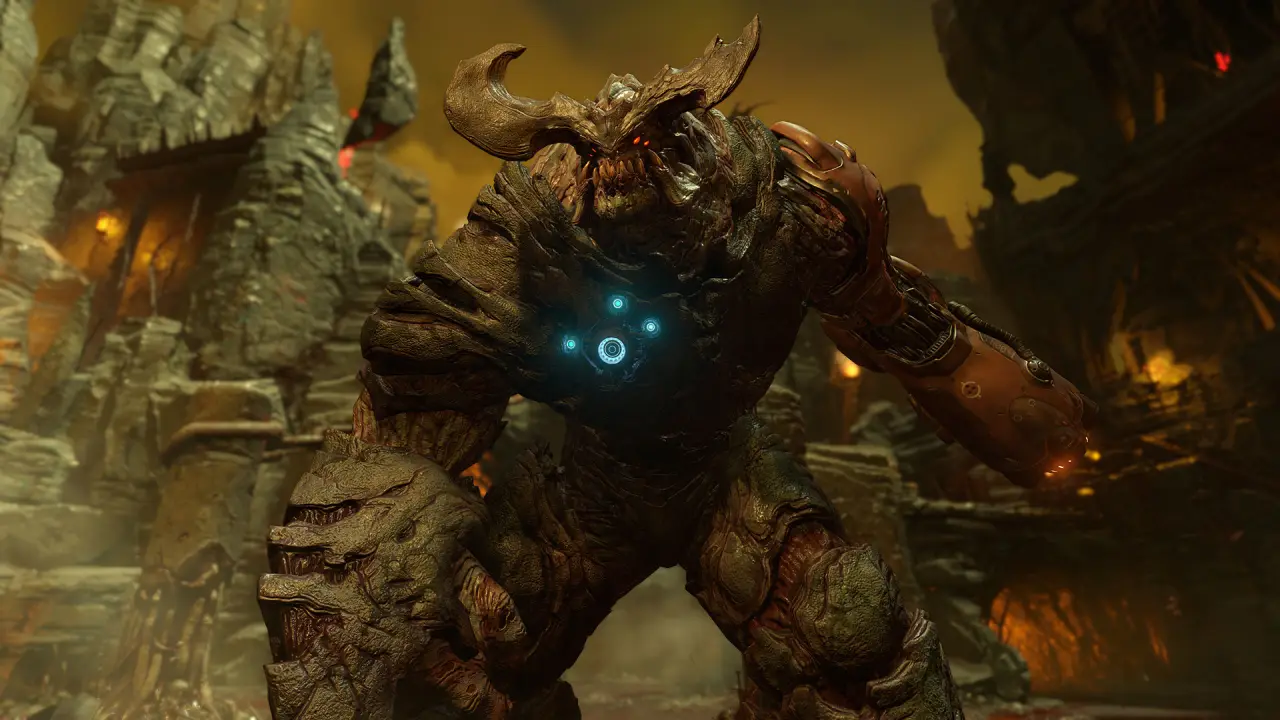
If this game has any narrative ambition, it is hidden in the environment. Every corner of the Mars facility is littered with data logs, employee recordings, and research notes; stop and read them and you can assemble a backstory about humanity digging its own grave through arrogance and hubris — scientists rationalizing the harvest of Hell energy one step at a time, management looking past the risk for the sake of output. It is fragmentary storytelling that never forces itself on you. Want to soak it in? Soak it in. Want to skip it? Sprint past and keep killing.
The more sophisticated storytelling, though, is the space itself. The first half on Mars is all cold technological metal — corridors, labs, an energy core, every surface radiating a suffocating industrial rationality. Then you step through a portal into the Hell levels and the entire aesthetic flips into a foreign world of flesh, bone, and sulfur, where even the light and the sense of gravity have changed. That violent contrast is a story told without a single line of dialogue: it tells you that humanity took an orderly facility and turned it, with its own hands, into a doorway to chaos.
Put this next to Wolfenstein: The New Order, another Bethesda-published shooter from the era, and the difference snaps into focus. That game spent real screen time on its hero's interior life, on the bonds between comrades, on a genuinely affecting romance — narrative was one of its load-bearing pillars. This one runs the opposite play. It knows its selling point is feel and rhythm, so it shrinks the narrative to the bone and hands every spare ounce of attention to combat. That is not id Software failing to tell a story; it is id Software choosing not to. And because nothing distracts from it, the push-forward combat gets to be pure. You will not remember the plot a week later, but you will remember the feeling — and for a Doom reboot, that may well have been the right thing to optimize for all along.
Audio | 9.0/10
Audio: 9/10Mick Gordon's industrial metal is the soul of the whole thing
Ask a roomful of players for the single most irreplaceable thing about this game and a surprising number will skip past the gunplay and say it outright: the music. Mick Gordon's industrial-metal score does more than sound great — it defines the emotional register of the entire experience. There is a detail people love to repeat: for the main-menu track, Gordon blended the tone of a nine-string guitar with a sample of the chainsaw from the original Doom. Folding the series' DNA into a new sound like that is practically a thumbnail sketch of what this reboot is.

The way the score came to exist is its own little drama. By Gordon's account, he was told early on that guitars and metal were off the table, so he first built a layer of synthesized Argent-energy soundscapes; only after six-odd months did he talk id Software into letting the heavy guitars in. That arc — restraint first, then release — mirrors the game's own rhythm of tension snapping into violence. The result swept the field. It took Best Music/Sound Design at The Game Awards, the SXSW award for Excellence in Musical Score, and a D.I.C.E. Award for Outstanding Achievement in Original Music Composition, plus a BAFTA nomination for Best Music. In 2016, it was about as close to an uncontested best soundtrack as the medium produced.
The music breathes with the fight, and that is the genius of it
A great metal soundtrack is not enough on its own. The cleverest thing about this score is how tightly it is wired into the gameplay. The music is not a fixed loop running in the background; it is a dynamic system that shifts in real time with the intensity of combat. Explore a corridor or grab an upgrade and you get the low, restrained Argent soundscape with its sense of a storm about to break. Trigger an encounter and watch the demons spill out, and the heavy guitar riffs come crashing down all at once, as if someone scored your adrenaline for you.
This is integration, not atmosphere. The music actively participates in the push-forward combat — when the drums and distorted guitars are roaring, you are practically being shoved forward by the soundtrack itself. Clear the room and the music recedes back into that electronic layer, handing you a brief breath and coiling for the next wave. The switch is not a crude volume swell but a real change of instrumentation and mood, keeping your body's rhythm and your ears' rhythm locked in sync. That is the hidden engine behind how immersive the whole thing feels.
The weapon work is just as deliberate, and it all serves the same goal: making every shot land with weight. The double-barrel roar of the signature close-range weapon is thick, low, and trailing with recoil; the hum of the plasma blaster, the crack of the rocket launcher, the heavy chunk of the chainsaw biting in — each weapon carries its own auditory signature. Together with the impact feedback and the visual response, those sounds build the so-called meatiness: you can hear, precisely, what your ranged fire just connected with. When the fight peaks, the dense barrage and the heavy guitars braid into something close to an overwhelming sonic assault, and that is exactly what pushes the sense of unstoppable force to its ceiling. Set against the many same-era shooters that treat audio as a purely functional cue, this one sculpts sound as part of the immersion, and that is why it earns a near-perfect mark here.
Visuals | 8.5/10
Graphics: 8.5/10A rock-steady frame rate is the real visual flex
The most praiseworthy thing about how this game looks is not any single dazzling texture — it is that the thing runs fast and stays smooth on every platform it touches. Credit id Software's in-house id Tech 6 engine. For a game that treats speed and rhythm as a lifeline, frame stability is not a bonus feature; it is infrastructure. Drop frames and the whole push-forward design collapses on contact.

On exactly this point the game turns in a benchmark-setting answer for its generation. From PC to PS4 to Xbox One, it holds a fluid, high frame rate, and outlets like The Telegraph cited that cross-platform stability and optimization quality among their reasons for a perfect score. In an era when blockbusters were routinely dragged down by performance problems, its slick running was its own kind of luxury — and it never bought that smoothness by shrinking the spectacle. Cram the screen with demons, effects, and ranged fire all at once and the engine still refuses to buckle.
Two worlds, one art direction: cold steel and living Hell
The art leans hard into a two-flavor structure. The first half — the Mars UAC facility — is textbook technological metal: cold-toned corridors, a vast energy core, labs heavy with industrial rationality, every surface pressing in with the weight of precision machinery. It fits the science-fiction setup and quietly plants the seed for the contrast to come.
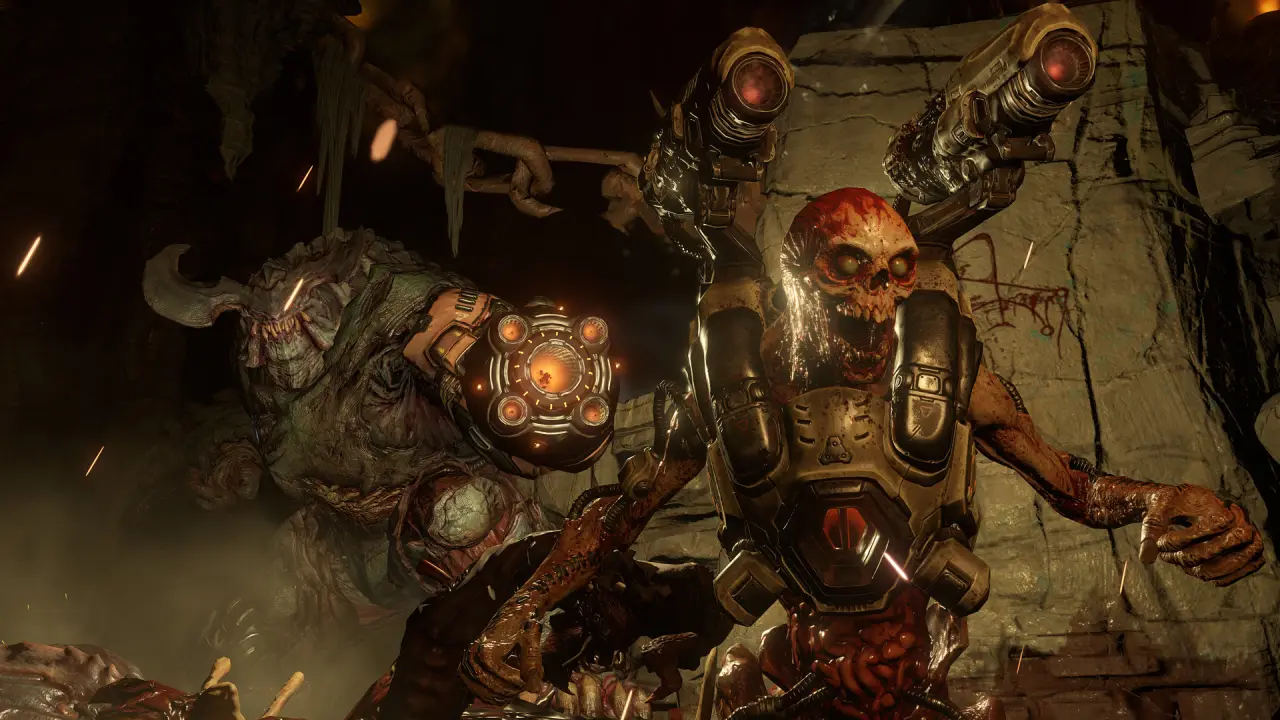
Step through the portal into the Hell levels and the visual language flips on a dime: flesh, bone, sulfur, and twisted rock build a thoroughly foreign space where even the light and color turn scorching and chaotic. That swing from order to chaos hands each stretch of the campaign its own unforgettable landmarks, and it lands all the harder because the first act spent so long establishing the cold, clinical opposite. The demon designs nod back to the originals too — from the nimble imp up to the colossal Spider Mastermind that closes the game out, every enemy reads clearly, so you can clock a threat's tier at a glance in the middle of a melee. It is a roster that respects its lineage without feeling like nostalgia for its own sake.
Readability is a gameplay requirement, not just a flourish
That clarity is more than artistic taste; it is a hard demand of the design. Inside that high-speed combat you have to decide, in a fraction of a second, which silhouette on screen is the priority target, and clean visual differentiation is what makes that snap judgment possible. A cacodemon reads differently from an imp, a hell knight differently from a revenant, and you internalize those shapes fast enough to triage threats mid-sprint without ever consciously thinking about it.
The art direction is forever serving the play rather than showing off. Every demon's outline, every scene's palette, has a functional rationale underneath it — color and contrast steer your eye toward what wants killing first, and the lighting in an arena often telegraphs where the next wave is about to erupt. That restrained, precise approach to art, where readability and spectacle pull in the same direction instead of fighting each other, is where the game's visuals feel genuinely mature. Plenty of prettier games from the same year are harder to actually read in motion; this one never is, and in a game where a missed read gets you taken down, that legibility is worth more than any extra polygon.
Minimal UI and the spread across platforms
The interface follows the same do-not-interrupt-the-fight rule. The HUD is pared to the minimum — key information is legible without ever crowding your view — and when an enemy drops into the staggered, executable state, a clear highlight guides you in for the finisher. That bespoke design for high-speed combat means you almost never have to drag your eyes off the battlefield.
On the platform front, the game later reached Switch, Stadia, and the beefier PS5 and Xbox Series versions. Worth flagging: the Switch port, hemmed in by handheld horsepower and storage, dropped the SnapMap level editor and made matching concessions on fidelity — though getting this combat running on a handheld at all is no small feat, and the port largely preserves the feel that matters most. The later current-gen releases, meanwhile, let the framerate breathe even further, which is precisely the upgrade a game like this benefits from.
Against the era's visual benchmarks, the trade is clear: this game does not win on texture density or physics detail, it spends its whole technical budget on presentation tension and a locked frame rate. For a shooter built on tempo, that is exactly the right order of priorities, and it is a large part of why the visuals have aged far better than many flashier contemporaries.
Combat | 9.5/10
Gameplay: 9.5/10Push-forward combat: a philosophy engineered to make you attack
Everything that matters about how this game plays is distilled into the design philosophy id Software named "push-forward combat." The core idea is brutally pure: anything in the game that would slow you down, make you hide, or push you to retreat gets cut. There is no health bar you crouch behind cover to refill, no reload animation forcing you to stop, no mechanic anywhere that rewards playing it safe. The entire system, start to finish, is doing one job — shoving you forward.

By id Software's own GDC post-mortem, the philosophy rests on four pillars: the high movement speed of both the player and the demons, the clear individuality of each demon archetype, the distinct functional identity of every weapon, and the player's overwhelming sense of power in the face of adversity. Weaken any one pillar and the whole experience caves, which is why you can feel the designers' restraint and discipline in every detail. That near-obsessive design discipline is what gives the combat a rare purity. It does not try to please everyone at once; it takes the single thing — high-speed aggressive shooting — and pushes it to the limit.
Glory Kills and the chainsaw turn you into your own supply line
The keystone mechanics propping up that philosophy are the Glory Kill and the chainsaw. Beat a demon down to the brink and it lights up; sprint in, land a melee finisher, and your health snaps back on the spot. Run dry on munitions and the chainsaw carves an enemy open into a heap of rounds. In other words, resupply has been folded entirely into the act of attacking — you no longer break off to scoop up a health pack or hunt for a munitions crate, you just keep pushing forward, because the finisher is the resupply.
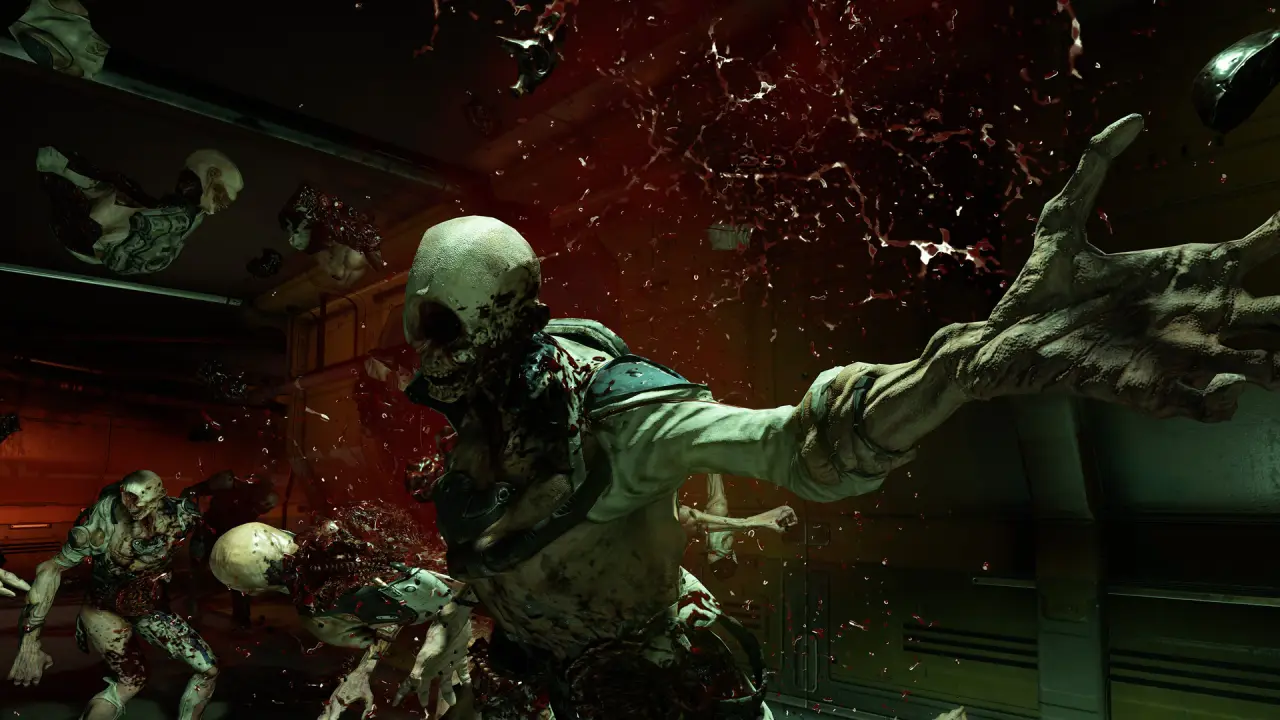
The elegance here is that it resolves a fundamental tension in high-speed shooting: you want the player perpetually on the attack, yet you still owe them a means to survive. Glory Kills and the chainsaw fuse those into one, and the player becomes their own walking health pack and resupply station. The whole campaign then sits inside a positive-feedback loop where the harder you fight, the longer you live — which is the bedrock reason the feel is so addictive. id Software later noticed players leaning far too hard on the signature double-barrel weapon, and that single observation drove Eternal's overhaul: tighter resource caps and specific enemy weaknesses to force weapon rotation. In a real sense, this game's loop set the terms for everything the series did next.
Depth tucked where it never breaks the tempo
The arsenal brings back series staples like the double-barrel close-range weapon and the BFG alongside a full spread of ranged firepower — plasma blaster, rocket launcher, gauss cannon, chainsaw. What gives the play its chew, though, is the mod system: by tracking down Field Drones, every weapon (the starter sidearm and the double-barrel aside) unlocks two mods offering wholly different secondary-fire forms, which you then level through challenges before "mastering" them via a dedicated trial.
Progression runs three parallel systems on top of that. Rune Trials drop you into standalone, time-limited challenge stages and reward a rune on completion, with up to three equipped at once to tune a build. Praetor Tokens upgrade your suit's attributes. Argent Cells let you divide capacity freely between health, armor, and resource reserves. The brilliance is that all of it rewards exploration and offers depth without a single piece interrupting your combat rhythm. You can mix runes and mods to your own taste — some chase faster execution speed, others double down on one weapon's secondary fire — and the build space is genuinely open. That trade, hiding depth where it never breaks the tempo, is the smartest call the system makes: it hands hardcore players room to optimize while never burying the player who just wants to charge in. Set against the safer, shield-and-cover route that Halo 5: Guardians represented in the same window, this game runs the opposite play and comes out feeling more thrilling for forcing you forward. The difficulty climbs from normal all the way to Ultra-Nightmare, where a single death is permanent and standing still is fatal — and that demanding ceiling only sharpens the philosophy further, because at the top end the only viable strategy is to keep moving and keep finishing enemies until the room is empty.
Content | 7.5/10
Content: 7.5/10Eleven lean hours across thirteen branching levels
By HowLongToBeat's numbers the single-player campaign runs roughly eleven hours, stretching to around twenty-one if you commit to mopping up every collectible and upgrade. For a tempo-first shooter, that length is admirably restrained — it does not pad, it does not prop up its runtime with busywork side quests, it concentrates everything into thirteen sharply designed levels.

What makes those thirteen levels worth their length is that almost none of them are linear corridors; they are three-dimensional spaces threaded with multiple routes and stuffed with secrets. You can blast straight through, or slow down and comb every corner — both ways hold up. That compact-mainline, free-exploration structure suits the player chasing a brisk clear and the completionist alike. Better still, those eleven hours carry almost no dragging filler; every level keeps throwing new demon combinations and arena layouts at you, forcing constant tactical adjustment rather than mechanical repetition of one routine. Against today's forty- and fifty-hour open worlds padded with errands, this "rather short than dull" discipline feels genuinely precious. The game knows its strength is high-density combat, so it keeps the campaign clamped at the length where that strength stays fresh.
Exploration that feeds the fight, plus a nod to 1993
The exploration density is high. Levels are seeded with upgrade points, Argent Cells, Praetor Tokens, and Rune Trial entrances, and players willing to dig get tangible combat growth out of it. The most sentimental touch is the hidden lever: find and pull one in certain levels and you unlock a slice of a classic original-Doom map, an Easter egg for the faithful. These collectibles are not checklist box-ticking; they mesh deeply with the combat system. The more you explore, the richer your weapon mods and rune builds, and the more ways every fight opens up. Exploration here is not a leisure beat divorced from combat but a loop that directly feeds combat intensity — comb one extra room and you might unlock one more secondary-fire form, and the next encounter you get to play it a new way. For the completionist that is solid second-run fuel; for the player who only wants a clean clear, it is all entirely skippable, never gating progress behind a hunt. That elasticity — meaningful to engage with, painless to ignore — is the mark of strong level design, and it is a big reason the campaign rewards a return visit on a harder difficulty rather than feeling fully wrung out after one run.
Generous free updates, thin paid DLC, and a quiet editor
The game shipped three paid DLC packs — Unto the Evil, Hell Followed, and Bloodfall, at $14.99 apiece — but they aim almost entirely at multiplayer maps, weapons, and demons, which leaves them of limited value to anyone playing only the campaign. That is a clear weak spot for the game's content: the paid expansions added nothing substantial to its best-reviewed single-player half.
The free updates, by contrast, were strikingly generous. October 2016's update added Arcade Mode, pulling the pure combat thrill out into a standalone, replayable score-chase with all weapon upgrades on tap; later patches folded in Photo Mode and, with Update 6.66, reworked the multiplayer progression and rebalanced weapons and runes. id Software eventually made the once-paid multiplayer DLC maps free for everyone — a posture of post-launch investment that actually gave back to players, and a rare one in the AAA climate of the time.
The game also bundles SnapMap, a level editor co-developed with Escalation Studios that lets players build and share their own single-player or multiplayer maps from in-game assets, in theory offering a long tail of user content. The catch is that it is locked to in-game assets, capped in both approachability and ceiling, and was cut entirely from the Switch port over storage — so SnapMap never grew into a living creative ecosystem. The overall shape, then, is "single-player lean and solid, multiplayer and expansions weak." The campaign is well-sized and rich in exploration, but the multiplayer is mediocre, the DLC of limited value, and the loop does start to show repetition after dozens of hours. Had id Software shifted some of the resources it sank into multiplayer and SnapMap toward campaign length or replay content, the content score might have climbed a tier — but even so, that lean, solid campaign alone earns its asking price.





Comments 0
Share your game review
Join the discussion and share your review of this game.
No comments yet. Share your thoughts on this review.